What Is CBG? Effects, Benefits & Uses
CBG Explained: Formation, Properties and Current Research
Updated: July 2026 | Everything you need to know about CBG (cannabigerol): its formation, properties, potential benefits, uses, differences from CBD and THC, safety and the current state of scientific research.
Author: Cannapot Grow Team | approximately 24 min read
The Most Important Points at a Glance
✓ CBG stands for cannabigerol and is a naturally occurring phytocannabinoid in the cannabis plant.
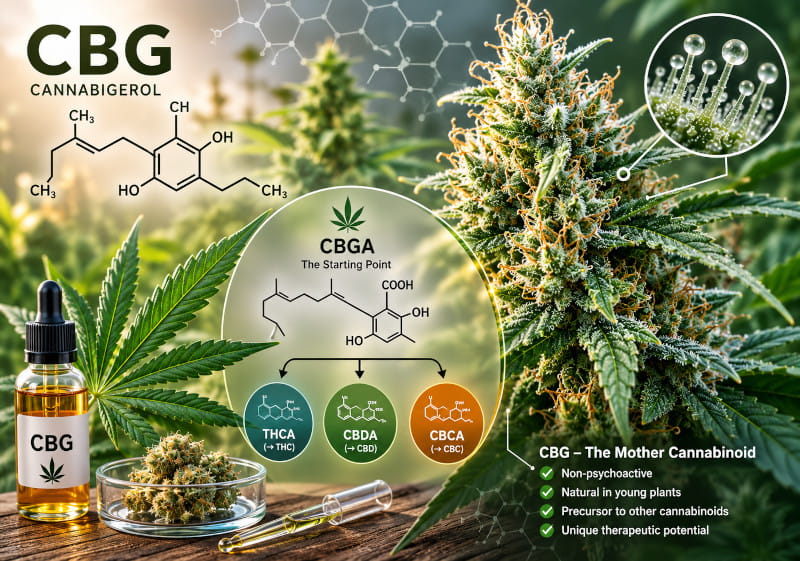
✓ In the living cannabis plant, cannabigerolic acid (CBGA) is formed predominantly. Enzymes use CBGA to produce THCA, CBDA and CBCA, among other compounds.
✓ According to current scientific knowledge, CBG is not considered typically intoxicating. However, CBG-containing products may contain THC or, depending on their composition, affect the central nervous system.
✓ Laboratory and animal studies are investigating CBG in connection with inflammatory processes, pain, the nervous system, digestion, intraocular pressure and certain microorganisms. However, robust clinical evidence is still lacking for most potential medical applications.
✓ A small human study from 2024 provides initial indications of short-term effects of CBG on perceived stress and anxiety. However, robust clinical evidence for medical use is not currently available.
CBG is a distinct cannabinoid and is also closely linked to the formation of other cannabinoids
CBG is the abbreviation for cannabigerol. The compound belongs to the phytocannabinoids, natural compounds that are formed primarily in the glandular hairs of the cannabis plant. Compared with THC, THCV or CBD, neutral CBG is generally present only in relatively small amounts in many fully mature plants grown from cannabis seeds.
The acidic precursor CBGA is particularly important. In plant biosynthesis, it serves as the starting material for several major cannabinoid acids. For this reason, CBGA is often simplistically referred to as the “mother cannabinoid.” Scientifically, however, it is more accurate to say that CBGA is a common biosynthetic precursor of several important phytocannabinoids.
What exactly is CBG?
CBG is the neutral form of the cannabinoid cannabigerol and is produced mainly through the decarboxylation of cannabigerolic acid (CBGA).
In fresh plant material, most cannabinoids are initially present predominantly as carboxylic acids. The acidic precursor of CBG is cannabigerolic acid (CBGA). Heat, light or natural ageing processes can cause CBGA to release a carboxyl group in the form of carbon dioxide (CO2). This produces the neutral cannabinoid CBG. This chemical process is known as decarboxylation.
CBG has the molecular formula C21H32O2. It is fat-soluble and only slightly soluble in water. These properties affect both processing and absorption in the body. Chemically, CBG is related to CBD, THC and CBC, but differs in its spatial structure and pharmacological profile.
Why is CBGA described as a starting material for other cannabinoids?
CBGA is a central biosynthetic precursor from which plant enzymes can produce THCA, CBDA and CBCA, among other compounds.
The cannabis plant forms CBGA from olivetolic acid and geranyl diphosphate. The plant’s genetically determined enzyme profile then largely determines which cannabinoid acids CBGA is converted into. THCA synthase predominantly produces THCA, CBDA synthase predominantly produces CBDA and CBCA synthase predominantly produces CBCA.
Not every CBGA molecule is processed completely. A remaining portion can become CBG through decarboxylation. In specially bred CBG-rich plants, conversion into other cannabinoid acids is genetically restricted or shifted. This allows more CBGA to accumulate.
In brief: CBGA is not the direct precursor of every known cannabinoid. However, it is the central starting point for several important synthesis pathways, including those leading to THCA, CBDA and CBCA.
How is CBG formed in the cannabis plant?
CBG is formed when CBGA is not completely converted into other cannabinoid acids and is subsequently decarboxylated.
Biosynthesis takes place predominantly in the glandular trichomes of female flowers. Building blocks are first produced through two different metabolic pathways: the polyketide pathway supplies olivetolic acid, while terpene metabolism supplies geranyl diphosphate. A prenyltransferase combines the two molecules to form CBGA.
How much CBG can later be detected depends on genetics, developmental stage, harvest time, drying, storage and processing. Young plants do not automatically have a high usable CBG content. What matters is the specific ratio of CBGA, CBG and the other cannabinoids in the analysed plant material.
Where does CBG occur naturally?
CBG occurs naturally in cannabis, but in many mature THC- or CBD-dominant plants it is only a minor constituent.
In most cannabis plants, a large proportion of the CBGA formed is converted by the plant’s own enzymes into other cannabinoid acids such as THCA, CBDA or CBCA as flowering progresses. As a result, many dried flowers contain significantly larger amounts of these cannabinoids than of CBGA or CBG. CBG-dominant genetics have been selectively bred so that more CBGA remains and correspondingly higher CBG levels can develop.
However, the name or designation of a cannabis strain alone does not provide a reliable indication of its actual CBG content. Even plants of the same strain may differ substantially in cannabinoid composition depending on genetics, phenotype, growing conditions and harvest time. A batch-specific laboratory analysis is therefore far more informative than a strain name.
Which cannabis strains contain particularly high levels of CBG?
CBG-rich cannabis strains have been specifically bred to produce higher amounts of cannabigerol. Because cannabinoid levels can vary according to genetics, phenotype, growing conditions and harvest time, the following strains are only examples of well-known CBG-dominant lines. While plants grown from CBD seeds are now widespread, the selection of cannabis strains bred specifically for high CBG content is still comparatively small.
| Strain | Breeder | CBG content | Characteristics |
|---|---|---|---|
| CBG Kush | Cannapot | 10 % CBG | Indica, earthy, sweet and diesel notes |
| CBG #18 | Ape Origin | 18 % CBG | mostly Indica, fresh, sour and berry notes |
| CBG Force | Dutch Passion | 12 % CBG | Hybrid, fruity with a lemon-cream aroma |
| CBG Relief Auto | Seedsman | 7 % CBG | Autoflower, mostly Sativa, floral aroma |
| Royal CBG Auto | Royal Queen | 8 % CBG | Autoflower, mostly Sativa, vanilla aroma |
The stated values are intended only as a guide. Actual CBG content can vary considerably depending on genetics, phenotype, growing conditions, harvest time and laboratory analysis.
How does CBG affect the body?
CBG influences several receptors, ion channels and enzyme systems without having the typical effect profile of THC.
The pharmacology of CBG is complex. In experimental models, the compound interacts with CB1 and CB2 receptors, alpha-2 adrenergic receptors, various TRP ion channels and the 5-HT1A receptor system, among other targets. Its precise effect depends on concentration, cell type, the tissue examined and the experimental design.
CBG is often described as a weak partial agonist at cannabinoid receptors. It may also influence certain signalling pathways outside the classic endocannabinoid system. However, no general health effect can be inferred from this broad laboratory activity. Binding to receptors describes a biological mechanism but does not prove clinical effectiveness. This also applies to potential uses in connection with cancer, for which sufficient clinical evidence is currently lacking.
What role does the endocannabinoid system play in CBG?
CBG can interact with components of the endocannabinoid system, but it acts differently and far less intensely there than THC.
The endocannabinoid system includes the CB1 and CB2 receptors, endogenous ligands such as anandamide and 2-arachidonoylglycerol (2-AG), and enzymes involved in their formation and breakdown. THC mainly activates CB1 receptors and thereby produces a substantial part of its intoxicating effect. Terpenes can shape the smell and aroma profile of a cannabis plant and are discussed as a possible factor influencing the overall effect. CBG has much lower functional activity at CB1 and, according to current knowledge, does not produce a comparable typical intoxication profile.
Some laboratory and animal studies suggest that CBG may also influence the availability of the body’s own signalling compounds. However, these mechanisms depend on the particular experimental model and have not yet been adequately studied in humans. Statements such as “CBG balances the endocannabinoid system” or “CBG regulates the endocannabinoid system” are not supported by current scientific evidence.
Is CBG psychoactive or intoxicating?
According to current scientific knowledge, CBG is not considered typically intoxicating, although it may produce biological and possibly subjectively noticeable effects.
The term “psychoactive” generally includes any substance that affects functions of the central nervous system. “Intoxicating”, by contrast, describes marked changes in perception, thinking, mood or coordination. CBG does not activate CB1 receptors in the same way as delta-9-THC and is therefore not associated with a classic cannabis high.
However, “non-intoxicating” does not automatically mean “ineffective” or “always safe.” CBG flowers and full-spectrum extracts may also contain THC. The actual effect of a product therefore depends on factors including the complete cannabinoid profile, dosage, route of administration and individual sensitivity.
How does CBG differ from CBD and THC?
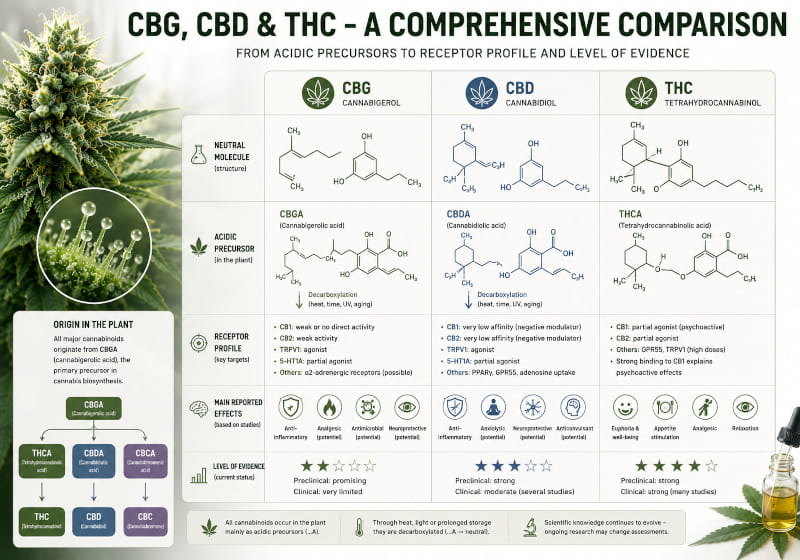
CBG, CBD and THC originate from related plant synthesis pathways, but differ in structure, natural concentration, receptor activity and the available clinical evidence.
| Feature | CBG | CBD | Delta-9-THC |
|---|---|---|---|
| Full name | Cannabigerol | Cannabidiol | Delta-9-tetrahydrocannabinol |
| Acidic precursor | CBGA | CBDA | THCA |
| Typical intoxication | not typical according to current knowledge | not typical | often pronounced |
| CB1 activity | weak and dependent on the test system | predominantly indirect or modulating activity | partial agonist |
| Natural occurrence | low in many mature plants; higher in CBG chemovars | often the main cannabinoid in CBD-dominant plants | often the main cannabinoid in THC-dominant plants |
| Clinical evidence | very limited | available for individual standardised medicines and indications | available for certain medical applications |
CBG is neither “stronger CBD” nor “THC without the high.” Each cannabinoid has its own pharmacological profile and differs in receptor binding, mechanisms of action and biological properties. Even identical milligram amounts cannot therefore be compared directly, because bioavailability, metabolism, product composition and individual responses may differ.
How is CBG absorbed and processed in the body?
CBG is fat-soluble, is absorbed at different rates depending on the route of administration and is then metabolised mainly in the liver.
When taken orally, CBG first passes through the stomach and intestines. It then reaches the liver via the portal vein, where part of it is converted before entering the general bloodstream. This first-pass effect can limit bioavailability and lead to substantial differences between individuals.
Inhaled cannabinoids are generally absorbed more quickly, although the actual dose depends heavily on the device, temperature, inhalation behaviour and product. Far fewer human pharmacokinetic data are available for CBG than for THC and CBD. Its half-life, active metabolites and reliable dose-response relationships have therefore not yet been fully described.
Which effects of CBG are being investigated scientifically?
CBG is being studied in numerous fields of research, but most of the data still come from cell cultures and animal models.
Inflammatory processes
Preclinical studies investigate how CBG affects inflammatory mediators and immune cells.
Pain processing
Animal models provide initial indications of possible effects on pain-related signalling pathways.
Nervous system
Possible effects on nerve cells, receptors and neurobiological processes are being investigated.
Digestion and the gut
Research examines intestinal motility and inflammatory processes in the digestive system.
Microorganisms
Laboratory studies test the activity of CBG against certain bacteria and other microorganisms.
Intraocular pressure
Older studies investigated possible links between CBG and intraocular pressure. Clinical evidence in humans is still lacking.
The following sections examine the most important research areas and the corresponding evidence in greater detail.
Can CBG reduce anxiety or stress?
A small placebo-controlled human study provides initial indications of short-term changes in perceived anxiety and stress, but does not prove effectiveness for anxiety disorders.
In a double-blind study published in 2024, 34 healthy adults received either 20 milligrams of CBG or a placebo. The study used a crossover design, meaning that the same participants completed both conditions on different dates. After taking CBG, participants reported lower average ratings of acute anxiety and stress. No indications of a typical high or measurable impairment were observed in this study.
The study was small, examined only a single dose and mainly recorded short-term effects in healthy individuals. It therefore cannot establish whether CBG is effective for diagnosed anxiety disorders, how long potential effects last or what risks may be associated with regular use. Further independent studies with larger groups of participants are needed. CBD for stress and the possible use of CBD for depression are also being intensively researched. However, the current evidence is not sufficient to support general therapeutic recommendations.
Does CBG improve concentration or memory?
There is no evidence that CBG reliably improves concentration, memory or cognitive performance.
In the same small 2024 study, participants performed better on a verbal memory test after taking CBG than after taking a placebo. This single result is interesting but must be interpreted cautiously. It may have been influenced by the specific test design, learning effects, sample size or chance.
There are insufficient data to support claims about everyday attention, learning performance, reaction time or long-term memory function. Marketing claims such as “focus cannabinoid” or “natural nootropic replacement” therefore go beyond the current state of scientific knowledge.
Does CBG have anti-inflammatory effects?
CBG shows inflammation-modulating effects in various preclinical models, but a general anti-inflammatory effect in humans has not been clinically established.
Cell and animal studies report changes in cytokines, oxidative stress, immune-cell activity and inflammation-related signalling pathways. It remains unclear which concentrations can be achieved in human tissue and whether they produce a relevant health benefit.
Changes in inflammatory markers in the laboratory do not yet demonstrate an improvement in symptoms, disease progression or quality of life in humans.
Can CBG relieve pain?
Preclinical data indicate that CBG may be involved in pain processing, but clinical evidence for reliable pain relief is lacking.
Possible mechanisms include modulation of cannabinoid receptors, alpha-2 adrenergic receptors and TRP ion channels. Animal models can provide initial indications of biological activity, but they reproduce human pain disorders only to a limited extent.
Randomised human studies covering different types of pain, suitable dosages and possible side effects are still largely unavailable.
What significance might CBG have for the stomach and intestines?
CBG is being investigated preclinically in connection with intestinal motility and inflammatory processes in the gut, but it is not a proven treatment for gastrointestinal diseases.
Animal studies have examined CBG in models of colitis and altered intestinal motility, among other settings. Changes in individual inflammatory markers and symptoms were observed. The relevance to humans is unclear because dosage, metabolism and disease progression differ substantially between animal models and patients.
Persistent or severe digestive symptoms should be medically assessed and should not be treated with CBG alone.
Does CBG work against bacteria?
CBG shows activity against certain bacteria in laboratory studies, but this does not prove effectiveness against infections in humans.
Studies involving gram-positive bacteria such as Staphylococcus aureus have attracted particular attention. However, a concentration that inhibits growth in a cell culture cannot automatically be achieved safely in the human body. Tissue distribution, protein binding, metabolism and potential toxicity also affect practical suitability.
CBG is therefore not a proven substitute for antibiotics or medical treatment of bacterial infections.
Does CBG lower intraocular pressure?
Older animal studies describe changes in intraocular pressure, but do not provide a sufficient basis for using CBG to treat glaucoma.
Glaucoma is a group of eye diseases in which the optic nerve can be damaged. Intraocular pressure is an important risk factor, but not the only one. Even when a substance changes pressure in the short term, it does not necessarily improve the course of the disease or make the substance suitable for long-term use.
Modern glaucoma treatments are designed around demonstrated effectiveness, an appropriate duration of action and local tolerability. CBG should not be used in place of prescribed eye drops or ophthalmological monitoring.
Does CBG affect appetite?
Animal studies suggest possible changes in food intake, but an appetite-stimulating or appetite-suppressing effect of CBG has not been reliably demonstrated in humans.
Individual animal studies report increased food intake. Because appetite regulation depends on numerous biological and health-related factors, however, no recommendations for humans can be derived from these findings.
Persistent changes in appetite or unexplained weight loss should be medically assessed.
What is CBG oil?
CBG oil is a carrier oil to which a CBG-containing extract or isolated cannabigerol has been added.
The term does not describe a standardised composition. A CBG isolate contains predominantly a single compound. Broad-spectrum products may contain other cannabinoids and accompanying substances but, depending on how they are produced, are intended to contain only low or non-detectable amounts of THC. Full-spectrum products contain a broader plant profile and may also contain THC.
The percentage usually indicates the amount of CBG in the complete product. A five-percent oil contains approximately 50 milligrams of CBG per millilitre in mathematical terms, provided the manufacturer’s declaration is accurate. The amount per drop depends on the dropper, viscosity and drop size and should not be estimated using a blanket figure.
In which forms is CBG available?
CBG may be available as plant material, an extract, oil, isolate or an ingredient in combined cannabinoid products.
| Form | Typical characteristic | Important point to check |
|---|---|---|
| CBG flowers | whole-plant profile containing CBG, CBGA and accompanying compounds | THC content, microbiological quality and residues |
| CBG oil | extract or isolate in a carrier oil | actual content per millilitre and complete ingredient list |
| CBG isolate | highly purified cannabigerol | identity, purity, solvents and by-products |
| Full-spectrum extract | contains several cannabinoids and plant constituents | THC, terpenes, contaminants and batch variation |
| Combination product | CBG together with CBD or other substances | individual effects are difficult to attribute |
Which CBG dosage is scientifically supported?
There is currently no generally accepted, scientifically validated standard dosage for over-the-counter CBG products.
The few human studies available examined specific preparations and usually single doses under controlled conditions. These values cannot automatically be transferred to other products, long-term use or people with medical conditions. Concentration, purity, route of administration and accompanying substances alter the amount actually absorbed.
A dosage should not be derived solely from personal reports, body weight or percentage figures. Anyone taking medication, who is pregnant or breastfeeding, or who has health problems should seek professional advice before use.
What side effects can CBG cause?
The side-effect profile of CBG has not yet been adequately described because controlled human studies are small and rare.
Possible symptoms may include tiredness, dizziness, dry mouth, nausea, diarrhoea, headaches or changes in appetite, mood, blood pressure and heart rate. Whether and how often such effects occur with isolated CBG has not yet been reliably quantified.
Even apparently mild side effects may be relevant when driving, operating machinery or combining the product with alcohol and sedative medication. Full-spectrum products may also contain THC or other active constituents and can therefore have a different risk profile from pure CBG.
Can CBG interact with medication?
Interactions are possible in principle, but have not yet been studied systematically enough in humans.
CBG is metabolised by liver enzymes and can affect enzyme systems in laboratory studies that are also involved in breaking down numerous medicines. Drug levels could therefore theoretically rise or fall. The clinical significance depends on the dose, duration of use, genetics, liver function and the specific medication.
Particular caution is required with medicines that have a narrow therapeutic range, as well as blood thinners, antiepileptic drugs, sedatives, antidepressants, blood-pressure medication and drugs that are extensively metabolised by liver enzymes. Prescribed medication should not be changed or discontinued without medical guidance.
Who should be particularly cautious with CBG?
Sufficient safety data are lacking for pregnancy, breastfeeding, children, adolescents and many pre-existing conditions.
-
Pregnancy and breastfeeding: Because safety data are lacking, CBG should not be used without medical advice.
-
Children and adolescents: Development of the nervous system and possible product contamination require particular caution.
-
Liver or kidney disease: Metabolism and excretion may be altered.
-
Cardiovascular disease: Possible effects on blood pressure and heart rate have not been adequately clarified.
-
Mental-health or neurological disorders: Individual reactions and interactions with medication may be relevant.
Can CBG cause a positive drug test?
CBG itself is not the main target of common rapid THC tests, but CBG products may contain THC and therefore cause a positive result.
Commercial urine tests usually look for THC metabolites. A pure, correctly analysed CBG isolate should not produce these metabolites. In practice, however, full-spectrum extracts, flowers, incorrectly labelled products or cross-contamination may contain measurable amounts of THC.
Anyone who requires a negative test result for professional, sporting or legal reasons should not rely on descriptions such as “THC-free.” Even a certificate of analysis only reduces the risk when it is current, batch-specific and methodologically meaningful.
How is CBG content determined in the laboratory?
CBG and CBGA are usually analysed chromatographically, with HPLC able to measure the two forms separately.
In high-performance liquid chromatography, the sample is separated without intense heating. This largely preserves acidic cannabinoids and allows them to be measured separately from the neutral forms. Gas-chromatographic methods often heat the sample, meaning that some CBGA may decarboxylate into CBG during analysis.
A meaningful laboratory report lists THC, THCA, CBD, CBDA and other relevant constituents in addition to CBG and CBGA. Detection limits, measurement uncertainty, sampling, analysis date and batch number are also important. A single percentage without this information can be verified only to a limited extent.
What does total CBG mean in a laboratory report?
Total CBG is a calculated value that combines the CBG already present with the proportion of CBG that could theoretically be produced from CBGA.
During decarboxylation, CBGA loses carbon dioxide and therefore part of its molecular mass. The CBGA value must therefore not simply be added to the CBG value on a one-to-one basis. A conversion factor of approximately 0.877 is often used:
Calculation: Total CBG = CBG + (CBGA × 0.877)
The value describes a theoretical potential assuming complete conversion. In practice, the actual yield may be lower because decarboxylation remains incomplete or degradation processes occur at the same time.
What happens when CBGA is decarboxylated into CBG?
During decarboxylation, CBGA loses a carboxyl group as carbon dioxide and is thereby converted into neutral CBG.
Heat accelerates the reaction, although light and long storage periods can also promote slow conversion. Temperature and duration affect not only the formation of CBG but also oxidation and thermal degradation. More intense heating therefore does not automatically produce a higher final content.
Optimal processing depends on moisture, the starting material, particle size, oxygen exposure and the desired product. Without controlled analysis, temperature and time alone cannot reliably indicate how much CBGA has actually been converted into CBG.
How stable is CBG when exposed to light, heat and storage?
CBG may change under the influence of light, oxygen, heat and time, although specific stability data are limited and depend on the product matrix.
Plant material, oil and purified isolate do not behave identically. Oxygen and light can promote oxidative reactions, while heat accelerates both decarboxylation and degradation. Moisture content and microbial contamination are additional quality factors for flowers.
Storage protected from light, airtight and at a stable temperature can slow changes, but cannot prevent ageing indefinitely. For older products, the analysis date should be considered because the current composition may differ from the original certificate.
How can you identify reliable CBG information?
Reliable CBG information is batch-specific, laboratory-tested and clearly separates measured values from health-related marketing claims.
-
CBG and CBGA are reported separately.
-
THC and THCA are reported with sufficiently low limits of quantification.
-
The batch number, analysis date and product match the certificate.
-
The laboratory states the method, measurement uncertainty and detection limits.
-
Pesticides, heavy metals, solvents and microbiological contamination are tested as appropriate for the product.
-
No guaranteed healing effects or blanket treatment promises are made.
A high CBG percentage alone is not a mark of quality. Purity, identity, accompanying substances, residues and storage conditions are at least as important.
Which claims about CBG are not scientifically supported?
Many popular claims about CBG prematurely transfer findings from laboratory and animal studies to humans.
Claim: CBG is the mother of all cannabinoids.
CBGA is an important precursor of several major cannabinoid acids. However, this simplified description must not be understood to mean that every cannabinoid is produced directly from neutral CBG.
Claim: CBG treats anxiety disorders.
A small study showed short-term changes in healthy adults. Sufficient clinical evidence for treating diagnosed anxiety disorders is lacking.
Claim: CBG is a natural antibiotic.
Laboratory activity against bacteria does not demonstrate a safe or effective treatment for infections in the human body.
Claim: CBG reliably helps with pain and inflammation.
The data come predominantly from preclinical models. A reliable clinical benefit has not been demonstrated.
Claim: CBG has no side effects.
Human data are too limited to rule out rare, dose-dependent or long-term risks.
Claim: CBG is always THC-free.
Plant material and full-spectrum extracts may contain THC. The specific laboratory analysis of the batch is decisive.
How robust is the scientific evidence on CBG?
The chemical fundamentals and many molecular targets are well described, but the clinical evidence for specific applications is predominantly very weak.
| Research question | Predominant evidence base | Assessment |
|---|---|---|
| Biosynthesis of CBGA and CBG | plant biochemistry, enzyme research and analytical science | well described |
| Receptor and ion-channel activity | cell models and tissue experiments | biologically plausible, highly model-dependent |
| Acute anxiety and stress | one small placebo-controlled human study | initial research signal, no treatment recommendation |
| Pain and inflammation | predominantly animal and cell models | clinical benefit not established |
| Neurological disorders | preclinical models | no established application |
| Long-term safety and interactions | insufficient human data | largely unresolved |
Frequently asked questions about CBG
What does CBG mean?
CBG stands for cannabigerol, a naturally occurring phytocannabinoid in the cannabis plant.
What is CBGA?
CBGA is cannabigerolic acid, the acidic precursor of CBG and a central starting material for several other cannabinoid acids.
Is CBG the same as CBD?
No. CBG and CBD are different molecules with their own receptor profiles, natural occurrence and bodies of research.
Does CBG make you high?
Pure CBG is not considered typically intoxicating. Products may nevertheless contain THC, which is why their complete composition is important.
Is CBG stronger than CBD?
The compounds cannot generally be ranked as “stronger” or “weaker.” They act at different biological targets and have been studied to different degrees clinically.
Can CBG help with anxiety?
A small study provides initial indications of short-term effects. The evidence is not sufficient to support treatment of anxiety disorders.
Does CBG work against pain?
Preclinical data are available, but robust clinical evidence for reliable pain relief is lacking.
Is CBG anti-inflammatory?
Inflammation-modulating effects have been observed in laboratory and animal models. A generally effective application in humans has not been demonstrated.
How much CBG should you take?
There is no generally accepted standard dosage. Study values apply only to the specific preparations and situations examined.
Can CBG cause side effects?
Yes. Possible side effects and interactions have not been fully researched. The limited evidence does not permit a guarantee of safety.
Can CBG affect a drug test?
CBG is not the main target of common THC tests. However, if the product contains THC, a positive result may occur.
Does CBG occur in every cannabis plant?
CBGA and CBG may be detectable in many plants, but the amounts vary greatly according to genetics and developmental stage.
Which technical terms are important for understanding CBG?
The following terms will help you assess studies, laboratory reports and information about cannabigerol objectively.
- CBG
- Cannabigerol, the neutral form of the cannabinoid.
- CBGA
- Cannabigerolic acid, the acidic precursor of CBG and the biosynthetic starting material for several cannabinoid acids.
- Phytocannabinoid
- A compound produced by plants that can interact with cannabinoid receptors or related biological targets.
- Decarboxylation
- A chemical reaction in which a cannabinoid acid loses carbon dioxide and is converted into a neutral form.
- CB1 receptor
- A cannabinoid receptor found particularly frequently in the central nervous system and substantially involved in the intoxicating effects of THC.
- CB2 receptor
- A cannabinoid receptor found in immune cells and various peripheral tissues, among other locations.
- TRP ion channel
- A group of membrane proteins that may be involved in the perception of temperature, pain and stimuli.
- Agonist
- A substance that activates a receptor and thereby triggers a biological response.
- Partial agonist
- A substance that activates a receptor but produces a lower maximum response than a full agonist.
- Bioavailability
- The proportion of an administered substance that reaches the systemic circulation.
- Metabolite
- A metabolic product formed during the enzymatic conversion of a parent compound.
- Chemovar
- Classification of a cannabis plant according to its measurable chemical profile rather than solely by its strain name.
Assessing CBG objectively: biologically interesting, but still poorly researched clinically
CBG is a relevant phytocannabinoid with a well-described plant origin but still very limited clinical evidence.
The particular significance of CBG initially lies in its connection with CBGA and therefore with the biosynthesis of several important cannabinoids. Cell and animal studies also show broad biological activity. These findings make CBG an interesting subject of research, but they are not equivalent to a demonstrated medical effect.
The first small controlled human study provides an early signal regarding acute stress and perceived anxiety. Larger independent studies are required for reliable conclusions about effectiveness, optimal dosage, long-term safety and interactions. A cautious assessment is therefore more scientifically appropriate than blanket promises.
Scientific sources
- Li S et al. Cannabigerol (CBG): A Comprehensive Review of Its Molecular Mechanisms and Therapeutic Potential. 2024. PubMed
- Cuttler C et al. Acute effects of cannabigerol on anxiety, stress, and mood: a double-blind, placebo-controlled, crossover, field trial. Scientific Reports. 2024. PubMed
- Walsh KB et al. Minor Cannabinoids: Biosynthesis, Molecular Pharmacology and Potential Therapeutic Uses. 2021. PubMed
- Jastrząb A et al. The Origin and Biomedical Relevance of Cannabigerol. 2022. PubMed
- Calapai F et al. Pharmacological Aspects and Biological Effects of Cannabigerol and Its Synthetic Derivatives. 2022. PubMed Central
- Nachnani R et al. The Pharmacological Case for Cannabigerol. Journal of Pharmacology and Experimental Therapeutics. 2021. Full article
- Luo X et al. Complete biosynthesis of cannabinoids and their unnatural analogues in yeast. Nature. 2019. PubMed
- Taura F et al. Phytocannabinoids in Cannabis sativa: recent studies on biosynthetic enzymes. Chemistry & Biodiversity. 2007. PubMed
- Henshaw FR et al. The Effects of Cannabinoids on Pro- and Anti-Inflammatory Cytokines: A Systematic Review of In Vivo Studies. 2021. PubMed
- Niyangoda D et al. Cannabinoids as Antibacterial Agents: A Systematic and Narrative Review. 2024. PubMed
- Tahir MN et al. The biosynthesis of the cannabinoids. Journal of Cannabis Research. 2021. PubMed
- Das PC et al. Postharvest Operations of Cannabis and Their Effect on Cannabinoid Content. 2022. PubMed