Cannabis Terpenes Explained: Aroma, Chemistry and Why THC Is Only Part of the Picture
Updated: October 2026 | Cannabis terpenes: aroma profiles, chemical composition and scientific evidence
Author: Cannapot Grow Team | Reading time: approximately fifteen minutes

Key Takeaways
Terpenes are volatile plant compounds that make a major contribution to the smell of cannabis. THC, by contrast, is primarily relevant to its intoxicating effects.
The characteristic aroma of cannabis comes from a mixture of terpenes and other compounds, including odor-active sulfur compounds.
A terpene profile describes measurable chemical constituents, but it cannot reliably predict how an individual will feel.
Genetics, growing conditions, maturity, drying and storage can influence the aroma profile. A strain name alone does not guarantee a particular result.
Labor reports (COAs) can help compare specific samples. What matters is which individual compounds were measured, their concentrations and the limitations of the analysis.
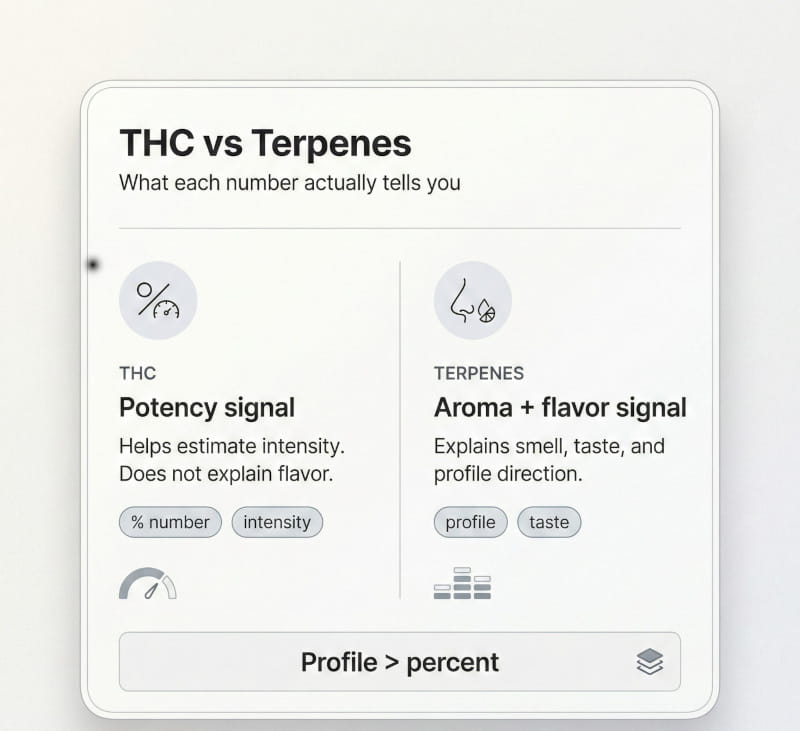
A cannabis strain containing 25 percent THC does not necessarily smell stronger than one containing 15 percent. A high THC figure also tells us little about whether a flower smells of citrus, pine, pepper or sweet fruit. Those aromas are largely produced by volatile compounds, including terpenes.
Terpenes are not unique to cannabis. Lemon peel, lavender, hops and coniferous trees also produce these compounds. In cannabis, they occur in varying combinations and proportions. These mixtures shape an important part of the detectable aroma, but they do not automatically indicate any particular effect.
This article explains what cannabis terpenes are, how they are produced, which compounds commonly occur and how to interpret laboratory results. It also examines what research actually establishes about the frequently discussed entourage effect.
What Are Terpenes?
Terpenes are a large family of naturally occurring organic compounds built from isoprene units. Many terpenes are volatile: they readily enter the gas phase and can therefore be detected by smell. Plants use these substances in various ecological interactions and forms of chemical communication.
In cannabis, many terpenes are produced or accumulated in glandular trichomes. These microscopic glandular structures are particularly abundant on flowers and nearby plant parts. Cannabinoids are also found there, although the two groups of compounds are chemically distinct.
A terpene profile describes the composition of terpenes detected in an analyzed sample. It can be regarded as part of the sample's chemical fingerprint. However, it is not a complete aroma profile: odor-active substances that fall outside standard terpene testing may also play a decisive role.
How Does Cannabis Produce Terpenes?
The plant produces terpenes through biochemical pathways. Two major pathways supply the necessary precursors: the MEP pathway (in plastids) and the mevalonate pathway, or MVA pathway (predominantly in the cytosol). With the help of various enzymes, these precursors are converted into different classes of terpenes.
Which terpenes a plant produces depends in part on its genetic makeup and the activity of the enzymes involved. Environmental conditions can also affect their composition. A strain's aroma is therefore not determined by its name alone.
Monoterpenes, Sesquiterpenes and Terpenoids
Monoterpenes: Often Fresh and Citrusy Notes
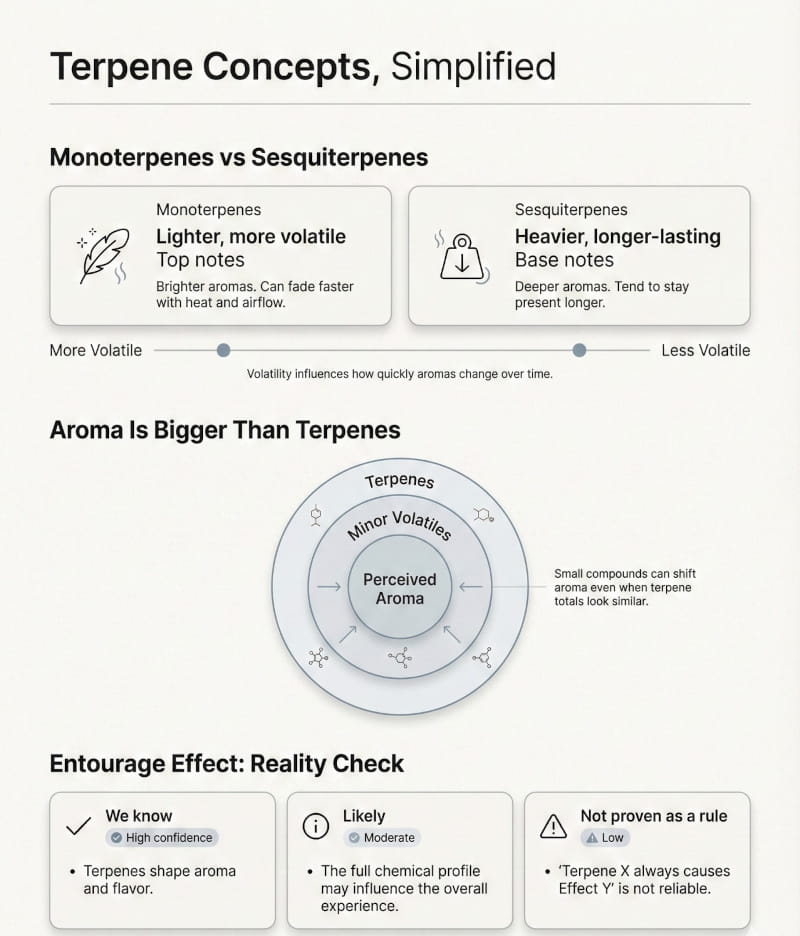
Monoterpenes contain ten carbon atoms (C10). Examples include limonene, α-pinene, β-pinene, myrcene and terpinolene. Many of these compounds are relatively volatile. Poor storage conditions or exposure to heat can cause them to evaporate or undergo chemical changes.
Sesquiterpenes: Often Spicy and Woody Notes
Sesquiterpenes contain fifteen carbon atoms (C15). Common examples include β-caryophyllene and α-humulene. They are generally less volatile than many monoterpenes. However, this does not mean that every sample rich in sesquiterpenes will necessarily smell stronger or retain its aroma longer: concentration, odor thresholds and the overall mixture also matter.
What Are Terpenoids?
In everyday usage, the terms terpenes and terpenoids are often used interchangeably. Broadly speaking, terpenoids are chemically modified compounds related to terpenes, including oxygen-containing substances. Examples include linalool and nerolidol. The distinction is not applied consistently across the literature; when evaluating aroma, the identity of the specific compound measured matters most.
Why THC Does Not Explain Aroma
THC (tetrahydrocannabinol) is one of the principal psychoactive cannabinoids in cannabis. THC content is therefore a relevant measure of chemical composition, but it is not a reliable indicator of smell, flavor or product quality.
A sample may contain high levels of THC yet have a relatively faint aroma. Conversely, samples with less THC may smell intense. The experience of cannabis effects also depends on factors such as dose, route of administration, individual sensitivity and other constituents. There is no sound basis for a simple formula such as “more THC = better.”
The distinction between Sativa and Indica is likewise no substitute for chemical analysis. These terms have botanical, historical and commercial meanings, but they do not automatically describe a uniform cannabinoid or terpene profile.
Why Cannabis Aroma Involves More Than Terpenes
Strain descriptions often present terpenes as the sole explanation for the smell of cannabis. That is an oversimplification. In addition to commonly analyzed terpenes, other volatile compounds contribute to aroma. These include certain volatile sulfur compounds (VSCs) and other classes of odor-active substances.
Some of these compounds are noticeable at extremely low concentrations because the human nose is particularly sensitive to them. This helps explain why two samples with similar dominant terpenes can smell different. Descriptors such as “Skunk,” “gas” or “tropical” usually refer to complex aroma mixtures rather than a single terpene.
For the historical and genetic background of the term, see our article Skunk Cannabis: Meaning, Origins and Genetics.
Terpenes and the Entourage Effect: What Does Science Show?
The term entourage effect refers to the hypothesis that different cannabis constituents may influence one another's biological properties. In discussions about terpenes, it is often claimed that individual compounds reliably produce calming, stimulating or focus-enhancing effects. However, there is insufficient clinical evidence to support such sweeping claims.
Experimental studies have investigated individual terpenes and possible interactions with biological signaling pathways. Findings from cell or animal models cannot simply be extrapolated to people's experiences of cannabis use. Moreover, studies involving different compounds, doses and routes of administration may produce different results.
One noteworthy compound is β-caryophyllene, which experimental studies have identified as a ligand of the cannabinoid CB2 receptor. This does not establish a general therapeutic effect for a cannabis product or make individual effects predictable from its caryophyllene content.
The Most Important Cannabis Terpenes at a Glance
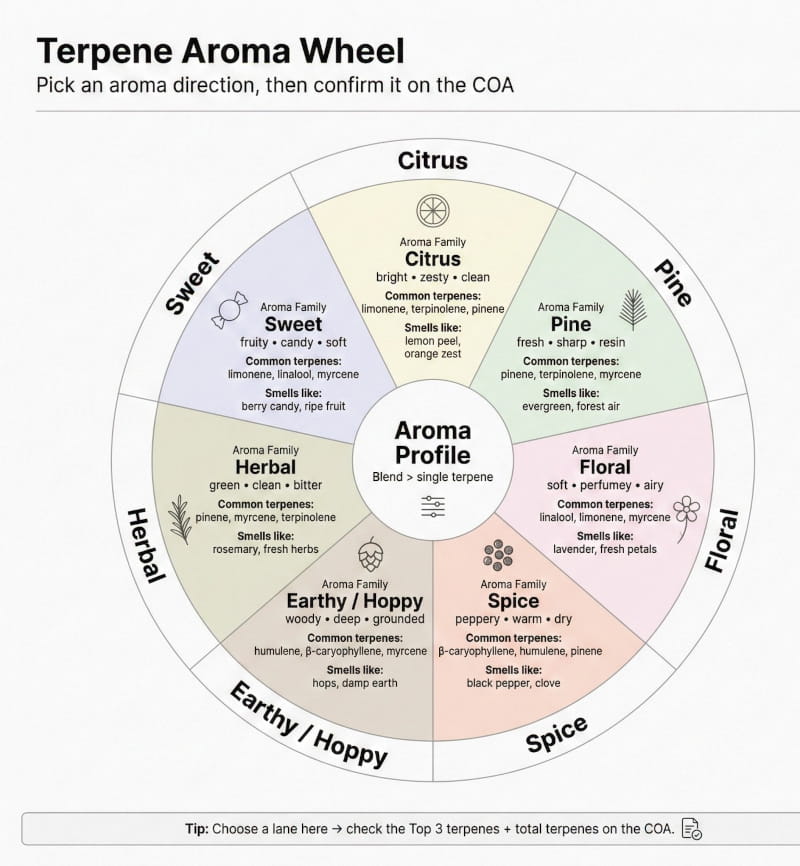
The following table lists commonly discussed terpenes and their typical aroma associations. These descriptions are guides, not fixed rules: a compound may smell different in a mixture than it does on its own.
| Terpene | Typical Aroma Notes | Also Found In | Classification |
|---|---|---|---|
| Limonene | Citrusy, fresh, orange peel | Citrus peels | Monoterpene |
| β-Myrcene | Earthy, herbal, balsamic | Hops, mango | Monoterpene |
| α-Pinene | Pine, resinous, fresh | Coniferous trees, rosemary | Monoterpene |
| β-Pinene | Woody, green, pine-like | Coniferous trees, herbs | Monoterpene |
| Linalool | Floral, lavender-like | Lavender | Oxygenated terpenoid |
| β-Caryophyllene | Peppery, spicy, woody | Black pepper, cloves | Sesquiterpene |
| α-Humulene | Hoppy, woody, earthy | Hops | Sesquiterpene |
| Terpinolene | Herbal, fresh, slightly sweet | Various herbs and woods | Monoterpene |
| Ocimene | Sweet, green, floral | Various flowering plants | Monoterpene |
| Nerolidol | Woody, floral, mild | Various flowers and essential oils | Oxygenated sesquiterpenoid |
The relative abundance of individual terpenes can vary considerably among genetics, phenotypes and tested samples. The table should therefore not be interpreted as assigning fixed effects to particular terpenes.
What Changes a Cannabis Plant's Terpene Profile?
Genetics and Phenotype
A plant's genetic makeup influences which enzymes and metabolic pathways it possesses. Even plants of the same strain can show differences. A strain name therefore does not necessarily represent an unchanging chemical profile.
Development and Environment
The composition of volatile compounds can change as a plant develops. Environmental factors may also play a role. The strength of individual influences depends on the genetics and conditions studied, making simple universal rules unreliable.
Harvesting, Drying and Storage
After harvest, volatile compounds can escape or undergo changes due to oxygen, light and heat. Particularly sensitive aroma components may decline as a result. However, such changes cannot be determined from the total terpene figure in an older laboratory report alone.
How to Read a COA and Terpene Analysis
A Certificate of Analysis (COA) is a laboratory report for a specific tested sample. Depending on the testing requested, it may include information about cannabinoids, terpenes and other parameters. A COA is not a blanket guarantee of quality for every product sold under the same strain name.
1. Check the Sample and Date
Look for the laboratory, sample identification, batch reference and analysis date. The results can only be meaningfully attributed to a product if the tested sample can be clearly linked to it.
2. Understand the Units
Terpenes may be reported as percentages (%) or milligrams per gram (mg/g). For mass-based measurements, 1% = 10 mg/g. Before comparing reports, check that they use the same basis and comparable analytical methods.
3. Look at Individual Terpenes, Not Just the Total
The sum of measured terpenes provides a useful overview, but it does not directly measure perceived aroma intensity. Some compounds have low odor thresholds and can be prominent even at low concentrations. Standard terpene panels also do not necessarily capture every odor-active substance.
4. Consider Detection Limits and Test Scope
A laboratory tests only for compounds included in its analytical panel. A result marked “not detected” does not necessarily mean that a substance is completely absent; its concentration may be below the detection limit. The analytical method and laboratory documentation are important when interpreting results.
5. Do Not Generalize Results to Every Plant
A single COA describes the sample tested, not automatically every subsequent harvest or phenotype of the same strain. This is especially important when comparing cannabis seed listings with laboratory results from finished flowers.
What Do Terpene Descriptions Mean for Cannabis Seeds?
For cannabis seeds, aroma descriptions generally reflect observations of plants or flowers from a genetic line, rather than guaranteed measurements for each individual seed. Phenotypes can vary even within the same breeding line.
Terms such as “citrusy,” “fruity” or “spicy” are therefore best understood as descriptions of possible aroma directions. When comparing strains, consider lineage, breeder information and the limitations of available analytical data as well.
The Cannapot cannabis seed range offers different genetics to compare. The advanced search provides additional selection options. Neither can guarantee that an individual plant will develop a particular terpene profile.
Frequently Asked Questions About Cannabis Terpenes
Are Terpenes and THC the Same Thing?
No. THC is a cannabinoid with psychoactive properties. Terpenes are a different group of compounds that make a major contribution to the aroma of many plants.
Can You Predict a Strain's Effects from Its Terpenes?
Not reliably. Terpene profiles can reveal chemical differences, but they are not a clinically validated tool for predicting individual effects.
Why Do Two Plants of the Same Strain Smell Different?
Genetic differences between individual plants, developmental stage, environmental conditions and post-harvest handling can all influence the composition of volatile aroma compounds.
Is a Higher Total Terpene Content Always Better?
No. The total alone does not determine quality or perceived aroma intensity. The identity of individual compounds, their odor thresholds and other aroma components also matter.
What Is the Difference Between Terpenes and Terpenoids?
Terpenes are compounds built from isoprene units. Terpenoids often refers to chemically modified members of this family, such as oxygen-containing derivatives. The terms are not always distinguished consistently in different contexts.
Which Terpenes Are Common in Cannabis?
Frequently cited compounds include myrcene, limonene, α-pinene, β-pinene, β-caryophyllene, humulene, linalool and terpinolene. Their concentrations vary between samples.
Can a COA Explain the Entire Aroma of Cannabis?
Usually not. A COA only reports the substances tested and their measured concentrations. Other odor-active compounds, including certain sulfur compounds, may fall outside a standard panel.
Does the Terpene Profile Change During Storage?
Yes. Volatile and reactive aroma compounds can change over time. The extent depends on storage conditions and the composition of the sample, among other factors.
Scientific References and Further Reading
The following publications provide background on cannabis chemistry, volatile aroma compounds and the discussion of potential interactions. They do not establish that an individual's experience of cannabis can be predicted from terpenes alone.
- Booth, J. K. & Bohlmann, J. (2019): Terpenes in Cannabis sativa – From plant genome to humans. Plant Science, 284, 67–72. DOI: 10.1016/j.plantsci.2019.03.022.
- Russo, E. B. (2011): Taming THC: potential cannabis synergy and phytocannabinoid-terpenoid entourage effects. British Journal of Pharmacology, 163, 1344–1364. DOI: 10.1111/j.1476-5381.2011.01238.x. A hypothesis-focused review, not clinical proof of general terpene effects.
- Gertsch, J. et al. (2008): Beta-caryophyllene is a dietary cannabinoid. Proceedings of the National Academy of Sciences, 105, 9099–9104. DOI: 10.1073/pnas.0803601105.
- Oswald, I. W. H. et al. (2021): Identification of a New Family of Prenylated Volatile Sulfur Compounds in Cannabis Revealed by Comprehensive Two-Dimensional Gas Chromatography. ACS Omega. DOI: 10.1021/acsomega.1c04196.
Related articles in the Cannapot Canna Wiki:
Sativa Cannabis: Meaning and Classification
Skunk Cannabis: Origins and Genetics
Canna Wiki Overview