Growing Marijuana in a Greenhouse
Growing Cannabis in a Greenhouse: Climate, Care & Common Mistakes
Updated: August 2026 | Growing cannabis in a greenhouse: location, greenhouse type, ventilation, temperature, humidity, irrigation, mini greenhouse, plant protection and seasonal care explained clearly.
Author: Cannapot Grow Team | Reading time: twenty-four minutes
The Most Important Points at a Glance
✓ A greenhouse combines natural sunlight with a degree of protection from rain, wind, cold and major temperature fluctuations.
✓ The most important success factor is not extra heat, but controlled air exchange. Without adequate ventilation, temperature and humidity rise quickly.
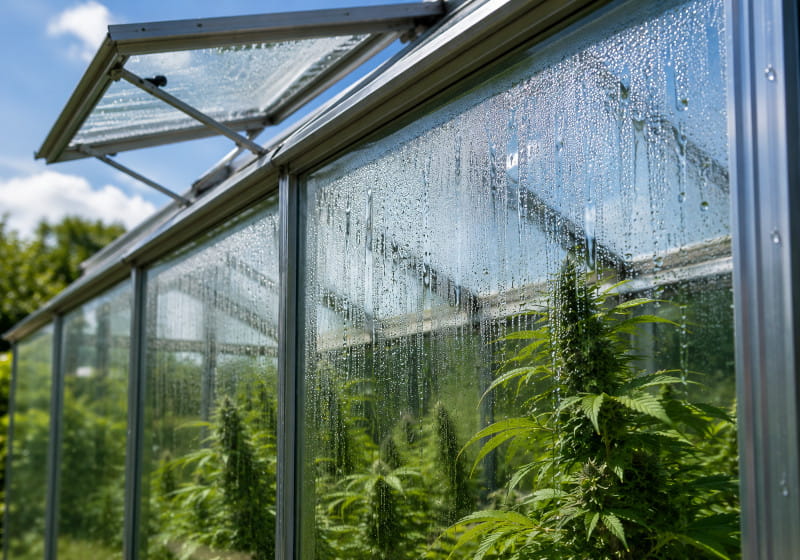
✓ Condensation on glass or film indicates that moist indoor air is cooling down. If plant surfaces remain damp for a long time, the risk of fungal diseases increases.
✓ A cannabis mini greenhouse is particularly suitable for seedlings, young plants or very compact genetics. Larger plants often lack the necessary air volume.
✓ Pots, raised beds and direct cultivation in the ground differ significantly in terms of water storage, root space, temperature patterns and controllability.
✓ Regular checks of leaf undersides, shoot junctions, substrate moisture and weather developments help identify problems early.
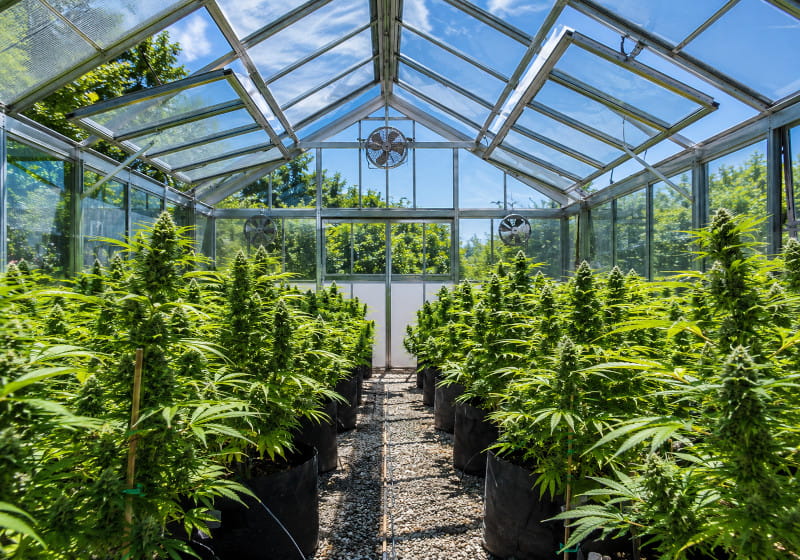
Anyone who wants to grow cannabis in a greenhouse combines the advantages of outdoor cultivation with a protected growing space. The plants grow mainly under natural sunlight, but are better protected from rain, wind and short-term changes in the weather. At the same time, a distinct microclimate develops that—similar to growing on a balcony—can differ significantly from the outdoor climate within a short period of time.
A greenhouse is therefore neither a conventional outdoor location nor a fully controlled indoor garden. Temperature, humidity and air movement continue to be influenced by the weather, but they often develop differently inside the enclosed structure than outdoors. Successful greenhouse cultivation is based on recognizing these changes in good time and deliberately compensating for them through ventilation, shading, irrigation or protection from cold.
What Does Outdoor Cannabis Greenhouse Cultivation Mean?
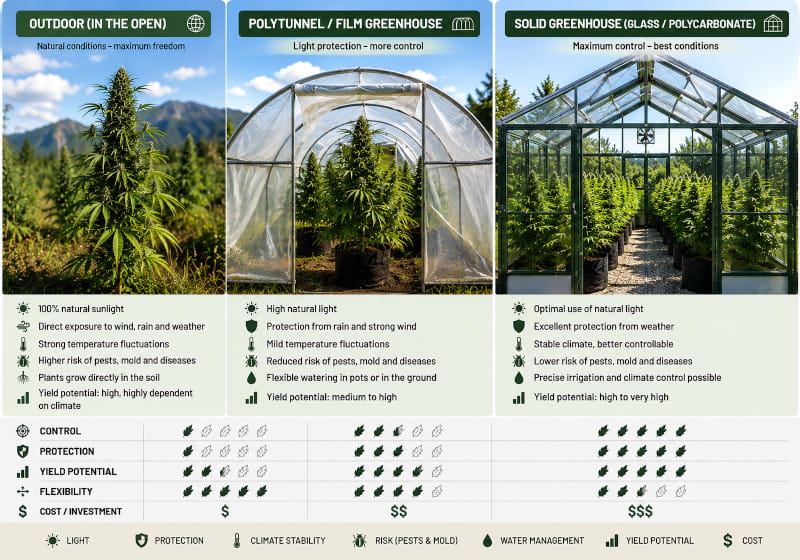
Outdoor cannabis greenhouse cultivation refers to growing under a translucent cover, where sunlight remains the main energy source and the greenhouse provides limited protection from the weather.
Unlike an indoor system, lamps, climate-control equipment and closed ventilation circuits do not create the entire growing environment. Outdoor weather continues to determine day length, available light and a large part of the temperature pattern. However, the transparent enclosure changes these conditions: short-wave solar radiation enters, surfaces heat up and the heat is released back into the surroundings more slowly.
On cool days, this effect can be advantageous. Under intense sunlight, however, heat can build up within a short time without adequate ventilation. At the same time, the plants continuously release water into the surrounding air. If this moist air cannot escape, relative humidity rises and water vapour condenses on cool surfaces. This creates conditions that encourage fungal diseases, mould and other plant problems.
A greenhouse can protect plants from direct precipitation, strong wind, hail and short cold spells, making the growing season easier to plan.
Greenhouse cultivation differs fundamentally from a guerrilla grow. While plants there are fully exposed to the weather, a greenhouse provides protection from rain, wind and major temperature fluctuations. Especially during wet weather, leaves and flowers can remain dry for longer. However, this protection does not replace adequate ventilation, because evaporation from plants and substrate continuously increases the humidity inside. A closed greenhouse can therefore develop very high relative humidity despite dry plant surfaces.
Other advantages include earlier warming in spring, slower cooling in the evening and better protection of young plants from harsh wind. Depending on the design, insect screens, automatic window openers, gutters and shade cloth can also be integrated. This makes cultivation easier to control without completely giving up natural light.
| Feature | Greenhouse | Open-Air Outdoor Cultivation |
|---|---|---|
| Sunlight | Natural, slightly reduced depending on the glazing | Natural and unobstructed |
| Rain protection | Good with an intact covering | No protection |
| Air exchange | Must be ensured through openings | Usually occurs naturally |
| Heat build-up | Significantly increased risk in sunshine | Lower, depending on the location |
| Humidity | Can build up considerably | Follows the outdoor climate more closely |
| Season extension | Possible to a limited extent | More strongly tied to the frost-free season |
Which Greenhouse Is Suitable for Cannabis?
A stable, sufficiently tall greenhouse with large ventilation areas, good accessibility and enough clearance between the plants and the roof is suitable.
The material and design influence light transmission, heat retention, wind stability and service life. Glass lets in plenty of light and retains its shape, but it is heavy and prone to breakage. Twin-wall polycarbonate panels provide better insulation and diffuse the light, but may become dirty or age over time. Polytunnels are comparatively light and flexible, but require secure anchoring and UV-resistant film.
Ventilation capacity is often more important than the material. A large internal volume heats up more slowly than a very small structure. Roof vents use the natural upward movement of warm air, while low-level or side openings allow cooler outside air to enter. Doors alone are often insufficient on windless summer days.
| Design | Strengths | Limitations |
|---|---|---|
| Glass greenhouse | High light transmission, durable, easy to clean | More expensive, heavy, prone to breakage |
| Polycarbonate | Good insulation, light diffusion, relatively robust | Reduced visibility; ageing and algae in the chambers are possible |
| Polytunnel | Large area, flexible, comparatively inexpensive | Vulnerable to wind; film must be checked and replaced |
| Lean-to greenhouse | Uses heat from the building, space-saving | Light enters from one side; heat build-up possible against south-facing walls |
| Mini greenhouse | Suitable for propagation and very small spaces | Very little climate buffering and limited height |
Where Should the Cannabis Greenhouse Be Located?
The ideal location receives plenty of direct light, is easy to access, is sheltered from wind without being completely windless, and has firm, level ground.
Trees, walls and buildings can cast long shadows in spring or autumn even if the location appears sunny in midsummer. Therefore, do not observe only the midday sun, but the entire path of the sun from morning to evening. An open location improves light exposure, but also exposes the greenhouse more strongly to gusts of wind. This increases the demands on the structure and—especially for unprotected plants—also the risk of wind burn. Polytunnels and lightweight aluminium greenhouses in particular should therefore stand on a stable foundation or be securely anchored in the ground.
Water should be within easy reach without hoses becoming a trip hazard. At the same time, rainwater must be able to drain reliably away from the outside of the greenhouse. A low-lying location where cold air or water collects prolongs damp periods and can intensify night-time cooling. When choosing suitable varieties, it is also worth consulting our cannabis climate map, which helps rule out unsuitable genetics for the respective climate zone at an early stage.
What Temperature Is Appropriate in a Greenhouse?
Cannabis grows in warm conditions, but persistently high temperatures and major fluctuations can strain water balance, photosynthesis and development.
Laboratory and greenhouse studies show that cannabis responds clearly to temperature, light intensity and humidity. Individual trials report favourable ranges in the mid-twenties Celsius for certain genotypes, but these values are not universal targets. Variety, developmental stage, root temperature, light and water availability all alter the response.
In a hobby greenhouse, a trend is therefore more important than a single reading: if the temperature rises quickly in sunshine, openings must be opened earlier. If nights remain cool, the greenhouse should still be ventilated in the morning as soon as condensation forms. A minimum-maximum thermometer or data logger positioned at leaf level shows which extremes actually occur.
| Observation | Possible Cause | Appropriate Response |
|---|---|---|
| Temperature rises very quickly in the morning | Insufficient ventilation area | Open earlier and combine roof and side ventilation |
| Leaves droop despite moist substrate | Heat or restricted root function | Ventilate, provide shade and check the root zone |
| Strong day-night fluctuations | Small air volume or low heat storage | Adjust ventilation timing and consider thermal mass |
| Condensation in the morning | Moist air cools down at night | Ventilate early and improve air movement |
How High Should the Humidity Be?
The key is to prevent humidity from remaining very high for long periods and to ensure that leaves and flowers can dry completely on a regular basis.
Relative humidity depends on temperature and water-vapour content. When moist air cools, relative humidity rises even if no additional water evaporates. Once the dew point is reached, condensation forms. This is why the highest readings often occur at night and in the early morning.
Fixed percentage values are only of limited significance because sensor position, temperature and plant stage all play a role. A sensor should not hang directly against a wet wall, in direct sunlight or immediately above moist substrate. Measurements at canopy height and the duration of humid periods are more informative.
As the plants become denser, humidity within the crop increases. A more humid microclimate may exist between the leaves than in the open central aisle. This is precisely where many fungal problems develop first. A loose arrangement, the removal of dead plant material and even air movement are therefore more important than a single hygrometer reading.
Why Is Ventilation So Important When Growing Cannabis in a Greenhouse?
Ventilation removes heat and moisture, brings fresh outside air into the crop and shortens the time during which surfaces remain damp.
Natural ventilation works through wind pressure and thermal buoyancy. Warm air rises and leaves the greenhouse through roof openings, while cooler air flows in through side or low-level openings. The greater the height difference between the inlet and outlet openings, the more effectively this process can work.
On windless days or in densely built-up locations, natural ventilation may not be enough. Circulation fans can mix layers of air and reduce humid zones within the crop, but they do not replace the exchange of air with the outdoors. They should create gentle, even movement and should not blow strongly and continuously at individual plants.
How Can Heat Build-Up Be Prevented?
Heat build-up can be limited most reliably through large open ventilation areas, timely opening, suitable shading and sufficient internal volume.
Automatic window openers react to heat without electricity and can open roof vents before you arrive. Doors and side panels should be secured so that they cannot slam shut in the wind. In polytunnels, roll-up sides are particularly effective because air can enter along the entire length.
Shade cloth reduces incoming solar energy. External shading keeps a larger proportion of the heat out before it enters the greenhouse. Internal fabric is easier to install, but by then the solar energy is already inside. Permanent heavy shading can reduce the light supply unnecessarily and should be adapted to the weather and season.
How Can Condensation and Persistently Wet Plants Be Prevented?
Condensation can be reduced by removing excess moisture, avoiding unnecessary evaporation at night and ventilating early in the morning.
Water in a way that avoids unnecessarily wetting the leaves and prevents the substrate from being completely saturated before the cool night. This does not mean leaving thirsty plants dry. The aim is demand-based irrigation that allows excess water to drain away and prevents open pools of water from remaining in the greenhouse.
Gutters, leaking connections and dripping film should be checked. Condensation dripping from the roof onto plants prolongs leaf wetness. Anti-drip film or a roof pitch that allows water to run off to the sides reduces this problem.
Is a Cannabis Mini Greenhouse Suitable?
A cannabis mini greenhouse is mainly suitable for propagation, the transitional period in spring or very compact plants, but not automatically for the full cycle of large genetics.
Small greenhouses respond particularly quickly to sun, cold and moisture. The low air volume heats up within a short time and cools down rapidly again at night. At the same time, plants quickly reach the roof and side walls. If leaves remain in contact with the covering, moisture persists for longer and air circulation deteriorates.
For the germination of cannabis seeds, as well as for seedlings and young plants, a mini greenhouse can create optimal conditions. It protects sensitive plants from draughts and helps maintain an even temperature and higher humidity. Nevertheless, it should be checked daily and ventilated regularly. In direct sunlight, a closed propagation dome must never be left unattended because the temperature can rise sharply within a short time. As soon as the plants begin to grow more vigorously, they need more space, a larger air volume and better air circulation.
| Use | Suitability | What Should You Watch For? |
|---|---|---|
| Germination | Good | Avoid overheating and ventilate regularly |
| Young plants | Good to conditionally suitable | Gradually acclimatise them to sun and wind |
| Compact autoflower | Conditionally suitable | Check final height, pot size and air volume |
| Large photoperiod plant | Usually unsuitable | Insufficient height and air exchange |
| Overwintering | Hardly suitable without heating | Frost protection and available light are often insufficient |
Should Cannabis Grow in a Pot, Raised Bed or Greenhouse Soil?
Pots offer the greatest control, raised beds combine control with more root space, and direct cultivation in greenhouse soil provides the largest soil volume but depends most heavily on the existing soil quality.
Pots can be moved and watered individually. At the same time, they heat up more quickly and dry out more often. Dark containers in direct sunlight can develop high root temperatures. Adequate drainage holes and supports that prevent waterlogging are essential.
Raised beds store more water and buffer temperature fluctuations more effectively. Direct cultivation in the ground gives roots plenty of space, provided the soil is loose, uncontaminated and well drained. If the previous use of the site is unknown, a soil analysis is advisable because cannabis can absorb heavy metals and other substances from contaminated soil.
Which Substrate Is Suitable in a Greenhouse?
A suitable substrate retains enough water and nutrients while remaining aerated and allowing excess irrigation water to drain reliably.
Very fine mixtures that remain permanently wet restrict oxygen in the root zone. Extremely coarse or sandy substrates, on the other hand, dry out quickly. Organic components such as mature compost can improve structure and nutrient retention, but they should be hygienically sound and fully matured.
The pH value influences how effectively plants can absorb individual nutrients. However, the decisive factor is not a supposedly perfect target value, but the interaction between source water, substrate, fertiliser, drainage and a healthy root system. Anyone who constantly adjusts the pH without reliable measurements often causes greater fluctuations than a slightly different but stable value. More information on suitable substrates can be found in the article about the best growing medium for cannabis.
How Should Cannabis Be Watered Correctly in a Greenhouse?
Water according to actual water demand and root volume, not according to a rigid schedule.
Sunny days, large leaf areas, small pots and strong air movement increase water consumption. Cool, overcast weather reduces it. Therefore, check the weight and moisture of the substrate as well as the condition of the plant. Dry soil at the surface does not automatically mean that the entire root ball is dry.
Drip irrigation delivers water directly to the root zone and keeps the leaves dry. However, it must be checked regularly for clogged emitters, uneven distribution and leaks. A timer does not replace inspection because demand can fluctuate considerably when the weather changes.
When Should You Water in a Greenhouse?
The morning is often a favourable time because plants receive water for the day and excess moisture can dry before nightfall.
On very hot days, an additional demand-based watering may be necessary. Large quantities late in the evening, however, increase night-time humidity if the greenhouse is closed at the same time. Actual demand remains decisive: a visibly thirsty plant should not be forced to wait until the next morning as a matter of principle.
Which Variety Characteristics Are Useful for a Greenhouse?
Suitable genetics have a final height, maturation time, growth pattern and resilience that match the available space and regional climate.
A greenhouse protects against rain but does not eliminate high humidity. Varieties with very dense flower clusters can therefore remain challenging in humid regions. An open plant structure, robust shoots and a maturation time suited to autumn make cultivation easier.
Tall photoperiod plants can exceed the roof height or block ventilation windows. More compact genetics and autoflowering varieties are often easier to plan in smaller greenhouses. However, actual size depends not only on the variety description, but also on sowing time, root space, light and care.
The 10 Best Cannabis Strains for a Greenhouse
Robust varieties whose height, development time and tolerance of humidity match the available space and regional climate are particularly suitable for greenhouse cultivation.
There is no single universally best greenhouse strain. Large photoperiod genetics can realise their full growth potential in spacious greenhouses, but they require sufficient height and reliable ventilation. Autoflowering varieties often remain more compact and are easier to schedule. In humid regions, early maturation, an open plant structure and good resistance to fungal diseases are also particularly important.
| Cannabis Strain | Breeder | Type | Why Is It Suitable for a Greenhouse? |
|---|---|---|---|
| Frisian Dew | Dutch Passion | Feminized, photoperiod | A very robust outdoor and greenhouse genetic with strong branching. Its vigorous growth requires plenty of height and adequate spacing. |
| Easy Sativa | Femaleseeds | Feminized, photoperiod | A fast-growing, robust semi-automatic sativa developed for outdoor and greenhouse cultivation. Suitable for larger structures. |
| Serious 6 | Serious Seeds | Feminized, photoperiod | An early-maturing and particularly mould-resistant genetic for humid or cooler climate zones. Of interest for unheated greenhouses in Central Europe. |
| Apple Fritter | Barneys Farm | Feminized, photoperiod | A vigorous greenhouse genetic with high growth potential. Suitable for large greenhouses, provided height and lateral space are planned early. |
| Sour Diesel Fast | Cannapot | Semi-autoflowering | An easy-care and very vigorous semi-automatic hybrid that can develop particularly strongly in warm greenhouse conditions. Adequate ventilation remains important. |
| Pine & Snow | Alpenhigh | Feminized, photoperiod | A robust, very easy-care strain with a manageable growth pattern. Highly resistant to humidity and mould. It smells of ripe pineapple and mint and is an absolute insider tip. |
| Amnesia Fast | Cannapot | Semi-autoflowering | The perfect outdoor and greenhouse sativa for growers who want to cultivate an Amnesia in a greenhouse. Excellent results and very easy to care for. |
| Auto Ultimate | Dutch Passion | Feminized, autoflowering | A productive autoflowering strain with a predictable life cycle. Suitable when no control of day length is planned and enough time remains for the complete cycle. |
| Mimosa Auto | Auto Monkey | Feminized, autoflowering | Growth is easy to schedule. It smells of citrus fruits such as oranges or limes and is resistant to mould and various diseases. |
| Auto Critical Orange Punch | Dutch Passion | Feminized, autoflowering | A versatile autoflowering genetic with a relatively short, easily planned cycle. Suitable for seasonal runs in small to medium-sized greenhouses. |
Autoflower or Photoperiod—Which Is Better Suited to a Greenhouse?
Autoflowering varieties offer a short, easily planned cycle, while photoperiod varieties usually require more time and space but grow more flexibly over the vegetative period.
| Characteristic | Autoflower | Photoperiod |
|---|---|---|
| Start of flowering | Age-dependent | Influenced by day length and genetics |
| Predictability | Often good | More strongly dependent on the season |
| Typical size | Usually compact to medium | Compact to very large |
| Suitability for a mini greenhouse | Conditional, with compact genetics | Usually only with plenty of height or late sowing |
| Multiple runs | More feasible seasonally | Usually one main cycle under natural light |
How Much Space Does a Cannabis Plant Need in a Greenhouse?
A plant needs not only floor space, but also free room for roots, side shoots, air movement and access for inspection.
Overcrowding causes leaves to overlap and the interior of the crop to dry more slowly after dew or watering. It also makes inspection more difficult. Plan walkways so that you can reach every plant without bending shoots. Ventilation windows, doors and fans must not be blocked by foliage.
Final size cannot be determined exactly from the variety alone. Pot volume, starting time and duration of growth have a major influence. Therefore, allow a safety margin below the roof and remember that plants often gain considerable height during flowering.
How Can Plants Be Supported in a Greenhouse?
Stable supports installed early prevent shoots from breaking under their own weight, during handling or in gusts of wind.
Individual stakes, soft plant ties or horizontal support nets are suitable. Ties must not constrict stems. Structures should be planned so that every plant can still be inspected and removed if necessary. In polytunnels, supports must not touch or damage the film.
Which Pests Occur in a Cannabis Greenhouse?
Common pests include aphids, whiteflies, thrips, spider mites, fungus gnats and various caterpillars.
The protected climate can accelerate their development, while natural predators enter the greenhouse less easily. Check new plants, tools and bags of substrate before they enter the crop. Yellow or blue sticky traps can indicate flying insects, but they do not replace examination of the plants.
Pay particular attention to leaf undersides, young shoots and the junctions between petioles and stems. Small populations detected early are usually easier to limit than an advanced infestation. Insect screens can reduce entry, but they also restrict airflow and must be considered in the ventilation plan.
| Problem | Typical Signs | Favourable Conditions |
|---|---|---|
| Aphids | Colonies on young shoots, honeydew, distorted growth | Warm conditions and soft new growth |
| Spider mites | Pale feeding spots, later fine webbing | Warm and dry |
| Thrips | Silvery feeding marks and small dark spots | Protected, warm climate |
| Fungus gnats | Small dark flies above persistently moist substrate | Wet, organic substrates |
| Whitefly | White insects fly up when the plant is touched | Dense crops and warm temperatures |
Which Diseases Are Particularly Relevant in a Greenhouse?
Grey mould, powdery mildew, root diseases and other moisture-dependent pathogens can develop especially in poorly ventilated crops.
Scientific studies on cannabis describe various fungal pathogens affecting roots, leaves and flowers. The decisive factors are not only the spores present, but also favourable infection conditions. High humidity, low air movement, dense foliage, injured tissue and prolonged leaf wetness increase the risk.
Remove dead leaves promptly and do not leave plant debris on damp ground. Clean reusable pots and tools before a new cycle. Diseased material should be handled separately so that spores or pests are not spread by hands, scissors or air movement.
How Does Hygiene Help with Prevention?
Clean surfaces, controlled new arrivals and the prompt removal of diseased plant parts reduce infection pressure in the greenhouse.
Plant debris, standing water, spilled substrate and algae deposits provide favourable conditions for pests or pathogens. Keep walkways clear and store bags, pots and tools in a dry place. A small quarantine area for new plants prevents an unnoticed infestation from immediately entering the entire crop.
How Does Care Change in Spring, Summer and Autumn?
In spring, protection from cold and acclimatisation to sunlight are the priorities; in summer, ventilation and water supply; and in autumn, moisture control and complete drying.
| Season | Main Issue | Typical Measures |
|---|---|---|
| Spring | Cool nights and strong solar radiation | Monitor temperatures, harden off young plants gradually and ventilate during the day |
| Early summer | Rapid growth | Check space requirements, install supports and adjust irrigation |
| Midsummer | Heat and high water consumption | Open early, provide shade and check emitters |
| Late summer | Dense crop | Keep airflow paths clear and inspect for pests and fungi |
| Autumn | Cool nights and condensation | Ventilate early in the morning, shorten leaf-wetness periods and monitor the weather |
Can the Season Be Extended in a Greenhouse?
A greenhouse can extend the usable season, but it replaces neither sufficient daylight nor reliable frost protection.
In spring, the interior warms earlier during the day. In autumn, plants remain protected from direct rain and briefly benefit from stored heat after sunset. During long cold nights, however, the temperature inside an unheated greenhouse increasingly approaches the outside temperature.
Water containers or solid floor surfaces can buffer heat, but they do not prevent severe frost. Heating devices also increase energy use, fire risk and humidity if they are unsuitable or operated incorrectly. Electrical installations in humid environments should be handled by qualified professionals.
Is Supplemental Lighting Useful in a Greenhouse?
Supplemental lighting can add to the natural light supply, but it turns a greenhouse into a technically more demanding system with higher energy and safety requirements.
Greenhouse studies with cannabis show that supplemental light can influence water use and plant development. An installation should therefore not be considered in isolation: more light can mean more evaporation, greater irrigation demand and additional heat. Lamps, cables and controls must be suitable for humid environments and installed safely.
What Role Does Light Deprivation Play?
Light deprivation changes the natural day length and requires a light-tight, well-ventilated structure that is controlled reliably every day.
In photoperiod plants, day length can influence the transition to flowering. However, light deprivation increases the workload and can impair air exchange and heat removal. Light-proof covers must therefore not simply block all openings. Even small light leaks and irregular routines can stress plants.
Which Mistakes Are Particularly Common When Growing Cannabis in a Greenhouse?
The most common mistakes are ventilating too late, allowing too little space, keeping the substrate permanently wet, failing to carry out inspections and assuming that a roof automatically prevents mould.
| Mistake | Possible Consequence | Better Approach |
|---|---|---|
| Leaving the greenhouse closed in the morning | Rapid heat build-up and high humidity | Open early according to the weather |
| Using only the door for ventilation | Warm air remains trapped beneath the roof | Combine roof and side openings |
| Placing plants too close together | Humid zones and poor access for inspection | Plan spacing and access routes |
| Watering according to a calendar | Over- or under-supply when the weather changes | Check the substrate and plant condition |
| Growing a large variety in a small structure | Contact with the roof and blocked vents | Plan final height and stretch in advance |
| Using only one sensor | Humid zones in the crop remain unnoticed | Combine measurements at plant height with visual inspection |
| Leaving diseased leaves in place | Increased infection pressure | Remove them and clean the tools |
Which Equipment Is Really Useful?
The most useful items are measuring devices and simple aids that improve ventilation, irrigation, hygiene and secure fastening.
| Equipment | Benefit | Note |
|---|---|---|
| Minimum-maximum thermometer | Shows daily extremes | Position at canopy height |
| Hygrometer or data logger | Identifies prolonged humid periods | Do not measure directly against a wall or over wet substrate |
| Automatic window opener | Opens according to temperature | Check operation and opening travel regularly |
| Shade cloth | Reduces extreme solar radiation | Use only when needed |
| Drip irrigation | Targeted water delivery | Check emitters and distribution |
| Soft plant ties | Support shoots without constriction | Loosen or reposition regularly |
| Clean scissors | Remove damaged material | Clean between plants |
What Does a Sensible Inspection Routine Look Like?
A brief daily visual inspection and a more thorough weekly check are often sufficient to identify changes early.
In the morning, check temperature, condensation and substrate moisture. Then inspect leaf undersides, young shoots and the interior of dense plants. Look for unusual spots, feeding marks, odours, wilted shoots or standing water. After storms or heavy rain, inspect the structure, anchoring and roof surfaces.
Frequently Asked Questions About Cannabis Greenhouses
Can cannabis remain permanently in a closed greenhouse?
No. A greenhouse that remains permanently closed can heat up considerably and accumulate moisture. Regular air exchange is necessary.
Is a polytunnel suitable?
Yes, provided the film and frame are stable, the structure is securely anchored and sufficiently large side or end openings are available.
Is an open door enough for ventilation?
It can help in small structures and light wind. For reliable air exchange, additional roof or side openings are usually considerably more effective.
Why is it so humid in the greenhouse in the morning?
The air cools at night. This raises relative humidity, and water vapour can condense on cold surfaces.
When should the greenhouse be opened?
That depends on the weather. On sunny days, it should often be opened during the morning before intense heat builds up.
Can a mini greenhouse be used for an autoflower?
It can work with very compact genetics. However, height, pot volume, ventilation area and summer overheating remain limiting factors.
Does a greenhouse provide complete protection against mould?
No. It keeps off direct rain, but inadequate ventilation can create high humidity and long damp periods.
Are fans necessary?
They are not essential in every greenhouse, but they can help in windless locations or dense crops. Exchange with outside air is still required.
Can rainwater be used for irrigation?
Collected rainwater may be suitable if the container, roof and pipes are clean and no unsuitable materials or contaminants enter the system.
How can plants be prevented from becoming too large?
Choose suitable genetics, plan the sowing time and root space realistically, and allow enough clearance below the roof. Late corrections are more difficult than appropriate planning.
Is direct midday sun a problem?
Not in itself. It becomes problematic if the greenhouse heats up excessively or plants raised in shade are suddenly exposed to intense sunlight without acclimatisation.
How often should inspections be carried out?
Daily checks are advisable in changeable or hot weather. Automatic openers and irrigation reduce the workload, but they do not replace visual inspection.
A Stable Greenhouse Climate Is Created Through Observation
Successful greenhouse cultivation depends on the interaction of light, temperature, air exchange, water, root space and plant health.
A greenhouse provides protection and extends the usable season, but it also creates new tasks. Anyone who ventilates early, avoids overcrowding, waters according to demand and regularly monitors changes can prevent many typical problems. It is particularly important not to regard the greenhouse as a sealed protective space, but as a dynamic system that responds to outdoor weather every day.
Scientific Foundations and Further Sources
- Chandra et al.: Photosynthetic response of Cannabis sativa L. to variations in photosynthetic photon flux densities, temperature and CO₂ conditions.
- Fleming et al.: Controlled environments for cannabis cultivation to support research.
- Punja et al.: Pathogens and molds affecting production and quality of Cannabis sativa L.
- Collado et al.: Supplemental greenhouse lighting and water use in Cannabis sativa.
- Penn State Extension: Fundamentals of greenhouse production and ventilation.
- University of Minnesota Extension: High relative humidity as a disease factor in greenhouse crops.
- Penn State Extension: Sources of plant diseases in greenhouses.