Powdery Mildew on Cannabis: Identify & Treat
Powdery Mildew on Cannabis: Identify the Causes, Control Mildew and Prevent It Long-Term
Updated: July 2026 | Learn how to identify mildew on cannabis plants at an early stage, how powdery mildew differs from downy mildew, and which measures can keep the disease under control in the long term.
Author: Cannapot Grow Team | Reading time: approximately twenty minutes
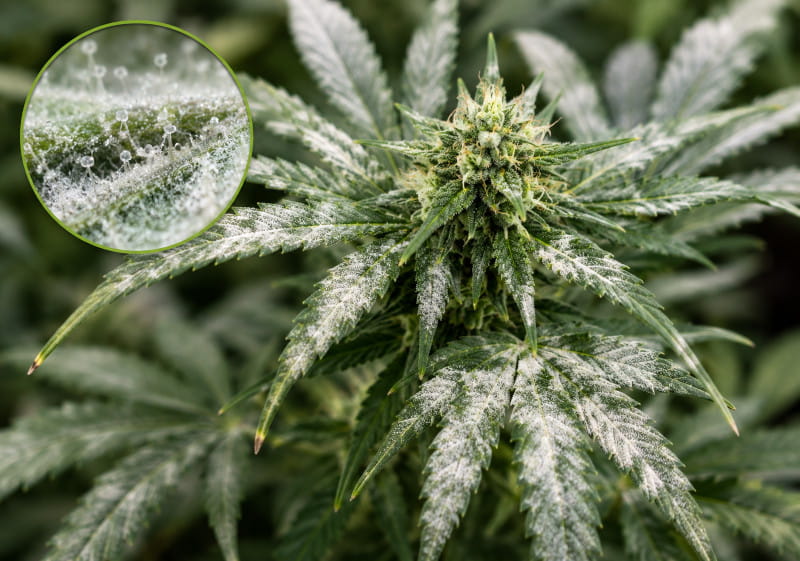
The Most Important Points at a Glance
✓ Mildew is one of the most common fungal diseases in cannabis cultivation. When an infestation is detected early, major damage can often be avoided.
✓ A distinction is made between powdery mildew and downy mildew. They cause different symptoms and prefer different environmental conditions.
✓ Poor air circulation, consistently high humidity, major temperature fluctuations and dense plant growth significantly increase the risk.
✓ Prevention, regular plant inspections and prompt action at the first signs of infection are essential.
✓ A stable climate with good ventilation, moderate humidity and sufficient spacing between plants considerably reduces the risk of mildew.
✓ Infected leaves should be removed and disposed of as early as possible. This helps limit the spread of fungal spores to healthy plant tissue and neighbouring plants.
White spots on the leaves are warning signs that should never be ignored when growing plants from the right cannabis seeds. What initially looks like a harmless coating is often mildew, a plant disease that can spread to large parts of a plant or even an entire crop within only a few days when conditions are favourable.
One particular problem is that the pathogen may already be developing before obvious damage becomes visible. It therefore pays to inspect plants regularly and take even minor changes seriously. The earlier mildew is detected, the better the chances of containing the infection and preventing it from spreading further.
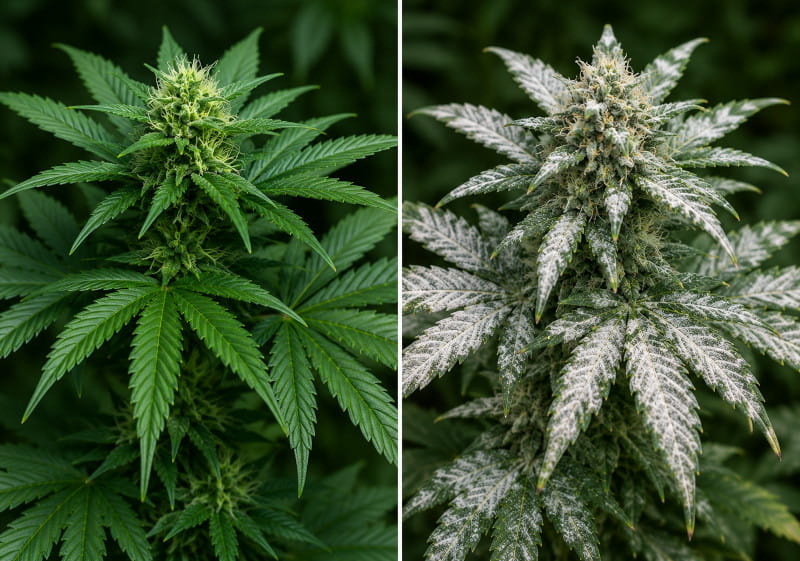
What Is Mildew on Cannabis?
Mildew is a plant disease caused by pathogens that attack leaves, shoots and, in some cases, flowers, potentially impairing photosynthesis and plant growth.
The term mildew covers several groups of plant pathogens that reproduce on living plants. Two forms are especially relevant in cultivation: powdery mildew and downy mildew. Although both cannabis diseases can have similar consequences, they differ significantly in their pathogens, appearance and the conditions under which they develop most rapidly.
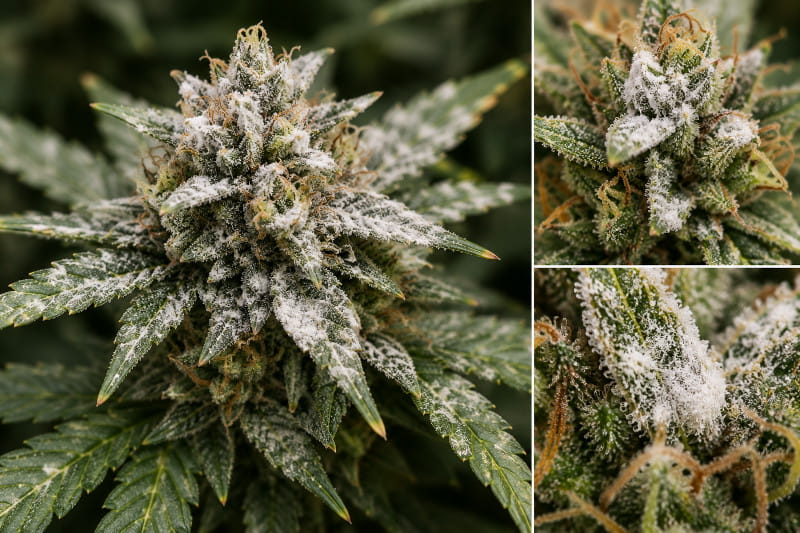
Powdery mildew produces a whitish, flour-like coating on the upper surface of leaves and may later spread to petioles, young shoots and flowers. Downy mildew, by contrast, often first appears as yellowish patches on the upper leaf surface, while a grey to violet growth may develop on the underside.
The pathogens use the plant as a food source. They draw water and nutrients from infected tissue, weakening the plant as a whole. An advanced infestation can significantly reduce leaf function, decrease vitality and negatively affect flower development. Even correct watering cannot compensate for an established mildew infection. Early detection and appropriate countermeasures are crucial.
What Is the Difference Between Powdery Mildew and Downy Mildew?
Powdery mildew and downy mildew are caused by different pathogens and differ both in their appearance and in the conditions under which they spread especially quickly.
Although both diseases are commonly described as mildew, they are biologically distinct. Powdery mildew is caused by ascomycete fungi that develop mainly on the plant surface. Downy mildew belongs to the oomycetes, or water moulds, which colonise plant tissue internally and may therefore remain undetected for longer.
Powdery mildew should also not be confused with mould. The white, flour-like coating initially sits mainly on the surface of the leaves and can sometimes be wiped away during the early stages. Mould, on the other hand, grows into plant tissue, often forms a fluffy coating and is much more likely to cause rot, particularly on flowers.
This distinction is important in practice because prevention and treatment differ in several respects. Powdery mildew can occur in warm conditions even when the leaf surface is temporarily dry, while downy mildew generally requires prolonged moisture to spread successfully.
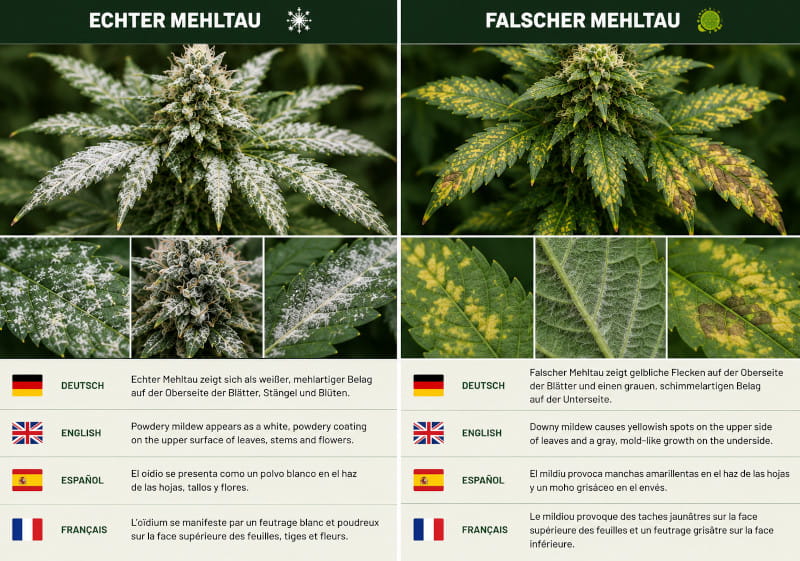
| Characteristic | Powdery Mildew | Downy Mildew |
| Pathogen | Ascomycete fungi | Oomycetes (water moulds) |
| First sign | White, powdery coating | Yellowish patches on the leaves |
| Underside of leaf | Usually inconspicuous | Grey to violet sporulation may be present |
| Preferred conditions | Warm conditions with a periodically dry leaf surface | High humidity and persistent leaf wetness |
| Spread | Through airborne spores | Primarily through moisture and splashing water |
How Can You Identify Mildew on Cannabis Plants?
Mildew is most reliably identified by inspecting leaves regularly and taking even small changes seriously.
At first, only a few small white spots or a fine, flour-like coating may appear. These early signs are easily mistaken for dust, mineral deposits or harmless contamination. Within a short time, however, they can develop into larger, connected patches that increasingly cover the leaf surface.
As the disease progresses, leaves lose vitality. They discolour, may curl and eventually die. At the same time, the pathogen continuously produces new spores that can spread to other parts of the plant and neighbouring cannabis plants through air movement, contact or contaminated tools. Without timely countermeasures, an infestation can become significantly worse within only a few days.
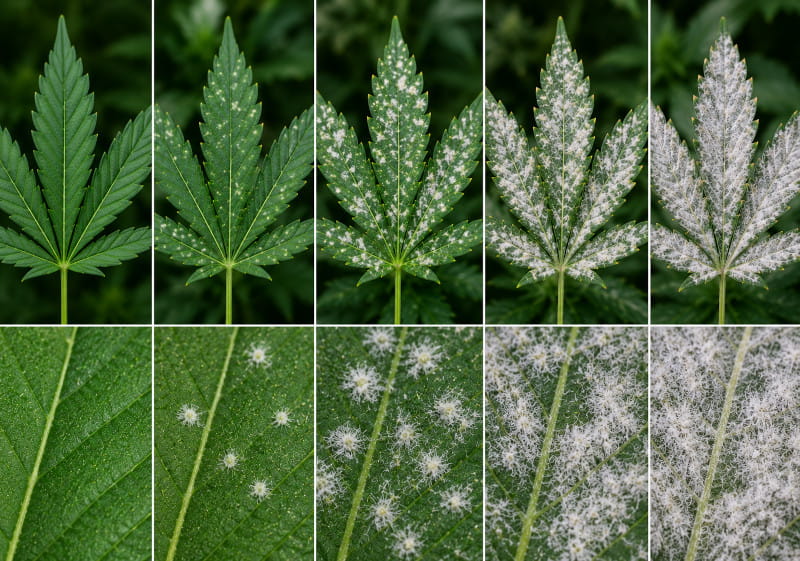
| Stage of Development | Typical Signs |
| Early infestation | Individual white dots or small spots on young leaves |
| Moderate infestation | Continuous white coating across several areas of the leaves |
| Advanced infestation | Yellowing leaves, stunted growth and spread to shoots or flowers |
Why Does Mildew Develop on Cannabis?
Mildew is not caused by one single factor, but by the interaction of favourable environmental conditions and existing spores.
Spores are present almost everywhere in the environment. Whether they can actually infect a plant depends on several factors. The microclimate within the crop and the plant’s overall vitality are particularly important.
Persistently high humidity, insufficient air movement, major differences between day and night temperatures, and very dense plant growth create ideal conditions for spores to germinate. Leaves also dry more slowly, making it easier for pathogens to establish themselves. An optimal grow setup with good ventilation, suitable humidity and sufficient plant spacing helps significantly reduce the risk of mildew.
Stress factors such as nutrient deficiencies, light stress, wind burn or mechanical injuries can also impair a plant’s natural resistance. Healthy, vigorous plants are not immune to mildew, but they may be able to withstand an emerging infection for longer.
Which Conditions Encourage Mildew on Cannabis?
Mildew develops especially quickly when high humidity, inadequate air movement and dense plant growth occur together.
Spores require suitable environmental conditions to germinate and colonise new plant tissue. Indoor gardens in particular can provide ideal conditions when climate and airflow are not properly controlled. In outdoor cultivation, prolonged wet weather can also significantly increase the risk of infection.
Areas inside dense plant canopies are especially critical. Air circulation is poor, moisture remains for longer and leaves dry much more slowly after watering or night-time condensation. This warm, humid microclimate creates ideal conditions for mildew and other plant pathogens to develop and spread.
| Risk Factor | Effect on Mildew Risk |
| High humidity | Significantly increases the likelihood of infection. |
| Poor air circulation | Moisture remains between the leaves for longer. |
| Very dense plant growth | Reduces air movement inside the canopy. |
| Major temperature fluctuations | Encourage condensation on leaf surfaces. |
| Persistently weakened plants | May have less natural resistance to pathogens. |
Is Mildew More Dangerous During Flowering Than During Vegetative Growth?
Yes. Mildew during flowering is generally much more serious because spores can spread between the flowers and the range of suitable countermeasures becomes increasingly limited.
During vegetative growth, individual infected leaves can often still be removed without difficulty. There is also enough time to optimise the growing climate and contain the further spread of the disease.
The situation changes significantly during the flowering stage. Increasingly dense flowers restrict airflow and retain moisture for longer. At the same time, residues from plant-protection or treatment products should be kept off the flowers whenever possible. This means that far fewer treatment options are available than during earlier stages of development.
An advanced mildew infestation can significantly reduce quality and yield. Weakened plants and persistently damp flower areas can also encourage other diseases such as Botrytis (grey mould), which may render entire flowers unusable.
Can Cannabis Affected by Mildew Still Be Used?
Flowers heavily affected by mildew should not be consumed because fungal tissue and spores may be present on the plant material.
If only a few leaves show early symptoms on an otherwise healthy plant, it may still be possible to contain the infestation. The situation is different once the pathogen has reached larger leaf areas or the flowers.
Simply removing visible deposits is not sufficient because fungal structures and spores are microscopic and may already be present on other parts of the plant. Visibly affected flower material should therefore always be assessed critically.
How Can Mildew on Cannabis Be Controlled Effectively?
The most effective strategy is to identify the infestation early, remove affected plant tissue and consistently eliminate the conditions that favour fungal growth.
Many growers initially focus on the visible coating. However, this is only the external sign of an existing infection. Long-term success is possible only when the climate in the grow room, greenhouse or outdoor area is improved at the same time. Otherwise, remaining spores can germinate again and infect additional plants.
The first steps include carefully removing clearly affected leaves with clean, disinfected tools. Humidity, air circulation, plant spacing and general plant health should then be reviewed. The earlier action is taken, the better the chances of limiting further spread.
- Remove affected leaves: Cut away heavily infected plant material as early as possible and dispose of it outside the growing area.
- Disinfect tools: Thoroughly clean scissors and other tools after every use to avoid transferring spores.
- Reduce humidity: Avoid persistently high humidity, especially at night.
- Improve air circulation: Even air movement helps leaf surfaces dry more quickly.
- Inspect plants daily: New infections are much easier to contain during the early stages.
Which Measures Are Most Effective Against Mildew?
Successful mildew control is based on several complementary measures. Some steps reduce the existing spore load, while others prevent the pathogen from spreading again. The greatest long-term success comes from combining hygiene, an optimised growing climate and regular inspections.
The following overview summarises the most important measures, explains their benefits and shows when they should ideally be implemented.
| Measure | Benefit | Timing |
| Remove affected leaves | Immediately reduces the spore load. | As soon as symptoms are discovered. |
| Disinfect tools | Prevents spores from being transferred to healthy plants. | After every cut. |
| Reduce humidity | Makes conditions less favourable for the pathogen. | Immediately after detection. |
| Improve air circulation | Helps leaf surfaces dry more quickly. | Continuously. |
| Inspect plants regularly | New infections are detected early and can be contained more quickly. | Throughout the entire grow. |
Which Home Remedies for Mildew Are Useful?
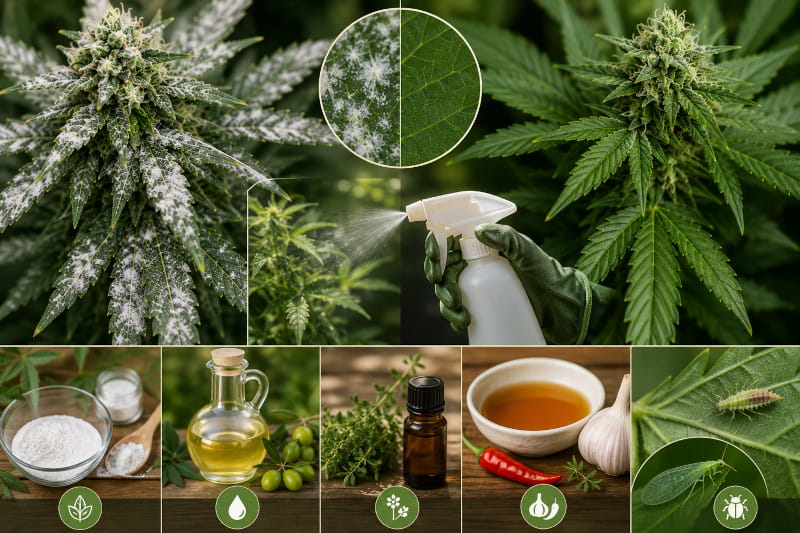
Home remedies are frequently recommended, but their effectiveness varies and they are no substitute for consistent prevention.
Numerous recommendations for controlling mildew circulate online. Some are based on horticultural experience, while others have only limited scientific support. Home remedies should therefore always be assessed critically.
Particular caution is needed during flowering. Residues on flowers may be difficult or impossible to remove completely later. Every application should therefore be considered carefully.
| Home Remedy | Scientific Assessment | Note |
| Milk solutions | Studies on various plants have produced partly positive results. | No guarantee of effectiveness on cannabis. |
| Sodium bicarbonate (baking soda) | May alter conditions on the leaf surface and make it harder for certain fungi to develop. | Incorrect concentrations can damage leaves. |
| Plant-strengthening products | May support plant resistance but do not replace disease control. | Primarily of interest as a preventive measure. |
Do Biological Products Help Against Mildew?
Biological plant-protection products may help contain an early infestation under certain conditions and are used primarily as part of integrated pest management.
Different biological active substances are available depending on the country. These may include preparations based on naturally occurring microorganisms or substances that can make plant tissue more resistant. Which products are authorised depends on the applicable legal regulations.
Approved products must always be used strictly according to the manufacturer’s instructions. A higher dose does not automatically produce a better result and may place additional stress on the plants.
Are Fungicides Useful Against Mildew?
Fungicides can be used to control mildew on certain crops. Whether their use is permitted and appropriate depends on the crop, the authorised plant-protection product and the applicable legal requirements.
Not every fungicide is approved for every plant species. Only products expressly authorised for the relevant application should therefore be used. When flowers are intended for later use, possible residues and prescribed pre-harvest intervals must be taken into account.
Even authorised fungicides do not eliminate the causes of a mildew outbreak. If persistently high humidity, poor air circulation or other unfavourable growing conditions remain, the pathogen may spread again despite treatment.
How Can You Prevent Mildew on Cannabis in the Long Term?
The most effective way to prevent mildew is to maintain a stable growing climate, inspect plants regularly and avoid conditions in which spores can reproduce easily.
Spores cannot be excluded completely from either indoor or outdoor cultivation. The decisive issue is therefore not whether spores are present, but whether they encounter favourable conditions. The more stable the climate, airflow and plant vitality, the lower the risk of successful infection.
Preventive measures usually require far less time than controlling an established outbreak. Growers who inspect their plants regularly and recognise small abnormalities early can often prevent major damage.
Which Cannabis Strains Are Particularly Resistant to Powdery Mildew?
The genetics of a cannabis plant have a major influence on its resistance to fungal diseases. Some strains are considered particularly robust and show greater resistance to powdery mildew even under less-than-ideal conditions. Choosing a resistant strain can significantly reduce the risk of infection, especially for outdoor cultivation or regions with high humidity. The following overview lists proven cannabis strains with high to very high resistance to powdery mildew.
| Strain | Type | Suitable For | Powdery Mildew Resistance |
|---|---|---|---|
| Durban Poison | Sativa | Indoor & Outdoor | Very high |
| Frisian Dew | Hybrid | Outdoor | Very high |
| Pakistan Valley | Indica | Outdoor | Very high |
| Chocolope | Sativa | Indoor | High |
| Blue Dream | Mostly Sativa | Indoor & Outdoor | High |
| Purple Urkle | Mostly Indica | Indoor & Outdoor | High |
| Ghost Train Haze #1 | Mostly Sativa | Indoor | High |
| Blue Cheese | Hybrid | Indoor & Outdoor | High |
| Acapulco Gold | Mostly Sativa | Indoor & Outdoor | High |
| Skywalker OG | Mostly Indica | Indoor | High |
What Humidity Level Helps Prevent Mildew?
Humidity adjusted to the plant’s current stage of development plays an important role in reducing the risk of infection.
Persistently humid air should be avoided, especially during flowering. Major differences between day and night values should also be kept as small as possible because they can cause condensation to form on the leaves.
Air movement within the crop is just as important as the measured value itself. Even when overall humidity appears suitable, small pockets of moisture can develop in dense areas of the canopy.
Why Is Good Air Circulation So Important?
Even air movement helps leaf surfaces dry more quickly and prevents moist air from accumulating between plants.
Fans should not be aimed directly at individual plants at full power for long periods. The goal is a gentle, even movement throughout the canopy so that no pockets of stagnant air develop.
With larger plants, it is especially worthwhile checking the inside of the canopy. Moisture often remains there much longer than on the outer leaves.
Does Defoliation Help Prevent Mildew?
Targeted, moderate removal of selected leaves can improve air circulation and thereby reduce the risk of fungal disease.
The aim is not to remove as many leaves as possible. Instead, heavily shaded areas or leaves lying closely on top of one another should be thinned so that air and light can reach the inside of the plant more effectively.
Excessive defoliation can cause additional stress. A balanced approach adapted to the plant’s stage of development and growth habit is therefore advisable.
Which Mistakes Most Commonly Encourage Mildew?
Many mildew problems are caused by several small mistakes that reinforce one another.
| Common Mistake | Possible Consequence |
| Humidity is too high | Spores can germinate more easily. |
| Plants are spaced too closely | Moist air remains trapped between the leaves. |
| Plants are inspected infrequently | An early infestation may remain unnoticed. |
| Insufficient air movement | Leaves dry much more slowly. |
| Plants are under constant stress | Natural resistance may decline. |
Indoor or Outdoor: Where Is Mildew More Common?
Mildew can occur in both indoor and outdoor grows, although the underlying causes differ in some respects.
Indoor problems often result from inadequate ventilation, excessive humidity or overcrowded plants. These factors can generally be controlled effectively, but doing so requires consistent climate management.
Outdoors, weather, rainfall, dew and natural temperature fluctuations influence the risk of infection. Longer periods of wet weather can significantly increase the occurrence of mildew, even though the outdoor climate can hardly be controlled.
Regardless of the cultivation method, regular visual inspections are among the most important preventive measures. They often reveal small changes before the disease can spread extensively.
FAQs
Q: Can mildew disappear on its own?
A: No. Without suitable countermeasures, the disease generally continues to spread and produces new spores.
Q: Is every white spot automatically mildew?
A: No. Mineral deposits, dust and other residues can look similar. If the spots remain or spread, inspect the plant more closely.
Q: Can mildew infect other plants?
A: Yes. Spores can reach other suitable host plants through air movement or direct plant contact.
Q: How quickly does mildew spread?
A: Under favourable conditions, an infestation can expand significantly within only a few days.
Q: Should affected leaves be removed immediately?
A: Yes. Heavily affected leaves should be removed as early as possible and disposed of outside the growing area.
Q: Does additional fertiliser help against mildew?
A: No. Mildew is not caused by a nutrient deficiency. Unnecessarily increasing fertiliser levels may place additional stress on the plants.
Q: Can mildew return in a grow tent?
A: Yes. If spores or unfavourable climate conditions remain, a new infestation can occur.
Q: What role does humidity play?
A: Persistently high humidity is one of the most important risk factors for many plant diseases.
Q: Is mildew dangerous to humans?
A: Mildew is a plant disease. Plant material visibly affected by fungal growth should nevertheless not be used.
Q: Can outdoor plants also develop mildew?
A: Yes. Longer periods of wet weather in particular significantly increase the risk.
Q: Is prevention more important than treatment?
A: Yes. A stable climate, good air circulation and regular inspections stop many infections before they become established.
Q: Can mildew spread to flowers?
A: Yes. This is why an infestation during flowering is considered particularly problematic.
Q: Is wiping off the white coating sufficient?
A: No. Visible deposits represent only part of the pathogen. The infection may already be present in plant tissue or may have colonised additional areas.
Q: How often should cannabis plants be inspected?
A: At least one thorough visual inspection per day is recommended throughout the grow, especially in densely grown areas.
Q: Can mildew be prevented completely?
A: There is no absolute guarantee. However, suitable growing conditions and consistent prevention can significantly reduce the risk.
Why Consistent Prevention Pays Off in the Long Term
Consistently stable crop management is the most effective protection against mildew and many other fungal diseases.
Regular plant inspections, a balanced growing climate, good air circulation and hygienic working practices significantly reduce the risk of infection. At the same time, the first signs of disease can usually be detected early, allowing timely action to be taken before major damage occurs.
Spores are present almost everywhere in the environment and cannot be completely excluded from either indoor or outdoor cultivation. Their mere presence is not decisive. What matters is whether they encounter conditions suitable for development. Growers who consistently maintain a stable climate, healthy plants and careful cultivation practices create the best possible conditions for preventing mildew from becoming established.
Sources and Further Information
- Julius Kühn Institute (JKI) – Federal Research Centre for Cultivated Plants
- Cornell University – Powdery Mildew (Disease Factsheet)
- University of California (UC IPM) – Powdery Mildew on Ornamentals
- Royal Horticultural Society (RHS) – Powdery Mildews
- European and Mediterranean Plant Protection Organization (EPPO) – Global Database
- American Phytopathological Society – Plant Disease (Peer-Reviewed Journal)
- Wikipedia – Powdery Mildew
- Wikipedia – Downy Mildews