Cannabis Root Rot: Causes, Signs & Solutions
Root rot in cannabis: how to identify, treat and prevent root rot
Updated: August 2026 | Identify root rot in cannabis, understand the causes, assess root rot correctly and specifically stabilize damaged roots in soil, coco and hydro systems.
Author: Cannapot Grow Team | Reading time: approximately twenty-five minutes
Key Facts at a Glance
✓ Root rot in cannabis describes damage to and decomposition of the root system. Waterlogging, oxygen deficiency and root-pathogenic microorganisms often act together.
✓ Typical warning signs include persistent wilting despite a moist substrate, slowed growth, yellowish leaves and brown, soft or slimy roots. Individual symptoms alone are not enough for a reliable diagnosis.
✓ In cannabis, various Pythium and Fusarium species have been scientifically described as pathogens causing root and crown rot. Pythium belongs to the oomycetes and is biologically not a true fungus.
✓ If you identify root rot, you should first stabilize the root zone: stop waterlogging, improve drainage and oxygen supply, remove dead material and narrow down the cause of the problem.
A cannabis plant can suddenly look wilted, pale and weak above the substrate even though the soil is still moist or there is sufficient water in the hydro system. This apparent contradiction is an important indication of problems in the root zone. If the roots are damaged, the plant can no longer absorb water and nutrients normally. Watering more often makes the situation worse rather than better.
The English term Root Rot is commonly used in cannabis cultivation as a collective term for root rot. However, more than one cause may be involved. Persistently wet substrate reduces the air supply to the roots, while certain soil- and water-borne pathogens can colonize weakened or injured root tissue. In cannabis, species from the genera Pythium and Fusarium have been associated with root and crown rot. Pythium refers to a group of fungus-like microorganisms known as oomycetes, various species of which can infect plant roots and cause root rot. Fusarium by contrast, is a genus of true fungi that includes numerous soil-borne plant pathogens. Certain Fusarium species can damage the roots, root crown and vascular tissue of cannabis and thereby cause root rot, growth disorders and wilting, among other symptoms.
Root rot in cannabis develops when the roots are continuously damaged and can no longer perform their functions properly. Unfavorable conditions in the root zone and pathogens often occur together.
It is important to note that too much water does not automatically mean that root rot is already present. However, if the substrate remains wet for a prolonged period, less oxygen reaches the roots. They become weakened and more susceptible to pathogens. Therefore, at the first signs you should not only look at the visible symptoms but, above all, check moisture, drainage and the condition of the roots. The earlier you identify the cause and improve conditions in the root zone, the greater the chance of preventing further damage.
What exactly is root rot in cannabis?
Root rot is progressive damage to the root system in which fine roots and later larger root areas die, become discolored and lose their ability to absorb water and nutrients.
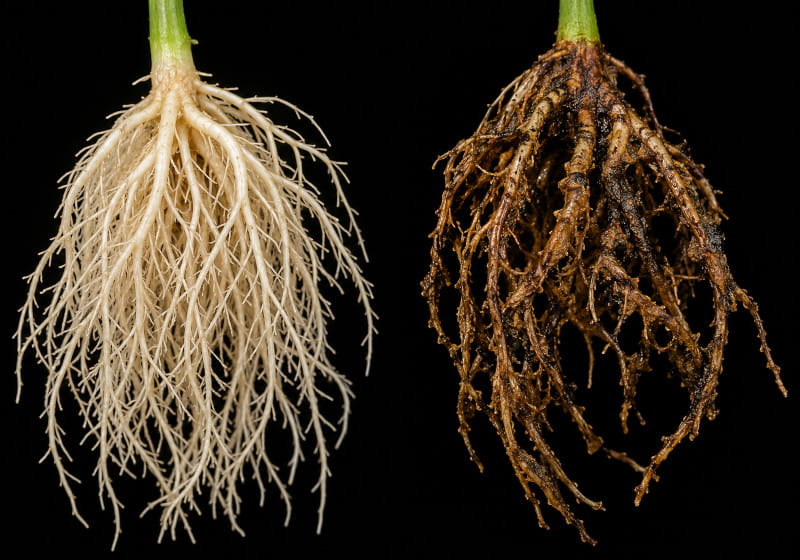
Healthy young cannabis roots are normally light-colored, firm and form numerous fine branches. With progressive root rot, this structure changes. Roots may turn beige, brown or dark, lose their fine roots and feel soft or unstable. In hydroponic systems, they may also appear greasy or slimy. In soil or coco, however, the damage often remains hidden for longer.
The term Root Rot therefore does not refer to one specific disease or a single pathogen, but to various forms of root rot. Scientific studies on cannabis show that different pathogens may be involved. Species of the genus Pythium as well as various Fusarium species have been studied particularly frequently. Which pathogens are actually involved usually cannot be determined reliably from visible symptoms alone.
Root problems can also arise without a pathogen being involved initially. If the substrate remains too wet for a prolonged period, the air pores increasingly fill with water and the roots receive less oxygen. This impairs important root functions and the plant becomes less able to absorb water and nutrients. At the same time, weakened roots can become more susceptible to pathogens. Therefore, root rot is influenced not only by possible pathogens but also by conditions in the root zone.
How can you identify root rot?
Root rot is most reliably identified by a combination of above-ground stress symptoms and visible changes to the roots: wilting despite a moist root zone, growth arrest, yellowing and brown, damaged or decaying roots are typical warning signs.
The problem often begins below the surface. The first signs on the leaves are therefore nonspecific. A plant may look limp even though enough moisture is present. New growth slows down, individual leaves become lighter or yellow, and the plant responds poorly to normal watering. With advanced damage, overall growth can decline significantly. However, not every conspicuous damage pattern begins at the roots. You can find an overview of possible causes under Cannabis Plant Problems & Diseases. Depending on the symptoms, for example, Mold on Cannabis or Powdery Mildew may also be possible causes.
Checking the roots is crucial. In a pot with an accessible root ball, you can carefully check whether light-colored, firm fine roots are still present around the outside. Assessment is usually easier in hydro systems. Dark roots alone, however, do not prove root rot: organic fertilizers, humic substances or other components of the nutrient solution can also discolor healthy roots. Therefore, also pay attention to structure, firmness, root mass and the overall condition of the plant.
|
Characteristic |
Possible indication of root rot |
What else you should check |
|
Leaves |
Wilting, yellowing, loss of turgor |
Water status, heat, salt stress and pH |
|
Growth |
Stagnation, weak new growth, low vitality |
Light, temperature, nutrient supply and pot size |
|
Roots |
Brown to dark areas, loss of fine roots, soft tissue |
Whether the color can be explained by fertilizers or organic additives |
|
Substrate |
Remains wet for a very long time, appears compacted or smells unusual |
Drainage, pot volume, watering amount and air pores |
|
Hydro system |
Root coating, loss of fine roots, unstable plants |
Aeration, temperature, hygiene and water circulation |
What do healthy and rotten cannabis roots look like?
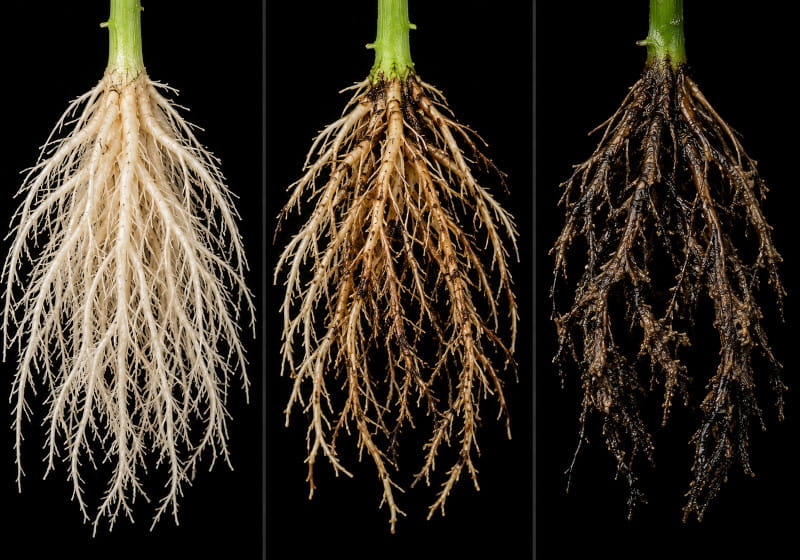
Healthy cannabis roots are predominantly light-colored, firm and finely branched; rotting roots lose fine roots, become increasingly brown or dark and show damaged, soft or dead tissue.
In young plants, a light-colored, dense network of fine roots is a good sign. As plants age, individual roots can naturally become somewhat darker or more corky. Therefore, you should not classify every beige root as diseased. It becomes problematic when discoloration occurs together with tissue breakdown, missing root tips and clear symptoms on the plant.
Another distinguishing feature is how the roots develop over several days. A healthy root zone continuously produces new light-colored tips. With active root rot, this new growth becomes weaker while damaged areas increase. In severe cases, only a few functional lateral roots remain.
What causes root rot in cannabis?
Root rot develops in cannabis particularly when unfavorable conditions in the root zone coincide with susceptible plant tissue and root-pathogenic microorganisms.
Watering too frequently is one of the most important preventable triggers in container cultivation. If the substrate is repeatedly fully saturated before enough water has been used or drained away, the pores remain filled with water for a long time. The roots receive less oxygen, growth slows and the tissue becomes more susceptible to stress. We explain in detail how to adjust the amount of water and watering intervals correctly to the plant in our guide to watering cannabis correctly.
Several root-pathogenic species have been detected in scientific studies on cannabis. These include, among others, Pythium dissotocum, Pythium myriotylum, Pythium aphanidermatum as well as various Fusarium species. Infections can lead to root browning, reduced root mass, chlorosis, wilting, stunted growth and, in severe cases, plant death.
Additional factors include poorly draining substrate, pots that are too large for small plants, compacted soil, constantly standing drainage water, root injuries, as well as contaminated water, tools or plant material. In recirculating hydro systems, an introduced pathogen can also reach several plants through the nutrient solution.
|
Risk factor |
Why it is problematic |
Practical countermeasure |
|
Persistently wet substrate |
Fewer air pores and reduced oxygen supply |
Adjust watering intervals to plant consumption and substrate |
|
Poor drainage |
Excess water remains in the root ball |
Keep drainage holes clear and use an airy substrate |
|
Root injuries |
Injured tissue can be colonized more easily |
Work as gently as possible when repotting and cleaning |
|
Contaminated systems |
Pathogens can spread through water, equipment or plant residues |
Consistently clean containers, lines and tools |
|
Stressed plants |
Weak roots regenerate more slowly |
Avoid extreme salt, heat and watering stress |
What role do Pythium and Fusarium play?
Pythium and Fusarium are among the best-documented groups of pathogens that can cause root, crown and wilt symptoms in cannabis.
In grower terminology, Pythium is often referred to as a “fungus,” but taxonomically it belongs to the oomycetes. Several Pythium species have been isolated from diseased cannabis roots and confirmed as disease-causing in pathogenicity tests. Typical consequences include root necrosis, loss of root hairs, reduced root mass and wilting.
Fusarium, by contrast, is in fact a fungal genus. Various Fusarium species can damage cannabis roots, the root crown and vascular tissue. Symptoms range from reddish-brown root discoloration and dead lateral roots to growth disorders and wilting. Mixed infections can be particularly severe.
For you, this means that the term root rot alone does not indicate which organism is involved. Reliable identification of the pathogen requires expert diagnostics. In home cultivation, however, systematic checking of growing conditions is already crucial because poor root-zone conditions must be corrected regardless of the specific pathogen.
Root rot – what should you do if you suspect it?
If you suspect root rot, you should stop further waterlogging, inspect the roots, improve oxygen supply and drainage, remove dead material and then stabilize the plant with as little additional stress as possible.
The first step is not treatment with an arbitrary product, but an assessment of the situation. Is the substrate completely wet? Is the pot standing in drainage water? Are the drainage holes working? Is the root ball compacted? In hydro systems: Is aeration running reliably, is the nutrient solution circulating and are dead root residues present in the system?
-
Check the water supply: Do not automatically continue watering water-saturated soil. Give the root zone a chance to take up air again.
-
Inspect the roots: Check color, firmness, the proportion of fine roots and the extent of visibly dead areas.
-
Improve drainage: Make sure excess water can drain away completely and that the pot does not remain standing in runoff water.
-
Remove dead material: Severely rotted, already detached root sections and plant residues should not remain in the wet root zone.
-
Reduce stress: At the same time, avoid major fertilizer corrections, radical pruning, heat or other additional stresses.
-
Monitor progress: What matters is whether new light-colored roots develop and whether leaf turgor and growth stabilize.
If root rot keeps recurring, you should primarily look for the underlying cause. Check watering, drainage, oxygen supply and the condition of the substrate or hydro system. If problems recur despite good conditions, a pathogen may also be involved. The earlier you notice changes in the roots, the better the chances of limiting further damage. If, however, a large part of the root system has already died or rotted, the plant may find it difficult to recover.
Can cannabis with root rot still be saved?
A cannabis plant with early root rot can recover if enough healthy root tissue remains and the triggering conditions are corrected in time.
The chance of regeneration depends mainly on the extent of the damage. If only parts of the outer root ball are affected and the plant is still producing new light-colored root tips, stabilization is more realistic. If, however, almost all fine roots have died, the root crown is severely damaged and the plant remains collapsed, the prospects of recovery decrease significantly.
After damage, the plant needs time to form new absorbing surfaces. Above-ground growth may therefore remain slow temporarily. An immediately high nutrient concentration offers no advantage at this stage if the roots cannot absorb it. The first priority is a functioning root environment.
Do not assess the plant's recovery based on a single day; observe it over a longer period. If new light-colored root tips form, the leaves look stronger again and the plant resumes regular water uptake, these are good signs of recovery. If, by contrast, more and more roots turn brown, soft or begin to die, the root rot is probably continuing to progress.
How do you treat root rot in soil?
For root rot in soil, the most important measure is to end the persistently wet and oxygen-poor conditions and restore a stable balance between water, air and root activity.
First allow a water-saturated substrate to dry in a controlled way instead of continuing to water according to a fixed schedule. This does not mean letting the plant dry out severely. The aim is for some of the pores to contain air again so that the roots are not permanently standing in a saturated zone.
Then check why the soil remains wet for so long. An oversized pot, very fine or compacted substrate, insufficient drainage or excessive watering can be the cause. A more airy, well-structured substrate reduces the risk of water being retained throughout the root ball for long periods.
If the substrate is severely damaged, careful repotting may be useful, but it is itself an additional stress. Do not indiscriminately remove healthy roots or tear the root ball apart unnecessarily. If the problem is only a watering error and the roots are predominantly firm and vital, correcting the watering routine may be gentler.
How should you deal with root rot in coco?
With coco, you need to distinguish between normally high moisture and actual oxygen deficiency; structure, drainage, root condition and a watering rhythm suited to the established root system are decisive.
Coco is watered differently from conventional potting soil. A well-rooted, structurally stable coco substrate can be watered frequently as long as sufficient drainage and air exchange are available. Problems arise when a small root ball sits in a large volume that remains saturated for a long time, or when the medium collapses and has hardly any air pores left.
Therefore, do not only check watering frequency, but also pot size, runoff, compaction and root mass. A routine that works for a strongly rooted plant may be too much for a young or damaged plant. After root rot, watering should be adjusted to actual water consumption.
What helps with root rot in hydro and DWC?
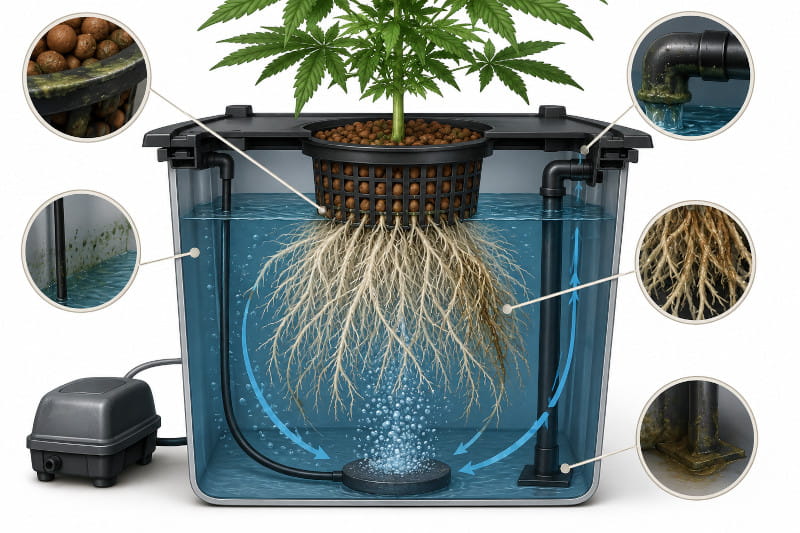
In hydro and DWC systems, a clean nutrient solution, reliable oxygen supply, hygienic equipment and removal of dead root residues are key measures against progressing root rot problems.
Hydroponic systems place the roots directly in contact with water and nutrient solution. This makes monitoring easier but also allows water-borne microorganisms to spread rapidly. In recirculating systems, one problem can therefore affect several plants at the same time.
First check whether the air pump, air stones, water level and circulation are working reliably. Remove dead plant material and clean accessible components. When changing a system, containers, hoses and tools should be cleaned thoroughly so that plant residues and biofilms are not unnecessarily retained.
The temperature of the nutrient solution also plays an indirect role because warmer water can hold less dissolved oxygen than cooler water and many biological processes proceed faster. However, there is no universal temperature value that prevents root rot on its own. What matters is the overall system of oxygen supply, plant load, hygiene and pathogen pressure.
Does hydrogen peroxide help against root rot?
Hydrogen peroxide can be used to disinfect water and hydro systems, but it does not automatically eliminate the cause of root rot. The key remains correcting the conditions that favored root rot.
Hydrogen peroxide (H₂O₂) is a strong oxidizing agent and is used, among other things, to reduce microbial loads and clean water-carrying systems. However, it does not act selectively against unwanted microorganisms only. Excessive concentrations or incorrect use can also damage sensitive roots and beneficial microorganisms. Hydrogen peroxide should therefore not be regarded as a simple standard treatment for every form of root rot.
Especially with persistently wet substrate, disinfection alone does not solve the problem. If the root zone remains poorly aerated, the underlying issue can persist. In hydro systems, you should therefore first check oxygen supply, water circulation, hygiene and dead root residues. In soil and coco, however, watering and drainage are the main priorities.
Do beneficial microorganisms help against root rot?
Beneficial microorganisms can help support a stable environment in the root zone. However, they do not replace good drainage, sufficient oxygen supply and clean conditions around the roots.
Research on cannabis is examining various biological antagonists and plant-growth-promoting microorganisms. Some approaches show a reduction in diseases caused by Pythium or Fusarium under controlled conditions. However, this does not mean that every microbial product can reliably eliminate an already advanced root rot infestation.
Biological systems also function differently from sterile or strongly oxidative hydro systems. If you deliberately work with beneficial microorganisms, you should not simultaneously use strong disinfectants indiscriminately, as these can also damage those populations. Choose a consistent system rather than contradictory individual measures.
How do you distinguish overwatering from actual root rot?
Overwatering initially describes an unfavorable water and oxygen condition in the root zone; root rot additionally means that root tissue is already clearly damaged or has been decomposed by pathogens.
The two can develop into one another. A freshly overwatered plant does not necessarily have infected roots yet. However, if the condition is repeated or maintained for a long time, roots can be damaged and susceptibility to soil-borne pathogens increases. It therefore makes sense to understand overwatering as a major risk factor rather than as a synonym for root rot.
|
Criterion |
Overwatering without obvious rot |
Progressive root rot |
|
Roots |
Still predominantly firm and vital |
Increasingly brown and damaged, with fine roots missing |
|
Response after drying |
Plant can stabilize relatively quickly |
Symptoms persist or worsen |
|
New root growth |
Can resume quickly after correction |
Remains weak while old roots continue to break down |
|
Cause |
Primarily too much water or too little air |
Tissue damage, often with pathogen involvement |
Can root rot be mistaken for a nutrient deficiency?
Yes, root rot can look like a nutrient deficiency because damaged roots absorb available nutrients less effectively, which can cause deficiency symptoms above ground.
Yellow leaves therefore do not automatically mean that the substrate contains too little nitrogen, magnesium or another nutrient. If the roots lose their uptake capacity, the plant can appear undernourished despite an adequate nutrient concentration. Additional fertilizing may then only increase salt stress in the already weakened root zone.
Before correcting a suspected deficiency, therefore check root condition, moisture, drainage as well as pH and EC. A problem that begins at the roots cannot be reliably diagnosed from leaf color alone.
How can you prevent root rot in the long term?
The most reliable way to prevent root rot is to maintain a well-aerated root zone, adapt watering appropriately, ensure functioning drainage, keep systems clean and minimize unnecessary root injuries.
-
Do not water according to a fixed schedule: Base watering on actual water consumption, pot weight and the condition of the substrate.
-
Use an airy medium: Structurally stable substrates facilitate air exchange and reduce prolonged saturation.
-
Keep drainage clear: Excess water must be able to leave the pot.
-
Choose an appropriate pot size: Small plants in very large volumes of wet substrate often use water too slowly.
-
Keep hydro systems clean: Remove dead root residues and clean containers, lines and tools between cycles.
-
Handle roots gently: Keep injuries during repotting or maintenance work to a minimum.
-
Document recurring problems: If root rot returns, record watering, temperatures, system condition and affected plants instead of treating only individual symptoms.
Damp conditions can cause problems on different parts of cannabis plants. While root rot affects the root system, Bud Rot in Cannabis develops on the flowers. Despite some similar favorable environmental conditions, the two damage patterns should therefore be clearly distinguished from each other.
Prevention is especially important because advanced root damage recovers only slowly. A stable root zone is therefore not only protection against root rot, but also a basis for even growth, resilient plants and controllable nutrient uptake. Choosing a loose and well-draining substrate is also crucial. We explain the differences between soil, coco fiber, rockwool and perlite in detail in our guide to the best growing medium for cannabis.
Are there cannabis strains that are less susceptible to root rot?
There is currently no sound scientific basis for claiming that specific cannabis strains are resistant to root rot. Robust outdoor genetics can nevertheless offer advantages under difficult and wet conditions if soil, drainage and watering are also appropriate.
When choosing a strain, general robustness, good suitability for the respective climate and, for outdoor plants, timely maturation are particularly relevant. However, no genetics can compensate for permanently waterlogged soil, oxygen deficiency or high pathogen pressure. The following strains should therefore not be understood as proven root-rot-resistant varieties, but as examples of robust genetics or genetics that may be of interest for outdoor cultivation.
|
Strain |
Type |
Why is it interesting? |
|
Hybrid |
Proven outdoor genetics for cooler and changeable climates |
|
|
Fast Hybrid |
Fast-flowering genetics that allow for a shorter outdoor season |
|
|
Fast Hybrid |
A short flowering period can reduce the time spent under unfavorable late-summer conditions |
|
|
Indica landrace |
Traditional mountain genetics with a robust landrace background |
|
|
Early Hybrid |
Early-flowering genetics for a shorter outdoor season |
|
|
Early Outdoor |
Early-maturing outdoor genetics for regions with a shorter growing season |
|
|
Landrace hybrid |
Robust genetics originating from traditional Lebanese cannabis lines |
|
|
Sativa-dominant hybrid |
Robust outdoor genetics with early maturity for temperate and changeable climatic conditions |
|
|
Landrace |
Traditional outdoor genetics with natural adaptation to open-field conditions |
|
|
Early Indica |
Early-flowering Afghan genetics with a short season and robust outdoor orientation |
For outdoor cultivation, you should therefore not focus on genetics alone. Location, soil structure, rainfall and drainage influence root health at least as strongly. You can find more suitable genetics among our Outdoor Cannabis Seeds. It is also worth keeping typical Cannabis Outdoor Pests in mind, since weakened plants can be exposed to several stress factors at the same time.
Which mistakes make root rot worse particularly often?
Root rot is often made worse by continued watering, unnecessarily high fertilizer doses, poor drainage, frantic use of multiple treatments and ignoring dead root material.
-
Mistaking wilting for dryness: A wet plant is watered even though the roots are already suffering from oxygen deficiency.
-
Increasing nutrients: Yellow leaves are interpreted as a simple deficiency even though the roots' uptake function is impaired.
-
Looking only at the upper leaf surface: The actual problem below the substrate remains unchecked. Conversely, visible leaf damage should not automatically be attributed to the roots, because, for example, Spider Mites on Cannabis can also cause clear symptoms on the leaves.
-
Leaving drainage water standing: The lower root zone remains permanently saturated.
-
Using several treatments at the same time: This makes it unclear which measure is helping or causing additional stress.
-
Neglecting hydro hygiene: Root residues, biofilm and dirty components remain a source of stress in the system.
Growers with little experience in cannabis cultivation often water too early or use very large pots even for small plants. As a result, the substrate remains moist for longer and the risk of problems in the root zone increases. Our guide explains how to assess watering, substrate, location and other basics correctly: Growing Cannabis Without Experience.
Checklist: What should you check if you suspect root rot?
A systematic check can help you better assess whether root rot is actually present, which factors are putting stress on the root zone and whether the plant is stabilizing again after the changes you have made.
-
Assess moisture: If the substrate is still completely wet after an unusually long time, this is a clear warning sign.
-
Check the roots: Inspect accessible roots for firmness, discoloration, dead fine roots and new light-colored tips.
-
Check drainage and oxygen: Correct standing water, blocked drains or failed aeration.
-
Rule out other stresses: Check pH, salinity, temperature and possible root pests.
-
Remove damaged material: Remove only clearly dead and already decaying parts without unnecessarily injuring healthy tissue.
-
Simplify care: Do not apply several extreme measures at the same time. Keep light, climate and nutrient supply stable.
-
Monitor regeneration: New light-colored roots and increasing plant stability are better indicators of success than short-term changes in individual leaves.
When is a plant with root rot hardly worth saving anymore?
Saving the plant becomes difficult when a large part of the root system has already died or rotted, the root crown shows severe damage and no new healthy roots are forming.
Severely damaged roots can no longer supply the plant adequately with water and nutrients. If their condition continues to worsen even after watering, drainage and oxygen supply have been corrected, the damage may already be too advanced. Dead and rotting root residues can also encourage the growth of unwanted microorganisms.
You should be particularly attentive in hydro systems with a shared nutrient solution. If one plant shows severe root damage, also inspect the roots of the other plants as well as the water, containers, lines and other shared components. If several plants show similar symptoms, look for a common cause within the system.
Frequently Asked Questions About Root Rot
Q: What does root rot mean in cannabis?
A: Root rot is the English term for root rot in German-speaking cultivation contexts. It describes various forms of root damage in which root tissue dies or can be damaged and decomposed by pathogens.
Q: What are the first signs of root rot?
A: Possible early signs include slower growth, wilted leaves despite moist substrate and a root zone that remains wet for an unusually long time. If the roots also turn brown or soft or lose their fine branching, the suspicion of root rot becomes stronger.
Q: Do brown roots always mean root rot?
A: No. Organic fertilizers and other additives can discolor roots without the roots being rotten. Therefore, also check whether the roots are firm or soft, whether healthy fine roots are present and how the plant is developing overall.
Q: Can overwatering cause root rot?
A: Yes, persistently wet substrate can promote root rot. If the air pores in the substrate remain filled with water for a prolonged period, the roots receive less oxygen and become weakened. This can make them more susceptible to further damage and pathogens.
Q: Can a cannabis plant recover from root rot?
A: Recovery is possible if enough healthy root tissue remains and the cause is corrected early. New light-colored root tips and visible stabilization of the plant are good signs that the root system is regenerating.
Q: Do you have to repot when there is root rot?
A: Not always. If the problem is mainly caused by watering too frequently, adjusting the watering routine may already help. However, if the substrate is heavily compacted, permanently waterlogged or poorly drained, moving the plant into a more suitable medium may make sense.
Q: What does root rot smell like?
A: Severely damaged or rotting roots can smell unpleasant, musty or rotten. However, smell alone is not enough to reliably identify root rot. The appearance, firmness and condition of the roots must always be considered as well.
Q: Is Pythium a fungus?
A: No. Pythium belongs to the oomycetes, a group of fungus-like microorganisms. Various Pythium species can infect plant roots and cause root rot.
Q: Can root rot spread from one plant to another?
A: If pathogens are involved in the root rot, they can spread under suitable conditions. The risk is increased, for example, in hydro systems with a shared nutrient solution as well as through contaminated equipment or infected plant residues.
Q: Should I fertilize more heavily when there is root rot?
A: No. Damaged roots absorb water and nutrients less effectively. More fertilizer therefore does not correct the cause, and an excessively high nutrient concentration can place additional stress on already weakened roots.
Q: Does it help to let the soil dry out completely?
A: No, extreme drying is not the goal. Overly wet substrate should be allowed to take up enough air again without putting additional stress on the already weakened plant through severe dryness. Afterward, return to a normal watering rhythm in which the substrate can dry sufficiently between waterings.
Q: How do I prevent root rot in DWC?
A: Ensure a reliable oxygen supply to the nutrient solution, good water circulation and a clean system. Remove dead root residues and inspect the roots regularly so that changes are noticed early.
How can cannabis roots stay healthy in the long term?
Healthy cannabis roots need sufficient oxygen, the right amount of water, enough space and a loose, well-draining substrate, or a clean and well-aerated hydro system.
The best prevention against root rot therefore begins long before the first roots turn brown. Water according to the size and water needs of the plant, avoid persistently wet substrate and make sure excess water can drain away reliably. In hydro systems, good oxygen supply, water circulation and regular cleaning are particularly important.
If a cannabis plant repeatedly wilts despite moist substrate, grows noticeably more slowly or shows other unexplained symptoms, you should also inspect the roots. Problems in the root zone often become visible on the above-ground parts of the plant only after the roots have already been weakened. By regularly monitoring watering and the root zone, you can therefore recognize the first signs of root rot earlier and react more quickly.
Which scientific sources document root rot and root diseases in cannabis?
Scientific studies confirm that various pathogens can cause root, crown and wilt diseases in cannabis. Species from the genera Pythium and Fusarium are among those that have been particularly well studied.
- Punja: Emerging diseases of Cannabis sativa and sustainable management
- Punja et al.: Pathogens and Molds Affecting Production and Quality of Cannabis sativa L.
- McGehee et al.: Pathogenicity and Mefenoxam Sensitivity of Pythium Species From Cannabis Production
- Gwinn et al.: Diseases of Cannabis sativa Caused by Diverse Fusarium Species
- Pitman et al.: First Report of Pythium myriotylum Causing Root Rot in Cannabis sativa in California
- Plant Disease: Crown and Root Rot Caused by Pythium on Cannabis