Cannabis Climate Map: Which Strains Grow Where?
Cannabis Climate Map: Which Cannabis Strains Grow in Which Climate?
Updated: July 2026 | Overview of climate zones, suitable cannabis genetics, maturation times, and key outdoor characteristics
Author: Cannapot Grow Team | Reading time: approximately eighteen minutes
The Most Important Points at a Glance
✓ Genetics, maturation time, temperature, precipitation, humidity, and day length determine success in outdoor cultivation.
✓ In cool and temperate regions, early-maturing, robust, or autoflowering genetics are more suitable than longer-flowering lines.
✓ Mediterranean regions offer long, warm, and often dry summers. The selection is especially broad there, provided irrigation and heat protection are taken into account.
✓ Tropical genetics can tolerate high humidity and long growing seasons well, but usually require a great deal of time to mature.
✓ The map is a climatic guide. Microclimate, elevation, soil, location, and the specific phenotype can significantly affect the outcome.
What Does a Cannabis Climate Map Show?
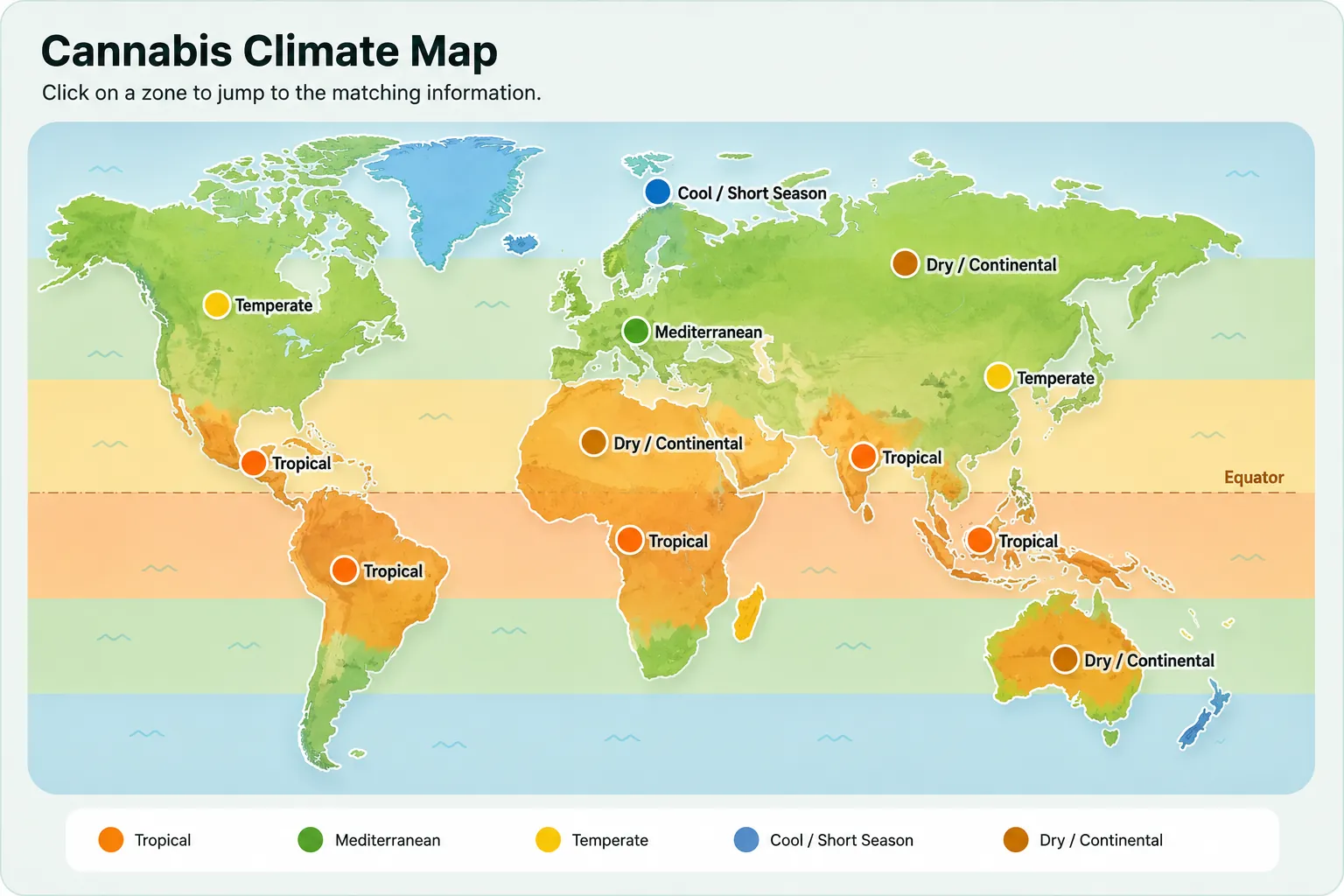
Our cannabis climate map does not rigidly assign genetic types to individual countries; instead, it shows which plant characteristics are suited to specific climatic conditions.
Cannabis can generally grow in very different regions. Nevertheless, genetics vary considerably in how they cope with short summers, high humidity, heat, drought, or early autumn rain. A strain that matures without difficulty in southern Spain may enter the flowering phase too late in northern Germany. Conversely, a compact, fast-maturing line may suffer more from heat stress in a very hot area than a more open-growing, tropically influenced genetic line.
The map serves as a guide and shows which cannabis strains are particularly well suited to specific climate zones based on their climate type and their plant characteristics However, it is neither a guarantee nor does it mean that a strain can be grown successfully only in the respective region.
Which Factors Determine the Right Strain?
The key factors when choosing a strain are season length, maturation time, humidity, temperature, wind, elevation, and the risk of autumn rain.
Genetic origin provides useful clues, but modern cannabis strains are usually complex hybrids. Information about outdoor maturity, flowering time, mold resistance, growth habit, and general resilience to stress is more meaningful. Above all, what matters is whether a plant can fully mature at the particular location before cold weather and persistent rain begin, and how well it copes with plant problems it.
Season Length
Short summers require early maturity. Long summers also allow late-flowering genetics.
Humidity
Dense flowers can be more susceptible to Botrytis and other fungal problems during humid autumn periods.
Temperature
Extreme heat, cold nights, or early frost can limit growth and maturation.
Precipitation
Dry regions require water management; rainy regions benefit from an open structure and early maturity.
Which Cannabis Genetics Are Suited to Tropical Climates?
Long-flowering, open-growing strains adapted to high humidity are especially suitable for tropical climates.
Tropical regions are warm year-round and often have high humidity. Classic equatorial landraces frequently develop wide spacing between flower clusters, narrow leaves, and a long flowering period. This open structure can improve air circulation. Typical genetic reference points include Thai, South Indian, Colombian, Panamanian, and Central and Southern African sativa lines. However, Haze strains can also be grown successfully.
The 6 Best Sativa Strains for Growing in Tropical Climates
In Central European gardens, pure tropical cannabis strains are often only suitable to a limited extent because of their long flowering periods, as they frequently mature very late. Modern hybrids, by contrast, combine the desired tropical characteristics with a significantly shorter flowering period and are therefore better adapted to the Central European climate.
Which Strains Are Suited to Mediterranean Climates?
A Mediterranean climate offers a long, warm season and is suitable for many hybrids, Kush lines, and sativa-dominant strains.
Hot, dry summers and comparatively mild transitional seasons are typical. This allows both medium-late hybrids and many longer-flowering genetics to mature. Suitable options include Haze hybrids, Skunk hybrids, OG and Kush lines, as well as numerous modern cannabis genetics and US hybrids, provided they tolerate heat and intense sunlight.
The 6 Best Cannabis Strains for Mediterranean Climates
The greatest challenges are water scarcity, very high soil temperatures, dry wind, and salty air near the coast. A strain with good heat tolerance and a strong root system is often more important here than a short flowering period.
Which Cannabis Genetics Are Suited to Temperate Climates?
In temperate climates, robust, medium-early to early-maturing hybrids with good resistance to moisture are especially suitable.
Central Europe often has warm summers, but changeable weather and humid autumn periods. The ideal outdoor genetics should therefore enter flowering reliably and mature before prolonged autumn rain. Skunk, Northern Lights, early Afghan, and selected Dutch outdoor strains often fit this profile well.
The 6 Best Cannabis Strains for Growing in Temperate Climates
Labels such as Early, Fast or Outdoor are not a guarantee of a successful harvest. What matters are realistic outdoor maturity estimates and experience from regions with comparable climatic conditions and latitudes.
Which Strains Are Suitable for Cool Climates and Short Summers?
For cool regions, very early-maturing photoperiod strains, autoflowering strains, and robust Ruderalis hybrids are usually the most reliable choice.
In Scandinavia, the Baltic states, higher elevations, or regions with early frost, the available season is limited. Autoflowering strains begin flowering largely independently of day length and can therefore fully mature during a short summer. Specially selected early hybrids are also suitable.
The 6 Best Fast-Flowering Cannabis Strains for Cool Climates
- Afghan Kush Early
- +Speed Automatic
- Frosted Bubba
- Amnesia Fast
- All Gas OG Automatic
- Pink Sunset Automatic
Important characteristics include a short overall life cycle, cold tolerance, a flower structure that is not too compact, and low sensitivity to humid nights. Very long-flowering Haze or tropical genetics are unsuitable here.
Which Genetics Are Suited to Dry or Continental Climates?
In dry regions, genetics with good heat tolerance, manageable water requirements, and a robust root system are needed.
Afghan, Pakistani, and Central Asian lines are often associated with dry, continental regions of origin. They frequently grow more compactly and can tolerate strong temperature differences between day and night. Genetic reference points include Hindu Kush, Afghanica, Mazar, and Pakistan Chitral lines.
The 6 Best Cannabis Strains for Dry, Continental Climates
Dense flowers are usually less problematic in dry air, but they can retain moisture after unexpected rain. In desert and steppe climates, irrigation, soil cover, and protection from extreme midday heat remain key site factors.
Climate Zones and Suitable Genetics Compared
| Climate | Suitable Characteristics | Genetic Examples | Main Risk |
|---|---|---|---|
| Tropical | open growth, humidity tolerance, long flowering period | Thai, Panama, Colombia, Malawi, South Indian lines | fungal pressure, heavy rain, very long maturation |
| Mediterranean | heat tolerance, strong roots, medium to long flowering period | Haze hybrids, Skunk, OG/Kush hybrids, modern hybrids | drought stress, heat, water scarcity |
| Temperate | early maturity, robust structure, moisture resistance | early hybrids, Skunk, Northern Lights, outdoor selections | autumn rain, Botrytis, excessively late maturity |
| Cool / short season | very short overall duration, cold tolerance, compact cycle | autoflowers, Ruderalis hybrids, very early photoperiod strains | frost, slow growth, immature flowers |
| Dry / continental | heat and drought tolerance, strong roots | Hindu Kush, Afghanica, Mazar, Pakistan Chitral | water scarcity, hot soils, dry wind |
Why Are Autoflowering Strains Interesting in Challenging Climate Zones?
Autoflowering strains begin flowering independently of shortening day length and therefore finish before unfavorable autumn weather arrives.
This advantage is particularly relevant in northern regions, at higher elevations, and in areas with short summers. The entire life cycle is usually more compact than that of classic photoperiod strains. However, “autoflowering cannabis” does not automatically mean that every strain is resistant to cold or mold. Genetics, flower structure, and actual maturation time also vary significantly here.
What Role Does Flower Structure Play?
Flower structure affects how quickly moisture can escape and how high the risk of rot is in rainy regions.
Very compact flowers can be advantageous in dry climate zones. During humid autumn periods, however, they dry more slowly after rain or dew. Loosely structured flowers with wider spacing are often airier and therefore easier to manage in humid regions. In addition to genetics, wind, plant spacing, location, and overall plant health play an important role.
Why Is the Indica–Sativa Classification Not Enough?
Indica and sativa broadly describe growth characteristics and historical origin, but they do not allow reliable predictions about the climate suitability of modern hybrids.
Many modern strains combine genetics from several regions. A strain marketed as “Cannabis indica” may mature late, while a sativa-dominant hybrid may have been specifically selected for early outdoor maturity. For climate selection, concrete characteristics such as the outdoor harvest window, flowering duration, mold resistance, and temperature tolerance are therefore more important than a simple percentage figure.
How Important Are Microclimate and Location?
In addition to the general climate zone, the microclimate also plays a decisive role. Even two gardens in the same city can offer very different conditions for cannabis cultivation because of sunshine hours, wind, slope position, soil characteristics, or nighttime humidity.
A sheltered south-facing slope is often significantly warmer and drier than a shaded depression where cold air and dew collect at night. Coastal regions often benefit from milder temperatures, but they are usually more humid and windier. In urban areas, walls and buildings also retain heat and create a more favorable microclimate. The climate map should therefore always be considered together with the actual conditions at the specific location.
What Are the Most Common Mistakes When Choosing a Strain?
The most common mistakes include choosing genetics that mature too late, blindly trusting strain labels, and underestimating autumn humidity and the microclimate.
A common mistake is to apply strain recommendations for Mediterranean or tropical climate zones directly to Central Europe. The stated flowering time in weeks is also only partly informative because the actual start of flowering depends on latitude and light conditions. For outdoor cultivation, real harvest windows and experience from regions with comparable climatic conditions are therefore especially important.
What Is Most Important About the Cannabis Climate Map?
The best outdoor strain is the one whose maturation time, growth habit, and resilience match the local climate.
Tropical genetics reach their full potential primarily in regions with long, warm growing seasons. Mediterranean climate zones offer the greatest variety of strains and are suitable for numerous genetics. In temperate regions, however, early-maturing and mold-resistant hybrids are usually the best choice. Autoflowering strains and especially early-maturing genetics are recommended for cool climate zones, while heat- and drought-tolerant Kush and Central Asian genetics can play to their strengths in dry, continental regions.
The climate map does not replace a detailed strain description, but it provides valuable guidance for selecting suitable cannabis strains by climate zone and avoiding common mistakes when choosing a strain. In our range, you will find the right cannabis seeds for almost every climate—from autoflowering seeds and outdoor seeds through to CBD seeds.
FAQs
Q: Which cannabis strains are suitable for Germany?
A: In Germany, robust outdoor hybrids or autoflowering strains that mature early to medium-early are usually suitable. A harvest window before prolonged autumn rain and a flower structure that is not too compact are important.
Q: Which strains grow in hot regions?
A: Many Haze, Skunk, Kush, and modern hybrid lines can cope with warm conditions. In very hot and dry regions, heat tolerance, root development, and water supply are crucial.
Q: Are autoflowering strains always better for cold climates?
A: Not always, but their short development cycle, independent of day length, is a major advantage in short summers. The specific strain must still be suited to the temperature and humidity.
Q: Which genetics are particularly mold-resistant?
A: There is no such thing as absolute mold resistance. An open flower structure, early maturity, and documented tolerance of humid climates reduce the risk.
Q: Can a tropical sativa grow in Central Europe?
A: It can grow, but it often matures too late outdoors. Shorter-flowering hybrids with tropical genetic influence are usually more suitable.
Q: Is the climate map a guarantee of successful cultivation?
A: No. It is a guide. Weather patterns, microclimate, genetics, soil, plant health, and location can affect the outcome.
Sources and Further Information
Botanical literature, climate classifications, breeder information, and documented outdoor experience from comparable regions are useful for a professional assessment of climate, plant adaptation, and cannabis genetics. Strain information should be checked against several sources whenever possible.
- Köppen-Geiger Climate Classification – Climate classification as a scientific basis for categorizing regional climate zones.
- National Center for Biotechnology Information (NCBI) – Botanical fundamentals of cannabis, genetic diversity, morphology, and photoperiodism.
- Strain descriptions from established cannabis seed banks, including information on outdoor harvest time, flowering time, growth behavior, and the resilience of the respective genetics.
- World Meteorological Organization (WMO) and NASA POWER Data Access Viewer – Regional weather and climate data on temperature, precipitation, humidity, solar radiation, and day length.
You can find more recommendations for suitable outdoor genetics in our Canna Wiki: Top 10 Early-Flowering Cannabis Strains for Outdoor Growing.