Bud Rot in Cannabis: How to Prevent Flower Rot
Recognizing Bud Rot, Understanding the Causes and Preventing It
Updated: August 2026 | Learn how bud rot develops, how to recognize flower rot early, how to reduce the risk before harvest, and why mold problems can also occur during drying.
Author: Cannapot Grow Team | Reading time: approximately twenty-two minutes
Key Facts at a Glance
✓ Bud rot is a form of decay affecting cannabis flowers that is particularly often caused by Botrytis cinerea. The infection can begin inside dense flowers and therefore initially remain unnoticed.
✓ Early warning signs often include individual wilted sugar leaves, brown or gray areas inside the flower, and plant tissue that appears soft, brittle, or unusually loose.
✓ Damp flowers, high humidity, condensation, stagnant air, and very compact flowers are especially favorable for bud rot. What matters most is how long moisture remains inside the flower.
✓ Preventing bud rot primarily means avoiding prolonged periods of moisture, ensuring sufficient air exchange, removing dead plant material, and regularly checking especially dense flowers.
✓ Bud rot during drying may only become visible after harvest even though the infection began earlier. Flowers that are too moist, hung too closely together, or poorly ventilated can also develop mold during drying.
✓ You should not consume cannabis flowers that are visibly moldy or rotting. Cutting away affected areas, washing, or heating does not reliably make contaminated plant material safe again.
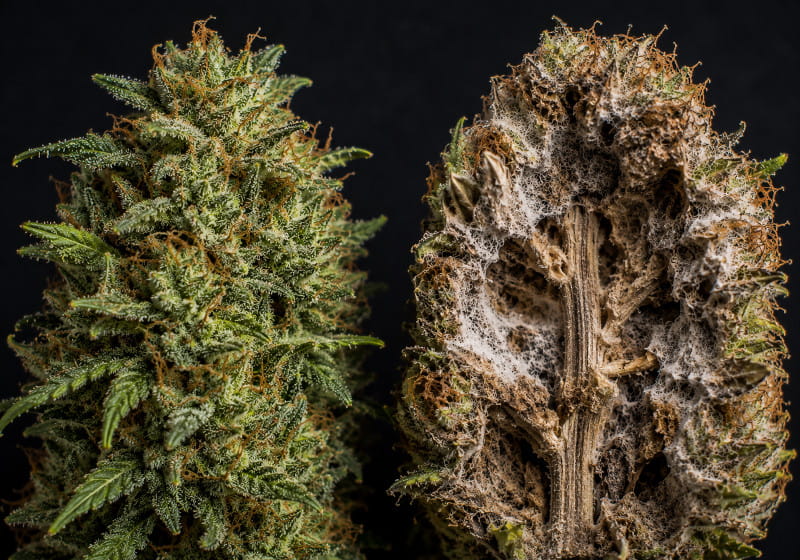
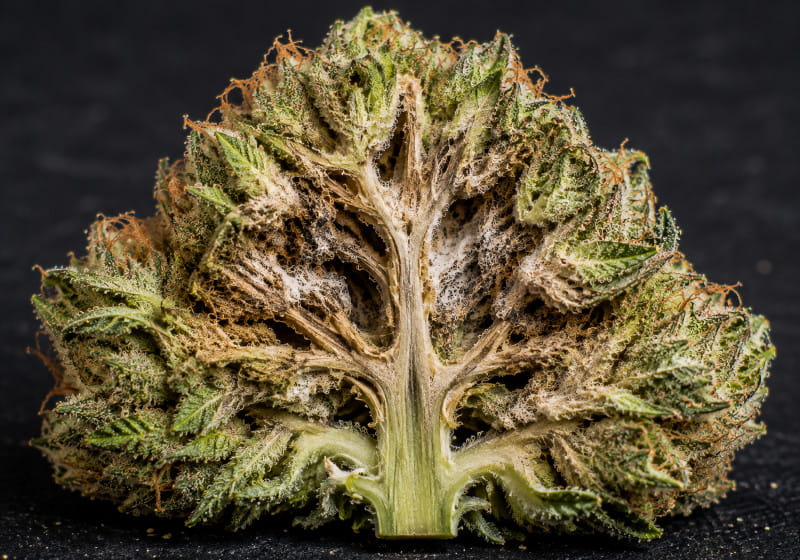
A compact cannabis flower that looks vigorous from the outside may already be damaged inside even though almost nothing is initially visible on its surface. This is precisely what makes bud rot so problematic: a distinct microclimate develops between tightly packed flower structures, allowing moisture to persist longer than in the surrounding air. When fungal spores encounter susceptible tissue and suitable conditions, rot can develop unnoticed inside the flower.
The English term Bud Rot is generally used in cannabis cultivation for flower rot caused by gray mold. From a scientific perspective, the main focus is on Botrytis cinerea. However, studies on cannabis show that other fungi can also be involved in flower rot or microbial contamination. Therefore, not every brown area should automatically be diagnosed as Botrytis. In practice, the most important rule remains the same: suspicious flowers must be checked early, and visibly rotting or moldy material must be consistently discarded.
What Is Bud Rot in Cannabis?
Bud rot is a form of decay affecting cannabis flowers in which the affected flower tissue dies and progressively breaks down. This type of damage is particularly often associated with the gray mold pathogen Botrytis cinerea.
Botrytis cinerea is a widespread fungus that can infect numerous plant species. In cannabis, it can develop particularly in the flowers and damage plant tissue there. Affected areas often turn beige, brown, or gray, lose their firm structure, and may progressively break down. Under humid conditions, the typical gray mold growth can also develop.
Bud rot refers to the visible pattern of damage and does not automatically indicate a specific fungus. Scientific studies on cannabis have identified, in addition to Botrytis, other fungal genera such as Fusarium and Penicillium in association with damaged or microbially contaminated flowers. Which fungus is actually present cannot always be determined reliably from appearance alone.
Is Bud Rot the Same as Botrytis or Gray Mold?
Bud rot is often caused by Botrytis cinerea and is therefore frequently equated with gray mold. However, flower rot can also be caused by other fungi.
A classic Botrytis infection involves Botrytis cinerea. Under suitable conditions, the fungus produces large quantities of spores that can be spread by air movement. Infections can begin on injured, weakened, or dying tissue; sensitive flower and fruit tissue can also become infected under high humidity without any clearly visible injury.
Cannabis flowers cannot always be reliably assessed from the outside because their individual structures are tightly packed together. As a result, bud rot can initially develop unnoticed inside before brown or gray areas and visible mold appear on the surface. However, bud rot is only one possible form of mold infestation. You can learn how to recognize mold on cannabis and distinguish between different types of damage in our detailed Canna Wiki article.
| Term | Meaning | Practical classification |
| Bud Rot | Term for decay and damaged tissue on cannabis flowers | Most often associated with Botrytis, but can also have other causes |
| Botrytis | Fungal genus; in cannabis, the most important species is Botrytis cinerea | Can damage flower tissue, cause brown to gray discoloration, and lead to rot |
| Gray mold | Common term for diseases caused by Botrytis cinerea | Typical is a gray to gray-brown, fuzzy mold growth on affected plant tissue |
How Can You Recognize Bud Rot Early?
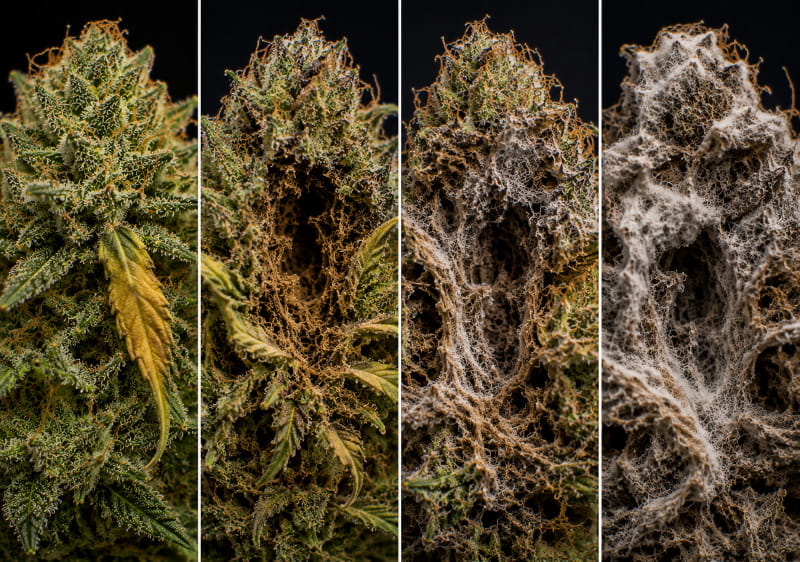
Early bud rot can often be recognized by individual sugar leaves that suddenly wilt, small brown areas, and damaged tissue inside an otherwise healthy-looking cannabis flower.
A sugar leaf that suddenly turns yellowish or brown and dries out in the middle of a green flower can be an early warning sign. If it can be pulled unusually easily from the flower or the area at its base is already brown or soft, you should inspect the flower more closely. A single wilted sugar leaf does not prove bud rot, but it can indicate the beginning of an infection inside the flower.
As bud rot progresses, the affected flower tissue often turns beige, brown, or gray and increasingly loses its firm structure. It may become dry and brittle or, under high humidity, soft and rotten. At an advanced stage, a gray to gray-brown fuzzy mold growth may also develop, and larger areas of the flower may die.
| Stage | Possible signs | Why it is easily overlooked |
| Early | Individual wilted sugar leaves, small beige or brown areas | The infection can begin inside |
| Progressing | Brown, dead, or crumbly flower tissue | Outer flower parts may still look healthy |
| Advanced | Gray fuzz, extensive necrosis, obvious tissue breakdown | By this point, a large amount of tissue is already affected |
What Causes Bud Rot?
Bud rot develops when fungi such as Botrytis cinerea encounter susceptible flower tissue and sufficient moisture as well as other favorable conditions allow the fungus to develop.
Fungal spores can be spread through the air and reach plants and flowers. Plant debris, tools, or direct contact can also contribute to their spread. Spores alone, however, do not automatically cause bud rot. What matters is whether they reach suitable plant tissue and encounter conditions in which the fungus can grow.
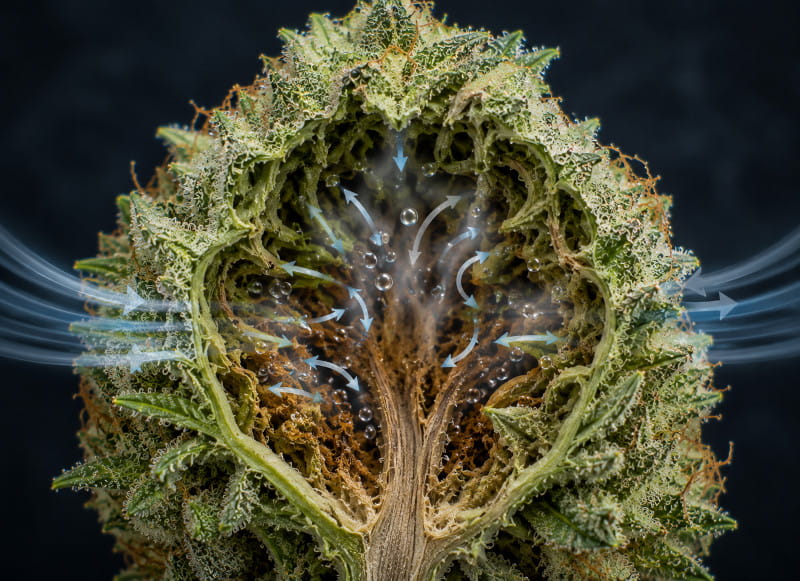
Large and dense cannabis flowers are especially critical. Humidity inside them can be higher than a hygrometer outside the flower would suggest. Moisture escapes more slowly there and air movement is reduced. Dead small leaves or other damaged plant parts inside the flower can further increase the risk. This can create a humid microclimate in which bud rot develops more easily.
Injuries can also promote infection. Damage caused by plant care, wind, insects, or other mechanical effects creates weakened areas that Botrytis can infect more easily. A visible injury is not required, however: under favorable conditions, the fungus can also infect sensitive flower tissue that initially appears undamaged from the outside.
Which Conditions Increase the Risk of Bud Rot?
The risk of bud rot increases particularly with persistent moisture, weak air exchange, dense flower structure, condensation, and plant tissue that remains wet for longer periods.
Botrytis generally benefits from high humidity. The length of time plant tissue remains moist also plays a role in infection. A single humidity reading is therefore less informative than the combination of relative humidity, temperature changes, dew point, air movement, and the actual moisture level inside the flower.
| Risk factor | Why it is problematic |
| Prolonged high humidity | Promotes germination, growth, and sporulation of many molds |
| Condensation or wet flowers | Extends the period of direct moisture on sensitive tissue |
| Dense flowers | Moisture can remain trapped inside for longer |
| Stagnant air | Moist boundary layers dry more slowly |
| Dead or injured tissue | Can make it easier for Botrytis to penetrate and spread through plant tissue |
Why Does Bud Rot Often Begin Inside the Flower?
Bud rot often begins inside dense cannabis flowers because moisture is retained there for longer and air circulates less effectively between the tightly packed flower structures.
A hygrometer measures humidity only at its specific location. Different conditions may exist inside a compact flower. Moisture from transpiration, rain, or dew can escape more slowly there and create a humid microclimate even when the surrounding air is already considerably drier.
A cannabis flower can therefore still look green and healthy from the outside while tissue near the stem is already turning brown and beginning to rot. Bud rot often becomes clearly recognizable only when the infection spreads farther outward or visible gray mold develops.
How Can You Distinguish Bud Rot from Normal Brown Flower Parts?
You do not identify bud rot from brown areas alone, but especially from damaged or rotting flower tissue, wilted sugar leaves, and an infection that often begins inside the flower.
Cannabis flowers naturally change color as they mature. Pistils can darken, small leaves age, and some genetics develop purple, reddish, or brownish tones. Such changes alone are not an indication of bud rot.
With bud rot, by contrast, the affected flower tissue increasingly loses its healthy structure. It often turns brown to gray and may become dry and brittle or, under high humidity, soft and rotten. At an advanced stage, a gray, fuzzy mold growth may develop. This differs from powdery mildew on cannabis, which typically appears as a whitish, powdery coating on leaves and other plant surfaces.
How Can You Prevent Bud Rot?
You can prevent bud rot primarily by avoiding prolonged periods of moisture, ensuring sufficient air exchange, removing dead plant material, and regularly checking especially dense flowers.
There is no complete guarantee against bud rot because Botrytis spores are widespread in the environment. The key is therefore to avoid conditions in which the fungus can develop particularly well. Preventive measures are far more sensible than reacting only after clearly visible brown areas or gray mold are already present.
- Keep moisture periods short: Flowers should not remain wet for extended periods after rain, dew, or other moisture.
- Ensure air exchange: Avoid persistently stagnant and humid air between plants, especially around large, dense flowers.
- Avoid condensation: Sharp drops in temperature can cause moisture to condense on plant surfaces and make flowers wet again.
- Remove dead material: Wilted, rotting, or visibly mold-infected plant parts should not remain on the plant.
- Check flowers regularly: Pay particular attention to large and dense cannabis flowers as well as individual sugar leaves that suddenly wilt or turn brown.
- Work cleanly: Hands, tools, and plant debris can transfer fungal spores or infected plant material to other areas.
What Role Does Humidity Play in Bud Rot?
High humidity can promote bud rot. However, what matters is not only the measured percentage but also how long the flowers remain moist and whether a persistently humid microclimate develops inside dense flowers.
There is therefore no single value that reliably distinguishes between “safe” and “critical.” Temperature and relative humidity jointly influence whether condensation can form. If the surface of a plant cools to the dew point or below, moisture can condense directly on the plant tissue—even without rain or other external moisture.
Especially in large and dense cannabis flowers, humidity inside can be higher than in the surrounding air. A hygrometer should therefore measure as close to plant height as possible rather than far away from the crop. In larger areas, multiple measuring points can help identify more humid zones and differences in the room climate early.
Why Are Rain, Dew, and Condensation Particularly Critical?
Rain, dew, and condensation are critical because they directly wet flowers and can therefore extend the period during which Botrytis can grow on wet or very moist tissue.
Outdoors, a sequence of rainfall, cool nights, and poor drying can be more problematic than a single short rain shower. Moisture can penetrate deep into large flowers and remain there longer even when the outer surface already appears dry.
Indoors, water on plant surfaces is more likely to result from climate fluctuations, excessive humidity, or condensation. Rapid temperature changes between the light and dark phases can promote local dew-point problems. A stable climate is therefore more important than briefly achieving a single ideal value.
Does Good Air Circulation Help Against Bud Rot?
Yes, even air movement can reduce humid boundary layers and support drying, but it does not replace humidity control or sufficient air exchange.
Air movement within the crop and air exchange are two different things. Circulation redistributes the existing air, while ventilation removes humid air from the area or replaces it with drier air. Both functions can be relevant for a stable microclimate.
Excessively strong direct airflow on individual flowers is not automatically better. It can mechanically stress plants and does not guarantee that the inside of compact buds remains sufficiently dry. What matters is distribution that is as even as possible without permanently sheltered pockets of moisture.
Are Dense Cannabis Flowers More Susceptible to Bud Rot?
Tightly packed cannabis flowers can be more susceptible to bud rot because their interior dries more slowly and a humid microclimate can develop there.
Flower architecture is a biological risk factor, but it does not predict certain infection. Loose flowers can also become diseased under unfavorable conditions, while compact flowers can remain healthy in a dry, well-controlled climate.
For inspection, this means that the denser and larger a flower is, the less you should rely on its external appearance alone. Wilted small leaves or localized color changes deserve particular attention.
Genetics can also influence how compactly flowers develop and how long moisture remains inside them. When choosing cannabis seeds it is therefore worth considering not only flowering time and growth habit but also suitability for the relevant climate conditions. For regions with changeable or more humid weather, suitable outdoor cannabis seeds can be of interest. Lowryder seeds or autoflower genetics, by contrast, offer the possibility of completing the harvest before particularly wet periods depending on sowing time, thanks to their short life cycle.
Which Cannabis Strains Are Less Susceptible to Bud Rot?
No cannabis strain is completely resistant to bud rot, but some genetics have characteristics that can be advantageous in humid or changeable climates.
Robust outdoor strains, early-maturing genetics, and plants whose flower structure or growth pattern promotes faster drying are particularly interesting. An early harvest can also help avoid long, wet autumn periods. How much these advantages actually matter always depends on location, weather, air movement, and the individual characteristics of the plants.
| Strain | Breeder | Suitable for | Advantage when bud rot risk is present |
| Seriotica | Serious Seeds | Indoor & greenhouse | Explicitly described by the breeder as having good natural resistance to gray mold and powdery mildew |
| Hawaii Maui Waui | Nirvana | Indoor & Outdoor | Very good resistance to fungi and powdery mildew as well as a more sativa-typical growth and flower structure |
| Blueberry Muffin | Humboldt Seeds Company | Indoor & greenhouse | Selection specifically focused on reducing the Botrytis risk typical of heavy, dense flowers |
| Western Winds | Sagarmatha Seeds | Indoor | Sativa-dominant, airier flower structure and described by the breeder as particularly mold-resistant |
| Pineapple Chunk | Barney's Farm | Indoor & Outdoor | Robust genetics with good resistance to mold and powdery mildew as well as a comparatively short flowering time |
| Jaggen | Cannapot Seeds | Primarily indoor | Highlighted by the breeder as mold-resistant, fast-maturing genetics for controlled indoor conditions |
| Northern Lights | Sensi Seeds | Indoor | Short flowering time and described by the breeder as comparatively resistant to mold |
| Cinderella 99 F2 | Cannapot Seeds | Outdoor & Indoor | Very high mold resistance and early maturity; interesting as a counterpart to the more indoor-oriented strains |
What Should You Do If You Discover Bud Rot?
If you discover bud rot, you should carefully separate affected flowers from healthy plant parts, thoroughly inspect adjacent areas, and address the cause of the increased moisture as quickly as possible.
Proceed carefully and avoid vigorous shaking, squeezing, or unnecessary touching of affected flowers. In advanced Botrytis infections, fungal spores can be released and spread through the air or by direct contact. Therefore, remove visibly affected material as carefully as possible and avoid contact with healthy flowers.
Then carefully inspect neighboring and especially dense flowers for brown areas, wilted sugar leaves, or gray mold. At the same time, look for possible causes: persistently high humidity, rain, dew or condensation, flowers that dry poorly, dead plant material, and low air movement can promote the development of bud rot.
Can You Simply Cut Away Bud Rot?
Bud rot cannot be reliably eliminated by cutting away only the visibly affected area because the fungus may already have spread beyond the visible boundaries.
The visible brown or gray area does not necessarily show how far the infection actually extends. Fungal tissue and spores may also be present in adjacent areas even if these still appear normal from the outside. Cutting away visible mold generously and then using the remaining part of the same flower is therefore not a reliable approach.
On a living plant, however, it can still make sense to remove an affected flower completely and carefully so that obviously diseased material does not remain on the plant. Afterwards, pay particular attention to surrounding flowers for early signs of further infection. Visibly moldy or rotting flowers should be discarded completely and not used further.
Can Bud Rot Continue After Harvest?
Yes, flower tissue contaminated with fungi or already infected can continue to deteriorate after harvest as long as sufficient moisture and suitable environmental conditions are present.
Microbial activity does not stop immediately when the plant is cut. Fresh cannabis flowers contain a great deal of water. After harvest, this water initially remains in the tissue and must be released in a controlled manner during drying.
An infection that is already present but still inconspicuous can therefore become visible during the post-harvest phase. Other molds can also colonize dried or drying cannabis flowers. Studies on cannabis show that various fungal genera can be detected on flowers both before and after harvest.
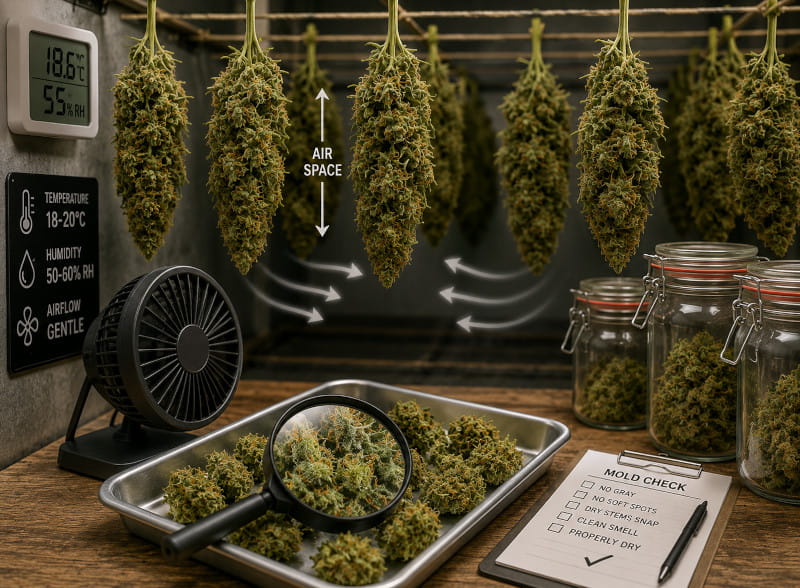
How Does Bud Rot Develop During Drying?
Bud rot during drying can develop when cannabis flowers that were already infected unnoticed continue to rot after harvest, or when too much moisture remains inside the flowers and creates favorable conditions for mold.
Two situations need to be distinguished. Bud rot may already have been present inside a flower before harvest without being clearly visible from the outside. During drying, the infection often becomes easier to recognize. At the same time, existing fungal spores can become problematic if freshly harvested flowers remain moist for extended periods and air circulation is insufficient.
Flowers hung too closely together or lying on top of each other are especially critical because they touch and can release moisture only slowly. Large and compact cannabis flowers may also already appear dry on the outside while significantly more moisture remains inside. Sufficient spacing between flowers, even air movement, and regular inspections during drying are therefore particularly important.
| Problem during drying | Possible consequence |
| Flowers are hung or placed too closely together | Humid air can remain locally trapped |
| Insufficient air exchange | Released moisture accumulates in the drying area |
| Very large, compact buds | The inside dries considerably more slowly than the surface |
| Already infected harvested material | Hidden rot can become visible during drying |
| Moist flowers sealed airtight too early | Residual moisture can create a mold-friendly microclimate |
How Can You Prevent Bud Rot During Drying?
The best way to prevent bud rot during drying is to ensure that only carefully inspected harvested material enters the drying area and that the flowers can release moisture evenly without humid air accumulating.
Inspect the harvest while cutting. Suspicious flowers should not be dried together with unaffected material. Especially large buds deserve additional attention because their interior can dry more slowly and hidden damage is easier to overlook.
In the drying room, flowers should not be tightly packed or stacked on top of each other. The moisture they release must be able to leave the room or the immediate surroundings. At the same time, high-speed air should not be directed straight at individual flowers because very rapid surface drying does not reliably indicate the residual moisture inside.
A daily visual and odor check is necessary. If individual areas become soft, gray, brown, or musty, they should be examined separately immediately. The goal is not simply “dry air,” but controlled and even moisture loss from the entire harvest.
Can Bud Rot Become Visible Only During Drying?
Yes, bud rot may only become clearly visible during drying even though the infection began inside the cannabis flower before harvest.
Botrytis can infect plant tissue without immediately causing clearly recognizable symptoms. Especially in dense flowers, an early infection can remain hidden inside while the outside still appears largely healthy. Typical signs such as brown or gray tissue and visible mold only become recognizable later.
If a cannabis flower suddenly turns brown from the inside during drying, this does not automatically mean the infection originated in the drying room. Bud rot may already have begun on the living plant and only become noticeable after harvest. Affected flowers should be discarded, and the remaining harvest should be carefully checked for additional suspicious areas.
How Can You Distinguish Bud Rot During Drying from Normal Drying?
During normal drying, cannabis flowers lose moisture evenly, whereas bud rot is usually noticeable through individual brown or gray areas, deteriorating flower tissue, and possibly visible mold.
During normal drying, the flowers become lighter and drier. Small leaves lose their turgor and the plant material gradually changes in texture. Slight color changes can also occur. However, the flower should not rot in isolated areas or develop a clearly abnormal structure.
With bud rot, by contrast, individual areas often develop that clearly differ from the rest of the flower material. Affected areas can turn brown to gray, appear soft or brittle, and increasingly break down. At an advanced stage, a gray, fuzzy, or dusty mold growth may also appear. An unusually musty or moldy odor is also a warning sign but is not sufficient on its own to identify bud rot with certainty.
Can Bud Rot Develop During Curing?
Mold can also develop during curing if cannabis flowers still contain too much residual moisture and it cannot escape sufficiently from a closed container.
Curing cannot compensate for inadequate drying. If flowers that are still too moist are sealed airtight, the relative humidity inside the container can rise significantly and promote the growth of existing molds. The flowers should therefore be sufficiently and as evenly dried as possible before curing. Our detailed Canna Wiki article explains how to properly cure cannabis and what you should pay attention to.
Also check the flowers regularly during curing for unusual discoloration, unusually soft areas, visible mold, or a musty smell. If a flower shows signs of mold, you should discard it. Further drying or merely removing the visibly affected area does not reliably make moldy flower material usable again.
Is Bud Rot a Health Concern for Humans?
You should not consume cannabis flowers affected by bud rot or other mold because they can contain fungal spores and other unwanted contaminants.
The health effects of moldy plant material cannot be judged from its appearance alone. The risk depends, among other factors, on which fungi or other microorganisms are present, how heavily the material is contaminated, and how sensitive a person is to them. Particular caution is warranted for people with weakened immune systems or increased sensitivity to molds.
Heating does not reliably make visibly moldy plant material safe. Affected cannabis flowers should therefore be discarded completely and not used further.
Can You Wash Moldy Buds or Save Them in Another Way?
No, visibly moldy buds cannot be reliably made safe again by washing, rinsing, or surface cleaning.
Mold is not necessarily confined to the visible surface of a cannabis flower. The fungus can extend deeper into the plant tissue, while spores and other components are not visible to the naked eye. A visible gray or whitish coating may therefore be partially removable, but this does not reliably eliminate the entire infestation.
Re-drying, strong heating, or removing individual visibly affected areas is also not a reliable way to make moldy cannabis flowers usable again. Flowers visibly affected by bud rot or other mold should therefore be discarded completely and not used further.
Which Mistakes Particularly Promote Bud Rot?
Bud rot is particularly promoted by recurring moisture problems, delayed inspections, and a false sense of security based on individual climate readings.
| Common mistake | Why it increases the risk |
| Measuring only room air | Humid microclimates inside flowers remain unnoticed |
| Allowing wet flowers to remain moist for too long | The duration of moisture relevant to fungal infections increases |
| Ignoring suspicious areas | An internal infection can continue to progress |
| Moving affected buds vigorously | Spores can spread more easily |
| Storing a moist harvest too densely | Water escapes less effectively and local humidity increases |
Is Bud Rot More Likely Indoors or Outdoors?
Bud rot can occur both indoors and outdoors. What matters most is how long the flowers remain moist and how well air can circulate between and inside dense flowers.
Outdoors, the risk is more strongly influenced by the weather. Prolonged rainy periods, dew, fog, and cool nights can cause cannabis flowers to become repeatedly wet and dry only slowly. This can become especially problematic toward the end of the season when large, compact flowers encounter persistently damp autumn weather.
Indoors, conditions are easier to control, but bud rot is not ruled out. Persistently high humidity, insufficient air exchange, stagnant air between plants, or large temperature differences can promote humid areas. Especially in large and dense flowers, an unfavorable microclimate can develop inside even though the measured room humidity initially appears unremarkable.
Can Bud Rot Spread from One Flower to Other Flowers?
Yes, bud rot can spread through a crop because Botrytis produces numerous spores that can travel through the air to other flowers.
However, fungal spores reaching another flower does not automatically mean that bud rot will develop there as well. Whether the fungus can continue to develop depends largely on the conditions at the flower. If plant tissue remains moist for extended periods and moisture cannot escape well, the risk of further infection increases.
It is therefore not enough to remove only visibly affected flowers. Also inspect neighboring flowers and make sure to reduce moisture and improve air circulation. Fungal spores can also be carried via plant debris, hands, or tools, which is why clean working practices are particularly important when an infection is present.
Can Bud Rot Suddenly Appear After a Rain Shower?
Yes, visible symptoms can seemingly appear suddenly after wet weather periods even though the infection may have begun earlier.
Botrytis can initially establish itself without obvious signs. If prolonged periods of moisture then follow, the fungus can spread rapidly and cause clearly visible necrosis within a short time. Therefore, after rainy periods, inspection should not be limited to the surface.
Large flowers that appear dry on the outside but are still moist inside are particularly relevant. Another humid night can further delay drying and increase the risk.
What Role Do Dead Leaves and Injuries Play?
Dead plant parts and injuries can promote bud rot because Botrytis can colonize damaged and dying tissue particularly easily.
Wilted sugar leaves, dead flower remnants, or other damaged plant material can become problematic especially inside dense cannabis flowers. Moisture often remains there for longer while air circulation is limited. This combination can create favorable conditions for Botrytis.
Injuries can also promote infection. They may result, for example, from wind, damaged plant parts, or plant-care measures. Outdoors, feeding damage caused by cannabis pests can also occur. Not every damaged area automatically develops bud rot, but the risk can increase when high humidity is present at the same time.
How Important Is Hygiene for Preventing Bud Rot?
Hygiene is an important part of preventing bud rot because dead or infected plant parts can be removed and unnecessary spread of fungal spores can be reduced.
Remove dead leaves, flower remnants, and visibly affected plant material as promptly as possible. Scissors and other tools should also be kept clean, especially if you previously worked on a suspicious or infected plant. The drying area should likewise be free of old plant debris, larger accumulations of dust, and moist organic residues.
Hygiene alone cannot prevent bud rot because fungal spores cannot be completely avoided in a normal cultivation environment. What matters is the combination of clean working practices, regular inspections, and conditions under which flowers can dry quickly again after becoming moist. Controlled humidity and sufficient air movement are particularly important.
FAQs About Bud Rot
Q: What does bud rot look like at the beginning?
A: Often, the first signs are individual wilted sugar leaves or small beige to brown areas inside a flower. A gray spore coating does not have to be visible in the early stage.
Q: Does bud rot always smell musty?
A: No. A musty odor can occur, but it is not a mandatory early symptom and does not allow reliable identification of the pathogen.
Q: Can bud rot develop overnight?
A: Clear symptoms can become noticeable within a short period. However, the underlying infection may have begun earlier.
Q: Is every brown sugar leaf bud rot?
A: No. Individual leaves can age or die for various reasons. However, if the discoloration is located in the middle of a dense flower, the area should be inspected.
Q: Can bud rot be present without visible gray mold?
A: Yes. Earlier stages can appear mainly as brown or necrotic tissue. Visible sporulation does not develop immediately in every situation.
Q: Can bud rot develop during drying?
A: Yes. Already infected flowers can continue to deteriorate after harvest. In addition, harvested material that is too moist and poorly ventilated can be colonized by molds.
Q: Can bud rot become visible only during drying?
A: Yes. An infection may have begun before harvest and initially remained hidden inside the flower.
Q: Can you cut away bud rot and use the rest?
A: Visibly moldy flower material should not be consumed. The visible boundary does not reliably correspond to the actual extent of fungal structures.
Q: Does heat reliably kill Botrytis?
A: Heating is not a suitable method for subsequently classifying visibly moldy plant material as safe.
Q: Are compact buds automatically at risk?
A: No. Dense flower structure is a risk factor, but infection depends on the interaction of moisture, pathogens, and other conditions.
Q: Can bud rot occur indoors?
A: Yes. High humidity, condensation, and localized areas with weak air exchange can also create favorable conditions indoors.
Q: Can bud rot occur outdoors?
A: Yes. Rain, dew, fog, and prolonged periods of wet weather are typical outdoor risk factors.
Q: Is a hygrometer enough to prevent bud rot?
A: No. A hygrometer only shows the conditions at its measuring point. The microclimate inside dense flowers can differ from this.
Q: Can Botrytis spores spread through the air?
A: Yes. Botrytis cinerea produces spores that can be spread by air movement.
Q: Is prevention more effective than late treatment?
A: Yes. Once dense flower tissue is visibly rotting, the damaged material cannot be restored. Moisture management, hygiene, and early inspection are therefore decisive.
Why Early Inspection Is Crucial with Bud Rot
The earlier suspicious changes are recognized, the better the chances of preventing heavily affected material from remaining unnoticed in the crop or later in the drying room.
Bud rot is particularly insidious because the visible outside of a flower does not reliably reflect the condition of its interior. Effective prevention therefore combines several levels: a stable climate, moisture periods that are as short as possible, air exchange, clean working practices, and regular inspections of especially dense flowers.
This principle continues after harvest. Only unaffected material should enter the drying area, and the flowers must be able to release their moisture evenly. This can reduce the risk that a hidden infection or an excessively humid post-harvest climate leads to visible mold only at a late stage.
Sources and Further Information
- Punja et al. – Pathogens and Molds Affecting Production and Quality of Cannabis sativa L. (Frontiers in Plant Science)
- Punja – Integrated Management of Pathogens and Microbes in Cannabis sativa L. under Greenhouse Conditions
- Garfinkel et al. – Three Botrytis Species Found Causing Gray Mold on Industrial Hemp (Cannabis sativa) in Oregon
- Balthazar et al. – Biocontrol Activity Against Botrytis cinerea and Other Cannabis Fungal Pathogens
- Fungal and mycotoxin contaminants in cannabis and hemp flowers: implications for consumer health and directions for further research
- Jerushalmi et al. – Reduction of fungal colony forming units in medical cannabis inflorescences
- Royal Horticultural Society – Grey mould: symptoms, causes and control
- Wikipedia – Botrytis cinerea