What Is THC? Effects, Risks & THC Seeds
THC explained simply: Formation, effects and current state of research
Updated: July 2026 | What is THC? Everything about tetrahydrocannabinol, THCA, its effects in the body, the endocannabinoid system, possible risks, medical applications, THC seeds and high THC seeds.
Author: Cannapot Grow Team | Reading time: approximately twenty-eight minutes
The Most Important Points at a Glance
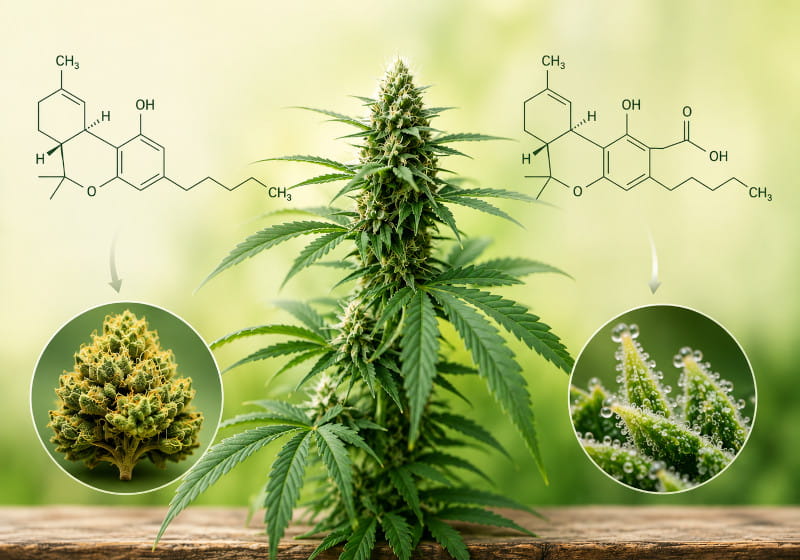
✓ THC is short for tetrahydrocannabinol. It usually refers to delta-9-tetrahydrocannabinol, the most important intoxicating cannabinoid in many cannabis plants.
✓ In fresh plant material, THC is present primarily as tetrahydrocannabinolic acid (THCA). Heat and other influences convert part of the THCA into neutral THC.
✓ THC acts mainly as a partial agonist at CB1 receptors. These receptors are especially common in the brain and play a major role in changes to perception, memory, mood and coordination.
✓ The effects do not depend on THC content alone. Dose, route of administration, individual sensitivity, tolerance, product composition and setting can significantly alter the experience.
✓ THC can cause adverse effects such as dizziness, anxiety, slower reactions, palpitations, concentration problems or temporary memory impairment.
✓Cannabis seeds do not contain THC – terms such as ‘high THC Seeds’ refer to the genetic potential of the plants that will grow from them.
✓ Certain medicines containing THC are used medically. This does not mean that every cannabis product is suitable, effective or safe for health complaints.
THC is the main intoxicating cannabinoid in the cannabis plant
THC is the common abbreviation for tetrahydrocannabinol. When people refer to THC in general, they usually mean delta-9-tetrahydrocannabinol (Δ9-THC). It is one of the naturally occurring phytocannabinoids in the cannabis plant and is mainly responsible for the characteristic intoxicating effects of cannabis.
However, the plant does not produce large amounts of neutral THC from the outset. In fresh flowers and leaves, the cannabinoid is present primarily as tetrahydrocannabinolic acid (THCA) . Only through heat, exposure to light or natural ageing does THCA release carbon dioxide (CO2) and convert into THC. This process is called decarboxylation .
In the human body, THC binds primarily to cannabinoid receptors. The CB1 receptors in the central nervous system play a central role. Their activation can influence perception, mood, sense of time, attention, memory, appetite and motor coordination, among other functions. The effects that actually occur and their intensity depend on numerous factors, including dose, route of administration, individual sensitivity and the remaining cannabinoid and terpene profile.
What exactly is THC?
THC is a fat-soluble phytocannabinoid that binds to cannabinoid receptors and can produce intoxicating effects depending on the dose and route of administration.
The full chemical name is delta-9-tetrahydrocannabinol. THC has the molecular formula C21H30O2 and a molar mass of approximately 314.5 grams per mole. The molecule is highly fat-soluble and only very poorly soluble in water. This property affects its absorption, distribution, storage and elimination in the body.
After absorption, THC is distributed rapidly in well-perfused tissues. Because it is fat-soluble, it can also be stored in fatty tissues and released again gradually. The immediately noticeable effects therefore do not last as long as THC or its metabolites may remain detectable in the body.
THC is not the same as the cannabis plant as a whole. Cannabis contains numerous other cannabinoids such as CBD, CBG or THCV as well as terpenes, flavonoids and numerous other plant compounds. THC content therefore describes only one component of the chemical composition of a cannabis plant.
In brief: THC refers to a single cannabinoid. Cannabis, by contrast, is the plant or the plant material derived from it, which can contain many other components in addition to THC.
What does the abbreviation THC stand for?
THC stands for tetrahydrocannabinol, and in common usage it almost always refers to delta-9-tetrahydrocannabinol.
The term describes a group of closely related chemical compounds. The designation “delta-9” identifies the position of a particular double bond in the molecule. Moving this double bond to a different position creates another isomer, such as delta-8-THC.
Delta-9-THC is the best-studied and, in many THC-dominant cannabis plants, the most important intoxicating isomer. For this reason, the shortened term “THC” is often used synonymously with delta-9-THC in scientific and general texts. For precise classification, however, it is still important to determine which isomer is actually meant.
Who discovered THC?
Delta-9-THC was isolated from cannabis and its structure determined in the 1960s by an Israeli research group led by Raphael Mechoulam and Yechiel Gaoni.
Various components of the cannabis plant were already known before this work. However, the successful isolation and complete structural determination of delta-9-THC in 1964 established which plant compound was mainly responsible for the characteristic intoxicating effects. This discovery remains one of the most important milestones in modern cannabinoid research.
The work of Mechoulam and Gaoni enabled numerous further research projects. In the decades that followed, researchers discovered the cannabinoid receptors CB1 and CB2 as well as the body’s own endocannabinoids such as anandamide and 2-arachidonoylglycerol (2-AG). This showed that THC does not act nonspecifically on the brain, but binds to an existing biological signalling system—the endocannabinoid system .
The discovery of THC therefore not only advanced cannabis research but also provided important insights into fundamental regulatory mechanisms in the human body. Today, the endocannabinoid system is being studied intensively in connection with appetite, memory, pain processing, mood, stress responses and motor control, among other functions.
Where is THC found in the cannabis plant?
The highest levels of the THC precursor THCA are typically found in the resin of glandular trichomes on female cannabis flowers.
Trichomes are microscopic glandular structures on the plant surface. They are especially abundant on the flower clusters and the small leaves near the flowers. Cannabinoids and various aromatic plant compounds are produced and accumulate in the glandular heads.
Large leaves, stems and roots normally contain substantially lower cannabinoid levels than resin-rich flowers. Even in THC-dominant genetics, not every part of the plant therefore has the same composition.
The amount of THCA and THC detectable in a mature cannabis plant depends on factors including genetics, phenotype, the growth cycle, stage of development, environmental conditions, harvest time, curing and storage . A strain name or manufacturer information therefore cannot replace a batch-specific laboratory analysis.
What is the difference between THC and THCA?
THCA is the acidic plant precursor of THC and does not have the same characteristic intoxicating profile as decarboxylated delta-9-THC.
THCA stands for tetrahydrocannabinolic acid. The molecule contains an additional carboxyl group. This changes its chemical and pharmacological properties and, among other things, makes it more difficult to cross the blood-brain barrier.
When THCA is heated sufficiently, it can release carbon dioxide, producing neutral THC. However, the conversion is neither instantaneous nor automatically complete. At the same time, prolonged storage, oxygen, light or intense heat can produce degradation products.
| Feature | THCA | Delta-9-THC |
|---|---|---|
| Full name | Tetrahydrocannabinolic acid | Delta-9-tetrahydrocannabinol |
| Occurrence | primarily in fresh plant material | formed, among other ways, through decarboxylation of THCA |
| Carboxyl group | present | absent |
| Typical cannabis intoxication | not in a comparable manner | possible and dose-dependent |
| Molecular formula | C22H30O4 | C21H30O2 |
| Conversion | can form THC through decarboxylation | can be further degraded through ageing and oxidation |
How is THC produced in the cannabis plant?
The cannabis plant first produces CBGA, converts it enzymatically into THCA, and THC can then form from it through decarboxylation.
The relevant biosynthetic pathway begins with cannabigerolic acid (CBGA). It serves as a common starting compound for several important cannabinoid acids. Which of these are produced in larger quantities depends largely on the plant’s genetically determined enzyme profile.
In a THC-dominant cannabis plant grown from cannabis seeds , the enzyme THCA synthase converts a large proportion of the available cannabigerolic acid precursor (CBGA) into tetrahydrocannabinolic acid (THCA) . The THCA produced accumulates mainly in the glandular hairs (trichomes) of the flowers. Only through heat, exposure to light or natural ageing is part of the acidic form converted into neutral THC by decarboxylation.
In simplified terms, the pathway can be shown as follows:
Simplified synthesis pathway: Plant precursors → CBGA → THCA → delta-9-THC
This illustration shows only the main pathway most relevant to THC. In reality, numerous parallel enzymatic and chemical processes occur in the plant. By-products, other cannabinoids and degradation compounds can also form.
How much THCA and later delta-9-THC a cannabis plant can potentially produce is already determined by its genetic characteristics. For this reason, THC seeds in their potential to produce cannabinoid-rich flowers. Modern breeding programmes have developed numerous genetics that can produce particularly high THCA and subsequently THC levels under suitable growing conditions.
What does decarboxylation mean in relation to THC?
Decarboxylation is the removal of carbon dioxide from THCA, producing neutral and characteristically intoxicating delta-9-THC.
The carboxyl group of THCA is released as carbon dioxide. This reduces the molecular mass and gives the molecule different biological properties. Heat significantly accelerates this process, although conversion can also occur slowly during prolonged drying or storage.
The reaction does not proceed identically under all conditions. Moisture, oxygen exposure, temperature, duration, particle size and the composition of the plant material influence the result. THC and other plant compounds may be degraded or oxidised alongside the desired conversion.
It is therefore incorrect to assume that the highest possible temperature or longest possible heating automatically produces the highest THC content. Without analytical testing, the actual composition after processing cannot be determined reliably from temperature and time alone.
What does total THC mean in a laboratory report?
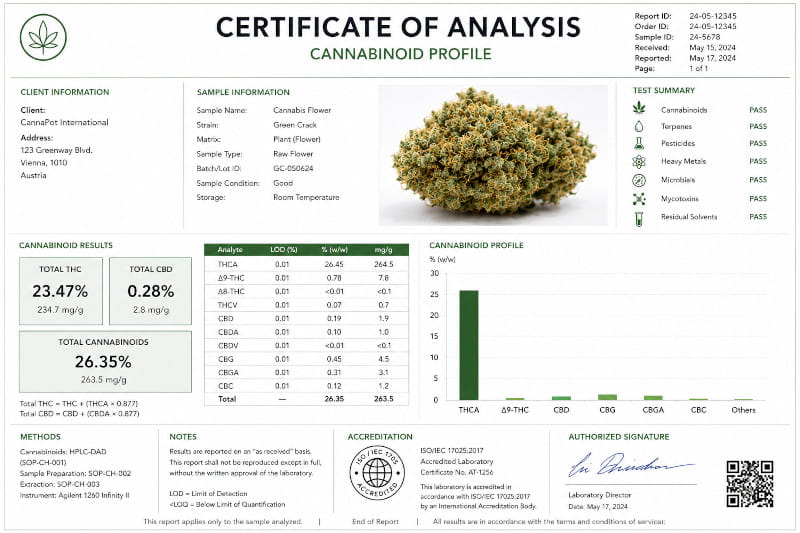
Total THC is a calculated value that combines THC already present with the amount of THC that could theoretically be formed from THCA.
THCA cannot be added to measured THC on a one-to-one basis. Carbon dioxide is lost during decarboxylation, so the mass of the resulting THC is lower than the original THCA mass. A conversion factor of approximately 0.877 is therefore commonly used.
Common calculation: Total THC = delta-9-THC + (THCA × 0.877)
For example, if a sample contains 1% delta-9-THC and 20% THCA, the calculated total THC is approximately 18.54%. This value describes a theoretical potential assuming complete conversion. In practice, incomplete decarboxylation and degradation losses may result in a lower achievable value.
When assessing a laboratory report, delta-9-THC, THCA and total THC should therefore be considered separately. Measurement uncertainty, detection limits, sampling and the analytical method also influence the significance of the result.
How does THC affect the body?
THC acts mainly as a partial agonist at CB1 and CB2 receptors, thereby altering the release of various signalling substances.
An agonist is a substance that activates a receptor. As a partial agonist, THC does not produce the maximum possible response in every biological system, even at high receptor occupancy. Its effects also depend on the tissue in which the receptor is located and the signalling pathways connected to it.
Activation of CB1 receptors in the brain is particularly relevant to intoxication. These receptors are often located at nerve endings, where they regulate the release of neurotransmitters. THC can therefore temporarily alter existing communication patterns between nerve cells.
CB2 receptors are found in immune cells and various peripheral tissues, among other locations. The classic intoxicating effect, however, is associated mainly with CB1 receptors in the central nervous system.
THC does not affect everyone in the same way. Genetic differences, age, body composition, previous experience, tolerance, mental state, accompanying compounds and other substances used at the same time can influence the response.
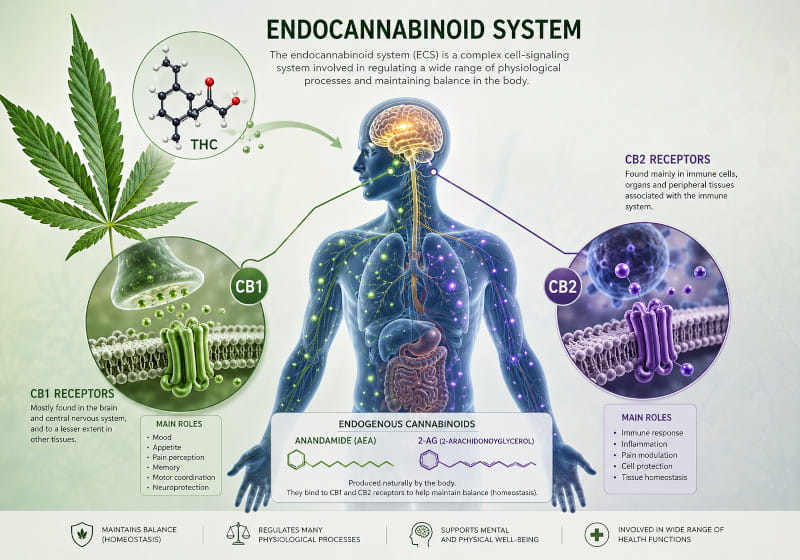
What role does the endocannabinoid system play in THC’s effects?
THC uses receptors in the body’s own endocannabinoid system and can thereby temporarily alter normal regulatory processes.
The endocannabinoid system primarily includes the CB1 and CB2 receptors, endogenous signalling substances such as anandamide and 2-arachidonoylglycerol, and enzymes that produce and break down these substances. The system is involved in numerous biological processes, including appetite regulation, stress responses, memory, pain processing, mood and motor control.
Endocannabinoids are generally produced only when needed and then broken down relatively quickly. THC, by contrast, comes from outside the body, is distributed throughout it because of its fat solubility and can activate CB1 receptors for longer or in a different way than endogenous signalling substances.
The simplified claim that THC generally brings the endocannabinoid system “into balance” is not scientifically established. Depending on the dose, situation and person, THC may alter certain processes without this automatically producing a health benefit.
How does THC affect the brain?
THC can influence brain functions involved in memory, attention, time perception, emotions, reward and motor coordination, among other processes.
CB1 receptors are not distributed evenly throughout the brain. High concentrations are found in regions involved in learning, memory, motor control, motivation and the processing of sensory input. This helps explain many typical acute THC effects biologically.
Activation in the hippocampus can impair the short-term storage and retrieval of new information. Effects in the cerebellum and basal ganglia can alter coordination and reaction time. Influences on emotional networks may promote relaxation and euphoria, but also restlessness, suspiciousness or anxiety.
These effects are not equally strong at every dose. Particularly high amounts of THC, low tolerance, rapid onset and a stressful environment can make adverse reactions more likely.
Why does THC make you high?
THC can cause intoxication because it activates CB1 receptors in the brain, thereby changing how neurotransmitters and sensory impressions are processed.
The experience described as being “high” is not a single, clearly defined effect. It can include changes in mood, flow of thought, body awareness, time perception, appetite and sensory impressions. Some people report relaxation or euphoria, while others experience tiredness, nervousness or an unpleasant sense of losing control.
The effect does not depend solely on the THC percentage printed on the product. What matters is how much THC is actually absorbed, how quickly it enters the bloodstream and how sensitive the person is. CBD and other product components can also influence the overall profile without making the effects reliably predictable.
A high THC content therefore does not automatically mean a higher-quality product. Instead, it increases the potential for strong effects and may also raise the risk of unwanted acute reactions.
High THC seeds: 12 especially THC-rich strains
High THC seeds are THC seeds whose genetic characteristics can enable particularly high THC levels under optimal conditions. Genetic potential alone does not determine the THC level ultimately achieved. Phenotype, growing conditions, climate, harvest time, post-harvest processing and laboratory analysis also influence the final THC content. The following overview presents some of the best-known THC-rich cannabis strains that are especially popular with growers worldwide.
| Cannabis strain | Breeder | THC content* | Characteristics |
|---|---|---|---|
| Permanent Marker | Super Strains | 35% | Gas, candy and Kush aroma |
| Oreoz | Super Strains | 32% | Dessert terpenes, extremely resinous |
| Acai Jelly | Sherbinski | 30% | Bacio Gelato x Acai Berry Gelato |
| Alien Moonrocks | Original Sensible | 33% | Sour Dubble x Tahoe Alien |
| Hyper ZA | Humboldt Seeds CO | 35% | Intense terpene profile, extremely potent |
| Bruce Banner #3 | Cannapot Seeds | 29% | Very potent hybrid genetics |
| Godfather OG | Ape Origin | 30% | Robust indica |
| Blueberry Muffin | Humboldt Seeds CO | 26% | Potent and distinctive indica |
| Jealousy | Cannapot Seeds | 26% | Dessert and cookie terpenes |
| RS11 | Cannapot Seeds | 28% | Rainbow Sherbert #11 |
| Original Glue | Joesy Whales | 30% | The legendary GG #4 |
| Apple Fritter | Barneys Farm | 30% | Apple, cake and vanilla notes |
*Note: The stated THC values are typical manufacturer or laboratory figures and are intended solely as guidance. The THC content actually achieved depends on factors including genetics, phenotype, growing conditions, harvest time, post-harvest processing and the respective laboratory analysis.
What effects can THC produce?
THC can temporarily alter perception, mood, thinking, memory, appetite, body awareness and motor coordination.
The effects of THC cannot be reduced to relaxation or euphoria. Depending on dose, sensitivity and situation, the experience may be pleasant, neutral or distressing. Some people report an elevated mood, more intense sensory impressions or an altered sense of time. Others experience tiredness, concentration problems, dizziness, inner restlessness or anxiety.
Acute THC effects can involve the following areas, among others:
-
Mood: Euphoria, relaxation, amusement, irritability, restlessness or anxiety.
-
Perception: An altered sense of time and more intensely perceived sounds, colours or bodily sensations.
-
Thinking: Altered flow of thought, difficulty concentrating or slower information processing.
-
Memory: Temporary difficulty taking in and recalling new information.
-
Movement: Impaired coordination, slower reactions and less reliable fine motor control.
-
Physical reactions: Dry mouth, red eyes, increased heart rate, dizziness and increased appetite.
These effects do not necessarily occur together. The same person may also experience THC differently on different occasions. A previous pleasant experience therefore does not reliably predict how a later use will feel.
Actual THC content is determined not only by genetics but also by environmental conditions, sunlight, temperature, nutrient supply and harvest time. Particularly with outdoor cultivation , weather and location can influence cannabinoid development. Numerous specially suited outdoor seeds are available for outdoor cultivation.
Why does THC affect each person differently?
The individual effects of THC arise from the interaction of dose, route of administration, the body, experience, mental state and product composition.
A product’s THC content is only one of several influencing factors. What matters most is how much active substance actually enters the body and how quickly its concentration rises. Rapid absorption can feel more intense than the same calculated amount absorbed slowly.
| Influencing factor | Possible significance for the effects |
|---|---|
| Amount of THC absorbed | Higher doses can cause stronger desired and undesired effects. |
| Route of administration | Inhaled and orally consumed products differ considerably in onset, intensity and duration. |
| Habituation and tolerance | Regular use can reduce certain acute effects but does not eliminate risks. |
| Age and body composition | Distribution, metabolism and sensitivity may differ. |
| Mental state | Stress, uncertainty or anxiety can increase the likelihood of distressing reactions. |
| Environment | An unfamiliar, conflict-ridden or overwhelming situation can influence the experience. |
| Other ingredients | CBD, other cannabinoids and terpenes can help shape the overall profile without making the effects reliably predictable. |
| Alcohol and medicines | Combinations can intensify tiredness, dizziness, circulatory problems and impairment. |
What determines the strength of THC’s effects?
The intensity depends more on the amount of THC actually absorbed and how rapidly it reaches the body than on the percentage alone.
A product containing 25% THC contains more active substance per gram on paper than a product containing 10%. This does not directly indicate how strongly a particular use will affect someone. The quantity used, losses during administration, inhalation technique, bioavailability and individual sensitivity can substantially alter the actual effect.
Laboratory figures also have measurement uncertainty. Individual flowers from the same batch of plant material can differ in composition. Depending on the labelling, the stated figure may refer either to existing delta-9-THC or to calculated total THC including THCA potential. The overall quality of a cannabis strain is not determined exclusively by its THC content. The ratio to other cannabinoids, the terpene profile, genetics, harvesting, drying, curing and storage also influence the chemical composition and thus the plant’s overall profile. Different THC seeds therefore also differ in their genetic potential to produce cannabinoids and terpenes. Under comparable growing conditions, these genetic differences influence the later cannabinoid and terpene composition and the achievable THC content of the flowers.
Important: A high THC percentage is not a direct measure of quality. Only the interaction of cannabinoids, terpenes, genetics and processing determines the overall chemical profile of a cannabis plant.
How quickly does THC take effect?
Inhaled THC can take effect within minutes, whereas orally consumed THC often does not become clearly noticeable until thirty minutes to several hours later.
When inhaled, THC passes rapidly through the lungs into the bloodstream. Initial effects can therefore occur within a short time. The blood concentration rises quickly and then falls again comparatively rapidly.
When taken orally, THC must first pass through the gastrointestinal tract. Absorption speed, stomach contents, the fat content of a meal, product form and individual metabolism can significantly delay onset. The effects may therefore begin later than many people expect.
This delay creates a risk that more will be consumed before the first dose has taken full effect. The overall effects may then become unexpectedly strong and long-lasting.
| Route of administration | Typical onset | Special feature |
|---|---|---|
| Inhalation | usually within a few minutes | rapid rise in concentration and relatively early peak effect |
| Oral consumption | often after about 30 to 90 minutes, sometimes considerably later | delayed and less predictable effects |
| Oromucosal administration | depends on the preparation and application | part may be absorbed through the mucous membrane and another part after swallowing |
The time ranges are guidance values, not guarantees. Oral THC in particular can vary greatly between individuals and products.
How long do THC’s effects last?
Clearly noticeable effects can last for several hours after inhalation and considerably longer after oral consumption.
After inhalation, the effects usually peak relatively quickly and then gradually subside. With orally consumed THC, the peak occurs later, but the effects can last longer and may be more intense.
A subjective decline in effects does not automatically mean that attention, reaction time and coordination have fully recovered. Residual impairment can persist longer than the clearly perceived intoxication.
Duration is influenced by factors including:
-
the total amount of THC absorbed,
-
the route of administration and product form,
-
individual metabolic rate,
-
body composition and liver function,
-
regular or occasional use,
-
alcohol, medicines and other substances.
How is THC absorbed?
THC can be absorbed through the lungs, digestive tract or certain mucous membranes, with each route producing a distinct effect profile.
With inhalation, THC passes directly from the alveoli into the bloodstream. However, some of the active substance is lost through heating, sidestream smoke, exhalation and incomplete absorption. The dose actually absorbed therefore cannot be calculated precisely from the THC content of the starting material alone.
With oral consumption, THC is absorbed through the intestine and first transported to the liver. Part of it is metabolised there before entering the general bloodstream. This so-called first-pass effect changes the quantity and composition of the active substances.
Oromucosal medicines are applied to the lining of the mouth. Part of the dose can be absorbed there, while another part is swallowed and processed like orally consumed THC. Onset and intensity can therefore vary.
How does eaten THC differ from inhaled THC?
Orally consumed THC acts more slowly and lasts longer because it is absorbed through the digestive tract and converted more extensively into 11-hydroxy-THC in the liver.
11-hydroxy-THC is an active metabolite that can also enter the brain and contribute to the effects. Proportionally larger amounts are often produced after oral consumption than after inhalation. This is one reason orally consumed THC can feel intense and long-lasting despite its slower onset.
| Feature | Inhaled THC | Orally consumed THC |
|---|---|---|
| Onset | rapid | delayed and variable |
| Peak effect | comparatively early | often only after several hours |
| Duration | usually shorter | often longer |
| 11-hydroxy-THC | generally less prominent proportionally | more strongly involved because of liver metabolism |
| Predictability | Effects become noticeable sooner | Timing and intensity vary more |
| Specific risk | rapid and intense onset | taking an additional dose too soon because of delayed effects |
How is THC broken down in the body?
THC is metabolised mainly in the liver into active and subsequently mostly inactive metabolites.
An important initial metabolite is 11-hydroxy-THC. This substance has pharmacological activity of its own. Further metabolism produces, among other compounds, 11-nor-9-carboxy-THC, usually called THC-COOH. THC-COOH is not considered characteristically intoxicating, but it is highly relevant to many drug tests.
Metabolism primarily involves enzymes of the cytochrome P450 system. Differences in enzyme activity, liver function, genetics, age and medicines taken at the same time can influence how quickly THC is processed.
Simplified: Delta-9-THC → 11-hydroxy-THC → THC-COOH → further conversion and elimination
Elimination occurs through urine and faeces. Because THC is fat-soluble and distributed throughout the body, this process can take considerably longer than the perceptible effects.
How long does THC remain in the body?
THC and its metabolites can remain detectable in the body for much longer than the intoxicating effects last.
After the peak effect, the THC concentration in the blood initially falls quickly. Some of the active substance is distributed into tissues and may later re-enter the bloodstream. With regular use, THC and its metabolites can accumulate more than after a single use.
A single fixed half-life does not adequately describe this multi-stage process. Measurements depend on factors including timing, sample material, use pattern, body composition and the sensitivity of the laboratory method.
Detectability and impairment are not the same. A metabolite test may remain positive even when there is no clearly perceptible intoxication. Conversely, a single measurement cannot always show precisely how impaired a person was at an earlier time.
How long is THC detectable?
Depending on the test, pattern of use and individual, the detection window ranges from a few hours to several days, or longer with regular use.
Different sample types answer different questions. Blood tests can detect THC itself and certain metabolites. Urine tests often look for THC-COOH and therefore indicate previous use rather than current impairment. Saliva tests are mainly used to identify relatively recent exposure. Hair analysis can cover a longer period but has its own methodological limitations.
| Sample material | Commonly tested substances | General interpretation |
|---|---|---|
| Blood | THC, 11-hydroxy-THC and THC-COOH | may indicate relatively recent use; interpretation is complex |
| Urine | mainly THC-COOH metabolites | confirms previous use but does not reliably show current impairment |
| Saliva | often unchanged THC | mainly indicates relatively recent contact or use |
| Hair | THC and selected metabolites | can reflect exposure further in the past; external contamination must be considered |
Blanket claims such as “THC is definitely gone after three days” are not reliable. Detection windows vary considerably, especially with regular use.
What does a THC drug test actually show?
A THC test can detect use or exposure, but it does not always provide precise information about timing, dose or current impairment.
Rapid tests initially provide a screening result. Depending on the purpose, positive findings can be confirmed with more specific laboratory methods. Cut-off values, test quality, sample collection and possible contamination influence reliability.
Urine tests generally measure a metabolite rather than intoxicating THC itself. A positive result may therefore occur long after the acute effects have ended. Blood and saliva levels are usually closer in time to use, but they also cannot be interpreted without context.
Products labelled as CBD, CBG or full-spectrum products may also contain small amounts of THC. With frequent or extensive use, these amounts may in some circumstances contribute to a positive test result.
What acute side effects can THC cause?
Acute side effects can include anxiety, dizziness, palpitations, nausea, tiredness, concentration problems and impaired coordination.
The risk of adverse reactions generally rises with the absorbed dose. Highly concentrated products, low tolerance, oral products with delayed onset and combination with alcohol can make effects harder to predict.
Possible acute reactions include:
-
anxiety, panic or severe discomfort,
-
suspiciousness or temporary paranoid thoughts,
-
dizziness and circulatory problems,
-
a rapid heartbeat or pronounced palpitations,
-
dry mouth and red eyes,
-
nausea or vomiting,
-
tiredness, drowsiness or slower reactions,
-
impaired attention, memory and coordination,
-
confusion and disorientation with very strong effects.
Why can THC trigger anxiety or panic?
In sensitive people or at high doses, THC can intensify emotional and physical reactions that are perceived as anxiety or panic.
A rapid pulse, dizziness, altered perception and the feeling of losing control can reinforce one another. Interpreting these bodily reactions as dangerous can create an escalating cycle of anxiety.
The risk may be higher in inexperienced people, with a high THC dose, low mood, sleep deprivation, an unfamiliar environment and a personal or family history of mental illness. Although CBD is being studied as a possible modulating factor, it does not reliably prevent distressing THC reactions.
How does THC affect the heart and circulation?
THC can temporarily alter heart rate, blood pressure regulation and cardiovascular sensations.
After use, the pulse may rise temporarily. At the same time, blood pressure may fall on standing, causing dizziness or weakness. The intensity and duration vary with dose, route of administration, tolerance and health status.
For people with cardiovascular disease, such changes may be more relevant than for healthy adults. Chest pain, fainting, pronounced racing heart or shortness of breath should not be dismissed as normal intoxication.
Does THC impair reaction time and driving ability?
THC can impair reaction time, attention, coordination, distance estimation and decision-making.
Safe driving requires many tasks to be managed simultaneously, including lane control, speed adjustment, observing other road users and responding quickly to unexpected situations. THC can impair several of these abilities at the same time.
Alcohol and THC can intensify each other’s impairing effects. A subjective assessment such as “I feel normal again” is not reliable evidence of full driving ability. This is especially true after high doses and orally consumed THC, whose effects can last a long time. 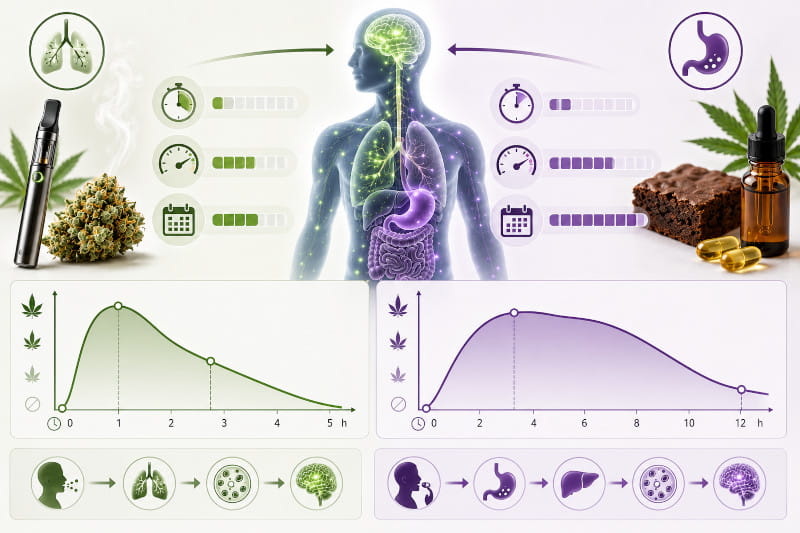
Can tolerance to THC develop?
Regular THC use can lead to tolerance, so that the same amount produces certain effects less strongly over time.
The body adapts to repeated activation of cannabinoid receptors. CB1 receptors may temporarily become less sensitive or be available in smaller numbers on the cell surface. As a result, a person may need larger amounts to experience an effect previously achieved with a lower dose.
Tolerance does not develop equally quickly to all effects. Subjective intoxication, tiredness, cardiovascular responses, memory performance and coordination may change differently. Becoming accustomed to the feeling of intoxication does not automatically mean reaction time or attention remain unimpaired.
Tolerance can decrease again after a longer break. If the same amount as before is then consumed, the effects may be unexpectedly strong. This is particularly relevant with highly concentrated THC products.
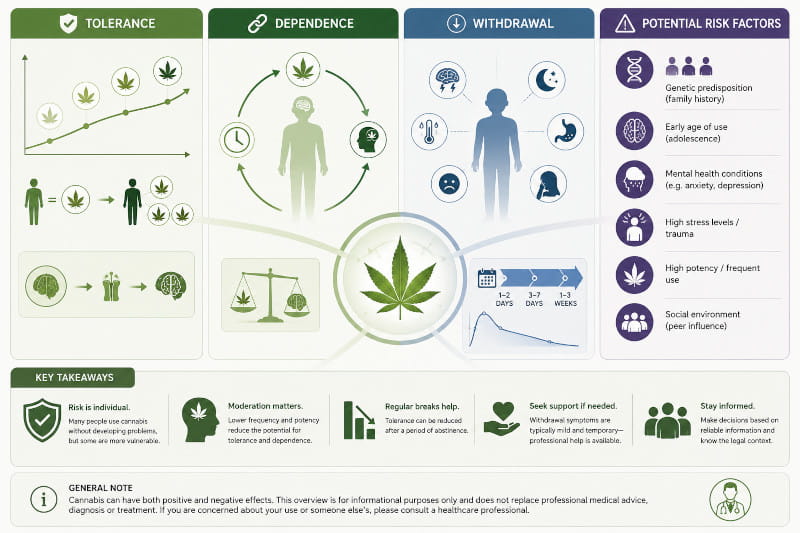
Can THC be addictive?
Regular THC use can lead to cannabis use disorder, in which control, everyday life and well-being become increasingly impaired.
Dependence is not identified solely by how often someone uses cannabis. The key question is whether use continues despite negative consequences, becomes increasingly difficult to control or interferes with important obligations and relationships.
Possible signs of a problematic pattern include:
-
repeated unsuccessful attempts to reduce or stop use,
-
strong cravings for cannabis or THC-containing products,
-
increasing amounts of time spent obtaining, using or recovering from the effects,
-
neglect of work, education, family or leisure activities,
-
continuing despite psychological, physical or social problems,
-
use in dangerous situations, for example before driving,
-
development of tolerance or withdrawal symptoms.
The risk is not the same for everyone. Early initiation, frequent use, high THC concentrations, psychological stress and other substance problems can promote a problematic pattern.
Context: Not every regular use meets the criteria for dependence. Conversely, problematic use can exist even when a person does not use THC every day.
What is cannabis use disorder?
Cannabis use disorder is a clinically significant pattern of use that leads to loss of control, distress or impairment in important areas of life.
The medical term describes a spectrum of severity. Several features are assessed over a defined period. The more criteria present and the more everyday life is affected, the more severe the disorder is classified.
A diagnosis cannot be made from a single online test, the number of grams consumed or a positive drug test. It requires professional assessment of the entire pattern of use and its consequences.
Use can become particularly problematic when THC is used continuously to regulate sleep, stress, mood or unpleasant feelings and alternative coping strategies are increasingly lost.
What withdrawal symptoms can occur after THC use?
After stopping regular THC use, irritability, sleep problems, restlessness, reduced appetite and mood swings may occur.
Cannabis withdrawal is well documented scientifically. It occurs mainly after frequent or intensive use when consumption is stopped suddenly or reduced substantially. Not everyone develops symptoms, and their intensity can vary considerably.
Typical symptoms may include:
-
irritability, anger or increased aggression,
-
nervousness, tension or anxiety,
-
difficulty falling asleep or staying asleep,
-
unusually vivid or distressing dreams,
-
reduced appetite or weight loss,
-
low mood,
-
inner restlessness,
-
headaches, sweating, abdominal discomfort or tremors.
Symptoms often begin within the first few days after stopping. They may be most pronounced during the first week and then gradually decline. Sleep problems and intense dreams may persist longer in some people.
Withdrawal is generally not associated with the same immediately life-threatening risks as severe alcohol or sedative withdrawal. It can nevertheless be highly distressing, increase relapse risk and require professional support in people with pre-existing mental illness.
How long does THC withdrawal last?
Acute withdrawal symptoms often last several days to around two weeks, although some complaints may persist longer.
Course and duration depend on factors including frequency of use, THC potency, amount used, individual sensitivity and concurrent tobacco or other substance use. Daily use of highly concentrated products may produce a more pronounced course than occasional use.
Expectations and life circumstances also matter. Sleep deprivation, stress, mental illness and lack of support can make symptoms feel more severe or harder to manage.
Persistent depression, severe anxiety, psychotic symptoms or suicidal thoughts require professional help. Such symptoms should not be regarded solely as temporary withdrawal.
What long-term effects can frequent THC use have?
Frequent THC use can be associated with dependence, persistent cognitive impairment, mental health problems and limitations in everyday life.
Long-term effects are more difficult to study scientifically than acute effects. People differ in age, amount used, THC concentration, tobacco and alcohol use, education, mental health and social environment. This makes it difficult to determine precisely how much of any observed association is caused directly by THC.
The following areas are studied particularly often:
| Area | Possible association | Important limitation |
|---|---|---|
| Dependence | Regular use can lead to loss of control and cannabis use disorder. | Individual risk varies greatly. |
| Memory and learning | Frequent use can be associated with poorer attention, learning performance and memory function. | Some effects may decline after abstinence; extent and duration are not the same for everyone. |
| Mental health | Frequent and high-dose use is associated with an increased risk of psychosis. | Genetic predisposition, early initiation and other factors influence risk. |
| Respiratory system | Smoking cannabis can promote coughing, mucus production and bronchitis-like symptoms. | These risks arise mainly from smoke and combustion products, not exclusively from THC. |
| School, work and everyday life | Problematic use can impair motivation, reliability and performance. | Social and psychological accompanying factors must also be considered. |
Risk does not increase according to a simple all-or-nothing principle. Early initiation, high THC doses, frequent use and long duration of use may raise the likelihood of negative consequences.
Does THC impair memory and concentration?
THC can acutely impair attention, working memory and the storage of new information.
This effect is particularly noticeable during acute intoxication. People may have difficulty following a conversation, processing several pieces of information at once or remembering something that happened shortly before.
In studies of frequent users, differences in learning, attention and memory have sometimes also been observed outside the acute intoxication phase. Whether and how fully such changes reverse after a longer period of abstinence probably depends on age, duration and intensity of use, and individual factors.
Not every memory lapse or concentration problem in cannabis users is automatically caused by THC. Sleep deprivation, depression, anxiety disorders, medicines, alcohol and other substances can produce similar complaints.
Can THC trigger psychosis?
High doses of THC can trigger temporary psychotic symptoms, and frequent use is associated with an increased risk of longer-lasting psychosis.
Possible acute symptoms include pronounced suspiciousness, persecutory ideas, hallucinations, severe confusion or loss of a realistic assessment of the surroundings. Such reactions are not the same as ordinary relaxation or typical intoxication.
Observational studies show a particularly clear association with early initiation, frequent use and products containing high levels of THC. People with a personal or family predisposition to psychotic disorders may be especially sensitive.
The relationship is complex. In vulnerable people, cannabis may contribute to earlier manifestation of an illness, worsen existing symptoms or be used to self-medicate pre-existing complaints. A single observation therefore does not always establish a clear direction of causality.
Warning signs: Hallucinations, severe fear of persecution, marked disorientation, unusually confused behaviour or loss of contact with reality require prompt medical assessment.
Does THC cause schizophrenia?
THC does not cause schizophrenia in everyone, but frequent and early cannabis use is associated with a higher risk of developing the disorder.
Schizophrenia arises from a complex interaction of genetic, biological and psychosocial factors. THC should therefore not be understood as a sole cause. In susceptible individuals, however, frequent use may be an additional risk factor.
The observed association is stronger in studies when cannabis is used at a young age, very frequently or at high THC concentrations. Psychotic disorders may also have a less favourable course if cannabis use continues.
People with previous psychotic episodes or a corresponding family history should discuss the issue with a medical professional and should not use THC as a self-directed treatment for mental health complaints.
Can THC affect depression or anxiety disorders?
THC can alter anxiety and mood in the short term, but it is not a generally established self-treatment for depression or anxiety disorders.
Low or individually well-tolerated doses may be perceived as relaxing. Higher doses, however, can intensify restlessness, panic and negative thoughts. These opposing reactions make blanket statements difficult.
People with depression or anxiety disorders sometimes use cannabis for short-term relief from distressing feelings. A temporarily pleasant effect does not prove sustained treatment of the underlying condition. In some people, frequent use can additionally impair sleep, motivation, anxiety and emotional stability.
Persistent low mood, panic attacks or severe mood swings should be professionally assessed. THC-containing products should not be used independently in place of diagnosed treatment.
Why is THC particularly risky for adolescents?
Adolescents are considered particularly sensitive because brain development, learning processes and psychological maturation are not yet complete.
During adolescence, neural networks important for impulse control, planning, reward processing and emotional regulation are changing. Regular THC exposure can influence these processes, although the long-term significance depends on dose, frequency and individual predisposition.
Early initiation is associated with an increased risk of cannabis use disorder, learning problems, school dropout and mental health complaints. Family, social environment, other substances and pre-existing stressors also play a role.
Products with very high THC levels may pose additional risks of anxiety reactions, accidents and acute psychotic symptoms because of their strong effects. High potency is especially difficult to assess for inexperienced and young people.
Does THC affect brain development?
Frequent THC use during adolescence can be associated with changes in learning, attention and brain function.
The endocannabinoid system itself plays a role in the development and fine-tuning of neural networks. Regular activation by external THC could alter these natural processes. However, the extent and permanence of such effects cannot be predicted reliably for an individual.
Imaging and cognitive studies do not provide a completely uniform picture. Differences in patterns of use, duration of abstinence, tobacco and alcohol use and baseline mental health are among the reasons. Nevertheless, the available evidence supports not treating early and frequent use as risk-free.
Is THC safe during pregnancy?
THC is not considered safe during pregnancy and should not be used without explicit medical direction.
THC can cross the placenta and reach the foetus. Observational studies associate cannabis use during pregnancy with lower birth weight and possible developmental risks, among other outcomes. Precise interpretation is complicated because factors such as tobacco use, nutrition and social stress are often also involved.
The fact that a product is plant-based or legally available in a region does not mean it is harmless during pregnancy. Cannabis should not be used as a self-treatment for nausea without medical advice.
Pregnant people who use THC for medical or other reasons should discuss it openly with a doctor or midwife. Professional advice can help weigh risks and consider suitable alternatives.
Does THC pass into breast milk?
THC can pass into breast milk and, because of its fat solubility, may remain detectable there for longer.
Infants can absorb THC through breast milk while their nervous system is still in a sensitive stage of development. Available research is insufficient to establish a safe dose or a reliable interval between use and breastfeeding.
Briefly pumping and discarding milk does not reliably solve the problem because THC is not present in the blood only for a short time. Individual medical advice is required for questions about medical use while breastfeeding.
Can THC affect fertility?
THC can influence hormonal and reproductive processes, although the clinical significance for human fertility is not yet fully understood.
The endocannabinoid system is involved in various reproductive processes. Studies are examining possible changes in sperm count, motility, hormone levels, ovulation and implantation.
Results are not consistently uniform. Differences in frequency of use, THC dose, tobacco use, age and general health make clear conclusions difficult. Regular use should be mentioned in a medical consultation when trying to conceive or undergoing fertility treatment.
What risks arise from smoking THC-containing cannabis?
Smoking produces combustion products that irritate the airways and can cause health risks independently of THC’s effects.
Cannabis smoke contains fine particles, carbon monoxide and various irritating or potentially harmful substances. Frequent smoking can be associated with coughing, increased mucus production, wheezing and chronic bronchitis-like symptoms.
When cannabis is used with tobacco, the known risks of nicotine and tobacco smoke are added. An additional nicotine dependence may also develop, making it harder to stop combined use.
Vaporising does not prevent THC’s effects and is not automatically risk-free. Product quality, temperature, additives and technical components influence which substances are inhaled.
Can THC be absorbed through second-hand smoke?
In heavily smoke-filled and poorly ventilated rooms, other people may absorb small amounts of THC and combustion products.
Under ordinary conditions, clearly intoxicating effects from brief passive exposure are less likely. With intense smoke exposure in enclosed spaces, however, measurable THC levels and subjective effects can occur.
Children, pregnant people and individuals with respiratory disease should not be exposed to cannabis smoke. Regardless of THC, the smoke contains particles and combustion products that pollute indoor air.
What is cannabinoid hyperemesis syndrome?
Cannabinoid hyperemesis syndrome is a possible consequence of long-term frequent cannabis use involving recurrent nausea, abdominal pain and severe vomiting.
The syndrome occurs only in some regular users. Recurrent episodes can lead to dehydration, electrolyte disturbances and repeated emergency treatment. Some affected people report that hot showers or baths temporarily relieve symptoms.
The exact cause is not yet fully understood. The key point is that, despite its known use against certain forms of nausea, frequent long-term cannabis use can itself cause a severe vomiting syndrome.
Persistent vomiting, inability to keep fluids down, severe weakness, confusion or reduced urination require medical examination.
Is THC used medically?
THC is used in certain medicines and medical cannabis preparations, with benefits, dosage and risks requiring individual medical assessment.
Medical use is not based on THC being generally healthy or suitable for every condition. What matters is a specific indication, the available evidence, previous treatments, coexisting conditions, possible interactions and the individual risk of side effects.
Depending on the country, different THC-containing or THC-related preparations may be available. These include standardised cannabis flowers and extracts, dronabinol, THC-CBD combination products and synthetic cannabinoid-like active substances such as nabilone.
A medically prescribed preparation differs from an arbitrary cannabis product through defined quality requirements, controlled active-ingredient information, pharmaceutical manufacture and documented medical use, among other factors.
Important distinction: The use of individual THC-containing medicines for certain complaints does not prove that THC treats every form of those complaints or that arbitrary cannabis products have the same effect.
What is dronabinol?
Dronabinol is the pharmaceutical name for delta-9-tetrahydrocannabinol when used as a standardised medical active ingredient.
Chemically, dronabinol corresponds to naturally occurring delta-9-THC. The term is used primarily in pharmaceuticals. Depending on the preparation, the active ingredient may be produced synthetically or extracted from cannabis.
Dronabinol may be supplied as a capsule, solution or individually compounded prescription. The available and approved dosage forms depend on the country and its medicines legislation.
Pharmaceutical dronabinol can also cause typical THC side effects, including dizziness, tiredness, concentration problems, altered perception, anxiety, palpitations and impaired reaction time.
What is nabilone?
Nabilone is a synthetically produced cannabinoid-like medicine whose structure and effects are related to THC.
Nabilone does not occur naturally in the cannabis plant. It activates cannabinoid receptors and can therefore produce both medically intended and THC-like psychoactive effects.
In some countries, nabilone is used for severe nausea and vomiting associated with chemotherapy when conventional treatments are insufficient. The precise approval differs by region.
Nabilone must not be confused with synthetic cannabinoids found in unregulated smoking mixtures. The latter can be chemically very different, substantially stronger and particularly hazardous to health.
What is a THC-CBD mouth spray?
A THC-CBD mouth spray is a standardised medicine containing defined amounts of both cannabinoids for application to the oral mucosa.
One well-known example is an oromucosal cannabis-extract preparation containing approximately comparable amounts of THC and CBD. Depending on national approval, it is used particularly for certain forms of treatment-resistant spasticity associated with multiple sclerosis.
Application to the oral mucosa does not produce a completely uniform route of absorption. Some of the active ingredients may be absorbed through the mucous membrane, while another portion is swallowed and processed through the digestive tract.
Combining THC with CBD also does not reliably prevent THC-related side effects. Dizziness, tiredness, drowsiness and changes in attention remain possible.
For which conditions is medical THC studied or used?
THC-containing medicines are studied or used mainly for selected forms of nausea, appetite loss, pain and muscle spasticity.
The evidence is not equally strong for all complaints. Studies also differ in active ingredient, THC-CBD ratio, dosage, treatment duration and patient population. Results from a standardised medicine therefore cannot automatically be transferred to cannabis flowers or other products.
| Area of use | Possible medical role | Important limitation |
|---|---|---|
| Nausea and vomiting | Certain THC-related medicines may be used for treatment-resistant symptoms associated with chemotherapy. | They are not automatically first-line options and can cause pronounced side effects. |
| Loss of appetite | In some countries, dronabinol may be used for severe disease-related appetite and weight loss. | Stimulating appetite does not automatically treat the underlying disease. |
| Spasticity | THC-CBD preparations may be an additional option for selected people with multiple sclerosis. | Not everyone responds; dizziness and tiredness may limit use. |
| Chronic pain | Cannabinoid-containing preparations are studied particularly for neuropathic pain. | Average benefit is often limited and must be weighed against side effects. |
| Sleep problems | Tiredness or a change in symptom burden may affect sleep in some people. | THC is not a generally established standard treatment for chronic sleep disorders. |
| Palliative medicine | In selected situations, appetite, nausea, pain or well-being may be therapeutic targets. | The decision depends on the overall situation, treatment goal and tolerability. |
Does THC help with pain?
THC-containing preparations can relieve certain chronic pain in some people, but the average benefit is usually limited and accompanied by side effects.
Cannabinoids are studied particularly often for neuropathic pain, which results from damage to or disease of the nervous system and differs from acute injury pain.
Studies use different products and assessment methods. Some show a small to moderate improvement in a proportion of patients, while others find no clinically meaningful advantage over placebo.
As the THC dose rises, dizziness, tiredness, thinking and coordination problems may increase. A statistically measurable reduction in pain therefore does not automatically mean an overall favourable benefit-risk balance.
Can THC cure cancer?
There is no robust clinical evidence that THC can cure cancer in humans or replace an established cancer treatment.
Laboratory and animal studies examine how cannabinoids influence certain signalling pathways, cell division or programmed cell death. Such findings are scientifically interesting but cannot be translated directly into a safe and effective cancer treatment in humans.
In oncology, cannabinoid-containing medicines may be considered in selected situations for certain accompanying symptoms, such as treatment-resistant nausea or poor appetite. This is symptom control, not treatment of the tumour itself.
Stopping, delaying or replacing a recommended operation, radiotherapy, chemotherapy, immunotherapy or targeted treatment with THC can have serious consequences.
Clear context: Antitumour effects in cell cultures are not evidence of effectiveness in humans. The concentrations, conditions and cell models used in laboratories often do not correspond to realistic medical use.
Can THC help with nausea?
Certain THC or cannabinoid-like medicines can reduce severe nausea and vomiting in selected patient groups.
The best-established medical use concerns certain forms of nausea and vomiting associated with chemotherapy, particularly when standard medicines do not work sufficiently or are not tolerated.
Modern antiemetics are often effective and are normally used according to defined treatment regimens. THC-related preparations therefore do not generally replace these medicines.
At the same time, long-term frequent cannabis use can cause cannabinoid hyperemesis syndrome. Depending on the situation and pattern of use, THC can therefore be associated with both reduced and increased nausea.
Why does THC increase appetite?
THC can increase appetite by activating CB1 receptors in networks that regulate hunger, reward and the perception of food.
The appetite effect may be associated with a more intense perception of smell and taste. THC also influences neural signals involved in motivation, food intake and reward.
Medically, appetite stimulation may be relevant in selected forms of severe disease-related weight loss. However, it is not sufficient in every situation and does not automatically improve muscle mass, nutritional status or the course of the underlying disease.
For other people, a regularly increased appetite may be undesirable. The individual response depends on dose, product, metabolism and eating environment.
Can THC help with muscle spasticity?
Standardised THC-CBD preparations can reduce certain spasticity symptoms in some people with multiple sclerosis.
Spasticity is an abnormally increased muscle tone that can impair movement, sleep and daily life. Cannabinoid-containing preparations are generally considered only when established treatments are insufficient or not tolerated.
Objectively measured muscle tone does not always change to the same extent as subjectively perceived burden. Studies therefore consider both clinical examinations and patient reports.
Treatment should be stopped or adjusted when no relevant improvement occurs or side effects outweigh the potential benefit.
Does THC improve sleep?
THC can cause short-term drowsiness but is not a generally established long-term treatment for sleep disorders.
Some people fall asleep faster after taking THC or experience fewer symptoms that normally keep them awake. Others experience restlessness, palpitations or anxiety and consequently sleep worse.
With regular use, tolerance to the sedating effect can develop. Difficulty falling asleep and vivid dreams are common withdrawal symptoms after stopping.
Chronic sleep disorders can have many causes, including sleep apnoea, depression, anxiety, pain, medicines and unfavourable sleep habits. A sedating effect is no substitute for assessing these causes.
Does THC help with elevated intraocular pressure?
THC can temporarily reduce intraocular pressure, but its short duration and systemic side effects make it unsuitable as a standard glaucoma treatment.
Glaucoma can permanently damage the optic nerve. Protecting vision requires reliable pressure control around the clock. THC’s pressure-lowering effect generally does not last long enough for this.
Repeated high THC intake would also cause intoxication, concentration problems and other side effects. Modern eye drops, laser treatments and surgical procedures can be used more selectively.
Elevated intraocular pressure should be monitored by an eye specialist because progressive damage may remain unnoticed for a long time.
How well established are the medical effects of THC?
Depending on the condition, the evidence ranges from approved uses to small, contradictory or predominantly preclinical studies.
A medical claim is particularly robust when several high-quality randomised controlled trials show comparable results and benefits and risks are confirmed in systematic reviews.
Different cannabis and THC products complicate assessment. Dried flowers, extracts, dronabinol, nabilone and THC-CBD sprays are not fully interchangeable chemically or pharmacologically.
| Level of evidence | Example | What can be concluded? |
|---|---|---|
| Approved medicine | Defined active ingredient for a specifically tested indication | Benefits and risks have been assessed under defined conditions. |
| Several controlled trials | Comparison with placebo or standard treatment | A justified statement of efficacy may be possible if results are consistent and clinically relevant. |
| Observational study | Patients report experiences in everyday life | Shows associations but does not reliably prove cause and effect. |
| Case report | Description of an individual treatment | May provide clues but does not support a general claim of efficacy. |
| Animal or laboratory study | Study of cells, receptors or animal models | Explains possible mechanisms but does not prove safe treatment in humans. |
Why is self-medication with THC problematic?
Self-medication can mask symptoms, cause interactions and delay effective diagnosis or treatment.
Pain, insomnia, weight loss, anxiety or nausea can be symptoms of very different conditions. A short-term change in perception does not explain their cause.
Unstandardised products can vary considerably in THC content, CBD proportion, contaminants and effects. This makes dosage harder to control than with a tested medicine.
Particular caution is required with mental illness, cardiovascular problems, pregnancy, breastfeeding, older age and the simultaneous use of several medicines.
What interactions can THC have with medicines?
THC can intensify the effects of other medicines or influence their metabolism, especially sedating and centrally acting drugs.
THC is metabolised by liver enzymes that are also involved with numerous medicines. Active substances that inhibit or induce these enzymes can theoretically alter THC concentrations. Conversely, cannabinoids can influence the metabolism of other substances.
Additive effects are particularly relevant. Combining several substances that cause drowsiness or slow reactions can increase sedation, fall risk and impaired driving ability.
| Substance group | Possible interaction |
|---|---|
| Alcohol | increased drowsiness and problems with coordination and reaction time |
| Sleeping pills and sedatives | increased tiredness, confusion and risk of falls |
| Opioids | additional sedation and impaired attention |
| Psychiatric medicines | possible intensification of central side effects or changes in active-substance levels |
| Blood-pressure medicines | dizziness or circulatory problems may become more pronounced |
| Anticoagulant medicines | possible changes in active-substance levels require professional monitoring |
This overview is not exhaustive. Before medical use, all medicines, supplements and other substances should be disclosed to a doctor or pharmacist.
What is the difference between THC and CBD?
THC can cause a typical cannabis high, whereas CBD alone does not have the same intoxicating effect.
Both substances are naturally occurring phytocannabinoids in the cannabis plant, but their pharmacological effects differ substantially. THC activates CB1 receptors as a partial agonist. Plants grown from CBD seeds , by contrast, primarily contain CBD, which does not activate CB1 receptors in the same way and instead influences various other receptors, ion channels and signalling pathways.
| Feature | THC | CBD |
|---|---|---|
| Full name | Tetrahydrocannabinol | Cannabidiol |
| Typical intoxication | possible | not in a comparable way |
| CB1 receptor | partial agonist | no direct activation like THC; complex modulating effects |
| Acute risks | anxiety, intoxication, coordination and memory problems possible | tiredness, diarrhoea and medicine interactions possible, among other effects |
| Plant precursor | THCA | CBDA |
| Medical preparations | dronabinol and THC-containing extracts and combinations | purified CBD and CBD-containing preparations for defined uses |
CBD is not automatically free of side effects or interactions. A non-intoxicating substance can still be pharmacologically active and influence the metabolism of medicines.
Does CBD reduce THC’s effects?
CBD can alter individual THC effects under certain conditions, but it does not reliably prevent intoxication or adverse reactions.
The interaction depends on the ratio, absolute dose, timing and route of administration, among other factors. Studies produce different results depending on their design.
A product containing THC and CBD can therefore still impair perception, reaction time and driving ability. The presence of CBD is not proof of safety and not a reliable antidote to an excessive THC dose.
What does the entourage effect mean in relation to THC?
The entourage effect is the hypothesis that several cannabis components act differently together than isolated THC.
Cannabis contains other cannabinoids, terpenes and plant compounds in addition to THC. This led to the idea that certain combinations might influence each other’s effects or tolerability.
There are pharmacological indications for individual interactions. However, the often far-reaching claim that a complete plant profile is inherently more effective or safer has not been clinically established for all uses.
Terpene profiles or strain names therefore cannot reliably predict a medical effect. Standardised products and controlled comparative studies would be required.
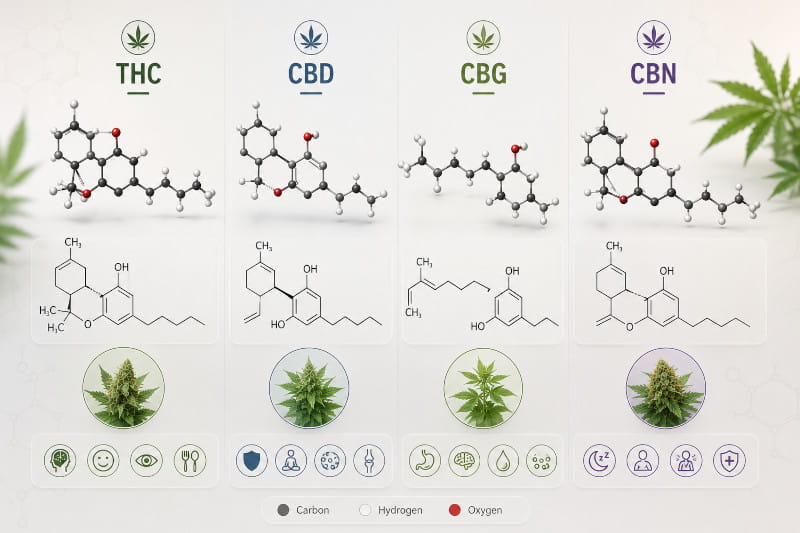
How does THC differ from CBG and CBN?
THC is typically strongly intoxicating, whereas CBG and CBN have different receptor profiles and have been studied far less clinically.
CBG stands for cannabigerol and is formed through decarboxylation of CBGA. CBGA is also an important starting compound for several cannabinoid acids, including THCA and CBDA.
CBN stands for cannabinol. It can form when THC is altered by oxygen, light and ageing. A high CBN proportion may therefore indicate older or more heavily oxidised plant material.
Claims such as “CBN is the sleep cannabinoid” or “CBG works against numerous diseases” go beyond the current clinical evidence. Many promoted uses lack sufficiently large controlled human studies.
What is the difference between delta-9-THC and delta-8-THC?
Delta-8-THC is a structural isomer of delta-9-THC in which the position of a double bond differs.
Delta-8-THC can also activate CB1 receptors and produce intoxication. It generally occurs naturally only in small amounts. Many commercial delta-8 products are therefore made by chemically converting other cannabinoids.
Manufacturing processes may involve acids, solvents and other reagents. Without careful purification and independent laboratory testing, there is a risk of by-products, incorrect labelling or contaminants.
Frequent marketing as “milder” does not automatically mean delta-8-THC is safe or free from dependence, anxiety reactions and driving impairment.
What is THCP?
THCP is a rare THC-related phytocannabinoid with a longer side chain and high binding affinity for the CB1 receptor.
THCP stands for tetrahydrocannabiphorol. Laboratory studies show strong receptor binding, but this cannot be used to calculate directly how strongly a particular product affects humans.
Clinical data on effects, dosage, interactions and long-term risks are substantially weaker than for delta-9-THC. Especially cautious assessment is required for highly concentrated products and semi-synthetically produced variants.
Are synthetic cannabinoids the same as THC?
Synthetic cannabinoids are not equivalent to natural THC and can cause substantially stronger and less predictable effects.
Many of these substances were developed to activate cannabinoid receptors. Unlike THC, some act as very strong or full agonists at the CB1 receptor and can therefore stimulate the receptor system much more intensely.
Possible consequences include severe anxiety, seizures, cardiovascular problems, kidney damage, altered consciousness and psychotic symptoms. The composition and concentration of illegal products can vary greatly between batches.
Nabilone is also manufactured synthetically but is used as a controlled medicine with defined quality. It must therefore not be equated with uncontrolled designer cannabinoids.
What does THC content mean in cannabis?
THC content describes how much delta-9-THC or theoretically available total THC is present in a tested sample.
For dried cannabis flowers, the value is generally stated as a percentage by mass. A laboratory value of 20% means, in simplified terms, that the tested sample contains approximately 200 milligrams of the stated cannabinoid per gram of dry material.
The decisive point is which value appears on the certificate of analysis. Some laboratory reports list delta-9-THC and THCA separately. Others also state a calculated total THC value that accounts for the conversion potential of the tetrahydrocannabinolic acid present.
A high percentage describes only the concentration in the tested material. It does not automatically show how much THC a person actually absorbs or how strong the subjective effects will be.
How much THC is 10, 20 or 30 percent?
A THC value of 10, 20 or 30 percent corresponds mathematically to approximately 100, 200 or 300 milligrams of THC per gram of tested dry material.
| Stated content | Calculated amount per gram | Context |
|---|---|---|
| 5% | about 50 mg per gram | comparatively low concentration |
| 10% | about 100 mg per gram | moderate concentration |
| 20% | about 200 mg per gram | high concentration |
| 30% | about 300 mg per gram | very high concentration |
This calculation describes the analytical content of the sample, not the absorbed dose. Losses occur during use, and bioavailability differs substantially by product and route of administration.
It is also necessary to check whether the percentage refers to delta-9-THC alone or calculated total THC. Without this information, comparing figures from different laboratory reports can be misleading.
At what point is THC content considered high?
Values clearly above those of average cannabis flowers are generally described as high THC content, but there is no uniform scientific threshold.
Terms such as low, medium, high or extremely high are not internationally standardised quality levels. Their meaning also changes because the average potency of available cannabis products varies over time and between markets.
As a rough editorial guide, flowers with less than about 10% total THC may be classified as comparatively low, values between approximately 10 and 20% as medium to high, and values above 20% as high. This classification is not a medical or legal definition.
Products containing more than 25 or 30% are often marketed as particularly potent. For such claims, the analytical method, measurement uncertainty, sample selection and plausibility are especially important.
How high can the THC content of a cannabis flower be?
Very cannabinoid-rich flowers can achieve laboratory values above 25% total THC, but extremely high claims should be examined critically.
Dried cannabis flowers do not consist exclusively of cannabinoids. They also contain plant tissue, residual water, proteins, carbohydrates, minerals, terpenes, waxes, pigments and many other components. Natural THC content therefore has a biological upper limit.
Laboratory values can also be influenced by which part of a plant was sampled. Particularly resin-rich small flower areas may produce higher values than a representative composite sample of the entire batch.
An unusually high figure should therefore not be considered in isolation. Complete certificates of analysis containing sample identity, method, measurement uncertainty, laboratory and date are more informative.
How is THC content measured in the laboratory?
THC content is usually determined using chromatographic methods that separate and quantify individual cannabinoids in a sample.
High-performance liquid chromatography, or HPLC, is especially common. It can measure THC and THCA separately without strongly heating the sample during analysis.
Gas chromatographic methods are also used. Because the sample is heated, acidic cannabinoids may decarboxylate during analysis. The evaluation and naming of results must account for this conversion.
| Method | Basic principle | Special feature |
|---|---|---|
| HPLC | separation of dissolved substances in a liquid column | THCA and THC can be reported separately |
| Gas chromatography | separation of volatile substances in the gas phase | heating can alter acidic cannabinoids during measurement |
| Mass spectrometry | identification based on the mass-to-charge ratio | can be combined with chromatographic separation |
A laboratory value is only as representative as the sample tested. Errors in collection, storage, homogenisation or assignment can distort the result even when the measuring instrument works correctly.
What appears on a THC certificate of analysis?
A complete certificate of analysis documents the sample, measurement method, cannabinoid values, date and responsible laboratory.
A reliable test report should identify the product or batch examined. A general analysis of a strain does not automatically apply to every later plant or production run.
Important information includes:
-
name or unique identification of the sample,
-
batch or sample number,
-
date of sampling and analysis,
-
analytical method used,
-
unit and reference basis of the measurements,
-
separate values for THC and THCA,
-
calculated total THC where applicable,
-
limits of detection and quantification,
-
name and contact details of the testing laboratory.
A cannabinoid profile alone also does not prove that the product is free from pesticides, heavy metals, microorganisms, residual solvents or other contaminants. Additional testing is required.
Why can THC laboratory values differ?
THC values can differ because of different samples, measurement methods, moisture, calculations and natural variation.
Cannabis flowers are not completely homogeneous material. Even within one plant, position, maturity and trichome density can produce different cannabinoid values.
Testing only a particularly resin-rich individual flower may produce a higher result than a carefully assembled composite sample. The percentage is also affected by whether it is based on dry mass or on the material at its existing moisture level.
Other causes include:
-
different sample homogenisation,
-
storage with exposure to light, heat or oxygen,
-
different calibration and measurement uncertainty,
-
different calculations of total THC,
-
confusion between fresh weight and dry weight,
-
unrepresentative or incorrectly labelled samples.
Can THC content be determined by appearance?
THC content cannot be determined reliably from colour, smell or visible trichomes.
A dense resin layer may indicate that a flower has many glandular hairs. However, trichomes do not contain THC alone. They can contain THCA, CBDA, CBGA, other cannabinoids, terpenes and other compounds.
An especially intense smell also does not prove high THC content. Aroma is determined mainly by volatile compounds such as terpenes, which are analysed separately from cannabinoids.
Dark, purple or reddish flowers are not automatically stronger either. Such colours arise mainly from pigments, genetics and environmental conditions.
Key point: Visible resin can indicate high trichome density, but only a representative laboratory analysis can determine actual THC and THCA content.
What role do trichomes play in THC production?
Glandular trichomes are specialised glandular hairs in which a large proportion of a cannabis flower’s cannabinoids and terpenes are produced and stored.
Stalked glandular trichomes on female flowers are particularly important. Their spherical head contains secretory cells and a storage cavity in which resinous plant compounds accumulate.
The number of visible trichomes alone does not reveal which cannabinoids predominate. A CBD-dominant plant can also look heavily frosted even though its THC content is comparatively low.
Trichomes are sensitive to mechanical stress, heat, light and oxygen. Improper processing or storage can therefore alter the chemical profile.
What happens to THC during long-term storage?
During prolonged or unsuitable storage, THC can gradually degrade or undergo chemical changes because of light, oxygen and heat.
One known oxidation product is CBN. However, conversion does not follow a fixed timetable and is not complete. At the same time, terpenes can evaporate, other cannabinoids can break down and sensory properties can deteriorate.
Heat and light accelerate many degradation processes. Frequently opening a container also increases contact with oxygen and changing humidity.
An older product is therefore not simply weaker. Its entire chemical profile may change without its remaining effects being reliably predictable from age alone.
Does moisture affect measured THC content?
Water content affects percentages because the same amount of cannabinoids is distributed across a greater total mass in wetter material.
If a sample contains more water, its THC percentage based on total weight may appear lower. After further drying, the calculated proportion rises even though no additional THC has formed.
Comparisons must therefore clarify whether values are based on the existing sample weight or dry mass. Different reference bases may otherwise falsely appear to be chemical differences.
Excessive moisture also increases the risk of microbial growth. A high THC value says nothing about whether plant material is hygienically sound.
Does genetics alone determine THC content?
Genetics establishes the basic cannabinoid potential but does not determine final THC content on its own.
Genes particularly influence which cannabinoid synthases a plant produces. This helps determine whether the plant predominantly forms THCA, CBDA or a mixed cannabinoid profile.
The extent to which this potential is expressed also depends on phenotype, developmental stage and environment. Plants from the same seed line can differ because they are not genetically identical.
Manufacturer claims about possible THC values should therefore be understood as guidance, not a guarantee. A binding value can only be determined from a specific, representative sample.
What is a THC-dominant chemotype?
A THC-dominant chemotype is a cannabis plant whose cannabinoid profile contains substantially more THCA or THC than CBDA or CBD.
Chemotype describes a plant’s chemical expression and is more informative than the broad indica or sativa classification. Plants with a similar appearance can have different cannabinoid ratios.
| Chemotype | Typical ratio | Simplified classification |
|---|---|---|
| Type I | THCA substantially higher than CBDA | THC-dominant |
| Type II | THCA and CBDA in relevant proportions | mixed THC-CBD chemotype |
| Type III | CBDA substantially higher than THCA | CBD-dominant |
Other chemotypes are described for CBG-dominant or cannabinoid-poor plants, among others. The simplified three-part classification therefore does not capture the full diversity.
What are THC seeds?
THC seeds are cannabis seeds whose genetics are intended to produce plants with a THC-dominant cannabinoid profile.
The term is botanically abbreviated. The seed itself normally contains no intoxicating amount of THC. It refers instead to the genetic potential of the plant that can develop from the seed.
Many modern THC-rich strains are the result of decades of breeding. Although feminised or autoflowering seeds are now often used for cultivation, regular weed seeds remain the basis of classic breeding programmes. Because they produce both male and female plants, they continue to play an important role in developing new THC-rich genetics.
THC is produced mainly in the glandular trichomes of mature female flowers, initially as THCA. A dry seed has neither such flowers nor a developed layer of cannabinoid-rich glandular hairs.
In common usage, terms such as THC seeds are mainly used to distinguish them from CBD-dominant, CBG-dominant or cannabinoid-poor hemp seed lines.
Definition: THC seeds do not contain the advertised THC percentage of the later plant. They carry genetic traits from which a THC-dominant plant may develop under suitable biological conditions.
Do cannabis seeds contain THC?
Cannabis seeds do not contain THC - detectable traces usually come from adhering plant resin or external contamination.
Cannabinoids are produced mainly in specialised glandular hairs on above-ground plant parts. Seeds do not have comparable production and storage structures.
During harvesting and processing, however, seeds may come into contact with resinous flowers or leaves, making small external residues possible. Thorough cleaning can reduce such contamination.
Consuming ordinary cleaned hemp seeds therefore does not cause a typical THC high. Food-law limits may nevertheless be relevant because even small residues can be measured analytically.
What are high THC seeds?
High THC seeds are seed lines selected for high genetic THCA or THC potential in the later plants.
“High THC” is not a strictly protected scientific term. Suppliers use it for genetics whose tested plants have achieved high total THC values under certain conditions.
The claim generally refers to peak values from selected plants or batches. It does not mean that every individual seed will automatically produce a plant with exactly that value.
Seed-propagated lines produce genetically individual offspring. Even stable lines can show different expressions in growth, flowering, aroma and cannabinoid content.
Do high THC seeds guarantee especially high values?
With suitable genetics, high THC seeds increase the probability of THC-rich plants but do not guarantee a particular laboratory value.
A percentage in a strain description is generally an expected range or a documented maximum. The value actually achieved may be lower or, in individual cases, higher.
Important causes of variation include:
-
genetic differences between individual seeds,
-
different phenotypes within the same line,
-
differences in developmental stage and plant health,
-
environmental conditions during development,
-
harvesting, drying and storage conditions,
-
the type and representativeness of the laboratory sample.
Without analysis of a specific sample, the advertised THC range remains genetic guidance rather than a guaranteed property of every seed.
Can THC seeds be identified by appearance?
THC-dominant, CBD-dominant and other cannabis seeds cannot be distinguished reliably by appearance.
Colour, size, pattern and surface texture can provide clues about a seed’s maturity and condition. They do not show which cannabinoid synthases the later plant possesses.
Two seeds that look almost identical can produce plants with very different THC-CBD ratios. Conversely, differently looking seeds from the same line can develop a similar cannabinoid profile.
Reliable classification requires traceable origin, a documented breeding line and ultimately analysis of the plant material.
Which genes influence THC seeds?
Genetic variants that influence the formation and activity of THCA synthase are particularly relevant to THC dominance.
THCA synthase catalyses the conversion of CBGA into THCA. CBD-dominant plants, by contrast, have a stronger functional expression of CBDA synthase.
The cannabinoid profile is nevertheless more complex than a single gene. Gene copies, regulatory regions, enzyme activity and other metabolic pathways influence how much cannabinoid a plant actually produces.
Breeding can stabilise certain traits over generations. Completely identical results should still not be expected from seed-grown plants because every seed represents a new genetic combination.
What are feminised THC seeds?
Feminised THC seeds are seeds from THC-dominant genetics intended to produce female plants with high probability.
The term “feminised” describes the expected sex, not the level of THC content. A feminised line can be THC-dominant, CBD-dominant or balanced.
Feminised seeds also produce genetically individual plants. Differences in cannabinoid content therefore remain possible.
A very high probability of female plants is also not an absolute biological guarantee. Genetic instability or pronounced stress can influence the sexual expression of individual plants.
Can autoflowering seeds have high THC content?
Modern autoflowering genetics can have high THC potential, while their automatic flowering trait is inherited independently of cannabinoid type.
Autoflowering describes the genetic tendency to begin the transition to flowering more according to age and less according to day length. This trait alone says nothing about whether a plant is THC-, CBD- or CBG-dominant.
Many modern autoflowering genetics trace back to the legendary Lowryder . Crossing such autoflowering lines with THC-rich photoperiod strains produced numerous autoflowering seeds that can now also have high THC potential.
As with other seed lines, manufacturer claims remain guidance values. Actual THC content can vary according to genetics, phenotype, growing conditions and harvest time and must be determined analytically in the later plant or its flowers.
What are regular THC seeds?
Regular THC seeds are seeds from THC-dominant lines that can produce both male and female plants.
“Regular” describes sex distribution, not cannabinoid potency. Regular seeds can also have high, medium or low THC potential.
Male plants pass on genetic information about cannabinoid profiles but generally do not form the same resin-rich flower clusters as unpollinated female plants.
Several characteristics must therefore be considered separately when assessing a seed line: sex type, flowering trait, genetic background, stability and expected chemotype.
How can reliable claims about THC seeds be recognised?
Reliable claims state traceable genetics and realistic THC ranges and explain that plant values cannot be guaranteed.
Information is especially credible when based on several analyses of different plants or batches. A single exceptional peak value describes the typical line less reliably than a traceable range.
Warning signs of exaggerated advertising include absolute guarantees, unusually high percentages without analytical evidence and claims that every plant will deliver identical results.
| Claim | Context |
|---|---|
| “Up to 28% THC” | generally describes a documented or expected maximum, not every plant |
| “20 to 25% total THC” | may be a realistic target range if based on several analyses |
| “Guaranteed exactly 30%” | cannot be guaranteed biologically for every individual seed |
| “Very resinous, therefore extremely high THC” | a visual description does not replace cannabinoid analysis |
Are THC seeds and THC-containing plants legally the same?
Cannabis seeds and the THC-containing plants that develop from them may be treated differently under the law.
The seed itself generally contains no relevant amount of THC but can have the genetic potential for a THC-dominant plant. Laws may therefore regulate possession, trade, germination, cultivation and harvesting separately.
The legal situation differs by country and may change. Medical, private, agricultural and commercial rules can also differ within a country.
The legal availability of a seed therefore does not automatically mean every later use or cultivation is permitted. The current rules at the place of the intended activity are decisive.
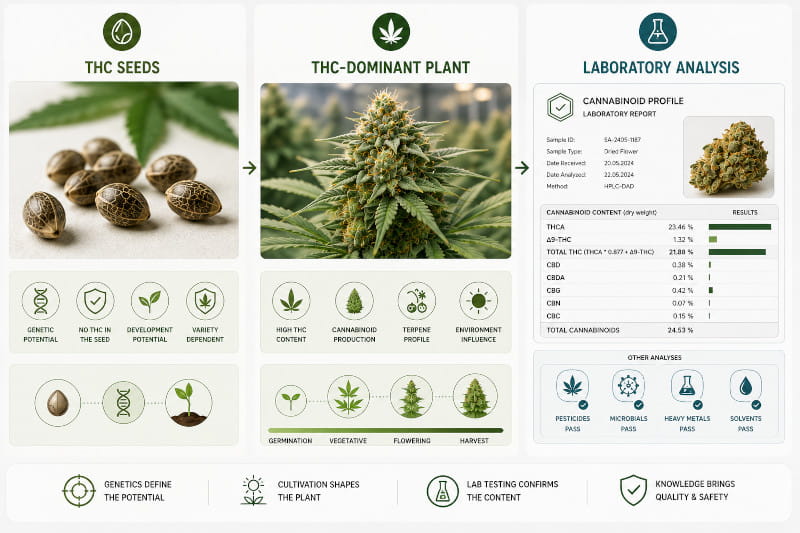
Which products can contain THC?
THC can be present in cannabis flowers, resin products, extracts, oils, capsules, sprays, foods and pharmaceutical preparations.
Product form affects not only concentration but also absorption speed, duration, dose control and possible risks. Dried flowers primarily contain THCA, part of which is converted into THC by heating. Processed extracts or foods, by contrast, may contain activated THC.
Common THC-containing product forms include:
-
Cannabis flowers: dried female flowers with a natural cannabinoid and terpene profile.
-
Hashish: compressed or processed trichomes or resin components.
-
Extracts and concentrates: products with highly concentrated cannabinoids.
-
Oils and drops: THC or cannabis extracts in a carrier liquid.
-
Capsules: standardised or individually compounded oral dosage forms.
-
Foods: edible products made with activated THC.
-
Mouth sprays: pharmaceutical or standardised preparations for application to the oral mucosa.
Products stating the same amount of THC can nevertheless feel very different. Reasons include route of administration, concentration over time, accompanying compounds and individual sensitivity.
How much THC do cannabis flowers contain?
Depending on chemotype and genetics, cannabis flowers can range from very low values to more than 25% total THC.
In fresh and gently dried flowers, most is generally present as THCA. Heat or long-term storage converts part of it into delta-9-THC.
The laboratory value of one flower does not automatically apply to all flowers on the same plant. Larger, more strongly illuminated and particularly trichome-rich flower areas may have different values from smaller or less developed plant parts.
Strain names are not reliable analyses either. Plants with the same commercial name can have different cannabinoid profiles depending on breeder, phenotype, batch and origin.
What is THC-containing hashish?
Hashish is a cannabis product made primarily from separated and compressed resin-rich trichomes.
Because trichomes contain a large proportion of the cannabinoids, hashish can have a higher total THC content than the original flower material. Concentration depends greatly on the starting material, purity and manufacturing method.
Traditional products can be made by sieving, rubbing or other mechanical methods. Modern forms may use ice water, filter bags or other separation techniques.
Colour, consistency and smell are insufficient to assess purity or active-ingredient content reliably. Contaminants, plant residues and added substances may be difficult to identify visually.
What are THC concentrates?
THC concentrates are products in which cannabinoids and often terpenes have been highly concentrated from plant material.
Different methods produce very different consistencies and compositions. Commercial terms such as wax, shatter, rosin, resin or distillate partly describe production, consistency or purity, but are not defined uniformly everywhere.
Concentrates can reach substantially higher THC levels than flowers. A high active dose can therefore be absorbed from a small product quantity. The risk of unpleasantly strong effects rises especially with limited experience.
A high cannabinoid concentration is not the same as high purity. Residual solvents, pesticides, heavy metals, degradation products or unwanted additives must be tested separately.
How are THC extracts made?
THC extracts are produced by mechanical separation or with solvents that dissolve cannabinoids and other fat-soluble plant compounds from the starting material.
Mechanical methods separate trichomes using pressure, movement, temperature or water. Solvent-based methods may use ethanol or supercritical carbon dioxide, for example.
Extraction does not dissolve THC alone. Depending on polarity, temperature and method, waxes, pigments, terpenes, other cannabinoids and unwanted residues may also enter the product.
Further processing steps may follow extraction, such as filtration, purification, decarboxylation or distillation. Every step changes the chemical profile.
What is a THC distillate?
A THC distillate is a highly purified cannabis extract with a high cannabinoid concentration and generally fewer natural accompanying compounds.
Distillation separates substances according to their physical properties. THC can thereby be highly concentrated while waxes, pigments and many volatile aromatic compounds are removed.
An almost odourless distillate may later be mixed with terpenes or other ingredients. The resulting profile does not necessarily correspond to the original plant material.
Because of the high concentration, accurate labelling and laboratory testing are especially important. Small differences in the amount used can already make a large difference to the absorbed THC dose.
What does full spectrum mean for THC products?
Full spectrum refers to extracts intended to contain several other natural components of the cannabis plant in addition to THC.
These may include other cannabinoids, terpenes, flavonoids, waxes and other plant compounds. However, the term is not legally or consistently defined everywhere.
A product may therefore be marketed as full spectrum even though processing has substantially reduced certain components. A complete analytical profile is more informative than the label alone.
Full spectrum also does not automatically mean better tolerated, more effective or safer. Such products can also contain high THC doses and unwanted contaminants.
What is a THC isolate?
A THC isolate is a highly purified single substance from which other cannabis components have largely been removed.
An isolate allows comparatively precise determination of the active-ingredient amount. However, it does not automatically contain the terpene or cannabinoid profile typical of flowers.
Even a chemically pure isolate is not risk-free. The pharmacological effects and possible side effects of isolated THC remain.
What are THC edibles?
THC edibles are foods or drinks containing active THC that are absorbed through the digestive tract.
Examples include sweets, baked goods, drinks and other orally consumed products. Because onset is delayed, their risk profile differs substantially from inhalation.
A particular problem is that taste and appearance often do not indicate a psychoactive active ingredient. Products can be mistaken for ordinary foods and accidentally consumed by children or other people.
Uneven distribution of the active ingredient can also mean that individual portions contain more THC than others. Standardised manufacturing and verified portion information are therefore essential.
What is THC oil?
THC oil is a collective term for products in which THC or a cannabis extract is dissolved in an oily carrier liquid.
Carriers may include medium-chain triglycerides or other oils suitable for pharmaceutical or food use. The term alone says nothing about concentration, purity or medical approval.
THC oils must be distinguished from essential hemp oil, hemp seed oil and CBD oil. Hemp seed oil naturally contains no relevant amount of THC if it is produced cleanly and is not contaminated with resinous plant parts.
With orally used oils, onset may be delayed. If part is absorbed through the oral mucosa and part is swallowed, the time course may vary.
Does hemp seed oil contain THC?
Pure hemp seed oil normally contains no THC because cannabis seeds themselves do not produce THC. Any detectable traces originate exclusively from adhering plant material or external contamination.
Traces can arise when seeds come into contact with resinous flowers or leaves during harvesting and processing. Cleaning and controlled production reduce this risk.
Hemp seed oil is pressed from seeds and is used mainly for its fatty-acid profile. It is not equivalent to a THC-containing cannabis extract.
What are THC vape products?
THC vape products contain vaporisable cannabis extracts or mixtures that are heated and inhaled using an electronic device.
Many vape products have a high THC concentration. Because absorption through the lungs is rapid, effects can become pronounced within a short time.
Health risk does not depend on THC alone. Solvents, diluents, flavourings, metals from the device and thermal degradation products may also be relevant.
Products of unknown origin or without traceable analysis carry a greater risk of incorrect labelling and unwanted ingredients.
Is synthetically produced THC different from plant-derived THC?
Chemically identical delta-9-THC acts essentially the same regardless of whether it is extracted from a plant or produced synthetically.
Differences arise mainly from purity, accompanying compounds, dosage form and dose. An isolated pharmaceutical active ingredient has a different overall profile from a cannabis flower containing numerous other substances.
This must be distinguished from synthetic cannabinoids that only resemble THC functionally but are chemically different substances. They can have substantially stronger and less predictable effects.
Is natural THC automatically safe?
The natural origin of THC is not proof of safety, tolerability or medical benefit.
Many active natural substances can cause side effects or poisoning at unsuitable doses. THC likewise has dose-dependent risks.
Natural cannabis products can also be contaminated with mould, bacteria, pesticides, heavy metals or other harmful substances. Natural origin is therefore no substitute for quality control.
Does indica or sativa contain more THC?
A plant’s THC content cannot be determined reliably from the labels indica or sativa.
Both terms are often used commercially to describe growth form, origin or expected effects. Modern strains, however, are generally highly genetically mixed.
Strains marketed as either indica or sativa can have low, medium or high THC values. A specific cannabinoid profile and batch-specific laboratory analysis are more informative.
Does a strain name predict THC’s effects?
A strain name cannot reliably predict THC content, effects or tolerability.
The same names can be used by different breeders for genetically distinct lines. Different phenotypes can also develop within a seed line.
Terms such as “energetic,” “creative” or “relaxing” are also often based on subjective experience reports and marketing. They do not replace controlled clinical data.
Do terpenes make THC stronger?
Terpenes can influence smell and possibly individual perceptions, but they do not automatically increase measured THC content.
Terpenes are volatile aromatic compounds found in numerous plants. Some have pharmacological properties of their own, but their significance in typical cannabis products is not yet fully understood.
An intense smell is therefore not proof of especially strong THC. Cannabinoid and terpene content must be measured separately.
What are common misconceptions about THC?
Many widespread claims about THC oversimplify complex biological relationships or confuse laboratory values with actual effects.
| Claim | Context |
|---|---|
| “Cannabis seeds contain a great deal of THC.” | Seeds do not contain THC; any traces are usually due to external contamination. |
| “More THC always means better quality.” | THC is only one quality characteristic among many and can intensify side effects at high doses. |
| “CBD completely cancels out THC.” | CBD can alter effects but does not reliably prevent intoxication and impairment. |
| “A lot of resin automatically means a lot of THC.” | Trichomes can contain different cannabinoids; only analysis reveals the profile. |
| “Natural THC is harmless.” | Natural active substances can also cause dose-dependent risks and interactions. |
| “A positive urine test proves current intoxication.” | Urine tests generally detect inactive metabolites from earlier use. |
| “Indica always contains more THC than sativa.” | The broad strain category does not reliably indicate THC content. |
Frequently asked questions about THC
What is THC in simple terms?
THC is a natural cannabinoid in the cannabis plant that can influence perception, mood, memory, appetite and coordination through cannabinoid receptors.
What does THC stand for?
THC stands for tetrahydrocannabinol. It usually refers to delta-9-tetrahydrocannabinol.
Is THC the same as cannabis?
No. Cannabis is the plant or a product derived from it. THC is only one of numerous plant compounds it contains.
Is THC a drug?
THC is a psychoactive substance. Depending on the context, it may be part of a recreational product, a controlled substance or a medicine.
Is THC psychoactive?
Yes. THC can alter consciousness, perception, mood and thinking and is therefore considered psychoactive.
Is THCA also intoxicating?
In its original form, THCA does not cause the same typical intoxication as delta-9-THC. Heat can, however, decarboxylate it into THC.
How quickly does THC take effect?
Inhaled THC can take effect within minutes. Orally consumed THC often does not become clearly noticeable until thirty to ninety minutes later or even longer.
How long do THC’s effects last?
Clearly perceptible effects may last several hours after inhalation and substantially longer after oral consumption. Residual impairment is also possible.
How long is THC detectable?
This depends on the sample type, dose, frequency of use and metabolism. Metabolites can remain detectable substantially longer than intoxication lasts.
Can THC be addictive?
Yes. Regular use can lead to tolerance, withdrawal symptoms and cannabis use disorder.
Can THC cause anxiety?
Yes. High doses, limited experience and psychological stress in particular can promote anxiety, panic or paranoid thoughts.
Can THC trigger psychosis?
High doses can trigger temporary psychotic symptoms. Early, frequent and high-dose use is also associated with an increased risk of longer-lasting psychosis.
Is THC medically effective?
There is medical evidence for individual standardised THC-containing medicines and selected indications. This does not imply general effectiveness for every condition.
Can THC cure cancer?
No. There is no robust clinical evidence that THC cures cancer in humans or can replace an established cancer treatment.
Which is stronger: THC or CBD?
The substances act differently. THC typically causes intoxication, whereas CBD does not do so in the same way. “Stronger” is therefore not a meaningful general comparison.
Do THC seeds contain THC?
The seed itself does not contain any THC. The term ‘THC seeds’ refers exclusively to the genetic potential of the cannabis plant that will eventually grow from them.
What does high THC seeds mean?
High THC seeds are seed lines selected for plants with genetically high THCA or THC potential.
Do high THC seeds guarantee a particular THC content?
No. Genetics influences potential, but phenotype, environment, maturity, processing and sampling also determine the value actually measured.
Can THC seeds be identified by appearance?
No. A seed’s later cannabinoid profile cannot be determined reliably from its colour, size or pattern.
Are feminised seeds automatically high THC?
No. Feminised describes the expected sex expression, not the level of THC content.
Can autoflowering seeds develop high THC levels?
Yes. Modern autoflowering genetics can have high THC potential. Automatic flowering alone, however, says nothing about cannabinoid content.
Is 30% THC realistic?
Such laboratory values are possible in individual samples with very high cannabinoid content, but they should be checked against a complete and plausible certificate of analysis.
Can THC content be smelled?
No. Smell is produced mainly by terpenes. A strong aroma does not prove high THC content.
Do many trichomes automatically indicate a lot of THC?
No. Trichomes can contain different cannabinoids. A CBD-dominant plant can also be heavily coated in resin.
Is high THC content a quality characteristic?
It is an analytical characteristic, but not a complete measure of quality. Purity, stability, terpene profile, hygiene and correct labelling are also decisive.
Sources and further information
- National Institute on Drug Abuse – Cannabis
- PubChem – Dronabinol / Delta-9-THC
- World Health Organization – Cannabis
- Centers for Disease Control and Prevention – Cannabis and Public Health
- U.S. Food and Drug Administration – Cannabis Research and Drug Approval
- EUDA – Cannabis Drug Profile
- National Academies – The Health Effects of Cannabis and Cannabinoids
- Human Cannabinoid Pharmacokinetics
- Clinical Management of Cannabis Withdrawal
- Cannabis Chemotypes and Cannabinoid Genetics