Scale Insects on Cannabis: Identification & Damage
When scale insects settle on stems and leaves
Updated: October 2026 | Scale insects on cannabis: families, protective coverings, damage symptoms, identification, biological control and prevention.
Author: Cannapot Grow Team | Reading time: approximately sixteen minutes
Key facts at a glance
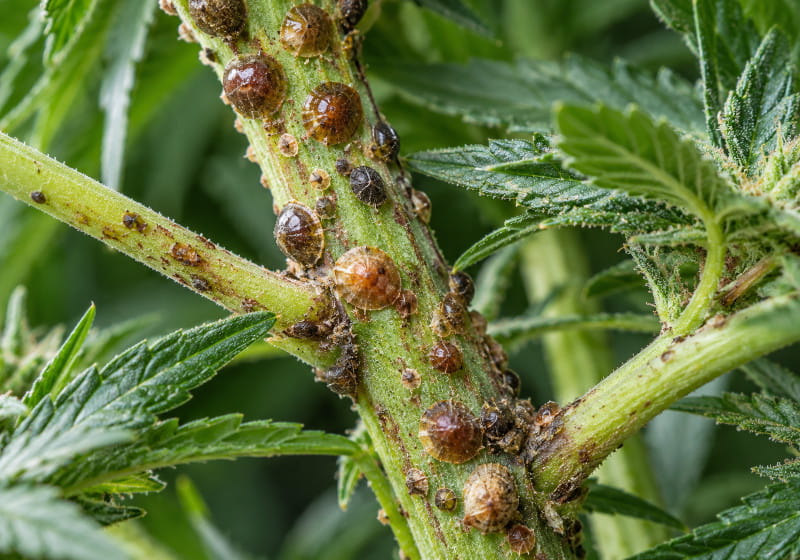
✓ Scale insects belong to the insect group Coccomorpha and feed on plant sap or the contents of plant cells. They include soft scales (Coccidae), armored scales (Diaspididae) and mealybugs (Pseudococcidae). This guide focuses primarily on soft and armored scales; mealybugs are covered in detail in a separate Canna Wiki article.
✓ Soft scales often have a domed covering that is part of their body and typically excrete honeydew while feeding. Armored scales, by contrast, are protected by a separate cover made of wax and shed skins, which can be lifted away from the insect. Unlike soft scales, armored scales do not produce honeydew.
✓ Scale insects may appear as small, rounded or elongated bumps on cannabis stems, shoots and leaf veins. Depending on the species and developmental stage, their color ranges from pale beige and yellowish to dark brown. Because natural plant structures can look similar, their shape, surface, location and other signs of infestation should be assessed together.
✓ Visible scale covers do not necessarily mean live insects are still present. Protective coverings can remain attached to a plant after the insects die. An active infestation is more reliably identified through living specimens, mobile young stages and newly established colonies during repeated inspections.
✓ Effective control starts with identifying the scale insect group as accurately as possible and assessing the actual infestation. Mechanical measures, regular inspections and suitable natural enemies may help limit populations. Since no beneficial insect works against every scale species, biological control must be selected specifically. Pesticides are subject to the relevant national authorization and application rules.
Small brown or beige bumps on cannabis stems and branching points may indicate a scale insect infestation. These inconspicuous insects often sit close to the plant surface and can be difficult to distinguish from natural structures at first glance. Leaf scars, cork formation and other changes in plant tissue can produce similar bumps. Appearance alone is therefore not enough for a reliable diagnosis. What matters is whether characteristic scale insect features and evidence of an actual infestation can be found.
Scale insects vary considerably in body structure, lifestyle and the damage they can cause, depending on their family and species. This Canna Wiki guide focuses on soft scales and armored scales: their typical features, potential damage symptoms and how to distinguish an active infestation from old remains or harmless plant structures. Other causes of unusual changes to leaves and stems are covered in our Cannabis Plant Problems & Diseases category.
What are scale insects?
Scale insects are plant-feeding insects belonging to the order Hemiptera. Within the suborder Sternorrhyncha, they form a diverse group commonly known today as Coccomorpha. The name Coccoidea is also widely used in scientific literature. Their precise taxonomic placement and rank vary between classification systems.
In many scale insect species, females become permanently or temporarily attached to a host plant during development. They use specialized piercing-sucking mouthparts to extract plant sap or the contents of individual plant cells. Despite their shared name, scale insects do not all have the same kind of protective covering: in soft scales the covering is integrated with the body, whereas armored scales produce a separate cover made from wax and cast skins. Mealybugs (Pseudococcidae) also belong to this insect group but are classified as a separate family and differ in their characteristic wax secretions.
Scale Insect Species: What Is Confirmed on Cannabis?
Not every scale insect species found on other cultivated plants has also been confirmed as a pest of cannabis. It is therefore important to distinguish confirmed host-plant relationships from scientific mentions and species used solely for identification or comparison.
A scientific review published in the Journal of Integrated Pest Management in 2024 examines pests associated with hemp (Cannabis sativa). The following table, however, presents selected scale insect species as taxonomic examples for comparison; it must not be interpreted as a species list from that publication or as evidence that these species occur on cannabis. Examples used to distinguish families include Parthenolecanium corni and Saissetia coffeae (Coccidae), Icerya purchasi (Monophlebidae), and Aonidiella aurantii (Diaspididae). Pseudococcus longispinus belongs to the mealybugs (Pseudococcidae). These examples are not a list of confirmed cannabis host records.
Listing a species for comparison does not demonstrate that it infests cannabis. In particular, species mentioned in identification keys or diagnostic comparisons must not be classified as typical cannabis pests without additional evidence.
| Species | Family | Classification and context | Cannabis host record |
| Parthenolecanium corni | Coccidae | Soft scale with numerous known host plants; relevant to scale insect identification. | Not verified here; not classified as a confirmed cannabis pest. |
| Saissetia coffeae | Coccidae | Soft scale known from a range of cultivated and ornamental plants. | Not verified here; not classified as a confirmed cannabis pest. |
| Icerya purchasi | Monophlebidae | Scale insect with conspicuous wax secretions; belongs to neither the soft scales nor the armored scales. | Not verified here; not classified as a confirmed cannabis pest. |
| Pseudococcus longispinus | Pseudococcidae | Mealybug with characteristic wax filaments; included here solely to distinguish taxonomic groups. | Not verified here; not classified as a confirmed cannabis pest. |
| Aonidiella aurantii | Diaspididae | Armored scale found on citrus plants, among other hosts, and used here as a comparison species. | Not verified here; not classified as a confirmed cannabis pest. |
This table provides taxonomic and diagnostic orientation; it is not a list of confirmed cannabis pests. Specific cannabis host records for the species shown have not been independently verified here. General host-plant information cannot establish how frequently they occur on cannabis, their economic significance or possible damage thresholds. In practice, distinguishing the main scale insect groups is therefore more important initially than prematurely assigning a particular species.
Soft scales and armored scales compared
Soft scales and armored scales differ primarily in the structure of their protective covering and how they feed. These biological differences affect their appearance, the damage they may cause and the features used to identify them.
| Feature | Soft scales (Coccidae) | Armored scales (Diaspididae) |
| Protection | The body and its protective covering form a single integrated structure. | Separate protective cover made of wax and shed skins. |
| Body shape | Often oval, domed or approximately hemispherical. | Usually flat to slightly raised, rounded or elongated. |
| Feeding | Primarily feed on sugar-rich phloem sap. | Feed on cell contents from plant tissue. |
| Honeydew | Excreted by many species and may leave sticky deposits. | Do not produce their own honeydew. |
| Sooty mold | Can grow on excreted honeydew. | Not caused by their own honeydew secretion. |
| Mobility | Young crawlers are mobile; later female stages remain mobile in some species. | Crawlers are mobile; females usually become stationary after settling. |
| Identification | The body covering cannot be lifted off as a separate shield. | The protective cover can be carefully separated from the insect beneath it. |
The removable protective cover is an important distinguishing feature of armored scales. Ideally, this examination should be performed on an already collected specimen under suitable magnification. Color, size and location alone are insufficient for reliable identification. Although characteristic features often allow the two families to be distinguished, identifying individual species frequently requires microscopic examination.
What do scale insects look like on cannabis?
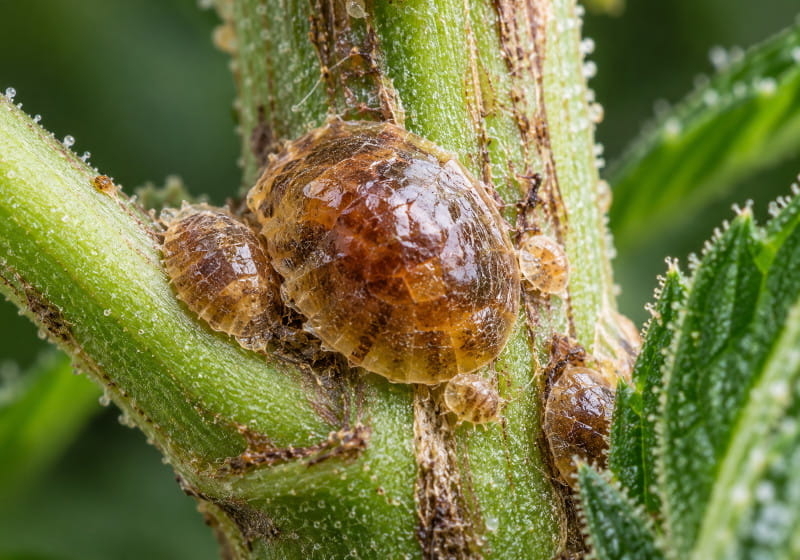
Scale insects often appear as small, firmly attached bumps that hardly resemble insects at first glance. Depending on the species and developmental stage, they may be rounded, oval or elongated and range in color from yellowish and beige to brown, gray or almost black. In particular, stationary female stages are easily confused with natural changes in the plant surface.
When inspecting a potentially affected cannabis plant, pay particular attention to stems, branching points, leaf stalks, leaf veins and leaf undersides. Scale insects may occur individually or in larger groups. While many adult females remain attached to one location, newly emerged young stages, known as crawlers, are initially mobile. Their small size means they are often overlooked without a magnifying glass.
However, not every unusual bump is a pest. Leaf attachment points, natural corking and old injuries can produce similar structures. Unlike scale insects, these changes are part of the plant tissue and do not have a separate insect body. Close examination of the surface and accompanying features allows a more reliable assessment.
Distinguishing living scale insects from old covers
A visible scale cover does not necessarily mean a living insect remains underneath. After death, both the body remains of soft scales and the protective covers of armored scales can remain attached to the plant for an extended period. The number of visible covers therefore does not necessarily correspond to the number of living insects.
Clearer signs of an active infestation include living specimens, mobile young stages and newly colonized areas detected during repeated checks. Careful examination of suitable samples under magnification may reveal whether a living insect is still present beneath a covering. Empty, dry or damaged covers are more consistent with a past infestation. However, live scale insects may still be present elsewhere on the plant even when individual covers are abandoned or contain dead insects.
Brown bumps alone do not prove the presence of scale insects. A sound assessment combines characteristic body features, evidence of living specimens and observations made over several inspections.
What damage can scale insects cause?
Scale insects damage their host plants by extracting plant sap or cell contents. The consequences depend especially on the scale species, number of insects, duration of infestation and overall condition of the plant.
Possible symptoms range from small discolored spots and yellowish leaf areas to reduced growth and the death of individual plant parts under heavy infestation. However, these changes are not unique to scale insects. Other sap-feeding pests, nutrient problems or unfavorable environmental conditions can cause similar symptoms. Visible damage should therefore always be checked against evidence of the insects actually responsible.
There are currently few reliable species-specific damage thresholds for cannabis that would allow a particular number of scale insects to be linked directly to yield or quality losses. A few individuals do not automatically indicate serious damage. More important are whether the infestation is growing, whether it spreads to other plant parts and whether new symptoms develop at the same time.
Honeydew and sooty mold: which scale insects cause sticky leaves?
Many soft scales feed on sugar-rich phloem sap and excrete excess sugars as honeydew. Sticky deposits can accumulate on leaves and other plant parts, providing a suitable surface for the growth of sooty mold fungi.
Sooty mold usually appears as a dark surface coating which, when extensive, may reduce the amount of light reaching the leaves. Unlike powdery mildew, it mainly grows on sugary deposits rather than parasitizing plant tissue. However, honeydew and sooty mold are not definitive evidence of soft scales: aphids, mealybugs and whiteflies can also produce these deposits. Armored scales do not produce their own honeydew. Sticky leaves are therefore a possible accompanying sign of certain scale insect groups, but not a universal identifying feature.
Scale insects, mealybugs or aphids?
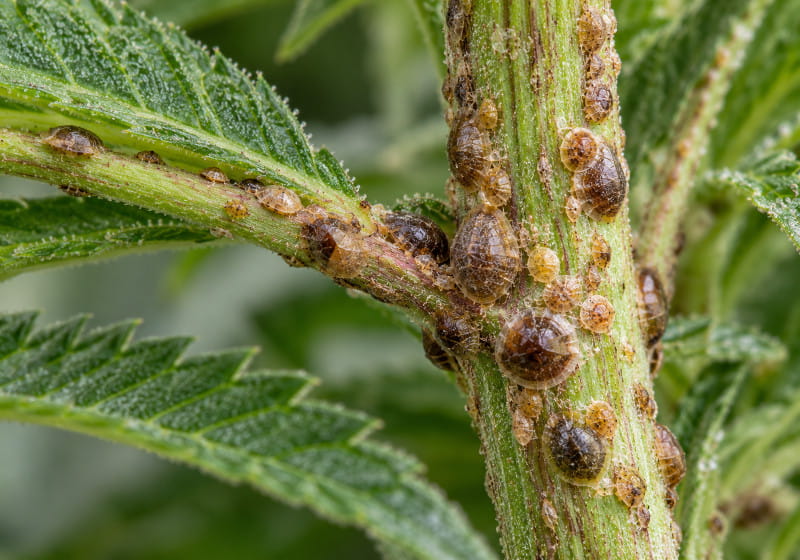
Soft scales, armored scales, mealybugs and aphids can cause similar plant damage, but differ substantially in body structure and appearance. Body shape, wax secretions and mobility are therefore especially important for reliable identification. Yellowing leaves or sticky honeydew alone are not enough to distinguish them.
| Feature | Soft / armored scales | Mealybugs | Aphids |
| Appearance | Usually small, firmly attached, rounded or elongated bumps with a protective body covering. | Soft-bodied insects with whitish, often cottony or threadlike wax secretions. | Soft-bodied, usually pear-shaped insects with clearly visible legs and antennae. |
| Mobility | Young crawlers are mobile; older females often remain in one place. | Many developmental stages remain mobile and can move to different locations. | Nymphs and adults are generally mobile; winged forms occur in many species. |
| Honeydew | Typical of many soft scales; armored scales do not produce their own honeydew. | Produced by many species and may cause sticky deposits. | Common in many species; large colonies may leave substantial honeydew deposits. |
| Typical locations | Stems, branching points, leaf stalks, leaf veins and leaf undersides. | Leaf axils, branching points, sheltered plant areas and leaf undersides. | Especially young shoots, tender plant parts and leaf undersides. |
| Key diagnostic features | Structure of the body covering and evidence of the insect beneath or integrated with it. | Characteristic wax filaments or cottony deposits with a soft-bodied insect underneath. | Pear-shaped body, visible legs and, in many species, two small abdominal tubes (cornicles). |
Our guide to aphid infestations on cannabis provides a detailed overview of identification, damage symptoms and possible control measures. Whiteflies on cannabis can also excrete honeydew and thereby promote sooty mold. Although mealybugs also belong to the scale insect group, they form a separate family, Pseudococcidae. Because of their conspicuous wax secretions, body structure and lifestyle, we cover them in detail in a separate Canna Wiki article.
How to inspect for scale insects: step by step
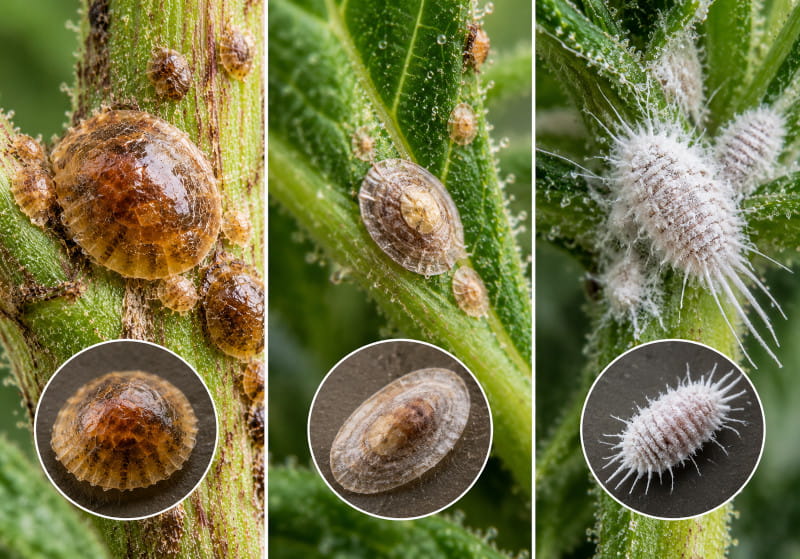
A systematic inspection helps distinguish scale insects from natural plant structures and assess whether an infestation is active. Examine not just individual bumps but also their distribution and any changes observed over repeated inspections.
1. Document suspicious locations: Photograph unusual bumps on stems, branching points, leaf stalks or veins and record their exact position. Then inspect adjacent plant parts and other plants for similar signs.
2. Use magnification: Examine suspicious areas with a suitable magnifying glass. Look for body shape, surface texture, protective coverings and possible cast skins. Very small, mobile young stages can easily be missed without magnification. Color and size alone do not allow reliable species identification.
3. Rule out natural plant structures: Determine whether the bump is part of the plant tissue or a separate body sitting on the surface. Leaf scars, corking and old injuries can resemble scale insects. Avoid unnecessarily scraping or damaging healthy plant tissue.
4. Establish whether the infestation is active: Look for living scale insects, mobile first-instar nymphs and newly colonized areas. Living insects may still be present beneath some older covers. Conversely, dead scales and their protective covers often remain attached even after the original infestation has declined.
5. Compare changes over time: Reinspect the same plant areas later and compare them with the original photographs. Pay particular attention to new scales, growing clusters or colonization of additional plant parts.
6. Seek expert identification when needed: If the scale insect group cannot be identified confidently, clear macro photographs or carefully collected specimens can be submitted to a qualified advisory or diagnostic service. Identifying individual species often requires microscopic examination.
Not every brown bump is a scale insect, and not every visible cover contains a living insect. Only characteristic features combined with repeated inspections provide a reliable assessment.
Life cycle and spread
In many scale insect species, the mobile first-instar nymphs, known as crawlers, play a central role in colonizing new plant parts. After hatching or being born, they move away from the mother and search for a suitable feeding site. They settle there and continue their development.
The subsequent life cycle varies considerably by family and species. Many females lose most of their mobility as they develop and remain attached to the host plant. In numerous species, males instead develop into small winged insects that no longer feed as adults and generally live only briefly. Reproduction also varies: depending on the species, eggs may be laid or live young produced, and reproduction may be sexual or asexual. There is therefore no single developmental period that applies to all scale insects.
Scale insects are frequently introduced through infested plants, cuttings or other plant material. Mobile crawlers can spread within a plant and between closely adjacent plant parts. Because of their small size, passive dispersal, for example by air currents, is also possible under suitable conditions. Ants may also visit honeydew-producing scale insects to feed on their sugary secretions. Some ant species protect such colonies from natural enemies, potentially encouraging their development. However, this relationship does not occur with all scale insects.
What should you do after confirming a scale insect infestation?
Once an infestation has been confirmed, first assess the scale insect group involved, the extent of colonization and whether the insects are currently active. A few old covers left behind do not call for the same response as a growing colony containing living females and numerous mobile young stages.
Where possible, separate affected plants from unaffected ones and carefully inspect nearby plants. Individual accessible scale insects can be gently removed mechanically from suitable plant parts without unnecessarily injuring the surface. If a heavy infestation is confined to a small area, removing individual heavily colonized plant parts may also be appropriate. Dispose of removed material in a way that prevents living insects from re-entering the growing area. The appropriate measure depends on the actual extent of infestation and the condition of the plant.
Mobile crawlers deserve particular attention because they have not yet developed the fully formed protective covering of older stages and may be easier to reach with certain control methods. By contrast, the covers and wax secretions of older insects can reduce the effectiveness of direct contact treatments. When checking the outcome, the key question is therefore not whether every visible cover has disappeared. What matters more is whether the number of living insects is declining and no new colonies are forming.
Biological control: which beneficial insects help against scale insects?
Parasitoid wasps and predatory insects are among the most important natural enemies of many scale insect species. Their effectiveness depends on the target species, its developmental stage and the conditions under which the beneficial organisms are used.
Parasitoid wasps of the genus Aphytis are used for biological control of certain armored scales. Species of Metaphycus and Coccophagus, among others, may be effective against particular soft scales. Various predatory lady beetles also feed on scale insects or their immature stages. Most of this evidence comes from fruit production, ornamental horticulture and gardening and cannot automatically be transferred to cannabis. Before a targeted release, the scale species, suitable environmental conditions, availability of beneficial organisms and applicable legal requirements must all be considered.
Broad-spectrum pesticides may harm natural enemies as well as the pests themselves. Integrated pest management (IPM) therefore combines reliable identification, regular monitoring, suitable mechanical measures and the conservation or targeted use of natural enemies. The aim is to choose measures appropriate to the actual infestation rather than rely on a single blanket treatment.
Contact treatments and pesticides: important limitations
A pesticide approved for fruit trees or ornamental plants is not automatically authorized for use on cannabis. The applicable national regulations and the specific authorization for the crop, target pest and intended use must always be followed.
Particular care is required with plant material intended for later consumption or processing. Residues on flowers and other plant parts can pose a relevant risk. Untested home remedies, aggressive mixtures or general spraying advice that ignores the crop and developmental stage are therefore not reliable solutions. Wherever pesticide use is legally permitted, all relevant authorization conditions, application instructions and safety requirements must be followed in full.
The key indicator is not whether all visible covers disappear, but whether living scale insects and new colonies decline. Regular follow-up inspections show whether the selected measures are actually working.
Preventing scale insects through regular plant inspections
The most important preventive step is to carefully inspect newly introduced plants, young plants and cuttings. Since small scale insects and their early stages are easy to overlook, temporarily observing new plants separately can help detect an introduced infestation before the insects spread to other plants.
Regular visual inspections should not be limited to the upper leaf surfaces. Leaf undersides, leaf stalks, stems and hard-to-reach branching points also deserve attention. A clear plant layout, clean tools and careful handling of plant material support early detection and can reduce accidental spread. Outdoors, natural enemies may help regulate scale insect populations under suitable conditions. Other host plants nearby and ants that protect honeydew-producing species can also influence infestation development.
Regular plant inspections can be incorporated into routine care using our Cannabis Grow Calendar. When choosing outdoor cannabis seeds, the main considerations should be local climate and how well a variety suits the site. This does not establish any generally proven resistance of particular cannabis varieties to scale insects.
FAQ: Frequently asked questions about scale insects on cannabis
What are scale insects on cannabis?
Scale insects are plant-feeding insects belonging to Coccomorpha. Many species appear as small, firmly attached bumps on stems, shoots or leaves. Important families include soft scales, armored scales and mealybugs. Whether a particular species actually infests cannabis must be established using appropriate evidence.
How can you identify scale insects on cannabis stems?
Typical signs are small, rounded or elongated bumps firmly attached to the plant surface. Depending on the species, they may be beige, brown, gray or dark in color. A magnifying glass helps examine the body covering and other features. Individual brown spots, however, are not conclusive evidence.
Are brown spots on cannabis stems always scale insects?
No. Natural corking, leaf scars and old injuries can also create scale-like bumps. What matters is whether a separate insect body, a characteristic protective covering or mobile young stages can be identified.
What is the difference between soft scales and armored scales?
In soft scales, the protective body covering is integrated with the insect. Armored scales have a separate protective cover made of wax and shed skins. Many soft scales also excrete honeydew, whereas armored scales do not produce their own honeydew.
Do all scale insects produce honeydew?
No. Many soft scales and mealybugs excrete sugary honeydew, but armored scales do not. Sticky leaves can also result from aphids or whiteflies. Honeydew alone therefore does not identify the pest reliably.
Are mealybugs also scale insects?
Yes. Mealybugs belong to the family Pseudococcidae within Coccomorpha. Unlike typical soft and armored scales, they often have conspicuous white, cottony or threadlike wax secretions. Their distinctive features and biology are covered in a separate Canna Wiki article.
Can scale insects fly?
Adult females of many scale insect species are largely immobile. In some species, however, males develop into small winged insects. Mobile first-instar nymphs, known as crawlers, are particularly important for colonizing new plant parts.
How can you tell whether scale insects are still alive?
Living specimens, mobile crawlers and newly colonized plant parts are important signs of an active infestation. Old body remains or protective covers can stay attached after the insects die. Repeated checks help distinguish an old infestation from an ongoing one.
Which beneficial insects help control scale insects?
Depending on the target species, parasitoid wasps such as certain Aphytis, Metaphycus or Coccophagus species and predatory lady beetles may contribute to biological control. Their effectiveness is species-specific and depends on conditions. There is no universally effective beneficial insect for all scale species.
Can scale insects occur indoors?
Yes. Scale insects may enter indoor growing areas on infested young plants, cuttings or other plant material. Since infestations can remain unnoticed for a long time, regular checks of stems, leaf stalks and leaf undersides are useful indoors too.
Sources & further reading
Journal of Integrated Pest Management (2024) – Arthropod and Mollusk Pests of Hemp: Scientific publication. Review of arthropods and mollusks associated with hemp (Cannabis sativa). Provides a basis for assessing hemp-related pests and distinguishing documented records from general diagnostic comparisons.
University of Maryland Extension – Introduction to Scale Insects: Scale insect reference. Explains body structure, development, characteristic differences between soft and armored scales and basic identification features.
University of California – Integrated Pest Management: Scales: Scale insect IPM guide. Practical information on identifying scale insect groups, typical plant damage, infestation monitoring and integrated management options.
University of California – Integrated Pest Management: Soft Scales: Soft scale reference. Covers the biology of soft scales (Coccidae), honeydew and sooty mold formation and the role of natural enemies in horticulture.