Whiteflies on Cannabis: Infestation and Control
Whiteflies on Cannabis: Infestation and Control Measures
Updated: August 2026 | Learn how to identify whiteflies on cannabis, what damage whiteflies can cause, and which measures are useful in the event of an infestation.
Author: Cannapot Grow Team | Reading time: approximately twenty-five minutes
The Most Important Points at a Glance
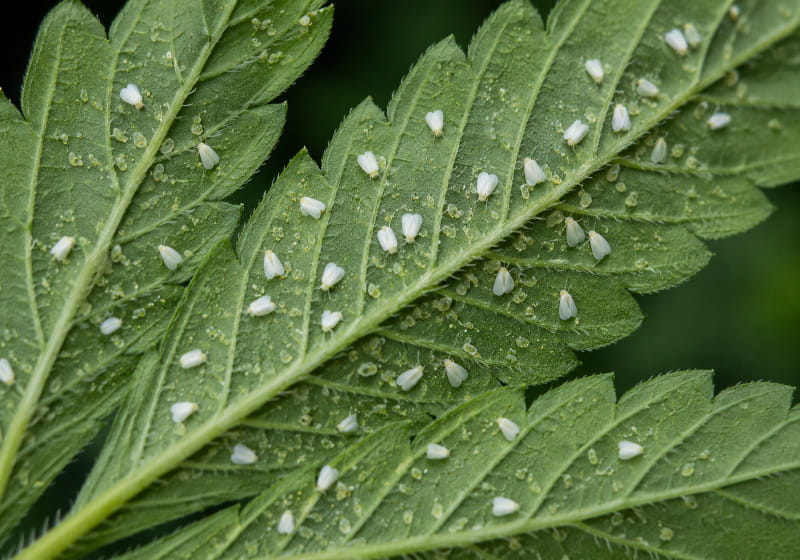
✓ Despite their name, whiteflies are not true flies, but members of the whitefly family. The insects, which are only about one to two millimetres in size, usually sit on the undersides of cannabis leaves. If an infested leaf is moved, the white insects often take flight immediately.
✓ The undersides of the leaves are home not only to the adults, but also to eggs and various developmental stages. The flat, almost immobile nymphs in particular are barely noticeable and are therefore easily overlooked.
✓ In heavier infestations, cannabis leaves may turn yellowish, growth may slow, and the leaf surface may become sticky. This is caused by honeydew, on which dark sooty mould can later develop.
✓ Yellow sticky traps are especially useful for detecting an infestation early and keeping track of the number of flying adults. However, they do not catch eggs and nymphs on the leaves, which is why yellow sticky traps alone are usually not enough.
✓ Indoors and in greenhouses, beneficial insects such as the parasitic wasp Encarsia formosa can provide useful support. Which measure is suitable depends mainly on how severe the infestation is and on the stage of growth the plant is in.
✓ During flowering, sprays should be used with particular caution. Flowers should, where possible, not be wetted with soaps, oils or other preparations; with any product, suitability and legal approval must always be taken into account.
You move a cannabis plant and suddenly several tiny white insects fly up from the leaves. On closer inspection, more insects are sitting on the undersides of the leaves, or individual leaves feel noticeably sticky. These are typical signs of whiteflies, which actually belong to the whitefly family. The adults are relatively easy to spot, whereas their eggs and young developmental stages are much less conspicuous.
Whiteflies can occur indoors, in greenhouses and outdoors. If you suspect an infestation, you should therefore turn over several leaves and inspect the undersides carefully. In addition to the adults, eggs and nymphs can also be found there. Sticky honeydew and changes to the leaves provide further clues. Our overview of outdoor cannabis pests also shows which other pests may be involved.
What Are Whiteflies on Cannabis?
Whiteflies are small sap-sucking insects from the whitefly family (Aleyrodidae). Despite their name, they are not true flies. Adult insects are only about one to two millimetres long and are most noticeable because of their white, powdery wings.
Whiteflies belong to the order Hemiptera and are related, among others, to aphids and scale insects. Adults and several of their developmental stages feed on plant sap. To do so, they pierce plant tissue with their mouthparts. A few insects may initially go almost unnoticed, but larger populations can increasingly put stress on a cannabis plant.
Why Are Whiteflies Also Called Aleyrodids?
The term whitefly actually suits their appearance quite well. With their white wings, the adults resemble tiny moths. The young developmental stages, however, look completely different: they are flat, sit closely against the underside of the leaf and, after the first larval stage, hardly move at all.
The adults owe their striking white colour to a fine waxy coating on their bodies and wings. This makes the small pests relatively easy to recognise despite their tiny size – especially when several of them take flight at once as an infested leaf is moved.
Which Species of Whitefly Can Infest Cannabis?
Two well-known whitefly species are particularly relevant to cannabis: the greenhouse whitefly (Trialeurodes vaporariorum) and the tobacco whitefly (Bemisia tabaci). Both can live on a wide range of different plants and, under suitable conditions, can also infest cannabis.
Greenhouse Whitefly – Trialeurodes vaporariorum
Trialeurodes vaporariorum is especially well known from greenhouses and occurs on many vegetable and ornamental plants. Warm, sheltered conditions provide good conditions for reproduction. The adults prefer the undersides of younger leaves, where they also lay their eggs.
As the plant continues to grow, the nymphs that are already present remain on their leaves. This is why the older developmental stages are often found on lower leaves, while the adults tend to stay on younger leaves. In a heavier infestation, eggs, nymphs and adult whiteflies can therefore all be present on a single cannabis plant at the same time.
Tobacco Whitefly – Bemisia tabaci
Bemisia tabaci can also infest a large number of different plants and thrives particularly well in warm conditions. The adults appear slightly more yellowish than greenhouse whiteflies. The position of the wings also differs somewhat, which can provide an indication of the species on very close inspection.
For a grower, however, this distinction is usually of secondary importance in everyday practice and cannot always be made reliably with the naked eye anyway. The first step is to determine whether whiteflies are actually present and how far the infestation has already spread. The exact species may then become important, for example if beneficial insects are to be used in a targeted way.
How Can You Identify Whiteflies on Cannabis?
An infestation can often be recognised simply because several tiny white insects suddenly take flight when a leaf is moved. More adults, eggs and flat nymphs are usually found on the underside of the leaf. If sticky areas or yellowish discolouration are also present, a closer inspection is worthwhile.
What Do Adult Whiteflies Look Like?
Adult whiteflies are only about one to two millimetres long. Their bodies and wings are covered with a fine white waxy coating, making them look almost like tiny white moths. At rest, the wings lie roof-like or slightly to the sides over the body.
A single insect is easy to overlook. Once whiteflies have multiplied more strongly, several are often found on the underside of a single leaf. There they suck plant sap and also lay their eggs.
What Do Whitefly Eggs Look Like?
The eggs are tiny and are found mainly on the undersides of leaves. Depending on the species, they are laid singly or in groups, sometimes in a circular arrangement. Fresh eggs are usually pale and may become darker as they develop.
Individual eggs are difficult to see with the naked eye. A magnifying glass is therefore useful if adult whiteflies have already been discovered and you want to find out whether they are already reproducing on the plant.
What Do Larvae and Nymphs Look Like?
After hatching, the first larval stage is still mobile and searches for a suitable place on the underside of the leaf. This stage is also known as a crawler. After that, the insects become largely immobile and remain flat against the leaf.
The nymphs are oval, flat and, depending on the developmental stage, almost transparent to whitish. This makes them much less conspicuous than the adults, and they can easily be mistaken for small pieces of plant debris. The final nymphal stage is often referred to as the puparium. The adult whitefly eventually emerges from it.
Where Do Whiteflies Sit on the Cannabis Plant?
When looking for whiteflies, you should first inspect the undersides of cannabis leaves. This is where the adults stay, where the eggs are laid and where the nymphs develop. Adults and eggs are often found on younger leaves, whereas older nymphs tend to be found on leaves that have been on the plant for longer.
From above, an infested cannabis plant may initially look completely normal. If you suspect an infestation, you should therefore not rely only on the visible damage pattern, but carefully lift several leaves and inspect them from below.
Why Do Whiteflies Take Flight When the Plant Is Moved?
Adult whiteflies react quickly to disturbances. If a colonised leaf is moved or the plant is lightly shaken, the insects take flight. They usually remain nearby and settle on a leaf again a short time later. This behaviour is one of the most noticeable signs of an infestation.
| Feature | What Indicates Whiteflies? | How to Check |
| Small white insects | Adults are only about 1–2 mm long and resemble tiny white moths | Inspect the undersides of the leaves closely |
| Insects suddenly take flight | When infested leaves are moved, the adults often fly up immediately | Gently move a suspicious leaf |
| Flat nymphs | They are oval, flat and sit almost motionless on the underside of the leaf | Use a magnifying glass to look for pale, flat nymphs |
| Sticky leaves | In heavier infestations, excreted honeydew can make the leaves sticky | Also inspect leaves below the infested areas |
| Yellowish leaves | Prolonged sap feeding can lead to pale or yellowish discolouration | Inspect the undersides of discoloured leaves for insects and nymphs |
| Dark coating | Dark sooty mould fungi can grow on sticky honeydew | Look for honeydew and an infestation on leaves above |
What Damage Do Whiteflies Cause to Cannabis?
Whiteflies suck plant sap from cannabis leaves and can significantly weaken the plant in a heavier infestation. A few individual insects usually do not cause visible damage. However, if the pest is allowed to reproduce unchecked, yellowish leaves, reduced growth and sticky honeydew can result.
Yellow Spots and Chlorosis
When large numbers of whiteflies and their nymphs feed on the leaves over a longer period, the damage becomes increasingly visible. The leaves may first become paler in places and later develop yellowish areas. In a severe infestation, the entire plant visibly loses vigour, growth may slow and individual leaves may die prematurely.
Yellow leaves alone, however, are not enough to identify whiteflies with certainty. Similar discolouration can also be caused by nutrient problems, other sap-sucking pests or stress. The decisive step is therefore to look underneath the leaves: if whiteflies, eggs or flat nymphs are present there, the cause becomes much clearer.
Why Do Cannabis Leaves Become Sticky During an Infestation?
Another noticeable sign is a sticky or slightly glossy coating on the leaves. While feeding, whiteflies take in sugar-rich plant sap and excrete part of it again. This sugary liquid is known as honeydew.
Honeydew does not remain only on the infested leaf itself, but can also drip onto leaves below. If these suddenly feel sticky, you should therefore also inspect the undersides of the leaves above them. Whiteflies are not the only pests that produce honeydew, however. Aphids on cannabis can also leave sticky deposits.
What Is Sooty Mould and Why Can It Develop?
So-called sooty mould fungi can colonise sticky honeydew. They form a dark grey to black coating on the leaves and other parts of the plant. The fungi do not directly infect the plant tissue, but instead grow on the sugary excretions of the pests.
A light coating is initially mainly a sign that larger amounts of honeydew are already present. If the sooty mould spreads heavily, however, it can cover parts of the leaf surface and thereby impair photosynthesis. At that point, the sticky honeydew becomes an additional problem for the plant.
What Happens in a Severe Infestation?
A few individual whiteflies will not normally throw a healthy cannabis plant out of balance. It becomes problematic when the insects reproduce unnoticed and colonise more and more leaves. Numerous adults and nymphs then feed on the plant at the same time. Growth may decline, leaves can yellow and wilt and, in severe infestations, eventually fall off.
At the same time, the amount of honeydew increases, and with it the risk of sooty mould. Young, small or already weakened plants in particular can suffer from a heavy infestation. What matters is therefore not a single whitefly you have discovered, but whether eggs, nymphs and adults are already present on several leaves and their numbers are visibly increasing.
Whitefly or Another Cannabis Pest?
Whiteflies can be identified mainly by three things: the adults are tiny, white and moth-like, they prefer to sit under leaves, and they often take flight when disturbed. If eggs and flat nymphs are also present there, the infestation can be distinguished fairly well from many other cannabis pests.
| Feature | Whitefly | Aphid | Thrips | Fungus gnat | Mealybug |
| Appearance | 1–2 mm, white, moth-like | Soft, usually pear-shaped, various colours | Very narrow and elongated | Small dark, gnat-like insects | Whitish, waxy, often cottony |
| Typical location | Mainly on leaf undersides | Young shoots and leaf undersides | Leaves, young shoots and flowers | Adults around the growing medium, larvae within it | Leaf axils, stems and sheltered areas |
| Behaviour when disturbed | Often flies off the leaf immediately | Usually remains in place; only winged forms fly | Runs quickly and may also fly up | Flies mainly near the ground and growing medium | Does not take flight |
| Honeydew / sticky leaves | Typical in heavier infestations | Also typical | Not typical | No | Possible |
| Typical damage pattern | Pale areas, yellowing, honeydew | Deformed shoots and leaves, honeydew | Silvery spots or streaks, often with dark faecal specks | Primarily root damage caused by the larvae | Feeding damage, growth problems and honeydew |
| Juvenile stages | Flat nymphs on the underside of the leaf | Young aphids resemble smaller adult aphids | Pale, slender larvae on the plant | Pale larvae with a dark head in the growing medium | Young stages also on the plant |
Whiteflies or Aphids?
Whiteflies and aphids have one striking thing in common: both suck plant sap and excrete sticky honeydew. So simply because cannabis leaves feel sticky, you still cannot tell which of the two pests is responsible.
The difference usually becomes clear on closer inspection. Aphids have soft, rather stocky to pear-shaped bodies, and many of them are wingless. Whiteflies, on the other hand, are covered in a white powdery wax and often take flight immediately when an infested leaf is moved. If you are unsure how to tell them apart, you can find more distinguishing features in our article on aphids on cannabis.
Whiteflies or Thrips?
Thrips look quite different. They are narrow and elongated and often leave silvery pale areas or streaks on the leaves. Small dark faecal specks near these areas are another typical clue. Adult thrips can also fly, but they do not look like the small white, moth-like whiteflies.
If you mainly discover silvery areas on the leaves and dark specks, without numerous white insects taking flight when the leaves are moved, you should also consider an infestation with thrips on cannabis.
Whiteflies or Fungus Gnats?
Fungus gnats can usually be distinguished from whiteflies quite well simply by where they are found. The small dark gnats spend most of their time near the growing medium, while their larvae develop within it. Whiteflies and their developmental stages, by contrast, are found directly on the leaves, especially on their undersides.
If small dark gnats fly up from the soil when watering or moving the pot, this points more towards fungus gnats on cannabis. If, on the other hand, small white insects rise from the underside of a leaf when it is touched, whiteflies fit the finding much better.
Whiteflies or Spider Mites?
Spider mites are tiny arachnids and cannot fly. An infestation often shows up as many small pale dots on the leaves. Once the mites have multiplied heavily, fine webbing may also become visible between leaves, petioles and shoots. Whiteflies do not produce this kind of webbing.
If you mainly see fine pale leaf spots or even the first signs of webbing, but no white insects taking flight, you should compare the damage with spider mites on cannabis.
How Does the Whitefly Develop and Reproduce?
Whiteflies pass through several developmental stages directly on the plant. Mobile larvae first hatch from the eggs. After they have found a suitable place, the following nymphal stages become largely immobile. The adult whitefly eventually emerges from the final stage. How quickly this cycle proceeds depends, among other things, on the species, temperature and host plant.
| Developmental Stage | Appearance / Behaviour | Where You Find It |
| Egg | Tiny, usually pale at first and sometimes darker later | On the underside of the leaf, often on younger leaves |
| 1st larval stage / crawler | Very small and initially mobile | On the underside of the leaf |
| Further nymphal stages | Oval, flat and almost immobile | Firmly attached to the underside of the leaf |
| Puparium / final nymphal stage | More pronounced than younger nymphs; the adult later emerges from it | Often on older leaves |
| Adult | About 1–2 mm long, powdery white and capable of flight | Mainly on the underside of younger leaves |
How Does Temperature Affect the Life Cycle?
How quickly whiteflies develop depends strongly on temperature. Within a range that is favourable to them, development proceeds faster in warmer conditions. This is why a few insects can turn into a larger population comparatively quickly in a warm grow room or greenhouse. Under cooler conditions, development is slower.
There is no fixed development time, however. In addition to temperature, the whitefly species and the respective host plant also play a role. With the greenhouse whitefly (Trialeurodes vaporariorum), the development from egg to adult can take only a few weeks under favourable conditions. This is why it is worth keeping an eye even on an infestation that initially seems small.
How Do Whiteflies Get onto the Plants?
Whiteflies do not simply appear because of incorrect watering, high humidity or an unfavourable grow climate. The pests first have to reach the plants. They are often introduced on plants or plant material that are already infested. Warmth and sheltered conditions can then allow them to reproduce particularly quickly.
Introduction via Cuttings and Other Plants
One common route into the grow is through plants that are already infested. Cuttings and young plants can be affected just as much as houseplants, herbs or other nearby plants. Adult whiteflies do not even have to be visible: eggs or nymphs can also be brought in unnoticed on a new plant.
This is exactly why early inspection is so important. The flat nymphs sit firmly on the underside of the leaf and are easy to overlook with the naked eye. A newly introduced plant may therefore look completely normal at first and still already be carrying whiteflies.
Which Conditions Encourage an Infestation?
Warm conditions over a longer period and a sufficient supply of suitable host plants are particularly favourable. Indoors and in greenhouses, many natural enemies and weather influences that can at least partly limit a population outdoors are also absent. As a result, whiteflies can reproduce quickly under protected conditions.
Good air circulation and a balanced grow climate are generally sensible, but they do not solve an existing infestation. If eggs and nymphs are already sitting under the leaves, they will not disappear simply because a stronger fan is used. The key therefore remains to detect an infestation as early as possible and respond to it in a targeted way.
Indoors, Greenhouse, Outdoors or Guerrilla – Where Do Whiteflies Occur?
Whiteflies can occur on cannabis indoors, in greenhouses and outdoors. This also applies to plants grown using guerrilla growing methods. The pests feel particularly comfortable in warm, sheltered conditions. Outdoors, however, weather, natural enemies and other host plants in the surrounding area play a greater role.
| Growing Situation | What Is Typical? | What to Watch For |
| Indoor Grow Box | Consistent warmth and few natural enemies can encourage rapid reproduction | Inspect new plants carefully and regularly look under the leaves |
| Greenhouse | Warm, sheltered conditions are particularly favourable for species such as Trialeurodes vaporariorum and Bemisia tabaci | Inspect the crop regularly; yellow sticky traps can help with monitoring and beneficial insects can be introduced early |
| Outdoors | Weather and natural enemies influence development more strongly than under protected conditions | Inspect leaf undersides and keep an eye on other possible host plants in the immediate surroundings |
| Guerrilla Growing | Plants are usually checked less often, so an early infestation can remain unnoticed for longer | At every visit, inspect several leaf undersides and look for white insects taking flight, eggs, nymphs and honeydew |
How Can You Reduce a Whitefly Infestation?
With whiteflies, a single measure often achieves little. It is more useful to first find out how far the infestation has already spread. Mechanical measures, regular checks and – especially indoors or in a greenhouse – suitable beneficial insects can then be combined.
Assess the Severity of the Infestation First
Once you have discovered the first whiteflies, you should not inspect only the affected leaf. Check several leaves and neighbouring plants and pay particular attention to:
- adult whiteflies,
- eggs and flat nymphs,
- sticky honeydew,
- pale or yellowish leaf discolouration,
- dark sooty mould on more heavily affected leaves.
The earlier you find individual infestation hotspots, the easier it is to slow further spread. If eggs, nymphs and adults are already present on many leaves, however, removing only the visible flying insects is not enough.
Remove Heavily Infested Leaves
If only individual leaves are heavily covered with eggs and nymphs, they can be removed carefully. This allows part of the population to be taken directly off the plant. The removed leaves should then not be left beside the plants or placed on an open compost pile from which adults could fly back.
However, this should not be overdone. If many leaves are already affected, heavy defoliation is not a good solution. The plant unnecessarily loses healthy leaf area while some of the whiteflies still remain in the crop.
Can Whiteflies Be Rinsed Off Cannabis?
With a light infestation, carefully rinsing the plant can help mechanically remove some of the whiteflies from the leaves. The undersides of the leaves are especially important because that is where most of the insects and developmental stages are found.
This rarely solves the problem completely, however. Eggs and firmly attached nymphs in particular can remain on the leaves and produce the next generation. Extra caution is required during flowering: dense cannabis flowers should not be soaked unnecessarily, as prolonged moisture there can create new problems.
Do Yellow Sticky Traps Help Against Whiteflies?
Yellow sticky traps are particularly useful for detecting whiteflies early and monitoring how the infestation develops. Flying adults are attracted to the yellow surface and become stuck in the adhesive. A yellow sticky trap does not, however, reach eggs and nymphs under cannabis leaves.
This makes yellow sticky traps a good monitoring tool, and at the same time they can catch some of the adults. If you suddenly find the first whiteflies on them, it is worth checking under the leaves immediately. In a heavier infestation, however, yellow sticky traps alone are not enough because a large part of the population continues to develop directly on the plant.
If beneficial insects are being used at the same time, sticky traps should be handled with care. Useful flying insects can also become trapped on them. The number of yellow sticky traps used and where they are positioned should therefore be compatible with the respective biological control programme.
Which Beneficial Insects Help Against Whiteflies?
Beneficial insects can help bring whiteflies under control, especially indoors and in greenhouses. Tiny parasitic wasps such as Encarsia formosa have proven particularly useful. Depending on the whitefly species, temperature and severity of the infestation, Eretmocerus eremicus, certain predatory mites or other natural enemies may also be suitable.
Encarsia formosa
Encarsia formosa is a parasitic wasp only about half a millimetre long and has been used for many years for the biological control of whiteflies. The females actively search for suitable nymphs on leaf undersides and parasitise them. The offspring of the wasp then develop inside the host, which dies in the process.
In the case of the greenhouse whitefly, successful parasitism can sometimes even be seen with the naked eye: affected nymphs turn dark to black after some time. If such dark nymphs remain on the leaf, this is therefore not necessarily a sign that the beneficial insect is not working.
Some patience is important. Encarsia formosa does not work within a few hours like a contact treatment. The parasitic wasps first have to find and parasitise the nymphs. They are therefore particularly interesting when whiteflies are detected early and a huge population has not yet built up.
Eretmocerus eremicus
Another option is Eretmocerus eremicus. This small parasitic wasp also parasitises whitefly nymphs and is used, among other things, against the greenhouse whitefly (Trialeurodes vaporariorum) and the tobacco whitefly (Bemisia tabaci).
Eretmocerus eremicus also copes with comparatively warm conditions and is therefore used in biological plant protection programmes, depending on the situation, either alone or together with other beneficial insects. Which species is most suitable and how many insects are needed depends, among other things, on temperature, severity of the infestation and area. The specific instructions provided by the respective beneficial-insect supplier should be followed.
Predatory Mites and Other Natural Enemies
Parasitic wasps are not the only option. The predatory mite Amblyseius swirskii feeds, among other things, on whitefly eggs and young nymphs. It is especially useful under warm, protected conditions. At the same time, it can also prey on young developmental stages of certain thrips.
There are also predatory bugs such as Macrolophus pygmaeus, which also feed on whiteflies. However, such beneficial insects are not automatically the best choice for every cannabis plant or every grow. Their suitability depends strongly on the conditions and the available food supply. Some predatory bugs may also pierce plant tissue when prey is scarce.
Do Potassium Soap and Neem Oil Help Against Whiteflies?
Potassium soap and neem are often mentioned when it comes to whiteflies. But it is not quite that simple: whether a product is suitable depends on the specific product, its approval and the plant stage. Homemade remedies are not automatically a good alternative either and, in the worst case, can cause additional damage to the plant.
Potassium Soap – Effects and Limitations
Suitable products based on potassium salts of fatty acids work through direct contact with the pests. With whiteflies, it is therefore essential to reach the undersides of the leaves as well. This is where the adults and a large proportion of the young developmental stages are found.
This should be distinguished from homemade mixtures of washing-up liquid, household soap and water. Such mixtures may contain additional ingredients or be far too concentrated and can therefore damage the leaves. If such a treatment is to be used, a suitable and approved product applied according to the manufacturer's instructions is clearly the better choice.
Neem – Not Automatically Suitable for Every Situation
With neem, too, it is worth looking closely at the specific product. Neem preparations are not all formulated in the same way. Certain products, for example, contain the active ingredient azadirachtin, which can affect feeding and development in various pest insects. However, this should not be taken to mean that any homemade mixture of neem oil and water is suitable for cannabis.
Particular caution is advisable during flowering. Flowers should not simply be sprayed with neem oil or other preparations. The decisive factors are always the approval and intended use of the particular product, as well as the manufacturer's instructions.
What Can You Do Against Whiteflies During Flowering?
During flowering, spray treatments should be used especially sparingly. Residues on the flowers and additional moisture are undesirable. Mechanical measures, regular checks and – under suitable conditions – beneficial insects therefore become particularly interesting during this phase.
If the infestation is still manageable, individual heavily colonised leaves can be removed and the remaining leaf undersides checked regularly. Yellow sticky traps help keep track of adult whiteflies. Indoors and in greenhouses, suitable beneficial insects can also be used without coating the flowers with a spray residue.
In a severe infestation, the temptation to quickly reach for any household remedy is great. Precisely at this stage, however, oils, soaps or homemade mixtures should not be sprayed indiscriminately into the flowers. In addition to possible residues, spray treatment adds extra moisture to dense flowers and can therefore encourage further problems.
How Can You Prevent Whiteflies When Growing Cannabis?
The best approach, of course, is not to bring whiteflies into the grow in the first place. New plants should therefore be inspected thoroughly. It is just as important to look under the leaves regularly, because a small infestation is much easier to bring under control than a population that has already spread across several plants.
- Inspect new plants: Check cuttings, young plants and other plants carefully before bringing them in. The undersides of the leaves are particularly important because eggs and inconspicuous nymphs may be hidden there.
- Keep new plants separate at first: If possible, do not immediately place new plants among the existing crop, but observe them separately for a few days.
- Check under the leaves regularly: Do not wait until numerous white insects are already taking flight when the plant is touched. Individual infestation hotspots are noticed much earlier with regular checks.
- Use yellow sticky traps for monitoring: They can help detect individual adult whiteflies early. However, they do not replace checking the leaves themselves.
- Remove infested plant material: Do not leave cut leaves and other plant debris in the grow area if whiteflies or their developmental stages are present on them.
- Keep an eye on other plants: Houseplants, herbs, vegetables and other nearby plants can also harbour whiteflies and become the starting point of an infestation.
- Keep the grow area clean: Clean work surfaces and tools do not directly prevent whiteflies, but they are part of good plant management and make it easier to monitor the crop.
- Monitor temperature and climate: Whiteflies can reproduce more quickly under continuously warm, protected conditions. The climate should therefore be appropriate for the respective growing situation.
Not every discolouration or abnormality on the leaves is caused by a pest. You can find an overview of other possible causes in our section on cannabis plant problems and diseases.
Which Mistakes Should You Avoid with Whiteflies?
Many problems arise not because nothing is done against whiteflies at all, but because the measures used only address part of the infestation. The developmental stages under the leaves are particularly often overlooked, or yellow sticky traps and one-off treatments are overestimated.
| Common Mistake | Why It Does Not Work |
| Looking only for flying insects | A large part of the infestation is present as eggs or nymphs under the leaves and therefore goes unnoticed. |
| Relying only on yellow sticky traps | The traps mainly catch adults. Eggs and nymphs continue to develop on the plant. |
| Immediately attributing sticky leaves to whiteflies | Aphids and other sap-sucking pests can also leave honeydew. Checking the undersides of the leaves is what provides clarity. |
| Stopping after a single measure | Remaining eggs and nymphs can continue developing. Repeated checks are therefore particularly important. |
| Using washing-up liquid instead of a suitable product | Household products may contain fragrances, surfactants and other additives and can damage the leaves if used at an unsuitable concentration. |
| Spraying indiscriminately during flowering | Preparations can leave residues and introduce additional moisture into the flowers. Particular caution is required during this phase. |
| Introducing beneficial insects immediately after spray treatments | Residues from certain products can also harm parasitic wasps, predatory mites and other beneficial insects. Compatibility and waiting periods should be checked beforehand. |
| Adding new plants without inspecting them | Eggs and flat nymphs in particular are easily overlooked and can therefore enter a previously clean crop unnoticed. |
FAQs About Whiteflies on Cannabis
Q: Are whiteflies really flies?
A: No. Despite their name, whiteflies belong to the whitefly family (Aleyrodidae) and are related, among others, to aphids and scale insects. They get their name from the powdery white wings of the adults.
Q: How large are whiteflies on cannabis?
A: Adult whiteflies are usually only about one to two millimetres long. Despite this, the white waxy coating on their bodies and wings makes them fairly noticeable, especially when several insects take flight from a leaf at the same time.
Q: How can I identify whiteflies with confidence?
A: A clear sign is tiny white, moth-like insects sitting on the undersides of leaves and taking flight when the leaf is moved. If you also find eggs and flat, almost immobile nymphs there, this strongly points to whiteflies.
Q: Why do whiteflies sit under cannabis leaves?
A: The underside of the leaf is their preferred location. The insects feed on plant sap there, the females lay their eggs there, and the nymphs also develop directly on the leaf.
Q: Why are my cannabis leaves sticky?
A: With whiteflies, so-called honeydew may be responsible. The pests excrete this sugary liquid while feeding. Sticky leaves alone do not prove an infestation, however, because aphids, for example, can also leave honeydew behind.
Q: What is the black coating on infested leaves?
A: Dark sooty mould fungi can grow on sticky honeydew. In a severe infestation, this coating can cover larger parts of the leaf surface and, among other things, impair photosynthesis.
Q: Do yellow sticky traps help against whiteflies?
A: Yes, especially for early detection and monitoring. Adult whiteflies become stuck on the adhesive surfaces. Eggs and nymphs under the leaves are not caught, however. In a heavier infestation, yellow sticky traps alone are therefore not sufficient.
Q: Which parasitic wasps help against whiteflies?
A: Encarsia formosa, which parasitises whitefly nymphs, is particularly well known. Depending on the whitefly species, temperature and growing conditions, Eretmocerus eremicus may also be suitable.
Q: Can whiteflies be rinsed off?
A: Carefully rinsing the leaves can remove some of the insects and initially reduce the population in a light infestation. Eggs and firmly attached nymphs may remain, however. The undersides of the leaves should therefore continue to be checked afterwards.
Q: Does neem help against whiteflies on cannabis?
A: Certain neem preparations contain active ingredients such as azadirachtin that are used against various pest insects. Whether a specific product is suitable and approved for the intended use must, however, be checked from its label. Homemade neem-oil mixtures are not automatically a suitable alternative.
Q: Can whiteflies be controlled during flowering?
A: Yes. During flowering, however, spray treatments should be used with particular caution. Mechanical measures, regular checks, yellow sticky traps for monitoring and, under suitable conditions, beneficial insects can be especially useful at this stage.
Q: How do whiteflies get into an indoor grow?
A: A common route is through cuttings, young plants or other plants that are already infested. Eggs and flat nymphs on the undersides of leaves are particularly easy to overlook. New plants should therefore be checked carefully before they are placed with the others.
Q: Are whiteflies the same as fungus gnats?
A: No. Fungus gnats are small dark gnats whose larvae develop in the growing medium. Whiteflies are powdery white insects whose eggs and nymphs sit on the undersides of leaves.
Detect Whiteflies Early and Limit the Infestation
With whiteflies on cannabis, it is worth taking a closer look as early as possible. If several tiny white insects take flight when a leaf is moved, the next step should be to inspect the underside of the leaf. Eggs and flat nymphs, sticky honeydew and the first yellowish discolouration provide further indications of an infestation.
Removing only the visible adults is usually not enough. Eggs and nymphs may still remain on the leaves and later develop into a new generation. The plant should therefore be monitored over a longer period. Yellow sticky traps help track the development of the adult population. Indoors and in greenhouses, beneficial insects such as Encarsia formosa can additionally be used against the nymphs.
An infestation is easiest to limit while only a few plants are affected. Growers who inspect new plants before bringing them in and occasionally look under the leaves even on healthy plants often discover whiteflies before honeydew, sooty mould or clearly visible damage develops.
Sources and Further Information
- North Rhine-Westphalia Chamber of Agriculture: Biological Control of Whiteflies – Information on species, developmental stages, honeydew, sooty mould, life cycle and biological control.
- North Rhine-Westphalia Chamber of Agriculture: Whiteflies on Fruiting Vegetables – Damage symptoms, yellow sticky traps, introduction and the use of Encarsia formosa.
- Koppert: Greenhouse Whitefly – Trialeurodes vaporariorum – Biology, developmental stages, damage symptoms, honeydew and sooty mould.
- Royal Horticultural Society: Glasshouse whitefly – Diagnosis, yellow sticky traps for monitoring and biological control with Encarsia formosa.