Mealybugs on Cannabis: Symptoms & Control
Understanding white waxy colonies on cannabis
Updated: October 2026 | Mealybugs on cannabis: biology, damage symptoms, diagnosis, integrated management and prevention.
Author: Cannapot Grow Team | Reading time: approximately eighteen minutes
Key takeaways at a glance
✓ Mealybugs belong to the insect family Pseudococcidae, a group of scale insects. They are small, sap-feeding pests characterised by their distinctive white, waxy appearance.
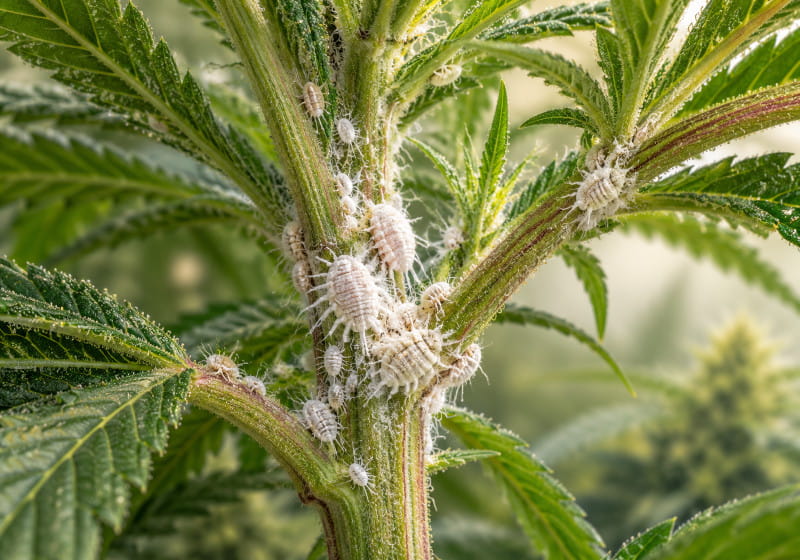
✓ Typical signs include small, soft-bodied insects covered in white, cotton-like wax. Colonies often hide in leaf axils, branch junctions and on the undersides of leaves. White deposits alone, however, are not sufficient to confirm an infestation.
✓ Scientific literature documents Phenacoccus madeirensis in indoor hemp cultivation in Florida. Other species, including Pseudococcus longispinus and Nipaecoccus viridis, are also mentioned in studies relating to hemp. Their actual prevalence and economic impact on cannabis remain insufficiently documented.
✓ Mealybugs feed on plant sap and may produce sticky honeydew, which can encourage the growth of dark sooty mould. However, honeydew and sooty mould are not exclusive to mealybugs and may also indicate other sap-feeding pests.
✓ Effective management begins with careful inspection and accurate identification. Small colonies can be removed manually, while regular follow-up checks, good plant hygiene and suitable biological control agents may help limit further spread. Findings from other crops should not be applied to cannabis without considering their relevance.
Small white, cotton-like clusters suddenly appear at a branch junction on a cannabis plant. On closer inspection, oval insects may be visible beneath a pale waxy coating. These signs may indicate an infestation of mealybugs. However, other scale insects, fungal growth or residues from plants and treatments can look similar. Not every white deposit is therefore evidence of mealybugs.
Reliable identification depends on the details: Are live insects present? Can their characteristic body shape and fine wax filaments be seen? Are new colonies appearing elsewhere on the plant? This Canna Wiki guide explains mealybug biology, typical damage symptoms and scientifically documented associations with cannabis. It also shows how to distinguish an infestation from other plant problems and which management options may be appropriate. Other causes of abnormal leaves and damaged plants are covered in our category Cannabis Plant Problems & Diseases.
What are mealybugs?
Mealybugs are insects in the family Pseudococcidae, a group within the scale insects. They are characterised by a usually whitish, waxy covering, which gives them their common name. Unlike many other scale insects, females do not have a hard protective scale but a soft body with characteristic wax secretions.
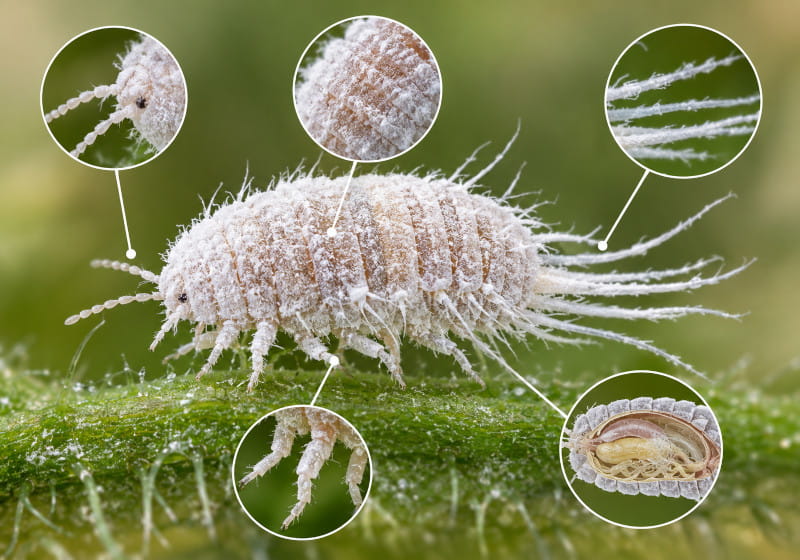
Many mealybug species have an oval, slightly flattened body with wax filaments along the sides. Adult females are usually wingless and remain mobile, while males of many species look very different and may have wings. Body size, colour and the length of wax projections vary with species and developmental stage. Reliable species identification is therefore usually impossible from white wax residues or general body shape alone.
Mealybugs occur worldwide and feed on numerous plant species. Several species are particularly well studied in citrus, vineyards and ornamental horticulture. This knowledge helps explain their biology and potential management methods. Nevertheless, infestation of another crop does not automatically mean comparable importance on cannabis. It is essential to distinguish documented host plants, individual occurrence records and demonstrated damage.
Which mealybug species have been documented in association with cannabis?
Scientific reports identify Cannabis sativa as a host plant for certain mealybugs or describe their occurrence in hemp cultivation. However, the available literature does not justify classifying every familiar greenhouse mealybug as a typical cannabis pest. Nor does a single host record establish how often a species occurs or what economic damage it causes under particular growing conditions.
The longtailed mealybug (Pseudococcus longispinus) is listed and illustrated as an identification example in a 2024 review of hemp pests in Florida. The relevant passage does not, however, document a specific hemp collection of this species. Its notably long wax filaments at the rear of the body are characteristic. Another distinctive feature is reproduction: unlike many mealybugs, it gives birth to live young rather than producing typical cottony egg sacs. The long posterior filaments are a useful identification clue but do not always permit certain species identification.
For the hibiscus mealybug (Nipaecoccus viridis), internationally known as the Hibiscus Mealybug, a 2023 scientific review explicitly includes Cannabis sativa in a table of documented host plants in Florida. This species should not be confused with Maconellicoccus hirsutus (Pink Hibiscus Mealybug). The host record alone establishes neither a typical infestation frequency nor a particular level of damage in cannabis production.
The Madeira mealybug (Phenacoccus madeirensis) was recorded during an investigation of indoor hemp production in Apopka, Florida, in 2020, according to the 2024 review. This is a specific occurrence record, not evidence of general infestation frequency or economic importance. The citrus mealybug (Planococcus citri) also appears in the species list in that review and has been extensively studied in horticulture. Inclusion in a species list does not demonstrate regular or severe damage to cannabis.
| Species / group | Scientific evidence | Relevance to cannabis |
| Pseudococcus longispinus | Listed in a scientific inventory of hemp pests in Florida | Mentioned in the hemp pest review; a live-bearing species with long posterior wax filaments |
| Nipaecoccus viridis | Cannabis sativa listed in a published host-plant review | Documented host-plant association; infestation frequency and severity cannot be inferred generally |
| Planococcus citri | Listed in the hemp pest review; extensively studied in horticulture | Listed as a hemp-associated species; infestation frequency and severity require separate assessment |
| Phenacoccus madeirensis | Recorded in indoor hemp cultivation in Apopka, Florida, in 2020 | Specific hemp record; frequency and severity cannot be inferred from it |
| Other Pseudococcidae | Numerous species with different host plants, characteristics and reproductive strategies | Do not assign unidentified specimens to a species without sufficient diagnostic characteristics |
How can mealybugs and their developmental stages be identified?
Mealybugs are recognised mainly by their oval body shape, whitish wax covering and often visible wax filaments. As these characteristics vary by species and developmental stage, white colouring alone is not sufficient for reliable identification. A hand lens or sharp macro photograph can help distinguish individual insects from fungal growth or plant residues.
Adult females: They usually have an oval to elongated, slightly flattened, soft body covered by a white, often powdery-looking wax layer. Short or long wax filaments may extend from the body margins. Wingless females remain mobile but often stay in sheltered areas such as leaf axils or branch forks. Body size, colouring and filament arrangement differ between species.
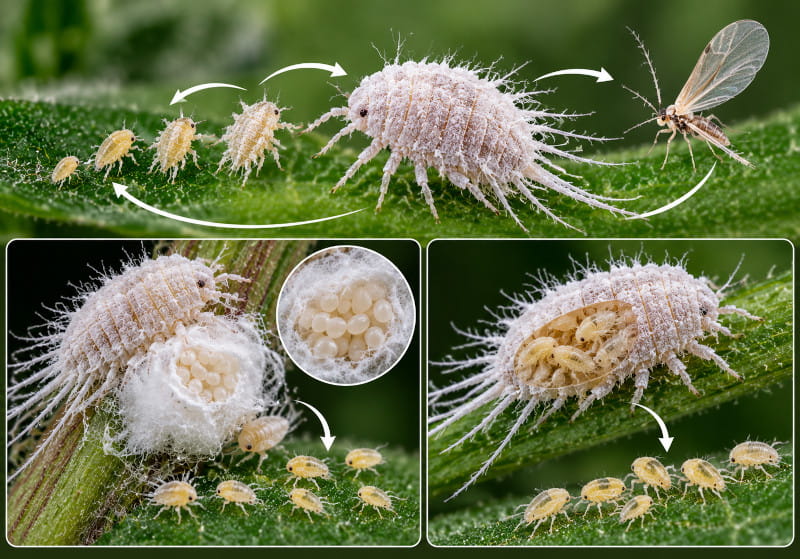
Immature stages (crawlers): Newly hatched or born mealybugs are particularly small and highly mobile compared with older stages. Their wax covering is initially often poorly developed, so they may not immediately be recognised as mealybugs. The young insects can colonise other parts of the same plant and may move onto neighbouring plants where plant parts touch. These mobile immature stages are particularly important in the spread of an infestation.
Eggs and egg sacs: Many mealybug species lay their eggs in whitish, cotton-like sacs made of fine wax threads. Such clusters are often found on sheltered plant parts, for example between a stem and leaf stalk. However, not all species produce visible egg sacs. The longtailed mealybug (Pseudococcus longispinus) gives birth to live young, for example. The absence of cottony egg sacs therefore does not rule out a mealybug infestation.
Males: Adult male mealybugs look very different from females. In many species they are much smaller and winged, resembling tiny flying insects rather than typical white-coated mealybugs. Their adult lifespan is often short. For practical diagnosis, the characteristic females and mobile immature stages are therefore most relevant.
Why are mealybugs white and cotton-like?
The characteristic appearance of mealybugs results from whitish wax secretions that cover the body like a fine powder. Many species also produce lateral wax filaments, while others deposit eggs in cottony egg sacs. Consequently, insects and colonies can resemble small tufts of cotton or white powdery clusters. Beneath the protective wax layer, the insect body may be yellowish, pinkish or brownish, depending on the species.
These deposits become particularly conspicuous when several mealybugs gather in a sheltered location. In leaf axils and branch forks, living insects, wax threads, species-specific egg sacs and older residues can combine into larger white colonies. However, the amount of visible wax does not reliably indicate how many live mealybugs are present on the plant.
White wax residues can remain on leaves and stems even after the insects have been removed or have died. Conversely, newly hatched or born young insects may have so little wax that they are easily overlooked. To distinguish an active infestation from old residues, inspect the area with a hand lens and check the affected plant parts again later.
Where do mealybugs hide on cannabis plants?
Mealybugs often occupy sheltered plant parts where they can feed on sap undisturbed. Areas where leaves, petioles and shoots meet are especially worth inspecting. If mealybugs are suspected, carefully examine leaf axils, petiole bases, branch forks, stems and leaf undersides.
Depending on the species and infestation severity, insects may spread to other above-ground plant parts. Dense foliage and closely spaced shoots provide numerous hiding places and make small colonies harder to detect early. Even when exposed leaf surfaces appear normal, insects and wax deposits may already be present in concealed locations. A thorough inspection should therefore cover several parts of the plant.
Certain root mealybugs are a special case: they live mainly in the root zone and feed on underground plant parts. They also belong to the Pseudococcidae but differ in their biology from the above-ground mealybugs discussed here. White insects in the root zone may also belong to other pest groups. Correct differentiation matters because not every root-dwelling insect is a mealybug.
What symptoms and damage can mealybugs cause on cannabis?
Mealybugs are sap-feeding plant pests. Their piercing-sucking mouthparts allow them to extract plant sap and potentially impair the development of infested plants. The severity of damage depends, among other factors, on the species, the number of insects and the overall condition of the plant. Possible effects include leaf discolouration, reduced growth and weakened shoot development. White deposits or yellowing leaves alone are not enough to confirm a mealybug infestation.
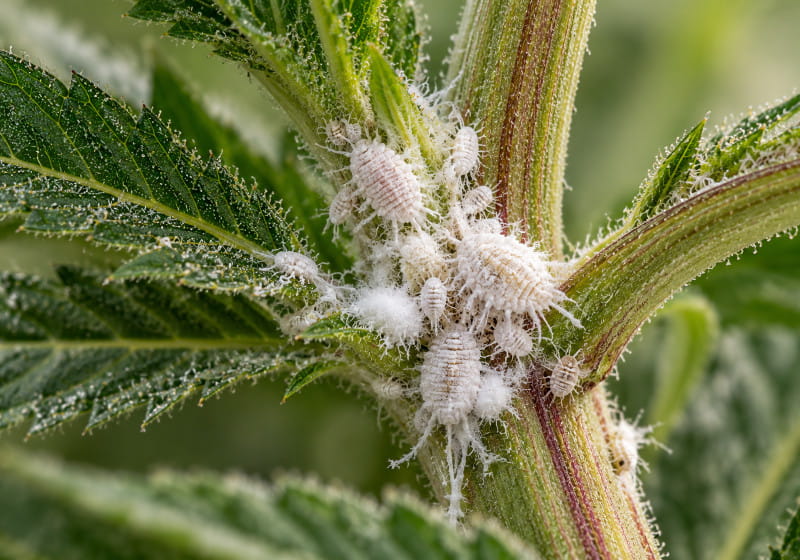
Early signs: At first, only individual oval insects, fine white wax threads or small cotton-like clusters may be noticeable. Initial colonies can develop especially in leaf axils, at petiole bases and in branch forks. Affected plants do not necessarily show visible growth problems at this stage, so an early infestation may go unnoticed without targeted inspection.
Advanced infestation: As the population increases, multiple colonies may develop, becoming visible as larger white wax accumulations. Sticky residues may also appear on leaves and stems. Heavy infestations can cause discolouration, growth suppression or general plant weakening. However, the extent of damage caused to cannabis by mealybugs has not been adequately studied for every species and growing condition. Observations from ornamental or fruit crops therefore cannot be transferred without qualification.
Because other problems can cause similar symptoms, careful differentiation is important. Aphids, whiteflies, nutrient imbalances and certain plant diseases may also cause leaf discolouration or growth problems. The most important indication of mealybugs is therefore direct identification of the characteristic insects with their typical body shape and whitish wax secretions.
Honeydew and sooty mould: Why do cannabis leaves become sticky?
Many mealybug species excrete a sugary liquid during feeding known as honeydew. It is produced because the insects take in large quantities of plant sap and excrete excess components. Honeydew can land on leaves, stems and plant parts below, leaving a sticky film. Fungi known as sooty mould can subsequently grow on these sugary deposits.
Sooty mould usually appears as a dark grey to black surface coating. The fungi mainly grow on the excreted honeydew rather than directly inside plant tissue. Heavy coverage may reduce the amount of light reaching affected leaf surfaces and thus interfere with photosynthesis. Sooty mould must be distinguished from the white wax secretions of mealybugs and the pale fungal coating of powdery mildew. However, not every dark mark on a cannabis leaf is necessarily sooty mould.
Important for diagnosis: Sticky leaves and black sooty mould are not unique signs of mealybugs. Aphids on cannabis and Whiteflies on cannabis can also excrete honeydew and encourage sooty mould. To establish the actual cause, inspect the affected plant parts and any insects present carefully.
Honeydew and sooty mould can indicate sap-feeding insects, but neither is specific to mealybugs. Reliable diagnosis requires identification of the responsible pests by their body shape and other characteristic features.
Mealybugs, other scale insects or whiteflies?
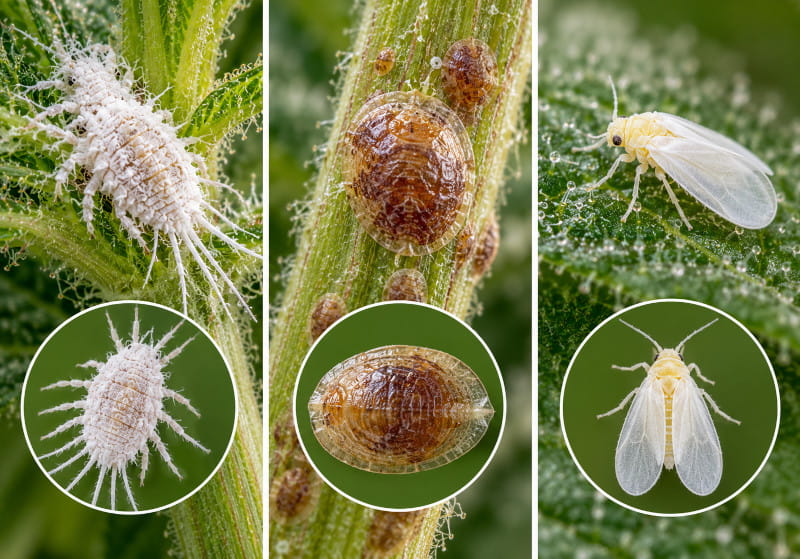
Not every small whitish insect on a cannabis plant is a mealybug. Other scale insects and whiteflies can also feed on sap, produce wax secretions or leave sticky honeydew. Although some symptoms overlap, there are clear differences in appearance and behaviour. Body shape, mobility, wax covering and typical locations are particularly important for identification.
| Feature | Mealybugs | Other scale insects | Whiteflies |
| Appearance | Usually oval, soft-bodied insects with a whitish wax layer and often lateral wax filaments | Flat, domed or shield-like depending on species; some have a firm protective covering | Small winged insects, usually dusted white; immature stages have a very different shape |
| Mobility | Females and young stages mobile; older individuals often slow-moving | Adult females of many species largely stationary; young stages mobile | Adults can fly; older immature stages usually remain attached to leaves |
| Typical locations | Leaf axils, petiole bases, branch forks and sheltered stem sections | Stems, leaf veins and leaf undersides, depending on species | Mainly leaf undersides, often in groups |
| White deposits | Powdery wax coating, fine wax filaments and, in some species, cottony egg sacs | Different wax coatings or protective scales depending on species | White-dusted adult wings; some species also produce additional wax secretions |
| Honeydew | Excreted by many species and may cause sticky residues | Produced mainly by certain scale insect groups; not all species excrete honeydew | Often present; may encourage sooty mould |
| Most useful identification clue | Oval, segmented body with whitish wax and often conspicuous marginal filaments | In many species, stationary females with characteristic scale or body shape | Small white flying insects that often take flight when leaves are disturbed |
A useful distinction often becomes apparent when checking leaf undersides: gently moving the leaves may cause adult whiteflies to take flight. Female mealybugs, by contrast, are wingless and usually move slowly across the plant surface. Adult females of other scale insect groups often remain largely stationary. Since developmental stages differ, identification should be based on several features wherever possible. Our separate guide explains the biology, damage and management of whiteflies on cannabis.
Mealybugs or powdery mildew: How can white deposits be distinguished?
White spots and cotton-like deposits on cannabis do not necessarily come from mealybugs. Powdery mildew can also produce conspicuous whitish growth on leaves and other above-ground plant parts. Whereas mildew is caused by fungi and often appears as a widespread powdery coating, mealybugs have identifiable insect bodies and characteristic wax threads. They also tend to gather in sheltered areas such as leaf axils and branch forks.
A hand lens helps distinguish the two. Mealybugs have visible body segments, legs and, depending on the species, lateral wax filaments. Powdery mildew has none of these insect features; instead, it forms fungal growth on the plant surface. Both problems can also occur at the same time. Diagnosis should therefore be based on the structures actually present, not on white colour alone. You can find detailed information about this fungal disease in our Canna Wiki guide to powdery mildew on cannabis.
Distinguishing an active mealybug infestation from old wax residues
Not every white wax coating on a cannabis plant indicates an active mealybug infestation. Wax secretions can remain after the insects have disappeared. What matters is whether live insects or new colonies can be found.
Signs of an active infestation: Live mealybugs, mobile young stages or newly forming colonies are strong evidence of current colonisation. Fresh egg sacs may provide an additional clue in egg-laying species, but they are not required for an active infestation.
Signs of older wax residues: If white deposits remain unchanged over several inspections and no live insects are found, they may be remnants of an earlier infestation. However, a single inspection without findings does not reliably rule out hidden insects.
White wax threads, cotton-like clusters, honeydew and sooty mould are useful clues, but none proves an infestation on its own. Characteristic insect features and the appearance of new insects or colonies are decisive.
Inspecting cannabis for mealybugs: Step by step
A systematic inspection helps identify a possible mealybug infestation early, rule out other causes and assess its spread within a crop. A hand lens and sharp macro photographs are particularly useful for comparing suspicious areas during subsequent inspections.
1. Document suspicious areas: First examine all suspicious plant parts closely, especially leaf axils, petiole bases, branch forks, stems and leaf undersides. Photographs help record locations and assess later changes reliably.
2. Examine body features with a hand lens: Look for an oval body, visible segments, legs and wax filaments. Cotton-like clusters alone do not allow species identification.
3. Look for live mealybugs: Finding live insects is particularly informative. Include slowly moving females and small immature stages; a lack of movement during a brief observation does not prove that an insect is dead.
4. Rule out similar pests and diseases: Broad powdery coatings may indicate powdery mildew. Small white insects that fly up when leaves are disturbed are more suggestive of whiteflies. Firmly attached, shield-like bodies may belong to other scale insect groups. Always consider several characteristics together.
5. Inspect neighbouring plants: If a mealybug colony is found, carefully inspect adjacent plants as well. More insects may be concealed at branch junctions and on leaf undersides even when exposed leaf surfaces still look normal. This helps determine whether only one plant or several areas are affected.
6. Monitor the infestation regularly: Revisit suspicious areas and compare them with the original photographs. New insects or colonies suggest an ongoing infestation; unchanged residues without repeated evidence of live insects are more consistent with older deposits.
If visible characteristics do not allow confident species identification, high-quality macro images or examination by an entomological specialist may be helpful. Accurate species identification can be particularly important when selecting biological control agents.
Mealybug life cycle and spread on cannabis
Mealybugs pass through several developmental stages before becoming adults. Depending on the species, females lay eggs or give birth to live young. Newly hatched or live-born young are commonly known as crawlers. They are highly mobile and can colonise new plant parts. These early stages therefore play an important role in the spread of mealybug infestations.
The speed at which mealybugs develop and reproduce depends on the species, temperature, host plant and surrounding conditions, among other factors. Under favourable conditions, populations may build up over several generations. This does not establish a universally applicable development period for mealybugs on cannabis. Offspring numbers, egg-sac production and reproductive strategies also vary between species.
Mealybugs may be introduced through infested young plants or cuttings. Within a crop, mobile immature stages can spread to new shoots and move to neighbouring plants when plant parts touch. Unintentional transfer through plant material or working practices is also possible. Outdoors, ants may play an additional role: in some honeydew-producing mealybug species, ants visit colonies and can interfere with natural enemies. However, this interaction is species-specific and has not been demonstrated for every mealybug infestation on cannabis.
Mealybugs can also become established indoors and in greenhouses when infested plant material is introduced. Protected growing conditions therefore do not automatically prevent infestation. Outdoors, weather, natural enemies and other environmental factors also influence population development. Conditions that favour reproduction depend on the species and should not be generalised across all Pseudococcidae.
What should you do when a mealybug infestation is confirmed?
When a mealybug infestation is confirmed, first assess how extensively the plants are colonised. Individual insects in an accessible location are generally easier to manage than numerous colonies spread across several plants. The important steps are to inspect affected areas carefully, choose appropriate measures and then check whether live mealybugs remain.
Where possible, temporarily separate infested plants from unaffected ones to make further spread less likely. Individual mealybugs and small colonies can be carefully removed from affected plant parts. For heavily infested leaves or shoots, selective removal may also be appropriate if it does not cause disproportionate damage. Collect infested plant material immediately and dispose of it in accordance with local rules so that live insects do not reach other plants.
Because mealybugs often hide in hard-to-reach locations, removing visible colonies once may not be enough. Tiny immature stages can remain unnoticed and colonise other plant parts. Regular follow-up inspections are therefore an essential part of successful containment. A reduction in live insects and the absence of new colonies are more informative than the complete disappearance of white wax residues, which may persist after an earlier infestation.
Biological control of mealybugs: Ladybirds and parasitoid wasps
Natural enemies can play an important role in biological mealybug management. Professional horticulture uses, among others, the mealybug destroyer ladybird Cryptolaemus montrouzieri and various parasitoid wasps. However, not every beneficial organism is suitable for every mealybug species. Accurate pest identification, environmental conditions and demonstrated suitability of the natural enemy are crucial.
Mealybug destroyer ladybird (Cryptolaemus montrouzieri): Both larvae and adult beetles feed on mealybugs. The species is especially known for use against mealybugs that lay eggs in conspicuous cottony sacs. Effectiveness can vary considerably with mealybug species and infestation conditions. Against the live-bearing longtailed mealybug (Pseudococcus longispinus), performance is not necessarily as reliable as against certain egg-laying species. Its suitability for the species present should therefore be checked before use.
Parasitoid wasps: Certain parasitoid wasps, including species of the genus Anagyrus, use mealybugs as hosts for their development. Females lay eggs inside suitable host insects, where their offspring subsequently develop. This can contribute to natural regulation of certain mealybug populations. However, effectiveness depends strongly on the particular wasp and mealybug species. Successful use in ornamental horticulture does not automatically mean the same natural enemy is suitable for every mealybug species on cannabis.
Before releasing biological control agents, also consider temperature, humidity, previously used plant protection products and possible disruptive factors. Ants can play a role in certain honeydew-producing species because they visit colonies and may interfere with natural enemies. Comprehensive efficacy data for targeted biological control of mealybugs on cannabis are still lacking. Experience from other crops provides useful guidance but does not replace a species-specific assessment.
Contact treatments and plant protection products: What should you consider?
The whitish wax covering of many mealybugs can make them harder to wet with surface-applied contact products. The insects also favour sheltered places such as leaf axils, petiole bases and tight branch forks, where treatment may not reach them completely. The effectiveness of a contact treatment therefore depends on the product, mealybug developmental stage, application and species. Young stages with little wax may differ in susceptibility from adults.
Avoid blanket home-remedy recipes, aggressive mixtures and unverified spraying advice. Such applications may damage plant tissue without reliably controlling the infestation. Plant protection products must be used only in accordance with local authorisations and prescribed conditions. Approval for vegetables, fruit or ornamental plants does not automatically mean a product is approved for cannabis. Potential residues, pre-harvest intervals and applicable legal requirements are particularly important for plants whose flowers are intended for later use.
Successful management is not determined by whether all white wax residues disappear, but by whether the number of live mealybugs decreases and new colonies stop forming. Repeated checks help detect remaining immature insects and renewed infestation early.
Preventing mealybugs on cannabis: Monitoring and crop hygiene
Carefully inspecting newly introduced plants and cuttings is one of the most important ways to prevent mealybugs. Because the insects often remain in sheltered locations, pay particular attention to leaf axils, petiole bases, branch forks and leaf undersides. Where possible, keep new plants separate for observation before introducing them into an established crop. This can help detect unnoticed pests early and reduce the risk of introducing them.
An orderly plant arrangement also helps prevention. Accessible shoots and visible plant sections make routine inspections easier before larger colonies develop. In densely arranged growing systems such as Sea of Green (SOG) or Screen of Green (SCROG), hidden leaf axils and branch forks may be harder to inspect. These growing methods do not themselves cause mealybug infestations. The key is to ensure that even less accessible plant parts can be checked regularly.
Regular pest inspections should be part of plant care throughout the year. Our Cannabis Grow Calendar offers guidance for seasonal planning. Outdoors, weather, natural enemies and, for certain mealybug species, ants may also affect infestation development. When choosing outdoor cannabis seeds, prioritise documented strain characteristics and local growing conditions rather than unsupported claims of special resistance to mealybugs.
Good crop hygiene complements regular plant inspections. This includes careful handling of infested plant material, cleaning shared tools and avoiding accidental pest transfer. Hygiene measures can reduce the risk of further spread but do not replace targeted monitoring of existing mealybug colonies. After an infestation has been identified, inspect affected areas repeatedly for live insects and fresh wax secretions.
Are any cannabis strains naturally resistant to mealybugs?
At present, no sufficiently robust comparative scientific studies are known that identify a particular cannabis strain as demonstrably resistant or especially tolerant to mealybugs. Studies do indicate that cannabis genetics may differ in susceptibility to certain pests and plant diseases. However, those findings concern organisms such as spider mites, particular caterpillars or powdery mildew. Lower susceptibility to these organisms does not automatically mean better protection against mealybugs.
Frequently mentioned traits such as high trichome density, vigorous growth or generally robust plant development do not scientifically establish specific resistance to mealybugs. Plant characteristics can influence pest behaviour and development, but interactions vary by insect species. Which genetic or morphological cannabis traits might actually be associated with lower susceptibility to Pseudococcidae has not yet been adequately studied.
A cannabis strain should therefore not be described as mealybug-resistant without appropriate scientific evidence. When choosing cannabis seeds, documented strain characteristics, site requirements and intended growing conditions are more useful criteria. Regardless of genetics, careful inspection of new plants, early detection of small colonies and consistent crop hygiene remain the most important preventive measures.
FAQ: Frequently asked questions about mealybugs on cannabis
Are mealybugs a type of scale insect?
Yes. Mealybugs belong to the family Pseudococcidae, which forms part of the larger group of scale insects. Unlike many other scale insects, adult female mealybugs typically have soft, mobile bodies covered in whitish wax secretions.
How can you identify mealybugs on cannabis?
Typical signs are small, usually oval, soft-bodied insects covered with a whitish, powdery-looking wax layer. Fine wax filaments are often visible along the body. Examine leaf axils, branch forks and leaf undersides with a hand lens, as small colonies may hide there.
What do white, cotton-like deposits on cannabis mean?
Such clusters may consist of mealybugs, their wax secretions or egg sacs produced by certain species. Fungal growth and other residues are also possible causes. Recognising characteristic insect features allows a more reliable assessment.
Do all mealybugs lay eggs in cottony egg sacs?
No. Many species deposit eggs in white sacs made of wax threads, while others give birth to live young. One example is the longtailed mealybug Pseudococcus longispinus. The absence of visible egg sacs therefore does not rule out an infestation.
How can you tell mealybugs from powdery mildew?
Mealybugs are insects whose body segments, legs and often wax filaments can be seen under magnification. Powdery mildew, by contrast, is a fungal disease that usually produces a whitish, powdery coating on plant surfaces. White colour alone is not enough for reliable differentiation.
Why do cannabis leaves become sticky during a mealybug infestation?
Many mealybug species excrete sugary honeydew, which can form a sticky film on leaves and stems. Dark sooty mould fungi may grow on it. Because aphids and whiteflies also produce honeydew, sticky leaves are not definitive evidence of mealybugs.
How can mealybugs on cannabis be controlled?
Once an infestation is confirmed, inspect the affected plant parts and, where possible, separate them from uninfested plants. Individual insects and small colonies can be carefully removed mechanically. Suitable natural enemies may also be an option depending on the mealybug species. Regular follow-up inspections are important because concealed immature insects may remain. Plant protection products may only be used in accordance with local authorisations.
Which beneficial insects can help control mealybugs?
Horticulture uses the mealybug destroyer ladybird Cryptolaemus montrouzieri and certain parasitoid wasps, among other organisms. Their suitability depends on the mealybug species and environmental conditions. Not every beneficial organism works equally well against all Pseudococcidae; evidence for cannabis must be evaluated particularly carefully.
Can mealybugs also occur in indoor cannabis cultivation?
Yes. Mealybugs may be introduced into indoor rooms and greenhouses through already infested young plants or cuttings. Protected conditions do not automatically prevent introduction. Inspect newly introduced plants and concealed plant parts regularly, including indoors.
Can white wax residues remain after a mealybug infestation?
Yes. Characteristic wax secretions may remain attached to the plant after the insects have been removed or have died. Such residues do not reliably indicate an ongoing infestation. What matters is whether repeated inspections reveal live insects or newly forming colonies.
Sources & further reading
Journal of Integrated Pest Management (2024) – Arthropod and Mollusk Pests of Hemp: Open scientific source. Scientific review of arthropod and mollusc pests in hemp production in Florida, including a mealybug species list and a documented indoor hemp record of Phenacoccus madeirensis from 2020.
Journal of Integrated Pest Management (2023) – Hibiscus Mealybug: Open scientific source. Scientific review of Nipaecoccus viridis listing Cannabis sativa among documented host plants in Florida; not to be confused with Maconellicoccus hirsutus.
University of California – IPM: Mealybugs: Open scientific source. Background on body characteristics, wax secretions, developmental stages, damage symptoms and monitoring of mealybug populations.
University of California – IPM: Foliar-Feeding Mealybugs: Open scientific source. Practical guidance on integrated pest management in ornamental horticulture, including natural enemies and the conditions affecting their use.
University of California – IPM: Mealybugs in Grapes: Open scientific source. Information on mealybugs in grapevines, honeydew production and interactions with ants and natural enemies.
University of California – IPM: Mealybugs in Citrus: Open scientific source. Comparative information on mealybug biology, typical damage and biological management in citrus cultivation.