Jack Herer – History, Genetics & Effects
Jack Herer – History, Genetics & Effects
Updated: July 2026 | Jack Herer explained simply: history, namesake, origin, genetics, phenotypes, effects, THC, terpenes, aroma and the significance of this legendary cannabis strain.
Author: Cannapot Grow Team | Reading time: approximately twenty minutes

The Most Important Points at a Glance
✓ Jack Herer is a cannabis hybrid developed in the Netherlands, introduced in 1994 and named after the American hemp activist and author Jack Herer.
✓ A Haze line, Northern Lights #5 and Shiva Skunk are commonly cited as its genetic foundation. However, the exact breeding composition was never fully documented publicly.
✓ The strain is usually described as a sativa-dominant hybrid, but it can produce several distinctly different phenotypes with sativa- or indica-leaning characteristics.
✓ Typical descriptions mention mentally stimulating, mood-enhancing and simultaneously physically balancing effects. Such statements are based mainly on experience reports and cannot be applied to every person or every sample.
✓ Jack Herer is often associated with spicy, peppery, pine-like, herbal and citrus aromas. Which terpenes actually dominate depends on genetics, phenotype, cultivation and post-harvest treatment.
✓ The strain name alone does not guarantee genetic or chemical identity. Scientific studies show that cannabis products carrying the same name can differ considerably between sources.
Jack Herer is one of the best-known names in international cannabis history. The term refers both to the American author and hemp activist Jack Herer and to a cannabis strain named after him, which has been regarded as a classic of the Dutch breeding era since the 1990s. This dual meaning explains why searches about the person, the strain and its history often overlap.
The strain was developed as a complex hybrid intended to combine the tall, aromatic and often mentally stimulating Haze genetics with more compact, resin-rich lines. Its ancestry is commonly described as Haze, Northern Lights #5 and Skunk. However, because the exact breeding formula was never fully disclosed and numerous reproductions now exist, the name Jack Herer can refer to different genetic and chemical profiles.
Its lasting fame is not based on genetics alone. Jack Herer connects strain history, cannabis culture and contemporary political history. The name honoured an activist whose book The Emperor Wears No Clothes had a lasting influence on the international hemp movement. The strain therefore became a cultural symbol whose significance extends far beyond aroma, THC content or cultivation characteristics.
This article clearly distinguishes historical facts, breeding tradition and subjective descriptions of effects. This is important because strain names are neither standardised medical diagnoses nor reliable chemical specifications. The decisive factors are always the specific genetics, a current laboratory analysis, the amount consumed, individual sensitivity and the method of use.
What Is Jack Herer?
Jack Herer is a traditional cannabis hybrid from the Netherlands that combines Haze, Northern Lights and Skunk influences and was named after the American hemp activist Jack Herer.
In everyday usage, Jack Herer is often classified as a sativa-dominant strain. This description refers to typical traits of certain phenotypes: longer internodes, relatively upright growth, a fresh and spicy aroma and effects frequently described as clear, activating or creative. Other plants from the same line may grow more compactly and feel physically heavier.
Botanically, the term “strain” is less precise in the cannabis market than it may sound. Scientific literature often refers to cultivars or chemovars, because trade names guarantee neither uniform genetics nor a consistent cannabinoid and terpene profile. This distinction is especially relevant to Jack Herer: for decades, the name has been used for original seed lines, selected clones, feminised reproductions and autoflowering interpretations.
Who Was Jack Herer?
Jack Herer was an American author and hemp activist who campaigned for decades for a reassessment of cannabis and industrial hemp.
Jack Herer was born in Buffalo, New York, in 1939 and died in Oregon in 2010. From the 1970s onward, he publicly campaigned against cannabis prohibition. His best-known work, The Emperor Wears No Clothes, was first published in 1985 and combined historical documents, political arguments and calls for the increased use of hemp as a raw material.
Herer was often called the “Emperor of Hemp”. His publications and lectures had a considerable influence on the international legalisation and hemp movements. Some historical or agronomic claims in his work were later criticised by scientists. This does not diminish his importance as an organiser, author and symbolic figure in cannabis culture.
The genetics named after him were intended as recognition of his commitment. As a result, his name became permanently associated with a strain that itself went on to become a classic. People searching for “Jack Herer history” therefore often mean both the activist’s biography and the origin of the cannabis strain.
Why Was the Cannabis Strain Named After Jack Herer?
The strain was named Jack Herer in recognition of his long-standing commitment to cannabis education, industrial hemp and drug policy reform.
The naming differed from many strain names that merely describe aroma, origin or parent lines. In this case, a real person was deliberately placed at the centre. The genetics were introduced in 1994, at a time when Amsterdam and the Dutch breeding scene played a central international role in preserving and combining different cannabis lines.
The name contributed greatly to the strain’s cultural visibility, but it does not explain its success on its own. Cannabis genetics usually achieve lasting recognition only when plants display distinctive traits over several generations and continue to be used by breeders. Jack Herer became internationally established both as a line in its own right and as a parent of later hybrids.
Jack Herer Timeline
| Period | Development |
|---|---|
| 1939 | Birth of the future hemp activist and author Jack Herer. |
| 1970s | Herer begins his public work on cannabis and hemp policy. |
| 1985 | First publication of The Emperor Wears No Clothes. |
| 1994 | The cannabis genetics named after Jack Herer are officially introduced in the Netherlands. |
| 1999 | Jack Herer wins first place in the Sativa category at the Amsterdam Cannabis Cup. |
| 2010 | Jack Herer dies at the age of 70; his political and cultural legacy continues. |
| Today | The name refers to numerous photoperiod, feminised, regular and autoflowering interpretations. |
The timeline shows that the strain cannot be viewed in isolation. It emerged from the connection between Dutch breeding history and American cannabis activism, becoming one of the best-known cannabis strains named after a person.

How Were the Original Jack Herer Genetics Created?
The original Jack Herer genetics were created by combining a Haze line with Northern Lights #5 and Shiva Skunk, although the precise breeding sequence was never fully documented publicly.
The combination was intended to bring together traits considered particularly valuable during the 1980s and early 1990s. Haze was associated with a complex spicy and incense-like aroma, pronounced sativa-style growth traits and effects often described as mentally focused. Northern Lights #5 was known for more compact structures, heavy resin production and shorter flowering times. Shiva Skunk combined Northern Lights and Skunk influences and contributed additional stability, vigour and spicy notes.
The frequently cited formula should not be understood as a fully decoded family tree. Breeding programmes of that era often disclosed only the most important foundation lines, not every backcross, generation or selection stage. The description “Haze × Northern Lights #5 × Shiva Skunk” is therefore an accepted account of its origin, but not complete scientific documentation.
The complex ancestry produced several phenotypes. This explains why Jack Herer can grow tall and slender or more compact and heavily branched, depending on the selection. Flowering time, yield, aroma and subjectively perceived effects can also vary within the line.
| Foundation Line | Historically Attributed Traits | Possible Contribution to the Overall Profile |
|---|---|---|
| Haze | taller growth, spices, herbs, incense, mentally focused effects | sativa-dominant character and complex aroma |
| Northern Lights #5 | more compact structure, resin production, earthy and pine-like notes | flower structure, resin production and physical balance |
| Shiva Skunk | vigour, spice, branching and Skunk character | robustness, structure and additional aromatic depth |
Is Jack Herer Sativa or Indica?
Jack Herer is predominantly classified as a sativa-dominant hybrid, although individual phenotypes can display considerably more indica-leaning characteristics.
Percentages such as “70 percent sativa” or “80 percent sativa” appear precise, but for historic cannabis lines they are generally not genetically measured values. They are often based on breeder information, ancestry estimates or visible plant traits. Scientific studies also show that the traditional market labels Sativa and Indica reflect the actual genetic or chemical composition only to a limited extent.
For Jack Herer, the description sativa-dominant is nevertheless useful as a practical shorthand. Many selections show upright growth, relatively narrow leaves and more pronounced stretching at the beginning of flowering. At the same time, compact flowers, strong side branches and a physically relaxing component may point to the Northern Lights and Skunk side.
For evaluating a specific plant, the documented line, phenotype and laboratory values are therefore more informative than a fixed sativa-indica percentage.
Which Jack Herer Phenotypes Exist?
Jack Herer can produce several phenotypes that differ primarily in growth pattern, flowering time, flower structure, aroma and the balance between mental and physical effects.
Historical descriptions often refer to four basic expressions. Three are generally described as more strongly sativa-leaning, while one phenotype may grow more compactly and appear closer to indica. This classification is not a binding botanical system, but it illustrates the diversity of the original seed line.
| Phenotypic Tendency | Possible Characteristics | Important Limitation |
|---|---|---|
| strongly sativa-leaning | greater stretch, longer flowering, airier structure, Haze and spice notes | not every modern line contains this expression at the same frequency |
| balanced hybrid | medium height, strong branching, balanced relationship between Haze and Skunk | traits depend heavily on selection and environment |
| more compact expression | denser flowers, less stretch, stronger earthy or resinous notes | must not automatically be equated with a particular effect |
With vegetatively propagated clones, a selected phenotype remains genetically largely unchanged. Seeds, by contrast, produce new individuals in which parental traits are recombined in different ways. This is a major reason why two plants carrying the Jack Herer name do not necessarily look or smell identical.
Why Can Different Jack Herer Strains Vary?
Different Jack Herer products can vary because the strain name is not internationally standardised and numerous breeding lines, clones and reproductions are in circulation.
Scientific analyses of popular cannabis names have repeatedly identified genetic differences between samples carrying the same trade name.
Even genetically identical clone material can develop different cannabinoid and terpene concentrations under different environmental conditions. Light, temperature, nutrient supply, harvest timing, drying and storage further influence the measurable profile.
A specific Jack Herer sample should therefore not be assessed solely by its strain name. For an objective classification, information about origin, batch, cannabinoids and terpenes is far more informative. In medical use, a standardised and laboratory-tested composition is more important than a traditional strain name.
What Are the Effects of Jack Herer?
Jack Herer is often described as mentally stimulating, clear, sociable and mood-enhancing, but depending on the dose and phenotype it may also feel physically relaxing or cause unpleasant restlessness.
The widespread description of a “clear” or “creative” Jack Herer effect comes mainly from consumer reports and strain descriptions. Controlled clinical studies generally examine isolated cannabinoids or standardised preparations rather than the Jack Herer trade name. A specific medical effect of the strain has therefore not been scientifically demonstrated.
THC can temporarily alter perception, mood, attention, memory, reaction time and coordination. At lower exposure levels, some people report euphoria, increased talkativeness or more intense sensory perception.
Higher amounts can intensify cognitive impairment and may promote nervousness, anxiety, heart palpitations, dizziness or panic in sensitive individuals. The possible influence of other compounds such as CBD on the overall experience remains under scientific investigation. Individual effects therefore cannot be predicted from THC content alone.
The effect does not depend on the strain alone. Important factors include THC and CBD content, the amount consumed, tolerance, consumption method, setting, expectations, age, health status and the simultaneous use of alcohol or medication. Descriptions of effects are therefore not reliable predictions for an individual person.
How High Is the THC Content of Jack Herer?
There is no uniform THC content for Jack Herer because values can vary considerably depending on the line, phenotype, cultivation, sample and laboratory. In addition to cannabinoids, the terpenes present also play an important role in the overall profile of a cannabis flower. They shape aroma and flavour and are being studied intensively in connection with the overall impression of a strain.
Commercial descriptions often cite values in the medium to higher THC range. However, such ranges are only rough guides and should not be understood as a fixed characteristic of the entire strain. Even within a uniformly cultivated batch, flowers from different parts of the plant can contain different total THC levels.
The percentage on a laboratory report describes the concentration in the sample tested. It does not precisely predict what dose a person actually absorbs or how strong the subjective effect will be. Consumption method, inhalation technique, decarboxylation and individual pharmacokinetics influence actual exposure.
| Information | What It Indicates | What It Does Not Indicate |
|---|---|---|
| THC as a percentage | concentration in the analysed plant sample | no reliable prediction of individual effect strength |
| Strain name | historical or commercial classification | no guarantee of an identical cannabinoid profile |
| Laboratory report | measurement for a specific sample and batch | no universally valid statement about all Jack Herer lines |
What Side Effects Are Possible?
Possible adverse effects mainly correspond to the known acute effects of THC-rich cannabis products and range from dry mouth and dizziness to anxiety, reduced reaction ability and temporary memory problems.
Especially with a high dose, low tolerance or an unfavourable setting, THC can trigger restlessness, mistrust or panic. The ability to drive safely and operate machinery may be impaired. Cannabis should therefore not be combined with road traffic or safety-critical activities.
Regular intensive use can contribute to the development of cannabis use disorder. Adolescents, pregnant women, people with certain cardiovascular conditions and individuals with a personal or family predisposition to psychotic disorders are considered special risk groups. Medical questions should be discussed with a qualified physician.
Which Terpenes Are Associated With Jack Herer?
Jack Herer is often associated with terpinolene, caryophyllene, pinene, myrcene and limonene, although the actual ranking can vary considerably between samples.
Terpinolene has a complex aroma that, depending on concentration, may be reminiscent of herbs, fresh wood, citrus or floral notes. Pinene is associated with pine-like and resinous impressions, while caryophyllene is linked to pepper and spices. Limonene can contribute citrus accents, whereas myrcene is often described as earthy, herbal or slightly fruity.
Smell and flavour are not created by individual terpenes alone. Cannabis flowers contain numerous volatile compounds, including terpenes, esters, alcohols and sulphur-containing substances. Current research therefore shows that aroma and possible differences in effects cannot be inferred from a single terpene.
| Compound | Commonly Associated Aroma | Classification |
|---|---|---|
| Terpinolene | herbal, fresh, woody, sometimes citrus-like | often cited as important in many Jack Herer profiles |
| β-Caryophyllene | peppery, spicy, dry | may support the characteristic spicy note |
| α- and β-Pinene | pine, resin, forest herbs | matches frequently described coniferous notes |
| Limonene | citrus peel, fresh, slightly sweet | may add citrus highlights |
| Myrcene | earthy, herbal, fruity | concentration varies between samples |
What Does Jack Herer Smell and Taste Like?
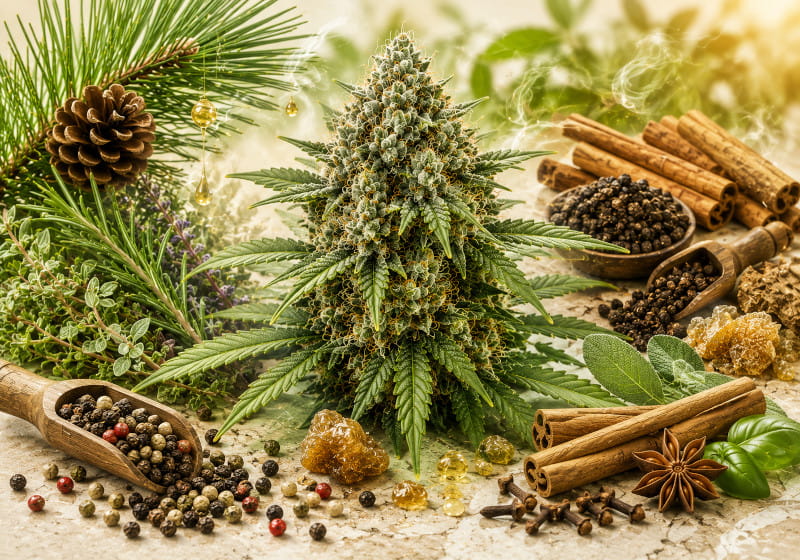
The typical Jack Herer aroma is described as spicy, peppery, pine-like and herbal, often complemented by citrus, wood, earth or a slightly sweet Skunk note.
Sativa-leaning phenotypes may be more reminiscent of Haze, incense, fresh herbs and citrus peel. More compact expressions are often associated with earth, resin, wood and a heavier spiciness. In the flavour, pepper and pine may be joined by sweet or fruity nuances.
Smell and taste are perceived subjectively and are influenced by storage, humidity, temperature and consumption method, among other factors. Storage that is too warm or too long can reduce volatile aromatic compounds. Even genetically similar flowers can therefore smell and taste different in intensity or complexity.
-
spicy and peppery base notes
-
pine, resin and fresh herbs
-
citrus peel and occasional sweet fruit
-
earthy, woody or Skunk-like undertones
What Characteristics Does Jack Herer Show During Cultivation?
Depending on the phenotype, Jack Herer shows moderate to strong stretch, good branching and a flowering time that often ranges from approximately nine to eleven weeks in photoperiod lines.
Sativa-leaning plants often grow taller and need more time to mature. More compact phenotypes usually remain shorter and develop denser flowers. Height and yield can nevertheless vary considerably depending on genetics and phenotype. Manufacturer information should therefore always be treated as a guideline for the specific line.
Dense flowers require good air circulation and a stable climate to prevent moisture problems. Plants with strong stretch benefit from early planning of the available space. The intense smell may increase significantly during flowering.
| Characteristic | Typical Range | Why Values Vary |
|---|---|---|
| Growth habit | upright to bushy, usually well branched | different expression of Haze, Northern Lights and Skunk traits |
| Stretch | moderate to strong | phenotype, light, vegetative period and pot size |
| Flowering time | often approximately 9 to 11 weeks | line and maturity of the individual phenotype |
| Resin production | usually medium to high | genetics, light intensity, health and harvest timing |
| Cultivation environment | indoor, greenhouse and suitable outdoor regions | climate, season length and specific breeding line |
How Do Regular, Feminised and Autoflowering Versions Differ?
Regular, feminised and autoflowering Jack Herer seeds may carry the same historic name, but they differ in reproductive biology, breeding method and genetic proximity to the original photoperiod line.
Regular seeds can produce male and female plants and are often used for breeding projects. Feminised seeds are selected to produce predominantly female plants. Autoflowering varieties also contain self-flowering genetics and transition into flowering largely independently of day length.
A Jack Herer Auto is therefore not an unchanged copy of the original genetics. Additional crosses and selections are required to introduce the self-flowering trait. Feminised reproductions can also differ depending on the starting material and breeding objective. Any comparison should always consider the specifically stated ancestry.
Which Well-Known Crosses Descend From Jack Herer?
Jack Herer has been used as a parent line for numerous later cannabis strains because of its Haze aroma, resin production and hybrid vigour.
Internationally known descendants and relatives include Jack the Ripper, XJ-13, Critical Jack, Black Jack and Jack’s Cleaner lines. However, not every strain with “Jack” in its name necessarily descends from the same Jack Herer selection. Some names refer to other family branches or are merely commercial references.
Its influence is especially visible in hybrids intended to combine spicy Haze notes, mentally focused effects and a shorter flowering time. Which traits are actually inherited depends on the parent used and the subsequent selection.
Well-Known Jack Herer Variants and Crosses
Over the years, numerous strains and further developments based on Jack Herer genetics have emerged. Some are direct crosses with other well-known lines, while others are feminised, autoflowering or specially selected interpretations.
| Variant | Type | Special Feature |
|---|---|---|
| Jack Herer | Original line | The classic photoperiod genetics from Sensi Seeds |
| Jack Herer fem | Feminised line | The original Jack Herer in a feminised version |
| Jack Herer Auto | Autoflower | Excellent automatic Jack Herer with Ruderalis genetics |
| Auto Cinderella Jack | Autoflower | Excellent automatic Jack Herer × C99 × Magnum variant |
| Sweet Cinnamon | Cross | Very strong cinnamon aroma, Jaggen × Jack Herer cross |
| Jack Flash #5 | Selection | Further-developed Jack Flash line from Sensi Seeds |
| Jack 47 Fast | Semi-auto | Fast outdoor strain, a combination of AK47 × Jack Herer |
| Jacky White | Cross | High-end cross between Jack Herer and White Widow |
| Black Jack | Cross | Award-winning cross: Jack Herer × Black Domina |
| Critical Jack | Cross | A true heavyweight: Critical Mass × Jack Herer |
| Jaggen | Selfing | Legendary German Jack Flash phenotype from Dr. Knospe |
| Jack the Ripper | Cross | Very powerful Jack Herer cross from TGA Subcool |
Not every one of these variants descends directly from the original Jack Herer line. Many are based on different parent lines, backcrosses and selection programmes. The shared Jack Herer name therefore does not automatically mean identical genetics or the same characteristics.
Why Is Jack Herer Considered a Legendary Cannabis Strain?
Jack Herer is considered legendary because the strain combines historic genetics, strong recognition, competition success and the memory of an important hemp activist.
In 1999, Jack Herer won first place in the Sativa category at the Amsterdam Cannabis Cup. Further awards and later competition successes strengthened its reputation. However, competition results are snapshots of specific entries and do not guarantee that every modern version has the same characteristics.
Its special position also results from the period in which it was created. Jack Herer combined the Haze tradition of the 1970s and 1980s with more compact Dutch hybrid lines, making it a bridge between older classics and more modern strains. Many present-day hybrids follow a similar principle.
Jack Herer or Haze – What Is the Difference?
Jack Herer has a clear Haze influence, but it is not a pure Haze line. It is a hybrid with additional Northern Lights and Skunk components.
Classic Haze lines can grow very tall, flower for a long time and develop pronounced incense, spice or citrus aromas. Jack Herer was selected to combine some of these traits with more compact growth, stronger flower structure and often a shorter maturation period.
Compared with Super Silver Haze or Amnesia Haze, there is no universally valid ranking for potency, yield or effects. What matters instead is the specific line, the individual batch and current laboratory values—not the strain name alone.
Is Jack Herer Medical Cannabis?
The name Jack Herer may also be used for products in the field of medical cannabis. However, the strain name alone is neither a medical indication nor evidence of efficacy, quality or a standardised composition.
Medical cannabis products are evaluated on the basis of controlled manufacturing, laboratory testing and defined cannabinoid levels. Suitability depends on the condition, treatment objective, dosage form, dose, accompanying medication and individual risks. A traditional strain name can aid orientation but does not replace a pharmaceutical specification.
For certain conditions, evidence exists for particular cannabinoid-containing medicines or standardised cannabis preparations. This does not establish a specific therapeutic effect for the Jack Herer strain. Medical use should take place only under a physician’s supervision.
Frequently Asked Questions About Jack Herer
The most important questions about Jack Herer concern its origin, genetic classification, effects, THC levels and the differences between modern versions.
When was Jack Herer created?
After several years of breeding work, the genetics were officially introduced in the Netherlands in 1994.
What genetics does Jack Herer have?
Haze, Northern Lights #5 and Shiva Skunk are cited as the genetic foundation. The complete breeding sequence has not been publicly documented.
Is Jack Herer indica or sativa?
It is usually described as a sativa-dominant hybrid, but it can also produce more compact and indica-leaning phenotypes.
What are the effects of Jack Herer?
Common experience reports describe mentally stimulating yet balancing effects. The actual experience depends particularly on THC content, dose, the individual and the setting.
How much THC does Jack Herer contain?
There is no fixed value. Different lines and batches can vary considerably; the laboratory report for the specific sample is decisive.
Which terpenes are found in Jack Herer?
Terpinolene, caryophyllene, pinene, limonene and myrcene are commonly mentioned. However, their composition and ranking are not identical in every sample.
How long does Jack Herer flower?
Photoperiod lines often require approximately nine to eleven weeks. Strongly sativa-leaning phenotypes may take longer to mature.
Is Jack Herer available as an autoflower?
Yes. However, autoflowering interpretations contain additional self-flowering genetics and are not identical to the original photoperiod line.
Why do Jack Herer seeds from different suppliers vary?
The name is not genetically standardised in a uniform way. Starting material, breeding generation and selection can differ considerably between lines.
Why Jack Herer Remains Relevant Today
Jack Herer remains relevant because hardly any other cannabis strain connects genetics, cultural history and political symbolism so enduringly.
The strain represents a period in which Dutch breeding programmes recombined classic Haze, Skunk and Afghani-derived lines. At the same time, its name commemorates an activist who helped shape the international debate about cannabis and industrial hemp for decades.
Its history also demonstrates the limitations of strain names. Today, Jack Herer is not one globally identical plant, but a family of related interpretations. Anyone seeking to assess genetics, effects or terpenes objectively should therefore consider both the historical origin and modern laboratory analysis.
Sources and Further Information
- Official Jack Herer Website – Life and Legacy
- Wikipedia – Jack Herer
- Schwabe et al. – Genetic Differences Between Cannabis Products With Identical Strain Names
- Reimann-Philipp et al. – Limitations of Cannabis Chemovar Nomenclature
- Zandkarimi et al. – Influence of the Cultivation Environment on Cannabinoid and Terpene Profiles
- Sommano et al. – Overview of Terpenes in Cannabis
- Lichenstein et al. – THC, CBD and Anxiety: A Review of the Research
- Crean et al. – Acute and Long-Term Cognitive Effects of Cannabis