Cannabinol (CBN): Formation & Properties
What Research Shows About CBN in Cannabis
Updated: October 2026 | What cannabinol (CBN) is, how it forms through changes in THC-related cannabinoids, the role of aging and storage, and what research actually shows about psychoactivity and sleep.
Author: Cannapot Grow Team | Reading time: approximately 25–30 minutes
The Most Important Points at a Glance
✓ CBN stands for cannabinol. It is a cannabinoid naturally detectable in cannabis whose concentration is typically associated with chemical aging and degradation processes.
✓ Unlike THCA, CBDA or CBCA, current research has not established a dedicated enzymatic biosynthetic pathway for CBN in the cannabis plant. CBN is regarded primarily as a transformation or degradation product of THC-related cannabinoids.
✓ The frequently used shorthand “THCA → THC → CBN” is only partly correct. Oxidative changes can occur both at the THC level and apparently already at the THCA level; among other products, CBNA can form and subsequently decarboxylate to CBN.
✓ Oxygen, light, temperature, time, and the particular material or storage matrix influence cannabinoid stability. However, a loss of THC does not automatically mean that the same amount of substance will be recovered as CBN.
✓ An elevated CBN level can indicate aging and degradation processes, but on its own it is not a reliable timestamp for the age of a cannabis sample.
✓ CBN interacts with cannabinoid receptors but differs markedly from THC pharmacologically. The limited human studies do not support viewing CBN simply as a weaker version of THC.
✓ The popular label “sleep cannabinoid” is scientifically too broad. More recent controlled human studies show individual signals for certain sleep parameters, but so far no consistent clinical picture.
✓ Historically, cannabinol is particularly significant: it was studied from cannabis resin as early as the late 19th century and, in 1940, became one of the first cannabinoids whose structure was confirmed by synthesis.
What Is Cannabinol (CBN)?
Cannabinol, or CBN for short, is a cannabinoid that usually occurs in cannabis only in relatively small amounts and is chemically closely related to THC. A distinctive feature of CBN is how it forms: according to current knowledge, it is not produced through an established dedicated synthase pathway like THCA or CBDA, but arises primarily through oxidative changes in THC-related cannabinoids.
CBN is therefore often classified among the so-called minor cannabinoids. This designation does not mean that the compound is scientifically insignificant; it mainly refers to its generally lower abundance compared with dominant cannabinoids such as THCA, THC, CBDA or CBD.
It is precisely this unusual origin that makes cannabinol interesting. Its concentration can change after harvest and is related, among other things, to THC stability, oxygen, light, temperature and storage duration. CBN therefore connects plant chemistry, post-harvest processes, storage and analytical cannabis research in an unusually direct way.
In short: CBN is not simply a cannabinoid that the plant deliberately produces through a known synthase in the same way as THCA or CBDA. A substantial proportion forms only through chemical transformation and aging of THC-related compounds.
How Is CBN Formed in Cannabis?
CBN is formed predominantly through oxidative transformation of THC or THC-related precursors. The common description “THCA becomes THC and THC then becomes CBN” describes one important possible pathway, but it is too simplistic as a complete explanation.
To understand the difference, it is first necessary to distinguish between biosynthesis in the living plant and chemical changes during and after maturation, harvest, processing and storage. Many important cannabinoids initially occur in cannabis as cannabinoid acids. A central precursor is CBGA, from which specialized enzymes can form THCA, CBDA and CBCA, among others.
We explain more about the common starting point of various cannabinoid acids in our article on CBG.
Is CBN a Normal Biosynthetic Product of the Cannabis Plant?
So far, no dedicated enzymatic biosynthetic pathway is known for CBN or CBNA that would be comparable to THCA synthase, CBDA synthase or CBCA synthase. Scientific reviews therefore classify CBN predominantly as a product of oxidative changes.
This does not mean that CBN in a cannabis sample is “unnatural.” Rather, it means that its occurrence depends substantially on chemical changes in cannabinoids that have already formed. These changes can begin in the plant material and continue after harvest.
What Role Does THCA Play in the Formation of CBN?
THCA is the acidic precursor of Δ9-THC and therefore an important starting point for understanding CBN formation. In fresh THC-dominant plant material, a large proportion of the corresponding cannabinoid profile is initially present as THCA.
We explain in detail how this cannabinoid acid forms and how it differs from THC in the Canna Wiki article on THCA (tetrahydrocannabinolic acid).
Decarboxylation: How Does THCA Become THC?
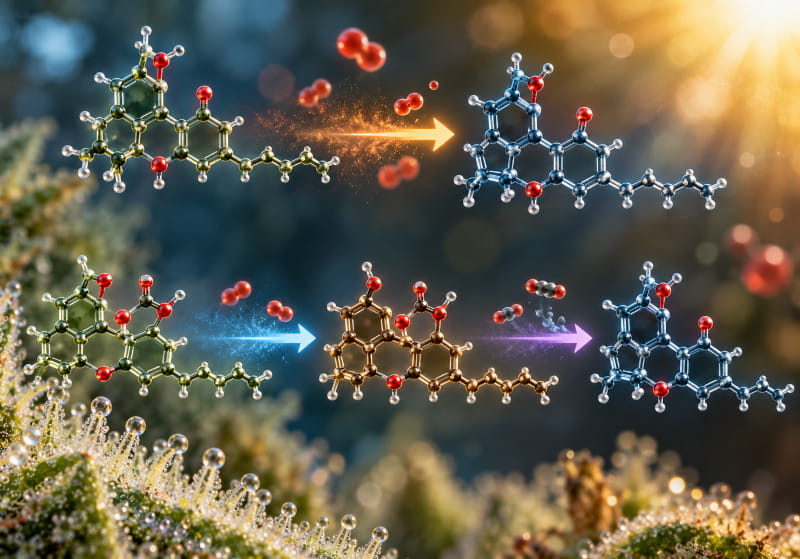
During decarboxylation, THCA loses its carboxyl group in the form of carbon dioxide (CO₂) and becomes Δ9-THC. Heat significantly accelerates this non-enzymatic process, although it can also occur to a lesser extent over longer periods.
Decarboxylation and oxidation are two different chemical processes. Decarboxylation explains the conversion of a cannabinoid acid into its neutral form. CBN formation, by contrast, requires oxidative or dehydrogenative structural changes in which the ring system changes relative to THC and becomes aromatic.
How Does THC Become CBN?
Under oxidative conditions, Δ9-THC can be further transformed into CBN. The molecule does not simply become “older”; its chemical structure changes: THC’s partially saturated ring system becomes more unsaturated and aromatic.
We cover the fundamentals of THC separately. For CBN, the key point is that THC is not indefinitely stable under suitable conditions and that several degradation or transformation pathways are possible.
As early as 1979, Turner and ElSohly proposed a possible multistep degradation pathway from Δ9-THC or Δ8-THC to CBN via epoxide and hydroxylated intermediates. Later studies also show that the actual reaction pathways can depend on the matrix and conditions. For example, different oxidation products were found in decades-old plant material than had previously been observed in aged THC solutions.
Important: A loss of 1 mg of THC does not mean that 1 mg of CBN will subsequently form. THC can undergo various reactions, and CBN is only one of the possible products. THC degradation therefore must not be analytically equated with complete 1:1 conversion to CBN.
Can CBN Also Be Formed via CBNA?
Yes. Cannabinolic acid (CBNA) has been detected in cannabis, and research suggests that oxidative changes can already occur at the THCA level. CBNA can subsequently decarboxylate and thereby form CBN.
A particularly interesting study examined cannabis samples from the Pitt Rivers Museum in Oxford dating approximately from 1896 to 1905. In addition to large amounts of CBN, David J. Harvey also found substantial quantities of CBN acid-A. This compound is heat-sensitive and can readily decarboxylate to CBN.
| Simplified pathway | Chemical process | Interpretation |
|---|---|---|
| THCA → THC | Decarboxylation | Release of CO₂; a well-established process. |
| THC → CBN | Oxidative transformation / aromatization | An important degradation pathway, but not the only possible pathway of THC degradation. |
| THCA → CBNA | Oxidative transformation | CBNA has been detected in cannabis; details of its natural formation pathway are less fully understood. |
| CBNA → CBN | Decarboxylation | Release of CO₂ from cannabinolic acid. |
What Influences the Formation of CBN?
How quickly a cannabinoid profile changes does not depend on a single factor. Oxygen, light, temperature, storage duration, starting material, moisture, packaging and the physical form of the sample can jointly influence how stable THC remains and how much CBN or other degradation products form.
What Role Does Oxygen Play?
Oxygen is particularly relevant to oxidative changes. A classic storage study by Fairbairn, Liebmann and Rowan showed that oxidation by air can cause substantial cannabinoid losses and, under dark conditions, was associated with an increase in CBN.
Another interesting observation was that intact glandular trichomes can provide a certain degree of protection. When these structures are damaged, their contents are more exposed to the surrounding environment.
We explain the structure of cannabinoid-rich trichomes and how they develop during flowering in a dedicated Canna Wiki guide.
What Influence Does Light Have?
Light can significantly accelerate cannabinoid degradation, but THC loss caused by light does not necessarily lead stoichiometrically to a corresponding increase in CBN. This was already shown by Fairbairn and colleagues: light was an important factor in cannabinoid losses, while the loss of THC under light exposure could not simply be explained entirely by newly formed CBN.
This is an important distinction from the simplified idea that every THC molecule that disappears inevitably ends up as CBN.
What Role Does Temperature Play?
Higher temperatures can accelerate chemical reactions and therefore aging and degradation processes. However, the magnitude of this effect depends on the material being studied and the other storage conditions.
A four-year study by Zamengo and colleagues compared cannabis and hashish samples at 22 °C with and without light, at 4 °C in the dark, and at −20 °C in the dark. At room temperature, THC decreased substantially while CBN increased. Cooler storage slowed the changes considerably; at −20 °C, the cannabinoid profiles studied were much more stable.
How Important Is Storage Duration?
Time creates the conditions for slowly occurring chemical changes to become measurable, but it never acts independently of storage conditions. A sample stored cool, dark and as stably as possible can change far less over the same period than material exposed to heat, light and air.
We cover the practical aspects of protection from light, temperature, containers and other storage conditions in detail in the guide How to Store Cannabis Properly.
CBN in Fresh and Aged Cannabis
Fresh cannabis typically contains significantly less CBN than heavily aged THC-containing material. As the cannabinoid profile undergoes increasing chemical change, CBN can become more prominent because THC and THCA are not indefinitely stable.
However, the size of this difference cannot be expressed as a universal percentage. Genetics, original THC/THCA content, maturity, drying, processing, storage time and storage conditions all influence the result.
What Do Cannabis Samples More Than 80 Years Old Show?
A particularly illustrative example comes from historical cannabis samples from the Pitt Rivers Museum dating approximately from 1896 to 1905. When analyzed, most of the cannabinoid content still detectable was present as CBN. At the same time, CBNA and small amounts of THC and THCA were detected.
The study also showed something important: intermediates that had previously been observed during the aging of THC solutions were largely absent or present only in trace amounts. Other oxidation products were found instead. Real plant material therefore does not necessarily behave chemically in the same way as an isolated cannabinoid solution.
Key point: A high CBN level is consistent with an aged and oxidatively altered THC-containing cannabinoid profile. However, the actual amount depends heavily on what has happened to the sample since its formation and harvest.
Does a High CBN Level Automatically Mean Cannabis Is Old?
No. An elevated CBN level can indicate aging and degradation processes, but on its own it does not allow the age of a cannabis sample to be determined reliably.
The reason is simple: ideally, interpretation would require knowing what the original cannabinoid profile looked like and the conditions to which the material was exposed. A THC-rich starting sample has a different potential for CBN formation than a THC-poor sample. Light, temperature, oxygen and time also alter the reaction rate and, in some cases, the distribution of the products formed.
For this reason, forensic research has investigated ratios between THC and CBN, as well as mathematical models, as possible aging indicators. Such models can be useful under defined conditions, but they are not a universal “CBN clock” that can be applied independently of the starting material and storage history.
The History of Cannabinol
Cannabinol holds an exceptional place in the history of cannabis chemistry. CBN was among the first substances isolated from cannabis resin and systematically studied, decades before Δ9-THC was structurally identified as the principal intoxicating constituent of cannabis.
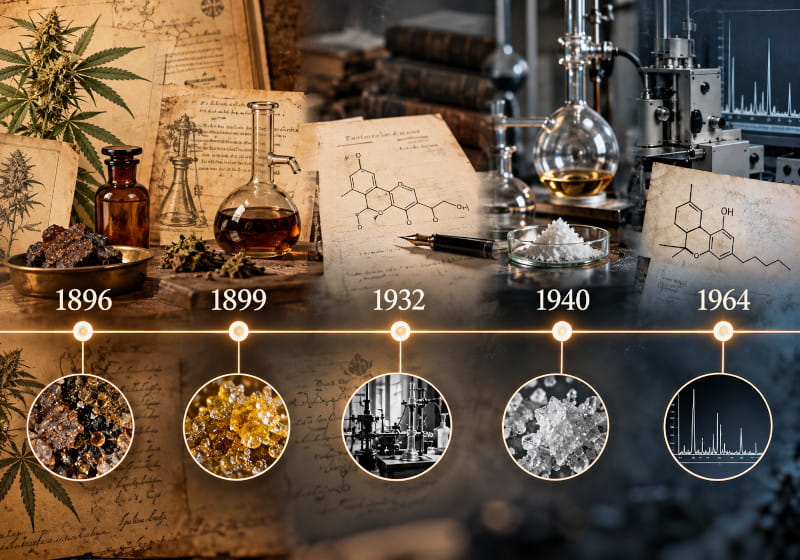
1896: Early Isolation from Charas
In the 1890s, Thomas Barlow Wood, W. T. Newton Spivey and Thomas Hill Easterfield studied charas, or cannabis resin. As early as 1896, the research group reported an isolated substance they called cannabinol. The molecular formula proposed at the time later proved to be incorrect, a good example of how difficult structural elucidation of organic natural products was in that era.
1899: “Cannabinol. Part I”
In 1899, Wood, Spivey and Easterfield published their detailed paper “Cannabinol. Part I” in the Journal of the Chemical Society, Transactions. This is why modern accounts cite both 1896 and 1899 as early dates in CBN history: 1896 refers to the early isolation and naming, while 1899 refers to the detailed publication.
Robert Sidney Cahn and the Structure of Cannabinol
In the early 1930s, British chemist Robert Sidney Cahn made decisive progress in elucidating the structure. His work on the “constitution of cannabinol” helped define the molecule’s basic framework and correct earlier misconceptions. An important publication appeared in 1932.
1940: Synthesis Confirms the Structure
In 1940, Roger Adams, B. R. Baker and R. B. Wearn succeeded in synthesizing cannabinol, providing decisive confirmation of its structure. In the same year, R. Ghosh, Alexander R. Todd and S. Wilkinson also published a synthesis of cannabinol. CBN thus became a milestone in early cannabinoid chemistry.
The work of this period was also important for research into other cannabis constituents. In 1940, for example, studies on the isolation and structure of cannabidiol were published. Cannabis chemistry thus began to evolve from poorly characterized resin extracts toward the chemistry of defined individual compounds.
We cover the broader historical context of the plant separately in our History of Cannabis and Hemp.
What Properties Does CBN Have?
Cannabinol is a lipophilic, neutral cannabinoid with the molecular formula C21H26O2 and a molar mass of approximately 310.44 g/mol. Structurally, CBN is closely related to THC but has a more unsaturated, aromatic ring system.
This structural difference is important not only chemically. It also changes interactions with biological targets. It is therefore scientifically incorrect to treat CBN merely as “old THC” in the sense of an identical molecule with weaker effects.
| Characteristic | CBN |
|---|---|
| Full name | Cannabinol |
| Molecular formula | C21H26O2 |
| Molar mass | approx. 310.44 g/mol |
| Typical occurrence | Usually small amounts; may increase in aged THC-containing material |
| Formation | Primarily oxidative transformation of THC-/THCA-related cannabinoids |
| Related acidic form | CBNA (cannabinolic acid) |
CBN and the Endocannabinoid System
CBN can interact with cannabinoid receptors of the endocannabinoid system. Laboratory studies show binding to CB1 and CB2 receptors, although with a pharmacological profile that differs from Δ9-THC.
Studies using recombinant receptor systems show that CBN can bind to both receptor types. The measured affinity depends on the assay and experimental model used. In several studies, binding or functional activity at CB1 was weaker than with THC, while CBN also showed relevant interactions with CB2.
Such receptor data are important but must not be overinterpreted. Binding to CB1 or CB2 initially shows that a molecule can interact with a receptor system. It does not automatically prove a particular subjective, therapeutic or clinical effect in humans.
Important for interpretation: Receptor binding, an effect in cultured cells, a result in an animal model, and a reproducible effect in a controlled human study represent different levels of evidence.
Is CBN Psychoactive or Intoxicating?
CBN has pharmacological activity at cannabinoid receptors, but the limited human studies provide no evidence that CBN alone produces intoxication comparable to Δ9-THC. Blanket statements such as “CBN is one-quarter as psychoactive as THC” are scientifically problematic because the human evidence cannot be reduced to such a simple percentage.
In a small controlled study from 1975, five male participants received, among other treatments, 50 mg CBN, 25 mg Δ9-THC, or combinations of the two substances. With THC, participants reported typical subjective changes such as feeling intoxicated, dizzy or drowsy. With CBN alone, these effects did not occur in a comparable way in this study.
Another human study from 1975 examined THC together with CBN. The combination produced no clearly discernible change in the quality, intensity or duration of THC effects compared with THC alone.
Animal studies, by contrast, show that CBN can produce cannabimimetic or THC-like effects under certain conditions. This is pharmacologically relevant but cannot be directly extrapolated to subjective human experience.
Does CBN Make You Tired? What the Research on Sleep Really Shows
CBN is frequently marketed as a “sleep cannabinoid” or as a particularly sedating cannabinoid. The current state of research is much more nuanced: controlled human studies now exist, but their results do not present a consistent picture and so far do not justify the blanket claim that CBN reliably causes drowsiness or treats sleep disorders.
Where Does Its Reputation as a “Sleep Cannabinoid” Come From?
Part of this reputation may have arisen from the association between CBN and aged cannabis. Older THC-containing material can have higher CBN levels, and subjective reports about the characteristics of old cannabis were later partly attributed to CBN. Such observations, however, cannot isolate which molecule was responsible for a subjective effect.
A 2021 review specifically examined the human literature available at the time and concluded that the clinical evidence was insufficient to support sleep-promoting claims. In particular, modern studies using validated sleep measures or polysomnography were lacking at that time.
What Did the 2024 Controlled Human Study Show?
A randomized, double-blind, placebo-controlled study examined CBN alone and in combination with CBD over seven nights. The modified intention-to-treat analysis included 293 adults who rated their own sleep quality as poor or very poor.
Compared with placebo, 20 mg CBN produced a statistically significant reduction in the number of nighttime awakenings and overall sleep disturbance. However, the primary endpoint—sleep quality—did not reach statistical significance. Other parameters likewise showed no consistently uniform benefit. Adding CBD did not consistently improve the CBN results.
What Did Another Study of CBN Products Show?
Another randomized, double-blind, placebo-controlled study from 2024 tested three CBN formulations containing 25, 50 or 100 mg, as well as melatonin and placebo. Such product studies expand the human evidence base, but each must be evaluated separately with regard to formulation, endpoints, study design and possible manufacturer interests. They do not replace independent confirmation of a general sleep-promoting effect of pure CBN.
What Did the 2026 Sleep-Laboratory Study Show?
In 2026, a randomized, double-blind, placebo-controlled crossover study was published involving 20 adults with diagnosed insomnia. Single oral doses of 30 mg CBN, 300 mg CBN and placebo were examined; sleep was measured in the laboratory using polysomnography.
The primary endpoint was wake time after sleep onset, known as Wake After Sleep Onset (WASO). Neither 30 mg nor 300 mg CBN produced a statistically significant improvement in this primary endpoint.
At 300 mg, however, changes were observed in some secondary endpoints: sleep-onset latency was shorter, subjective sleep quality was better, NREM stage 2 sleep increased, and certain EEG arousal measures decreased. Because the study involved only 20 people and a single treatment night for each condition, larger and longer-duration studies are needed.
| Evidence | What the evidence shows | Limitations |
|---|---|---|
| Older animal studies | Individual sedation- or sleep-related signals have been described. | Not directly transferable to humans. |
| Older human studies | Small studies do not provide a clear picture of CBN as an independently sedating cannabinoid. | Very small samples and older methodology. |
| RCT 2024 | 20 mg CBN improved some secondary sleep parameters, but did not significantly improve the primary endpoint of sleep quality. | Self-reported poor sleep quality; limited study duration. |
| Sleep-laboratory RCT 2026 | Primary WASO endpoint not significant; changes in individual secondary parameters at 300 mg. | 20 participants, acute single dose. |
Conclusion on the sleep question: Research has advanced compared with just a few years ago, but “CBN makes you tired” remains too broad as a general statement. Controlled human studies show some interesting signals, but there is still insufficiently consistent clinical evidence to classify CBN generally as a sleep aid or as a clearly sleep-promoting cannabinoid.

What Else Is Being Researched About CBN?
CBN is being investigated in numerous preclinical research fields. However, many of the “effects” frequently mentioned online are based on cell experiments or animal models and must not be presented as proven effects in humans.
Research has examined, among other things, receptor signaling pathways, inflammation models, pain models, neurobiological processes, intraocular pressure, skin and cell models, and interactions with additional molecular targets. The scientific value of such work initially lies in identifying possible mechanisms and research questions.
| Research level | What can it show? | What can it not prove? |
|---|---|---|
| In vitro | Molecular mechanisms, receptor interactions and effects in cell models. | No clinical efficacy in humans. |
| Animal studies | Biological effects in a living organism and possible mechanisms. | Dose and effect cannot be directly extrapolated to humans. |
| Human studies | Acute effects, tolerability and, depending on the design, clinically relevant endpoints. | Small or short studies do not permit arbitrarily broad conclusions. |
| Clinical evidence | Requires reproducible results from appropriate controlled studies. | Cannot be inferred from preclinical data alone. |
This distinction is essential for a scientifically sound treatment of CBN. An interesting observation in a cell culture is a research finding—not a medical claim.
CBN vs. THC: What Is the Difference?
CBN and THC are structurally related but are not chemically or pharmacologically identical. THC is formed by decarboxylation of THCA and is the best-known principal intoxicating constituent of cannabis; CBN, by contrast, is formed predominantly through oxidative changes in THC-related cannabinoids.
| Characteristic | CBN | THC |
|---|---|---|
| Name | Cannabinol | Δ9-Tetrahydrocannabinol |
| Molecular formula | C21H26O2 | C21H30O2 |
| Origin | Primarily oxidative transformation of THC-/THCA-related compounds | Formed from THCA through decarboxylation |
| Fresh plant material | Usually small amounts | Neutral THC fraction usually lower than the total potential from THCA + THC |
| Intoxication | Human evidence shows no intoxication comparable to THC | Clearly intoxicating |
| Aging | May increase as THC-containing material ages | May decrease under unfavorable conditions |
CBN vs. CBD: What Is the Difference?
CBN and CBD are two distinct cannabinoids with different origins and structures. CBD is formed by decarboxylation of CBDA, whereas CBN is predominantly associated with oxidative changes in THC-related cannabinoids.
The acidic precursor CBDA is formed enzymatically from CBGA in CBD-dominant plants and can later decarboxylate. This established biosynthetic pathway differs fundamentally from the predominantly degradative origin of CBN. This is also relevant when classifying CBD seeds: their characteristic cannabinoid profile is based on genetically determined cannabinoid biosynthesis, whereas an elevated CBN content should not be understood in the same way as a distinct genetic chemotype.
The two compounds should not be equated pharmacologically either. We therefore cover the fundamentals of CBD and how it differs from THC in a separate article.
| Characteristic | CBN | CBD |
|---|---|---|
| Full name | Cannabinol | Cannabidiol |
| Typical formation | Oxidative transformation of THC-related cannabinoids | Decarboxylation of enzymatically formed CBDA |
| Related acidic form | CBNA | CBDA |
| CB1/CB2 | Direct binding to cannabinoid receptors has been described | More complex pharmacological profile; no simple THC-like CB1 agonist action |
| Intoxication | No intoxication comparable to THC in limited human studies | Not intoxicating in the THC-typical sense |
Are There Really CBN-Rich Cannabis Strains?
The term “CBN-rich strain” should be used with caution. A high CBN content is not the same genetic concept as a THC-, CBD- or CBG-dominant chemotype because no established dedicated synthase pathway is known for CBN.
In THC- or CBD-dominant plants, variants and activity of the relevant cannabinoid synthases, among other factors, determine the direction in which the cannabinoid profile develops. With CBN, by contrast, the measured concentration depends heavily on how much THC or THCA was originally present and on the aging, processing and storage conditions to which the material was subsequently exposed.
This does not rule out finding cannabis samples or products made from them with elevated CBN levels. Scientifically, however, it is more accurate to distinguish between a measured CBN-rich product and a genetically defined “CBN strain.” Anyone selecting cannabis seeds according to their cannabinoid profile should therefore distinguish between genetically determined chemotypes and later changes in the plant material: while strains can be specifically selected for a particular THC, CBD or CBG profile, a CBN level measured later is much more strongly influenced by aging, processing and storage.
Important: “CBN-rich” initially describes an analytical result. It does not automatically prove that a plant was genetically selected for an independent CBN biosynthetic pathway.
CBN in Cannabis Laboratory Analysis
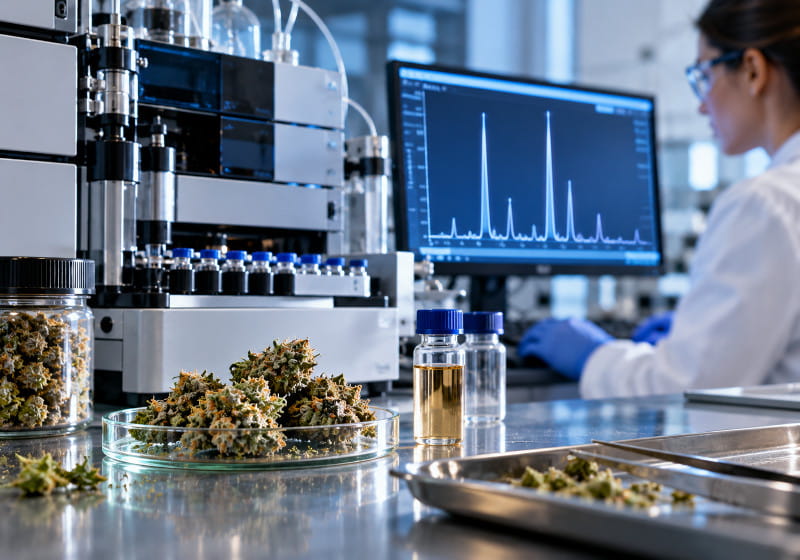
In cannabis analysis, CBN is of interest not only as an individual cannabinoid but also as a possible indicator of changes in a THC-containing cannabinoid profile. Modern chromatographic methods can quantitatively measure CBN alongside THC, THCA, CBD, CBDA and other cannabinoids.
How Is CBN Measured?
Common methods include liquid chromatography, particularly HPLC or LC-based methods, and gas chromatography. The choice of method is important because acidic cannabinoids can decarboxylate under intense heating. To determine THCA, CBNA and their neutral forms separately, the analytical method must be designed accordingly.
Can CBN Serve as an Aging Marker?
CBN can be regarded as part of an aging or degradation pattern, particularly together with the remaining THC and THCA levels. However, an isolated CBN value is not sufficient to reliably reconstruct the history of a sample.
Forensic studies have attempted to derive information about storage duration or original THC levels from THC and CBN concentrations or their ratios. Such models work best under known or controlled conditions. With unknown genetics, an unknown starting profile and unknown storage conditions, uncertainty increases substantially.
Why CBN Is Important for Cannabis Research
The significance of cannabinol extends far beyond the question of whether a particular cannabis product contains a lot or a little CBN. The molecule connects the history of cannabis chemistry with modern questions about cannabinoid stability, storage, analysis and pharmacology.
Historically, research into CBN helped break cannabis down from a complex plant resin into individual chemically defined constituents. Chemically, CBN shows that a plant’s cannabinoid profile does not remain static after biosynthesis. Analytically, it demonstrates that harvest, processing and storage can alter the composition of a sample.
The chemical changes that occur in cannabis after harvest are not limited to cannabinoids. Other classes of compounds, such as terpenes have their own stability and volatility characteristics. Cannabinoid degradation and changes in aroma should therefore not be treated as the same chemical process.
Frequently Asked Questions About Cannabinol (CBN)
What Is CBN?
CBN stands for cannabinol and is a cannabinoid found in cannabis. It is formed predominantly through oxidative changes in THC-related cannabinoids and usually occurs only in small amounts in fresh plant material.
What Does CBN Stand For?
CBN is the abbreviation for cannabinol. It is a distinct cannabinoid that is structurally related to THC.
How Is CBN Formed from THC?
CBN can form through oxidative transformation of THC. In the process, THC’s ring system changes and becomes more aromatic. Actual degradation can involve several intermediates and by-products, which is why THC is not converted completely 1:1 into CBN.
Is CBN Also Formed from THCA?
Research suggests that oxidative changes can already occur at the THCA level. CBNA can form in this process and can subsequently produce CBN through decarboxylation. In addition, THCA can first decarboxylate to THC, which can later be further transformed oxidatively into CBN.
Is THCA → THC → CBN the Complete Reaction Chain?
No. This representation is a useful simplification, but it is not the only possible pathway. Oxidation can apparently also occur before decarboxylation, and both THC and other intermediates can undergo additional degradation pathways.
Does Fresh Cannabis Contain CBN?
Yes, CBN can also be detectable in cannabis samples that have not aged extensively, although typically in relatively small amounts. Higher levels are often associated with more advanced changes in THC-containing material.
Does a Lot of CBN Mean Cannabis Is Old?
A high CBN level can indicate aging and oxidative degradation, but on its own it is not reliable proof of age. The starting profile, temperature, light, oxygen, processing and storage duration influence the measured concentration.
Does CBN Make You Tired?
This has not yet been clearly established. More recent controlled human studies show changes in individual sleep parameters, but no consistent overall picture that would justify the blanket label “sleep cannabinoid.”
Is CBN Psychoactive?
CBN is pharmacologically active and interacts with cannabinoid receptors, but small human studies show no intoxication comparable to THC. Animal data on THC-like effects must not be directly extrapolated to humans.
What Is the Difference Between CBN and THC?
THC is formed through decarboxylation of THCA and has a pronounced intoxicating effect. CBN is formed predominantly through oxidative changes in THC-related compounds and does not show comparable intoxication in the limited human research.
What Is the Difference Between CBN and CBD?
CBD is formed from CBDA through decarboxylation, whereas CBN is predominantly associated with the oxidative degradation of THC-related cannabinoids. The two molecules also have different pharmacological profiles.
Are There CBN-Rich Cannabis Strains?
The term should be used with caution. A high measured CBN value can depend strongly on aging, processing and storage. A genetically defined CBN chemotype therefore cannot readily be compared with THC-, CBD- or CBG-dominant chemotypes.
Can the Age of Cannabis Be Determined from Its CBN Level?
Not reliably from the CBN level alone. THC/CBN ratios and models can provide clues under defined conditions, but without knowledge of the original cannabinoid profile and storage conditions, age determination remains uncertain.
What Should You Know About Cannabinol?
Cannabinol is an exceptional cannabinoid above all because its history is closely linked to the chemical history of cannabis itself. CBN was one of the first cannabinoids to be studied intensively and is also an important example of how the cannabinoid profile can continue to change after it has formed.
Its formation cannot be fully reduced to the simple formula “THCA → THC → CBN.” THCA can decarboxylate and THC can be further transformed oxidatively into CBN; at the same time, analytical data suggest that oxidation can also occur at the THCA level and produce CBNA. Which pathways dominate in a real cannabis sample depends on the material and conditions.
Light, oxygen, temperature and time influence stability, but THC loss and CBN increase do not automatically correspond directly. CBN is therefore a useful indicator of aging and degradation processes, but not a universal timestamp.
Nuance is also essential when considering the properties that are frequently discussed. CBN interacts with the endocannabinoid system and is being studied intensively, but many biological findings come from preclinical models. Regarding the popular claim that CBN is fundamentally a “sleep cannabinoid,” the human studies now available provide some interesting signals, but still no consistent clinical confirmation.
Scientific Sources
- Wood TB, Spivey WTN, Easterfield TH (1899): Cannabinol. Part I.
- Adams R, Baker BR, Wearn RB (1940): Structure of Cannabinol. III. Synthesis of Cannabinol.
- Fairbairn JW, Liebmann JA, Rowan MG (1976): The stability of cannabis and its preparations on storage.
- Turner CE, ElSohly MA (1979): A possible decomposition pathway of Δ9-tetrahydrocannabinol to cannabinol.
- Harvey DJ (1990): Stability of cannabinoids in dried samples of cannabis dating from around 1896–1905.
- Karniol IG et al. (1975): Effects of delta9-tetrahydrocannabinol and cannabinol in man.
- Zamengo L et al. (2019): The role of time and storage conditions on the composition of hashish and marijuana samples: A four-year study.
- Cannabinol: History, Syntheses, and Biological Profile of the Greatest “Minor” Cannabinoid (2022).
- Bonn-Miller MO et al. (2024): A double-blind, randomized, placebo-controlled study of the safety and effects of CBN with and without CBD on sleep quality.
- Lavender IG et al. (2026): Cannabinol for Acute Treatment of Insomnia Disorder in a Randomized Placebo-Controlled Crossover Trial.