Cannabis Trichomes: Structure, Development & Maturity
Cannabis Trichomes: Structure, Development & Maturity
Updated: September 2026 | Cannabis trichomes explained clearly: structure, types, development, and how to interpret clear, cloudy, and amber trichomes
Author: Cannapot Grow Team | Reading time: approximately twenty minutes
The Most Important Points at a Glance
✓ Trichomes are tiny structures on the surface of the cannabis plant. They are particularly easy to see on female flowers, where they form the characteristic sparkling coating.
✓ Important plant compounds are produced and stored in glandular trichomes. These primarily include cannabinoids and terpenes.
✓ Cannabis has several types of trichomes. Glandular trichomes include bulbous, capitate-sessile and capitate-stalked forms, which differ in size and structure.
✓ As they mature, the appearance of the trichomes changes. Their heads are initially clear, later become cloudy or milky, and may eventually develop an amber colour.
✓ To assess maturity, it is best to examine the trichomes directly on the flowers or bracts. Trichomes on sugar leaves may develop faster or differently and can distort the overall picture.
✓ Trichome colour is an important indicator of maturity, but not an exact timer. What matters is the overall appearance of many trichomes, not a single head or a fixed percentage.
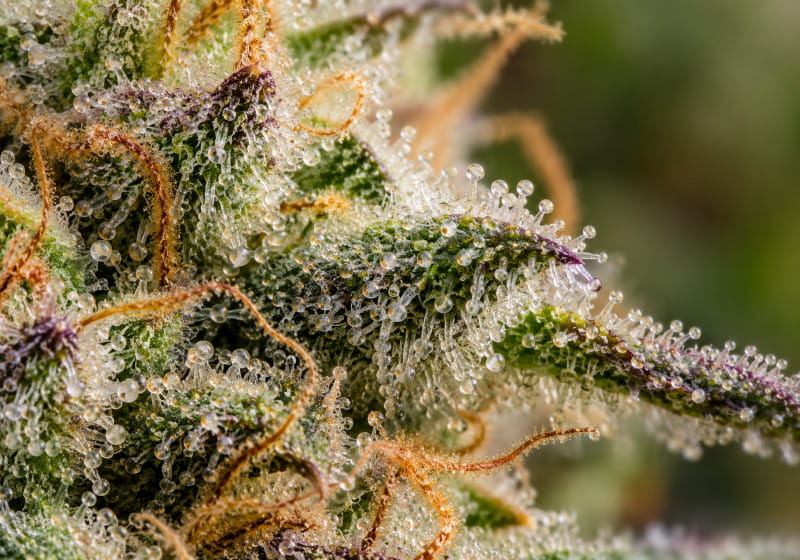
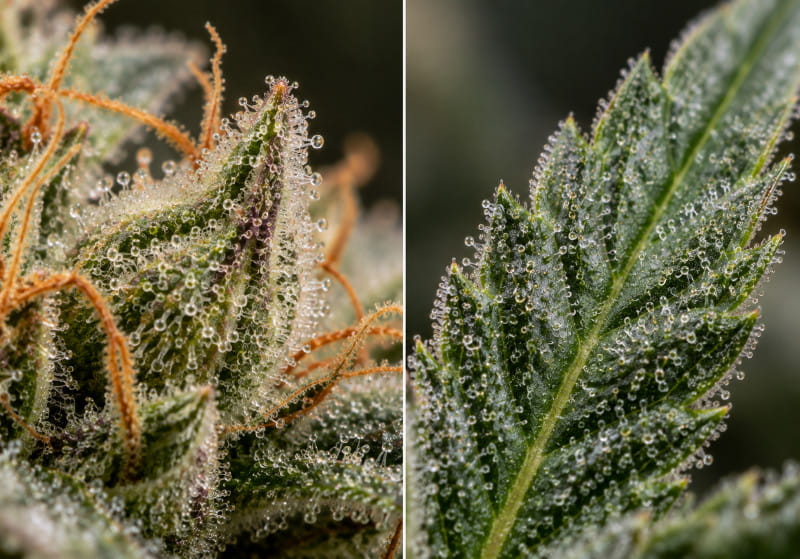
When a cannabis flower is examined under magnification, countless tiny structures can be seen, many with clearly visible heads. These are the trichomes of the cannabis plant. They are particularly conspicuous on female flowers, where they create the characteristic sparkling coating. But trichomes are more than a visual feature: certain glandular trichomes produce and store numerous plant compounds, including cannabinoids and terpenes.
Anyone who closely observes plants grown from Cannabis Seeds during flowering can also see changes in their trichomes. The heads initially appear mostly clear, become cloudy or milky as they mature, and may later develop an amber colour. These changes provide important clues to the maturity of cannabis trichomes, but they should always be interpreted as part of the overall picture.
This guide explains how trichomes are structured, which types occur on cannabis, where they are found on the plant, and how they change during flowering. We also look at the differences between clear, cloudy, and amber trichomes and what matters when examining them with a loupe or microscope. How these characteristics fit into the actual harvest decision is covered in detail in our guide to the right time to harvest cannabis.
What Are Trichomes on Cannabis?
Trichomes are fine outgrowths of the epidermis, the outer tissue layer of a plant. They occur not only in cannabis but in many plant species. Their shape, size, and function can vary considerably depending on the plant and the type of trichome.
Cannabis generally has both glandular and non-glandular trichomes. Non-glandular trichomes primarily perform protective and structural functions. Glandular trichomes, by contrast, have a glandular head containing cells that produce various plant compounds. Cannabinoids and terpenes are among the compounds produced and accumulated there.
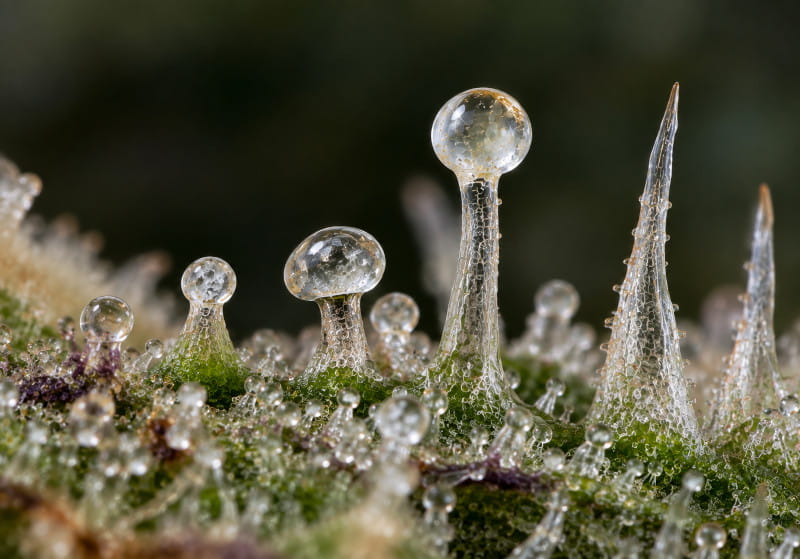
The glandular trichomes on female flowers are particularly conspicuous. Under a loupe or microscope, many resemble tiny mushrooms, with a rounded glandular head sitting on a slender stalk. However, not all trichomes look alike; several different types occur, as explained in more detail below. Our Anatomy of the Cannabis Plant also shows where trichomes occur and how they differ from bracts, stigmas, and other plant structures.
Where Are Trichomes Located on the Cannabis Plant?
Trichomes occur on various above-ground parts of the cannabis plant, but their density differs considerably between tissues. Glandular trichomes are especially abundant on female flowers, particularly on the bracts and the small sugar leaves protruding from the flowers.
The bracts are particularly important in this context. In cannabis terminology they are often referred to as the “calyx,” although this is not botanically precise. Bracts surround parts of the female flower and are often densely covered with glandular trichomes. The elongated white, and later brownish, “hairs” protruding from them are stigmas rather than trichomes.
Trichomes are also found on sugar leaves, larger leaves, petioles, and other parts of the plant. This distinction matters when assessing maturity because not all trichomes develop at the same rate. The trichomes directly on the flower bracts are particularly informative. Further below, we explain why relying on sugar leaves can give a misleading impression.
How Are Cannabis Trichomes Structured?
In simplified terms, the conspicuous glandular trichomes on cannabis flowers consist of a glandular head and, depending on the trichome type, a stalk of varying length. The glandular head contains specialised cells involved in the biosynthesis of cannabinoids, terpenes, and other compounds.
These compounds are not simply distributed throughout the trichome. A small storage cavity forms beneath the outer layer of the glandular head, where the produced compounds accumulate. This gives the head its characteristic rounded shape, which is especially easy to see under a loupe or microscope.
A glandular trichome is therefore much more than a simple plant hair. It is a specialised structure in which important metabolic processes take place and various plant compounds are produced and stored. Size, structure and shape differ considerably depending on the trichome type – something that is particularly apparent among the different types of glandular trichomes.
What Functions Do Trichomes Have in Cannabis?
Trichomes perform several functions in cannabis and contribute, among other things, to the plant’s protection. Their specific role depends on the trichome type. Non-glandular trichomes, for example, form a fine physical barrier on the plant surface. Glandular trichomes are especially notable because they produce and store a variety of plant compounds.
These compounds include cannabinoids and Cannabis Terpenes. Their biosynthesis takes place primarily in the glandular heads, where the compounds subsequently accumulate in a storage cavity. In fresh plant material, many cannabinoids are present predominantly in their acidic forms.
Well-known examples include THCA (tetrahydrocannabinolic acid) and CBDA (cannabidiolic acid). CBG and its precursor CBGA also play an important role in cannabinoid biosynthesis. Which cannabinoids a plant predominantly produces is determined primarily by its genetics and chemotype. Trichomes are therefore important sites of cannabinoid production and storage, but they do not themselves determine a cultivar’s cannabinoid profile.
What Types of Trichomes Are Found on Cannabis?
Cannabis has several types of trichomes that differ in size, shape, and function. Glandular trichomes are especially important and are commonly divided into bulbous, capitate-sessile, and capitate-stalked forms. Cannabis also has non-glandular trichomes.
|
Trichome type |
Typical structure |
Classification |
|
Bulbous |
very small, with a simple glandular structure |
smallest of the commonly described glandular trichome forms |
|
Capitate-sessile |
rounded glandular head on a very short stalk |
occurs on leaves and around the flowers, among other areas |
|
Capitate-stalked |
larger glandular head on a clearly visible stalk |
particularly numerous and conspicuous on female flowers |
|
Non-glandular |
hair-like structure without a glandular head |
primarily performs protective and structural functions |
This classification helps distinguish the different trichomes. Their development, however, is more complex than the individual terms might suggest. Studies of cannabis flowers show that some glandular trichomes that initially appear capitate-sessile can develop into clearly stalked forms during flower development. The different trichome types should therefore not always be understood as completely independent structures.
How Do Trichomes Develop During Flowering?
Trichomes change considerably during flowering: they increase in number, develop their characteristic morphology, and pass through different stages of maturation. As female flowers develop, increasing numbers of glandular trichomes become visible, particularly on the bracts.
Their structure can also change during this period. Studies of cannabis flowers show that some initially capitate-sessile glandular trichomes can develop into stalked forms as flowering progresses. At the same time, individual trichomes do not all mature at once, so different developmental stages may occur side by side on the same flower.
How quickly this process occurs depends, among other factors, on the genetics and developmental age of the plant. As a result, differences can occur not only between cultivars but also between individual flowers on the same plant. Our guide to the Cannabis Flowering Stage Week by Week explains how the flowers change throughout this period. For an overview of the plant’s entire development from germination to harvest, see our article on the Cannabis Growth Cycle.
What Does Trichome Colour Reveal About Maturity?
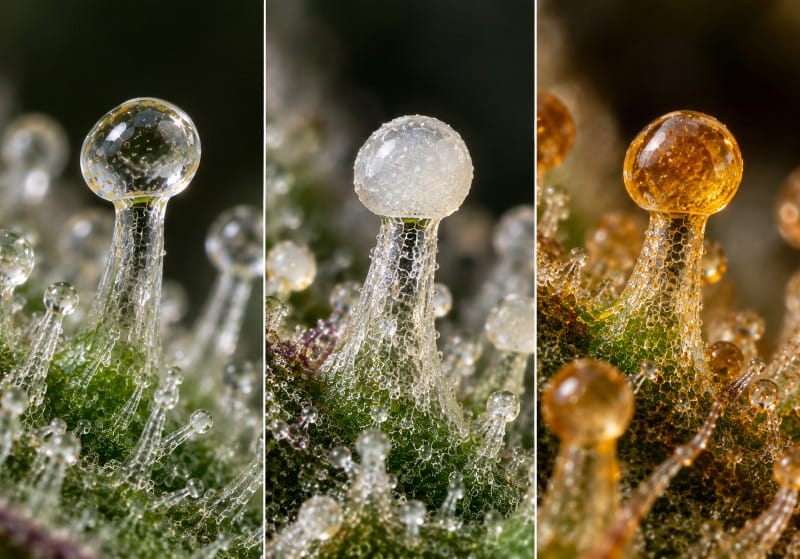
The colour of trichome heads changes as they mature and provides useful clues to their developmental stage. Young trichomes initially appear clear and transparent. Later, many heads become cloudy or milky, while amber trichomes may appear at more advanced stages of maturation. Because these changes do not occur everywhere at the same time, several colours are often visible side by side.
|
Appearance |
Maturity |
What can be observed? |
|
Clear / transparent |
early stage |
the trichomes are still developing |
|
Cloudy / milky |
advanced maturity |
the clear glandular head increasingly appears whitish or opaque |
|
Amber |
late stage |
the trichome heads show yellowish to golden or amber tones |
Clear Trichomes
Clear trichomes can be recognised by their transparent, almost glass-like heads. Under a loupe or microscope, light can pass visibly through them. If a flower still has many clear trichomes, those trichomes are at a comparatively early stage of development.
However, not all trichomes mature at the same time. Individual clear heads may therefore still be present even on a well-developed flower. When assessing maturity, the overall appearance of many trichomes should always be considered rather than the colour of a single head.
Cloudy Trichomes
Cloudy or milky trichomes are no longer transparent but appear whitish, hazy, or opaque. This change occurs as the trichomes mature. During flower development, the proportion of cloudy trichomes therefore usually increases, while fewer heads remain completely clear.
The terms “milky”, “cloudy” and “opaque” initially describe only the visible appearance of the trichomes. Colour alone cannot reveal the exact concentration of a particular cannabinoid. A laboratory analysis would be required for that.
Amber Trichomes
Amber trichomes appear at a later stage of maturation. Their heads are no longer clear or milky but show yellowish, golden, or amber tones. Cloudy trichomes and individual amber heads are often visible on the same flower at the same time.
The term “brown trichomes” is also sometimes used in this context, but amber describes the typical colour more accurately. Very dark or visibly damaged trichome heads should not automatically be equated with normally matured amber trichomes.
How Do You Examine Trichomes With a Loupe or Microscope?
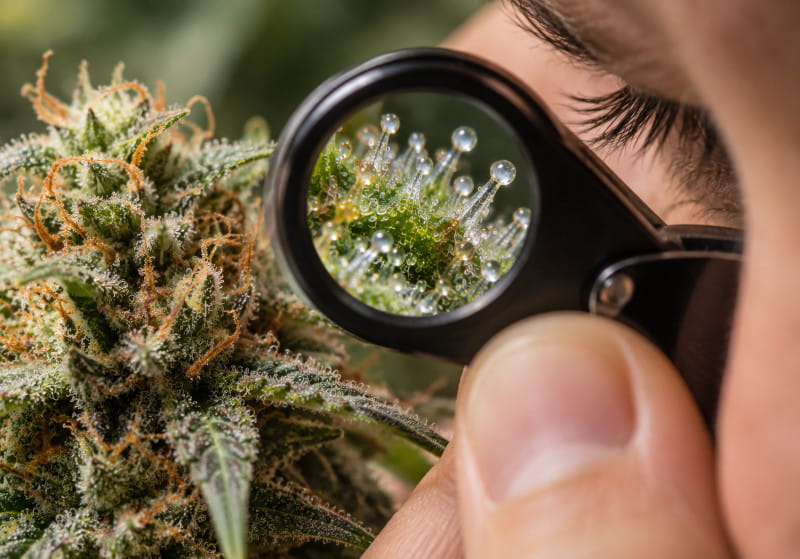
Clear, cloudy, and amber trichomes are much easier to distinguish with a loupe or microscope than with the naked eye. The main requirement is sufficient detail to see individual trichome heads clearly enough to assess their colour and transparency.
For a quick inspection, a jeweller’s loupe or hand lens may already be sufficient. A pocket microscope or digital microscope allows the trichomes to be examined in greater detail. Magnification of around 30x to 60x is generally well suited to assessing them. Higher magnification reveals more detail, but it also reduces the visible field and can make steady observation more difficult.
Lighting also plays an important role. Warm or strongly coloured light can make trichome heads appear more yellowish and distort the assessment. Trichomes are therefore best examined under lighting that is as neutral as possible. If in doubt, it is useful to check the same area from several angles.
Which Parts of the Plant Should You Examine for Trichomes?
When assessing maturity, trichomes should be examined on several flowers from the same plant. The glandular trichomes directly on the bracts are particularly useful. Looking at only one location can give a misleading impression because not all flowers and trichomes mature at the same rate.
It is therefore best to compare several areas of the flowers. Heavily illuminated tops and strongly shaded areas may develop differently and should not be used as the sole reference. What matters is the overall appearance of many trichomes, not the colour of individual heads.
Trichomes on Flowers or Sugar Leaves – What Is the Difference?
When assessing maturity, the focus should be on trichomes on the flowers rather than only those on the sugar leaves. Both can be densely covered with glandular trichomes, but they do not necessarily develop at the same rate.
Sugar leaves are the small leaves that protrude directly from the flowers. Because they are often heavily covered with trichomes and easy to inspect, their colour is sometimes used as a reference for the entire flower. However, the trichomes on the bracts of the actual flowers provide a more informative reference.
Trichomes on sugar leaves can also be examined for comparison. However, they should not be the sole basis for assessing maturity. Checking several flowers, especially their bracts, provides a much more reliable overall picture.
Why Do Cannabis Trichomes Mature at Different Rates?
Not all trichomes on a cannabis flower mature at the same time. While some heads may still appear clear, others may already be cloudy or amber. A mixture of different stages of maturity is therefore completely normal and can often be observed even within the same flower.
How quickly trichomes develop depends on several factors, particularly the genetics and developmental stage of the plant. Flower position can also play a role because different areas do not necessarily form at the same time or develop under identical conditions. Differences in light exposure and microclimate can further influence development.
For this reason, maturity should not be judged by whether every individual trichome has the same colour. The overall appearance across several flowers and different parts of the plant is more informative and provides a much better indication of how far the trichomes have developed overall.
Cloudy Trichomes – How Much Longer?
There is no universal number of days remaining once trichomes have become cloudy. The common question “Cloudy trichomes – how much longer?” depends, among other things, on how far the flower as a whole has developed and how the trichomes continue to change over the following days.
It makes a difference whether only a few trichome heads are becoming cloudy or whether a large proportion of the observed trichomes already look this way. Genetics also plays a role: some plants change trichome colour more quickly, while others remain predominantly cloudy for a longer period. Even different flowers on the same plant can develop differently.
Rather than relying on a fixed number of days, it is more useful to observe the changes in the trichomes over several checks. This makes it possible to see whether the proportion of clear heads continues to decrease, more trichomes become cloudy, or the first amber heads begin to appear.
Why Aren’t Trichomes Turning Amber?
Trichomes do not turn amber at the same rate or to the same extent on every plant. How their colour develops depends, among other factors, on genetics and the developmental stage of the flower. If many trichomes remain cloudy for an extended period, this does not automatically mean that something is wrong with the plant.
It is also important to consider where on the plant the trichomes are examined. Trichomes on sugar leaves may develop differently from those on the bracts. Warm lighting, strong reflections, or insufficient magnification can also make clear, cloudy, and amber heads difficult to distinguish.
A high proportion of amber trichomes is also not a stage that every plant must reach at a particular time. Some flowers remain predominantly cloudy for a long period and show only a few amber heads. Here too, the entire development should be considered rather than waiting for a particular colour or fixed percentage.
Trichomes or Pistils: What Is the Difference?
Trichomes and pistils are often confused, but they are different structures of the cannabis plant. Trichomes occur on the plant surface and can perform different functions depending on their type. The clearly visible white, and later brownish, flower hairs belong to the female flower. More precisely, these visible hairs are stigmas, the pollen-receptive structures of the flower.
|
Feature |
Trichomes |
Stigmas |
|
What is it? |
fine structures on the plant surface |
part of the female flower |
|
Appearance |
hair-like or with a rounded glandular head, depending on the type |
long, thread-like flower hairs |
|
Function |
depending on the type, protection as well as production and storage of various plant compounds |
receive and retain pollen |
|
Examination |
glandular heads are best examined with a loupe or microscope |
clearly visible to the naked eye |
The stigmas also change during flowering: they may change colour, dry out, and curl inward. This is a visible sign of advancing flower development, but it should not be confused with changes in trichome colour. Anyone assessing maturity by the trichomes should therefore examine the glandular heads with a loupe or microscope.
What Mistakes Can Occur When Assessing Trichomes?
Even small mistakes when examining trichomes can create a misleading impression of maturity. It is therefore important to inspect several flowers rather than focusing only on individual trichomes or easily accessible sugar leaves.
-
Checking only sugar leaves: The trichomes visible there may develop differently from the trichomes on the bracts of the actual flowers.
-
Looking at only one spot: Not all flowers and areas of a plant develop at the same rate. Checking several locations therefore provides a more reliable overall picture.
-
Confusing trichomes and stigmas: Brown or curled flower hairs do not automatically indicate the colour of the trichome heads.
-
Checking under unsuitable light: Warm or coloured light and strong reflections can make clear, cloudy and amber trichomes appear different.
-
Overemphasising individual trichomes: A single clear or amber head says little about the flower as a whole. The overall appearance of many trichomes is what matters.
-
Relying on fixed percentages: Figures such as “10, 20 or 30 percent amber trichomes” can serve as a rough guide, but they are not universally valid biological thresholds.
-
Inferring exact cannabinoid levels from colour: Colour shows visible changes in the trichomes. It cannot determine exactly how much THCA, CBDA or other cannabinoids are actually present.
What Do Trichomes Reveal About Harvest Timing – and What Don’t They Reveal?
Clear, cloudy, and amber trichomes provide important clues to how far a cannabis flower has developed. Trichome colour alone, however, cannot determine an exact harvest day. Differences between genetics, individual flowers, and different areas of the same plant must also be taken into account.
Trichomes are therefore an important indicator of maturity, but they are not the only information that matters. Our guide Harvesting Cannabis – the Right Time to Harvest explains in detail how trichome development can be considered together with flower development and other visible characteristics when evaluating harvest timing.
FAQs
Q: What are trichomes on cannabis?
A: Trichomes are fine structures on the surface of the cannabis plant. There are glandular and non-glandular forms. The glandular trichomes on female flowers are particularly conspicuous; cannabinoids and terpenes, among other compounds, are produced and stored in them.
Q: What do mature trichomes look like?
A: As they mature, the appearance of trichome heads changes. They are initially mostly clear, later become cloudy or milky, and may eventually develop amber tones. Because not all trichomes mature at the same time, different stages are often visible side by side.
Q: What do cloudy trichomes mean?
A: Cloudy trichomes indicate an advanced stage of maturity. Their heads are no longer transparent but appear cloudy, whitish or opaque. However, colour alone cannot determine the concentration of individual cannabinoids.
Q: Cloudy trichomes – how much longer?
A: A fixed number of days cannot be derived from cloudy trichomes. Further maturation can proceed at different rates depending on genetics and developmental stage. It is more informative to observe how the trichomes change over several checks.
Q: Do trichomes have to turn amber?
A: No. Trichomes do not turn amber at the same rate or to the same extent on every plant. Some flowers remain predominantly cloudy for a longer period and show only a few amber heads.
Q: Why aren’t my trichomes turning brown or amber?
A: How quickly trichome colour changes depends, among other things, on genetics and the developmental stage of the flower. It is also important to examine the trichomes on the bracts rather than only those on the sugar leaves. Lighting and magnification can also influence colour perception.
Q: What magnification is suitable for cannabis trichomes?
A: Magnification of around 30x to 60x is generally well suited for assessing trichomes. The key is that the individual glandular heads can be seen sharply enough to distinguish clear, cloudy and amber trichomes.
Q: Should you check trichomes on flowers or sugar leaves?
A: To assess maturity, you should primarily examine the trichomes on the bracts of several flowers. Trichomes on sugar leaves can also be checked, but they should not be the sole basis for the assessment.
Q: Are trichomes and the white hairs on a cannabis flower the same thing?
A: No. The white, and later brownish, flower hairs are stigmas and belong to the female flower. Trichomes, by contrast, are fine structures on the plant surface, and the glandular forms can be recognised by their small glandular heads.
How Should Cannabis Trichomes Be Interpreted?
Trichomes are far more than the sparkling coating on a cannabis flower. Different trichome types perform different functions. Glandular trichomes on female flowers are especially significant because they produce and store numerous plant compounds, including cannabinoids and terpenes.
The appearance of trichomes also changes during flower development. Their heads initially appear clear, often become cloudy as they mature, and may later develop amber tones. Because this process does not occur everywhere at the same time, the overall appearance of multiple trichomes and flowers should always be considered.
A loupe or microscope makes these differences much easier to recognise. What matters, however, is not a single trichome head or a rigid percentage, but the development of the plant as a whole. Understanding where trichomes are located, how they are structured and how their appearance changes during flowering makes it much easier to interpret their stage of maturity. More background information on cannabis, plant anatomy, and plant compounds can be found in our Cannabis Knowledge section.
Scientific and Technical Sources
-
Livingston et al. (2020): Cannabis glandular trichomes alter morphology and metabolite content during flower maturation, The Plant Journal 101(1):37–56.
-
Tanney et al. (2021): Cannabis Glandular Trichomes: A Cellular Metabolite Factory, Frontiers in Plant Science.
-
Conneely et al. (2023): Glandular trichome development, morphology, and maturation are influenced by plant age and genotype in high THC-containing cannabis (Cannabis sativa L.) inflorescences, Journal of Cannabis Research.
-
Hancock, Livingston & Samuels (2024): Building a biofactory: Constructing glandular trichomes in Cannabis sativa, Current Opinion in Plant Biology 80:102549.
-
Conneely et al. (2021): Characterization of the Cannabis sativa glandular trichome proteome, PLOS ONE.