THCA: What Is It & How Does It Differ from THC?
THCA – Tetrahydrocannabinolic Acid, Differences from THC & Fundamentals
Updated: August 2026 | THCA explained clearly: formation in the cannabis plant, THCA synthase, differences from THC, decarboxylation, conversion factor, stability and current research.
Author: Cannapot Grow Team | Reading time: approximately twenty-five minutes
The Most Important Points at a Glance
✓ THCA stands for tetrahydrocannabinolic acid. It is a naturally occurring cannabinoid in the cannabis plant and the direct precursor of Δ9-THC.
✓ The cannabis plant initially produces a large proportion of the THC that develops later as THCA. The starting point is CBGA, an important precursor of various cannabinoids.
✓ THCA synthase plays a central role in the formation of THCA. This enzyme converts CBGA into THCA and thereby influences the plant's cannabinoid profile.
✓ THCA and THC are not the same. THCA has an additional carboxyl group that is split off as carbon dioxide (CO₂) during decarboxylation.
✓ THCA does not cause the intoxicating effect typical of Δ9-THC. However, this does not mean that THCA is biologically inactive: various possible effects are being investigated scientifically.
✓ Heat can accelerate the conversion of THCA into THC. Temperature and time are crucial – there is no single temperature at which THCA is converted immediately and completely into THC.
✓ When calculating theoretical total THC, THCA is often converted using the factor 0.877. The reason is the loss of mass caused by the release of CO₂.
✓ Research on THCA is still limited. Many findings come from cell and animal studies and therefore must not be presented as effects proven in humans.
What is THCA?
THCA is the abbreviation for tetrahydrocannabinolic acid. It is a naturally occurring acidic cannabinoid in the cannabis plant and the direct precursor of Δ9-tetrahydrocannabinol, or Δ9-THC for short.
The key difference lies in the chemical structure: compared with Δ9-THC, THCA has an additional carboxyl group. When this group is split off, Δ9-THC is formed with the release of carbon dioxide (CO₂). This process is known as decarboxylation.
When THCA is mentioned in connection with cannabis, this usually refers to THCA-A. THCA-B is also known as a structurally related form. However, THCA-A is the form that is far more important for the natural cannabinoid profile of THC-rich cannabis flowers.
In short: THCA and THC are closely related, but they are not identical. The cannabis plant initially produces a large proportion of the THC that develops later as THCA. Through decarboxylation, this can become Δ9-THC.
Are THCA, THCa and THC-A the same thing?
THCA is the scientifically established abbreviation for tetrahydrocannabinolic acid. On the internet, in product descriptions and in search queries, the spellings THCa and THC-A are also frequently found. They generally refer to tetrahydrocannabinolic acid as well.
For a technical text, THCA is the most appropriate standard spelling. The variant “THCa” does not automatically mean THCA-A; it is usually simply an alternative spelling. If a distinction between THCA-A and THCA-B is intended, these forms must be identified accordingly.
How is THCA formed in the cannabis plant?
THCA is produced by the cannabis plant through several metabolic steps. Cannabigerolic acid (CBGA), a common precursor of various cannabinoid acids, plays a central role.
In simplified terms, the pathway begins with two starting compounds: olivetolic acid and geranyl diphosphate are combined to form CBGA. From this common starting point, specialized enzymes can produce different cannabinoid acids. THCA-Synthase converts CBGA into THCA. Other synthases can produce, for example, CBDA or CBCA from CBGA.
| Stage | Compound / Enzyme | Significance for THCA |
|---|---|---|
| Starting compounds | Olivetolic acid + geranyl diphosphate | form the starting basis for CBGA |
| Common precursor | CBGA | serves as a precursor to various important cannabinoid acids |
| Enzymatic conversion | THCA-Synthase | converts CBGA into THCA |
| Product | THCA | acidic precursor from which Δ9-THC can form through decarboxylation |
What is the role of THCA synthase?
THCA synthase is the enzyme that converts CBGA into THCA and therefore plays a central role in the formation of THCA in the cannabis plant. During this enzymatic reaction, the structure of CBGA is altered and THCA is formed. Biochemically, it is an FAD-dependent enzyme in which flavin adenine dinucleotide (FAD) is involved in the reaction as a cofactor.
Which cannabinoid acids a plant produces and in what proportions depends, among other things, on its genetic makeup and the cannabinoid synthases involved. Therefore, the ratio of THCA, CBDA and other cannabinoid acids is not determined solely by the amount of CBGA. The activity of the respective synthases also shapes the cannabinoid profile of a plant.
Where is THCA found in cannabis?
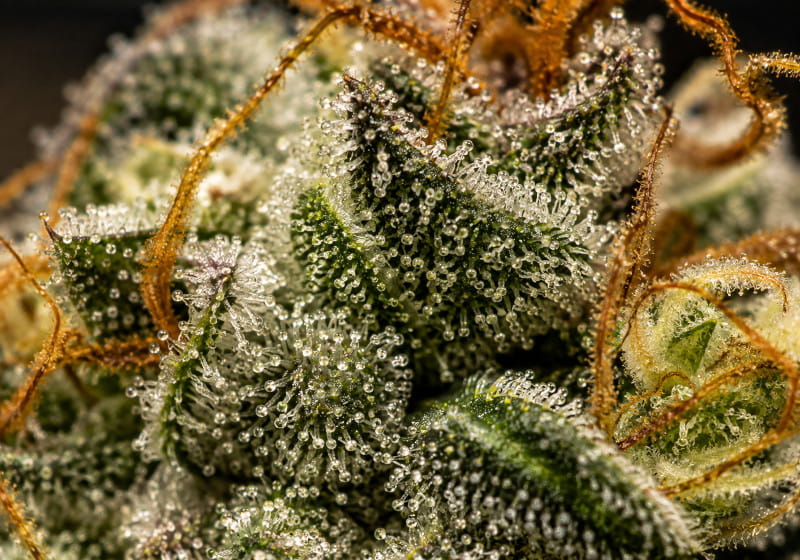
THCA is formed primarily in the glandular trichomes of the cannabis plant – tiny glandular structures that occur in particularly large numbers on female flowers and plant parts close to the flowers. Cannabinoids are produced and stored in these trichomes. Mature, resin-rich flowers can therefore contain particularly high concentrations of cannabinoid acids.
How much THCA is actually present depends on various factors. These include genetics and chemotype, stage of development, environmental conditions, as well as harvest, drying and storage. A strain name alone therefore does not allow a reliable statement about the specific THCA content of a flower.
Do raw cannabis flowers contain THC or THCA?
Fresh or not heavily heated THC-rich cannabis flowers typically contain significantly more THCA than Δ9-THC. A certain amount of THC may nevertheless already be present, because some THCA can decarboxylate during drying, processing, ageing or storage.
The common statement “raw cannabis contains no THC” is therefore too general. More precisely: the cannabis plant initially produces a large proportion of the later Δ9-THC as THCA. After harvest, the ratio of THCA to THC can change through drying, storage, ageing and especially heat. Further post-processing of the flowers also plays a role; you can find more information in our guide to curing cannabis.
Which cannabis strains can develop a THC-rich cannabinoid profile?
How much THCA a specific cannabis flower contains cannot be determined from the strain name alone. However, there are numerous genetics known for a THC-dominant cannabinoid profile. In non-decarboxylated plant material, a large proportion of the THC that develops later is initially present in the form of THCA.
Examples of well-known THC-rich genetics in our range include:
| THC-rich strain | THC | Genetics / Special feature |
|---|---|---|
| Godfather OG | 30 % THC | THC-rich OG genetics with a stated THC content of 30%. |
| Bubba Kush | 29 % THC | Indica-dominant Kush genetics with high THC potential. |
| Ice T’s BodyCount | 26 % THC | Modern hybrid with a THC content of 26%. |
| GSC - Thin Mint | 22 % THC | Well-known US genetics with high THC potential and a pronounced Cookies profile. |
| Forbidden Fruit | 23 % THC | Indica-dominant cross of Cherry Pie and Tangie with a THC content of 23%. |
You can find more genetics in our large selection of cannabis seeds from international seed banks and breeders.
What is the difference between THCA and THC?
THCA and Δ9-THC are closely related, but they are chemically and pharmacologically different compounds. THCA has an additional carboxyl group and therefore also a higher molecular mass. Its molecular formula is C22H30O4, with a molar mass of approximately 358.5 g/mol. Δ9-THC has the molecular formula C21H30O2 and a molar mass of approximately 314.5 g/mol.
During decarboxylation, the carboxyl group of THCA is split off as carbon dioxide (CO₂), producing Δ9-THC. This structural difference is not only chemically relevant: THCA also does not cause the intoxicating effect typical of Δ9-THC.
| Characteristic | THCA | Δ9-THC |
|---|---|---|
| Name | Tetrahydrocannabinolic acid | Δ9-Tetrahydrocannabinol |
| Molecular formula | C22H30O4 | C21H30O2 |
| Molar mass | approx. 358.5 g/mol | approx. 314.5 g/mol |
| Carboxyl group | present | not present |
| Typical intoxicating effect | no | yes |
| Relationship | direct precursor of Δ9-THC | can form through decarboxylation of THCA |
Learn more about Δ9-tetrahydrocannabinol, its properties and the current state of research in our detailed article What is THC? Effects, Risks and THC Seeds.
Also CBD is one of the best-known cannabinoids in the cannabis plant, but differs from both THCA and Δ9-THC. We explain the key properties and differences separately in our CBD guide.
Is THCA psychoactive and does THCA get you high?
THCA does not cause the intoxicating effect typical of Δ9-THC and therefore does not get you “high” in the same way. One important reason lies in the pharmacological differences between the two cannabinoids. Studies on human CB1 and CB2 receptors show a significantly lower binding affinity for THCA-A than for THC.
However, this does not mean that THCA is biologically inactive. Various possible mechanisms of action and biological effects have been observed in preclinical studies. These include interactions with the PPARγ receptor. However, much of the evidence to date comes from cell and animal models and cannot automatically be translated into a medical effect in humans.
Important: THCA does not cause the typical THC intoxication, but it may still be biologically active. However, results from cell and animal studies are not proof of a therapeutic effect in humans.
How is THCA converted into THC?
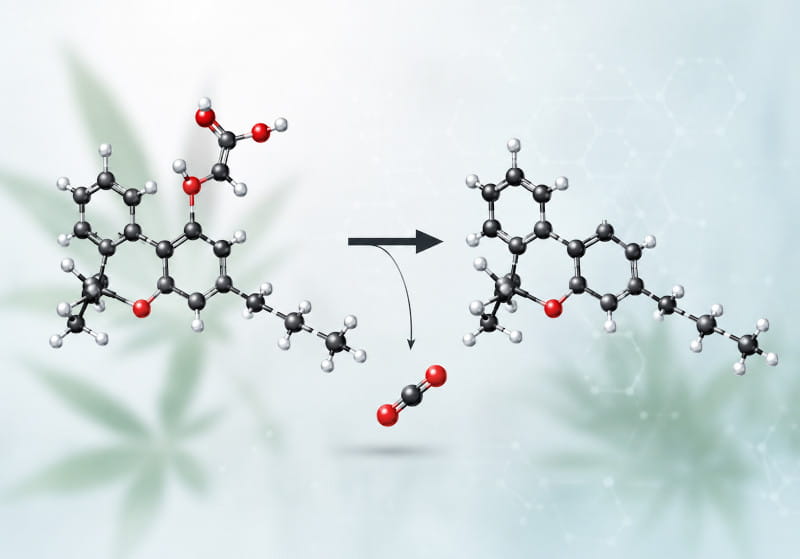
THCA can be converted into Δ9-THC through a chemical process called decarboxylation. In this process, the additional carboxyl group of THCA is split off and released as carbon dioxide (CO₂). This changes the molecular structure and THCA becomes Δ9-THC.
Heat significantly accelerates decarboxylation. However, the conversion does not occur suddenly at a specific temperature, but depends on both temperature and the duration of heat exposure. THCA can also slowly decarboxylate during drying, ageing and prolonged storage, thereby changing the ratio of THCA to THC.
What happens chemically when CO₂ is released?
During decarboxylation, THCA loses its carboxyl group, which is split off as carbon dioxide (CO₂). This changes the molecular structure and THCA can become Δ9-THC. At the same time, the mass of the molecule decreases.
For this reason, 100 mg of THCA cannot theoretically produce 100 mg of THC. Although one molecule of THCA can yield one molecule of THC, part of the original mass is released as CO₂. This loss of mass is taken into account with a conversion factor when calculating the theoretically possible amount of THC.
Why is THCA converted using the factor 0.877?
The factor 0.877 accounts for the loss of mass that occurs when THCA is converted into Δ9-THC through the release of CO₂. It can be calculated from the molar masses of the two compounds: Δ9-THC has a molar mass of approximately 314.5 g/mol, while THCA has a molar mass of approximately 358.5 g/mol.
Calculation: 314.5 ÷ 358.5 ≈ 0.877. Therefore, 100 mg of THCA can theoretically yield a maximum of around 87.7 mg of Δ9-THC. This would require complete conversion without any additional losses.
THCA-to-THC Calculator
With the calculator, you can calculate the theoretically possible amount of THC from a specified THCA value. Optionally, you can also enter any Δ9-THC that is already present. The calculator uses the factor 0.877.
An example: If a sample contains 20% THCA and 1% Δ9-THC, the THCA theoretically yields 17.54% THC. Together with the THC already present, this results in a theoretical total THC value of 18.54%.
This value describes the calculated maximum assuming complete conversion. In practice, incomplete decarboxylation and chemical degradation processes, among other factors, can result in a lower actually measured THC content.
At what temperature is THCA decarboxylated?
There is no single temperature at which all THCA is immediately and completely converted into THC. What matters instead is the interaction between temperature and time: the higher the temperature, the faster the conversion of THCA into Δ9-THC can proceed.
Scientific studies illustrate this relationship. In one frequently cited study, the decarboxylation of THCA was investigated at 80, 95 and 110 °C, among other temperatures. The reaction proceeded significantly faster as the temperature increased. However, these values come from controlled experimental conditions and should therefore not be understood as a universally applicable specification for every cannabis product or plant material.
| Influencing factor | Effect on decarboxylation |
|---|---|
| Temperature | higher temperatures accelerate the conversion of THCA into THC |
| Time | the longer THCA is exposed to certain conditions, the further decarboxylation can progress |
| Starting material | cannabis flowers, extracts and pure cannabinoid samples can behave differently |
| Moisture | can influence conditions within the plant material and heat transfer |
| Oxygen | can promote additional chemical changes alongside decarboxylation |
| Intense heat exposure | can promote degradation and side reactions in addition to conversion into THC |
If scientific studies arrive at different conditions for decarboxylation, this is therefore not necessarily a contradiction. What matters is always which starting material was examined and under what conditions the measurement was performed.
This section deliberately focuses on the chemical fundamentals of converting THCA into THC. We explain in detail in our guide Make THC Oil Yourself: Production, Instructions & Important Fundamentals what role decarboxylation plays in further processing and which fundamentals are important.
How stable is THCA?
THCA is not indefinitely stable and can change over time. Factors such as temperature, light, oxygen, storage duration and the form of the material being examined all play a role. Heat can accelerate decarboxylation, but changes can also occur during prolonged storage.
Laboratory studies also show that the stability of THCA depends on its chemical environment. In different solvents, for example, THCA can change at different rates. However, such results cannot be directly transferred to an intact cannabis flower because the conditions there are different. We explain in detail which factors matter when storing cannabis in our guide How to Store Cannabis Properly.
Can THCA slowly turn into THC at room temperature?
Yes, THCA can also slowly change over a longer period at room temperature and partially decarboxylate into THC. Heat significantly accelerates this process, but the reaction does not begin only above a specific fixed temperature. Therefore, the ratio of THCA to THC can also shift during prolonged storage.
However, not every amount of THCA that is lost is necessarily recovered completely as THC. Depending on the storage conditions, other chemical changes and degradation processes can occur at the same time.
What does research tell us about THCA?
THCA is being investigated for various possible biological properties, but many findings so far come from cell and animal studies. When evaluating the research, it is therefore crucial to distinguish between laboratory experiments, animal models and studies in humans. An effect in the laboratory does not automatically mean that the same effect also occurs in humans.
| Research area | What is being investigated? | How should the results be interpreted? |
|---|---|---|
| Cell studies | including receptor binding, signalling pathways and interactions with PPARγ | can reveal possible mechanisms of action but do not prove an effect in humans |
| Animal studies | including neurological and inflammation-related processes | provide preclinical indications that cannot be directly transferred to humans |
| Human studies | direct studies of THCA in humans | the clinical evidence is still considerably more limited |
| Well studied | biosynthesis, chemical structure and decarboxylation of THCA | these fundamentals are much better established than possible therapeutic applications |
What do cell studies show about THCA?
Cell studies show that THCA can interact with various biological targets. Studies have examined, among other things, binding to cannabinoid receptors as well as interactions with the nuclear receptor PPARγ. THCA-A was found to have comparatively low binding affinity at CB1 and CB2 receptors, while other studies described activity at PPARγ.
Such studies help to better understand possible mechanisms of action of THCA. However, they do not show whether a medical effect occurs in humans or at what dosage. Statements about safety or therapeutic benefit also cannot be derived from these findings alone.
What do animal studies show?
Various possible biological effects of THCA have been investigated in animal studies. These include neurological and inflammation-related processes. Individual studies, for example, describe PPARγ-dependent effects in corresponding cell and animal models.
These results provide indications for further research, but they are not evidence that THCA can treat corresponding diseases in humans. Animal models can be used to investigate certain biological processes, but they do not replace controlled clinical studies.
What human studies are there on THCA?
Direct research on isolated THCA in humans is still significantly more limited than research on Δ9-THC. Many of the frequently discussed possible properties of THCA are based on cell and animal studies rather than controlled clinical studies using pure THCA.
For this reason, caution is important when making statements about possible medical effects. A plausible mechanism of action or a positive result in an animal model does not prove a corresponding effect in humans. The chemical structure, biosynthesis and decarboxylation of THCA are much better studied.
THCA is only one of numerous phytocannabinoids in the cannabis plant. Another cannabinoid that is related to THC but is a distinct compound is THCV. Despite the similar name, THCV, THC and THCA differ chemically and pharmacologically from one another.
Frequently Asked Questions About THCA
What is THCA?
THCA stands for tetrahydrocannabinolic acid and is a naturally occurring acidic cannabinoid in the cannabis plant. It is the direct precursor of Δ9-THC. In THC-rich cannabis flowers that have not been strongly heated, a large proportion of the THC that develops later is initially present as THCA.
What does THCA stand for?
THCA stands for tetrahydrocannabinolic acid. The “A” in the abbreviation refers to the word “acid.”
What does THCa mean?
THCa is a commonly used spelling variant of THCA. In scientific texts, THCA is the standard spelling. The lowercase “a” in THCa does not automatically mean THCA-A.
Is THCA the same as THC?
No. THCA and Δ9-THC are two different chemical compounds. THCA has an additional carboxyl group. If this is split off as carbon dioxide (CO₂) during decarboxylation, Δ9-THC can form.
What is the difference between THCA and THC?
THCA is the acidic precursor of Δ9-THC and has an additional carboxyl group as well as a higher molecular mass. The two cannabinoids also differ pharmacologically: THCA does not cause the intoxicating effect typical of Δ9-THC.
Where is THCA found?
THCA is found primarily in the glandular trichomes of THC-rich cannabis flowers. The actual THCA content depends, among other things, on genetics, stage of development, harvest, drying and storage.
Is THCA psychoactive?
THCA does not cause the intoxicating effect typical of Δ9-THC. However, this does not mean that THCA is biologically inactive. Various possible biological effects are currently being investigated scientifically.
Does THCA get you high?
THCA itself does not produce the characteristic THC intoxication. However, if THCA is decarboxylated, it can form Δ9-THC, which produces the typical intoxicating effect.
How is THCA converted into THC?
THCA can be converted into Δ9-THC through decarboxylation. In this process, the additional carboxyl group is split off as carbon dioxide (CO₂). Heat significantly accelerates this process.
What does decarboxylation mean for THCA?
Decarboxylation refers to the removal of a carboxyl group as carbon dioxide (CO₂). This changes the molecular structure and THCA can become Δ9-THC.
At what temperature is THCA decarboxylated?
There is no single temperature at which THCA is immediately and completely converted into THC. Decarboxylation depends primarily on temperature and time. The starting material and other conditions also influence how the reaction proceeds.
Why is THCA converted using 0.877?
The factor 0.877 accounts for the loss of mass that occurs when CO₂ is released. It is derived approximately from the ratio of the molar masses of THC and THCA: about 314.5 divided by 358.5.
How do you calculate theoretical total THC?
Theoretical total THC is often calculated using the formula Δ9-THC + (THCA × 0.877). The result describes a theoretical value and not automatically the amount of THC present after actual decarboxylation.
Is THCA sensitive to heat?
Yes. Heat significantly accelerates the decarboxylation of THCA into THC. However, how quickly the conversion occurs depends not only on temperature, but also on duration and other conditions.
How stable is THCA?
THCA is not indefinitely stable and can change during processing and storage. Temperature, light, oxygen and storage duration can all play a role.
What does research tell us about THCA?
The chemical fundamentals of THCA are well studied, while research into possible medical effects is considerably more limited. Many findings on biological effects so far come from cell and animal studies and cannot be transferred directly to humans.
Does THCA have an effect?
THCA can be biologically active, but it does not cause the intoxicating effect typical of Δ9-THC. Various possible effects are being investigated scientifically. However, robust clinical evidence in humans is still lacking for many of the applications being discussed.
What should you know about THCA?
THCA is more than simply “THC before heating”: it is a distinct acidic cannabinoid with its own chemical structure and properties. In THC-rich cannabis plants, THCA is formed from CBGA with the help of THCA synthase and serves as the direct precursor of Δ9-THC.
During decarboxylation, CO₂ is released and THCA can become Δ9-THC. This loss of mass also explains the commonly used conversion factor of 0.877. It is based on the ratio of the molar masses of THC and THCA and is not an arbitrarily chosen rule of thumb.
A clear distinction is also important when it comes to effects: THCA does not cause the typical THC intoxication, but it can be biologically active. Much of the evidence so far comes from preclinical research. Possible medical effects in humans are therefore far less well established than the chemical fundamentals of THCA.
Scientific and Technical Sources
- Sirikantaramas S. et al. (2004): The gene controlling marijuana psychoactivity: molecular cloning and heterologous expression of THCA synthase
- Shoyama Y. et al. (2012): Structure and function of THCA synthase
- Wang M. et al. (2016): Decarboxylation Study of Acidic Cannabinoids
- Acidic Cannabinoid Decarboxylation: review of chemistry, kinetics and mechanisms
- McPartland J.M. et al. (2017): Affinity and Efficacy Studies of THCA-A at Cannabinoid Receptor Types One and Two
- Nadal X. et al. (2017): Tetrahydrocannabinolic acid is a potent PPARγ agonist with neuroprotective activity
- Onofri C. et al. (2015): Sequence heterogeneity of CBDA- and THCA-synthase and its relationship with chemical phenotype
- Stone N.L. et al. (2020): A systematic review of minor phytocannabinoids with promising neuroprotective potential
- Therapeutic potential of acidic cannabinoids: an update