How to Make THC Oil: Step-by-Step Guide
Make THC Oil Yourself: Production and Basics Clearly Explained
Updated: August 2026 | THC-containing cannabis oil from THC-rich plant material: basics on THCA, decarboxylation, carrier oils, filtration, concentration and storage.
Author: Cannapot Grow Team | Reading time: approximately twenty-five minutes
The Most Important Points at a Glance
✓In this article, “THC oil” means a THC-containing infused oil in which cannabinoids from cannabis are transferred into a suitable carrier oil. It should not be equated with a standardized medical cannabis extract.
✓In THC-rich cannabis flowers, a large proportion is initially present as THCA. Through decarboxylation, THCA is converted into THC under the influence of heat.
✓Temperature and duration work together during decarboxylation. According to current research, there is no single temperature-time combination that is optimal for every type of plant material.
✓Suitable carrier oils include olive oil, MCT oil and coconut oil. They differ, for example, in taste, consistency and storage properties.
✓The exact amount of THC in the finished oil cannot be determined without laboratory analysis. The amount of flower and the stated THC content can only be used to estimate a theoretical concentration.
✓Light, heat, oxygen and storage time can affect the composition of the oil. It should therefore be prepared cleanly and stored cool, dark and tightly sealed.
✓We deliberately cover CBD oil separately: there is a dedicated Cannapot guide for CBD-rich flowers and the conversion of CBDA to CBD.
What is THC oil and how is it made?
THC oil is an oil-based preparation containing THC and other fat-soluble compounds from cannabis.In the method described here, THC-rich cannabis flowers are processed with a suitable carrier oil such as olive oil or MCT oil. The cannabinoids are transferred into the oil phase.
However, the term “THC oil” is not always used consistently. It can refer to simple cannabis-infused oils as well as more concentrated or standardized cannabis extracts. A homemade infused oil differs significantly from medical cannabis extracts, whose cannabinoid content is determined and standardized under controlled conditions.
This guide focuses on theproduction of a THC-containing oil from THC-rich cannabis flowers and a suitable carrier oil. Decarboxylation plays an important role because it converts THCA into THC. Extraction methods using butane, naphtha or other highly flammable or hazardous solvents are not covered.
Good to know:Homemade THC oil is not standardized. The amount of cannabinoids that actually transfer into the carrier oil depends, among other things, on the starting material and processing. As a result, the actual THC concentration can vary even when the same amounts of flowers and oil are used.
What is the difference between THCA and THC?
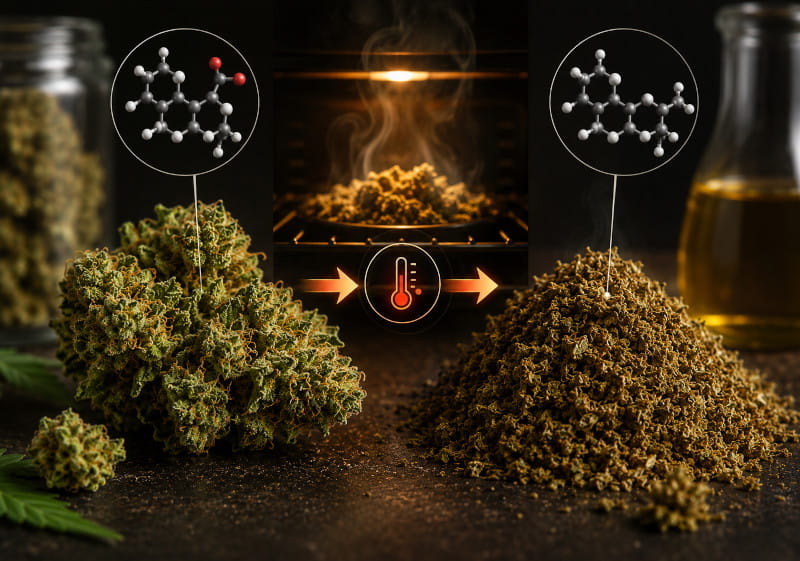
In the plant, a large proportion of the THC that develops later is initially formed as tetrahydrocannabinolic acid (THCA).THCA has an additional carboxyl group. When this is removed under suitable conditions, the neutral form Δ9-THC is produced with the release of carbon dioxide.
This process is known asdecarboxylation. It can be accelerated by heat and also occurs to a lesser extent during storage and aging. The reaction is therefore central to the composition of a subsequent THC-containing oil.
If you would like to explore the basics of tetrahydrocannabinol in more detail, see our comprehensive article What is THC? Effects, Risks and THC Seeds.
Why is decarboxylation important for THC oil?
Decarboxylation converts THCA into THC under the influence of heat.This step is particularly important when the aim is to make an oil from THC-rich plant material with the highest possible proportion of activated THC.
How quickly this conversion takes place depends mainly on thetemperature and duration of heating. Higher temperatures can accelerate decarboxylation. However, excessive or prolonged heat can also promote further changes and the degradation of compounds. More heat therefore does not automatically mean a better result.
Scientific studies have examined decarboxylation under various temperature and time conditions. The results show that there is no single combination that can be applied universally to every plant material and every type of processing. Moisture, the condition of the plant material and the actual temperature during heating can also affect the result.
Good to know:A fixed rule such as “X degrees for Y minutes” would be too general. Temperature and time must always be considered together. Controlled heating is what matters – stronger or longer heating does not automatically lead to more THC.
Is THCA completely converted into THC?
With a homemade preparation, it cannot be assumed that all of the available THCA will be completely converted into THC.The extent of decarboxylation depends, among other things, on temperature, duration, moisture and the condition of the plant material.
There is another step as well: after decarboxylation, the cannabinoids still have to transfer into the carrier oil. Here too, the entire theoretically available amount of THC is not automatically transferred into the finished oil. There can therefore be significant differences between the theoretically possible THC content and the concentration actually measured.
What starting material is suitable for THC-containing oil?
Plant material with a high THCA or THC content is particularly suitable for a THC-containing oil.What matters is the actual composition of the flowers used, not just the name or description of a strain.
Cannabinoids are particularly abundant in the flowers and adjacent trichome-rich plant parts. Large fan leaves and stems generally contain significantly smaller amounts. The actual content can vary depending on genetics, phenotype, harvest time, processing and storage of cannabis flowers.
Post-harvest processing can also influence the properties of the plant material. We explain the role of drying and controlled curing in detail in our guide Curing Cannabis.
You can find a large selection of different cannabis seeds in the Cannapot shop. However, for estimating the strength of a homemade oil, an analysis of the flowers actually used is much more informative than a general THC figure for the strain.
Which THC-rich strains can be used as starting material?
THC-rich cannabis strains can differ significantly in their stated cannabinoid content.The following examples show different genetics with high stated THC levels. However, the values for each strain do not guarantee the actual THC content of an individual harvest or the oil made from it.
| THC-rich strain | THC | Genetics / Special feature |
|---|---|---|
| RS11 | 28 % THC | Mostly Indica cross of Pink Guava and OZ Kush with a high THC content. |
| Ghost Train Haze #1 | 25 % THC | Sativa-dominant Haze genetics from Ghost OG and Nevil’s Wreck with 25% THC. |
| Apple Fritter | 30 % THC | Balanced hybrid of Sour Apple and Animal Cookies with a THC content of 30%. |
| Notorious THC | 26 % THC | Mostly Indica cross of Ghost of Von Humboldt, Caramel Cream and Humboldt Frost with more than 26% THC. |
| La Bomba | 22 % THC | Modern cross of Wedding Cake and Jet Fuel Gelato by Compound Genetics. |
Important:The stated THC level of a strain is only a guide and must not be treated as a guaranteed value for home-grown flowers. For the THC calculator, an analysis of the plant material actually used is much more informative.
Which oil is suitable for THC oil?
Cannabinoids such as THC are fat-soluble and can therefore be absorbed by suitable carrier oils.Olive oil, MCT oil and coconut oil are commonly used. Which one is most suitable depends, among other things, on taste, consistency, intended use and storage.
| Carrier oil | Properties | Practical feature |
|---|---|---|
| Olive oil | liquid, distinct flavor of its own | commonly used for cannabis oil preparations and well studied scientifically |
| MCT oil | liquid, usually neutral in taste | showed cannabinoid values similar to olive oil in comparative studies and, in some cases, advantages for terpenes |
| Coconut oil | high in fat, solid or liquid depending on temperature | can solidify at cooler temperatures and is therefore not equally practical for every application |
Can THC oil be made with olive oil?
Yes, olive oil is well suited as a carrier oil for cannabinoids and has also been used in scientific studies of cannabis oil.THC and other cannabinoids are fat-soluble and can transfer into the oil during processing.
One advantage is that olive oil is readily available and liquid at room temperature. However, it has a distinct flavor that remains noticeable in the finished cannabis oil. The amount of THC actually absorbed depends not only on the carrier oil, but also on the starting material and processing.
Is MCT oil suitable for THC oil?
MCT oil is also suitable as a carrier for THC and other cannabinoids.It is liquid at room temperature and usually more neutral in taste than olive oil. In one comparative study, similar cannabinoid concentrations were achieved with MCT and olive oil.
For some of the terpenes examined, MCT oil performed better in the same study. However, this does not mean that MCT oil is always the best choice. Which carrier oil makes more sense also depends on taste, intended use and storage.
Can coconut oil be used for THC oil?
Coconut oil can also be used as a fat-based carrier.Unlike olive and MCT oil, however, it can solidify at lower room temperatures. This should be taken into account if the finished oil is to be bottled easily and portioned evenly later.
What equipment is needed for preparation?
No complicated equipment is required to make a THC-containing infused oil.The most important things are clean, heat-resistant, food-safe utensils.
- THC-rich cannabis flowers or suitable plant material
- olive oil, MCT oil, coconut oil or another suitable carrier oil
- heat-resistant container
- suitable heat source or water bath
- kitchen scale and measuring container
- fine sieve, filter cloth or comparable filter
- clean container for collecting the filtered oil
- dark, tightly sealable bottle for storage
A kitchen scale and accurate volume measurements help document quantities consistently. However, they cannot determine the actual THC concentration of the finished oil. Laboratory analysis would be required for that.
How is THC oil made from cannabis?
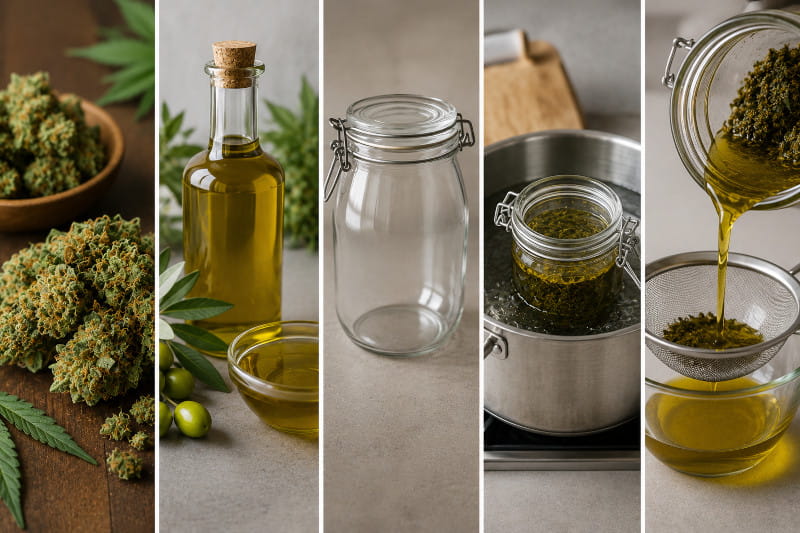
The process can basically be divided into four steps: prepare the plant material, decarboxylate the THCA, transfer the cannabinoids into the carrier oil and then filter the finished oil.
| Step | What happens? | Why is it important? |
|---|---|---|
| 1. Prepare | The plant material is prepared for processing as evenly as possible. | Moisture, size and distribution of the material can affect heating. |
| 2. Decarboxylate | Controlled heating converts THCA into THC. | This increases the proportion of neutral THC in the plant material. |
| 3. Add to oil | The plant material is gently heated together with the carrier oil. | The fat-soluble cannabinoids can transfer into the oil. |
| 4. Filter | The solid plant residue is separated from the oil. | The filtered oil can then be bottled cleanly and stored. |
Scientific studies provide important guidance on decarboxylation and oil infusion. However, their results cannot always be transferred 1:1 to home preparation. In the laboratory, temperature, starting material and other conditions are controlled much more precisely than with ordinary kitchen equipment.
What temperature is suitable for THC oil?
When preparing THC oil, there is no single “perfect” temperature; what matters is the interaction between temperature and duration.How quickly THCA is converted into THC and how the cannabinoids behave during further processing depends on several factors.
In general, a higher temperature accelerates decarboxylation. However, excessive or prolonged heat can also promote the degradation of cannabinoids and other plant compounds. The aim is therefore controlled, even heating – not simply the highest possible temperature.
In addition, the set temperature of an oven or another heat source does not necessarily correspond to the temperature actually reached in the plant material or oil. Quantity, moisture, container and heat distribution can also affect the result.
Good to know:Statements such as “X degrees for Y minutes” should not be understood as universally valid rules. Scientific studies operate under controlled conditions that can differ significantly from home preparation.
Can THC oil be made in a water bath?
A water bath allows the carrier oil to be heated gently and comparatively evenly.The container with cannabis and oil is not heated directly on the heat source, which can help avoid strong temperature peaks at the bottom of the container.
The temperature should still be monitored. A water bath provides more even heat transfer, but it does not automatically guarantee the desired temperature in the oil. Care should also be taken to prevent water or condensation from getting into the oil.
How is THC oil filtered and bottled?
After infusion, the solid plant residue is separated from the oil using a fine sieve or filter.The filtered oil can then be poured into a clean, tightly sealable and preferably light-protected bottle.
Some of the oil remains in the plant material and filter. This is particularly important if a theoretical THC concentration is to be calculated later: what matters is not only the amount of oil originally used, but also how much filtered oil actually remains at the end.
The plant residue should not be pressed unnecessarily hard, as this can force more fine particles and unwanted plant components into the oil. After filtering, the oil should be as clean as possible and free of larger plant residues.
How strong is homemade THC oil?
The exact amount of THC in a homemade oil cannot be determined without laboratory analysis.Even if the THC content of the flowers used is known, decarboxylation, oil infusion and filtration can affect the result.
Relevant factors include the amount of flower used, the actual THCA and THC content, the conversion of THCA to THC, the amount of carrier oil and losses during processing. The THC figure for a strain alone is therefore not enough to reliably predict the strength of the finished oil.
Can the THC concentration be calculated?
A rough theoretical estimate is possible, but it should not be confused with the THC concentration actually measured in the finished oil.It is particularly important whether THC and THCA are listed separately for the flowers used.
During decarboxylation, THCA is not converted into THC 1:1 by weight. Mass is lost through the release of carbon dioxide. Therefore, to calculate the theoretically available THC, the THCA content is usually multiplied by the factor0,877. Any THC already present is then added.
Simplified formula:
Total THC ≈ (THCA × 0.877) + THC
The formula describes the theoretical THC potential of the starting material. It does not account for losses during decarboxylation, transfer into the carrier oil or filtration.
THC calculator: estimate theoretical concentration
The calculator lets you estimate the theoretical THC potential based on the stated THCA and THC values. The result isnot a laboratory valueand does not account for losses during processing.
Important:The calculator provides only a theoretical guide value. For calculation purposes, it assumes that the THC already present and the THC theoretically available from THCA end up completely in the finished oil. Actual losses due to incomplete decarboxylation, infusion, filtration, processing or storage are not taken into account. Only laboratory analysis can determine the actual THC content.
Example: How can the theoretical strength be estimated?
Assume that analyzed plant material contains20% THCA and 1% THC. Mathematically, 20% THCA does not become 20% THC, but rather:
20 × 0.877 = 17.54% theoretical THC
Together with the 1% THC already present, this gives a theoretical total THC of approximately18.54%.
For example, 10 g of this plant material would theoretically correspond to a maximum of about1,854 mg THC potential. However, this expressly does not mean that the finished oil will subsequently contain 1,854 mg THC. Some of the potential may be lost during decarboxylation, infusion and filtration or remain in the plant material.
Any further conversion to, for example, mg THC per ml of oil therefore remains only a theoretical estimate. Only laboratory analysis can show the concentration actually achieved in the finished oil.
Good to know:Studies of cannabis oil preparations show that the cannabinoid concentrations actually measured can vary significantly. A calculation based on the amount of flower and stated THC content is therefore a guide – not an exact determination of the finished oil.
How should THC oil be stored?
THC-containing oil should be stored as cool, dark and tightly sealed as possible.Light, heat and oxygen can alter cannabinoids and other compounds over time. A dark glass bottle is therefore more suitable for storage than a permanently transparent container.
Scientific studies also show that storage temperature plays an important role. In a twelve-month study, changes at 25 °C were significantly greater than in samples stored at cooler temperatures. For the cannabis extracts in olive oil examined, storage at 4 °C proved particularly favorable for preserving cannabinoids.
How long does homemade THC oil keep?
No universal shelf life can be specified for homemade THC oil.It depends, among other things, on the carrier oil used, cleanliness during preparation, storage and whether moisture or plant residue remains in the oil.
The carrier oil itself also ages and can become rancid over time. If the smell changes significantly, or unusual deposits, moisture or signs of mold are visible, the oil should no longer be used.
What mistakes should be avoided during preparation?
Too much heat, uneven heating and an incorrect estimate of the eventual THC concentration are among the most common mistakes.The quality of the starting material, losses during filtration and unsuitable storage can also affect the result.
| Common mistake | Possible consequence | What to watch for |
|---|---|---|
| Only estimating the THC content | The actual strength of the oil can differ significantly from the calculation. | Do not equate strain information with an analysis of the finished oil. |
| Heating unevenly | The plant material may be heated to different degrees. | Aim for heating that is as even and controlled as possible. |
| Heating too strongly or for too long | Cannabinoids and other plant compounds can change or degrade. | More heat does not automatically mean a better result. |
| Ignoring losses during filtration | Some of the oil and the cannabinoids it contains remain in the plant material. | Use the actual final volume obtained in calculations. |
| Storing incorrectly | Light, heat and oxygen can accelerate aging. | Store cool, dark and tightly sealed. |
How can you tell if something is wrong with the oil?
A distinctly rancid or unusual smell, visible contamination, moisture or signs of mold are warning signs.In such cases, the oil should no longer be used.
Color, smell and taste, however, do not reveal how much THC is actually in the oil or how completely decarboxylation occurred. This can only be reliably determined by appropriate laboratory analysis.
What is the difference between THC oil, CBD oil and hemp seed oil?
THC oil, CBD oil and hemp seed oil differ mainly in their starting material and the compounds they contain.While THC- and CBD-containing oils can be made from cannabinoid-rich plant parts, hemp seed oil is obtained from the seeds of the hemp plant.
| Product | Starting material | Special feature |
|---|---|---|
| THC oil | THC-/THCA-rich cannabis flowers and carrier oil | THCA is converted into THC through decarboxylation. |
| CBD oil | CBD-/CBDA-rich plant material or CBD extract and carrier oil | Here the focus is on CBDA and CBD rather than THCA and THC. |
| Hemp seed oil | Seeds of the hemp plant | Pressed from hemp seeds and not equivalent to a cannabinoid-containing flower extract. |
If you would instead like to make an oil from CBD-rich cannabis flowers, you can find the individual steps and CBD-specific basics in our guide Make CBD Oil Yourself: Making CBD Oil from Flowers.
Frequently Asked Questions About THC Oil and How It Is Made
How can you make THC oil yourself?
The process can basically be divided into four steps: prepare the plant material, decarboxylate the THCA, transfer the cannabinoids into a suitable carrier oil and then filter the oil.The amount of THC actually contained in the finished oil depends on the starting material and processing and cannot be determined exactly without laboratory analysis.
Which oil is suitable for THC oil?
Olive oil, MCT oil and coconut oil can be used as carriers for THC and other fat-soluble cannabinoids.They differ, among other things, in taste and consistency. Which carrier oil is most suitable therefore also depends on the intended use and storage.
Does cannabis need to be decarboxylated for THC oil?
If the aim is to convert as much of the available THCA as possible into THC, decarboxylation is an important step.The conversion is accelerated by heat and depends on the interaction of temperature and duration as well as the properties of the plant material.
Can THC oil be made with olive oil?
Yes, olive oil is suitable as a carrier for cannabinoids and has also been used in scientific studies of cannabis oil.It is liquid at room temperature, but it has a distinct flavor of its own.
Is MCT oil suitable for THC oil?
Yes, MCT oil can also be used as a carrier for THC and other cannabinoids.It is liquid at room temperature and usually more neutral in taste than olive oil. In one comparative study, similar cannabinoid concentrations were achieved with MCT and olive oil.
Can coconut oil be used for THC oil?
Yes, coconut oil can also be used as a fat-based carrier.Unlike olive and MCT oil, however, it can solidify at lower room temperatures, which should be taken into account when bottling and using it later.
What temperature is suitable for THC oil?
There is no single temperature that can be defined as optimal for every preparation.What matters is the interaction between temperature and duration. Excessive or prolonged heat can promote not only the desired decarboxylation but also the degradation of cannabinoids and other plant compounds.
How long is cannabis heated in the oil?
There is no universal duration that applies equally to every quantity, carrier oil and method.Temperature and time must be considered together. Longer heating therefore does not automatically mean that more THC will end up in the finished oil.
How long does homemade THC oil keep?
No universal shelf life can be specified for homemade THC oil.It depends, among other things, on the carrier oil, cleanliness during preparation and storage conditions. The oil should be stored as cool, dark and tightly sealed as possible.
How strong is homemade THC oil?
The actual THC concentration cannot be reliably determined without laboratory analysis.The amount of flower and the stated THC content allow only a theoretical estimate, because deviations and losses can occur during decarboxylation, oil infusion and filtration.
Can the THC concentration be calculated?
A theoretical estimate is possible, but an exact calculation of the finished oil is not.If THCA is listed separately, the factor 0.877 can be used for the theoretical conversion to THC, and any THC already present can then be added. However, this does not account for losses during processing.
What is the difference between THC oil and CBD oil?
With THC oil, the focus is on THC-/THCA-rich cannabis flowers and the conversion of THCA into THC, while CBD oil focuses on CBD or CBDA.We explain how to make oil from CBD-rich flowers separately in our Cannapot guide to CBD oil.
What is especially important with homemade THC oil?
For THC-containing cannabis oil, suitable starting material, decarboxylation of THCA, an appropriate carrier oil and controlled processing are particularly important.It is equally important to assess the strength of the finished oil realistically.
There is no simple universal formula for temperature and duration. Heat does accelerate the conversion of THCA into THC, but excessive or prolonged heat can also promote further changes and the degradation of compounds. Heating that is as even and controlled as possible is therefore more important than a supposedly perfect single value.
The THC concentration can also only be estimated theoretically from the amount of flower and cannabinoid content. How much THC is actually present in the finished oil after decarboxylation, oil infusion and filtration can only be reliably shown by laboratory analysis.
Scientific and Technical Sources
- Wang M. et al. (2016): Decarboxylation Study of Acidic Cannabinoids
- Perrotin-Brunel H. et al. (2011): Decarboxylation of Δ9-tetrahydrocannabinol: Kinetics and molecular modeling
- Calvi L. et al. (2020): Impact of Lipid Sources on Quality Traits of Medical Cannabis-Based Oil Preparations
- Milay L. et al. (2020): Metabolic Profiling of Cannabis Secondary Metabolites for Evaluation of Optimal Postharvest Storage Conditions
- Carcieri C. et al. (2018): Cannabinoids concentration variability in cannabis olive oil galenic preparations
- Citti C. et al. (2018): Extraction Method and Analysis of Cannabinoids in Cannabis Olive Oil Preparations
- Processing and extraction methods of medicinal cannabis: a narrative review
- Phytocannabinoid-rich galenic preparations for topical administration: extraction and stability testing