How to Make CBD Oil from Cannabis Flowers
Make Your Own CBD Oil: CBD Oil from Flowers
Updated: August 2026 | Make your own CBD oil from CBD-rich cannabis flowers: basics of CBDA, decarboxylation, carrier oils, preparation, concentration and storage.
Author: Cannapot Grow Team | Reading time: approximately twenty-five minutes
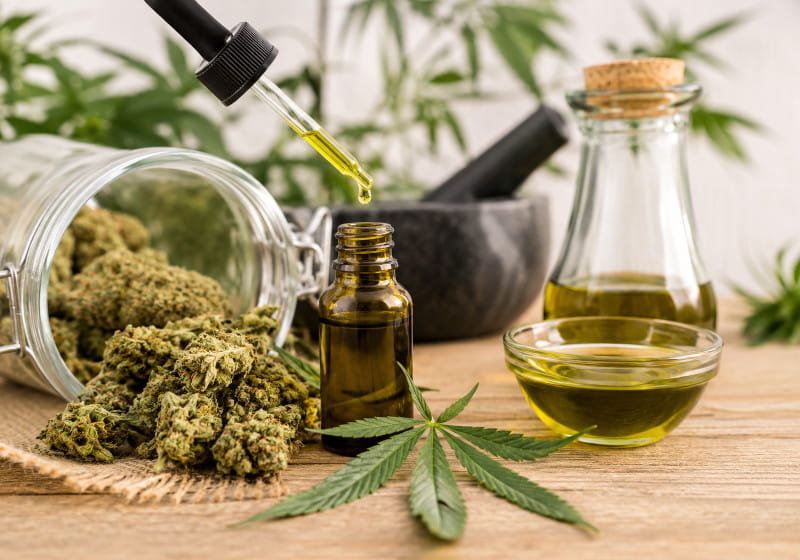
The Most Important Points at a Glance
✓ CBD oil can be made at home from CBD-rich cannabis flowers and a suitable carrier oil such as olive oil or MCT oil (oil containing medium-chain fatty acids).
✓ In untreated CBD flowers, a large proportion of the cannabinoid potential is present as CBDA. Through decarboxylation, heat converts CBDA into CBD.
✓ The temperature and duration of decarboxylation must be balanced. Excessive heat or heating for too long can lead to cannabinoid losses and degradation.
✓ Olive oil and MCT oil are particularly suitable carrier oils. Coconut oil can also be used; the choice depends on factors such as taste, consistency and intended use.
✓ Homemade CBD oil is not comparable to standardized commercial CBD oil. Without laboratory analysis, the actual CBD content cannot be determined precisely.
✓ Hemp seed oil is not CBD oil. CBD is produced mainly in the resin-rich flowers of the cannabis plant, while hemp seeds themselves are not a relevant natural source of CBD.
✓ Light, heat and oxygen can impair the quality and stability of the oil. Homemade CBD oil should therefore be stored in a cool, dark place and kept tightly sealed.
What is homemade CBD oil?
When you make CBD oil from cannabis flowers at home, the result is usually a CBD-containing infused oil. The fat-soluble constituents of the flowers are transferred into a suitable carrier oil through gentle heating.
This distinction is important because different products are sold under the term “CBD oil.” Commercial CBD oils often contain a previously extracted and analyzed CBD or hemp extract that is then mixed with a defined amount of carrier oil. When making it yourself, by contrast, CBD-rich cannabis flowers are processed directly in a suitable edible or carrier oil.
The finished infused oil may contain CBD and other fat-soluble plant constituents. However, the actual cannabinoid concentration cannot be determined precisely without laboratory analysis. Even if the CBD or CBDA content of the starting material is known, the entire calculated amount does not necessarily transfer into the finished oil.
Important distinction: Here, by “homemade CBD oil” we mean a CBD-containing infused oil made from CBD-rich cannabis flowers and a carrier oil. It is neither an isolated CBD extract nor a standardized medical cannabis extract.
CBD oil, cannabis extract or hemp seed oil – what is the difference?
CBD oil, hemp seed oil, CBD extract and homemade CBD-infused oil differ significantly in how they are made and in their composition. Especially if you want to make CBD oil yourself, you should not confuse these terms.
| Term | What does it mean? | CBD content |
|---|---|---|
| Homemade CBD-infused oil | CBD-rich cannabis flowers are processed directly in a fatty carrier oil. | Not precisely known without laboratory analysis |
| Commercial CBD oil | Depending on the product, contains a defined hemp or CBD extract, or CBD in a carrier oil. | Stated according to the product specification |
| CBD extract | Concentrated extract obtained from plant material in a separate extraction process. | Depends on the extract and manufacturing process |
| Hemp seed oil | Plant oil obtained from the seeds of the hemp plant. | Not a relevant natural source of CBD; traces may occur through contact with other plant parts |
| Standardized cannabis extract | Cannabis preparation produced under controlled conditions and analytically characterized. | Analytically determined or standardized |
If you would like to learn more about cannabidiol, its properties and the differences from other cannabinoids, you can find further basics in our article on CBD, effects, risks and differences.
Can you make CBD oil from cannabis flowers yourself?
Yes, CBD-rich cannabis flowers are suitable as starting material for homemade CBD oil. Cannabinoids such as CBD are fat-soluble and can therefore transfer into a suitable carrier oil during preparation.
The cannabinoid profile of the flowers used is crucial. If you want to make a CBD-dominant oil, the starting material should be correspondingly rich in CBD or its precursor CBDA. We explain the role CBDA plays and why decarboxylation is important in the next section.
However, the stated CBD values of a cannabis strain are only a guide. The actual cannabinoid content can vary depending on the plant, growing conditions, harvest time and batch. A strain specification therefore does not replace laboratory analysis of the flowers actually used. This is especially important if you later want to estimate the possible CBD concentration of your homemade oil.
If you are already specifically looking for CBD-rich strains when choosing genetics, you can find a selection of CBD seeds.
Which CBD strains are suitable for homemade CBD oil?
For homemade CBD oil, strains that can develop a clearly CBD-dominant cannabinoid profile are particularly interesting. The higher the CBD or CBDA content of the plant material used, the greater the potential CBD content for the subsequent oil infusion in principle.
The following CBD-rich strains are examples of genetics that, due to their high CBD and comparatively low THC content, may be suitable as starting material for a CBD-dominant infused oil:
| CBD strain | CBD / THC | Why interesting for CBD oil? |
|---|---|---|
| Therapy | 8–10 % CBD 0.5 % THC |
CBD-rich genetics with a significantly higher CBD than THC content, making it interesting for a CBD-dominant infused oil. |
| Elixir Vitae | up to 14 % CBD approx. 0.25 % THC |
Very high stated CBD content combined with a low THC content; therefore particularly interesting as starting material for CBD-rich oil infusions. |
| Candy Girl CBD | up to 14 % CBD 0.29 % THC |
Combines a high stated CBD content with less than 0.3 % THC, providing a strongly CBD-dominant cannabinoid profile. |
| Tatanka Pure CBD | 14 % CBD 0.25 % THC |
With a stated 14 % CBD and only 0.25 % THC, the strain has a distinctly CBD-dominant profile for corresponding oil infusions. |
| La Bella CBD | up to 12 % CBD 0.28 % THC |
CBD-rich genetics with a low stated THC content, making it another interesting basis for a CBD-dominant infused oil. |
Important: The CBD and THC values stated for a strain are typical or manufacturer-provided reference values. The actual cannabinoid content of the harvested flowers may differ. For calculating the possible CBD concentration of the oil, laboratory values for the flowers actually used are much more meaningful.
What is the difference between CBDA and CBD?
CBDA (cannabidiolic acid) is the natural precursor of CBD. When heated, CBDA can release carbon dioxide (CO₂) and convert into CBD. This process is called decarboxylation.
In untreated or only lightly heated cannabis flowers, part of the cannabinoid potential is therefore present as CBDA rather than CBD. Targeted heating can significantly accelerate the conversion of CBDA into CBD. Such a conversion can also occur during natural aging, but much more slowly.
Important for later calculations: 100 mg of CBDA does not produce 100 mg of CBD. During decarboxylation, CO₂ is released, reducing the mass. A factor of approximately 0.877 is therefore used for the theoretical conversion. Assuming complete conversion, 100 mg of CBDA can theoretically yield a maximum of about 87.7 mg of CBD.
Remember: 10 % CBDA does not automatically become 10 % CBD after heating. The theoretical amount of CBD is already lower because CO₂ is released. In practice, additional losses may occur due to incomplete decarboxylation, extraction, filtration and degradation.
We explain in detail how cannabidiolic acid forms in the cannabis plant, what properties it has and how it differs from CBD in our basic article on CBDA and the difference from CBD.
Do CBD flowers need to be decarboxylated before preparation?
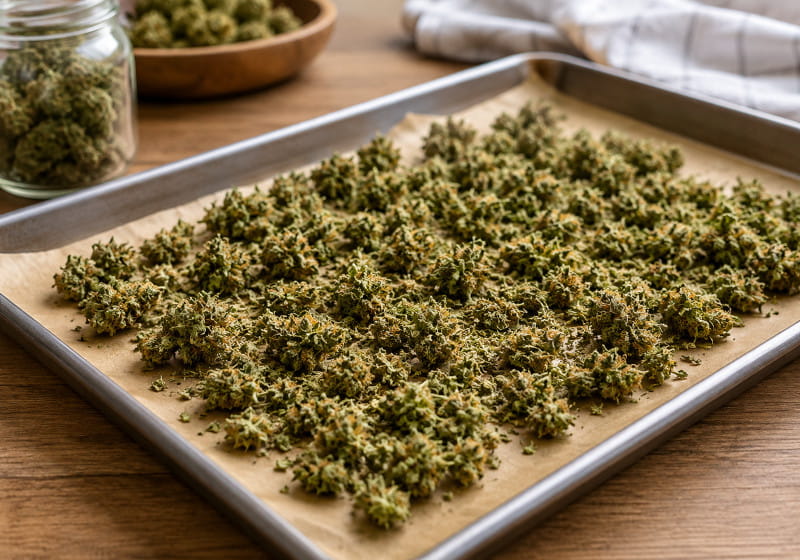
If you want to make an oil in which CBD rather than its precursor CBDA is the focus, decarboxylating the CBD flowers beforehand is advisable. Controlled heating accelerates the conversion of CBDA into CBD.
Temperature and time work together here. At lower temperatures, decarboxylation proceeds more slowly, while higher temperatures accelerate the process. More heat is not automatically better, however: if the flowers are heated too intensely or for too long, cannabinoids can increasingly degrade.
What temperature is suitable for CBD decarboxylation?
There is no single perfect temperature for decarboxylating CBD flowers. What matters is always the interaction between temperature and duration.
Scientific studies have investigated the conversion of CBDA into CBD at different temperatures. In general, decarboxylation proceeds faster as temperature increases. At the same time, intense or prolonged heat exposure increases the risk that cannabinoids already formed will begin to degrade again. Studies have shown, for example, strong CBDA-to-CBD conversion at 140 °C within a comparatively short time, while at 160 °C and with longer heating, decreasing concentrations of neutral cannabinoids were already observed.
For oil-based cannabis preparations, scientific manufacturing protocols have, for example, used prior decarboxylation at about 115 °C for 40 minutes This value is a practical reference from research, but not a universal guarantee for every plant material or oven. Moisture, the amount and condition of the flowers, and the actual oven temperature can influence the result.
Why is there no perfect temperature? How quickly and completely CBDA is converted into CBD depends not only on the temperature setting. Moisture, the amount and condition of the flowers, and the actual temperature in the oven also play a role. In addition, the oven display does not always correspond exactly to the temperature to which the flowers are actually exposed.
Which oil is suitable for homemade CBD oil?
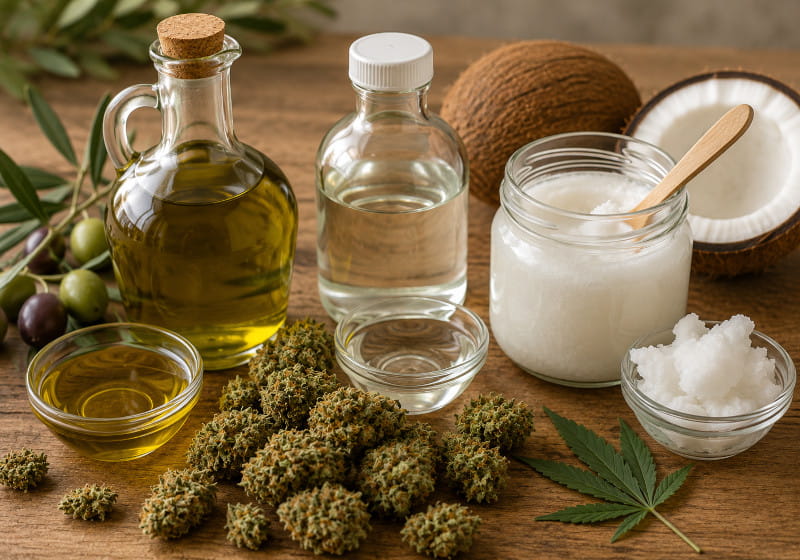
Olive oil and MCT oil are particularly suitable carrier oils. MCT stands for “Medium-Chain Triglycerides.” Coconut oil can also be used, but differs mainly in taste and consistency.
Which carrier oil is best suited depends on the intended use. In addition to absorbing fat-soluble plant constituents, factors such as taste, consistency, storage stability and the later use of the finished oil also play a role.
| Carrier oil | Properties | Points to consider |
|---|---|---|
| Olive oil | well studied for cannabis oil preparations, liquid, readily available | characteristic flavor remains noticeable in the finished oil |
| MCT oil | oil made from medium-chain triglycerides, usually neutral in flavor and liquid at room temperature | practical when a carrier oil that is as neutral and liquid as possible is desired |
| Coconut oil | rich in fat and suitable for oil infusions | may be solid or semi-solid at room temperature and, depending on the product, can have a pronounced coconut flavor |
Can you make CBD oil with olive oil yourself?
Yes, olive oil is well suited as a carrier oil and has also been used in scientific studies and standardized manufacturing procedures for cannabis oil preparations.
One advantage is its easy availability. However, olive oil has a distinctive flavor that remains noticeable in the finished CBD-infused oil. If you prefer a carrier oil that is as neutral in flavor as possible, MCT oil can be an alternative.
Is MCT oil suitable for CBD oil?
Yes, MCT oil is well suited as a carrier oil. The abbreviation MCT stands for “Medium-Chain Triglycerides.” These are fats containing medium-chain fatty acids that can, for example, be obtained from coconut oil for MCT oil.
MCT oil is generally neutral in flavor and remains liquid at room temperature. This distinguishes it from ordinary coconut oil, which can become solid or semi-solid depending on the temperature. For homemade CBD oil, MCT is therefore particularly practical when a neutral carrier oil that remains liquid is desired.
In one study of cannabis oil preparations, olive oil and MCT oil showed no significant differences in the cannabinoid concentrations examined during storage. For the terpene profile studied, MCT oil performed better in some respects in terms of extraction and preservation. However, this does not mean that MCT oil is generally the better carrier oil for every preparation.
Can you make CBD oil with coconut oil?
Yes, coconut oil can also be used as a fatty carrier for a cannabis infusion. Unlike MCT oil, however, ordinary coconut oil can become solid or semi-solid at room temperature.
This is less practical if the finished CBD oil is intended to remain liquid. Coconut oil can also have a pronounced flavor of its own. For culinary use, however, these properties may be desirable.
What do you need to make CBD oil from flowers?
For homemade CBD oil, you need CBD-rich cannabis flowers, a suitable carrier oil and a few simple kitchen utensils. Highly flammable solvents are not required for this method.
| Required | What for? |
|---|---|
| CBD-rich cannabis flowers | Starting material for the CBD-containing infused oil |
| Olive oil, MCT oil or coconut oil | Carrier oil for the fat-soluble cannabinoids and other plant constituents |
| Oven and oven-safe container | For decarboxylating the CBD flowers |
| Saucepan and heat-resistant container | For gentle infusion in a water bath |
| Kitchen thermometer | For better temperature control |
| Fine sieve or filter cloth | For filtering out the plant material |
| Dark, clean glass bottle | For bottling and storage protected from light |
Make Your Own CBD Oil: Step-by-Step Instructions
The preparation takes only a few steps: first, the CBD-rich flowers are prepared and decarboxylated. They are then placed in a water bath together with the carrier oil. Finally, the oil is filtered and bottled protected from light.
1. Prepare the CBD flowers
Use dry, clean CBD-rich cannabis flowers. Ideally, the cannabinoid profile of the starting material is known. Then roughly break up the flowers with your fingers or a grinder. They do not need to be ground into a fine powder – plant material that is ground too finely is more difficult to filter out of the oil later.
2. Decarboxylate the CBD flowers
Spread the roughly broken-up flowers as evenly as possible in a thin layer in an oven-safe container. As a reference, scientific manufacturing protocols for cannabis oil preparations have used decarboxylation at about 115 °C for 40 minutes as a guide.
This converts part of the existing CBDA into CBD. However, the stated 115 °C and 40 minutes are not a universal ideal. Moisture, the condition and amount of the flowers, and deviations in the actual oven temperature can influence how far decarboxylation proceeds. A significantly higher temperature therefore does not automatically produce a better result.
3. Mix the CBD flowers with the carrier oil
Place the decarboxylated flowers in a heat-resistant container and add enough olive oil, MCT oil or another suitable carrier oil to completely cover the plant material. Stir gently so that the flowers come into contact with the oil as evenly as possible.
How concentrated the finished CBD-infused oil can theoretically become depends on the amount of flowers used, their CBD and CBDA content, and the amount of oil used. We explain below how you can calculate an approximate value from these figures.
4. Gently heat the CBD oil in a water bath
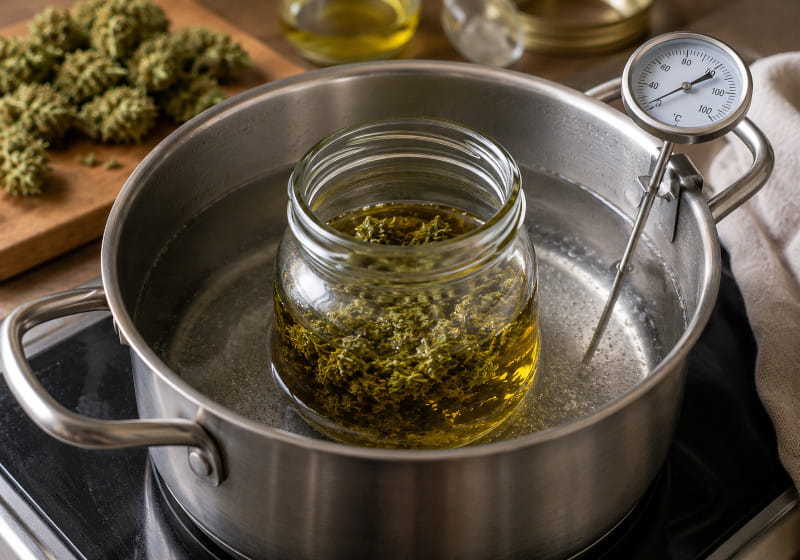
Place the container with the flowers and carrier oil in a water bath. This allows the oil to be heated more evenly and gently than by direct contact with a hot stovetop.
In scientific studies of cannabis oil preparations, extraction in oil has been investigated at temperatures around 100 °C and times between 30 and 120 minutes Among other conditions. When making it at home, you should focus above all on heating as evenly and controllably as possible and avoid unnecessarily high temperatures. Gently stir the plant material occasionally during this time.
Important when using a water bath: The container with the CBD oil sits in the heated water, but the water itself must not get into the oil. Therefore, use a stable, heat-resistant container and, if possible, monitor the temperature with a thermometer.
5. Filter the CBD oil
After infusion, remove the container from the water bath and let the oil cool slightly. While it is still sufficiently fluid, pour it through a fine sieve or filter cloth into a clean container. This removes flower residue and other solid plant material.
Some of the oil remains in the plant material. Pressing it hard can increase the amount of oil recovered, but it also causes more fine plant particles and suspended matter to enter the finished oil.
6. Bottle and label the CBD oil
Pour the filtered oil into a clean, preferably dark glass bottle that can be tightly sealed. It is best to label it with the date of preparation, the carrier oil used, the amount of plant material and – if known – the CBD and CBDA values of the flowers used.
This information will help you later to trace how the oil was made. However, it still does not provide an exact figure for the actual CBD content – that would require laboratory analysis of the finished oil.
How can the CBD concentration be calculated?
The possible CBD concentration of a homemade oil can be estimated roughly. However, the result is only a theoretical reference value – only laboratory analysis can reliably show how much CBD is actually contained in the finished oil.
The estimate works best when laboratory values for CBD and CBDA are available for the CBD flowers used. Because carbon dioxide (CO₂) is released when CBDA is converted into CBD, the CBDA value cannot simply be counted in full as CBD. The factor 0.877 is therefore used for the theoretical conversion:
Theoretical total CBD:
CBD + (CBDA × 0.877)
An example: You use 10 g of CBD flowers that, according to laboratory analysis, contain 10 % CBDA and 1 % CBD. 10 % of 10 g corresponds to 1,000 mg of CBDA. Multiplied by 0.877, this theoretically yields a maximum of about 877 mg of CBD. Add the 100 mg of CBD already present. This gives a total theoretical CBD potential of about 977 mg.
If these theoretical 977 mg were transferred completely into 100 ml of carrier oil, the finished oil would mathematically contain about 9.77 mg CBD per ml. In practice, however, this value is not fully achieved because losses can occur during decarboxylation, infusion and filtration.
CBD Oil Calculator: Calculate the Theoretical Concentration
With the following calculator, you can estimate the theoretical CBD potential of your flowers and the resulting maximum CBD concentration in the carrier oil. Enter the amount of flowers used, the CBD and CBDA content, and the amount of carrier oil.
Important: The calculator shows only a theoretical reference value. It mathematically assumes that the CBD already present and the CBD theoretically obtainable from CBDA end up completely in the finished oil. Actual losses due to incomplete decarboxylation, infusion, filtration, processing or storage are not taken into account. Only laboratory analysis can determine the actual CBD content.
Why is the calculated CBD concentration not exact?
Not all of the theoretically calculated amount of cannabinoids in the CBD flowers automatically ends up in the finished oil. Several factors can influence the actual result.
| Uncertainty factor | Why does it affect the calculation? |
|---|---|
| CBD and CBDA content | Strain specifications are only reference values and do not replace laboratory analysis of the flowers actually used. |
| Decarboxylation | In practice, CBDA is not necessarily converted completely into CBD. |
| Transfer into the carrier oil | Not all of the available CBD necessarily transfers into the oil during infusion. |
| Filtration | Some of the oil and the cannabinoids it contains remain in the flowers or in the filter. |
| Heat and storage | Cannabinoids can partially degrade during processing and subsequent storage. |
The calculation is therefore useful for estimating the possible order of magnitude and comparing different quantities. However, laboratory analysis is required to determine the CBD content of the finished oil precisely.
Is hemp seed oil the same as CBD oil?
No, hemp seed oil and CBD oil are two different products. Hemp seed oil is obtained from the seeds of the hemp plant and naturally contains no relevant amounts of CBD.
Cannabinoids such as CBD are produced mainly in the glandular trichomes of female cannabis flowers. Hemp seeds do not have these cannabinoid-rich glandular structures. If small amounts of cannabinoids are nevertheless detected in hemp seed oil, they may, for example, have entered the oil through contact between the seeds and resinous plant parts during harvesting and processing.
Hemp seed oil can generally be used as an edible vegetable oil or as a component of an oil blend. However, this does not automatically make it a CBD oil or CBD extract.
How should homemade CBD oil be stored?
Homemade CBD oil should be stored as cool, dark and tightly sealed as possible. Heat, light and oxygen can impair the stability of CBD and the quality of the carrier oil used.
A dark glass bottle protects the oil better from light. At the same time, the container should be sealed as tightly as possible to minimize contact with air. Direct sunlight, warm windowsills or leaving the container open for long periods are therefore unfavorable for storage.
How long does homemade CBD oil keep?
It is not possible to provide a reliable universally applicable shelf life for homemade CBD oil. How long it remains stable depends, among other things, on the carrier oil used, cleanliness during preparation, possible residual moisture, the container, and exposure to light, oxygen and storage temperature.
Studies on CBD stability show that heat, light and oxidative conditions in particular play a role. However, such laboratory results cannot simply be converted into a fixed shelf-life statement for homemade CBD-infused oil.
If the oil changes noticeably in smell, taste, color or consistency, or there are other signs of spoilage, you should stop using it.
Which mistakes should you avoid when making CBD oil yourself?
The most common mistakes result from inaccurate starting values, poorly controlled temperatures or the assumption that the theoretically calculated amount of CBD will later be fully contained in the finished oil.
| Mistake | Why is it problematic? |
|---|---|
| Using a strain specification as an exact laboratory value | The actual CBD and CBDA content of the flowers used may differ from general strain specifications. |
| Treating CBDA and CBD as equivalent | During decarboxylation, CO₂ is released, which is why 100 mg of CBDA does not produce 100 mg of CBD. |
| Heating too intensely or for too long | More heat does not automatically mean more CBD. Cannabinoids can degrade under excessive heat exposure. |
| Confusing hemp seed oil with CBD oil | Hemp seeds are not a relevant natural source of CBD, so hemp seed oil is not automatically CBD oil. |
| Treating the theoretical value as the actual concentration | Losses during decarboxylation, infusion, filtration and storage cannot be determined precisely without analysis. |
| Storing it warm, open or in the light | Heat, light and oxygen can impair the stability of CBD and the carrier oil. |
What distinguishes homemade CBD oil from standardized products?
The most important difference lies in control over composition. With homemade CBD oil, it is not possible to determine precisely without laboratory analysis which cannabinoids are present in the finished oil and at what concentrations.
Standardized products, by contrast, are manufactured under controlled conditions and can be analytically tested for their cannabinoid content. Depending on the product, this makes it possible to set and document the composition at specific concentrations. Professional analyses can also detect unwanted contaminants.
A calculation using the CBD and CBDA values of the flowers can therefore provide only a theoretical order of magnitude. It does not replace testing of the finished oil and does not allow an exact statement about how much CBD is actually present.
You can find more information on possible side effects, interactions and safety aspects in our guide to CBD side effects, risks and safety.
What is the difference between CBD oil and THC oil?
CBD oil and THC oil differ mainly in the cannabinoid profile of the starting material used and therefore in the cannabinoids that predominate in the finished oil. This guide focuses specifically on CBD- or CBDA-rich cannabis flowers.
We deliberately cover THC-rich flowers, THCA and the preparation methods tailored to them in a separate article. This keeps the two topics clearly separated both technically and in terms of search intent. If you are specifically interested in this, you can find the relevant basics in our guide to making THC oil yourself.
Frequently Asked Questions About Making CBD Oil Yourself
Can you make CBD oil yourself?
Yes, a CBD-containing infused oil can be made from CBD-rich cannabis flowers and a suitable carrier oil. However, it is not equivalent to standardized commercial CBD oil because the actual cannabinoid concentration cannot be determined precisely without laboratory analysis.
How do you make CBD oil from flowers?
CBD-rich flowers are first prepared and decarboxylated, then gently heated in a suitable carrier oil and subsequently filtered. Finally, the finished infused oil is stored in a clean glass bottle, protected from light as much as possible.
Which flowers are suitable for homemade CBD oil?
CBD- or CBDA-rich cannabis flowers are suitable for a CBD-dominant infused oil. Laboratory analysis of the flowers actually used is the most informative, because general strain specifications are only reference values and variations between individual plants or batches are possible.
Do CBD flowers need to be decarboxylated?
If you specifically want more CBDA to be converted into CBD, controlled decarboxylation is advisable. How far the conversion proceeds depends, among other things, on temperature, duration and the condition of the plant material.
What is the difference between CBDA and CBD?
CBDA, cannabidiolic acid, is a natural precursor of CBD. During decarboxylation, carbon dioxide is released and CBDA can convert into CBD. Because of this loss of mass, CBDA is often converted into potential CBD in theoretical calculations using the factor 0.877.
Which carrier oil is best for CBD oil?
Olive oil and MCT oil are both suitable carrier oils; coconut oil can also be used. Which option is best depends, among other things, on taste, consistency, intended use and storage.
Can you make CBD oil with olive oil?
Yes, olive oil is well suited as a carrier oil and has also been used in scientific studies of cannabis oil preparations. The main point to consider is its characteristic flavor, which remains noticeable in the finished infused oil.
Is MCT oil suitable for CBD oil?
Yes, MCT oil is a suitable carrier oil and consists of medium-chain triglycerides. It is usually neutral in flavor and remains liquid at room temperature, which can make it particularly practical for CBD-infused oil.
Can you use coconut oil for CBD oil?
Yes, coconut oil can also be used as a fatty carrier. Ordinary coconut oil can, however, become solid or semi-solid at room temperature and, depending on the product, may have a clearly noticeable flavor of its own.
How long does CBD oil need to be heated?
There is no single fixed heating time because temperature, plant material and preparation method interact. In scientific studies of cannabis oil preparations, infusion times of between 30 and 120 minutes, for example, have been investigated.
What temperature is suitable for CBD oil?
Decarboxylation and subsequent infusion in the carrier oil are two different steps and should not be reduced to a single temperature figure. Different temperature-time combinations have been studied for both processes. Controlled heating without unnecessarily intense heat is what matters.
How long does homemade CBD oil keep?
A fixed shelf life cannot generally be stated for homemade CBD oil. Carrier oil, hygiene, residual moisture, container, temperature, light and oxygen affect stability. The oil should therefore be stored as cool, dark and tightly sealed as possible.
Can you calculate the CBD concentration yourself?
Known CBD and CBDA values can be used to calculate a theoretical order of magnitude, but not the actual concentration of the finished oil. Losses during decarboxylation, infusion, filtration and storage cannot be determined precisely without laboratory analysis.
Is hemp seed oil the same as CBD oil?
No, hemp seed oil and CBD oil are two different products. Hemp seeds themselves are not a relevant natural source of CBD. If small amounts of cannabinoids are detected in hemp seed oil, they may, for example, have entered it through contact with resinous plant parts during harvesting and processing.
What is the difference between CBD oil and THC oil?
The most important difference lies in the cannabinoid profile of the starting material and the oil made from it. This article covers CBD- or CBDA-rich cannabis flowers. THC-rich starting material and the preparation methods tailored to it are covered in the separate guide to THC oil.
What is especially important when making CBD oil yourself?
For homemade CBD oil, CBD-rich flowers, controlled decarboxylation, a suitable carrier oil and gentle processing are especially important.
Olive oil, MCT oil and coconut oil can all be used as carriers. However, there is no single perfect combination of temperature, duration and type of oil. The result depends, among other things, on the cannabinoid profile and condition of the flowers as well as the actual conditions during decarboxylation and infusion.
The CBD concentration can also only be estimated theoretically at home. CBD and CBDA values of the flowers make it possible to calculate the potential CBD content, but not to determine exactly what actually remains in the oil after decarboxylation, infusion and filtration.
This is precisely one of the most important differences from analytically standardized products. Anyone who takes these limitations into account can assess the preparation, possible concentration and shelf life of homemade CBD oil much more realistically.
Scientific and technical sources
- Decarboxylation Study of Acidic Cannabinoids: A Novel Approach Using Ultra-High-Performance Supercritical Fluid Chromatography/Photodiode Array-Mass Spectrometry
- Thermo-chemical conversion kinetics of cannabinoid acids in hemp (Cannabis sativa L.) using pressurized liquid extraction
- Development of Standard Operating Protocols for the Optimization of Cannabis-Based Formulations for Medical Purposes
- Extraction Method and Analysis of Cannabinoids in Cannabis Olive Oil Preparations
- Impact of Lipid Sources on Quality Traits of Medical Cannabis-Based Oil Preparations
- Stability characteristics of cannabidiol for the design of pharmacological, biochemical and pharmaceutical studies
- Simple Extraction of Cannabinoids from Female Inflorescences of Hemp (Cannabis sativa L.)
- Chemical Analysis of Minor Bioactive Components and Cannabidiolic Acid in Commercial Hemp Seed Oil