How to Fertilize Cannabis: When and How?
How to fertilize cannabis correctly: nutrients, dosage and fertilizing practice
Updated: September 2026 | Fertilizing cannabis: practical beginner's guide to when to start fertilizing, frequency, dosage, NPK, growth, flowering, soil, coco, pH, EC and home remedies.
Author: Cannapot Grow Team | Reading time: approximately twenty minutes
The most important points at a glance
✓ Cannabis should not be fertilized according to a fixed calendar. When fertilizer is needed depends primarily on the stage of development, the substrate and the plant's nutrient supply up to that point.
✓ Seedlings initially need very few nutrients. Heavily pre-fertilized soil or additional fertilizer can damage the delicate young roots and, in the worst case, destroy seedlings. For the first few days, a mild propagation substrate that is only lightly fertilized or not fertilized at all, without additional fertilizer applications, is therefore usually the safest choice.
✓ How often and how heavily to fertilize depends on the fertilizer and the growing system. There is no fixed dosage that is equally suitable for every cannabis plant.
✓ Nutrient requirements change during the grow cycle. Vegetative growth, pre-flowering and flowering have different requirements – more fertilizer does not automatically mean better growth.
✓ Yellow or discolored leaves do not automatically mean a nutrient deficiency. The pH value, incorrect watering or problems in the root zone can also impair nutrient uptake.
Why does cannabis need to be fertilized at all?
During its development, cannabis needs various nutrients that it absorbs through the roots and uses for the growth of roots, leaves, shoots and later flowers. These include nitrogen, phosphorus and potassium in particular, as well as calcium, magnesium and various trace elements.
How many nutrients need to be supplied additionally as fertilizer depends heavily on the substrate and growing system used. Soil may already contain nutrients and make them available over a longer period. Coco, rockwool and other largely nutrient-poor media, on the other hand, are supplied specifically via the nutrient solution.
Fertilizing correctly therefore does not mean giving a cannabis plant as many nutrients as possible. What matters is a supply that matches its actual needs. Too little fertilizer can limit growth, while too much can damage the plant. Since different cannabis seeds can develop into plants with different growth characteristics and nutrient requirements, especially for beginners, a simple and clearly structured fertilizing system is usually easier to control than a combination of many different fertilizers and additives.
Which macro- and micronutrients does cannabis need?
The most important primary nutrients for cannabis include nitrogen, phosphorus and potassium. In addition, the plant also needs calcium, magnesium, sulfur and various trace elements, among others. How much of these are required changes during the grow cycle. The size and development of the plant, the substrate, root space and growing conditions also influence the actual demand.
Nitrogen is particularly important for vegetative growth and the formation of green plant matter. Phosphorus is involved, among other things, in energy transfer and numerous metabolic processes. Potassium performs important functions in water balance and in various processes within the plant. Calcium and magnesium are also part of a balanced nutrient supply.
Cannabis also needs smaller amounts of micronutrients such as iron, manganese, boron, zinc, copper and molybdenum. Although these are only required in small quantities, they are also important for healthy development.
What does NPK mean in cannabis fertilizer?
NPK stands for the three primary nutrients nitrogen (N), phosphorus (P) and potassium (K). The NPK value on a fertilizer indicates the ratio or concentration in which these nutrients are present. It helps to compare different fertilizers with one another.
However, the NPK values alone do not indicate whether a fertilizer is suitable for cannabis or for a particular growth stage. A base fertilizer may, for example, already contain calcium, magnesium and trace elements, while other fertilizing systems use additional components for these. The complete composition should therefore always be considered.
Particularly high phosphorus or potassium values are not automatically better either. High PK values are often promoted, especially during flowering. However, a cannabis plant can only make sensible use of the amount of nutrients it actually needs.
When should you start fertilizing cannabis?
Additional fertilizing should only begin once the cannabis plant actually needs more nutrients. Seedlings in particular need very little at first. Heavily pre-fertilized soil or additional fertilizer can damage the delicate young roots and, in the worst case, completely destroy a seedling.
For the first few days and the early seedling stage, a mild propagation substrate that is only lightly fertilized or not fertilized at all is therefore particularly suitable. Additional fertilizer is normally not necessary during this stage. The plant's nutrient requirements only increase as it grows larger and develops a stronger root system.
When this point is reached depends, among other things, on the substrate. With pre-fertilized soil, you should take into account how many nutrients are already present. Anyone who adds fertilizer even though there are still sufficient nutrients in the substrate risks oversupplying the plant. In coco, rockwool or other largely nutrient-poor media, however, the nutrient supply has to be structured differently from the outset.
Do cannabis seedlings already need to be fertilized?
No, cannabis seedlings grown in soil normally do not yet need additional fertilizer. At this early stage, the root system is small and the nutrient requirement is correspondingly low. A mild propagation substrate that is only lightly fertilized or not fertilized at all is therefore usually the better choice.
Heavily pre-fertilized soil or additional fertilizer applications can be too much for young plants. The delicate roots can be damaged as a result and, in the worst case, the seedling can die completely. Fertilizing should therefore not be started as a precaution while the young plant is still adequately supplied.
The situation is different with coco, rockwool or other practically nutrient-free media. There, the required nutrients must be provided via an appropriately mild nutrient solution. In this case, fertilizing is based on the growing system being used and must be adapted to young plants.
When should you start fertilizing with pre-fertilized soil?
With pre-fertilized soil, additional fertilizer should only be used once the nutrients already contained in the soil are increasingly being depleted. How long the pre-fertilization lasts cannot be stated generally in days or weeks. Important factors include the strength of the pre-fertilization, pot size, plant size and growth rate.
The soil manufacturer's information can be used as a guide. However, it should not be understood as an exact point at which fertilizing must automatically begin. A small plant in a larger volume of fresh soil uses up the available nutrients much more slowly than a vigorous plant in a pot that is already heavily rooted.
How can you tell that the soil's nutrient reserves are declining?
Whether the nutrient reserves in the soil are slowly running out can best be assessed from how long the plant has been in the substrate, the strength of the pre-fertilization and the plant's development. The aim is not to wait with fertilizing until a clear nutrient deficiency has already developed, but to continue the nutrient supply in good time and cautiously.
If leaves become lighter or discolored, or if growth slows down, this does not automatically mean that more fertilizer is needed. Incorrect watering, an unsuitable pH value or problems in the root zone can also impair nutrient uptake. We explain in detail how to identify an actual deficiency and distinguish it from other causes in our guide to nutrient deficiency in cannabis.
How often should you fertilize cannabis?
How often cannabis should be fertilized depends primarily on the substrate, the fertilizer used and the plant's nutrient requirements. There is therefore no blanket rule such as “once a week.” Nor should fertilizer automatically be used with every watering.
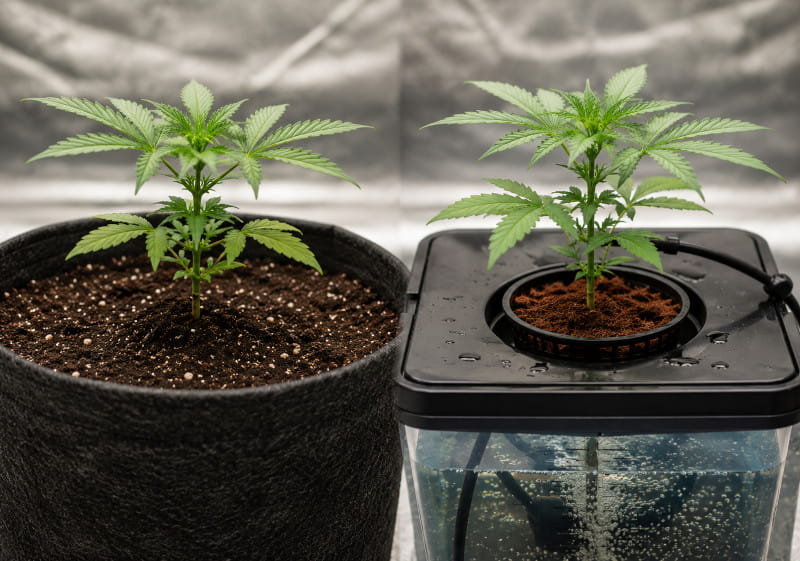
When growing in soil, sufficient nutrients may still remain in the substrate between individual fertilizer applications. With coco and hydroponic systems, on the other hand, nutrients are supplied regularly via the nutrient solution. The type of fertilizer also matters: an organic slow-release fertilizer is used differently from a liquid fertilizer added to the irrigation water.
Do you need to fertilize cannabis with every watering?
No, cannabis does not need to be fertilized with every watering. Especially when growing in soil, one fertilizer application can continue to provide sufficient nutrients beyond the next watering. How often fertilizer is added to the irrigation water therefore depends on the substrate, fertilizer and condition of the plant.
With coco and hydro, the situation is different because nutrient supply is part of regular irrigation there. The approach used in such a system should therefore not simply be transferred to growing in soil.
Fertilizing and watering are nevertheless closely connected. If a pot is kept permanently too wet, the roots can develop problems regardless of the amount of fertilizer. If the substrate dries out very quickly, on the other hand, it must be watered more frequently. We explain in detail how to assess pot weight, substrate moisture and the right time to water in our guide to watering cannabis correctly.
Why is there no universal fertilizing schedule?
A fertilizing schedule is always tailored to specific fertilizers and growing systems and can therefore only serve as a guide. Two products can provide completely different amounts of nutrients at the same dosage in milliliters per liter. In addition, the substrate, water quality, pot size and stage of development influence the actual requirements.
Fertilizing schedules from different manufacturers should therefore not be combined without careful consideration. A base fertilizer from one system and an additive from another can, for example, contain the same nutrients and thus lead to an unnecessarily high total amount. Especially for beginners, a simply structured fertilizing system is easier to control than a mixture of numerous fertilizers and additives.
How much fertilizer does cannabis need?
How much fertilizer cannabis needs cannot be answered with a general figure in milliliters per liter. Fertilizers differ considerably in their concentration and composition. A dosage that is appropriate for one product may already be much too high for another.
The required amount also depends on the stage of development, substrate, water, genetics and condition of the plant. Whether plants originate from conventional varieties or CBD cannabis seeds, fertilizer should always be adjusted to the actual development and nutrient requirements of the individual plant. Anyone using a new fertilizer should therefore not automatically start with the highest stated dosage. More fertilizer does not necessarily result in faster growth – an excessively high concentration can instead stress or damage the plant.
How should manufacturer recommendations for fertilizing cannabis be interpreted?
The manufacturer's dosage recommendations are the best starting point for the respective product, but they should not be understood as rigid instructions. First of all, it is important to know whether the fertilizing schedule is intended for soil, coco or hydro and whether the stated amount applies to every watering or to individual fertilizer applications.
The water used also influences nutrient supply. Depending on the region, tap water already contains different amounts of dissolved minerals, while very soft water or reverse-osmosis water provides a different starting point. Anyone who uses the EC value to monitor the nutrient solution should therefore also take the initial value of the water being used into account.
Why is cautious dosing often sensible?
When fertilizing, it is usually better to start cautiously and adjust the amount step by step if necessary. An amount of fertilizer that is too low can easily be increased, whereas severe overfertilization can damage the plant and may be much more difficult to correct.
Particular care is needed with pre-fertilized soil. As long as the substrate still contains sufficient nutrients, additional liquid fertilizer can quickly become too much. If heavily pre-fertilized soil is combined with a high fertilizer dose, the risk of oversupply and an excessively high salt concentration in the root zone increases.
Rule of thumb: More fertilizer does not mean more growth. It is better to start cautiously and increase the amount of fertilizer only when the plant actually needs more nutrients. Overfertilization can damage cannabis much more severely than a dosage that is initially slightly too low.
What role does the EC value play in dosing?
The EC value provides an indication of how many dissolved salts are present in the water or nutrient solution. Especially with mineral fertilizing, it can help to monitor the concentration of a nutrient solution and assess changes more accurately.
However, the EC value does not show which individual nutrients are present or whether their proportions are balanced. A high value therefore does not automatically mean that a plant is particularly well supplied. Excessively high concentrations can even impair water and nutrient uptake. The EC value should therefore always be considered together with the fertilizer used, the source water, the substrate and the plant's stage of development.
How to fertilize cannabis correctly – nutrient requirements by growth stage
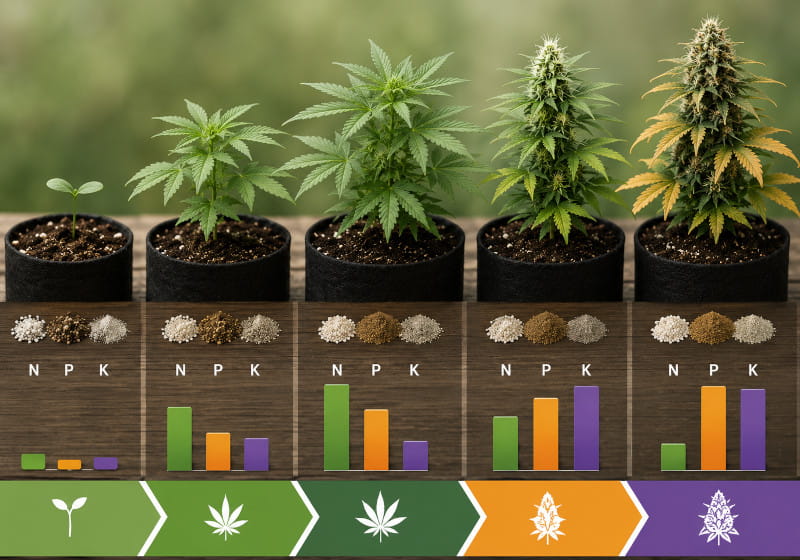
The amount of nutrients cannabis needs changes throughout the entire grow cycle. Seedlings require very little, while demand increases as the plant becomes larger and grows more vigorously. With the transition to flowering, the requirements for the composition of the nutrient supply also change.
However, this does not mean that every cannabis plant can be supplied according to the same fertilizing schedule. Strain, plant size, substrate and growing system influence the actual requirements. This applies to plants grown from regular cannabis seeds just as much as to other seed types. The following growth stages therefore serve as a guide rather than a rigid fertilizing schedule.
| Plant stage | Nutrient requirements | What should you pay attention to? | Typical mistake |
|---|---|---|---|
| Germination / seedling | very low; additional fertilizer in soil is normally not necessary | use a mild propagation substrate that is only lightly fertilized or not fertilized at all | fertilizing too early or using heavily pre-fertilized soil |
| Young plant | increases as the plant and roots develop | take the substrate, plant size and nutrient supply to date into account | immediately use the full dosage from a fertilizing schedule |
| Vegetative stage | increasing; nitrogen is particularly important for vegetative growth | adjust the amount of fertilizer to the plant's development | trying to force faster growth with ever more fertilizer |
| Pre-flowering / transition | changes with the transition from vegetative growth to flowering | gradually switch to the nutrient supply used for flowering | stopping nitrogen abruptly or immediately giving high amounts of PK |
| Flowering | continued balanced supply; nutrient ratios change | dose flowering fertilizer to suit the substrate, system and plant development | dosing phosphorus and potassium according to the motto “more is better” |
| Late flowering | decreases as maturity progresses, depending on the plant and growing system | adapt fertilizing to the stage of maturity and the system being used | adopting rigid rules such as “stop fertilizing X days before harvest” |
The table is deliberately intended as a guide and does not contain fixed dosage recommendations. How much cannabis actually needs depends not only on the stage of development but also on the substrate, fertilizing system, plant size and growing conditions. There is therefore no fixed NPK or ml/L value for all plants. We explain the entire development process from germination to harvest separately in the cannabis grow cycle.
How do you fertilize cannabis during the vegetative stage?
During the vegetative stage, nutrient requirements increase as the cannabis plant grows larger and its root system develops. Nitrogen in particular now plays an important role in the formation of leaves and shoots. The plant also continues to need a balanced supply of the other macro- and micronutrients.
A small young plant needs significantly less fertilizer than a vigorous plant shortly before flowering. The amount of fertilizer should therefore be adjusted as the plant develops and should not depend solely on how many weeks old it is. The substrate, pot size and growing conditions also influence how quickly available nutrients are used up.
How should cannabis be fertilized during pre-flowering?
During pre-flowering, the nutrient supply should not be switched abruptly but gradually from the vegetative stage to the flowering stage. Cannabis does not suddenly stop growing when flowering begins. Especially during the transition phase, the plant can still increase considerably in height and plant mass.
Nitrogen is therefore still required at the beginning of flowering. At the same time, nutrient requirements change as flower formation increases. It is therefore not sensible to stop nitrogen completely at the first sign of flowering while simultaneously supplying large amounts of phosphorus and potassium. With multi-part fertilizing systems, the changeover should take place gradually according to the intended schedule.
How often and with what should cannabis be fertilized during flowering?
How often cannabis is fertilized during flowering still depends on the substrate and the fertilizing system being used. A suitable flowering fertilizer should provide the plant with a balanced supply of the nutrients required during this stage. Phosphorus and potassium play an important role, but extremely high PK dosages do not automatically result in larger or better flowers.
Nitrogen is also still required during flowering, although usually in a different ratio than during vigorous vegetative growth. Calcium, magnesium, sulfur and various trace elements also remain part of a complete nutrient supply. We explain in detail how cannabis changes during this stage of development in our guide to the cannabis flowering stage week by week.
How long before harvest should you continue fertilizing cannabis?
There is no fixed number of days before harvest from which cannabis should generally no longer be fertilized. When fertilizing is reduced or stopped depends on the substrate, the fertilizing system used and the nutrient supply up to that point.
It is often recommended to water cannabis only with water for a certain period before harvest and to “flush” the plants. However, such a fixed period cannot be applied to every plant and every growing system. With mineral fertilizing, the nutrient supply can be reduced toward the end of flowering or adjusted according to the fertilizing schedule being used.
The situation is different with organically fertilized soil: nutrients that are already present in the substrate and become available there gradually cannot simply be removed by omitting liquid fertilizer. More important than a rigid “X days before harvest” rule is therefore not to fertilize cannabis unnecessarily heavily during late flowering and to adapt the nutrient supply to the plant's stage of maturity.
Should you fertilize cannabis after repotting?
No, cannabis does not automatically need to be fertilized after repotting. If a plant is placed in fresh soil that already contains nutrients, the soil can initially provide some or all of the required supply. An additional fertilizer application immediately after repotting may then be unnecessary and, with more heavily pre-fertilized soil, may even lead to oversupply.
Whether and when fertilizing is resumed therefore depends on the soil used and the fertilizing system applied up to that point. With soil that is only lightly fertilized or not fertilized at all, additional nutrients may become necessary earlier than with more heavily pre-fertilized substrate.
Different conditions apply to coco, rockwool or other largely nutrient-free media. If the plant is already being supplied via a nutrient solution there, this supply is continued after repotting according to the system being used. Repotting itself is therefore not a reason to automatically give an additional fertilizer application.
We explain in detail when cannabis should be repotted, which pot size makes sense and how to transfer the root ball as gently as possible in our guide to repotting cannabis.
Which fertilizer is suitable for cannabis?
Both organic and mineral fertilizers are suitable for cannabis, provided they supply the plant completely with nutrients and are appropriate for the substrate being used. Which option is more suitable depends mainly on the growing system and on how directly the nutrient supply is intended to be controlled.
Organic or mineral fertilizer?
| Characteristic | Organic fertilizing | Mineral fertilizing |
|---|---|---|
| Nutrient supply | some nutrients only become available through microorganisms and biological processes in the substrate | nutrients are predominantly present in a form directly available to plants |
| Controllability | release depends, among other things, on soil life, moisture and temperature | the concentration of the nutrient solution can usually be dosed and controlled directly |
| Adjustments | changes to the nutrient supply can have a delayed effect depending on the system | the dosage can be changed quickly, but overdosing can also become apparent more quickly |
| Typical use | soil, organic substrates and living soil | depending on the product: soil, coco and hydroponic systems |
Both options can reliably supply cannabis with nutrients. Organic fertilizers are not automatically safe from overfertilization: organic substrates or solid fertilizers can also contain too many nutrients. Mineral fertilizers can usually be dosed more quickly and precisely, but they likewise require careful handling of the nutrient solution's concentration.
Liquid fertilizer or slow-release fertilizer?
Liquid fertilizer is supplied via the irrigation water or nutrient solution and can therefore be adjusted relatively quickly. Slow-release and solid fertilizers, by contrast, release their nutrients into the substrate over a longer period. Which option is a better fit depends on the growing system used and the desired level of control over the nutrient supply.
With organic substrates, solid or slow-release fertilizers can be mixed in before planting or added later. Liquid fertilizer, on the other hand, is added to the irrigation water at a specified dosage and can be adjusted more easily if necessary.
Different fertilizing systems should not be combined without good reason. If the soil already contains a slow-release fertilizer, for example, and liquid fertilizer is also applied regularly, it can quickly become unclear how many nutrients are available to the plant in total. This increases the risk of oversupply.
What is the difference between vegetative and flowering fertilizer?
Vegetative and flowering fertilizers differ mainly in the ratio of nutrients they contain. Vegetative fertilizer is tailored to the vegetative stage, during which cannabis produces many new leaves and shoots and has a comparatively high nitrogen requirement. Flowering fertilizer, by contrast, takes into account the changing nutrient requirements during flower formation.
However, this does not mean that cannabis only needs phosphorus and potassium during flowering. Nitrogen, calcium, magnesium, sulfur and various trace elements also remain important. A good flowering fertilizer therefore continues to provide a balanced nutrient supply instead of merely delivering the highest possible PK values.
Additional PK boosters or other flowering additives are not fundamentally necessary. If such products are used, they should be compatible with the base fertilizer and its dosing schedule. Using several products with similar ingredients at the same time can unnecessarily increase the nutrient concentration.
How to fertilize cannabis correctly in soil, coco and hydro
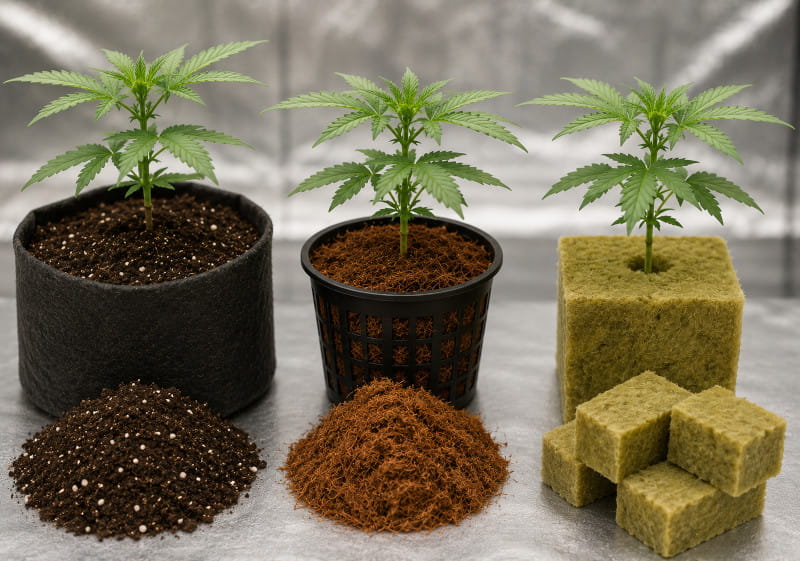
How cannabis is fertilized depends to a large extent on whether the plant is growing in soil, coco or a hydroponic system. The different media store and supply nutrients differently. A fertilizing schedule for soil therefore cannot simply be transferred to coco or hydro.
| Medium | Nutrient supply | Important when fertilizing |
|---|---|---|
| Soil | may be lightly, heavily or not pre-fertilized at all | take existing nutrients into account and do not automatically add more fertilizer |
| Coco | nutrients are supplied primarily via the nutrient solution | monitor nutrient solution, pH, EC, irrigation and runoff |
| Hydro / rockwool | nutrient supply is provided almost entirely via the nutrient solution | closely monitor the concentration, pH and composition of the nutrient solution |
How do you fertilize cannabis in soil?
When fertilizing cannabis in soil, the first thing to consider is how many nutrients the substrate already contains. Soil may be heavily, lightly or not pre-fertilized at all. This largely determines when additional fertilizing should begin.
With more heavily pre-fertilized soil, the existing nutrient supply may initially be sufficient. Additional liquid fertilizer is then not automatically necessary and, if dosed too heavily, can lead to oversupply. With lightly or non-pre-fertilized soil, however, you need to pay attention earlier to when the plant requires additional nutrients.
In organic soil, some nutrients are made available by microorganisms and other biological processes in the substrate. The supply therefore cannot be controlled as directly as with a mineral nutrient solution. Regardless of the soil used, the same principle applies: fertilize according to actual demand, not solely according to a fixed calendar.
How do you fertilize cannabis in coco?
When growing in coco, the required nutrients are supplied primarily via the nutrient solution. Coco differs significantly from soil and should therefore not be treated according to the same fertilizing and watering rules.
In addition to the composition and concentration of the nutrient solution, pH, EC, irrigation and runoff also play an important role with coco. Special coco fertilizers are tailored to the properties of the medium. Anyone switching from soil to coco should therefore not only change the substrate, but also adjust nutrient supply and irrigation accordingly.
What is different about fertilizing in hydro and rockwool?
In hydroponic systems and with rockwool, the required nutrients are supplied almost entirely via the nutrient solution. This allows nutrient supply to be controlled very precisely. At the same time, an excessively high nutrient concentration or an unsuitable pH value can affect the plant more quickly than when growing in soil.
The nutrient solution should therefore be checked regularly and adjusted to the respective system and the plants' stage of development. Anyone who wants to learn more about the differences between the individual growing media can find them in our comparison The best medium for cannabis – soil, coco or rockwool.
Why are pH and EC values important when fertilizing?
pH and EC values help to control the nutrient supply of cannabis more effectively. The pH value influences how available certain nutrients are in the root zone. The EC value, by contrast, provides an indication of the concentration of dissolved salts in the water or nutrient solution.
Both values play an important role especially with coco and hydroponic systems, because nutrient supply there is controlled largely via the nutrient solution. When growing in soil, pH and EC can also be useful, but they must always be considered together with the substrate, water and fertilizing system used.
Why does pH influence nutrient uptake?
The pH value influences how well cannabis can absorb the available nutrients through its roots. If it lies well outside the range suitable for the respective growing system, certain nutrients may become less available – even if enough of them are actually present in the substrate or nutrient solution.
This is particularly important when fertilizing: if a plant shows signs of poor nutrient supply, too little fertilizer is not necessarily the cause. If the problem is the pH value, an additional fertilizer application may have no effect or may even make the situation worse by increasing the salt concentration.
Which pH range is suitable depends on the medium. Soil, coco and hydroponic systems are therefore not automatically operated at the same target values. Anyone monitoring pH should also not look at just one individual reading, but should also take into account the water, substrate and fertilizing system being used.
What does the EC value of the nutrient solution indicate?
The EC value provides an indication of the concentration of dissolved salts in water or a nutrient solution. When mineral fertilizer is added to water, its electrical conductivity normally increases as well. This makes it possible to monitor how concentrated a nutrient solution is overall.
However, the EC value does not show which nutrients are present. Two nutrient solutions can have the same EC value and still have completely different compositions. A high EC value therefore means neither an automatically good nutrient supply nor a particularly suitable fertilizer.
The source water should also be taken into account. Tap water already contains dissolved minerals and therefore has its own EC value. If fertilizer is then added, the value increases accordingly. Especially with coco and hydro, the EC value can therefore be a useful way to monitor nutrient concentration.
For beginners, one point is especially important: pH and EC are monitoring values, not targets that need to be as high or as low as possible. They help you assess nutrient supply correctly and identify potential problems.
Fertilizing cannabis with home remedies – what makes sense?
Some home remedies can supply cannabis with individual nutrients, but they do not automatically replace a balanced fertilizer. The biggest problem is dosage: with homemade liquid manures, manure, ash or kitchen scraps, it is often difficult to estimate which nutrients actually become available and in what quantities.
Anyone using several home remedies at the same time can quickly lose track of the overall nutrient supply. Some materials only take effect after decomposition, while others can significantly change the pH value or stress the roots if used in excessive amounts. Especially for beginners, a fertilizer with a known composition is therefore usually easier and safer to dose.
| Home remedy / alternative | What can it provide? | Assessment | What should you watch out for? |
|---|---|---|---|
| Nettle liquid fertilizer | nitrogen and other minerals, among other things | can be used as an organic supplement, but is not a complete fertilizer for the entire grow | nutrient content and concentration vary depending on preparation; do not use undiluted |
| Guano | different amounts of nitrogen, phosphorus and other nutrients depending on origin | can be part of an organic fertilizing system | composition and concentration vary considerably; follow the dosage instructions for the respective product |
| Flower fertilizer | depending on the product, nitrogen, phosphorus, potassium and trace elements | not automatically suitable for cannabis | check composition and dosage; not every flower fertilizer adequately meets the plant's needs |
| Wood ash | potassium and calcium, among other things | rather unsuitable for fertilizing in pots | can raise the pH value considerably and is difficult to dose accurately |
| Coffee grounds | organic material and smaller amounts of various nutrients | not a complete cannabis fertilizer | nutrients are not immediately available; larger amounts can alter the properties of the substrate |
| Horse manure | organic matter and various plant nutrients | more suitable for preparing outdoor soil than for spontaneous fertilizing in a pot | fresh manure can be too nutrient-rich and damage plants; use only well-aged or composted material |
Especially important with home remedies: “Natural” does not automatically mean mild or harmless. Organic materials can also overfertilize cannabis, alter the pH value or damage the roots. Anyone using home remedies should therefore know exactly what they are adding to the substrate and should not combine several remedies at random.
How can overfertilization and nutrient lockout be avoided?
The best way to avoid overfertilization is to give cannabis only as many nutrients as the plant actually needs. Nutrients already present in the substrate should be taken into account just as much as liquid fertilizer and additional boosters. Oversupply can occur particularly quickly when several concentrated products are combined.
Nutrient lockout occurs when certain nutrients are present but can no longer be absorbed sufficiently by the plant. Causes can include an unsuitable pH value, an excessively high salt concentration in the substrate or problems in the root zone. The plant may then show deficiency symptoms even though enough or even too many nutrients are actually present.
This is precisely why it is problematic to react immediately to every supposed deficiency symptom with more fertilizer. If there is already a high nutrient concentration or an uptake problem, additional fertilizer can make the situation even worse.
Why does more fertilizer not mean more growth?
More fertilizer only leads to a better nutrient supply if the plant is actually lacking nutrients. If sufficient nutrients are already available, growth cannot simply be increased further by applying more fertilizer.
How quickly cannabis grows also depends on light, temperature, water, root development, CO₂ supply, plant size and genetics. Fertilizer is only one of these factors. A high nutrient concentration therefore cannot compensate for an unsuitable climate, too little light or problems in the root zone.
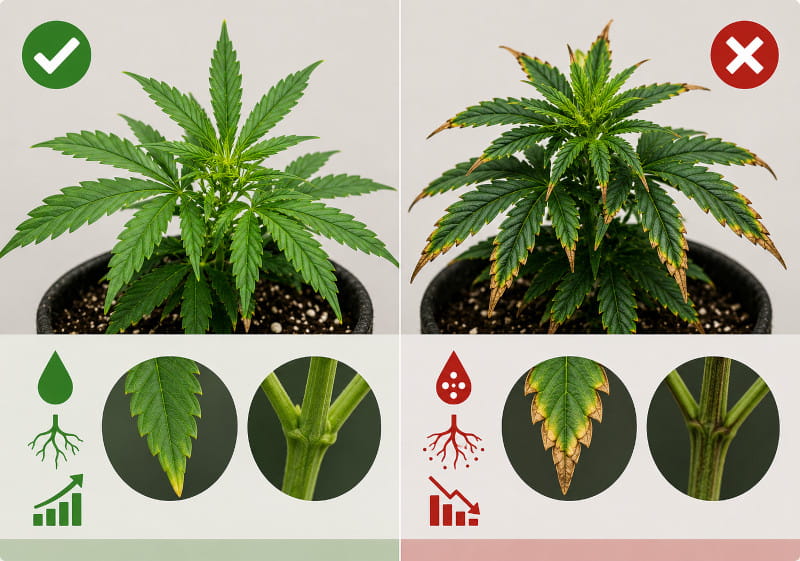
Too much fertilizer can instead impair water and nutrient uptake through the roots and damage the plant. Typical signs may include leaf tips that appear burned or very dark green foliage. If such changes occur, you should not continue fertilizing on suspicion, but first review the nutrient supply used so far and possible other causes.
Does cannabis automatically need more fertilizer when the leaves turn yellow?
No, yellow or discolored leaves do not automatically mean that cannabis needs more fertilizer. In addition to an actual nutrient deficiency, incorrect watering, an unsuitable pH value, problems in the root zone, overfertilization or the natural aging of older leaves can cause similar changes.
Anyone who immediately increases the fertilizer amount when leaves turn yellow may make the actual problem worse. The previous fertilizing, irrigation, pH value and condition of the root zone should therefore be checked first. We explain in detail which nutrient deficiencies can occur in cannabis and how to recognize them in our guide Identifying nutrient deficiencies in cannabis plants.
Which mistakes should you avoid when fertilizing cannabis?
Fertilizing too early or too heavily is one of the most common mistakes when growing cannabis. Problems also arise when fertilizing schedules are adopted without adjustment, different products are combined indiscriminately, or the substrate and water quality are not taken into account. Especially for beginners, a simple and clearly structured fertilizing system is usually easier to control.
| Mistake | Why is it problematic? | Better approach |
|---|---|---|
| Fertilizing seedlings too early | young plants need only very few nutrients and can be damaged by excessive fertilizing | use a mild propagation substrate that is only lightly fertilized or not fertilized at all and initially avoid additional fertilizer |
| Using the maximum dosage immediately | the manufacturer's highest recommended dosage may be too much for a smaller plant or one that is already well supplied | use the manufacturer's recommendations as a guide and adapt the dosage to the plant and growing system |
| Automatically fertilizing with every watering | this is not necessary with every substrate and can lead to an excessively high nutrient concentration | adapt fertilizing frequency to the substrate and fertilizing system being used |
| Treating soil and coco the same way | the two media differ significantly in nutrient supply and irrigation | plan fertilizing and irrigation to suit the respective medium |
| Immediately adding more fertilizer when leaves turn yellow | pH, incorrect watering, root problems or overfertilization can also cause similar symptoms | first identify the cause and only then change the nutrient supply |
| Combining many fertilizers and boosters | nutrients can overlap and unnecessarily increase the total concentration | work with a clear and coordinated fertilizing system |
| Ignoring pH and water quality | nutrient uptake and the concentration of the nutrient solution may then be assessed incorrectly | know the properties of the source water and monitor pH or EC as appropriate for the growing system |
| Dosing home remedies by feel | nutrient content, concentration and effects on the substrate are often difficult to estimate | use home remedies only for specific purposes and do not combine several remedies indiscriminately |
Additional factors come into play when growing outdoors. Plants grown from outdoor cannabis seeds in large pots or directly in the ground can use available nutrients differently from a plant in a small indoor pot. Soil conditions, pot volume, rainfall and plant size therefore also influence fertilizing. You can find further basics on choosing a location, soil and care in our guide to growing cannabis outdoors.
Frequently asked questions about fertilizing cannabis
Can you fertilize cannabis with normal flower fertilizer?
A normal flower fertilizer can in principle provide nutrients, but it is not automatically suitable for cannabis. What matters is the composition, concentration and ratio of the nutrients it contains. The plant's requirements also change between the vegetative and flowering stages.
Anyone who wants to use flower fertilizer should therefore check the NPK values and other ingredients and should not simply copy the dosage used for other plants. Especially for beginners, a fertilizer or fertilizing system whose composition and application are clearly specified is usually easier to control.
Can you fertilize cannabis with nettle liquid fertilizer?
Yes, nettle liquid fertilizer can be used as an organic supplement, but it is not a precisely formulated complete fertilizer. It can provide nitrogen and other minerals, among other things. However, its actual concentration depends on the starting material, preparation and dilution.
Nettle liquid fertilizer should therefore not be used undiluted and should not automatically be regarded as the sole nutrient supply for the entire grow. Especially during flowering, it does not necessarily cover the changing nutrient requirements in a balanced way.
Do autoflowering plants need less fertilizer?
Autoflowering cannabis does not generally require a specific percentage less fertilizer. Many plants grown from autoflower seeds remain smaller and go through a shorter grow cycle than large photoperiod plants. Their total nutrient requirements may therefore also be lower.
What matters, however, is the plant's actual development. A vigorous autoflower may need more nutrients than a small or slowly growing photoperiod plant. Strain, plant size, substrate and fertilizing system are therefore more important than a blanket dosage rule for autoflowers.
Should you fertilize cannabis with every watering?
No, cannabis does not generally need to be fertilized with every watering. When growing in soil, there may still be sufficient nutrients in the substrate, meaning additional fertilizer is not necessary with every watering. With coco and hydroponic systems, by contrast, nutrients are usually supplied more regularly via the nutrient solution.
How often fertilizer is applied should therefore match the substrate and fertilizing system being used. A general rule such as “every second watering” or “once a week” cannot sensibly be applied to all cannabis plants.
How can you tell that cannabis has received too much fertilizer?
Early signs of an excessively high nutrient concentration can include brown leaf tips that look burned, very dark green foliage or leaves curling downward. With more severe overfertilization, the damage can spread and growth can be significantly impaired.
However, such changes alone do not prove overfertilization, because similar symptoms can also have other causes. The amount of fertilizer used so far, the substrate, irrigation, pH value and – where useful in the respective system – the EC value should therefore be considered together. If overfertilization is suspected, you should not simply continue fertilizing or apply even more fertilizer.
Can you grow cannabis using only organic fertilizer?
Yes, cannabis can be fertilized entirely organically if all required nutrients are available in sufficient quantities and at the right time. In organic systems, the substrate, microorganisms and gradual release of nutrients play an important role.
Oversupply is also possible with organic fertilizing. “Organic” therefore does not mean that unlimited amounts of fertilizer, guano, manure or other additives can be used. A balanced nutrient supply that suits the plant and the substrate being used remains essential.
Sources and further information
- Optimisation of Nitrogen, Phosphorus, and Potassium for Soilless Production of Cannabis sativa in the Flowering Stage Using Response Surface Analysis
- Mineral nutrition for Cannabis sativa in the vegetative stage using response surface analysis
- Cannabis Hunger Games: nutrient stress induction in flowering stage – impact of organic and mineral fertilizer levels on biomass, cannabidiol yield and nutrient use efficiency
- Effect of augmented nutrient composition and fertigation system on biomass yield and cannabinoid content of medicinal cannabis cultivation
- Predicting vegetative phase nutrient uptake in Cannabis sativa L. via transpiration-driven mass-balance