Repotting Cannabis: Timing & Pot Size
Repotting cannabis correctly: timing, pot size and instructions
Updated: September 2026 | Repotting cannabis: a practical beginner's guide to timing, pot size, final pot, autoflowers, drainage and common mistakes.
Author: Cannapot Grow Team | Reading time: approximately eighteen minutes
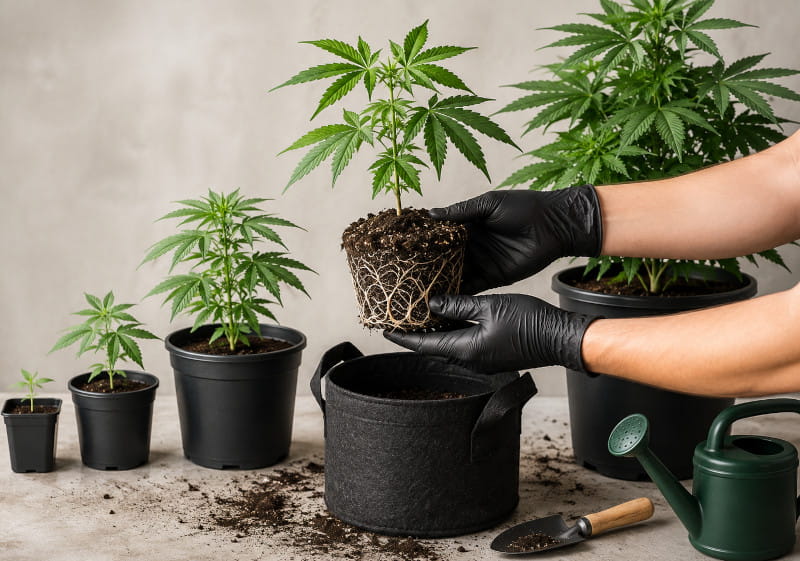
The Most Important Points at a Glance
✓ The right time to repot does not depend solely on the age of the plant. What matters most is how thoroughly the roots have already filled the existing pot.
✓ Roots at the drainage holes, a substrate that dries out quickly or a dense root ball are typical signs that more space is needed.
✓ Bigger is not automatically better: the new pot should match the size of the plant and its root system. This makes proper watering easier, especially for beginners.
✓ Photoperiod cannabis plants can be moved into larger pots step by step. Autoflowers, by contrast, are often placed directly into their final pot to avoid unnecessary repotting.
✓ When repotting, the root ball should remain as undamaged as possible. Afterwards, water gently and give the plant some time to adjust to the new pot.
When should you repot cannabis?
Cannabis should be repotted when the roots have thoroughly filled the current pot and the plant needs more space for further development. A fixed point in time such as “after two weeks” is not very useful. What matters instead is how far the roots and the plant have already developed.
Young cannabis plants in particular develop their root systems quickly. In a small propagation pot, the roots will therefore sooner or later reach the sides and bottom of the pot. This is completely normal at first. However, once space becomes limited, the substrate often dries out faster and the plant's further development can be impaired.
The best way to tell whether a cannabis plant should be repotted is therefore to look for several signs. Visible roots at the drainage holes are an initial indication, but not yet a reason to change pots immediately. At the latest, once the root ball is densely filled with roots and holds together well, a larger pot should be ready.
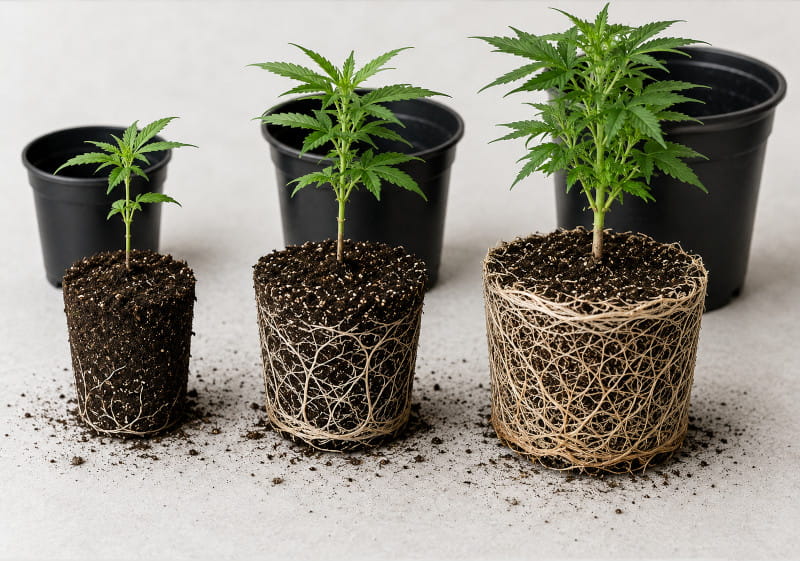
How can you tell when a pot is too small?
You can usually tell that a pot has become too small by several signs. Particularly informative signs are visible roots, substrate that dries out quickly and a root ball that already clearly fills the existing pot.
| Observation | What can it mean? | What should you do? |
|---|---|---|
| Roots at the drainage holes | The roots have reached the bottom of the pot and are continuing to spread. | Check the root ball and other signs. A single visible root does not yet mean that the plant must be repotted immediately. |
| Substrate dries out very quickly | Many roots and a larger plant use the available water increasingly quickly. | Check whether the plant now needs a larger pot. |
| Dense root ball | The root system has already filled most of the existing pot. | For a plant that is still growing, this is usually a good time to repot. |
| Plant becomes top-heavy | The plant has become large in relation to its pot and is losing stability. | Check whether a larger and more stable pot would be appropriate. |
| Growth slows down | Too little root space can be one possible cause. | Also check watering, light, climate and nutrient supply. |
Simple test: If the root ball can be carefully removed from the pot and the substrate largely stays together, the plant is usually ready for a larger pot. If the soil immediately falls apart and only a few roots are visible, you should wait a little longer before repotting. A very dense network of circling roots, on the other hand, indicates that the change may already be overdue.
How often should you repot cannabis?
There is no universal rule for how often cannabis should be repotted. The key factors are the size of the first pot, the planned final size of the plant, the length of the vegetative phase and the chosen growing method.
Photoperiod cannabis plants can, for example, start in a small propagation pot, later move into an intermediate pot and finally receive their final pot. Depending on the growing method, however, an intermediate step can also be skipped. We explain in more detail when the vegetative phase, pre-flowering and flowering follow one another in our Cannabis growth cycle.
The right timing is therefore more important than a specific number of repotting steps. A larger pot makes sense when the roots have filled the existing one and the plant needs additional space. If, on the other hand, there is still a lot of unused substrate, there is normally no reason to repot again yet.
What pot size does cannabis need?
The pot size cannabis needs depends mainly on the stage of development, the planned final size, the length of the vegetative phase and the growing method. There is therefore no specific litre capacity that is equally suitable for every cannabis plant.
A larger pot gives the roots more space and contains correspondingly more substrate. Nevertheless, it is not always sensible to place a small seedling directly into the largest possible container. As long as the plant still has a small root system, a large portion of the substrate remains unused. If the entire pot is watered heavily, the soil there can stay moist for longer.
A pot that is too small, by contrast, will eventually no longer provide enough room for further root development and will dry out increasingly quickly as the plant gets larger. The appropriate grow pot size should therefore provide enough space for the next stage of development without being unnecessarily large.
What pot size does cannabis need at each stage?
As a guide, different pot sizes can be used for cannabis depending on the stage of development. The following values are practical guideline ranges for classic soil growing and are not fixed requirements. With coco, automatic irrigation or other growing systems, smaller or larger containers may also make sense.
| Plant stage / situation | Pot size as a guideline | When to change? | Note |
|---|---|---|---|
| Germinated seed / small seedling | approx. 0.25–1 litre | when the roots have filled the small pot | the small volume makes moisture easier to control |
| Young plant / intermediate pot | approx. 1–3 litres | when the root ball is stable and the roots have filled the pot | this intermediate step is not always necessary |
| Vegetative phase | approx. 3–7 litres | depending on the length of the vegetative phase and the planned plant size | with a short vegetative phase, this may already be the final intermediate pot |
| Indoor final pot | often approx. 7–15 litres | preferably before the actual flowering phase begins | take plant count, available space and desired final size into account |
| Autoflower final pot | often approx. 7–15 litres | often used as the final pot from the start or very early on | this avoids unnecessary repotting later on |
| Outdoor in a pot | approx. 15–50+ litres | depending on season, genetics and desired final size | large photoperiod plants may need significantly more root space |
The figures in the table are deliberately only guidelines. A cannabis plant can also grow well in a smaller or larger pot if watering, substrate and the other conditions are appropriate. For beginners growing in soil, however, the ranges listed provide a good reference so that pot size and plant remain in a sensible proportion.
Can a cannabis pot be too large?
A large pot is not inherently a problem for cannabis, but with a small plant it can make proper watering more difficult. As long as the root system is still small, the roots are only occupying part of the available substrate.
If a very large pot is nevertheless frequently soaked completely, the soil in areas with little root development can remain moist for a long time. The decisive factor is therefore not the pot size alone, but whether the size of the plant, root system, substrate and watering are well matched.
Directly into the final pot or repot step by step?
Both methods can work well: with gradual repotting, the plant moves into larger containers step by step, while starting directly in the final pot eliminates the need for further repotting. Which option is more suitable depends mainly on the growing method and the type of cannabis plant.
| Method | Advantages | Disadvantages | Particularly useful when ... |
|---|---|---|---|
| Repot step by step | Moisture and root development are easier to control in smaller pots; the pot size can be adapted to the plant's development | several repotting steps and therefore a little more work | photoperiod plants are cultivated over a longer vegetative phase |
| Directly into the final pot | later repotting is unnecessary and the roots can spread in the final pot from the beginning | with small seedlings, watering in a large pot requires a little more attention | additional repotting should be avoided or autoflowers are being grown |
What pot size is suitable indoors and outdoors?
Indoors, the appropriate pot size depends mainly on the available space, the number of plants and the planned length of the vegetative phase. Outdoors, significantly larger pots can be useful.
What cannabis pot size makes sense indoors?
For indoor growing, the pot size has to match the available area. Several large grow pots require correspondingly more floor space and reduce the room available for additional plants. With a short vegetative phase or several compact plants, smaller final pots are therefore often sufficient. If, on the other hand, a single plant is intended to grow for longer and fill a larger area, a larger final pot can also make sense.
Anyone planning their first indoor grow can find the most important basics on space, lighting and ventilation in our Cannabis Grow Setup for Beginners and in our detailed guide to Growing Cannabis Indoors.
What cannabis pot size makes sense outdoors?
Outdoors, photoperiod cannabis plants can become considerably larger over a long season than many indoor plants. If you want to cultivate a large plant in a pot, you should therefore allow correspondingly more space for the roots. At the same time, large pots filled with substrate become very heavy and can only be moved with difficulty later on.
How large the pot should actually be outdoors depends, among other things, on genetics, location, length of the season and desired plant size. For outdoor growing, Cannapot offers a dedicated selection of outdoor cannabis seeds. We explain more about the special conditions outdoors in our guide to growing cannabis outdoors.
Should you repot autoflower cannabis?
Autoflowers can be repotted, but they are often placed directly into their final pot. This eliminates the need for repotting later during their comparatively short vegetative phase.
Unlike photoperiod cannabis plants, autoflowers begin flowering independently of a change in the light cycle. Their vegetative phase therefore cannot simply be extended if the plant needs time to recover after poorly executed or very late repotting.
However, this does not mean that autoflowers must never be repotted. If you start in a small propagation pot, you can move the young plant carefully into its final pot at an early stage. For beginners, however, it is often easier to start autoflowers directly in a suitable final pot and avoid additional repotting.
Anyone interested in autoflowering genetics will find a large selection of autoflower cannabis seeds at Cannapot. We explain further special characteristics of these plants in detail in our Canna-Wiki guide to growing autoflowering cannabis.
When should you repot cannabis after germination?
A cannabis seedling should only be repotted after germination once it has developed well and its roots have sufficiently filled the small propagation container. Here too, age alone is not a reliable measure.
If you start in a small pot or propagation cube, you should first observe the development of the plant and its roots. With a very young seedling, the root ball is often not yet stable enough. If it is removed from the pot too early, the loose substrate can fall apart and damage the fine young roots.
Regardless of which cannabis seeds are used, development begins with germination. We explain step by step how to germinate cannabis seeds successfully in our guide How to Germinate Cannabis Seeds Properly.
Can you repot cannabis before or during flowering?
A planned move into the final pot should, for photoperiod cannabis plants, ideally take place before the actual flowering phase. This gives the plant enough space for further development and allows it to adjust to the new pot before flowering is advanced.
When should you repot cannabis before flowering?
Indoors, the move into the final pot can be coordinated well with the start of flowering. If a photoperiod plant still needs a larger pot, you should not wait until flower development is already well advanced. Repotting in good time gives the roots the opportunity to spread through the new substrate before and during early flowering.
Can you repot cannabis during flowering?
Cannabis can also be repotted during flowering if necessary, but routine repotting is usually not advisable at this stage. If the existing pot is clearly too small, damaged or there is another important reason for changing it, the plant should be moved as carefully as possible and the root ball should not be disturbed unnecessarily.
We explain separately what happens in the plant during this stage of development and how it changes from week to week in our guide to the Cannabis Flowering Stage Week by Week.
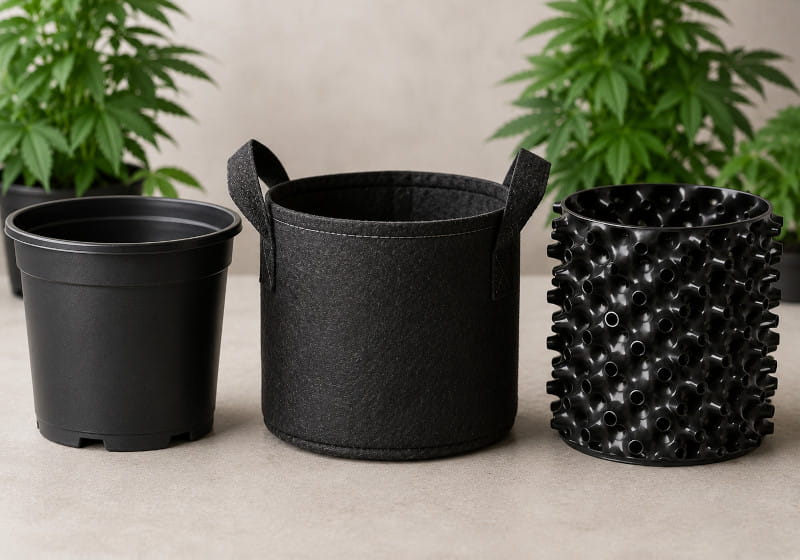
Which pots are suitable for cannabis?
Classic plastic pots, fabric pots and aerated pots such as Air-Pots are all suitable for cannabis. The most important factors are the right size, good water drainage and watering adapted to the particular type of pot.
| Pot type | Advantages | Points to consider |
|---|---|---|
| Plastic pot | lightweight, inexpensive, easy to clean and available in many sizes | sufficiently large drainage holes are important; hardly any water evaporates through the side walls |
| Fabric pot | air-permeable sides, good water drainage and low empty weight | the substrate often dries out faster than in a plastic pot |
| Air-Pot / aerated pot | good aeration of the root zone and very good water drainage | watering can feel a little unfamiliar at first and water may escape from the sides |
For beginners, a simple plastic pot with sufficiently large drainage holes is usually perfectly adequate. Fabric pots and Air-Pots are interesting alternatives, but because of their greater aeration and faster drying they require slightly adjusted watering habits.
Why are drainage and drainage holes important?
Drainage holes allow excess irrigation water to leave the cannabis pot so that the roots are not permanently sitting in overly wet substrate. Good drainage is therefore one of the most important features of a suitable growing container.
Cannabis roots need oxygen as well as water. If excess water cannot drain away, the substrate stays wet for longer and less air is available in the root zone. Water that collects in the saucer after watering should therefore not be left standing there permanently.
A layer of stones or expanded clay at the bottom of the pot is not a substitute for functioning drainage holes. More important are a loose, well-draining substrate and a pot from which excess water can drain away without difficulty.
What substrate should you use when repotting?
When repotting, you should use a substrate that matches the growing method used so far and provides the roots with both moisture and sufficient air. If you have been growing your cannabis plant in soil, you would normally also repot it into a suitable soil.
Coco, rockwool and other growing media have partly different requirements for watering and nutrient supply. For beginners, it is therefore usually easier not to change the entire growing system at the same time as repotting.
We explain the differences between the various options and which medium is suitable for which type of cultivation in detail in The Best Medium for Cannabis – Soil, Coco or Rockwool.
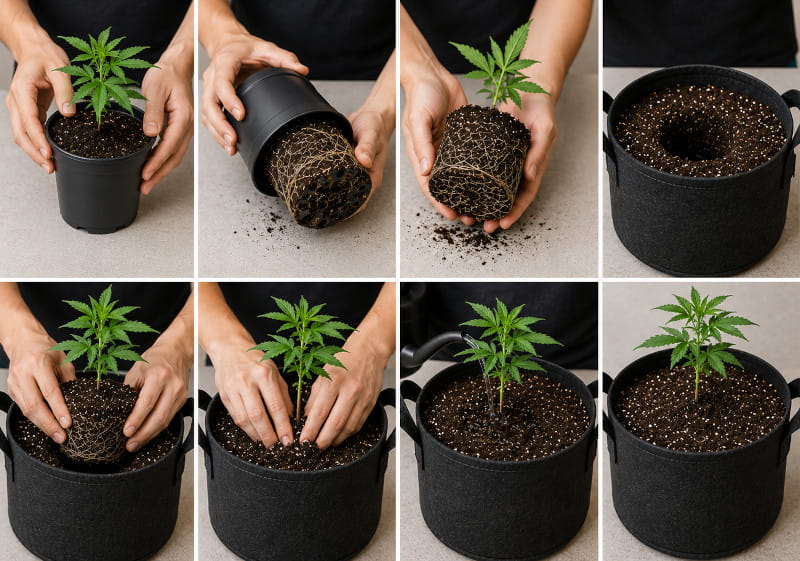
How do you repot cannabis correctly?
When repotting, the cannabis plant is carefully removed from the old pot together with its root ball, which should remain as intact as possible, and placed into a larger container. It is important to damage the roots as little as possible and then set the plant securely into fresh substrate.
1. Prepare the new pot and substrate
Choose a clean pot of the appropriate size and make sure it has sufficiently large drainage holes. First, add some fresh substrate to the bottom. Later, the root ball should sit high enough that there is still some space for watering at the top rim of the pot. To estimate the correct height, you can first place the old pot inside the new one as a test.
2. Carefully remove the cannabis plant from the old pot
The plant is easiest to remove when the root ball is neither completely soaked nor severely dried out. With a flexible plastic pot, you can gently squeeze the sides to loosen the root ball. Then support the surface of the substrate with one hand and slowly tilt the pot. Never pull the plant out forcefully by the stem.
3. Keep the root ball as intact as possible
During normal repotting, the root ball should remain together as much as possible. Healthy roots do not need to be pulled apart or freed from the old soil. If the plant has been repotted at the right time, the complete root ball can normally be placed directly into the new pot. Only with severely root-bound plants that have a very dense network of circling roots can gentle loosening be useful.
4. Place the plant in the new pot
Place the root ball in the centre of the prepared pot and check the height again. The plant should stand securely, and there should be enough space at the top edge so that neither water nor substrate immediately overflows during later watering.
5. Fill with fresh substrate
Fill the open areas around the root ball evenly with fresh substrate. Press it down only lightly so that the plant stands securely. Excessive compaction should be avoided because the roots need sufficient air as well as moisture.
6. Water cannabis after repotting
After planting, water the plant carefully. This allows the fresh substrate to settle around the root ball and closes larger air pockets. How much water is needed depends on the size of the plant, the new pot, the substrate used and its moisture level. A small seedling in a large final pot therefore requires a different watering approach than a large plant with an already vigorous root system.
How deep should cannabis be planted when repotting?
A normally developed cannabis plant is placed at approximately the same depth when repotting as it stood in the old pot. The upper part of the root ball therefore sits roughly level with the new substrate surface again.
An exception can be very young seedlings that have stretched considerably. In this case, part of the long stem can carefully be set deeper, as long as the cotyledons and true leaves remain clearly above the substrate. If a seedling is severely stretched, you should also check whether it is receiving enough light.
Should you water cannabis after repotting?
Yes, cannabis should normally be watered after repotting. This allows the new substrate to settle around the root ball and gives the roots direct contact with the surrounding soil. How much water is appropriate, however, depends on pot size, plant size and substrate moisture.
A common beginner mistake is to completely soak a significantly larger pot after repotting and then water again only a short time later. Especially with a small plant, the substrate that has not yet been reached by many roots can remain wet for a long time as a result.
Instead of watering at fixed intervals, you should always take the actual moisture level in the pot into account. We explain in detail how to assess pot weight, substrate surface, water quantity and excess irrigation water correctly in our guide to watering cannabis correctly.
Why do the leaves droop after repotting?
Drooping leaves after repotting can be a temporary reaction to the process. However, they do not automatically mean that the plant has been seriously damaged. Too much or too little water, damaged roots, high temperatures or other unfavourable conditions can also cause the leaves to droop.
If the root ball was moved carefully and light, temperature and watering remain unchanged, you should first give the plant some time. If it raises its leaves again and resumes normal growth, there is usually no reason for further action.
Important: Avoid heavily fertilising, pruning, intensively training or significantly changing the lighting immediately after repotting. Several changes at once create additional stress and make it more difficult to identify what the plant is actually reacting to.
Which mistakes should you avoid when repotting?
Repotting too early or too late, damaging roots and incorrect watering are among the most common mistakes when repotting cannabis. Most of them can be avoided if the repotting process is well prepared and the root ball is handled carefully.
| Mistake | Why is it a problem? | Better approach |
|---|---|---|
| Repotting too early | the root ball does not yet hold together and fine roots can be damaged more easily | wait until the roots have sufficiently filled the pot |
| Waiting too long | the roots have less and less space and the small pot dries out increasingly quickly | regularly monitor root development and the moisture level of the pot |
| Pulling on the stem | the stem and roots can be damaged | carefully loosen the pot and support the root ball with your hand |
| Unnecessarily pulling the root ball apart | fine roots can tear or be damaged | move a healthy root ball while keeping it as intact as possible |
| Pressing the substrate down too firmly | heavily compacted substrate contains less air for the roots | fill loosely and press down only lightly |
| Keeping the new pot constantly wet | areas with little root development can remain moist for a long time | adjust the amount of water to the plant size, root system and pot |
| Several interventions at the same time | the plant is subjected to additional stress and problems become harder to attribute | space out major measures over time wherever possible |
Especially on a first grow, it helps to observe changes in the plant closely before immediately changing several things at once. A straightforward grow and simple routines make it easier to assess possible problems correctly. You can find more fundamentals in our beginner's guide Growing Cannabis Without Experience.
Frequently asked questions about repotting cannabis
When is the best time to repot cannabis?
The best time has been reached when the roots have thoroughly filled the existing pot and the root ball holds together when carefully removed. The age of the plant alone is not a reliable measure.
How often do cannabis plants need to be repotted?
There is no fixed number. Photoperiod plants can, for example, move from a propagation pot via an intermediate pot into the final pot. Depending on the growing method, individual steps can also be skipped.
What pot size is best for cannabis?
The right pot size depends on the plant stage, planned final size and growing method. When growing indoors in soil, final pots of around 7 to 15 litres are often used, while large outdoor plants may need significantly larger pots.
Can you plant cannabis directly into an 11-litre pot?
Yes, cannabis can be started directly in an 11-litre final pot. With a small seedling, however, particular attention must be paid to watering because initially the roots only occupy a small part of the substrate.
Do you have to repot cannabis when roots come out of the bottom?
Not necessarily. Individual roots at the drainage holes show that they have reached the bottom of the pot. Also check how thoroughly the roots have filled the pot and how quickly the substrate now dries out.
Should autoflowers be planted directly into the final pot?
Autoflowers are often placed directly into their final pot. This eliminates the need for additional repotting during their comparatively short vegetative phase. Careful early repotting from a small propagation container is still possible.
Should you fertilise cannabis immediately after repotting?
No, additional fertilisation is not necessary solely because of repotting. Whether nutrients are needed depends, among other things, on the substrate used, its pre-fertilisation and the plant's previous nutrient supply.
How long does repotting stress last in cannabis?
There is no fixed period of time. A healthy plant that has been repotted carefully can continue growing with almost no visible delay. If roots have been damaged or conditions are not right, recovery can take correspondingly longer.
Can you repot cannabis into a fabric pot?
Yes, fabric pots are well suited as intermediate or final pots for cannabis. Because more moisture can evaporate through the air-permeable sides, the substrate often dries out faster than in a plastic pot.
Does a cannabis pot need drainage holes?
Yes, with classic soil growing, excess irrigation water should be able to drain away reliably. Without sufficient drainage, the substrate can remain too wet permanently and impair the oxygen supply to the roots.
Sources and further information
- Impact of Different Growing Substrates on Growth, Yield and Cannabinoid Content of Two Cannabis sativa L. Genotypes in a Pot Culture
- The effects of plant density and duration of vegetative growth phase on agronomic traits of medicinal cannabis
- Back to the roots: Cannabis sativa L. root metabolism, microbiomes, and biotechnological potential
- Effect of air-pot containers size on vegetative growth of Cannabis sativa L.