Fungus Gnats on Cannabis: Identify & Control
Identify fungus gnats, control larvae and prevent infestations
Updated: August 2026 | Learn how to identify fungus gnats on cannabis, why the larvae in the substrate are particularly problematic, and how you can specifically reduce an infestation with yellow sticky traps, SF nematodes, proper watering and preventive measures.
Author: Cannapot Grow Team | Reading time: approximately twenty-eight minutes
The most important points at a glance
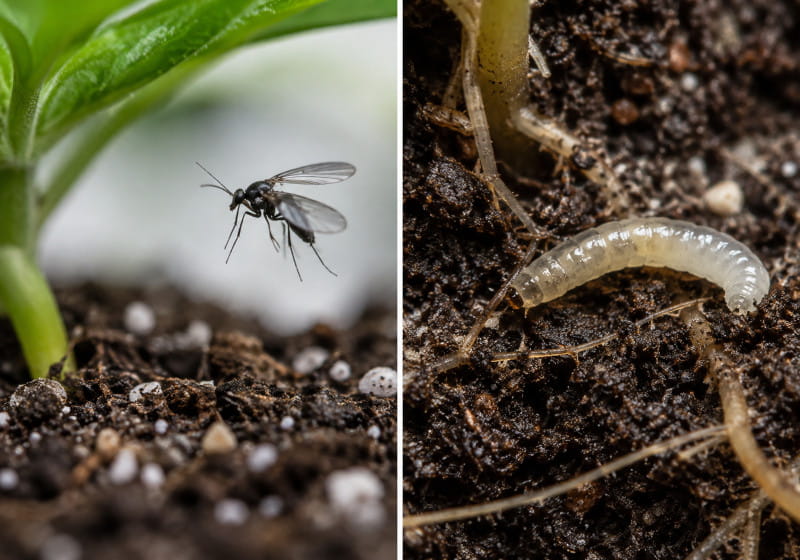
✓ Fungus gnats are small, usually dark and relatively weak-flying gnats that are particularly often found directly above moist substrate. If several tiny black flies rise from the soil when watering or moving the pot, this is a typical sign of an infestation.
✓ Adult fungus gnats usually cause hardly any direct damage to the cannabis plant itself. During flowering, however, they can still become a problem because the small flying insects can easily become stuck to the sticky, resinous flowers. There they can contaminate the plant material and impair the quality of the final product. For the health of the plant, however, the larvae in the substrate are the main concern: they feed mainly on fungi, microorganisms and organic material, but in heavier infestations they can also damage fine roots and root hairs.
✓ Seedlings, cuttings and young cannabis plants are particularly sensitive to damage in the root zone. In a heavier infestation, for example, slowed growth, wilting despite sufficiently moist soil or generally delayed development may occur. However, such symptoms can have many different causes and on their own are not definitive proof of fungus gnats.
✓ Permanently moist and organic substrate provides fungus gnats with particularly favorable conditions for laying eggs and developing their larvae. However, an infestation does not automatically arise from incorrect watering. Fungus gnats, eggs or larvae can also be introduced into the growing area with new soil, plants or other organic material, for example.
✓ Yellow sticky traps mainly catch adult fungus gnats. They are therefore very useful for detecting an infestation early, monitoring its development and reducing the number of flying insects. However, yellow sticky traps do not reach eggs and larvae in the substrate, which is why they are normally not sufficient on their own once an infestation is established.
✓ So-called SF nematodes are among the best-known biological measures against the larvae. These are tiny roundworms of the species "Steinernema feltiae" that are used specifically to control fungus gnat larvae in the substrate. The substrate must remain sufficiently moist during application so that the nematodes can move through the moisture film between the substrate particles and reach the larvae.
✓ A persistent fungus gnat infestation can usually be reduced most reliably when several measures are sensibly combined: create unfavorable conditions for further reproduction, control the adult fungus gnats and at the same time target the larvae in the substrate. Catching only the visible gnats is often not enough once an infestation is established.
Small black flies that rise from the soil when watering or walk around just above the substrate surface are among the most typical signs of fungus gnats. Many growers initially notice only the adult insects. However, most of the activity actually takes place inside the pot: eggs, larvae and pupae develop there, while the flying gnats merely represent the final stage of the life cycle.
For successful control, it is therefore not enough to catch only the visible gnats. The key is to target the larvae in the substrate at the same time and improve the conditions that encourage their continued reproduction. While yellow sticky traps mainly capture the adult fungus gnats above the soil, eggs and especially larvae must be controlled directly in the substrate. By addressing both areas, you can specifically interrupt the fungus gnat life cycle and prevent new gnats from repeatedly appearing after a short time.
How can you identify fungus gnats on cannabis?
Fungus gnats are small, dark, mosquito-like insects that prefer to stay in the immediate vicinity of moist soil. It is typical for individual insects to walk across the substrate or fly up when the pot is watered, lifted or moved. The larvae, by contrast, live hidden in the upper and middle zones of the substrate.
The name can be misleading at first: fungus gnats are not biting mosquitoes that attack people or animals. They belong to the Sciaridae family and are commonly referred to in English as “fungus gnats”. The English name already points to their close association with moist, fungus-rich and organic substrates.
What do adult fungus gnats look like?
Adult fungus gnats are only a few millimeters long. Their body appears slender, dark gray to black and distinctly mosquito-like. Their relatively long legs and antennae are noticeable. Unlike many sturdier flies, fungus gnats are not particularly strong fliers. They often move jerkily across the soil surface, walk along the rim of the pot or fly only short distances just above the substrate.
If you gently move the pot and several small dark gnats fly up directly from the soil, you should inspect the substrate more closely. A single small insect is not yet proof of an infestation, but several insects on the same pot surface are a clear indication.
What do fungus gnat larvae look like?
The larvae look completely different from the adult gnats. They are elongated, legless and whitish to almost transparent. The small dark to black head capsule is particularly characteristic. In moist soil they are not always easy to spot with the naked eye, but in a heavier infestation they can sometimes be seen directly beneath the substrate surface, along moist pot edges or around young roots.
The larvae move through thin water films in the substrate and prefer areas where sufficient moisture and organic material are present. Peat-based or highly organic growing substrates can therefore provide favorable conditions if they remain very moist for extended periods.
Where are fungus gnats found on cannabis plants?
Unlike aphids, thrips or spider mites, fungus gnats do not live mainly on the leaves. Adult insects are usually found on or just above the soil, around the lower stem, on pot rims or on moist surfaces in the immediate vicinity of the pots. Eggs, larvae and pupae are found in the substrate.
This is an important diagnostic clue: if small insects are mainly found on the undersides of leaves and fly up when the leaves are moved, you should think more of whiteflies or other leaf pests. If the insects emerge directly from the soil, fungus gnats are much more likely.
| Feature | Typical indication | How to check it |
| Small black flies | The insects walk across the soil or fly only short distances just above the substrate | Gently move or water the pot and observe whether small dark gnats fly up directly from the substrate |
| Larvae in the substrate | Pale to transparent, elongated larvae with a distinctly dark head capsule | Carefully inspect moist areas of the upper substrate layer as well as the area close to the roots |
| Catches on yellow sticky traps | Several small dark gnats become stuck on the yellow adhesive surfaces | Monitor catch numbers over several days. Yellow sticky traps mainly capture adult fungus gnats and provide an indication of how the infestation is developing |
| Weak plant growth | In a heavy larval infestation, damage to fine roots and root hairs can impair plant development | Growth problems alone do not prove a fungus gnat infestation. Also check watering practices, root health, nutrient supply and other possible causes |
What is the life cycle of fungus gnats?
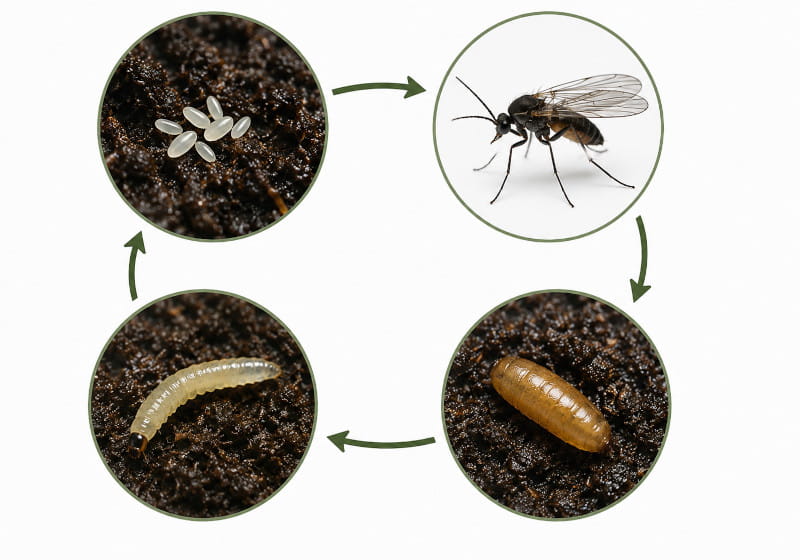
The life cycle progresses from egg through several larval stages and a pupa to the adult fungus gnat. Under warm and humid conditions, a new generation can develop within just a few weeks. This is exactly why new gnats can suddenly appear again after what seemed to be a successful trapping effort.
Eggs in moist substrate
Females prefer to lay their eggs in moist, organically rich substrates. Areas that remain continuously moist and contain fungi, algae, microorganisms and decomposing plant material are especially attractive. The eggs are tiny and are almost always overlooked during a normal visual inspection of the soil.
Four larval stages in the substrate
After hatching, fungus gnats typically pass through four larval stages. During this phase, their diet is focused on fungi, microorganisms, algae and dead organic material. However, at high larval densities or on sensitive plants, they can also feed on very fine roots and root hairs.
This stage is particularly relevant for cannabis because the larvae are located exactly where water and nutrient uptake take place. A large plant with a strong root system can usually compensate for minor damage much better than a newly germinated seedling or a cutting with only a few young roots.
Pupa and adult fungus gnat
At the end of larval development comes the pupal stage. The adult fungus gnat emerges from it and then searches again for suitable places to lay eggs. The Plant Protection Service of the Chamber of Agriculture of North Rhine-Westphalia describes the entire development as temperature-dependent, progressing significantly faster under warmer conditions than at cooler temperatures.
This is precisely why an infestation often occurs in waves: while many adult fungus gnats may already be stuck on yellow sticky traps, eggs, larvae and pupae can still remain in the substrate. New fungus gnats gradually emerge from these developmental stages, making the infestation appear to keep returning.
| Stage | Where is it found? | Importance for control |
| Egg | Mainly in moist areas of the substrate | Yellow sticky traps do not reach the eggs. Less favorable conditions for egg laying can help limit further reproduction |
| Larva | In the substrate, especially in moist areas with organic material | The larvae are the main target of SF nematodes. These are tiny roundworms of the species Steinernema feltiae that are used specifically for the biological control of fungus gnat larvae |
| Pupa | In the substrate or near the substrate surface | New fungus gnats can continue to emerge from the pupae even when hardly any flying insects are temporarily visible |
| Adult fungus gnat | On the substrate surface and in the immediate vicinity of the plants | Easy to capture with yellow sticky traps. Catch numbers help show whether new fungus gnats are still emerging |
What damage do fungus gnats cause to cannabis?
Adult fungus gnats normally cause hardly any direct damage to the cannabis plant. The larvae are the main concern when they occur in large numbers and, in addition to fungi and organic material, also feed on fine roots or root hairs. Seedlings, cuttings and young cannabis plants are particularly sensitive. During flowering, however, adult fungus gnats can also become a nuisance because they can easily become stuck to the sticky, resinous flowers and thereby contaminate the later harvest.
Damage to fine roots and root hairs
Fine roots and root hairs increase the surface area of the root system and play an important role in the uptake of water and dissolved nutrients. If these young structures are repeatedly damaged during a heavy larval infestation, the plant may be supplied less efficiently. Such problems often only become visible above ground after a delay.
However, the damage pattern is not specific. Weak growth, slight wilting or yellowing can also result from overwatering, oxygen deficiency in the root zone, nutrient problems, an unsuitable pH value or other root damage. A fungus gnat infestation should therefore always be confirmed by the presence of the insects or larvae.
Why seedlings and young plants are particularly sensitive
A seedling has only a few young roots and limited reserves. Even comparatively minor damage can therefore affect a larger proportion of the entire root system. With cuttings, the new root system still has to establish itself. A heavy fungus gnat infestation in propagation substrate can therefore impair rooting and early development much more severely than in a large, vigorous cannabis plant.
Why fungus gnats are problematic during flowering
During flowering, an additional problem arises that has nothing to do with root damage. Fungus gnats often fly in the immediate vicinity of the plants and can come into contact with the sticky, resinous flowers. If the small gnats become stuck there, they are difficult to remove later and can contaminate the harvest with insect remains.
A heavier fungus gnat infestation should therefore not be ignored even on large and otherwise healthy plants. Even if the larvae cause hardly any visible impairment to the strong root system, numerous fungus gnats flying around during flowering can reduce the quality and cleanliness of the final product.
How dangerous are individual fungus gnats?
One or two adult fungus gnats on a vigorous plant are not yet an indication of a severe infestation. However, they do show that suitable conditions may be present or that eggs, larvae or pupae may already be in the substrate. Further development is therefore decisive: if the number of insects on the yellow sticky traps increases noticeably, you find larvae or young plants show growth problems at the same time, you should take action.
| Situation | Assessment | What makes sense now |
| Individual adult fungus gnats, vigorous plant | Not yet an indication of severe root damage | Use a yellow sticky trap, check watering practices and monitor catch numbers |
| Many adult fungus gnats above several pots | A larger population and larvae in the substrate are likely | Also target the larvae and check the conditions in the substrate |
| Many fungus gnats during flowering | Additional risk that gnats become stuck to the resinous flowers and contaminate the harvest | Reduce the population as early as possible and control the larvae in the substrate at the same time |
| Visible larvae + seedlings/cuttings | Increased risk of significant root damage | Quickly and specifically target the larvae and improve conditions in the root zone |
| Weak growth without visible insects | Fungus gnats are not automatically responsible | Also check watering errors, root problems, nutrient supply and other possible causes |
Why does cannabis get fungus gnats?
Fungus gnats do not simply appear because cannabis is watered too much. The insects or their developmental stages must first enter the growing area. Permanently moist substrate, organic material, little drying and favorable temperatures can then allow the population to develop particularly well.
Moist substrate and frequent watering
Moisture is one of the most important factors in the habitat of fungus gnat larvae. If the upper substrate layer remains permanently wet, females find suitable places to lay eggs and larvae can move through the existing water films. At the same time, persistent moisture often promotes fungal growth and microbial activity – exactly the food sources that are attractive to the larvae.
However, this does not mean that you should now radically dry out a cannabis plant with fungus gnats. How much a substrate may dry between waterings depends on pot size, plant stage, substrate and root density. What matters is a sensible watering rhythm adapted to the plant's actual water requirements.
Waterlogging and poor drainage
If water remains in the saucer for a long time or excess irrigation water cannot drain properly, the substrate stays unnecessarily wet for too long. Such conditions not only favor fungus gnats, but can also impair the oxygen supply to the roots and thereby promote additional problems such as root rot in cannabis. Good drainage and a substrate from which excess water can reliably drain are therefore important prerequisites for a healthy root zone.
Introduction via soil and plant material
Fungus gnats may already be present in new soil or organic substrates. Potted plants, cuttings or moist plant material from other areas can also bring in adult insects, eggs or larvae. If fungus gnats appear shortly after repotting or after introducing new plants, introduction in this way is therefore entirely possible.
How can you control fungus gnats on cannabis?
With a heavier fungus gnat infestation, it is usually not enough to catch only the gnats flying around. A combination of several measures is useful: yellow sticky traps reduce the number of adult fungus gnats and help monitor the infestation, while biological measures such as SF nematodes can be used specifically against the larvae in the substrate. At the same time, permanently over-moist conditions and other factors that encourage further reproduction should be corrected.
Which measures make sense also depends on the severity of the infestation. Do you see only isolated fungus gnats, or do numerous gnats rise from several pots every day? Are seedlings, cuttings or already vigorous plants affected? Does the substrate remain unusually wet for a long time, or was new soil used recently? Such observations help you not only eliminate the visible gnats, but also target the larvae and the causes of strong reproduction.
Correct watering practices and substrate moisture
If the soil remains very wet all the time, you should first look for the cause. Often, plants are watered again even though sufficient moisture is still present in the root ball. A pot that is very large relative to a small plant, poorly permeable substrate, poor drainage or water that remains in the saucer for a long time can also cause the soil to dry only slowly.
Allow the upper substrate zone to dry between waterings to the extent that is appropriate for the respective plant and the growing medium being used. This makes the conditions for egg laying and larval development less favorable. However, adapted watering alone does not necessarily eliminate an already severe infestation, especially if many larvae are already present in the substrate.
Yellow sticky traps against adult fungus gnats
Yellow sticky traps or yellow sticky cards have an adhesive surface to which flying fungus gnats become stuck. It is particularly useful to place the traps just above the substrate surface because fungus gnats prefer to stay in this area. The German Environment Agency explicitly lists yellow sticky traps as an insecticide-free measure against fungus gnats indoors.
Yellow sticky traps do more than reduce the number of adult fungus gnats. You can also use catch numbers to observe how the infestation is developing. If fewer and fewer new gnats become stuck over several days, this indicates a decline. If the number continues to increase or remains consistently high, new fungus gnats are probably still emerging from the substrate.
However, the limitation of this method is important: yellow sticky traps reach neither eggs nor larvae in the substrate. In a heavier infestation, they are therefore a useful supplement but cannot replace targeted control of the larvae. Outdoors, sticky traps should also not be used uncritically. According to the German Environment Agency, other insects can also land on the traps there, which can make their use outdoors problematic.
SF nematodes against fungus gnat larvae
SF nematodes of the species Steinernema feltiae are frequently used for biological control of the larvae. The tiny roundworms move through the moist substrate and search for fungus gnat larvae there. They enter the larvae and release symbiotic bacteria that ultimately cause the fungus gnat larvae to die. Steinernema feltiae is also listed by the Plant Protection Service of the Giessen Regional Council as a beneficial organism against fungus gnats.
SF nematodes are usually applied with irrigation water. It is important that the substrate remains sufficiently moist during application so that the nematodes can move through the moisture film between the substrate particles and reach the larvae. The exact dosage, suitable water and soil temperatures, storage and any necessary repeat application depend on the respective product. Therefore, always follow the manufacturer's instructions.
Why the soil must remain moist when using nematodes
This is a common source of confusion: on the one hand, the substrate should not remain permanently wet during a fungus gnat infestation; on the other hand, SF nematodes need sufficient moisture. Both are correct. Permanently wet substrate provides favorable conditions for fungus gnat reproduction. During and after nematode application, however, the substrate must remain sufficiently moist in accordance with the manufacturer's instructions so that the tiny roundworms can move through the moisture film between the substrate particles and reach the fungus gnat larvae.
Once treatment is complete, normal watering adapted to the plant's needs should again be the focus. The aim is therefore neither to keep the substrate as dry as possible for long periods nor to keep it permanently wet. Moisture should be managed specifically during nematode treatment and then once again according to the plant's actual water requirements.
Predatory mites and other biological options
In addition to SF nematodes, soil-dwelling predatory mites can also be used for biological control of fungus gnats. The Giessen Plant Protection Service lists, for example, Macrocheles robustulus, Hypoaspis miles and Hypoaspis aculeifer. These beneficial organisms live in or on the substrate and can prey on young fungus gnat larvae there, among other things.
Which beneficial organisms are suitable depends, among other things, on temperature, substrate, infestation severity and the growing situation. For smaller indoor grows, SF nematodes are often a particularly straightforward option because they can be applied with irrigation water. The relevant application conditions and manufacturer instructions should be followed for all beneficial organisms.
| Measure | Adult fungus gnats | Larvae | Main function |
| Yellow sticky traps | Yes | No | Monitor the infestation and reduce the number of flying fungus gnats |
| SF nematodes | No | Yes | Targeted biological control of larvae in the substrate |
| Predatory mites | No | Yes, especially young larvae | Biological control in and on the substrate |
| Watering management | Indirectly | Indirectly | Make conditions less favorable for egg laying and larval development |
| Dry top layer | Indirectly | Not directly | Can make egg laying and access to moist soil more difficult, but does not reliably control existing larvae |
Do sand, quartz sand or other top layers help against fungus gnats?
A dry and as continuous as possible top layer of suitable fine sand can make it more difficult for fungus gnats to access the moist substrate and thereby interfere with egg laying. However, larvae already present in the substrate are not reliably controlled by this. Such a top layer is therefore mainly useful as a supplementary or preventive measure.
The Giessen Plant Protection Service explicitly mentions a layer of fine sand on the soil surface as a way to make egg laying more difficult for fungus gnats. It is important that the top layer remains as continuous as possible and dry at the surface. If it is regularly disturbed during watering or mixed with the moist substrate underneath, its effect can decrease accordingly.
In a heavier infestation, a top layer does not replace targeted control of the larvae. If numerous larvae are already present in the substrate, they initially remain there despite the barrier. Sand or another suitable top layer should therefore be regarded as part of a combination of adapted watering, control of adult fungus gnats and, if necessary, targeted biological larval control.
Which home remedies against fungus gnats are useful?
Numerous home remedies against fungus gnats are recommended online. Many of them, however, are much less well supported and less reliable than yellow sticky traps, adapted watering or established biological measures such as SF nematodes. With cannabis in particular, it also makes sense not to introduce unnecessary substances into the substrate that could alter its properties or soil life.
Matches in the soil
Inserting matches head-down into the soil is one of the best-known home remedies against fungus gnats. The idea is that components of the match head enter the substrate and act against the larvae there. However, reliable dosing or targeted control is hardly possible in this way. In a heavier infestation, established biological measures are much easier to control.
Cinnamon, coffee grounds and garlic
Cinnamon, coffee grounds and garlic are also frequently recommended as home remedies. Such substances can alter conditions at the substrate surface, but they are not a reliably dosed method against an already established larval infestation. Coffee grounds are better avoided when fungus gnats are present: they add extra organic material to the pot and can help the substrate surface remain moist for longer – exactly the kind of conditions you want to avoid as much as possible during a fungus gnat infestation.
Neem and other products
Neem-containing products are also offered for controlling various plant pests. However, neem is not a classic home remedy and should not be equated with homemade mixtures. Whether a particular product is suitable for the respective plant, application method and intended purpose depends on the product and the applicable regulations. Therefore, do not use blanket mixing recipes from forums; follow the information and application instructions for the respective product.
| Method | Assessment | Important to know |
| Yellow sticky traps | Useful supplement | Catch adult fungus gnats and help monitor the infestation, but do not reach larvae in the substrate |
| SF nematodes | Targeted biological measure | Used against fungus gnat larvae; follow manufacturer instructions on application, temperature and moisture |
| Fine sand / quartz sand | Supportive | A suitable dry top layer can make egg laying more difficult, but does not reliably control existing larvae |
| Matches | Not recommended | The amount of active substances and their effect in the substrate are difficult to control |
| Cinnamon / garlic | Not the first choice | Not a reliably dosed method against an established larval infestation |
| Coffee grounds | Rather unfavorable | Adds extra organic material and can keep the substrate surface moist for longer |
What should you consider with fungus gnats during cannabis flowering?
During flowering, fungus gnats can be problematic for two reasons: the larvae remain in the substrate and can damage the roots there, while adult fungus gnats can become stuck to the sticky, resinous flowers and contaminate the later harvest. Measures should therefore begin as early as possible and specifically target the different developmental stages.
Especially in a heavier infestation, numerous fungus gnats may fly around between the plants. If they come into contact with the resinous flowers, the small insects can easily become stuck to them and are difficult to remove later. Even with large and vigorous cannabis plants whose root systems may tolerate a light larval infestation better, a larger fungus gnat population during flowering should therefore not be ignored.
At the same time, during flowering it makes sense to prefer measures that act directly on the substrate or in the root zone rather than unnecessarily applying sprays to the flowers. Yellow sticky traps can still be used indoors to catch adult fungus gnats and monitor how the infestation is developing. SF nematodes, on the other hand, are introduced into the substrate with irrigation water and reach the larvae there.
Even so, you should not give unnecessarily large amounts of water just because nematodes require sufficient moisture. Follow the manufacturer's instructions during application while also taking the plant's normal water requirements into account. We explain the differences between the individual stages of flower development in detail in our guide to the cannabis flowering phase.
What is different about fungus gnats indoors compared with outdoors?
Indoors, fungus gnats can become particularly persistent because temperature, moisture and substrate conditions remain relatively constant. They also occur outdoors, but weather, drying and natural enemies change the conditions more strongly. Yellow sticky traps should also not be used outdoors without consideration.
In an enclosed grow box, natural enemies are usually largely absent. At the same time, pots are watered regularly and temperatures are often in a range in which fungus gnats can develop well. If the population is introduced with soil or plants, it can therefore spread relatively undisturbed across several pots.
Outdoors, the life cycle can be influenced more strongly by severe drying, lower temperatures, rainfall events and natural enemies. Individual fungus gnats on a large outdoor pot are therefore not automatically equivalent to a severe indoor infestation. Our overview of outdoor pests on cannabis shows which other animals can affect cannabis outdoors.
| Aspect | Indoor | Outdoor |
| Conditions | Often relatively stable temperatures and regularly moist potting substrate | Greater fluctuations in temperature, wind, rain and drying |
| Natural enemies | Usually largely absent unless beneficial organisms are introduced | More diverse and naturally more common |
| Yellow sticky traps | Well suited for monitoring and catching adult insects | Not without concerns: they can catch non-target insects and, according to the UBA, endanger other animals |
| Source of infestation | Often soil, new plants, cuttings or other potted plants | Incoming insects and natural populations are also possible |
How can you prevent fungus gnats on cannabis?
For prevention, the substrate should not remain unnecessarily moist all the time. It is also useful to inspect new soil, plants and cuttings carefully and to detect the first fungus gnats as early as possible. The earlier an emerging infestation is noticed, the easier it is to prevent a larger population from developing in the substrate.
A particular genetic line does not protect against infestation: There is no cannabis strain that is immune to fungus gnats. This applies in principle to plants from classic cannabis seeds just as it does to autoflower seeds, outdoor seeds, CBD seeds or regular seeds. What matters more for the risk of infestation are the conditions in the substrate and the possibility that fungus gnats or their developmental stages can enter the growing area.
- Water according to the plant's needs: Do not water according to a rigid schedule; base watering on the plant's actual water requirements. The upper substrate zone should not remain permanently wet. You can find detailed tips in our guide How to water cannabis correctly.
- Remove drainage water: Allow excess irrigation water to drain well and avoid leaving water standing in the saucer for long periods.
- Inspect new soil: Store opened bags of substrate as dry as possible and check new soil for small dark gnats flying up or moving across the surface.
- Check new plants and cuttings: If possible, do not immediately place new additions indoors among your existing plants. In addition to leaves and shoots, also inspect the substrate surface.
- Use yellow sticky traps as an early warning system: A few strategically positioned yellow sticky traps can help detect the first adult fungus gnats early and monitor further development.
- Remove dead plant material: Do not leave cut leaves and other moist plant residues unnecessarily on the potting soil. Organic material combined with persistent moisture can create favorable conditions for fungus gnats.
- Pay attention to suitable substrate structure: A well-aerated and sufficiently permeable medium makes it easier to maintain a balanced relationship between moisture and oxygen in the root zone.
- Continue monitoring after treatment: Even if hardly any gnats are visible for several days, eggs, larvae or pupae may still be present in the substrate. Continue observing yellow sticky traps and pots for some time.
Fungus gnats or other small flies?
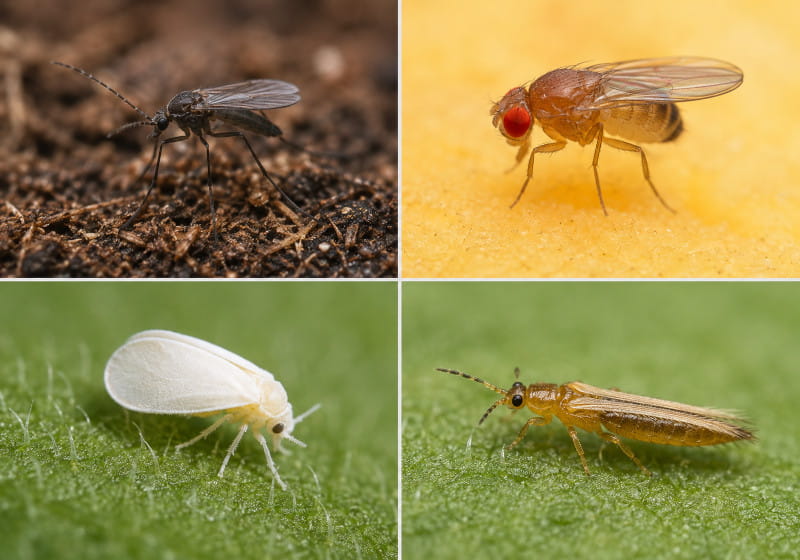
When distinguishing them, the most useful question is where the small insects mainly occur. Fungus gnats are often found on the substrate surface or flying directly above it. Fruit flies are more likely to be attracted to fermenting organic substances, while whiteflies mainly sit on the undersides of leaves. Thrips can additionally be distinguished by their typical damage pattern on the leaves.
Fungus gnats or fruit flies?
Fruit flies usually appear more compact and are often yellowish to brownish in color. They tend to gather around ripe or fermenting fruit, juices, organic waste and other fermenting organic substances. Fungus gnats, by contrast, are slimmer and darker, have noticeably long legs and antennae and are typically found directly on or just above moist plant substrate.
Fungus gnats or whiteflies?
Whiteflies are much lighter and, with their whitish wings, resemble tiny moths. They mainly sit on the undersides of leaves and suck plant sap there. When a heavily infested leaf is touched or moved, several insects often fly up at the same time. Fungus gnats, by contrast, are dark and mainly stay in the immediate vicinity of the substrate.
Fungus gnats or thrips?
Thrips have a very narrow, elongated body and are found on leaves, shoots and sometimes flowers. Typical signs of infestation include silvery, lightened or scraped-looking leaf areas as well as small dark fecal spots. Fungus gnats do not cause these characteristic feeding marks on leaves. We explain the damage pattern in detail in our guide to thrips on cannabis.
| Insect | Typical appearance | Typical location | Main difference |
| Fungus gnat | Small, slender and dark, with long legs and antennae | On and just above moist substrate | Larvae live in the substrate and can damage fine roots in a heavy infestation |
| Fruit fly | More compact, usually yellowish to brownish | Fermenting organic substances, fruit, juices and organic waste | Not typically associated with moist plant substrate |
| Whitefly | Small, light to white and moth-like | Mainly on the undersides of leaves | Feeds on leaves and often produces sticky honeydew |
| Thrips | Very narrow and elongated | Leaves, shoots and sometimes flowers | Typical signs are silvery feeding marks and small dark fecal spots |
Which mistakes make a fungus gnat infestation especially persistent?
A fungus gnat infestation can persist for a particularly long time if only the gnats flying around are controlled while larvae in the substrate and favorable conditions for further reproduction remain. A substrate that stays too moist, incorrectly applied beneficial organisms or stopping monitoring too early can also cause fungus gnats to reappear after a short time.
| Common mistake | Why it is problematic |
| Using only yellow sticky traps | Yellow sticky traps catch adult fungus gnats but reach neither eggs nor larvae in the substrate. New gnats can therefore continue to emerge |
| Continuing to water very frequently | If the upper substrate zone remains permanently moist, fungus gnats continue to find favorable conditions for egg laying and larval development |
| Allowing the soil to dry out completely | Radical drying can unnecessarily stress the cannabis plant. The goal is a watering rhythm adapted to the plant's water requirements, not soil that is as dry as possible |
| Applying SF nematodes and then allowing the substrate to dry out | SF nematodes need sufficient moisture during application so that they can move through the substrate and reach the fungus gnat larvae |
| Stopping checks after only a few gnat-free days | Eggs, larvae or pupae may still be present in the substrate. As a result, new fungus gnats can appear again even after several quiet days |
| Trying many home remedies at the same time | Unnecessary additives can alter the conditions in the substrate and make it harder to determine which measure actually helped |
| Treating only one individual pot | If several plants are grouped together, fungus gnats can also develop in other pots. The entire group of plants should therefore always be checked |
FAQs about fungus gnats on cannabis
Q: Are fungus gnats dangerous for cannabis plants?
A: Individual adult fungus gnats are usually hardly dangerous to a vigorous plant. In a heavier infestation, however, the larvae in the substrate can damage fine roots and root hairs. Seedlings, cuttings and young cannabis plants are particularly sensitive. During flowering, fungus gnats flying around can also become stuck to the sticky, resinous flowers and contaminate the harvest.
Q: Do yellow sticky traps help against fungus gnats?
A: Yes. Yellow sticky traps catch adult fungus gnats and help monitor the development of the infestation. However, eggs, larvae and pupae in the substrate are not directly controlled by them. In a heavier infestation, yellow sticky traps alone are therefore usually not enough.
Q: Which nematodes help against fungus gnats?
A: So-called SF nematodes are particularly commonly used against fungus gnat larvae. These are tiny roundworms of the species Steinernema feltiae that enter the substrate with irrigation water and control the larvae there. During application, the substrate must remain sufficiently moist in accordance with the manufacturer's instructions.
Q: Do you have to let the soil dry out when there are fungus gnats?
A: You should avoid permanently wet substrate, but you should also not allow the cannabis plant to dry out excessively and unnecessarily. The goal is a watering rhythm adapted to the actual water requirements. If SF nematodes are used, the substrate must remain sufficiently moist during treatment in accordance with the manufacturer's instructions.
Q: Why do fungus gnats keep coming back despite yellow sticky traps?
A: Yellow sticky traps catch only fungus gnats that have already emerged. At the same time, eggs, larvae and pupae can still be present in the substrate and gradually produce new gnats. In an established infestation, the larvae in the substrate should therefore also be targeted specifically.
Q: Can fungus gnats eat cannabis roots?
A: Fungus gnat larvae feed mainly on fungi, microorganisms and organic material. In a heavier infestation, however, they can also damage fine roots and root hairs. A severe infestation can therefore be particularly problematic for seedlings, cuttings and young plants.
Q: Do nematodes also help during cannabis flowering?
A: SF nematodes are introduced into the substrate with irrigation water and are not sprayed onto the flowers. This means they can also be used during flowering to specifically control fungus gnat larvae. Timely control is particularly useful in this phase because adult fungus gnats can become stuck to the sticky, resinous flowers and contaminate the harvest. Always follow the instructions for the respective product when applying them.
Q: Do you have to replace all of the soil when there are fungus gnats?
A: No, completely replacing the substrate is not automatically necessary in a fungus gnat infestation. The population can often be reduced considerably through adapted watering, yellow sticky traps and targeted control of the larvae. Unnecessary repotting can additionally stress the roots. However, if the substrate is fundamentally unsuitable, heavily compacted or permanently waterlogged, replacing it may make sense for other reasons.
Q: Can fungus gnats also occur outdoors?
A: Yes, fungus gnats can also occur on outdoor cannabis. Outdoors, however, weather, drying and natural enemies have a stronger influence on their development. Yellow sticky traps should be used outdoors only with care because other insects can also become stuck to the adhesive surfaces.
Keeping fungus gnats under control in the long term
Fungus gnats can be controlled most reliably when the visible gnats are not the only target. The key is to target the larvae in the substrate at the same time and avoid conditions that encourage further reproduction. Yellow sticky traps, adapted watering and, if necessary, suitable beneficial organisms can be sensibly combined.
First check whether the insects really are fungus gnats. Indoors, yellow sticky traps help confirm the presence of adult fungus gnats and show whether new insects are still appearing. At the same time, you should check whether the substrate remains permanently too moist and whether new soil, plants or cuttings may have been the starting point of the infestation. If numerous larvae are already present, SF nematodes or other suitable beneficial organisms can be used specifically in the substrate.
Continued monitoring afterwards is particularly important. Even if hardly any fungus gnats are visible for a few days, eggs, larvae or pupae may still remain in the substrate. If hardly any new gnats become stuck on yellow sticky traps over a longer period and no further signs of infestation are visible, this suggests that the population has declined significantly. Watering appropriate to the plant, good drainage and regular checks then help prevent another severe infestation.
Sources and further information
- German Environment Agency: Fungus gnats – Information on yellow sticky traps, a dry substrate surface and caution with sticky traps outdoors.
- Plant Protection Service of the Giessen Regional Council: Fungus gnats – biological control with Steinernema feltiae, predatory mites and information on fine sand as a top layer.
- Koppert Biological Systems: Beneficial nematodes – mode of action and use of Steinernema feltiae against fungus gnat larvae.
- e-nema: Nematodes against fungus gnats – information on biological larval control with Steinernema feltiae.