Freezing Cannabis: Buds, Butter & Brownies
Freezing Cannabis: How to Store Buds, Butter & Brownies Properly
Updated: August 2026 | Freezing cannabis: freezing marijuana, cannabis buds, vacuum sealing, freezer burn, thawing, cannabis butter, brownies, cannabinoids, terpenes and storage.
Author: Cannapot Grow Team | Reading time: approximately twenty-five minutes
The Most Important Things At A Glance
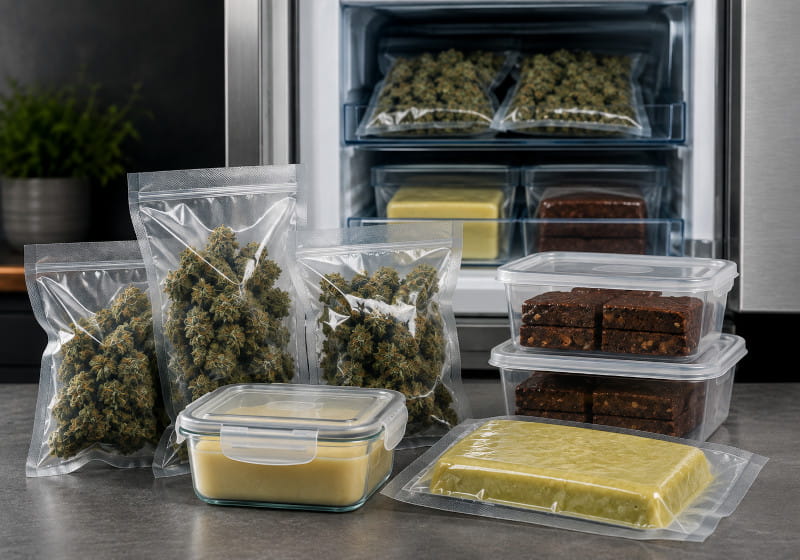
✓ Freezing can extend the shelf life of various cannabis products, but it is not equally suitable for every form. For prepared foods such as cannabis butter or brownies, freezer storage is generally easier than for dried buds.
✓ With cannabis buds, residual moisture, oxygen exposure and condensation are the main factors determining quality after storage. Before freezing, the buds should be fully dried and packaged as airtight and moisture-tight as possible.
✓ Low temperatures slow many chemical and microbiological processes, but they do not sterilize the material. Microorganisms can survive freezing and may become active again under suitable conditions after thawing.
✓ Vacuum sealing can reduce exposure to oxygen and moisture, but sensitive buds should not be compressed unnecessarily. A frozen, airtight container should also only be opened after its contents have largely adjusted to room temperature.
✓ Cannabis butter and cannabis brownies can be frozen well in portions. How well flavor, texture and quality are preserved after thawing depends especially on the recipe, packaging, storage duration and a temperature that remains as constant as possible.
Freezing cannabis can significantly slow aging and spoilage processes, but it is not equally useful for every cannabis product. Dried buds have different requirements for packaging, temperature and thawing than cannabis butter, brownies or other prepared foods. The key factor is therefore not low temperature alone, but above all what material is being stored and how well it is protected from moisture, oxygen and temperature fluctuations.
For quality, it is not only THC, CBD, CBG or THCV that matter. Terpenes and trichomes can also be affected by storage conditions. At the same time, residual moisture, oxygen exposure, packaging and, in the case of foods, hygiene all play an important role.
Thawing later requires particular attention. If a frozen package is opened too early, moisture from the warmer ambient air can condense on the still-cold contents. With cannabis buds this is especially undesirable because additional moisture can impair storage stability. This is why the appropriate procedures for freezing marijuana, beim vacuum sealing and freezing cannabis as well as freezing cannabis butter and cannabis brownies differ considerably.
Can You Freeze Cannabis?
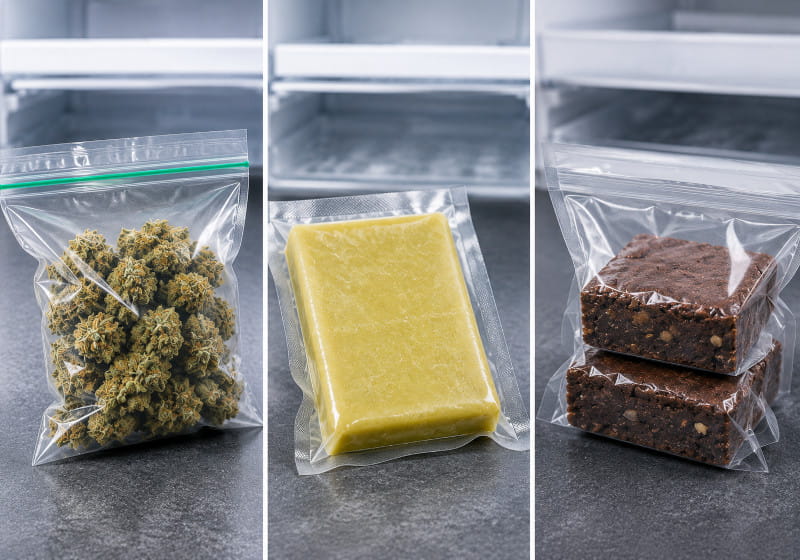
Yes, cannabis can be frozen, but for dried buds the freezer is more of a long-term storage option than the best standard solution for quantities used regularly.
Low temperatures slow many chemical and biological processes and inhibit the growth of many microorganisms. However, freezing does not sterilize plant material. Microorganisms can partially survive low temperatures and become active again under suitable conditions after thawing.
For cannabis, this means that cold can slow aging and degradation processes, but it cannot restore damp or already microbiologically contaminated plant material to good condition. Cannabis should therefore only be frozen when it is sufficiently dry and suitable for storage. Visible mold, musty odors or problematic residual moisture cannot be eliminated by freezing.
For the basic freezing procedure, it does not make any decisive difference whether the buds come, for example, from autoflower strains, classic outdoor genetics or CBD-rich strains . More important are the actual level of dryness, the structure of the buds, their residual moisture and suitable airtight and moisture-tight packaging.
Even with proper storage there is one special point to consider with dried buds: at low temperatures, the resin-rich trichomes become more brittle and can break off more easily under mechanical stress. Frozen buds should therefore be moved, squeezed or transferred as little as possible. For shorter storage periods, a cool, dark and low-air environment is often the gentler and more practical solution, while freezing is mainly suitable for longer-term storage that remains as undisturbed as possible.
What Happens to Cannabis When It Is Frozen?
During freezing, molecular movement, microbial activity and many chemical reactions slow dramatically, while existing water freezes and the structure of the buds can become more mechanically sensitive.
How freezing affects plant material depends largely on its water content. Fresh cannabis contains comparatively large amounts of water; when it freezes, ice crystals can form and mechanically damage cell structures. In fully dried and properly cured buds the water content is considerably lower. Even so, residual moisture and especially the formation of condensation during later thawing remain important factors for stable storage.
For cannabinoids, low temperatures are generally more favorable than heat. Studies on the storage stability of cannabis and cannabinoid-containing samples repeatedly show that lower temperatures can slow degradation. However, this does not provide a blanket shelf-life guarantee for a particular bud in a household freezer: plant material, extracts and biological laboratory samples are different matrices.
Also terpenes deserve attention. They are volatile aromatic compounds and are sensitive to heat, oxygen and repeated opening. Cold can reduce their volatility, but poor packaging can still lead to loss of aroma, foreign odors or drying out.
Is Freezing Marijuana Better Than Normal Storage?
For already dried buds, freezing is not inherently the best storage method. For long-term storage that remains as undisturbed as possible, however, a consistently low temperature can offer advantages under suitable conditions.
For short- and medium-term storage, controlled storage is often sufficient. A clean, airtight container kept in a dark, cool and temperature-stable place reduces the impact of important aging factors such as light, heat, oxygen and unfavorable moisture. It also avoids the temperature changes and associated condensation risk that can occur when frozen buds are repeatedly removed from the freezer.
These basic rules apply regardless of the genetics. Buds from different cannabis strains and genetics may vary in structure, density and aroma profile, but the key storage factors remain dryness, moisture, packaging, temperature and oxygen exposure.
For long-term storage, freezing may be more useful because low temperatures slow many chemical and biological processes. The buds should be fully dried, packaged airtight and moisture-tight, and preferably divided into individual portions. Repeated thawing and refreezing should be avoided because temperature fluctuations, condensation and additional mechanical stress can increasingly negate the advantages of freezer storage.
| Storage | Strength | Weakness | Suitable for |
|---|---|---|---|
| Cool, dark, airtight | Simple, few temperature fluctuations | Aging continues slowly | Buds for regular use |
| Refrigerator | Lower temperature | Moisture, odors and condensation possible | Only well-packaged special cases |
| Freezer | Very low temperature, reactions greatly slowed | Condensation, brittle trichomes, temperature shocks | Portioned long-term storage |
| Freezer + vacuum | Little oxygen and little air exchange | Compression can damage buds | Well-dried portions that are rarely opened |
Can You Freeze Cannabis Buds?
You can freeze cannabis buds if they are clean, sufficiently dried and airtight; however, once the buds are ready for use, freezing should be interrupted as rarely as possible.
The biggest mistake is freezing buds that are still damp. Freezing does not remove water. After thawing, it is still present. If the buds then sit warm and damp in a closed container, favorable conditions for microbial growth can develop.
Very loose packaging is also unfavorable. Air contains moisture and oxygen. In addition, dry freezer air can draw water out of the product if the packaging is unsuitable. With food, this type of superficial dehydration damage is known as freezer burn. With cannabis, it is primarily a quality issue: aroma and texture can suffer.
How Do You Freeze Dried Cannabis Buds Properly?
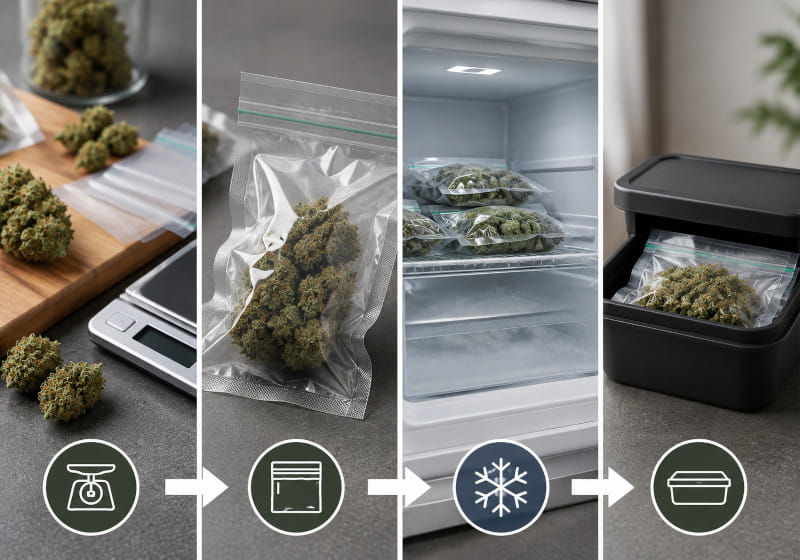
The gentlest way to freeze dried cannabis buds is in small, airtight portions that are protected from moisture, foreign odors, oxygen and mechanical pressure.
-
Check the condition: Use only dry, properly cured buds with no unusual odor.
-
Portion: Divide the amount so that each package ideally needs to be thawed only once later.
-
Pack airtight: Use freezer-safe containers or bags with as little trapped air as possible.
-
Protect from pressure: Do not tightly compress delicate buds.
-
Label: Note the strain, date and contents so packages do not need to be opened unnecessarily.
-
Keep consistently frozen: For frozen foods, around −18 °C is the usual reference temperature.
-
Let it warm while sealed: When removing it, initially keep the package closed until it has warmed considerably.
Handling the buds after removal from the freezer is especially important. If a still-frozen package is opened immediately in warm room air, moisture from the surrounding air can condense on the cold buds. Therefore, keep the airtight container closed until its contents have largely adjusted to room temperature. Only then should the package be opened to minimize the risk of condensation on the plant material.
Can You Vacuum-Seal and Freeze Cannabis?
Yes, vacuum-sealing and freezing cannabis can be useful for longer-term storage if the material is dry and the vacuum does not strongly compress the buds.
Vacuum packaging reduces the amount of air in the package. This is useful in principle because oxygen is involved in aging reactions, and less air also transports less moisture. With ordinary foods, suitable low-air packaging likewise improves protection against dehydration and freezer burn.
With cannabis, however, there is a trade-off: a strong vacuum can compress dense buds and mechanically damage them. For high-quality buds, a protected inner package or rigid container is therefore preferable to maximum negative pressure directly on the plant material.
Vacuum sealing also does not replace proper drying. If cannabis that is too moist is enclosed with little air and frozen, that moisture remains in the system. After thawing, this can become a problem.
What Packaging Is Suitable for Freezing Cannabis?
Suitable freezer packaging for cannabis should be as airtight, moisture-resistant, odor-neutral and mechanically stable as possible.
| Packaging | Advantages | Disadvantages | Assessment |
|---|---|---|---|
| Sturdy glass jar with tight lid | Odor-neutral, protects against pressure | Contains more air, can break | Good for small portions with additional outer protection |
| Freezer-safe vacuum bag | Very little air, space-saving | Can compress buds | Good if pressure is controlled |
| Rigid freezer-safe container | Protects bud structure | More residual air | Good practical solution |
| Thin household bag | Easy to obtain | Weak protection against air and aroma loss | Less suitable for long-term storage |
| Paper | Breathable | Insufficient moisture or air protection | Not suitable as the sole freezer packaging |
How Do You Prevent Condensation During Thawing?
The main way to prevent condensation is to keep the frozen package closed while it warms up and only open it afterward.
Warm air can hold more water vapor than cold air. When humid room air meets a very cold surface, water can condense. This is exactly why cold bottles fog up in summer. With cannabis, you want to avoid this effect directly on the buds as much as possible.
Therefore, only remove the portion you actually need. Let it warm up while still sealed. Depending on the size of the container, this can take considerably longer than just a few minutes. The package should only be opened once the container and contents are no longer ice-cold.
Also avoid repeated partial thawing and refreezing. With food, repeated freezing can reduce quality through moisture loss and structural changes. With cannabis, the sensitive trichomes and aromatic compounds are additional concerns.
Does THC Break Down When Frozen?
Normal freezer temperatures do not suddenly destroy THC; instead, low temperatures can slow chemical degradation processes without stopping them completely.
Cannabinoids are not indefinitely stable. Light, oxygen, heat and time affect their composition. Studies on dried hemp flowers and investigations into cannabinoid stability in different samples show that storage temperature plays an important role and that lower temperatures are often more favorable for stability.
Correct interpretation is important: a laboratory result for an extract, blood or plasma cannot be transferred one-to-one to a cannabis bud. What can safely be said, however, is that the freezer does not 'freeze away' THC. Practical quality losses are more likely to result from poor packaging, air exposure, condensation, mechanical damage or long storage periods.
What Happens to Terpenes in the Freezer?
Terpenes evaporate more slowly at low temperatures, but they can still be lost or altered through oxygen, poor packaging and frequent temperature changes.
What Happens to Terpenes in the Freezer?
Terpenes evaporate more slowly at low temperatures, but they can still be lost or altered through oxygen, poor packaging and frequent temperature changes.
Terpenes are volatile organic compounds and are responsible for a significant part of the strain-specific aroma of cannabis. Cool storage reduces their volatility, but protection only works as a complete system. Products in the Terpenes and CBD category also require appropriate storage and protection from heat, light and unnecessary air exposure. A poorly sealed bag in the freezer is therefore not automatically better for aroma than a tight container in a cool, dark place.
Frequent opening is particularly unfavorable. Each time, new air and moisture enter the package while aromatic compounds can escape. Small individual portions therefore also make sense from a terpene-preservation perspective.
Frequent opening is particularly unfavorable. Each time, new air and moisture enter the package while aromatic compounds can escape. Small individual portions therefore also make sense from a terpene-preservation perspective.
Are Trichomes Damaged by Freezing?
Frozen trichomes become more brittle and can break off more easily through friction, which is why frozen cannabis buds should be moved as little as possible.
This effect is even deliberately used in certain processing methods to mechanically separate resin glands from the plant material. For storing whole buds, however, this is undesirable. You should therefore avoid shaking, squeezing and frequent transferring.
A rigid container can protect the buds better than a close-fitting bag. If you vacuum-seal them, the negative pressure should not be stronger than necessary.
Can Freezing Prevent Mold on Cannabis?
Freezing inhibits mold growth, but it does not reliably eliminate existing molds or their possible metabolic products.
At freezing temperatures, microorganisms cannot reproduce under the same conditions as in a warmer and more humid environment. However, this does not mean that already contaminated cannabis becomes safe again through freezing. Bacteria, yeasts and molds can partially survive low temperatures and become active again under suitable conditions after thawing.
If cannabis smells musty before freezing, shows visible fuzz or is unusually damp, it should not be 'rescued' by freezing. This also applies to plant material that already shows signs of fungal infestation such as powdery mildew on cannabis . Such problems must be identified and assessed before storage—low temperatures do not restore affected plant material to good condition.
Can You Freeze Fresh Cannabis Immediately After Harvest?
Fresh cannabis can be frozen immediately after harvest, but this is a different process from storing ready-to-use dried buds.
Freshly harvested plant material contains a lot of water. During freezing, ice crystals form and the cell structure changes. Such material is mainly frozen when it is intended for certain processing methods afterward. Once thawed, it does not behave like normally dried and cured cannabis.
If your goal is classic dried buds, direct freezing replaces neither drying nor curing. For normal bud storage, you should therefore clearly distinguish between 'fresh frozen' and 'fully dried then frozen'.
How Long Can You Freeze Cannabis?
There is no scientifically defensible universal maximum freezing duration for cannabis buds because strain, moisture, packaging, oxygen, temperature stability and starting quality all strongly affect shelf life.
With ordinary foods, freezing recommendations often refer to quality rather than meaning that the product automatically becomes unsafe after a certain date. With cannabis too, it makes more sense to think in terms of quality factors than a magic number of months.
The longer the planned storage period, the more important a constant temperature, very good packaging, small portions and little oxygen become. A package stored undisturbed for years at a stable temperature is a completely different case from one that is removed from the freezer every week.
Can You Freeze Cannabis Butter?
Yes, cannabis butter freezes well and can therefore be stored for a longer period. It is best packaged airtight and already divided into suitable portions.
Butter is generally suitable for freezer storage. With cannabis butter, a temperature that remains as constant as possible and protection from light, oxygen and foreign odors are also important. Freezing individual portions is particularly practical because only the amount actually needed later has to be thawed.
Freezer-safe containers with tight-fitting lids or carefully prepared packaging with as little air as possible are suitable. Small portions can also be wrapped separately before freezing. Clear labeling is especially important so cannabis butter is not confused with ordinary butter or other foods. It should also be stored securely and out of reach of children and pets.
The refrigerator is suitable for thawing because the temperature rises in a controlled and gradual way. If you only need part of the frozen cannabis butter, ideally remove only that portion. Repeatedly thawing and refreezing the entire amount should be avoided because this can affect texture and quality.
What Is the Best Way to Freeze Cannabis Butter?
Cannabis butter is best frozen cooled, portioned, airtight and clearly labeled.
-
Cool completely: Do not put warm butter directly into a closed freezer container.
-
Portion: Prepare amounts that match your usual recipes.
-
Pack airtight: Limit odor transfer and drying out.
-
Label: Clearly state the contents, preparation date and portion size.
-
Store safely: Keep it distinguishable from ordinary food and out of reach of children.
Can You Freeze Cannabis Brownies?
Yes, cannabis brownies generally freeze well. Airtight packaging and freezing individual portions help preserve texture, flavor and quality as well as possible.
How well cannabis brownies tolerate freezer storage depends mainly on their recipe, moisture content and packaging. Pieces packaged as airtight as possible are better protected from drying out, freezer burn and foreign odors. If the brownies are portioned before freezing, you can later remove exactly the amount needed without having to thaw the entire supply.
Freshly baked cannabis brownies should cool completely before packaging. They can then be packaged individually or in small portions as airtight as possible and frozen. With soft or sticky brownies, baking paper between the individual pieces can prevent them from freezing together during storage.
Toppings and fillings require additional attention. If the brownies contain cream, cream cheese or other highly perishable ingredients, storage and thawing must also follow the requirements of those components. Depending on the recipe, texture can also change more after freezing and thawing than with plain brownies without sensitive fillings or toppings.
How Do You Thaw Cannabis Brownies Properly?
Cannabis brownies should preferably be thawed in portions and according to their recipe. If they contain highly perishable fillings or toppings, thawing in the refrigerator is the safer option.
Plain brownies without sensitive fillings can, depending on the recipe, also thaw at room temperature in their closed packaging. The packaging should initially remain closed so moisture from the surrounding air does not immediately condense on the still-cold baked goods while unnecessary drying is also avoided.
For food safety, the ingredients used, hygienic preparation and the conditions before freezing are especially important. If cannabis brownies contain cream, cream cheese or other highly perishable components, they should be thawed under refrigeration. Freezing slows spoilage processes but does not make food that was already spoiled safe again.
Is the Effect of Cannabis Brownies Preserved After Freezing?
Proper freezing does not cause the cannabinoids contained in cannabis brownies to disappear immediately. How stable they remain during longer storage depends, among other things, on temperature, oxygen exposure, light, storage duration and the composition of the food.
Cannabinoids can change or degrade over time under unfavorable storage conditions. High temperatures, light and oxygen promote such processes more strongly than a consistently low freezer temperature. Even so, no universal percentage can be given for homemade cannabis brownies to show how much THC or other cannabinoids remain after a certain period in the freezer. Reliable determination would require appropriate laboratory analysis.
For storage that is as stable as possible, cannabis brownies should therefore be packaged airtight, kept consistently frozen and protected from unnecessary temperature changes. Flavor, smell or storage duration do not provide a reliable indication of the actual cannabinoid content. The perceived effect of edibles can also vary considerably from person to person and cannot be reliably inferred from these factors.
What Other Cannabis Foods Can Be Frozen?
Many cannabis-infused foods can be frozen provided the underlying food itself is suitable for freezing.
| Product | Freezing | Important |
|---|---|---|
| Cannabis butter | Well suited | Portion, package airtight |
| Cannabis brownies | Usually well suited | Wrap individually, consider toppings |
| Cookies | Usually well suited | Protect from freezer burn |
| Cake without sensitive cream | Often suitable | Consider recipe-dependent texture |
| Products with cream or creamy filling | Depends on the recipe | Pay particular attention to food safety and texture |
| Oil-based preparations | Product-dependent | Use a suitable container and maintain temperature stability |
What Temperature Is Suitable for Freezing?
For normal freezer storage at home, around −18 °C is the established reference temperature; in everyday use, maintaining a temperature that is as constant as possible is more important than going even colder.
U.S. food safety authorities recommend 0 °F, or about −17.8 °C, for freezers. This recommendation applies to food, but it provides a useful technical reference for cannabis butter and brownies. With buds, protecting the delicate plant structure is an additional concern.
A small freezer compartment that is opened frequently and experiences strong temperature fluctuations is less suitable for long storage periods than a stable freezer. Avoid storing packages directly in areas where they regularly begin to thaw.
Is Freezer Burn a Problem for Cannabis?
Freezer burn is primarily a quality issue caused by dehydration and air exposure; with cannabis, inadequate packaging can therefore impair aroma, texture and outward quality.
With food, freezer burn occurs when water is lost from surface areas and air reaches the product. The USDA does not automatically consider freezer burn a safety problem, but primarily a loss of quality.
There is no standardized diagnosis of 'cannabis freezer burn' for buds as there is with meat. The underlying principle is still relevant: air-permeable packaging and long freezer storage can dry out the material. Tight packaging and small portions reduce this risk.
Can Thawed Cannabis Be Refrozen?
Repeated freezing should be avoided with cannabis buds whenever possible because each temperature change can promote condensation, mechanical stress and quality loss.
With food, refreezing can be possible under certain hygienic conditions, although quality may suffer. For cannabis buds, the better practical strategy is to prevent the issue in the first place: package them in portions before the initial freezing.
If a package has fully thawed and been opened, treat it afterward as a normal storage portion. Check it for moisture and unusual odors and avoid unnecessary further freeze-thaw cycles.
What Are the Most Common Mistakes When Freezing Cannabis?
The most common mistakes are starting with material that is too moist, using poor packaging, making portions too large, applying excessive vacuum, opening the package immediately while frozen and repeatedly thawing it.
-
Freezing damp buds: Freezing does not remove the moisture.
-
Using only a thin bag: Air, foreign odors and drying out are controlled less effectively.
-
Putting everything in one large package: Every removal warms the entire batch.
-
Vacuum-sealing buds as tightly as possible: Strong pressure can damage buds and trichomes.
-
Opening a cold package immediately: Humid room air can condense on cold surfaces.
-
Trying to save moldy cannabis by freezing: Freezing does not sterilize cannabis.
-
Failing to label edibles: Cannabis foods must be clearly distinguishable from ordinary foods.
When Is It Better Not to Freeze Cannabis?
It is better not to freeze cannabis if the buds are still damp or unstable, if you would need to open the package constantly or if no truly airtight freezer packaging is available.
For a small amount that you will use within a manageable period, the freezer is often unnecessarily complicated. Good normal storage avoids condensation risks and mechanical stress. Even after curing, cannabis should not be frozen prematurely just because cold theoretically slows aging.
For cannabis butter, brownies and other foods, by contrast, freezing is often very practical. Here, portioning, food hygiene and protection from drying out are the main priorities.
How Do Buds, Butter and Brownies Differ When Frozen?
Buds are particularly sensitive because of their trichomes, residual moisture and condensation, whereas with cannabis butter and brownies the usual rules for frozen foods are more important.
| Product | Main goal | Biggest risk | Best strategy |
|---|---|---|---|
| Dried cannabis buds | Slow aging | Condensation and mechanical trichome loss | Small airtight portions, let warm while sealed |
| Fresh cannabis buds | Preserve starting material for special processing | Ice crystals and cell damage | Freeze only if this exact use is intended |
| Cannabis butter | Store portions for longer | Foreign odors and quality loss | Freeze portioned and airtight |
| Cannabis brownies | Preserve baked goods | Drying out and unsuitable fillings | Wrap individually and thaw according to the recipe |
What Checklist Helps Before Freezing?
Before freezing, you should determine the condition, moisture level, portioning, packaging, labeling, freezer temperature and later thawing procedure.
-
Are the cannabis buds fully dried and stably cured?
-
Is there no musty odor, mold or unusual moisture at all?
-
Is each portion small enough to be thawed only once?
-
Is the packaging freezer-safe, tight and odor-neutral?
-
Are the buds protected from strong pressure?
-
Are cannabis butter or edibles clearly labeled?
-
Does the freezer operate steadily at around −18 °C?
-
Can the package later warm up while closed before you open it?
What Terms Should You Know When Freezing Cannabis?
Important terms include freezing temperature, condensation, freezer burn, vacuum sealing, oxidation, residual moisture, trichomes, terpenes and temperature fluctuation.
Condensation is the formation of liquid water from water vapor on a cold surface. Freezer burn describes dry quality changes caused by water loss in frozen foods. Vacuum sealing reduces the amount of air in a package. Oxidation includes chemical reactions with oxygen.
Residual moisture is the water that remains even in dried buds. Trichomes are the resin-bearing surface structures of the flower. Terpenes account for a large part of the aroma. Temperature fluctuations are repeated changes between colder and less-cold conditions and should be kept as small as possible during longer storage.
What Does Research Say About Cold Storage of Cannabis?
Available research suggests that temperature, light, oxygen, packaging and storage duration affect cannabinoid stability and that lower temperatures can slow many degradation processes.
A study published in 2024 on dried hemp flowers compared different storage conditions and explicitly examined temperature, light, time and packaging material as factors affecting cannabinoid stability. Other studies on cannabinoid stability likewise show advantages of lower temperatures, but some concern extracts or biological samples and therefore should not be read directly as shelf-life studies for ready-to-use buds.
For practical use, the conclusion is straightforward: cold is an effective factor against rapid aging, but it is not a substitute for dry starting material, suitable packaging and controlled thawing. Established food-safety rules also apply to cannabis foods.
Which Sources Are Helpful for Freezing Cannabis?
Studies on the storage stability of dried cannabis as well as official information on freezer storage and food safety are particularly helpful.
- Effect of short-term storage on cannabinoid content of dried floral hemp (Cannabis sativa L.) inflorescence
- Effects of the Storage Conditions on the Stability of Natural and Synthetic Cannabis in Biological Matrices
- In Vitro Stability of Free and Glucuronidated Cannabinoids in Blood and Plasma
- USDA: Freezing and Food Safety
- FoodSafety.gov: Cold Food Storage Chart
FAQs
Q: Can You Freeze Marijuana?
A: Yes. For dried buds, it is mainly an option for longer storage that remains as undisturbed as possible. The buds should be dry, clean and packaged airtight.
Q: Can You Freeze Cannabis Buds?
A: Yes, but they should already be properly dried and cured before freezing. Freezing replaces neither drying nor curing.
Q: Is Vacuum-Sealing and Freezing Cannabis Useful?
A: For long-term storage, the combination can be useful because less air remains in the package. However, the vacuum should not strongly compress the buds.
Q: Does Cannabis Need to Be Dry Before Freezing?
A: Dried buds should be stable for storage. Excessive residual moisture is not removed by freezing and can become problematic after thawing.
Q: How Do You Thaw Frozen Cannabis Buds?
A: It is best to let the airtight package warm up while still closed and only open it once it is no longer ice-cold. This reduces condensation from warm room air.
Q: Does Cannabis Lose THC Through Freezing?
A: Normal freezer temperatures do not suddenly destroy THC. Low temperatures can slow degradation processes, while long storage periods, oxygen and poor packaging continue to play a role.
Q: Can You Freeze Cannabis Butter?
A: Yes. Cannabis butter freezes well when portioned and packaged airtight.
Q: Can You Freeze Cannabis Brownies?
A: Yes. Fully cooled brownies can be individually wrapped and frozen. Sensitive fillings or toppings require additional rules for the particular food.
Q: How Cold Should the Freezer Be?
A: Around −18 °C is the usual reference for normal freezer storage. A constant temperature is particularly important.
Q: Does Freezing Kill Mold?
A: You should not rely on it. Freezing inhibits microbial growth but does not reliably sterilize contaminated material.
Q: Can You Freeze Fresh Cannabis Buds?
A: Yes, for certain processing purposes. Fresh-frozen buds are not the same as dried and cured buds, however, and they do not thaw back into conventionally ready-to-use buds.
Q: Can I Refreeze Cannabis After Thawing?
A: With buds, repeated freeze-thaw cycles should be avoided whenever possible. Portioning before the initial freezing is the better solution.
Q: Why Should the Package Stay Closed While Thawing?
A: This allows less warm, humid room air to reach the cold buds directly during temperature equalization and reduces the risk of condensation.
Q: Is a Normal Freezer Bag Sufficient?
A: For short-term storage it can work, but for long storage periods, truly airtight freezer-safe packaging and, if necessary, an additional protective container are better.
Q: Can Cannabis Be Frozen and Stored Everywhere?
A: No. Possession, processing and storage of cannabis are subject to the legal rules where you are located. Check the regulations currently in force.
Which Method Is Right for Your Cannabis?
For cannabis buds, cool, dark and airtight storage is the straightforward baseline, while freezing becomes especially interesting for longer, portioned storage; cannabis butter and brownies, by contrast, are very well suited to the freezer.
Low temperature alone is not what matters; the entire storage chain is decisive. Dry starting material, little air, suitable packaging, constant temperature and slow temperature equalization before opening all work together. If you follow these points, you avoid the typical problems of condensation, drying out and unnecessary freeze-thaw cycles.
With cannabis foods, standard food safety also applies. Freezing preserves but does not sterilize. Clean preparation, rapid cooling, clear labeling and safe storage therefore remain important even in the freezer.