Caterpillars on Cannabis: Identify Damage
Recognize caterpillars on cannabis, stop feeding damage and protect plants
Updated: August 2026 | Learn how to recognize caterpillars on cannabis, what feeding damage they can cause to leaves, shoots and flowers, and how to protect your outdoor plants effectively.
Author: Cannapot Grow Team | Reading time: approximately twenty-five minutes
The most important points at a glance
✓ Caterpillars can cause very different types of feeding damage on cannabis plants. Typical signs include irregular holes in the leaves, chewed leaf edges and missing plant tissue. Depending on the caterpillar species, young shoots, stems or flowers may also be affected.
✓ Holes in cannabis leaves alone do not prove a caterpillar infestation. Snails, slugs, beetles and other animals can cause similar damage. Visible larvae, droppings, feeding marks without slime trails, and rolled or webbed leaves are much stronger indicators of caterpillars.
✓ Caterpillar droppings are an important diagnostic sign. Dark to greenish-black pellets beneath chewed leaves, at branch junctions or inside dense flowers can indicate that a caterpillar is hiding nearby.
✓ You should be especially attentive during flowering. Caterpillars can hide between dense plant material and damage flower tissue there. Droppings, dead plant material and damaged tissue can also create conditions in which rot develops more easily.
✓ When only a few caterpillars are present, regular inspection and hand-picking is often the simplest measure. Check not only the upper surfaces of the leaves, but especially the undersides, shoot tips, branch junctions and dense flower areas.
✓ Biological preparations containing Bacillus thuringiensis can be effective against certain young butterfly and moth caterpillars. Whether a specific product may be used on cannabis or on the respective crop depends on its authorization in the relevant country and the product instructions.
✓ Outdoors, regular inspections and natural enemies help keep caterpillar populations low. Birds, predatory insects, and various parasitoid wasps and flies are among the natural enemies of many caterpillar species.
Suddenly, holes appear in the cannabis leaves, individual leaf edges are missing, or a plant looks as though someone has bitten out small pieces. Especially when growing outdoors this type of damage is not uncommon. One possible cause is caterpillars – the larvae of butterflies and moths, various species of which may feed on leaves, shoots or other parts of the plant.
Before taking action against caterpillars, however, you should identify the cause as reliably as possible. Not every hole in a cannabis leaf is caused by a caterpillar. Snails and slugs in particular can leave very similar feeding damage. Accompanying signs such as caterpillar droppings, slime trails, eggs, rolled leaves or visible animals are therefore much more important for diagnosis than a single hole.
How can you recognize caterpillars on cannabis?
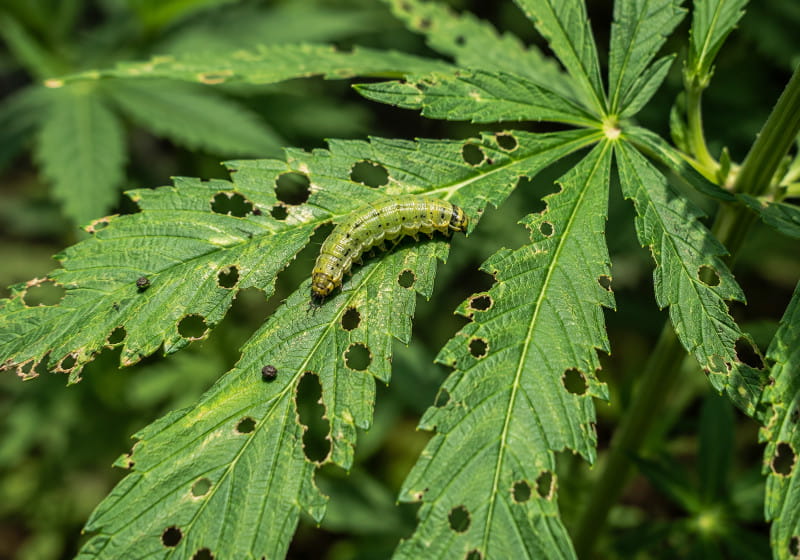
Typical signs of caterpillars include irregular feeding holes, chewed leaf edges, dark droppings, and visible larvae or eggs. Some caterpillars sit openly on the leaves, while others hide on leaf undersides, between young shoots, in rolled leaves or inside dense flowers.
Holes and feeding marks in cannabis leaves
Caterpillars have chewing mouthparts. Instead of sucking plant sap from individual cells, they actually remove leaf tissue. This creates holes, irregularly eaten-out areas or missing pieces along the leaf edge. With small caterpillars, the first feeding marks may initially be inconspicuous. Larger caterpillars can remove considerably more leaf area within a short period of time.
The extent of the damage depends greatly on the caterpillar species, size, number of animals and stage of plant development. A vigorous outdoor plant can usually tolerate a few damaged leaves well. The same feeding damage can have much greater effects on seedlings, small plants or young shoot tips.
Caterpillar droppings as an important diagnostic sign
A particularly useful indication of a caterpillar infestation is caterpillar droppings. Depending on the size of the caterpillar, they may look like tiny dark dots or clearly visible greenish-brown to black pellets. If you find such droppings beneath fresh feeding marks, you should inspect the surrounding leaves and shoots especially carefully for caterpillars.
Droppings can also be an important clue with stem-boring caterpillars. The European corn borer can, for example, enter stems and shoots. Small bore holes, damaged plant tissue and caterpillar droppings may be visible at the entry points, while the caterpillar itself may already be hidden inside the stem.
Eggs and hidden caterpillars
Many butterflies and moths lay their eggs directly on suitable host plants. Depending on the species, the eggs may occur singly or in groups on the leaves, often in protected places or on the undersides. After hatching, the young caterpillars usually begin feeding in the immediate vicinity, so the first small feeding marks may appear.
Some caterpillars are difficult to spot on cannabis plants. Green individuals in particular can be excellently camouflaged among the leaves. Other species hide in leaf folds, roll up leaves or join plant material with fine webbing to create a protected feeding site. If you notice suspicious feeding marks, you should therefore inspect not only the visible upper leaf surfaces but also the undersides, shoots and protected areas of the plant.
| Feature | What suggests caterpillars? | How to check |
| Irregular holes | Typical feeding marks caused by chewing mouthparts | Inspect the upper and lower leaf surfaces as well as neighboring shoots |
| Dark droppings | Strong indication of a feeding caterpillar nearby | Carefully inspect plant parts directly above and around the droppings |
| Rolled or webbed leaves | Certain caterpillars use such areas as protected feeding and hiding places | Carefully open the leaves and look for caterpillars, droppings, webbing or feeding marks |
| No slime trails | If feeding holes are present, this points more against snails as the cause | Nevertheless check leaves, pot and soil for silvery, shiny slime trails |
What damage do caterpillars cause to cannabis?
Caterpillars can damage more than just the leaves of cannabis. Depending on the species, young shoots, stems and flowers may also be affected. An infestation becomes particularly problematic when sensitive young plants are heavily defoliated or caterpillars feed hidden inside dense plant material during flowering.
Feeding damage to leaves
Leaf feeding is the most common visible symptom. A few small holes do not normally pose an immediate threat to a large, healthy plant. It becomes problematic when many caterpillars occur at the same time, new plant tissue is constantly damaged, or the animals specifically feed on young growth.
Damage to seedlings and young plants
Seedlings and young cannabis plants are particularly sensitive to caterpillar feeding because they have only a few leaves and therefore little leaf area. If larger portions are eaten within a short time, the plant loses a significant amount of the surface area needed for photosynthesis. This can slow growth and significantly impair further development.
Damage to the young growing tip is particularly problematic. While a larger and already strongly branched cannabis plant can usually compensate well for isolated feeding damage, heavily chewed seedlings or young plants can be set back considerably. Plants that have only recently been placed outdoors should therefore be checked regularly for new feeding marks.
Caterpillars in stems and shoots
Not all caterpillars feed visibly on the leaves. Some species can bore into stems or stronger shoots and continue feeding there while hidden. One species relevant to cannabis is the European corn borer (Ostrinia nubilalis). Its larvae can enter the plant tissue and damage vascular and supporting tissue in the process.
Possible signs include small entry or bore holes, caterpillar droppings at the affected areas, weakened stems, and shoots or upper plant parts that suddenly wilt. With more severe damage, the stem may lose stability and break at the feeding site. Because the caterpillar can be hidden inside, it is not always immediately visible from the outside.
The fact that the European corn borer can actually infest Cannabis sativa has also been scientifically documented. A study of industrial hemp in Estonia described, among other things, entry holes, caterpillar droppings, dead plant tissue and stems that partially broke. Caterpillar damage on cannabis can therefore differ considerably from ordinary feeding holes in leaves.
Caterpillars during cannabis flowering
During the flowering phase you should take feeding marks particularly seriously. Dense plant material offers small caterpillars many hiding places. If parts of the flowers are injured, dead or damaged areas develop where rot may additionally form under high humidity. Caterpillar droppings inside a dense flower are also undesirable and make inspection more difficult.
Which caterpillars can infest cannabis?
There is no single typical “cannabis caterpillar.” Different butterfly and moth species can use cannabis as a food plant. Which caterpillars actually occur depends, among other things, on the region, season, surroundings and available host plants. Accordingly, the feeding pattern and the animals’ location can also differ considerably.
Leaf-feeding caterpillars
Many caterpillar species feed mainly on the leaves. The damage ranges from individual small feeding holes and chewed leaf edges to larger areas where leaf tissue is clearly missing. With a heavier infestation, several feeding sites may merge and damage larger portions of a leaf.
Some caterpillars sit openly on the leaves and are relatively easy to spot. Others prefer leaf undersides, areas between young shoots or the inside of dense plant parts. Green caterpillars in particular can be excellently camouflaged among cannabis leaves. Dark droppings near fresh feeding marks can therefore help when searching.
Owlet moths and ground-dwelling caterpillars
The owlet moth family includes numerous species whose caterpillars feed on herbaceous plants. Some of these so-called cutworms hide during the day in the soil, under plant debris or in other protected places and become active mainly at night.
For cannabis, such caterpillars can be particularly problematic during the early growth phase. They feed close to the ground on leaves, young shoots or stems and can easily be overlooked during a normal daytime inspection. If young plants appear to have been chewed overnight, it is therefore also worth checking the soil and possible hiding places around the plant.
European corn borer on cannabis
The European corn borer (Ostrinia nubilalis) is widespread in Europe and has a broad host range. Cannabis sativa and industrial hemp are among the documented host plants. Unlike typical leaf-feeding caterpillars, its larvae can bore into stems and stronger shoots and continue feeding there while hidden.
This makes the damage pattern clearly different from ordinary leaf feeding. Signs can include small entry or bore holes, caterpillar droppings at the affected areas, suddenly wilting shoots or weakened stems. With more severe damage, the plant tissue can become so unstable that a shoot or stem breaks at the affected area.
Caterpillar or snail – what is eating my cannabis plant?
Caterpillars and snails can leave surprisingly similar feeding damage on cannabis. Both cause irregular holes in the leaves and can noticeably chew leaf edges. To distinguish them reliably, you should therefore not only look at the damaged leaves but specifically search for additional traces. Silvery, shiny slime trails strongly indicate snails or slugs, while dark droppings near fresh feeding marks are a typical sign of caterpillars.
| Feature | Caterpillars | Snails / slugs |
| Irregular holes | Typical | Typical |
| Chewed leaf edges | Common | Very common |
| Slime trails | No | Very typical diagnostic sign |
| Dark droppings | Typical sign near feeding marks | Not a typical diagnostic sign |
| Activity after damp nights | Possible depending on caterpillar species | Very typical |
| Rolled or webbed leaves | Possible with certain caterpillars | Not typical |
| Damage inside stems or shoots | Possible with stem-boring species such as the European corn borer | Not typical |
| Animals visible during the day | Possible depending on species and hiding place | Often not – many slugs hide during the day |
If you find silvery, shiny slime trails on the cannabis leaves, on the pot or on the ground, snails or slugs are much more likely to be the cause. If, on the other hand, you find dark droppings, a caterpillar or typical hiding places such as rolled leaves, this points more toward caterpillar feeding.
If snails are the cause, our detailed guide “Recognizing & controlling snails on cannabis” covers the typical damage patterns as well as suitable protective and control measures.
You can find other possible causes of outdoor feeding damage in our overview of outdoor cannabis pests.
How can you control caterpillars on cannabis?
With a light caterpillar infestation, extensive control measures are usually unnecessary. It is often sufficient to inspect the plants thoroughly, remove visible caterpillars and eggs, and examine heavily damaged plant parts more closely. The key is to react early before the caterpillars develop further or cause additional feeding damage.
Hand-picking caterpillars
With individual or only a few cannabis plants, hand-picking the caterpillars is one of the simplest and most targeted measures. Only the pests that are found are removed, while other insects and natural enemies remain unaffected. Do not inspect only obviously chewed leaves, but also leaf undersides, shoot tips, branch junctions and other protected areas.
Regular follow-up inspections are particularly important. If you find one caterpillar, there may be more animals or unhatched eggs on the same plant. Small caterpillars are also easier to detect and remove before they consume larger amounts of plant tissue or hide in dense vegetation.
Inspect heavily infested plant parts
Rolled, webbed or conspicuously heavily damaged leaves can serve as a hiding place for a caterpillar. Carefully open such areas and check them for caterpillars, eggs, droppings and additional feeding marks. Plant material that is already completely dead or severely damaged can be removed cleanly.
Special attention is required during flowering. If a caterpillar hides between dense flower material, feeding injuries, dead plant tissue and caterpillar droppings may remain behind. Affected areas should therefore also be checked for brown, soft or rotting spots.
Bacillus thuringiensis against caterpillars
Bacillus thuringiensis, abbreviated Bt, is a naturally occurring soil bacterium. Certain strains are used in biological crop protection against the larvae of various butterfly and moth species. Caterpillars ingest the active components when feeding on treated plant parts. Suitable Bt preparations can be effective especially against young caterpillars.
However, Bt is not a universal treatment for all caterpillars or other pests. Its effectiveness depends, among other things, on the bacterial strain used, the caterpillar species and the developmental stage. In addition, biological origin does not automatically mean that every Bt product may be used on cannabis.
The authorization of the specific plant protection product in the respective country, for the crop concerned and for the intended use is always decisive. Therefore, use only appropriately authorized products and follow the application instructions, dosage, waiting periods and all other requirements on the product label.
What natural enemies do caterpillars have?
Caterpillars have numerous natural enemies outdoors. Birds, predatory insects, and various parasitoid wasps and flies can use caterpillars or their eggs as food or hosts. A diverse, natural garden can therefore help limit caterpillar populations naturally.
Among the most important natural enemies are various parasitoid wasps. Depending on the species, they lay their eggs in or on caterpillars or their eggs. The larvae that hatch then develop at the expense of the host. Certain parasitic flies use caterpillars in a similar way.
Predatory bugs, beetles and other insects also eat caterpillars or their eggs. Numerous bird species also deliberately search plants for caterpillars and can capture large quantities of them, especially while raising their young. Which natural enemies actually occur depends greatly on the location of the guerilla grow and the surroundings of the cannabis plants.
How can you prevent caterpillars on outdoor cannabis?
A caterpillar infestation cannot be completely prevented when growing outdoors, because butterflies and moths can arrive at any time and lay their eggs on suitable plants. The most important preventive measure is therefore to detect the first signs as early as possible and remove caterpillars before more extensive feeding damage occurs.
- Inspect plants regularly: Check leaves, leaf undersides, young shoots and branch junctions for eggs, caterpillars, droppings and early feeding marks. During flowering, more densely growing areas should also be inspected.
- Watch for new feeding holes: Fresh holes or suddenly chewed leaf edges are a signal to inspect the affected part of the plant especially carefully. The earlier a caterpillar is found, the less plant tissue it can damage.
- Do not forget leaf undersides: Eggs and small caterpillars can easily be overlooked in protected places. Therefore, carefully lift suspicious leaves and also inspect their undersides.
- Inspect dense flowers: During flowering, you should examine damaged, conspicuously brown or dying areas more closely. Look for caterpillars, feeding marks and droppings.
- Keep an eye on the plants’ surroundings: Different caterpillar species use numerous herbaceous plants as hosts. Heavily infested plants immediately next to the cannabis plants can therefore be an additional source of caterpillars.
- Encourage natural enemies: A diverse garden with suitable habitats for birds and predatory or parasitoid insects supports the natural regulation of caterpillars.
- Monitor young plants especially closely: Seedlings and small cannabis plants have little leaf mass and are less able to compensate for heavy feeding damage. Therefore, inspect them more frequently than already large and vigorous plants.
A particular genetic line does not make cannabis immune to caterpillars. This applies to plants grown from classic cannabis seeds as well as to outdoor seeds, autoflower seeds or CBD seeds. The actual risk of infestation is determined mainly by the location, season, caterpillar species present and the plants’ surroundings.
What mistakes should you avoid with caterpillars?
When visible feeding damage appears, people often act too quickly without clearly identifying the actual culprit. Because caterpillars, snails and other pests can leave similar holes in cannabis leaves, you should first look for additional signs such as caterpillar droppings, slime trails, eggs or visible animals.
| Common mistake | Why it is problematic |
| Automatically attributing every hole to caterpillars | Snails, slugs and other animals can also cause very similar feeding damage. Without further signs, the damage pattern alone is not conclusive. |
| Checking only damaged leaves | The caterpillar may already be hiding on a neighboring leaf, on a shoot, on the underside of a leaf or inside dense plant parts. |
| Ignoring caterpillar droppings | Dark droppings are among the most useful diagnostic signs and can help narrow down the area where a hidden caterpillar is located. |
| Not continuing to inspect after finding one caterpillar | More caterpillars or unhatched eggs may be present on the same plant. Follow-up inspections are therefore important. |
| Inspecting only superficially during flowering | Caterpillars, droppings and damaged plant tissue can remain hidden inside dense flowers. These areas should also be checked for brown or rotting spots. |
| Using unnecessarily broad-spectrum products | Such measures can also affect natural enemies and other beneficial insects. When only a few caterpillars are present, targeted hand-picking is usually the better solution. |
| Using plant protection products without the appropriate authorization | Permitted use depends on the specific product, the crop, the intended application and the legal requirements in the respective country. |
FAQs about caterpillars on cannabis
Q: How can I recognize caterpillars on cannabis?
A: Typical signs include irregular feeding holes, chewed leaf edges, visible caterpillars or eggs and, in particular, dark droppings. Some caterpillars hide on leaf undersides, between shoots, in leaf folds or in rolled or webbed leaves.
Q: Do caterpillars make holes in cannabis leaves?
A: Yes. Caterpillars have chewing mouthparts and actually remove leaf tissue when feeding. This creates small to larger irregular holes and chewed leaf edges. However, holes alone do not prove a caterpillar infestation, because snails, for example, can cause similar feeding damage.
Q: What do caterpillar droppings look like on cannabis?
A: Depending on the caterpillar species and size, the droppings may look like small dark-green, brown or black dots or pellets. If you find such droppings directly beneath fresh feeding marks, you should inspect the leaves and shoots in that area especially carefully.
Q: Can caterpillars severely damage young cannabis plants?
A: Yes. Seedlings and young plants have little leaf mass and are therefore much less able to compensate for heavy feeding damage than large plants. Major losses of leaf area and damage to the young growing tip are particularly problematic.
Q: Can caterpillars damage cannabis flowers?
A: Yes. Certain caterpillars can also hide between dense flower material and feed on plant tissue there. Feeding injuries, dead tissue and caterpillar droppings are particularly problematic during flowering. Damaged or browning areas should therefore also be checked for rot.
Q: What is the difference between caterpillar and snail feeding damage?
A: Both can cause irregular holes and chewed leaf edges. Silvery, shiny slime trails strongly indicate snails or slugs. With caterpillars, dark droppings, visible larvae or eggs, and rolled or webbed leaves are important additional signs.
Q: Can I simply pick caterpillars off the cannabis plant?
A: Yes. With individual or only a few caterpillars, hand-picking is a targeted and usually sensible measure. Continue checking the plant for several days afterward, as additional caterpillars or eggs may still be present on leaves and shoots.
Q: Does Bacillus thuringiensis help against caterpillars?
A: Certain preparations based on Bacillus thuringiensis can be effective against certain butterfly and moth caterpillars, particularly in young larval stages. However, the effect depends, among other things, on the bacterial strain used and the caterpillar species. It is also essential that the specific product is authorized for the intended use and applied according to the instructions.
Q: Are individual caterpillars dangerous for a large cannabis plant?
A: A large and healthy plant can normally tolerate a few chewed leaves well. You should still take action if new feeding marks keep appearing, several caterpillars occur, young shoots are affected, or caterpillars are present inside dense plant material during flowering.
Recognize caterpillars early and remove them selectively
With caterpillars on outdoor cannabis, a reliable diagnosis is more important than acting hastily. Irregular holes and chewed leaf edges are initial signs, but additional traces such as caterpillar droppings, eggs, visible larvae or rolled leaves make a caterpillar infestation much more likely. The earlier you discover the animals, the easier it is to prevent more extensive feeding damage.
You should inspect seedlings and young plants particularly carefully because they tolerate heavy leaf feeding less well. During flowering, damaged or browning areas inside dense flowers also deserve special attention. When only a few caterpillars are present, regular inspection and hand-picking is often sufficient. At the same time, natural enemies can help limit caterpillar populations in the outdoor garden over the long term.
Sources and further information
- University of California Statewide IPM Program: Leaf-Feeding Caterpillars – Identification features, feeding damage, caterpillar droppings, mechanical removal and natural enemies.
- University of California Statewide IPM Program: Foliage-Feeding Caterpillars – Effects of caterpillar feeding on young plants and information on biological control.
- Runno-Paurson et al.: Widespread Occurrence of European Corn Borer and Damage of Industrial Hemp Crop in Northern Europe – Scientific study of European corn borer damage to Cannabis sativa and industrial hemp.
- Federal Office of Consumer Protection and Food Safety: Plant Protection Products Register – Current information on the authorization of plant protection products in Germany.