Leafhoppers on Cannabis: Damage & Control
Leafhoppers on cannabis: harmless visitors or a genuine infestation?
Updated: October 2026 | Leafhoppers on cannabis: species, symptoms, diagnosis, spread, plant diseases and management.
Author: Cannapot Grow Team | Reading time: approximately eighteen minutes
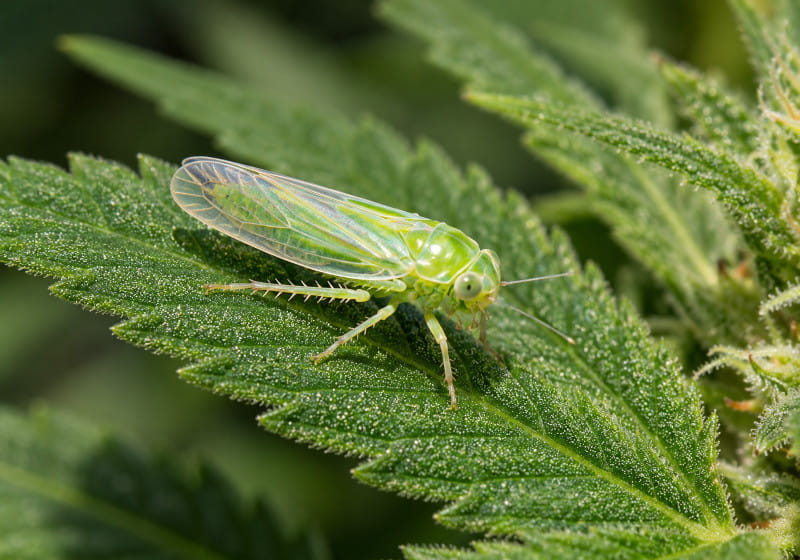
Key takeaways at a glance
✓ Leafhoppers belong to the insect family Cicadellidae and feed on plant fluids. Many species jump away quickly when disturbed or take flight. Not every leafhopper found on a cannabis plant uses it as a host or causes damage.
✓ Typical feeding damage may appear as small pale spots and irregular stippling on leaves. Certain species, including the potato leafhopper Empoasca fabae, may also cause pronounced damage to leaf tips and margins. This condition is known as hopperburn.
✓ Pale leaf spots are not conclusive evidence of leafhoppers. Thrips and spider mites can produce similar symptoms. Reliable identification therefore requires examining the insects, their movement and the overall pattern of damage.
✓ Several leafhopper species have been recorded on cannabis or hemp. Finding individual adults does not necessarily mean that the species reproduces on the plant or establishes a damaging population.
✓ Some leafhopper species can transmit plant pathogens. Beet curly top virus (BCTV) is particularly relevant to cannabis and can be transmitted by the leafhopper Circulifer tenellus, among others. This ability must not be assumed for other leafhopper species.
✓ Outdoors, leafhoppers may move in from nearby crops and surrounding vegetation. Regular inspections, identification as accurately as possible and targeted action are therefore preferable to treating plants hastily after isolated sightings.
A small green insect is sitting on a cannabis leaf. As soon as the leaf moves, it jumps away or takes flight. This behaviour is typical of many leafhoppers. Yet even when the insect has clearly been identified as a leafhopper, its presence does not automatically mean there is a pest infestation. Some species arrive on cannabis plants from surrounding vegetation without settling or reproducing there.
Extra attention is warranted when pale stippling, yellowish patches or changes to leaf tips and margins appear at the same time. However, these signs are not conclusive either. Thrips on cannabis and spider mites can cause comparable damage. A reliable assessment therefore needs to consider the insects' appearance and behaviour alongside the changes observed on the plant.
Studies of hemp show that the leafhopper species present can vary by region and site. While some species are known as plant pests or vectors of particular pathogens, others have merely been recorded on cannabis. A sighting alone proves neither plant damage nor transmission of a plant disease. This guide therefore distinguishes between the mere presence of leafhoppers, demonstrable feeding damage and the particular risks associated with individual species.
What are leafhoppers, and how do they differ from other hoppers?
Leafhoppers belong to the insect order Hemiptera and are traditionally classified within Auchenorrhyncha. This grouping includes numerous insect families with different lifestyles. The leafhoppers (Cicadellidae) are especially species-rich; their members use piercing-sucking mouthparts to take up plant fluids.
The broader group traditionally known as Auchenorrhyncha does not represent a single insect family. Alongside leafhoppers, the broader group includes froghoppers and other related insects. In the context of cannabis, the focus is primarily on leafhoppers of the family Cicadellidae. Several members have been recorded on hemp, and feeding damage or transmission of particular plant diseases has been scientifically documented for some species. However, a species' importance as a pest on other crops cannot simply be transferred to cannabis.
Leafhoppers have piercing mouthparts that penetrate plant tissue to extract fluids. Depending on the species, they feed on different plant tissues. The consequences depend on factors such as the leafhopper species, host plant and infestation level. While some species can cause obvious changes to leaves, even a large number of trapped insects initially tells us little about the actual extent of damage.
Which leafhopper species occur on cannabis?
Various leafhopper species belonging to the family Cicadellidae have been recorded on cannabis or hemp. Their importance as plant pests differs considerably. The key questions are whether a species was merely found on cannabis, actually feeds on it, develops on it or causes demonstrable damage. Regional distribution also matters when assessing the findings.
|
Species or group |
Occurrence and significance on hemp |
Assessment |
|
Potato leafhopper (Empoasca fabae) |
Described as a pest of hemp in North America. Feeding by this species can cause changes to leaves. Damage to leaf tips and margins, known as hopperburn, is particularly well documented. |
Relevant when assessing feeding damage. North American distribution patterns and research findings must not be applied directly to Europe. |
|
Other Empoasca species |
Members of this genus occur on various crops and can cause pale leaf spots, discolouration or other tissue damage through feeding. Members of the genus have also been recorded on hemp. |
Damage must be assessed for each species and host plant. Not every Empoasca species produces the same symptoms. |
|
Circulifer tenellus (beet leafhopper) |
This leafhopper is a known vector of beet curly top virus (BCTV). The virus has also been detected in cannabis or hemp. |
Primarily relevant to plant diseases. This species' ability to transmit pathogens cannot be generalised to all leafhoppers. |
|
Macrosteles species and other Cicadellidae |
Various members have been recorded in regional surveys of hemp crops. Host plants and lifestyles may differ from one species to another. |
Finding adults alone does not establish successful development on cannabis or economically significant damage. |
|
Occasional visitors from surrounding vegetation |
Adult leafhoppers may move onto cannabis from neighbouring crops, meadows or other vegetation without establishing a lasting population on the plant. |
Isolated sightings should first be monitored and assessed. Repeated records, nymphs and matching plant damage provide further evidence of possible colonisation. |
North American studies, including work by Cranshaw and colleagues, show that numerous leafhopper species may occur in hemp crops. However, not all recorded species use cannabis as a true host plant. European crops must therefore be assessed in light of the species found locally. The informal description “green leafhopper” is not sufficient for reliable species identification either.
What do leafhoppers look like?
Leafhoppers are generally small, slender insects with a characteristic, often wedge-shaped body. They have well-developed hind legs that allow many species to jump rapidly. Adults have wings that usually rest roof-like over the body. Depending on the species, leafhoppers may be green, yellowish, brownish or variously patterned.
Body size varies considerably among species. Many leafhoppers found on crops are only a few millimetres long. Their movement is especially distinctive: adults often jump away suddenly or take flight when disturbed. The wingless nymphs, by contrast, walk over the plant and in some species move sideways or backwards to evade disturbance. This behaviour can help with initial identification but is not a definitive diagnostic feature.
A hand lens and clear macro photographs are useful for closer examination. Body shape, wing markings and hind-leg details are particularly informative. As some species look very similar, reliable identification to species level is not always possible from a photograph. Expert examination may then be necessary.
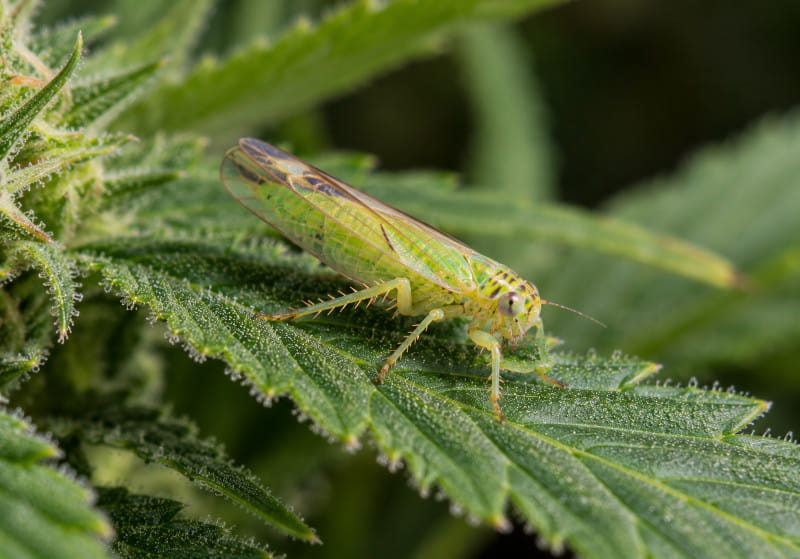
Distinguishing leafhopper nymphs from adults
Leafhoppers undergo incomplete metamorphosis and have no pupal stage. Wingless nymphs hatch from eggs and develop through several moults into adults, which are generally capable of flight. Body size and wing buds change gradually during this process.
In many leafhopper species, eggs are laid directly into plant tissue and therefore remain largely hidden during routine visual inspections. Nymphs already resemble adults but do not yet have fully developed wings. Repeatedly finding nymphs at different developmental stages on a cannabis plant may indicate local development. However, such a finding still does not prove that cannabis is the preferred host plant of that species.
The time required to develop from egg to adult depends on the species, temperature and other environmental conditions. The number of generations per year and overwintering strategy also vary. There is therefore no single developmental period that applies to all leafhoppers.
Where do leafhoppers stay on cannabis plants?
Depending on the species and developmental stage, leafhoppers may occur on the upper and lower surfaces of leaves and on young shoots. Some insects stay on cannabis only temporarily after arriving from nearby vegetation. Different parts of the plant should therefore be inspected to obtain a meaningful assessment.
It is best to start observing before touching or moving the plant. Adult leafhoppers can jump or fly away in an instant when disturbed and are easily missed. Wingless nymphs often remain inconspicuous on leaves or move sideways to evade detection. Leaf undersides deserve particular attention. Repeatedly finding insects at different developmental stages on the same parts of a plant provides additional evidence of possible colonisation.
What symptoms can leafhoppers cause on cannabis?
Feeding by certain leafhoppers can produce pale leaf spots, irregular stippling and, when damage is more severe, discolouration or dead tissue. The symptoms that actually develop depend on the species, its feeding behaviour and the host plant. There is no single symptom pattern shared by all leafhoppers.
In species whose feeding damages individual plant cells, small pinpoint pale areas may appear first. As damage progresses, these spots can merge into larger irregular pale patches. Other leafhopper species may instead cause yellowing, changes to leaf tips or disrupted growth through their feeding. However, such symptoms have not been demonstrated for every species or to the same extent on cannabis.
When assessing damage, it is important to distinguish recent symptoms from older ones. Damaged or dead leaf tissue generally does not recover completely. Visible spots may therefore remain even after the insects responsible have disappeared. New symptoms and repeated sightings provide a better indication of whether an infestation is still active.
Not every yellow leaf tip, brown leaf margin or stippled leaf indicates leafhoppers. Nutrient imbalances, drought stress and other pests can cause similar changes. Our guide to cannabis plant problems and diseases provides an overview of possible causes.
Pale spots and fine stippling on cannabis leaves
Small pale dots are among the possible early signs of damage caused by certain leafhopper species. At first the pale areas may be isolated and particularly noticeable in angled light. With continued damage, many dots may merge, leaving larger parts of the leaf pale or irregularly stippled.
However, these changes are by no means unique to leafhoppers. Spider mites in particular can produce very similar fine stippling. Both sides of the leaves should therefore be checked carefully for live pests. Leafhopper nymphs and adults look markedly different from mites and their eggs. Without direct evidence, the cause of the pale spots remains uncertain.
Hopperburn: damage to leaf tips and margins
Hopperburn describes a characteristic pattern of damage particularly associated with the potato leafhopper Empoasca fabae. Affected leaves may first turn yellow at their tips and margins. With more severe damage, brown areas of dead tissue develop. Leaves may also curl or show impaired growth.
Hopperburn is more than simple pinpoint feeding damage. Studies on other host plants show that feeding by Empoasca fabae can cause physiological changes in leaf tissue and interfere with the transport of assimilates. However, this symptom pattern is not a universal feature of all leafhoppers. Findings from potatoes, beans or other crops must not be transferred to cannabis without qualification.
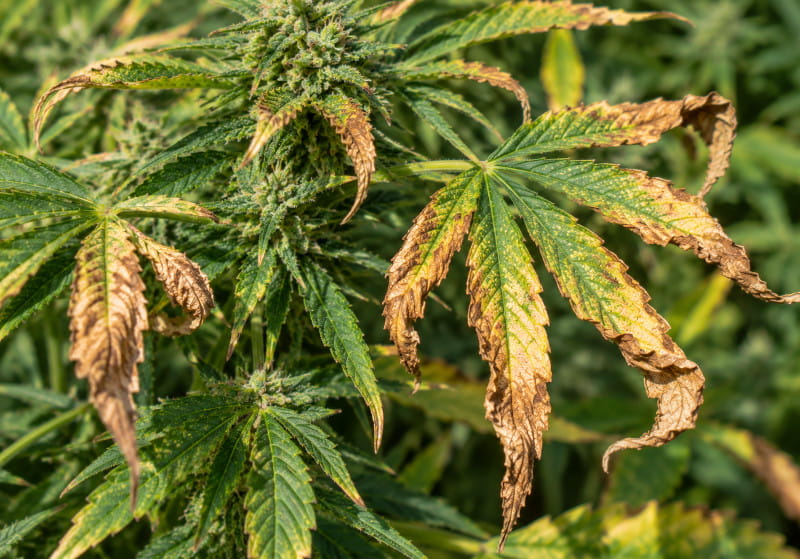
Pale stippling, yellow leaf tips or brown leaf margins do not prove a leafhopper infestation. More informative is the combination of clearly identifiable insects, repeated sightings and new damage consistent with the species and its feeding behaviour.
Leafhoppers, thrips or spider mites: how to tell them apart
All three pest groups can leave pale spots on cannabis leaves. Their body shape, movement and additional signs of infestation nevertheless provide important clues. The following table is a diagnostic aid and does not replace precise identification in uncertain cases.
|
Feature |
Leafhoppers |
Thrips |
Spider mites |
|
Typical appearance |
Small, usually wedge-shaped insects with powerful jumping legs |
Slender, elongated insects, often only a few millimetres long |
Tiny, usually oval arachnids; adults have eight legs |
|
Movement |
Often jump away abruptly when disturbed; adults may also take flight |
Mostly crawling or walking; winged individuals can take flight |
Slowly crawling; neither jumping nor flying |
|
Where they are found |
Upper and lower leaf surfaces and shoots, depending on species |
Leaves, young shoots and sheltered parts of plants |
Mainly leaf undersides; other areas in heavier infestations |
|
Damage pattern |
Depending on species, pale spots or yellowing; hopperburn in certain species |
Silvery, streak-like or irregular feeding damage |
Fine pale stippling; sometimes broader pale areas later |
|
Additional signs |
Webbing is not a typical sign produced by leafhoppers |
Small dark droppings can support identification |
Fine webbing may occur with web-forming spider mites |
|
Best inspection method |
Check body shape, jumping behaviour and nymphs |
Look for slender insects and possible dark droppings |
Use a magnifier to check leaf undersides for mites and eggs |
If you find very slender insects and small dark droppings, our guide to thrips can help with identification. If instead you find tiny, slowly crawling insects, eggs or fine webbing, our article on spider mites on cannabis provides further distinguishing features.
Also, whiteflies may take flight when the plant is touched. Adults are usually whitish and look different from the mostly wedge-shaped leafhoppers because of their powdery wings. Taking flight alone is therefore not a reliable distinguishing feature.
How can you recognise an active leafhopper infestation?
A single adult leafhopper on cannabis does not mean that an established infestation is present. Repeated sightings, the presence of nymphs and new damage consistent with the species are more important.
Inspect several plants and photograph suspicious leaf areas under similar lighting conditions whenever possible. Check after a few days whether new discolouration or additional insects have appeared. Also observe whether leafhoppers only fly in occasionally from surrounding vegetation or repeatedly settle on the same plants. The absence of nymphs does not definitively rule out colonisation, but a single adult sighting remains of limited significance.
Do not take action based solely on an unspecific leaf spot or a single insect sighting. Repeated checks help distinguish incidental visitors from persistent colonisation.
How do leafhoppers spread?
Adult leafhoppers are mobile and can fly in from meadows, hedges, wild vegetation or neighbouring crops. Species may therefore appear on cannabis even if they use the plant only temporarily or cannot successfully develop on it.
Some leafhoppers use a wide range of host plants, while others specialise in particular plant families or species. The vegetation from which they originate therefore depends on the leafhopper species and local conditions. Insects or eggs can also be introduced on newly acquired plants.
Depending on the species and climate, leafhoppers may overwinter at different developmental stages or remain active year-round. Their seasonal abundance consequently varies greatly. A universal leafhopper infestation calendar for cannabis would therefore be unreliable; observing local activity is more useful.
Leafhoppers outdoors, in greenhouses and indoors
Outdoors, leafhoppers can move between wild plants, meadows and crops. Isolated sightings on cannabis are therefore not unusual. Whether this leads to lasting colonisation or significant damage must be assessed separately.
Meadows, hedges and other vegetation can harbour both leafhoppers and their natural enemies. Completely removing surrounding vegetation is therefore not a generally advisable measure. What matters is which species are actually present and the conditions at the site.
Flying leafhoppers can enter a greenhouse through doors and ventilation openings. Suitable insect screens can reduce their entry but must allow adequate ventilation. Direct entry is usually limited in enclosed indoor rooms; however, newly introduced plants remain a possible source of infestation.
We discuss other common outdoor pests and how to distinguish them in our guide to outdoor cannabis pests. This section focuses on recognising and assessing leafhoppers.
Can leafhoppers transmit diseases to cannabis?
Certain leafhoppers are known vectors of plant pathogens. However, the specific combination of insect species, pathogen and host plant is crucial. A leafhopper's ability to transmit a pathogen to other crops does not automatically mean that it can transmit it to cannabis.
One important subject of research is beet curly top virus (BCTV), which can be transmitted by certain leafhoppers. Known vectors include Circulifer tenellus (beet leafhopper). Scientific studies from New Mexico specifically investigate interactions between this leafhopper species, hemp and BCTV. The possible transmission of plant viruses in cannabis is therefore a concrete research topic, not merely a supposition based on observations in other crops.
This does not mean that every leafhopper on cannabis is a disease vector. Pale leaf spots or growth disorders are not proof of viral infection either: feeding damage, nutrient problems or environmental stress can cause similar symptoms. Reliable pathogen detection requires appropriate diagnostic testing.
Reports of phytoplasmas or spiroplasmas in cannabis also require an important distinction: detecting a pathogen in a plant does not establish which insect species transmitted it. Separate studies of the transmission pathway are needed.
Leafhoppers on cannabis: what to do after confirming an infestation
Appropriate measures depend on the leafhopper species, the appearance of new damage and the actual extent of infestation. A few insects flying in without any obvious new damage are initially a reason to inspect rather than to treat immediately.
If nymphs or adults repeatedly occur alongside new, matching damage, document the findings and check how widely the insects are distributed across the crop. In small plantings, individual insects may be removed mechanically. However, this has limited value against mobile adult leafhoppers. The key question is whether insect numbers and fresh damage increase during subsequent inspections.
Monitoring: visual inspections, sweep nets and yellow sticky traps
Regular visual inspection of leaves and shoots is the most important starting point. Outdoors, sweep nets can help sample mobile insects in vegetation when used correctly. Yellow sticky traps provide additional evidence of flying insects but also catch many other species. Without identification and inspection of the plants, they cannot establish that a damaging leafhopper infestation is present.
Yellow sticky traps are therefore mainly a monitoring tool, not a reliable stand-alone control method. Beneficial insects may also become stuck to them. Whether nymphs are developing on the plants and whether new damage is occurring must be checked directly in the crop. For meaningful comparisons, keep inspection locations and methods as consistent as possible.
Natural enemies and biological control
In natural habitats, leafhoppers are preyed upon by predatory insects and spiders, among others. Parasitoids that exploit certain developmental stages of particular species also occur. However, this does not justify a general recommendation for any particular beneficial organism against leafhoppers on cannabis.
Encouraging natural enemies can form part of integrated pest management. Targeted releases, however, only make sense when effectiveness against the leafhopper species concerned has been demonstrated under comparable conditions. Beneficial organisms marketed for thrips, aphids or whiteflies are not automatically suitable for leafhoppers.
Plant protection products and residues
Whether a plant protection product may be used depends on applicable regulations and its specific authorisation for the crop and intended use. Additional restrictions may apply to cannabis and hemp. Potential residues are particularly important when flowers are intended for use.
For this reason, we do not make blanket recommendations for active ingredients, home remedies or applications to flowers. A product authorised for another crop is not automatically lawful or suitable for cannabis. Priority should be given to accurate identification, monitoring the development of damage and proportionate measures permitted by law.
For many leafhopper species on cannabis, sufficiently established economic injury thresholds are unavailable. A fixed number of insects per leaf would therefore not be a defensible universal treatment threshold.
How can leafhoppers be prevented?
Prevention starts with regular inspections and careful examination of newly introduced plants. Keeping plants accessible makes it easier to spot nymphs, adults and new changes to leaves early.
New plants should be checked for insects and unusual leaf symptoms before being introduced into existing crops. In greenhouses, suitable insect screens can reduce immigration provided that ventilation and other requirements are met. Complete exclusion is usually impractical outdoors. Regular checks and observation of surrounding vegetation are especially important there.
Successful management is not indicated by old leaf spots disappearing. Damaged tissue often remains permanently altered. More informative signs are the absence of new damage and declining sightings of live leafhoppers or nymphs.
FAQ: frequently asked questions about leafhoppers on cannabis
How can you identify leafhoppers on cannabis?
Leafhoppers are generally small, often wedge-shaped insects. Adults frequently jump away or take flight when disturbed. Nymphs and newly developing, matching leaf symptoms are also important for assessment.
Are all leafhoppers on cannabis pests?
No. Some species remain on hemp only temporarily. A single adult does not demonstrate reproduction on cannabis or significant plant damage.
What do leafhopper nymphs look like?
Nymphs resemble adult leafhoppers in overall shape but do not yet have fully developed wings. In some species, they move conspicuously sideways across leaves.
Why do cannabis leaves develop pale spots?
Possible causes include leafhoppers, thrips and spider mites, as well as other plant problems. Stippling alone does not allow a reliable diagnosis.
What is hopperburn?
Hopperburn is a pattern of damage involving yellowing and, later, brown areas of dead tissue at leaf tips or margins. It is particularly associated with Empoasca fabae but is not a universal feature of all leafhoppers.
Can leafhoppers transmit plant diseases?
Certain species can transmit pathogens. Research on Circulifer tenellus and beet curly top virus is particularly relevant to hemp. Not every leafhopper is a vector of cannabis pathogens.
Are leafhoppers mainly a concern outdoors?
Outdoors, adult leafhoppers can move in from neighbouring vegetation. Greenhouses may also be affected. The actual risk depends on region, species and growing conditions.
Do yellow sticky traps help against leafhoppers?
Yellow sticky traps can capture flying insects and assist with monitoring. They do not replace species identification or checking for nymphs and fresh damage.
What should you do if you find just one leafhopper?
First, document the insect if possible, check the plant for nymphs and new damage, and inspect it again later. An isolated sighting without damage does not automatically justify treatment.
Conclusion: assessing leafhopper infestations correctly
Leafhoppers also occur on cannabis, but not every sighting indicates a damaging infestation. What matters is the species involved, repeated observations, possible nymphs and the development of fresh, consistent damage.
Diagnosis particularly depends on distinguishing leafhoppers from thrips, spider mites and non-insect-related leaf problems. Documenting insects and the progression of symptoms helps growers act more precisely and avoid unnecessary interventions. The risk of pathogen transmission must also be assessed by species: not every leafhopper can transmit plant diseases to cannabis.
Sources and further reading
Cranshaw W. et al. (2019): Developing Insect Pest Management Systems for Hemp in the United States: A Work in Progress. Journal of Integrated Pest Management 10(1), 26. Foundational overview of arthropods on hemp, including leafhoppers and the distinction between incidental visitors and pests.
Agriculture and Agri-Food Canada: Leafhoppers – Hemp Pest Factsheet. Technical factsheet on leafhoppers in hemp, symptoms, monitoring and IPM.
Utah State University Extension: Potato Leafhopper in Hemp. Practical assessment of Empoasca fabae, damage risks and monitoring.
Pacific Northwest Pest Management Handbooks: Hemp – Leafhoppers. Species-specific guidance and vector relevance.
University of New Hampshire Extension: Hemp Pests in New Hampshire. Overview of hemp pests, including leafhoppers.
Research publication (2023): Interactions of Beet Leafhopper and Hemp in New Mexico. Study of the relationship between hemp, Circulifer tenellus and beet curly top virus.
Journal of Integrated Pest Management (2026): Sap-sucking Insects Associated with Medicinal Cannabis. Recent observations on medicinal cannabis and assessment of adult visitors.
USDA Agricultural Research Service (2026): Publication on phytoplasma and Spiroplasma in cannabis. Pathogen detections; no blanket conclusion about transmission by individual leafhopper species.