Cannabis Landraces: Origin, Significance and Genetics
Cannabis Landraces: Origin, Significance, Famous Strains and Why They Still Matter Today
Updated: June 2026 | Landraces – the original genetics behind modern strains
Author: Cannapot Grow Team | Reading time: approximately eighteen minutes
The Key Points At A Glance
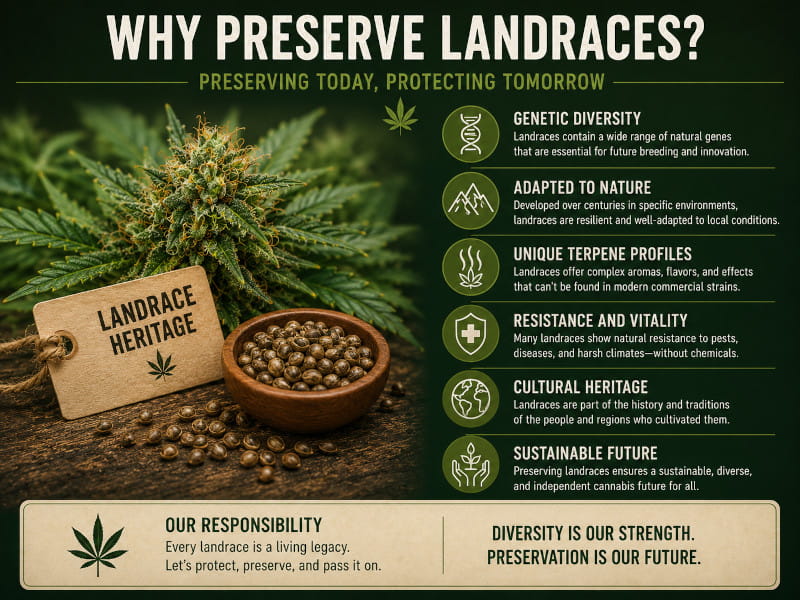
✓ Cannabis landraces are original regional cannabis populations that have adapted over many generations to climate, altitude, day length and local conditions.
✓ Well-known landraces such as Thai, Hindu Kush, Afghan, Durban Poison, Malawi Gold, Acapulco Gold and Colombian Gold form the genetic foundation of many modern cannabis strains.
✓ Landraces are not automatically weaker than modern hybrids, but they often offer unique terpene profiles, special growth patterns and valuable genetic diversity.
✓ Many true landraces are threatened today because modern hybrids, globalization and the loss of traditional cultivation areas are displacing original populations.
When you start looking into cannabis landraces, you quickly come across names like Thai, Hindu Kush, Afghan, Durban Poison, Malawi Gold, Acapulco Gold or Colombian Gold. These strains have become legendary, because landraces are not simply old strains with nice names. They are the genetic foundation from which almost everything we know today as modern cannabis has emerged.
Many current hybrids seem completely new at first glance: Gelato, Runtz, Zkittlez, Cookies, Haze, Kush, Skunk or Diesel. But if you trace their family trees back far enough, original regional lines almost always appear. That is exactly where the history of cannabis genetics begins.
This guide explains what a cannabis landrace is, which regions are especially important, which famous landrace sativas and landrace indicas exist, why many of them are threatened today, and what value they have for breeders, collectors and the future of modern cannabis strains.
What is a cannabis landrace?
A cannabis landrace is a regional cannabis population that has developed over many generations in a specific area. It was not modern breeders in a laboratory who decided which traits were important, but nature itself: climate, soil, hours of sunlight, rainy seasons, altitude, pests and local selection by humans.
A Thai landrace therefore developed differently from an Afghan landrace, and a Zamal developed completely differently again because of the isolation of the island of La Réunion. A plant from African Malawi had to solve different problems than a plant from the dry Hindu Kush mountains. This natural adaptation is exactly what makes landraces so exciting. In short: landraces are original, regionally adapted cannabis lines. They are not completely “wild,” but they also cannot be compared with modern hybrids. They were often cultivated locally, selected and passed on over decades or centuries.
Landrace, heirloom, hybrid and IBL – what is the difference?
In the cannabis field, several terms are often mixed up. Especially with old strains, it is worth making a clear distinction.
-
Landrace: A regional cannabis population that has adapted in a specific area over many generations.
-
Heirloom strain: An old line that was taken out of its region of origin and preserved elsewhere, usually without strong modern hybridization.
-
Hybrid: A cross of two or more lines, often deliberately bred to combine specific traits.
-
IBL: An inbred line, meaning a line stabilized over several generations with relatively predictable traits.
Not every old strain is automatically a true landrace. And not every strain with a traditional name still comes directly from the original population today. Especially with commercial seeds and strains, it is therefore worth taking a closer look.
Where do cannabis landraces come from?
Cannabis is a very old cultivated plant. The history of cannabis and hemp is complex, but many clues point to Central Asia and neighboring regions as important early areas of distribution. From there, cannabis spread to many parts of the world through trade routes, migration, traditional medicine, fiber use, religious practices and local cultivation.
Over a long period, different types of cannabis developed in different regions. Some were used, as in Afghanistan for example, mainly for resin and hashish, while others were used for flowers, fibers or seeds. This led to very different plant forms: tall tropical sativas, compact indicas, robust semi-wild populations and regional specialties with their own aromas.
The most important landrace regions in the world
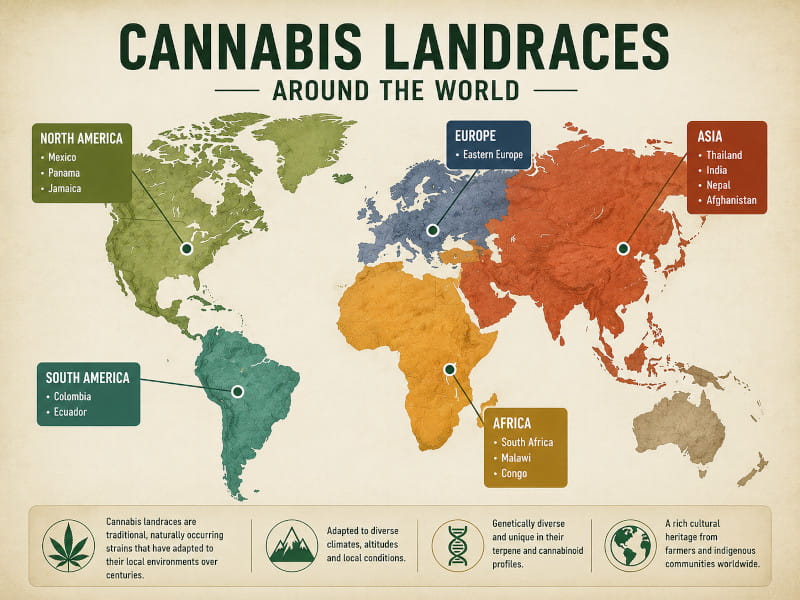
Historically, landraces can be found in many regions. However, a few major zones are especially important because they have massively shaped modern breeding.
Asia: Thai, Hindu Kush, Afghan, Nepal and Kerala
Asia is extremely important for landraces. Here you find both long-flowering tropical sativas and compact, resinous mountain lines. Some of the most influential genetics of all come from Thailand, India, Nepal, Pakistan and Afghanistan.
Africa: Durban Poison, Malawi Gold, Swazi and Congolese
African landraces are often sativa-dominant, vital, vigorous in growth and adapted to intense sun. Many are considered especially exciting because they show clear, energetic and characterful profiles. Durban Poison and Malawi Gold are among the best-known examples.
America: Mexico, Colombia, Panama and Jamaica
American landraces became famous mainly in the 1960s and 1970s. Names such as Acapulco Gold, Colombian Gold, Panama Red and Lambsbread appear in many stories surrounding classic cannabis culture. They later influenced important lines such as Haze and Skunk.
Famous cannabis landraces from Asia
Thai
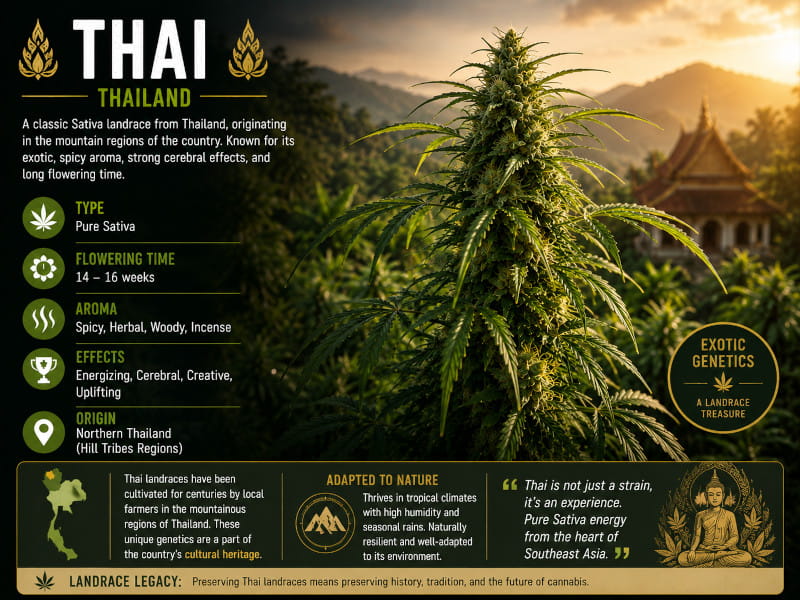
Thai is one of the most famous sativa landraces of all. It comes from tropical regions of Thailand and is known for very tall growth, long flowering times and an often clear, cerebral effect profile. Classic Thai Sativas can smell spicy, citrusy, herbal or slightly sweet. Thai genetics can be found in Haze lines and have strongly influenced modern breeding. At the same time, a true Thai is not necessarily easy to grow: long flowering, a lot of stretch and tropical requirements make it more demanding than many modern hybrids.
Chocolate Thai
Chocolate Thai is a legendary line that became known for darker, cocoa-like and spicy aromas. Many stories about Chocolate Thai come from the old-school scene. As with many old names, however, it is not always clear today whether commercial offerings still directly match the historical populations. A great strain with these genes, by the way, is Chocolope by Cannapot, which perfectly combines Chocolate Thai and Cannalope Haze.
Hindu Kush
Hindu Kush comes from the mountain region between Afghanistan and Pakistan. This landrace is the opposite of tropical sativas: compact, resinous, robust and adapted to harsher conditions. Hindu Kush is the basis of many modern strains and stands for earthy, spicy, sometimes slightly sweet or hashy aromas. Many modern strains carry the name “Kush,” but not all are close to the original Hindu Kush genetics. Even so, Hindu Kush remains one of the most important building blocks of modern hybrids.
Afghan
Afghan landraces are among the most important indicas in the world. They are known for strong resin production, compact growth, broad leaves and short flowering times. Historically, many Afghan strains are used for hashish production. Without these genetics, many modern classics would not exist. Skunk, Northern Lights, many Kush crosses and numerous mostly indica strains contain Afghan genetics.
Mazar-I-Sharif
Mazar-I-Sharif is a famous Afghan landrace from northern Afghanistan. It is often associated with strong resin formation, a robust structure and classic hashish genetics. For breeders, it is interesting because it provides strength, stability and traditional indica traits.
Chitral
Chitral comes from Pakistan and is especially known for colorful phenotypes and aromatic indica traits. Pakistan Chitral Kush is often associated with purple colors, spicy aromas and relaxing effects. For modern breeding programs, this landrace is very exciting because color, resin and resilience can come together.
Nepalese
Nepalese cannabis develops at high altitudes and in different microclimates. Many Nepalese strains (such as Nepalese Baglung) are considered robust, spicy and full of character. Some show sativa-dominant traits, while others appear more balanced. Precisely because of this diversity, they are interesting for collectors and breeders.
Kerala
This landrace comes from southern India and is often associated with tropical sativa genetics, strong growth and complex aromas. Kerala Chellakutti is less well known than Thai or Afghan, but it is also extremely exciting for lovers of original sativas.
Famous cannabis landraces from Africa
Durban Poison
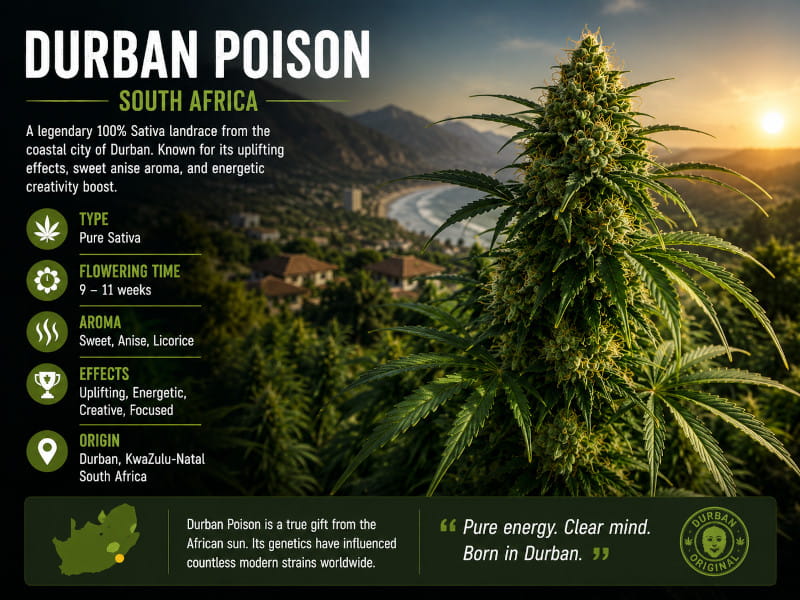
Durban Poison is probably the best-known African landrace. It comes from South Africa and is regarded as a clear, energetic sativa with sweet and at the same time spicy, sometimes anise-like or herbal notes. Many growers like Durban Poison because, despite its sativa character, it is comparatively very easy to grow. Durban is still used in modern breeding projects today. It often delivers vitality, a clear effect and special terpenes. Durban influences also keep appearing indirectly in modern hybrids with Cookies or dessert genetics.
Malawi Gold
Malawi Gold is a legendary African sativa from Malawi. It is known for strong growth, long flowering and very intense effects. Many lovers of original sativas count Malawi Gold among the most exciting landraces of all. Typical profiles are fruity, spicy and sometimes slightly woody, combined with delicious coffee notes. For modern indoor grows, true Malawi is not always convenient, but genetically it is extremely valuable.
Swazi Gold
Swazi Gold comes from southern Africa and is often associated with robust growth, a sativa-dominant structure and fruity-spicy notes. Swazi lines are historically interesting for outdoor cultivation in suitable climate zones and are valued by collectors of original genetics.
Congolese
Congolese strains come from Central Africa and are often less standardized than better-known names such as Durban or Malawi. That is exactly what makes Congo exciting. Depending on the line, they can show tropical adaptation, clear sativa traits and complex aromas.
Famous cannabis landraces from America
Acapulco Gold
Acapulco Gold comes from Mexico and is one of the most famous names of the 1960s and 1970s. The strain became known for golden flowers, special sweetness, spicy notes and a bright sativa high. Today the name is legendary, but true, original Acapulco Gold genetics are difficult to verify clearly.
Mexican Sativa
Mexican sativas have strongly influenced modern breeding. They were often described with tall growth, longer flowering, spicy-fruity aromas and activating effects. Mexican influences appear again and again in classic lines such as Haze and Skunk. One of the best-known strains is the legendary Mexican Sativa by Sensi Seeds.
Colombian Gold
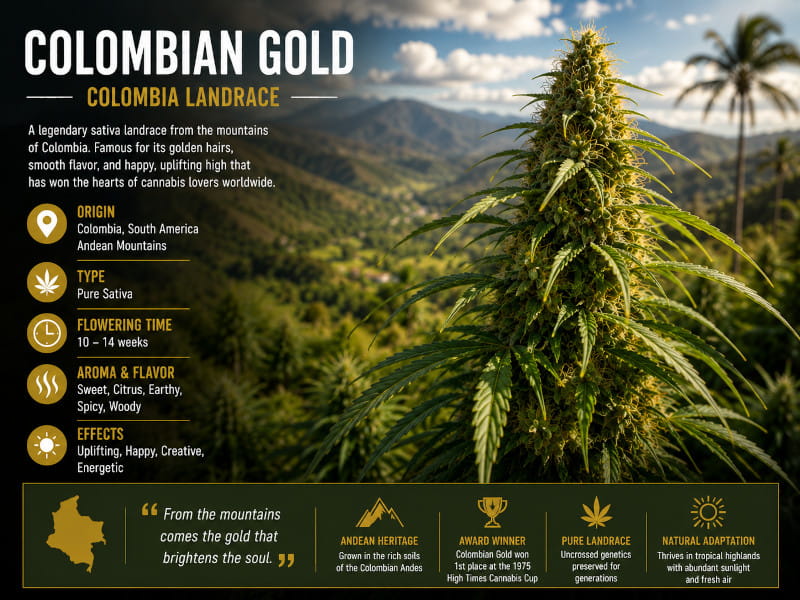
Colombian Gold is one of the best-known South American landraces. It is associated with golden flowers, citrus notes, a strong sativa structure and special vitality. Many classic hybrids and Haze lines were influenced by Colombian genetics. Colombian Gold is one of the absolute legends among sativas, a strain with enormous potential.
Panama Red
Panama Red was especially famous in the 1970s. The name refers to reddish pistils - Panama lines are often described as euphoric, clear and warm, but, like many tropical sativas, they need more time than modern strains.
Jamaican Lambsbread
Jamaican Lambsbread or Lamb’s Bread is a famous Jamaican sativa that is strongly connected with Rastafari culture and Caribbean history. It is often described with creative, clear and positive effects. As with many old names, different versions and interpretations exist today. There are not very many Lambsbread strains on the market, but with Bob's Lambsbread by Cannapot you get a wonderful blend of blueberries and the famous Lambsbread ganja.
Famous sativas
Landrace sativas mostly come from tropical or subtropical regions. They often grow tall, flower longer and show a more airy flower structure than compact indicas. Their profiles are often described as clear, activating, creative or energetic – although every line naturally has its own traits.
-
Thai: tropical, long-flowering, clear and spicy, citrusy.
-
Durban Poison: South African, vital, sweet, spicy and energetic.
-
Malawi Gold: vigorous, long-flowering, intense and legendary.
-
Colombian Gold: old-school sativa with a golden history.
-
Panama Red: classic 1970s sativa with a red touch.
-
Acapulco Gold: Mexican legend with a sweet-spicy reputation.
-
Jamaican Lambsbread: Caribbean sativa with a strong cultural background.
Famous indicas
Landrace indicas often come from drier, mountainous or harsher regions. They are often more compact, more resinous and finish faster than tropical sativas. Their genetics therefore became especially important for indoor breeding, hashish production and modern hybrids with shorter flowering times. It is also important to mention the famous Lebanese, which should definitely not be forgotten.
-
Afghan: compact, resinous, robust and extremely influential.
-
Hindu Kush: classic mountain indica with a spicy and earthy profile.
-
Mazar-i-Sharif: traditional Afghan hashish genetics.
-
Pakistani Chitral Kush: colorful, spicy and strong in stability.
-
Lebanese: historic hashish line from Lebanon.
What are the most popular cannabis landraces?
Popularity always depends on who you ask: collectors, breeders, growers, old-school fans or modern hybrid enthusiasts. Even so, some names appear especially often.
-
Durban Poison – probably the best-known African landrace.
-
Thai – one of the most important sativas for Haze genetics.
-
Hindu Kush – the foundation of countless Kush strains.
-
Afghan – indispensable for indica and hashish genetics.
-
Acapulco Gold – Mexican legend with a strong name.
-
Colombian Gold – South American sativa with great influence.
-
Malawi Gold – for many, one of the most intense original sativas.
-
Panama Red – old-school sativa with cult status.
-
Pakistani Chitral Kush – popular for color, aroma and indica stability.
-
Jamaican Lambsbread – culturally and historically very well known, of course also because of Bob Marley.
Landraces as the foundation of modern cannabis strains
Almost all modern strains are based directly or indirectly on landraces. Modern hybrids may often seem completely new, but their traits come from older building blocks. Breeders have combined these building blocks, stabilized them and selected them for specific goals.
From Afghan, Colombian and Mexican to Skunk
Skunk #1 is considered one of the most important modern strains. It is often described as having Afghan, Colombian and Mexican influences. This is exactly what made Skunk a bridge between original landrace genetics and modern, stable hybrid breeding.
From Thai, Mexican and Colombian to Haze
Many Haze lines contain tropical or subtropical sativa influences, including Thai, Mexican and Colombian. That is why classic Haze strains often appear long-flowering, citrusy, spicy, clear and energetic.
From Hindu Kush and Afghan to Kush, Northern Lights and modern indicas
Kush and Afghan provided compact structure, resin, robustness and shorter flowering times. Without these genetics, many modern indoor strains would hardly have developed the way we know them today.
Why grow landraces?
Many modern strains are easier, faster and higher yielding. So why are so many growers still interested in landraces? The answer is: landraces offer something that modern hybrids do not always provide – origin, character and genetic breadth.
-
Authentic genetics: Landraces show what cannabis looked like before intensive modern hybridization.
-
Unique aromas: Some terpene profiles are hardly found in modern hybrids in an unaltered form.
-
Special effects: Many landraces feel different from highly optimized modern strains.
-
Breeding value: Breeders use landraces to introduce new traits.
-
Collector value: For many cannabis fans, landraces are genetic time capsules.
What benefits do cannabis landraces have?
Landraces are not just romantic old-school genetics. They have real practical value for modern breeding and long-term diversity.
-
Genetic diversity: The narrower modern lines become, the more important original genes become.
-
Disease resistance: Regionally adapted populations can possess natural resilience.
-
Climate adaptation: Some strains perform better in heat, humidity, drought or high altitudes.
-
New terpene profiles: Landraces can provide aromas that are rare in the modern market.
-
Cannabinoid diversity: Not every interesting plant is interesting only because of THC.
For future breeding projects in particular, landraces can therefore be extremely valuable. They are like a genetic library from which breeders can bring back new traits.
Why are many landraces disappearing?
A major problem is mixing with modern hybrids. When modern seeds are introduced into traditional cultivation areas, they cross with local populations. After a few generations, the original landrace may only be partially present. There are also other factors:
-
loss of traditional cultivation areas
-
government eradication programs in some regions
-
commercial displacement by faster hybrids
-
lack of preservation of old seed stocks
-
unclear or incorrectly used strain names
That is why the term “landrace” can be difficult today. A strain may carry an old name but already be genetically heavily mixed. Transparency is important for honest classification.
How many cannabis landraces are there?
There is no exact number. That is because landraces are not fixed registered varieties like modern commercial strains. They are regional populations, and their boundaries are often fluid. One region can have several local lines, while similar names in different villages or valleys can describe different plants. Depending on the definition, some people speak of a few dozen known landraces, while others refer to well over a hundred regional cannabis populations. Historically, there were probably significantly more. Today, many of them have disappeared, become mixed or survive only in private collections, gene banks or remote regions.
Realistically speaking: There is no definitive list of all cannabis landraces. It makes more sense to speak of known landrace regions and documented lines.
Are landraces stronger than modern hybrids?
Modern hybrids have often been deliberately selected for high THC levels, strong resin production, short flowering times and high yields. Many landraces do not reach these modern peak values. But strength is not just a number. Many landraces impress with special effects, complex terpenes or a different ratio of cannabinoids and accompanying compounds. A Thai or Malawi can feel completely different from a modern 30% THC hybrid. For many connoisseurs, that is exactly the appeal.
Can landraces be grown indoors?
In principle, yes, but not every landrace is equally easy. Tropical sativas such as Thai, Malawi or Colombian can become very large and flower for a long time. That does not always suit small indoor setups. Compact indicas such as Afghan, Hindu Kush or Chitral are often much easier to control. Anyone who wants to grow original landraces should first find out whether the respective line is more tropical, mountainous, drought-adapted, mold-prone or especially stretch-heavy. Modern-inspired hybrids can be a good compromise if you are looking for the character of old genetics but want more practical traits.
True landrace or modern interpretation?
On today’s market, you find three categories:
-
True or very original landraces: as close as possible to regional populations, often less uniform and less modernly selected. Love of Landrace or Ace Seeds have some of these great strains in their range.
-
Heirloom or preservation lines: old genetics preserved outside the region of origin. For heirlooms, the breeder HYP3RIDS is recommended, for example.
-
Modern interpretations: hybrids that contain landrace genetics or carry the name of a landrace, but have been more heavily bred. Khalifa Genetics, for example, offers great combinations of these traits.
None of these categories is automatically better. What matters is knowing what you have in front of you.
Landraces and terpenes: why old genetics can smell so exciting
Modern strains are often very loud: Candy, Gas, Cream, Cookies, Gelato. Landraces can come across very differently. Some smell of spices, incense, leather, mango, citrus, earth, wood, tea, herbs or dry resin. These profiles are not always as sweet and obvious as modern dessert strains, but they are often much more layered. For breeders, such terpene profiles are extremely exciting because they open up new directions. If you only keep crossing modern hybrids with similar ancestry, you eventually end up with similar aromas. Landraces can bring back fresh, old and unexpected traits.
Landraces for breeders: why breeders use them
For breeders, landraces are not a nostalgia topic, but working material. They can help expand modern lines, reduce inbreeding problems or create completely new combinations.
-
New resistance: Landraces can possess traits that have become rare in modern lines.
-
New structure: Growth form, leaf structure, stretch and flower formation can vary greatly.
-
New aromas: Especially important for modern terpene breeding.
-
Genetic refresh: Old lines bring breadth into narrow modern family trees.
The disadvantage: landraces are often less predictable than modern IBLs or stabilized hybrids. Breeders have to select, test and stabilize a lot before a commercially practical strain can result from them.
Overview: known landraces by origin
|
Landrace |
Region |
Typical character |
|
Thai |
Thailand |
Tropical sativa, long flowering, clear effect |
|
Hindu Kush |
Afghanistan/Pakistan |
Resinous indica, earthy, compact |
|
Afghan |
Afghanistan |
Robust, fast, resin-rich |
|
Durban Poison |
South Africa |
Energetic sativa, sweet-spicy |
|
Malawi Gold |
Malawi |
Powerful African sativa |
|
Acapulco Gold |
Mexico |
Old-school sativa, sweet-spicy |
|
Colombian Gold |
Colombia |
Sativa, citrusy, vital |
|
Panama Red |
Panama |
Classic sativa, euphoric |
FAQs
Q: What is a cannabis landrace?
A: A cannabis landrace is an original regional cannabis population that has adapted over many generations to a specific climate, region and local conditions.
Q: What is the difference between a landrace and a hybrid?
A: A landrace developed regionally and over a long period in a relatively natural way. A hybrid is a deliberate cross of different lines, usually with specific breeding goals.
Q: Do true cannabis landraces still exist today?
A: Yes, but many are threatened, mixed or difficult to verify clearly. Some are preserved by collectors, local growers, breeding projects or gene banks.
Q: Which landrace is the best known?
A: Among the best known are Thai, Hindu Kush, Afghan, Durban Poison, Acapulco Gold, Colombian Gold and Malawi Gold.
Q: Which landraces are sativas?
A: Well-known landrace sativas include Thai, Durban Poison, Malawi Gold, Colombian Gold, Panama Red, Acapulco Gold and Jamaican Lambsbread.
Q: Which landraces are indicas?
A: Well-known indica landraces include Afghan, Hindu Kush, Mazar-I-Sharif, Pakistani Chitral Kush and Lebanese.
Q: Are landraces stronger than modern strains?
A: No, generally not. Modern hybrids are often bred more strongly for THC and yield. Landraces tend to stand out more through unique genetics, special terpenes and original character.
Q: Why do many sativa landraces flower for so long?
A: Tropical landraces come from regions with different light and climate conditions. They did not have to respond to short summers and therefore often developed longer flowering times.
Q: Why are landraces important for breeders?
A: They bring genetic diversity, new terpene profiles, resistance, growth traits and old characteristics back into modern breeding projects.
Q: How many cannabis landraces are there?
A: There is no exact number. Depending on the definition, a few dozen to more than a hundred regional populations are known or historically documented. However, many are no longer preserved unchanged today.
Q: Can landraces be grown indoors?
A: Yes, but not all are easy to grow. Compact indicas are often easier to control than tropical sativas with long flowering times and strong stretch.
Q: Is Durban Poison a true landrace?
A: Durban Poison is considered a South African landrace or landrace-like line. Commercial versions, however, may be selected or adapted to different degrees depending on the supplier.
Conclusion: landraces are the foundation of modern cannabis genetics
Cannabis landraces are more than just old strain names. They are the original building blocks of modern cannabis breeding. Without Thai, Afghan, Hindu Kush, Durban Poison, Colombian Gold, Acapulco Gold, Malawi Gold and many other regional lines, today’s diversity of hybrids would hardly exist. For growers, landraces are exciting because they bring character, history and special profiles. For breeders, they are important because they preserve genetic diversity and open up new breeding paths. And for cannabis culture as a whole, they are a piece of living origin.
Anyone who truly wants to understand modern cannabis strains should study landraces. Because almost every new strain begins somewhere with an old plant that adapted to its place over generations.