Broad Mites on Cannabis: Symptoms & Diagnosis
Broad Mites on Cannabis: Tiny, Hidden and Easy to Confuse
Updated: October 2026 | Broad mites on cannabis: symptoms, damage, diagnosis, spread, control and prevention.
Author: Cannapot Grow Team | Reading time: approximately twenty minutes
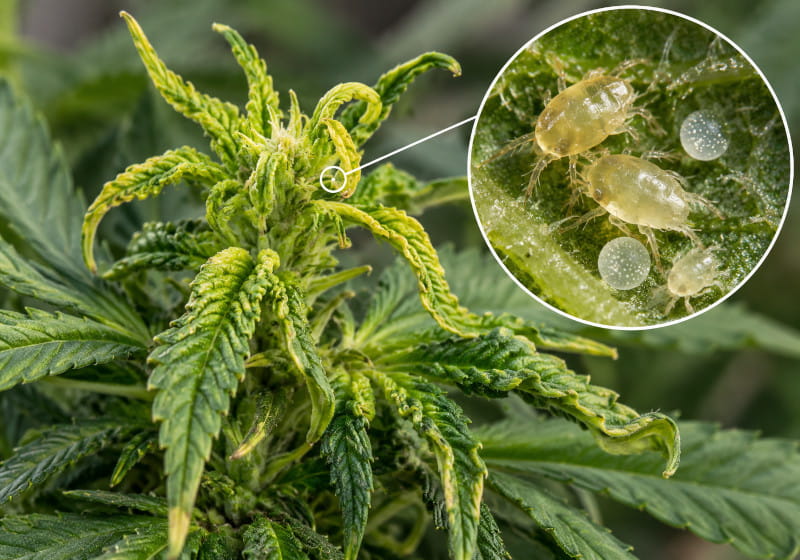
The Most Important Points at a Glance
✓ The broad mite, Polyphagotarsonemus latus, is a tiny plant-feeding mite in the family Tarsonemidae. It attacks numerous host plants and has also been documented as a pest of cannabis and hemp.
✓ Adult broad mites are only about 0.1 to 0.2 millimeters long and are very difficult to identify reliably with the naked eye. Adequate magnification using a magnifying glass, microscope or digital microscope is therefore necessary for reliable identification.
✓ Infestations may be especially apparent on young plant tissue: distorted or curled leaves, stunted new growth, damaged shoot tips and growth disorders are possible signs. However, the symptoms alone do not prove a broad mite infestation.
✓ The eggs are a particularly useful diagnostic feature. They are transparent to colorless, oval and have characteristic whitish bumps on their surface. With sufficient magnification, this makes them distinguishable from the eggs of other mites.
✓ Broad mites are not the same as hemp russet mites or spider mites. Because some symptoms overlap, diagnosis should consider the damage pattern, affected plant parts, and the mites and eggs observed under magnification together.
If the youngest leaves of a cannabis plant curl or twist, new shoots remain unusually small, or growth stalls, several causes are possible. One of them is broad mites. These pests are particularly troublesome because the tiny mites are very difficult to see reliably with the naked eye. As a result, damaged new growth is often noticed first – rather than the mites themselves.
The broad mite has the scientific name Polyphagotarsonemus latus and is known internationally as the Broad Mite. It belongs to the family Tarsonemidae and has a very wide host range. In addition to numerous vegetable, fruit and ornamental plants, the species has also been documented as a pest of cannabis and hemp.
However, the damage pattern alone is not enough for a reliable diagnosis. Distorted new growth is not proof of broad mites. Similar changes may be caused by hemp russet mites, thrips, nutrient supply or pH problems, root stress, heat and excessively intense lighting, among other things. For an overview of possible causes, see our guide to Cannabis Plant Problems & Diseases.
An important limitation must also be considered when assessing scientific evidence: Polyphagotarsonemus latus has been studied extensively on numerous cultivated plants, whereas published research specifically on broad mites affecting cannabis and hemp is much more limited. This guide therefore distinguishes between general findings on broad mite biology and observations explicitly documented for cannabis or hemp.
What Are Broad Mites?
Broad mites are tiny plant-feeding mites in the family Tarsonemidae. Polyphagotarsonemus latus is found worldwide and can colonize a large number of different host plants. Young, actively growing plant parts in particular may be damaged by the mites feeding on them.
Their extremely small size is particularly problematic in cannabis cultivation. Individual broad mites can easily go unnoticed even when changes to young plant tissue are already visible. An infestation may therefore initially look like a nutrient, pH or environmental problem.
The species Polyphagotarsonemus latus should not be confused with the hemp russet mite Aculops cannabicola. Both pests are extremely small and may cause similar changes to young plant tissue. However, they are different mite species: broad mites belong to the family Tarsonemidae, while hemp russet mites belong to Eriophyidae. With sufficient magnification, they can be distinguished by their body shape and other microscopic features.
What Do Broad Mites Look Like?
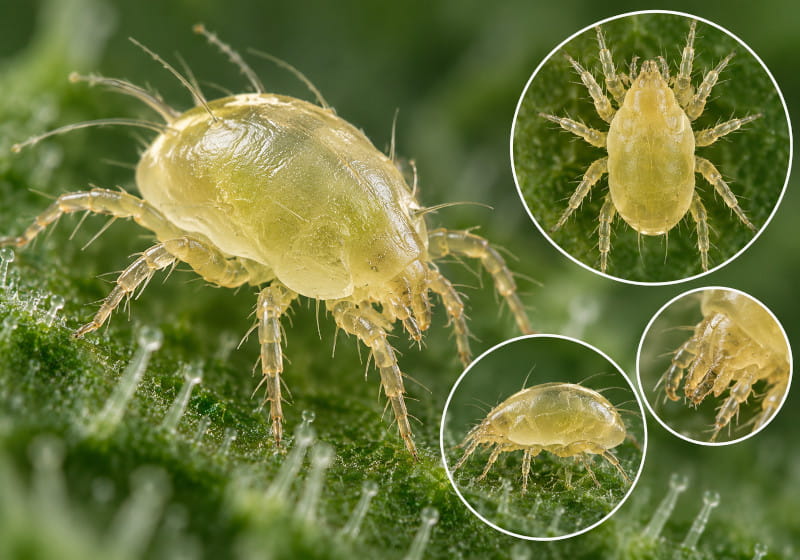
Broad mites are tiny, oval mites whose adults reach only about 0.1 to 0.2 millimeters in length. Females, measuring approximately 0.17 to 0.20 millimeters, are larger than males, which are about 0.11 millimeters long. Depending on their developmental stage and how they are observed, the mites appear transparent, pale yellow or yellowish-green and are very difficult to identify reliably with the naked eye.
Adult broad mites have four pairs of legs. This clearly distinguishes them from adult hemp russet mites, which have only two pairs of legs near the front of the body. Body shape also helps distinguish them under sufficient magnification: broad mites appear compact and oval, whereas hemp russet mites are conspicuously narrow, elongated and almost worm-like.
|
Characteristic |
Broad mite |
|
Scientific name |
Polyphagotarsonemus latus |
|
Family |
Tarsonemidae |
|
Adult size |
Females approximately 0.17–0.20 mm, males approximately 0.11 mm |
|
Body shape |
compact and oval |
|
Color |
transparent to pale yellow or yellowish-green |
|
Pairs of legs in adults |
four |
|
Webbing |
none |
Why Are Broad Mites So Difficult to Detect?
The biggest problem when looking for broad mites is their small size. Even several mites on a young leaf may go unnoticed during a routine visual inspection. Adult spider mites are much easier to spot, for example. Broad mites also do not produce webbing, which can be a conspicuous sign of a heavy spider mite infestation.
A good hand lens can help with an initial inspection. However, stronger magnification with a suitable microscope or digital microscope is useful for reliably examining these tiny mites, especially their diagnostically valuable eggs. Young leaves, leaf undersides and suspicious shoot tips should be examined in particular.
Another difficulty is that broad mites prefer young, actively growing plant tissue. Leaves in these areas may still be tightly clustered or not yet fully unfolded. The mites and their eggs are therefore located precisely where a superficial inspection can easily miss them.
Broad Mite Eggs: One of the Most Important Diagnostic Features
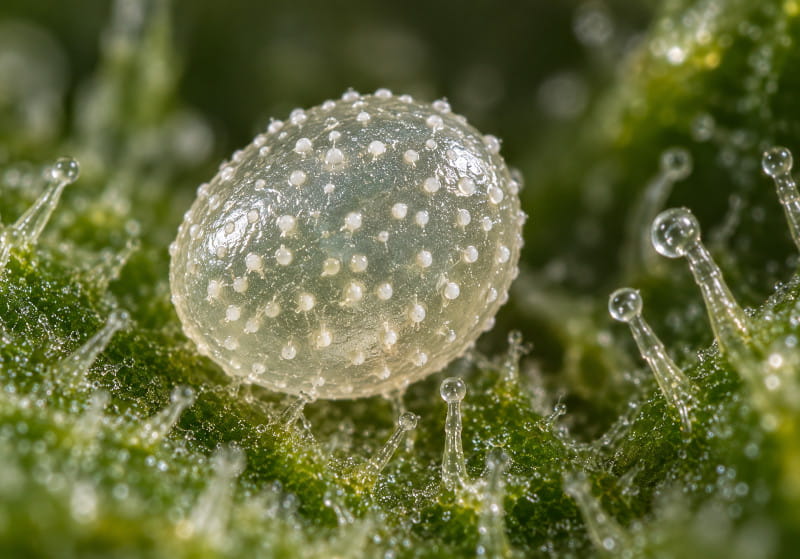
The eggs of Polyphagotarsonemus latus have a characteristic surface structure that is particularly helpful for identification. They are oval to elliptical, transparent or colorless, and only about 0.08 millimeters long.
Their surface has numerous whitish bumps. Scientific literature refers to these structures as tubercles. Approximately 29 to 37 such whitish bumps are reported per egg. With sufficient magnification, they form a distinctive pattern that is especially useful for distinguishing broad mites from other tiny mites.
The eggs are often laid on the undersides of young leaves. If an infestation is suspected, the search should therefore not focus exclusively on moving mites. The combination of an oval egg shape and the characteristically textured surface can provide an important indication of Polyphagotarsonemus latus.
A curled or distorted leaf alone does not prove a broad mite infestation. However, finding mites consistent with broad mites along with their characteristically structured eggs makes the suspicion much more convincing. The eggs are therefore among the most valuable features in microscopic examination.
From Egg to Adult Broad Mite
The development of Polyphagotarsonemus latus progresses from the egg through a mobile larval stage and an immobile resting stage to the adult. Larvae have three pairs of legs, while adult broad mites have four. Because of their small size, not only the larvae but also the immobile developmental stages can easily be overlooked during a superficial inspection.
How quickly a new generation develops depends on factors including temperature and host plant. Studies on various cultivated plants show that the developmental cycle can be very rapid under favorable conditions. As a result, an initially small infestation can grow into a much larger population in a relatively short time.
However, specific development times should not be applied to cannabis without verification. Many detailed studies on the biology of Polyphagotarsonemus latus were conducted on other host plants. In practice, regular monitoring is therefore more important than assuming a fixed life cycle that is identical under all conditions.
Where Are Broad Mites Found on Cannabis Plants?
Broad mites prefer young, actively growing plant tissue. Inspections should therefore focus on shoot tips, young leaves, leaf undersides and plant parts that have not yet fully unfolded. Their characteristic eggs are also frequently found on the undersides of young leaves.
Anyone suspecting an infestation should therefore not concentrate solely on large, older fan leaves. Areas where new growth is just unfolding or where the first distortions are visible are particularly relevant. Because the mites are extremely small and are not always evenly distributed across the plant, several suspicious areas should be checked.
This makes the search somewhat different from a typical infestation of spider mites. Spider mites may cause fine pale stippling on leaves and, in heavier infestations, visible webbing. With broad mites, changes to young growth and targeted examination of these areas under magnification are more important.
What Symptoms Do Broad Mites Cause on Cannabis?
A possible broad mite infestation is often first noticed through changes to young plant tissue. For Polyphagotarsonemus latus , distorted, curled or hardened young leaves, stunted growth, discoloration and damaged growing points have been described on various host plants.
On cannabis, unusually small, twisted or curled new leaves may raise initial suspicion. Shoot tips may appear stunted, young leaves may fail to unfold fully, and further growth may appear noticeably slowed. As damage progresses, yellowish to bronze discoloration may also occur.
However, none of these symptoms is specific to broad mites. Similar changes may be caused by other pests as well as nutrient, pH, root or environmental problems. The damage pattern therefore only narrows down the possible causes – it does not replace direct evidence of the mites or their characteristic eggs.
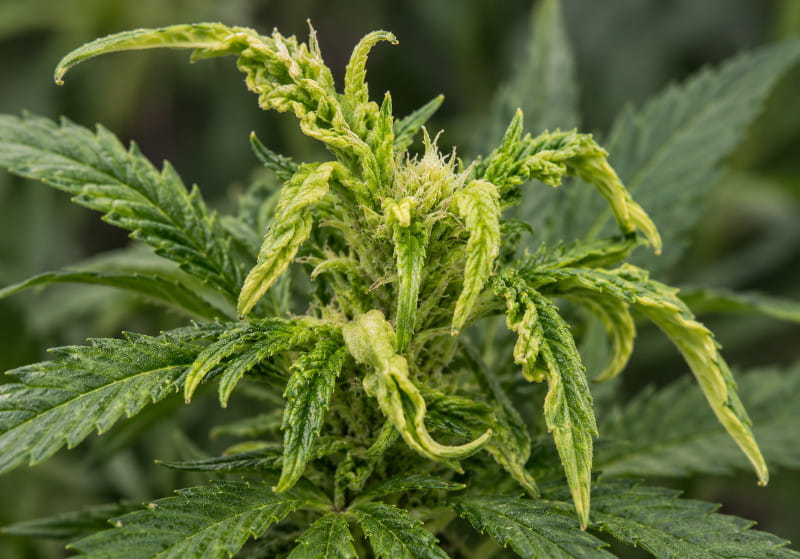
Stunted, twisted or curled young leaves are a warning sign, not a diagnosis. Before changing fertilization, adjusting pH or starting pest treatment, it is therefore best to establish what is actually causing the altered new growth.
How to Diagnose Broad Mites Reliably
A reliable diagnosis combines the damage pattern, location of the infestation and examination under sufficient magnification. First, determine which plant parts are affected and whether changes are concentrated on young growth and shoot tips. Then systematically examine suspicious leaves, especially their undersides.
Look for the tiny oval broad mites and their characteristically structured eggs. A single leaf with no visible signs is not enough to rule out an infestation, since mites and eggs may be unevenly distributed. It therefore makes sense to inspect several suspicious shoot tips and leaves and, where several plants are present, include different specimens in the examination.
Direct examination also helps distinguish broad mites from other mites. Elongated, almost worm-like mites with only two pairs of legs are more suggestive of hemp russet mites. Significantly larger mites associated with pale leaf stippling and possibly webbing later on are more consistent with spider mites. Because the damage patterns can overlap, this distinction is crucial when deciding what to do next.
How Can Broad Mites Spread?
Broad mites can enter a crop on infested plant material and spread from there to other plants. Newly introduced plants or cuttings therefore deserve particular attention. Because the mites and eggs are so tiny, an infestation may be present before obvious damage appears.
For Polyphagotarsonemus latus , a phenomenon known as phoresy has also been described: the mites can use other small insects for transportation. Transport by whiteflies, among others, has been scientifically documented. However, this does not establish how important the mechanism is under specific cannabis cultivation conditions.
Regardless of the growing system, it is therefore important to inspect new plants carefully and not immediately place suspicious specimens among established plants. This applies to indoor cannabis cultivation as well as plants in a greenhouse.
What Should You Do if a Broad Mite Infestation Is Confirmed?
Once an infestation has been confirmed, the first priority is to prevent the mites from spreading further through the crop. Infested or strongly suspected plants should be separated from unaffected plants wherever possible. Neighboring plants should then also be examined carefully, even if they do not yet show obvious symptoms.
Severely damaged plant material may be removed depending on the situation. Tools, work surfaces and other items that have come into contact with infested plants should be kept clean or cleaned. Follow-up inspections are also essential: a single measure does not establish whether all developmental stages have been addressed.
Because eggs and tiny developmental stages can easily be overlooked, the success of a measure should not be judged solely by the absence of visible moving mites immediately afterward.
Biological Control Using Predatory Mites
Various predatory mites have been studied for the biological control of Polyphagotarsonemus latus . These include Amblyseius swirskii and Neoseiulus cucumeris. Scientific studies are available on the use of these beneficial organisms to control broad mites on other cultivated plants.
These findings are relevant to understanding biological control strategies but should not automatically be interpreted as identical efficacy data for cannabis. The success and speed of biological control can depend on infestation severity, temperature, humidity, plant structure and the beneficial organism used, among other factors.
The same principle applies to plant protection products: the approvals and application requirements in force at the relevant location are decisive. Especially for plants whose flowers are intended for later use, possible residues and the application stage must be considered. Blanket recommendations for individual active ingredients are therefore inappropriate.
Preventing Broad Mites: Regular Monitoring Is Key
Regular monitoring is the most important preventive measure. New plants or cuttings should be carefully inspected before being introduced into an existing crop. Unusual new growth warrants closer examination, even if no mites are yet visible to the naked eye.
Indoors, a clearly organized and easily accessible growing area makes regular inspections easier. Anyone planning their own grow space can find further basics in our guide to building your own grow box. Young shoots and leaf undersides should also be checked regularly in the greenhouse, because a sheltered location does not inherently prevent pest infestations.
With outdoor cannabis seeds and other plants grown outdoors, environmental conditions are less controllable than in enclosed growing areas. This makes it even more important to notice unusual changes in new growth early and not automatically attribute them to nutrient or weather problems.
With a guerrilla grow, frequent inspections are naturally more difficult. When plants are visited only at longer intervals, early changes can more easily go unnoticed. Suspicious shoot tips should therefore be examined more closely during every inspection.
FAQ: Frequently Asked Questions About Broad Mites on Cannabis
How Can You Identify Broad Mites on Cannabis?
A possible infestation often first becomes apparent on young new growth. Twisted or curled young leaves, stunted shoot tips and growth problems may be signs. However, these symptoms are not enough for a diagnosis. Suspicious young leaves, especially their undersides, should be examined under sufficient magnification for broad mites and their characteristic eggs.
Can You See Broad Mites With the Naked Eye?
Individual broad mites are very difficult to identify reliably with the naked eye. Adults are only about 0.1 to 0.2 millimeters long. A powerful hand lens can help with the search, but a microscope or digital microscope is much better suited to accurate identification.
What Do Broad Mite Eggs Look Like?
The eggs of Polyphagotarsonemus latus are oval to elliptical, transparent or colorless, and approximately 0.08 millimeters long. Particularly striking are the numerous whitish bumps on their surface. Around 29 to 37 of these characteristic bumps have been described per egg. This pattern is a valuable feature for microscopic diagnosis.
Where Should You Look for Broad Mites on Cannabis?
Young shoot tips, leaves that have not yet fully unfolded, and their undersides are particularly important. Broad mites prefer young, actively growing plant tissue. Because mites and eggs may not be evenly distributed, several suspicious areas and, if possible, several plants should be checked.
What Is the Difference Between Broad Mites and Hemp Russet Mites?
They are different mite species. The broad mite Polyphagotarsonemus latus belongs to the Tarsonemidae and has a compact, oval body. The hemp russet mite Aculops cannabicola belongs to the Eriophyidae and has an elongated, almost worm-like shape. Because some damage patterns are similar, examination under sufficient magnification is especially important.
What Is the Difference Between Broad Mites and Spider Mites?
Broad mites are much smaller and are particularly associated with young plant tissue. They do not produce webbing. Spider mites, by contrast, often cause fine pale stippling on leaves; characteristic webbing may appear in heavier infestations. The mites and their eggs also differ clearly under magnification.
Are Curled Cannabis Leaves a Sure Sign of Broad Mites?
No. Curled, twisted or distorted young leaves can occur during a broad mite infestation, but they have many possible causes. Other pests, as well as nutrient, pH, root, heat or lighting problems, can cause similar changes. The damage pattern should therefore always be treated as the starting point for diagnosis, not as proof.
How Quickly Can Broad Mites Reproduce?
Under favorable conditions, the developmental cycle of Polyphagotarsonemus latus can be very rapid, allowing several generations to develop in quick succession. However, the exact development time depends on factors including temperature and host plant. Findings from studies on other cultivated plants should therefore not be applied to cannabis without qualification.
Conclusion: Accurate Diagnosis Is Crucial With Broad Mites
Broad mites are among the plant problems for which relying on the damage pattern alone can quickly lead to the wrong conclusion. Polyphagotarsonemus latus is extremely small, prefers young plant tissue and can cause changes that also occur with other pests or plant problems.
Direct examination of suspicious shoot tips and the characteristically structured eggs is therefore especially valuable for diagnosis. Anyone who does not automatically attribute distorted new growth to a single cause, but instead systematically searches for mites and eggs, distinguishes broad mites from hemp russet mites and spider mites, and continues monitoring after confirming an infestation, establishes the essential basis for a targeted response.
Sources & Further Reading
Utah State University Extension: Broad Mite – Polyphagotarsonemus latus. Overview of host plants including hemp, morphology, life cycle, damage symptoms and monitoring.
University of Florida, IFAS Extension: Broad Mite, Polyphagotarsonemus latus (Banks) (Arachnida: Acari: Tarsonemidae). Technical overview of morphology, biology, host range, spread and damage symptoms.
NC State Extension: Cyclamen Mite and Broad Mite. Description of developmental stages and characteristic broad mite eggs with approximately 29 to 37 whitish bumps.
Cranshaw W. et al. (2019): Developing Insect Pest Management Systems for Hemp in the United States: A Work in Progress. Journal of Integrated Pest Management, 10(1), 26. Overview of pests in US hemp cultivation, including Polyphagotarsonemus latus.
Journal of Integrated Pest Management (2024): Arthropod and mollusk pests of hemp, Cannabis sativa, and their indoor management plan in Florida. Review of the evidence on various hemp pests and the limited published documentation of specific damage caused by Polyphagotarsonemus latus on hemp.
USDA Agricultural Research Service: Study on phoresy of Polyphagotarsonemus latus by whiteflies. Scientific basis for the transport mechanism described.
Biological Control: Study of Neoseiulus cucumeris and the biological control of Polyphagotarsonemus latus. Study on the use of predatory mites against broad mites.
Experimental study of Amblyseius swirskii: Biological control of Polyphagotarsonemus latus using predatory mites. Study on the effectiveness of Amblyseius swirskii against broad mites on another cultivated plant.