Hemp Russet Mites on Cannabis: Identify & Control
Hemp Russet Mites: Tiny Pests with Major Damage Potential
Updated: October 2026 | Hemp russet mites on cannabis: symptoms, diagnosis, spread, control and prevention.
Author: Cannapot Grow Team | Reading time: approximately twenty minutes
The Most Important Points at a Glance
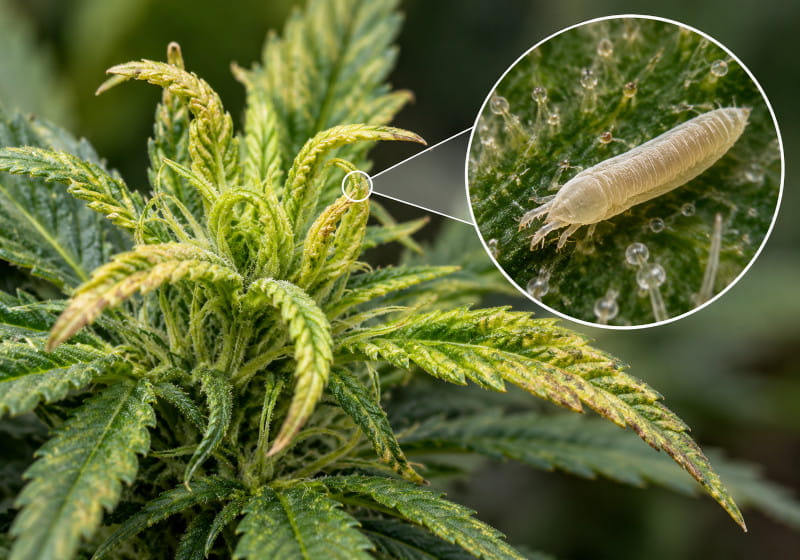
✓ The hemp russet mite Aculops cannabicola, internationally known as the Hemp Russet Mite, is a tiny mite species that attacks cannabis. Heavy infestations can significantly damage growth, leaves and flowers.
✓ With a body length of approximately 0.1 to 0.2 millimetres, adult hemp russet mites are barely identifiable reliably with the naked eye. Their bodies are elongated to worm-like and pale yellow to cream-coloured. Another characteristic feature is that they have only two pairs of legs.
✓ An infestation may become noticeable through deformed or stunted new growth, curled leaf margins, yellowish to bronze discolouration, brittle leaves and general growth disorders. However, these symptoms can also have other causes and are not sufficient on their own for a reliable diagnosis.
✓ Unlike spider mites, hemp russet mites do not produce typical webbing. For a reliable diagnosis, suspicious plant parts should therefore be examined under strong magnification and the mites should be detected directly.
✓ An important risk is introduction and further spread through infested plants or cuttings. Checking new plants, isolating suspicious specimens and regularly inspecting the crop are therefore among the most important measures for preventing further spread.
If the young growth of a cannabis plant becomes deformed, leaf margins curl or growth stalls despite apparently suitable conditions, pests may be one possible cause. Hemp russet mites are particularly difficult to detect: the tiny animals can barely be identified reliably with the naked eye, so an infestation may initially become apparent only through changes in the plant.
The hemp russet mite has the scientific name Aculops cannabicola and is internationally known as the Hemp Russet Mite (HRM). It belongs to the eriophyid mites, a group of very small plant-feeding mites. In heavier infestations, large populations can develop that colonise leaves, petioles and young shoots, among other plant parts, and significantly impair plant growth and development.
For diagnosis, one important basic rule therefore applies: The damage pattern provides clues, but it is not definitive proof. Curled, discoloured or deformed leaves can also result from other pests or from problems involving nutrient supply, roots, light, heat or excessive airflow. Our guide to Cannabis Plant Problems & Diseases provides an overview of possible causes.
What are hemp russet mites?
Hemp russet mites are tiny plant-feeding mites from the family Eriophyidae. The species was scientifically described as early as the 20th century and was later examined in greater taxonomic detail. Scientific publications and databases today use both the spelling Aculops cannabicola and Aculops cannibicola. Throughout the rest of this article, we use Aculops cannabicola, the name commonly used in numerous scientific publications.
Cannabis, or hemp, is a known host plant. This is particularly relevant in crops where plants are propagated vegetatively from mother plants and cuttings. If an infestation on a mother plant remains undetected, the mites can be carried with infested plant material into other areas or new crops.
Several names are used for this pest. In addition to hemp russet mite, the terms russet mite and Hemp Russet Mite are also used. The pest should not be confused with the broad mite Polyphagotarsonemus latus. Both mite species are extremely small and can cause similar changes in young plant tissue, but they belong to different mite families and must be distinguished from one another during diagnosis.
What do Hemp Russet Mites look like?
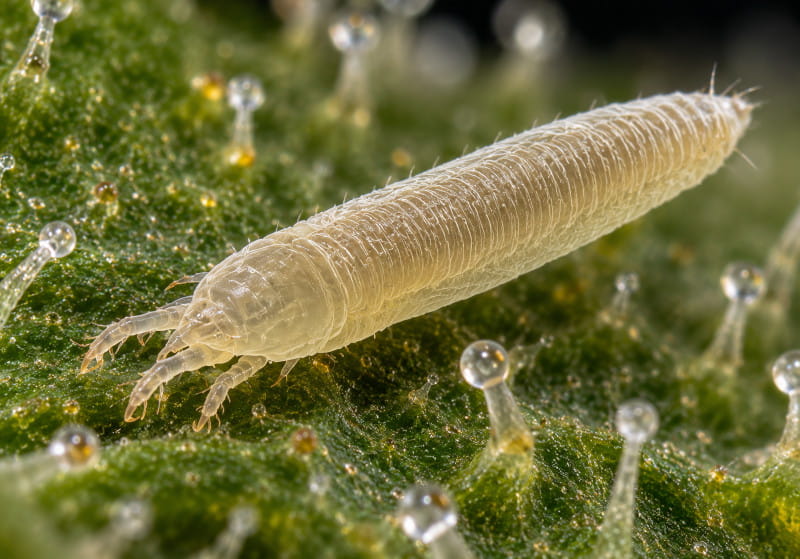
Hemp russet mites have a strikingly elongated, narrow and almost worm-shaped body. Adults reach a body length of approximately 0.1 to 0.2 millimetres, making them considerably smaller than many other cannabis pests. Their colour ranges from almost white and cream to pale yellow.
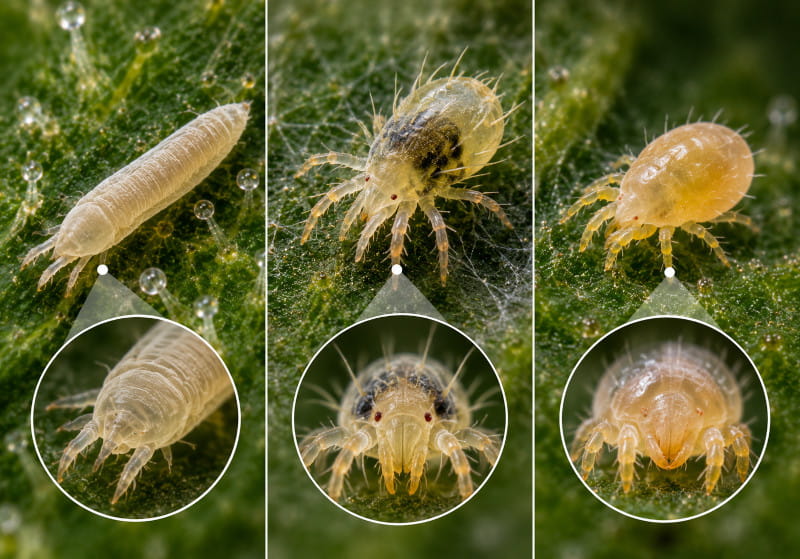
One particularly important identifying feature becomes visible under sufficient magnification: adult hemp russet mites have only two pairs of legs located at the front of the body. Adult spider mites, by contrast, have four pairs of legs and a distinctly different body shape. The combination of extremely small size, an elongated body and two pairs of legs is therefore particularly useful for microscopic differentiation.
|
Characteristic |
Hemp russet mite |
|
Scientific name |
Aculops cannabicola |
|
Family |
Eriophyidae |
|
Adult size |
approximately 0.1–0.2 mm |
|
Body shape |
elongated and worm-shaped |
|
Colour |
almost white, cream to pale yellow |
|
Legs |
two pairs of legs at the front of the body |
|
Webbing |
none |
Eggs, nymphs and adult hemp russet mites
The hemp russet mite develops from the egg through two nymphal stages to the adult mite. Young mites already resemble adults in body shape but are even smaller. The eggs are also extremely small and are practically impossible to identify reliably during a normal visual inspection.
How quickly a population develops depends, among other factors, on environmental conditions and the host plant. Various fixed development times and supposedly favourable temperatures are often cited in practice. However, such figures should not be regarded as universally applicable rules: the biology of Aculops cannabicola has been studied far less extensively than that of many other agriculturally important mite species. For control purposes, regular monitoring is therefore more informative than relying on a supposedly fixed life cycle.
Where are hemp russet mites found on the cannabis plant?
Hemp russet mites can colonise various above-ground parts of the cannabis plant. They have been detected on, among other areas, leaves, petioles and young growing regions. Because of their small size, they can also remain in protected areas of the plant, for example along leaf veins or between trichomes.
At the beginning of an infestation, particular attention should therefore be paid to leaf undersides, younger leaves and the area around new shoots. As population density increases, the mites can spread to additional leaves, petioles, shoots and eventually flowers. In a very heavy infestation, so many mites may be present on individual plant parts that the aggregations appear as a fine light to yellowish-brown coating.
What symptoms do hemp russet mites cause?
Typical indications of hemp russet mites include stunted growth, deformed new growth, curled leaf margins and yellowish to bronze changes in the leaves. How clearly these symptoms appear depends, among other factors, on infestation severity, plant stage and genetics. A particular damage pattern alone is therefore not sufficient to diagnose hemp russet mites reliably.
At first, new shoots may appear to develop more slowly or look unusually deformed. Young leaves may remain smaller, curl or roll upward at the edges. As the infestation progresses, yellowish, dull or bronze discolouration may appear. Severely damaged leaves can become brittle while the entire plant increasingly falls behind in growth.
In heavy infestations, flowers can also be colonised and their development impaired. Diagnosis as early as possible is therefore particularly important. The further flowering has progressed, the more difficult it becomes to select suitable measures because potential residues, additional moisture and the quality of the harvested material must be taken into account.
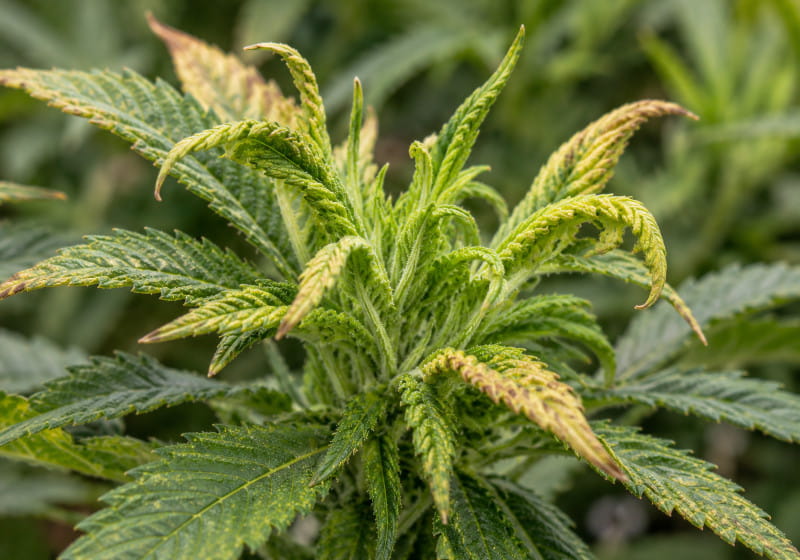
Deformed new growth, curled leaf margins or bronze discolouration may indicate hemp russet mites, but they are not proof of an infestation. Because similar changes can also be caused by other pests or plant problems, direct detection of the mites is particularly important for a reliable diagnosis.
Reliably identifying hemp russet mites: what magnification is useful?
Individual hemp russet mites can barely be identified reliably with the naked eye. Because of their small size, reliable assessment requires strong magnification with a suitable microscope or digital microscope. At lower magnification, the mites may become visible, but they can easily be overlooked, especially when infestation levels are low.
Do not examine only a single randomly selected leaf. Check several suspicious areas of the plant, especially leaf undersides, younger fully developed leaves, areas along the midrib and tissue around conspicuous shoot tips. If no mites are found during an initial inspection, this does not reliably rule out a light or locally restricted infestation.
Look for very small, pale and elongated mites with the body shape characteristic of eriophyids. If, instead, distinctly rounder to oval mites and fine pale stippling on the leaves are found, for example, spider mites on cannabis may be involved. In heavier spider mite infestations, the characteristic fine webbing may also appear.
Hemp russet mites, spider mites or broad mites?
Several mite species can infest cannabis, but they differ significantly in body shape, size and damage pattern. In particular, hemp russet mites and broad mites can cause similar changes in young plant tissue at first glance and are therefore occasionally confused. However, they are different pests that can be distinguished from one another under sufficient magnification.
|
Characteristic |
Hemp russet mite |
Spider mite |
Broad mite |
|
Typical species |
Aculops cannabicola |
Tetranychus urticae |
Polyphagotarsonemus latus |
|
Body shape |
elongated, worm-shaped |
roundish to oval |
oval |
|
Pairs of legs in adults |
2 pairs of legs |
4 pairs of legs |
4 pairs of legs |
|
Visibility |
very small, strong magnification useful |
larger and easier to identify with a magnifying glass |
very small, strong magnification useful |
|
Webbing |
no |
possible and typical in heavier infestations |
no |
|
Typical damage pattern |
deformed new growth, leaf curling, discolouration and stunted growth possible |
fine pale stippling on leaves, later stronger discolouration and webbing possible |
deformed, curled or stunted new growth possible |
|
Important for diagnosis |
directly detect elongated mites |
check damage pattern, mites and eggs; look for webbing |
direct detection and differentiation under magnification |
Distinguishing hemp russet mites from thrips and other plant problems
Also, thrips on cannabis can cause pale to silvery damage. More typical of thrips, however, are narrow, mobile insects, silvery-grey or scraped-looking feeding marks and often small black faecal spots. Hemp russet mites themselves are much smaller and have a completely different body shape.
Deformed or discoloured leaves can also occur without a pest infestation. Nutrient deficiencies, an unsuitable pH value, root-zone problems, excessive lighting, heat stress or mechanical stress can cause similar changes. In addition, cannabis wind burn can alter leaf margins and leaf posture.
For diagnosis, it is therefore crucial to consider the entire damage pattern and look for the actual cause. If hemp russet mites are detected, this supports a pest diagnosis, but it does not automatically rule out additional problems involving nutrient supply, roots, light or climate. With suspicious new growth, you should therefore neither fertilise prematurely or alter the pH nor apply a plant protection product without a confirmed diagnosis. The first step is to systematically narrow down the possible causes.
How do hemp russet mites spread?
Hemp russet mites can move from colonised areas of a plant into new tissue. Other pathways are more important over longer distances. Eriophyids can be dispersed passively by air movement; in cultivation, spread via infested plant material and cuttings is also particularly relevant.
A cutting can look healthy and still carry a small population that is difficult to detect. If it is introduced into an existing crop without quarantine, it can become a new starting point for spread. Working on several plants one after another can also mechanically transfer plant material or mites. Clean tools and a sensible working sequence are therefore part of IPM.
Fans do not “create” an infestation. However, air currents can promote passive dispersal when mites are already present. This does not mean that sensible air circulation should be abandoned. The key is to detect an infestation early and limit its spread between plants and rooms.
What should you do if you suspect hemp russet mites?
If an infestation is suspected, a fast but systematic approach is advisable. The affected plant should first be separated from unaffected plants as far as practically possible. Suspicious plant parts should then be examined under sufficient magnification.
The earlier an infestation is confirmed, the more options remain available. Especially when several plants are involved, do not inspect only the visibly affected plant; check directly neighbouring plants and shared plant material as well.
Controlling hemp russet mites: IPM instead of a single measure
For hemp russet mites, an integrated pest management approach makes more sense than relying on a single treatment. IPM – Integrated Pest Management – combines monitoring, hygiene, isolation, cultural or mechanical measures and, where appropriate and legally permitted, biological measures or authorised plant protection measures.
The goal is not only to reduce the existing population. It is equally important to prevent renewed spread from infested plants, cuttings or work areas and then monitor whether the population is actually declining.
1. Isolate infested plants and separate work routines
If the infestation is confirmed, affected plants should be separated from uninfested crops wherever possible. If possible, work on healthy plants first and infested plants last. Tools, hands or gloves and work surfaces should not be used between areas without appropriate cleaning or changing.
Particular caution is required with mother plants and cutting production. A persistently infested mother plant can repeatedly introduce new cuttings carrying mites into the crop. Therefore, treatment should not focus only on visible damage; the plant's role within the entire crop should also be considered.
2. Remove heavily infested plant material
Targeted removal of heavily colonised plant parts can reduce the number of mites present. Avoid carrying cut material through the grow room or placing it next to healthy plants. Infested plant material should be collected immediately and removed from the cultivation area.
For individual plants with very heavy infestations, it may be more sensible to remove the entire plant from the crop rather than maintaining a large population as a source of further spread over a prolonged period. This decision depends on infestation severity, plant stage, the number of plants and the possibility of spatial separation.
3. What do studies show about plant protection measures?
Scientific trials on industrial hemp have investigated various active ingredients and products against Aculops cannabicola. These include sulfur, mineral oils, rosemary oil and conventional acaricides. Results differed considerably in some field and greenhouse trials. This illustrates why individual trial results should not be transferred as universal treatment recommendations.
For example, a Colorado State University study showed substantial population reductions from sulfur treatments in the field system examined. Another study found clear effects for several tested treatments in the greenhouse, while only some treatments achieved strong suppression in the field.
Important: The fact that an active ingredient was effective against hemp russet mites in a scientific study does not mean that the corresponding product is authorised for cannabis in your country. Authorisations, permitted uses, pre-harvest intervals and residue limits vary between countries and products. Applications to flowers or material that will later be consumed must be assessed particularly critically with regard to regulation and possible residues. Use plant protection products only in accordance with the applicable authorisation and product label.
4. Do predatory mites help against Hemp Russet Mites?
Natural enemies are generally of interest for IPM, but the evidence for hemp russet mites is much less clear than, for example, for the two-spotted spider mite. Various predatory mites have been discussed or observed as possible natural enemies. However, the scientific literature indicates that commercially available biological control agents have not yet been reliably established as a stand-alone, economically effective control for high HRM populations.
Beneficial organisms should therefore not be presented with promises such as “predatory mite X eliminates hemp russet mites”. Whether a particular beneficial organism is useful depends on infestation severity, climate, production system, availability and any previous plant protection treatments. In professional systems, the strategy should be coordinated with the relevant beneficial-insect supplier or a qualified IPM adviser.
Research on the entomopathogenic fungus Hirsutella thompsonii is also of interest. A study published in 2024 confirmed infection of hemp russet mites under experimental conditions. However, the authors themselves emphasise that further research is needed. This is a good example of a promising research approach, but not yet a ready-made practical solution.
5. Hot-water treatment of cuttings: interesting, but not a general home remedy
A scientific study tested hot-water treatments for infested hemp cuttings. Certain experimental treatments substantially reduced the number of hemp russet mites without impairing rooting of the cuttings in that experiment. Such methods are particularly interesting for research and professional plant hygiene.
However, this should not be turned into a blanket recommendation to immerse arbitrary cannabis cuttings in hot water according to a fixed temperature-time schedule. Plant material, cultivar, initial condition, temperature control and experimental setup all play a role. In the Canna Wiki, we therefore treat such results as a scientific management option rather than an untested DIY recipe.
Why flowering makes control more difficult
The further flowering has progressed, the greater the restrictions become. Spray treatments can leave residues, increase moisture in dense flowers or affect later product quality. At the same time, mites may be located in areas that are difficult to reach.
This makes early monitoring particularly valuable. An infestation discovered during the vegetative phase can generally be managed with considerably more options than a high population shortly before harvest. Prevention and early detection are therefore not merely additions to control, but a central part of it.
How can hemp russet mites be prevented?
The most important preventive measure is to avoid introducing an infestation into the crop with new plant material in the first place. Anyone who raises plants themselves from cannabis seeds at least reduces the risk of introducing hemp russet mites through external cuttings or mother plants. New cuttings and mother plants should therefore not be placed immediately among established plants. A separate observation period makes it possible to identify symptoms and inspect samples under magnification.
Even apparently healthy cuttings deserve attention because a small population may be present before obvious damage develops. Regular monitoring of young shoots and leaves is particularly valuable. If you only reach for the microscope once entire plants are deformed, you lose the most important advantage: time.
|
Prevention |
Why it makes sense |
|
Keep new plants separate |
prevents an undetected infestation from immediately reaching the entire crop |
|
Inspect cuttings under magnification |
low populations may still appear inconspicuous externally |
|
Keep tools and work surfaces clean |
reduces mechanical transfer between plants |
|
Work on healthy plants before infested plants |
reduces the risk of spreading pests through work routines |
|
Regular monitoring |
increases the chance of detecting an infestation before severe plant damage occurs |
Does climate play a role with hemp russet mites?
As with other mites, environmental conditions influence development and population dynamics. For Aculops cannabicola, however, growers should not rely on a supposedly perfect temperature or humidity value as long as robust species-specific data are lacking. Blanket statements such as “lower the temperature to X °C and the russet mites will disappear” are not scientifically sound.
A stable plant climate nevertheless remains important because severely stressed plants are less able to compensate for additional problems. Temperature, relative humidity and leaf temperature should therefore be considered as part of the overall system. Our VPD calculator and guide explains these relationships – but not as a specific treatment for hemp russet mites.
How severely can hemp russet mites damage cannabis?
A heavy infestation can go far beyond cosmetic changes to the leaves. Scientific field trials show that high populations can significantly reduce biomass and cannabinoid yield. In one study, effective sulfur treatments under the experimental conditions prevented biomass losses of up to approximately 33 percent and losses in total cannabinoid yield of up to approximately 45 percent compared with untreated plants.
These figures are not a universally applicable prediction for every infestation. They come from a specific trial with defined cultivars, conditions and treatments. However, they show that hemp russet mites are not merely a cosmetic problem and that an infestation that remains undetected for a long time can substantially reduce yield.
Frequently asked questions about hemp russet mites on cannabis
Q: How can I identify hemp russet mites on cannabis?
A: Possible signs include deformed new growth, leaf curling, stunted growth and yellowish to bronze changes. However, these symptoms are not specific. For a reliable diagnosis, suspicious plant parts should be examined under strong magnification and the elongated, microscopic mites should be detected directly.
Q: Can Hemp Russet Mites be seen with the naked eye?
A: Individual hemp russet mites are only approximately 0.1 to 0.2 millimetres long and cannot be identified reliably with the naked eye. At extremely high population densities, the mass of mites may become visible as a fine coating, but magnification is required for identification.
Q: What magnification is needed for hemp russet mites?
A: Scientific studies describe the mites as detectable at around 20× magnification, although they can easily be overlooked at that level. For practical diagnosis, stronger magnification with a suitable microscope or digital microscope is advisable.
Q: Are hemp russet mites and broad mites the same thing?
A: No. The hemp russet mite Aculops cannabicola (also listed as Aculops cannibicola) belongs to the family Eriophyidae. The broad mite Polyphagotarsonemus latus, by contrast, belongs to the family Tarsonemidae. Both are very small and can cause deformed new growth, but biologically they are different pests.
Q: What is the difference between hemp russet mites and spider mites?
A: Hemp russet mites are elongated, microscopic and, as adults, have only two pairs of legs. Adult spider mites are more oval, have four pairs of legs and produce characteristic webbing in heavier infestations. Fine pale stippling is also a typical early damage pattern with spider mites.
Q: Can hemp russet mites be introduced through cuttings?
A: Yes. Infested plant material and clonal propagation are considered important pathways by which hemp russet mites can enter new crops. New cuttings should therefore be inspected separately before being placed together with established plants.
Q: Do fans spread hemp russet mites?
A: Air movement can contribute to the passive dispersal of very small eriophyids. However, a fan does not cause an infestation. What matters is whether the mites are already present in the crop. Sensible air circulation should therefore not simply be switched off; instead, the infestation should be isolated and controlled.
Q: Do predatory mites help against Hemp Russet Mites?
A: Predatory mites and other natural enemies are being investigated as possible components of biological control. For hemp russet mites, however, the evidence is less clear than for some other pests. Commercially available beneficial organisms should therefore not be regarded as a guaranteed stand-alone solution for a heavy infestation.
Q: Does a heavily infested cannabis plant have to be removed?
A: Not every infestation automatically requires disposal of the entire plant. However, removing an individual plant with a heavy infestation can make sense if it would otherwise serve as a persistent source of spread into a larger crop. Infestation severity, plant stage and the possibility of safe isolation are decisive factors.
Conclusion: Correct diagnosis is crucial with hemp russet mites
Hemp russet mites are among the cannabis pests for which visual inspection alone can quickly be misleading. Their small size and non-specific damage pattern explain why an infestation can be confused with nutrient problems, stress or other mites. This is precisely why systematic diagnosis is more important than rapid treatment based on suspicion.
Growers who inspect suspicious new growth early, observe new cuttings separately and combine isolation, hygiene, monitoring and appropriate measures when an infestation occurs are in a much better position to limit its spread. The basic principle always remains the same: identify first, then act specifically.
Scientific sources and further information
The biology and control of the hemp russet mite continue to be researched. Knowledge gaps remain, particularly regarding the life cycle, natural control and the transferability of individual control trials. For this reason, this guide primarily draws on scientific studies and university specialist information. Trial results involving plant protection products do not constitute an authorisation or application recommendation for cannabis.
• Hayes, C. B., Carter, O., MacWilliams, J. R., Cranshaw, W., Chaparro, J. M., Prenni, J. E. & Nachappa, P. (2023): Biology and management of hemp russet mite (Acari: Eriophyidae). Journal of Economic Entomology, 116(5), 1706–1714.
• Petanović, R., Magud, B. & Smiljanić, D. (2007): The hemp russet mite Aculops cannabicola (Farkas, 1960) (Acari: Eriophyoidea) found on Cannabis sativa L. in Serbia: Supplement to the description. Archives of Biological Sciences, 59(1), 81–85.
• Szczepaniec, A. et al. (2024): Suppression of hemp russet mite, Aculops cannabicola (Acari: Eriophyidae), in industrial hemp in greenhouse and field. Environmental Entomology, 53(1), 18–25.
• Ricciardi, M. M., Smith, H., Viloria, Z., Dixon, E., Szarka, D., Pearce, R., Gauthier, N. & Villanueva, R. T. (2024): First Report of Hirsutella thompsonii as an Entomopathogenic Fungus of Hemp Russet Mite (Aculops cannabicola) in Kentucky. Plant Health Progress, 25(1), 92–94.
• University of California, Davis: Integrated Pest Management – Hemp. Overview of scientific IPM resources for hemp.