Thrips on Cannabis – Identify Damage & Stop an Infestation
Recognizing thrips infestations, assessing them correctly and reducing them sustainably
Updated: August 2026 | Learn how to recognize thrips on cannabis, which silvery feeding marks and black fecal spots are typical, how thrips differ from spider mites and which mechanical, biological and preventive measures are useful.
Author: Cannapot Grow Team | Reading time: approximately twenty-five minutes
Key Facts at a Glance
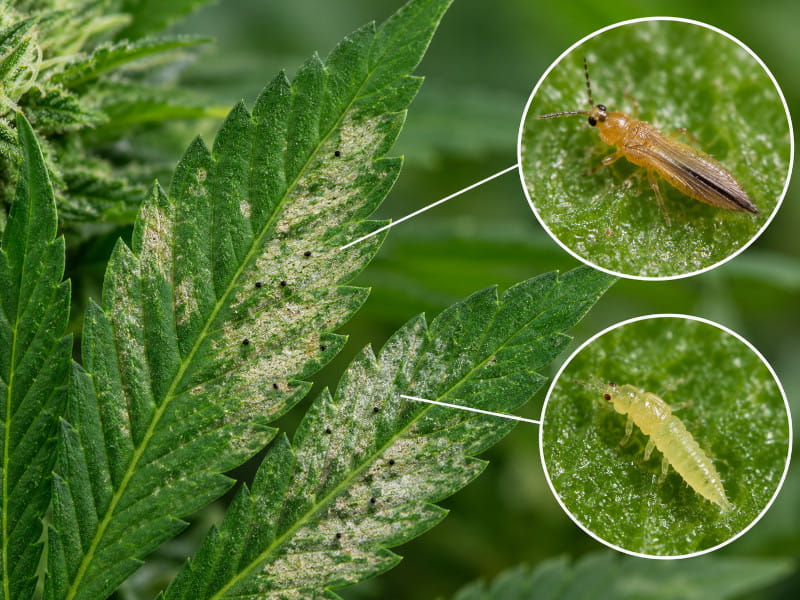
✓ Thrips are slender insects, usually only about one to two millimeters long. On cannabis, an infestation often first appears as silvery-gray, dull or scraped-looking leaf surfaces as well as small black fecal spots.
✓ Young thrips larvae are usually pale, yellowish to almost transparent and prefer protected areas and the undersides of leaves. Adult thrips are elongated, mobile and, depending on the species, yellowish, brown or distinctly darker in color.
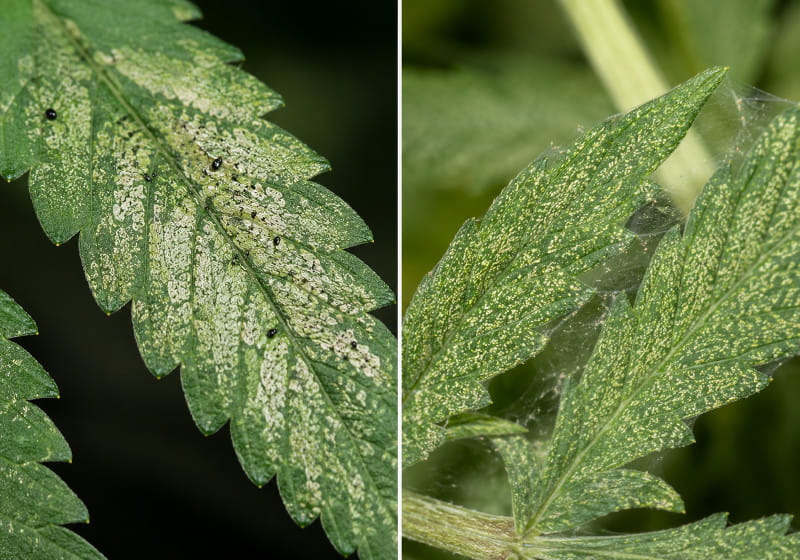
✓ Thrips can usually be distinguished quite well from spider mites: silvery feeding marks and black fecal spots are typical. Spider mites, by contrast, tend to cause fine pale stippling on the leaves and, in heavier infestations, characteristic webbing.
✓ A single measure is often not enough. Eggs can be protected inside plant tissue, larvae feed on above-ground plant parts and prepupae or pupae of important thrips species are often found in the substrate or in other protected places.
✓ Beneficial organisms can be used specifically against different stages. Predatory mites such as Neoseiulus cucumeris or Amblyseius swirskii mainly attack young thrips larvae, while Orius predatory bugs also prey on larger larvae and adult thrips.
✓ Prevention mainly relies on regular inspection: keep new plants separate at first, check leaf undersides, use sticky traps for monitoring and remove plant debris. After an infestation, the crop should be monitored over a longer period so that newly emerging thrips can be detected early.
Silvery or dull-looking areas on cannabis leaves can at first glance resemble a nutrient deficiency in cannabis, mechanical damage or the beginning of a spider mite infestation. However, if tiny elongated animals, pale larvae or small black dots are also present on the affected leaves, you should specifically check for thrips. These fringed-wing insects can occur both indoors and outdoors and, under favorable conditions, persist through several generations within a plant population.
For reliable control, simply removing the visible adult insects is not enough. Thrips pass through egg, larval, prepupal, pupal and adult stages. Some of these stages are located directly on or inside the plant, while others in important species are often found in the substrate or in protected places. A combination of accurate diagnosis, mechanical reduction, monitoring, biological measures and consistent follow-up checks is therefore usually more effective than a single measure.
What are thrips on cannabis?
Thrips are tiny, slender insects that can damage cannabis leaves, young shoots and other parts of the plant. Typical signs are silvery-gray or scraped-looking areas on the leaves, often accompanied by small black fecal spots.
Thrips belong to the order Thysanoptera and are also known as fringed-wing insects. In horticulture, important species include Frankliniella occidentalis, the western flower thrips, and Thrips tabaci. Unlike spider mites, thrips are not mites but insects. Adults have a narrow, elongated body and very narrow wings with conspicuous fringes along the edges – hence the name fringed-wing insects.
When feeding, plant-damaging thrips injure cells near the plant surface and remove their contents. The affected cells are damaged and reflect light differently from healthy leaf tissue. This creates the characteristic silvery, pale or dull-looking feeding marks that often make a thrips infestation on cannabis visible at an early stage.
What do thrips and their larvae look like?
Adult thrips look like very small, narrow, moving lines to the naked eye. The larvae are similarly elongated but usually lighter in color, wingless and, depending on the stage, whitish, yellowish or orange-yellow.
Many thrips relevant to horticulture are approximately one to two millimeters long. Their small size makes identification without a magnifying glass difficult. In Frankliniella occidentalis, adult females can vary in color from pale to almost black. The larvae are initially transparent to whitish and later become yellowish to orange-yellow. During inspection, they often look like tiny pale sticks moving slowly across the leaf.
Adult insects have fully developed, narrow wings. The two resting phases before adulthood – prepupa and pupa – already show developing wing pads but do not feed. In Frankliniella occidentalis, pupation often takes place in the soil, although it can also occur on leaves, in flowers or in other protected places.
| Stage | Typical appearance | Where you can find it |
| Egg | Barely visible to the naked eye | In important species, directly inside soft plant tissue |
| Larva I / II | Pale, slender, wingless; whitish to yellowish or orange-yellow | On leaves, young shoots and protected parts of the plant |
| Prepupa / pupa | With visible wing pads, only slightly mobile and non-feeding | Often in the substrate or in protected places |
| Adult | Very slender, about 1–2 mm, light to dark depending on species and form, with fringed wings | On leaves, shoots and flowers; flying adults also on sticky traps |
How do you recognize a thrips infestation on cannabis?
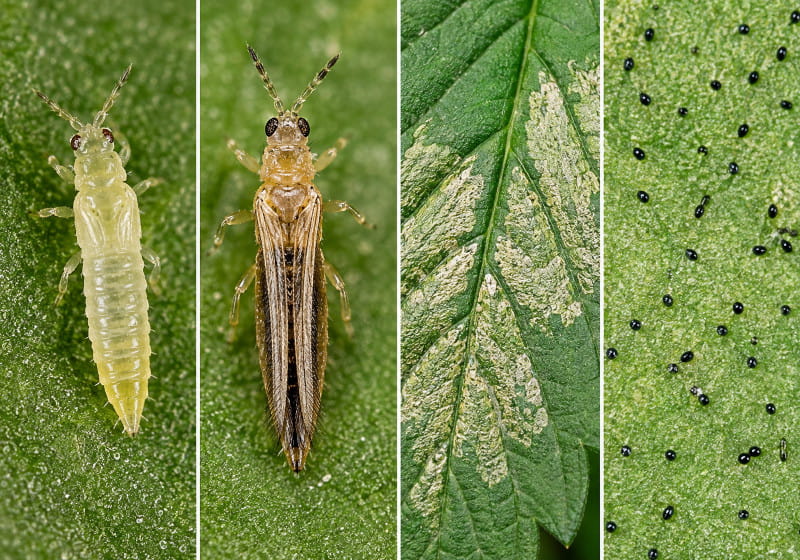
Typical signs of thrips on cannabis are silvery-gray or scraped-looking areas on the leaves, small black fecal spots and tiny elongated insects. The combination of several of these features is particularly informative.
An early infestation is often noticeable only through a few short silvery lines, pale speckles or irregular feeding marks. At first these may remain limited to small areas of a leaf and are therefore easily overlooked. As the infestation progresses, the damaged areas become larger, appear dull or silvery and may later turn brown or dry out.
Another important clue is small black to dark-brown dots directly on or next to damaged areas. These are often thrips feces. If you find silvery feeding marks as well as elongated pale larvae or adult thrips next to such fecal spots, this is a much stronger indication of infestation than a single leaf discoloration alone.
| Infestation stage | Typical signs | What else you should check |
| Early | Individual silvery speckles, short pale streaks, a few dark dots | Check leaf undersides and young leaves with a magnifying glass |
| Moderate | Larger silvery-gray areas, several fecal spots, visible larvae or adults | Check neighboring plants and sticky traps |
| Heavy | Extensive damage, dull or dry leaves, deformed new growth and slowed development | Include the entire crop and substrate strategy |
Why do silvery spots and black dots appear?
The silvery areas appear because thrips injure and suck out plant cells close to the surface. The damaged or emptied cells reflect light differently from healthy leaf tissue.
As a result, the affected areas initially look silvery-gray, pale or dull. With a longer-lasting or heavier infestation, the damaged tissue can discolor further, dry out or become necrotic. If the damage occurs on very young leaves, they may become deformed, curl or develop unevenly as they continue to grow.
The dark dots, by contrast, do not come from the plant tissue itself. They are thrips feces. Small black dots directly next to silvery feeding marks are a strong indication of a thrips infestation.
Not every unusual change on a leaf is caused by thrips. You can find an overview of other typical damage patterns, diseases and causes in our guide to cannabis plant problems & diseases.
What damage do thrips cause to cannabis?
Thrips damage cannabis primarily by reducing functional leaf area. In a heavy infestation, young leaves can become deformed, growth can slow and larger areas of leaves can die off.
A single small feeding spot is normally not a serious problem for a vigorous cannabis plant. An infestation becomes more critical when the population continues to develop and damages more and more new leaves. Because the affected cells can perform less or no photosynthesis, the usable leaf area decreases. On seedlings and small plants, this effect can become noticeable faster than on large, well-established plants.
Fresh, still-growing tissue is particularly sensitive. If young leaves or shoot tips are repeatedly damaged, they can become deformed or remain stunted. Thrips can also occur on flowers, where dense plant structures make direct visual inspection more difficult.
Thrips or spider mites – how can you tell the difference?
Thrips and spider mites can leave similar pale damage on cannabis leaves. Thrips, however, more typically leave silvery, scraped-looking feeding marks and small black fecal spots. Spider mites usually cause fine pale stippling and, in heavier infestations, characteristic webbing.
Confusion is especially possible in the early stages. Therefore, do not look only at individual spots, but at the overall damage pattern and the pests themselves. Thrips are slender, elongated insects and often look like tiny moving lines to the naked eye. Spider mites are much smaller, more rounded to oval and belong to the arachnids. Fine webbing on leaf undersides, petioles or between plant parts is a particularly clear sign of an advanced spider mite infestation.
| Feature | Thrips | Spider mites |
| Appearance | Slender and elongated, like a tiny moving line | Very small, more rounded to oval and often clearly visible only with a magnifying glass |
| Typical damage | Silvery, dull or scraped-looking areas and streaks | Many fine pale dots or speckles on the leaves |
| Black fecal spots | Often visible in or next to silvery feeding marks | Not a typical key identification feature |
| Webbing | No typical webbing | Characteristic in advanced infestations |
| Development | Prepupae and pupae of important species may be in the substrate or protected places | No comparable prepupal or pupal stage in the substrate |
If instead of silvery feeding marks you mainly see numerous fine pale dots or already visible webbing, you should check for a spider mite infestation. In our detailed guide to spider mites on cannabis you will find typical damage patterns, identification features and suitable countermeasures.
What is the life cycle of thrips?
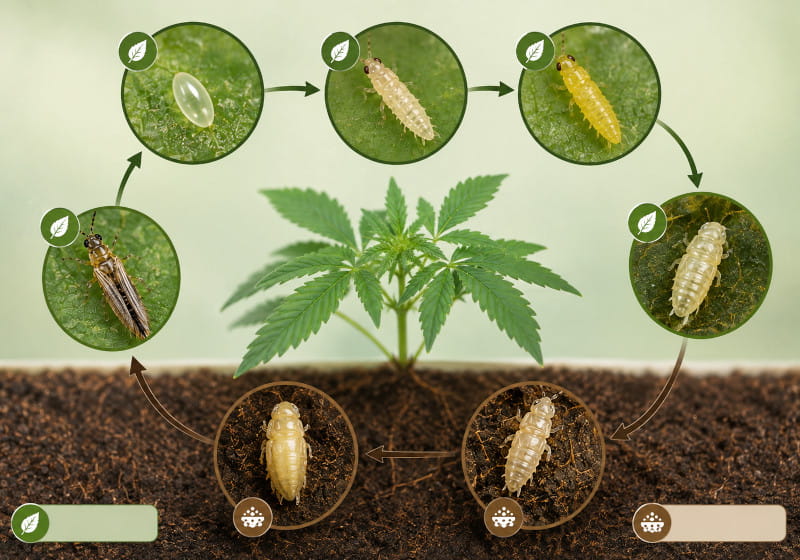
Thrips pass through several developmental stages: egg, two feeding larval stages, prepupa, pupa and finally the adult insect. This life cycle is crucial for control because not all stages are in the same place or can be reached with the same measure.
In western flower thrips, the female uses an ovipositor to insert its eggs directly into soft plant tissue, for example leaves, petals or young stem areas. There the eggs are protected from many surface-acting measures. After hatching, two mobile larval stages follow. The larvae feed on the plant and contribute significantly to the visible feeding damage.
The larvae then develop into prepupae and pupae. These two stages no longer feed. In Frankliniella occidentalis, pupation often takes place in the soil or substrate, but can also occur on leaves, in flowers or in other protected areas. An adult thrips eventually emerges from the pupa, can recolonize the plant and lay more eggs.
| Developmental stage | Where & what happens? | Importance for control |
| Egg | Protected inside plant tissue | Difficult to reach with purely surface-acting measures |
| Larvae | Mobile and feeding on leaves and other plant parts | Important target for predatory mites and suitable contact treatments |
| Prepupa / pupa | Non-feeding; in important species often in the substrate or protected places | Soil-dwelling predatory mites or suitable nematodes can complement control |
| Adult thrips | Mobile, winged and capable of laying more eggs | Sticky traps support monitoring; Orius predatory bugs can also prey on adult thrips |
How do thrips get into the grow?
Thrips are not caused by incorrect care. They have to enter the plant population – for example via new plants or cuttings, by flying in from outside or through already infested plant material.
Indoors, newly introduced plants are a particularly important risk factor. A cutting or another plant may already carry eggs in the tissue or inconspicuous larvae even though no obvious damage is visible at first glance. Other houseplants near the grow area can also serve as hosts.
Outdoors, thrips can fly in from surrounding host plants or be carried by air currents. Although thrips are not particularly strong sustained fliers, wind can distribute them over greater distances. An outdoor crop therefore cannot be completely protected against immigration.
Which conditions favor a thrips infestation?
Thrips are not caused by heat or incorrect care; they must first reach the plants. Once introduced or after arriving from outside, warm conditions and a sufficient supply of suitable host plants can promote reproduction and spread.
How quickly individual thrips develop into a larger population depends, among other things, on the species, temperature, availability of host plants and natural enemies present. In some species, development time becomes significantly shorter as temperatures rise. An initially inconspicuous infestation can therefore spread within a relatively short time under favorable conditions.
Indoors, weather and many natural enemies are also absent as regulating factors. Once a thrips population has become established in a grow tent or enclosed room, it can continuously find suitable host plants and protected places for development. Regular inspections and early intervention are therefore particularly important.
Thrips indoors or outdoors – what is the difference?
Thrips can infest cannabis both indoors and outdoors. Indoors they are usually introduced and can then establish themselves in the enclosed growing area. Outdoors, new insects can repeatedly reach the plants from the surrounding environment.
Indoors, plants, the substrate surface, hygiene and pest control can be monitored comparatively well. At the same time, an introduced infestation can spread unnoticed throughout the crop. Cuttings and other newly introduced plants should therefore be checked thoroughly and initially kept separate from existing plants.
Outdoors, immigration can hardly be prevented completely. Adult thrips can move from neighboring host plants onto cannabis and may also be dispersed by air currents. At the same time, weather conditions and natural enemies influence the population outdoors. You can find an overview of other typical outdoor pests in our guide to outdoor pests on cannabis.
At remote outdoor locations, regular checks are often more difficult, so an infestation may only be noticed later. You can find more information about site selection, care and the particular challenges of concealed outdoor cultivation in our detailed guide to guerrilla growing.
| Aspect | Indoor | Outdoor |
| How thrips reach the plant | Mainly via cuttings, new plants or other plant material | Immigration from surrounding host plants and partial dispersal by air currents |
| Monitoring | Easy to plan through regular plant inspections and sticky traps | Regular checks are useful, but renewed immigration remains possible |
| Use of beneficial organisms | Can be well controlled if temperature, humidity and other measures suit the beneficial organisms being used | Possible, but more strongly influenced by weather, natural enemies and dispersal |
| Main focus | Prevent introduction, detect infestations early and address several developmental stages at the same time | Inspect plants regularly, detect infestations early and limit damage |
How do you properly inspect cannabis for thrips?
If you suspect thrips, do not inspect only the tops of leaves. Specifically check leaf undersides, young leaves, shoot tips and other protected plant areas for silvery feeding marks, black fecal spots, pale larvae and elongated adult thrips.
- Examine suspicious leaves closely: Inspect silvery, dull or scraped-looking areas with a magnifying glass if possible. Pay particular attention to the transitions between healthy and damaged leaf tissue.
- Check leaf undersides: Carefully turn suspicious leaves over and also inspect leaf veins and protected areas. Pale thrips larvae can often be found more easily there.
- Look for black fecal spots: Small black to dark-brown dots in or next to silvery feeding marks are an important additional indication of thrips.
- Use a white surface: Hold a white sheet of paper under a suspicious shoot and tap it gently. Thrips and larvae that fall off are easier to see against the light background.
- Check sticky traps: Sticky traps help detect flying adult thrips and track changes in the population over repeated checks. They are mainly used for monitoring and are not sufficient as a control measure on their own.
- Repeat inspections regularly: Even if you do not find any insects, eggs may still be present in plant tissue or other developmental stages may remain. Therefore, continue checking suspicious plants over a longer period.
Do blue or yellow sticky traps help against thrips?
Blue sticky traps are used specifically for thrips monitoring. Yellow traps can also catch thrips, but they are less specific and attract many other flying insects.
Sticky traps are particularly useful for detecting adult flying insects early and observing how an infestation develops. If the number of trapped thrips rises from one inspection to the next, this indicates an active population or continued immigration. If the number drops after countermeasures, it may indicate that infestation pressure is decreasing.
Sticky traps are not sufficient as the only control measure. Eggs in plant tissue, larvae on the plant and pupae in the substrate are not reliably eliminated by them. Sticky traps are therefore mainly a monitoring tool and a way to reduce part of the adult population.
How can you control thrips on cannabis?
With a thrips infestation, a combination of several measures is useful: contain the infestation, reduce visible thrips and larvae, address different developmental stages and then monitor the plants over a longer period.
Which measures are appropriate depends, among other things, on the severity of the infestation, the plants' developmental stage and whether the cannabis is grown indoors or outdoors. If detected early, the population can often first be reduced mechanically and controlled with suitable beneficial organisms. In a heavier infestation, it is especially important not to focus only on visible adult thrips because eggs, larvae and pupae may be present at the same time.
Isolate infested plants
Indoors, infested plants should be separated from plants that still appear unaffected whenever this can be done without unnecessarily spreading the insects. This reduces the risk of thrips moving to additional plants. Afterwards, inspect the immediately neighboring plants particularly thoroughly.
Remove heavily damaged leaves
Individual leaves that are heavily damaged and clearly infested can be removed as long as this does not unnecessarily defoliate the plant. This also removes some of the larvae and adult thrips present on those leaves. Removed plant material should be taken directly out of the growing area and not left beside the plants.
Mechanically reduce thrips
On suitable plants, leaves can be carefully rinsed or wiped to remove some mobile thrips and larvae. Pay particular attention to leaf undersides and other protected areas. Such a measure can reduce the population but does not completely end the infestation: eggs may remain protected in plant tissue and pupae of important thrips species may still be present in the substrate or other protected places.
Continue monitoring and plant inspections
After the first measures, continue using sticky traps and direct plant inspections. What matters is not only whether no adult thrips are visible immediately after treatment. New insects can later emerge from eggs and pupae already present. Therefore, continue checking leaf undersides, young shoots and already damaged plant areas over a longer period.
Which beneficial organisms help against thrips?
Various beneficial organisms are available for biological thrips control. It is especially useful to choose them according to the pest's developmental stage and the existing climate conditions.
Predatory mites from the Amblyseius or Neoseiulus groups are used primarily against young thrips larvae on above-ground plant parts. Soil-dwelling predatory mites, by contrast, attack thrips pupae in the substrate. Steinernema feltiae can also be used against mobile thrips stages and stages present in the substrate. Orius predatory bugs are particularly interesting because they also prey on larger larvae and adult thrips.
| Beneficial organism | Target stage | Practical role |
| Neoseiulus cucumeris | Mainly young thrips larvae | Classic predatory mite for preventive or early biological control on plants |
| Amblyseius swirskii | Young thrips larvae | Very active leaf-dweller; particularly useful under warmer conditions |
| Orius species | Larvae and adult thrips | Predatory bugs that can also prey on larger or adult thrips |
| Soil-dwelling predatory mites, e.g. Stratiolaelaps/Hypoaspis | Soil stages, especially pupae | Complement leaf-dwelling beneficial organisms by attacking developmental stages in the substrate |
| Steinernema feltiae | Mobile stages and pupae in the substrate | Entomopathogenic nematodes as an additional biological measure |
Which predatory mite is suitable against thrips?
Neoseiulus cucumeris and Amblyseius swirskii are among the predatory mites frequently used against young thrips larvae. Which species is more suitable depends mainly on climate and application conditions.
Neoseiulus cucumeris has long been used for thrips control. The mites search the plants for young larvae. They are particularly suitable for an early or preventive strategy because larger thrips stages are not their main target.
Amblyseius swirskii is also active against young thrips stages and is used especially under warmer growing conditions. Neither species replaces a substrate strategy if many pupae are already present there.
When are Orius predatory bugs useful?
Orius predatory bugs are particularly useful when a thrips infestation is already established because they can prey on adult thrips as well as larvae.
They therefore complement predatory mites, which mainly feed on young larvae. Orius species are polyphagous predators and can also feed on other small insects, pollen and plant juices. However, the relevant cultivation and climate conditions must be suitable for successful establishment.
Do nematodes and soil-dwelling predatory mites help against thrips?
Yes. Soil-dwelling predatory mites and suitable entomopathogenic nematodes can complement control because prepupae and pupae of important thrips species are often found in the substrate.
Soil-dwelling predatory mites such as Stratiolaelaps, or beneficial mites traditionally referred to as Hypoaspis species, move through the upper substrate layer and can prey on thrips pupae there. This allows them to attack a developmental stage that many leaf-dwelling predatory mites do not reach.
Steinernema feltiae can also be used against thrips. In the substrate, these nematodes parasitize pupal stages among others. They require sufficient moisture because they move in a film of water. Their use must therefore always fit the crop, substrate and moisture management.
Neem oil, potassium soap and other sprays – what should you consider?
Contact treatments can reduce mobile thrips and larvae but do not automatically reach every developmental stage. Eggs can be protected inside plant tissue, while pupae of important thrips species may occur in the substrate or other protected places. A single spray treatment is therefore often not enough.
With contact treatments, it is crucial that the areas actually infested are reached. Thrips and their larvae are often found on leaf undersides, young leaves and other protected plant parts. If only the clearly visible upper leaf surfaces are treated, a large part of the population may remain untouched.
Neem-based preparations, potassium soaps and other contact treatments are used in horticulture against various pests. Whether a particular product is suitable and permitted for cannabis depends on the product itself, the intended use and the applicable regulations. Always follow the manufacturer's instructions and the rules that apply at your location.
Particular caution is advisable during flowering. Sprays can leave residues on flowers, introduce additional moisture into dense plant material and potentially affect beneficial organisms that have already been released. The further flowering has progressed, the more important it becomes to carefully weigh the available measures.
Which strategy suits which infestation level?
The earlier you detect a thrips infestation, the easier it usually is to contain the population. With a light infestation, mechanical reduction, regular monitoring and early use of beneficial organisms are the main priorities. With a heavier infestation, several developmental stages and the entire plant population must be considered.
| Infestation level | Useful measures | Further monitoring |
| Early / light | Separate infested plants where possible, mechanically reduce visible thrips and larvae, use sticky traps and introduce suitable predatory mites early | Check leaf undersides, young shoots and sticky traps several times per week |
| Moderate | Address larvae on the plant and developmental stages in the substrate; consider combining suitable beneficial organisms and remove heavily infested leaves | Continue inspections over a longer period and pay particular attention to newly appearing larvae and adult thrips |
| Heavy | Inspect the entire crop, remove heavily damaged plant material and combine measures against thrips on the plant with measures against developmental stages in the substrate | Continue close monitoring and do not stop control simply because adult thrips are temporarily no longer visible |
Thrips during cannabis flowering – what is different?
During flowering, particular caution is required with spray treatments. The denser and more developed the flowers are, the more important measures become that avoid getting liquid or residues on the flowers wherever possible – such as mechanical reduction, suitable beneficial organisms, monitoring and consistent hygiene.
Dense cannabis flowers dry much more slowly than open leaf surfaces. Liquid applications can introduce additional moisture between the flowers, where it may dry only slowly. Residues can also remain on the plant material. A measure that may still be an option during the vegetative phase is therefore not automatically the right choice in advanced flowering.
Suitable beneficial organisms can be particularly useful during flowering because no spray solution has to be applied to the flowers. Which species is appropriate depends on the developmental stage of the thrips, the severity of the infestation, temperature and humidity. With a heavier infestation, the plants should also be checked carefully for damaged or heavily contaminated areas.
How can you prevent thrips on cannabis?
Completely excluding thrips is especially difficult outdoors. Indoors, however, the risk can be reduced considerably if new plants are inspected, kept separate for a period of time and the crop is monitored regularly.
- Inspect new plants: Thoroughly check cuttings and other new arrivals for feeding marks, fecal spots and larvae before they come into contact with the rest of the crop.
- Use quarantine: Keep new plants separate at first and inspect them repeatedly, as eggs in the tissue may go unnoticed during the first check.
- Use sticky traps early: This can reveal adult thrips before obvious damage becomes visible.
- Remove plant debris: Do not leave fallen leaves and cut plant material in the grow area or on the substrate for extended periods.
- Check leaf undersides: Regularly inspect especially young leaves and protected areas with a magnifying glass.
- Keep tools and hands clean: After working on infested plants, do not immediately continue working on unaffected plants without cleaning your tools.
- React early: A small population is easier to contain than an infestation in which several developmental stages are already distributed throughout the crop.
Especially with your first plants, a consistent routine of inspection, hygiene and early response helps you recognize pest problems more quickly. We also explain the most important basics, from site and care to typical beginner mistakes, in our guide growing cannabis without experience.
Which mistakes make a thrips infestation especially persistent?
Thrips remain particularly persistent when only visible adults are controlled, eggs and soil stages are ignored or monitoring is stopped too early after a short-term improvement.
| Common mistake | Why it is a problem |
| Only setting up sticky traps | They mainly catch some of the adults, but not eggs and larvae on the plant or pupae in the substrate |
| Treating only once | Larvae or adults emerging later can make the infestation visible again |
| Ignoring soil stages | In species that pupate in the substrate, an important part of the life cycle remains untreated |
| Combining beneficial organisms with unsuitable sprays | The products can also harm the beneficial organisms being used and make the biological strategy ineffective |
| Spraying flowers without sufficient caution | Residues and additional moisture in dense flowers can create new problems |
| Checking only visible damage | New larvae may already be present before large silvery areas appear again |
Can thrips seriously damage a cannabis plant?
Yes. A light infestation usually causes local leaf damage at first, but a heavy and prolonged infestation can damage large leaf areas, deform young shoots and significantly slow plant development.
How severe the effects are depends, among other things, on plant size, developmental stage and duration of the infestation. A large healthy plant can compensate for individual damaged leaves better than a small cutting. If the population remains active over a longer period, however, new damage continuously appears and the available photosynthetic leaf area decreases.
Not every individual thrips is therefore an emergency, but a reproducing population should not be ignored either. The earlier the infestation is identified with certainty, the less invasive later countermeasures usually need to be.
Do thrips also live in the soil?
Thrips do not live exclusively on the plant. In important thrips species, prepupae and pupae may be present in the soil or substrate, while actively feeding larvae are found mainly on above-ground plant parts.
The statement “thrips live in the soil” is therefore only partly correct. The substrate serves as a protected location for certain developmental stages, while the typical feeding damage occurs mainly on leaves and other plant parts. A successful control strategy should therefore address both areas: treating only the substrate does not reach feeding larvae on the plant. Focusing only on the leaves, on the other hand, can overlook prepupae and pupae in the substrate.
How long does it take to get rid of thrips?
There is no universal answer for how long control takes. Important factors include the thrips species, temperature, severity of the infestation and the measures chosen. Above all, monitoring should not stop as soon as adult thrips are no longer visible.
Thrips development depends on temperature and can proceed faster under warm conditions. At the same time, protected eggs may still be present in plant tissue or pupae may remain in the substrate even if no insects are temporarily found on the leaves. You should therefore continue inspecting the plants regularly for an extended period even after the infestation has clearly declined.
Do not look only for adult thrips; pay particular attention to newly appearing larvae, fresh silvery feeding marks and black fecal spots. If these signs remain absent across several inspections, that is a much better indication of successful containment than a single day without visible insects.
FAQs about thrips on cannabis
Q: How do I recognize thrips on cannabis?
A: Typical signs are silvery-gray or scraped-looking feeding marks, small black fecal spots and tiny elongated insects on the leaves. Young thrips larvae are usually pale to yellowish, while adults can appear distinctly darker depending on the species.
Q: What do thrips larvae look like?
A: Thrips larvae are small, slender and wingless. Depending on species and developmental stage, they may look transparent, whitish, yellowish or orange-yellow and often resemble tiny pale sticks to the naked eye.
Q: What do silvery spots on cannabis leaves mean?
A: Silvery or dull areas can indicate thrips, but they can also have other causes. Therefore, also look for black fecal spots, pale larvae or elongated adult thrips before concluding that there is an infestation.
Q: What are the small black dots next to the feeding marks?
A: During a thrips infestation, these are often the insects' feces. The combination of black fecal spots and silvery-looking feeding marks is an especially important indication of thrips.
Q: How can I tell thrips and spider mites apart?
A: Thrips tend to leave silvery, scraped-looking feeding marks and often black fecal spots. Spider mites usually cause numerous fine pale speckles and, in advanced infestations, characteristic webbing.
Q: Do thrips also live in the soil?
A: Partly. In important thrips species, prepupae and pupae may be found in the soil or substrate. The actively feeding larvae, however, are mainly found on above-ground plant parts.
Q: Which predatory mites help against thrips?
A: Commonly used species include Neoseiulus cucumeris and Amblyseius swirskii. Both mainly prey on young thrips larvae. Which predatory mite is suitable depends, among other things, on temperature and humidity.
Q: Do blue or yellow sticky traps help against thrips?
A: Both can catch adult thrips and help with monitoring. Blue traps are used especially for monitoring thrips. Sticky traps, however, do not capture eggs or all larvae and pupae and are therefore not sufficient for control on their own.
Q: Can thrips be controlled with neem oil?
A: Neem-based preparations are used in horticulture against various pests. However, it must be checked whether a specific product is suitable and permitted for cannabis, the respective cultivation phase and the intended application. Compatibility with beneficial organisms already in use should also be considered.
Q: Is a single treatment enough against thrips?
A: Often not. While visible thrips and larvae are reduced, protected eggs may remain in plant tissue or pupae may remain in the substrate. Repeated inspections and measures against different developmental stages are therefore important.
Detect thrips infestations early and contain them effectively
The earlier thrips are detected, the easier it is to prevent individual feeding marks from developing into a larger infestation. Accurate diagnosis, regular inspections and measures that take the insects' life cycle into account are crucial.
Silvery feeding marks, black fecal spots and elongated insects provide important clues. At the same time, distinguishing thrips from spider mites and other plant problems helps avoid unnecessary or unsuitable measures. Once an infestation is confirmed, not only the visible thrips on the leaves but also protected eggs and possible developmental stages in the substrate should be taken into account.
Follow-up monitoring remains especially important: indoors, overlooked developmental stages can produce a new generation, while outdoors new thrips can also immigrate from the surrounding environment at any time. Regularly checking leaf undersides, young shoots and already damaged areas helps detect renewed infestation as early as possible.
Sources and further information
- Koppert – Western flower thrips: life cycle, appearance and damage symptoms
- Chamber of Agriculture of North Rhine-Westphalia – Thrips as pests and biological control
- Chamber of Agriculture of North Rhine-Westphalia – Amblyseius species for thrips control
- Chamber of Agriculture of North Rhine-Westphalia – Steinernema feltiae for thrips control
- Hortipendium – Thrips / fringed-wing insects: characteristics, feeding and damage symptoms
- Neudorff – Recognizing and controlling thrips: damage symptoms, fecal spots and plant inspection