Slurricane - Genetics, Effects, Aroma & Grow
Slurricane Strain Guide: Genetics, Effects, Aroma & Grow
Updated: August 2026 | Slurricane explained in detail: origin, genetics, strain profile, effects, THC, aroma, terpenes, phenotypes, plus tips for indoor and outdoor grows.
Author: Cannapot Grow Team | Reading time: approximately twenty minutes
The Most Important Points at a Glance
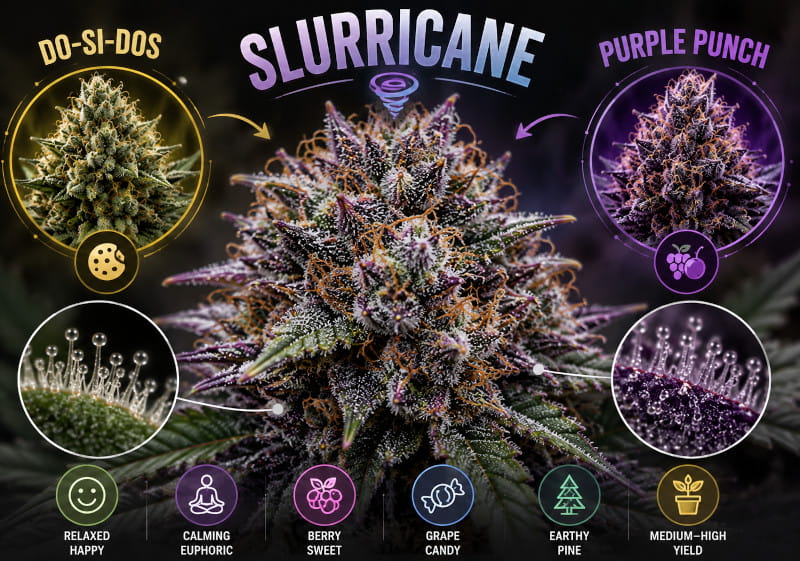
✓Slurricane is an indica-dominant hybrid strain developed by In House Genetics from Do-Si-Dos and Purple Punch.
✓ Typical notes include sweet berries and grapes, creamy nuances, as well as earthy, spicy and sometimes clearly noticeable OG or gas aromas.
✓ The effects are often described as pleasantly euphoric at first and increasingly physically relaxing afterward. Strength and progression, however, depend on dose, individual sensitivity and the actual cannabinoid profile.
✓ Slurricane is best known for its heavy trichome coverage, compact flowers and attractive green to purple coloration.
✓ Enough time should be allowed for flowering when growing Slurricane. Depending on the selection, around eight to ten weeks are commonly stated.
✓ The strain name alone does not guarantee an identical THC or terpene profile. Phenotype, growing conditions, harvest time and processing can significantly influence the chemical composition.
Slurricane combines the sweet, fruity Purple Punch with the spicy, earthy Do-Si-Dos and is now considered one of the characteristic US hybrids of modern cannabis breeding. The strain was developed by In House Genetics, which combined both parent lines into a predominantly indica-dominant hybrid. Typical features of Slurricane include purple and dark-green coloration, dense trichome coverage and a complex aroma profile in which berries, grapes and sweet dessert notes meet creamy, earthy and spicy nuances.
As with many modern hybrids, Slurricane can vary from plant to plant. Different phenotypes may occur within a seed population and can differ, for example, in growth habit, color, aroma or flower structure. Cannabinoid and terpene profiles are also not fixed strain characteristics; besides genetics, they are influenced by growing conditions, harvest time and other factors.
Despite these natural differences, Slurricane has several characteristic traits. The Do-Si-Dos × Purple Punch genetics combine sweet berry and grape aromas with creamy, earthy and spicy nuances. Many phenotypes also develop dense trichome coverage and can display attractive purple to dark-green coloration during flowering. This profile is complemented by generally strong effects that are often described as euphoric at first and increasingly physically relaxing later on.
What Is Slurricane?
Slurricane is a mostly Indica strain from In House Genetics created from Do-Si-Dos and Purple Punch.
Slurricane’s characteristic profile can be traced well to its two parent lines. Do-Si-Dos contributes the Cookies and OG influence with earthy, spicy, creamy and sometimes gassy nuances, while Purple Punch adds the noticeably sweeter side with grape, berry and dessert aromas. Slurricane combines these different characteristics into a complex profile in which either the fruity-sweet side or the spicy-earthy side may be more pronounced depending on the phenotype.
Slurricane is a mostly Indica and is commonly described as having a ratio of around 60 % Indica to 40 % Sativa. This influence is reflected, among other things, in the vigorous, bushy growth of many phenotypes, while the plants can also develop good lateral branching and noticeable stretch. During flowering, compact flowers heavily coated with trichomes develop, ranging from rich green to dark purple tones depending on the phenotype.
What Does the Slurricane Strain Profile Look Like?
Slurricane combines Do-Si-Dos x Purple Punch genetics with a sweet, fruity aroma profile, vigorous growth and pronounced trichome production.
| Characteristic | Slurricane – Typical Classification |
|---|---|
| Breeder | In House Genetics |
| Genetics | Do-Si-Dos × Purple Punch |
| Type | indica-dominant hybrid |
| THC | often described as THC-rich; specific values depend on batch and phenotype |
| CBD | usually not a defining characteristic of the strain |
| Aroma | berries, grape, sweet fruit, cream, earth, spices, OG/gas |
| Commonly Reported Terpenes | β-caryophyllene, limonene and myrcene; actual profiles may vary |
| Flowering Time | often around 8–10 weeks, depending on selection and conditions |
| Cultivation | indoors and outdoors under suitable climatic conditions |
| Notable Feature | heavy trichome coverage and often striking green to purple flowers |
THC content, terpene profile and aroma can vary in Slurricane depending on phenotype and growing conditions. Slurricane is generally considered a THC-rich genetic line and was not specifically selected for high CBD content. Those specifically looking for strains with a more pronounced CBD profile can find them under CBD seeds. The information in the profile should therefore be understood as typical guidance for Slurricane rather than fixed values that apply equally to every individual plant.
What Genetics Are Behind Slurricane?
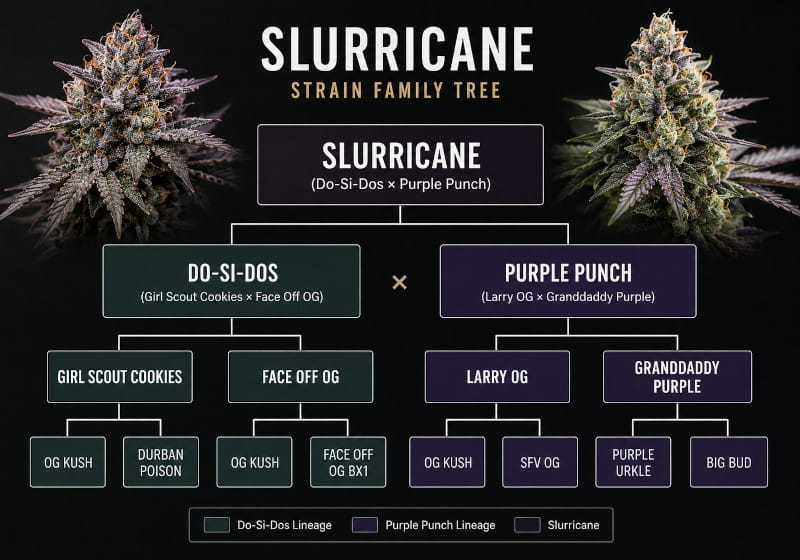
Slurricane was created by crossing Do-Si-Dos and Purple Punch, combining two well-known US genetics with very different aroma and growth characteristics.
Do-Si-Dos primarily contributes the Cookies and OG character to the cross. Typical traits include earthy and spicy notes, a creamy aromatic base and, depending on the phenotype, distinctly gassy accents. It also contributes a vigorous plant structure and pronounced trichome production, which can also be found in many Slurricane selections.
Purple Punch provides the sweet and fruity counterpart. The genetics are especially known for grape, berry and dessert notes as well as their often purple coloration. In Slurricane, this influence is mainly reflected in the fruity sweetness, darker colors and characteristic contrast with the spicier Do-Si-Dos aromas.
| Parent Line | Characteristic Traits | Influence on Slurricane |
|---|---|---|
| Do-Si-Dos | Cookies & OG, earth, spices, cream, gas | spicy depth, vigorous structure and heavy trichome coverage |
| Purple Punch | grape, berries, sweetness and dessert notes | fruity sweetness, smooth aroma and often purple coloration |
How strongly the traits of the two parents appear varies from phenotype to phenotype. Some Slurricane plants show more of the sweet, fruity Purple Punch side, while in others the creamy, spicy and gassy influences of Do-Si-Dos are more prominent. This range is one of the most interesting characteristics of Slurricane genetics.
What Phenotypes Does Slurricane Have?
Different Slurricane phenotypes can develop, differing mainly in growth, color, flower structure and aroma profile.
Some Slurricane phenotypes display especially dark purple tones and pronounced grape or berry aromas, while others remain greener and show the creamy, earthy and gassy influences of Do-Si-Dos more clearly. Differences can also be seen in stretch, internodal spacing, branching and flower density.
One particularly well-known selection is Slurricane #7, a selected expression of the original Slurricane genetics from In House Genetics. The number does not indicate a quality level but is used to identify a particular selection. Such selected phenotypes can subsequently be used for further breeding and form the basis for new lines and crosses.
In addition to the original Slurricane from In House Genetics, Slurricane strains from other breeders are now also available. They may differ in their exact lineage, selection and expression. Anyone comparing different Slurricane genetics should therefore always consider the respective breeder and the stated cross in addition to the strain name.
Which Slurricane Strains Are Available?
In addition to the original Slurricane from In House Genetics, various versions and selections are now offered by several breeders.
Depending on the breeding line, different Slurricane traits may be more pronounced. Some versions focus on the sweet berry and grape aromas, while others show more of the creamy, spicy and gassy notes of the genetics. Growth habit, flowering time, coloration and trichome production may also differ. The following overview shows five interesting Slurricane strains and their respective characteristics.
| Slurricane Strain | Breeder | Genetics |
|---|---|---|
| Original Slurricane | In House Genetics | Do-Si-Dos (Nor-Cal-Cut) x Purple Punch |
| Slurricane IX | In House Genetics | Slurricane x Slurricane |
| Slurricane | Archive Seeds | Slurricane S1 |
| Ape Slurricane | Ape Origin | Purple Punch x Do-Si-Dos |
| Anesia Slurricane | Anesia Seeds | Do-Si-Dos (Nor-Cal-Cut) x Purple Punch |
The various Slurricane lines show how versatile the original genetics can be when developed further. In particular, the combination of intense aroma, pronounced trichome production and attractive coloration has also made Slurricane an interesting starting point for numerous new crosses.
Which Interesting Slurricane Crosses Are There?
With its intense aroma profile, heavy trichome production and attractive coloration, Slurricane has also established itself as an interesting foundation for new crosses.
Combining it with other genetics creates strains that take the typical Slurricane character in different directions. Depending on the cross, the sweet berry and grape notes may become more pronounced or be complemented by citrus, dessert, spice and gas aromas. At the same time, the respective parents introduce new traits in growth, flower structure, color and flowering time into the offspring.
| Strain | Breeder | Genetics |
|---|---|---|
| Deluxe Sugarcane | In House Genetics | Slurricane x Platinum |
| Blueberry Pancakes | Humboldt Seed CO | Blueberry Pancakes x (Blueberry Pancakes x Slurricane) |
| Bananacane | In House Genetics | Bluenana x Slurricane #23 |
| Slush Mint Cake | Dutch Passion | Slurmint x Ice Cream Cake |
| Garlic Storm | In House Genetics | GMO x Slurricane |
This diversity is precisely what makes Slurricane interesting for modern breeding projects. The original characteristics are not simply copied but recombined with the traits of the respective crossing partner. This creates independent genetics that may still reveal their Slurricane ancestry while developing their own character through new aroma, growth and flowering traits. The wide variety of modern cannabis seeds shows just how differently such breeding lines and crosses can be developed further.
How High Is the THC Content of Slurricane?
Slurricane is considered a THC-rich cannabis strain and, depending on phenotype and growing conditions, often reaches levels of around 20 % and above.
The actual THC content can vary significantly from plant to plant. In addition to genetics, factors such as light, nutrient supply, maturity, harvest time, drying, curing and storage all play a role in the quality and composition of the finished plant material. A reliable THC value can therefore only be provided by laboratory analysis of the specific sample.
Because of its pronounced trichome coverage, Slurricane is also interesting for the production of concentrates. If the cannabinoid-rich resin glands are separated from the rest of the plant material and processed into hash, the end product can reach a significantly higher THC content than the original flowers. The actual concentration depends, among other things, on the starting material, the method used and the purity of the collected resin.
A higher THC content does not automatically mean that the effects will be equally strong for everyone. Dose, method of consumption, individual tolerance and the interaction with other cannabinoids all influence perception. This also includes CBD and its effects, which differs significantly from THC and does not produce a comparable typical intoxicating profile. When assessing Slurricane, the overall cannabinoid profile is therefore always relevant in addition to THC content.
What Are the Effects of Slurricane?
Slurricane is known for potent effects that usually begin with euphoria and a positive mood and increasingly transition into deep physical relaxation.
The initial effects are often described as uplifting and pleasantly relaxed. Thoughts and mood may feel lighter, while a noticeable sense of calm spreads through the body after some time. At higher doses, the relaxing side can become clearly dominant, making Slurricane feel heavy, calm and eventually sleepy. This combination of initial euphoria and later physical relaxation is a defining characteristic of the strain.
Is Slurricane Better Suited for the Evening?
Slurricane is considered a typical evening strain because its initially euphoric effects often transition into intense and long-lasting physical relaxation.
Especially after a long day, this progression of effects can suit relaxed hours when no demanding tasks remain. Depending on dose and personal tolerance, Slurricane can become increasingly calming and sleep-inducing. For early mornings or situations requiring concentration and performance, the strain is therefore generally less preferred.
What Does Slurricane Smell Like?
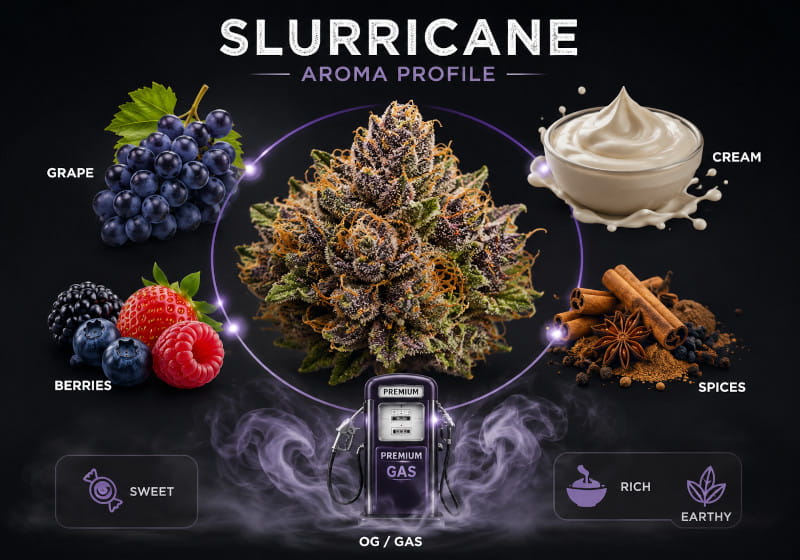
Slurricane has an intense, complex aroma in which sweet berries and ripe grapes meet creamy, earthy and spicy notes.
The Purple Punch side can be reminiscent of dark berries, grape skins or sweet fruit desserts. Do-Si-Dos often adds drier and heavier nuances: earth, pepper, herbs, cream and an OG-like undertone. Some phenotypes may also show citrus or tropical accents.
-
grape and dark berries
-
sweet fruit and dessert notes
-
creamy and slightly nutty nuances
-
earth, herbs and spices
-
OG, gas or diesel hints depending on the phenotype
What Does Slurricane Taste Like?
Slurricane tastes intensely sweet and fruity, with ripe berries and dark grapes in particular accompanied by creamy, earthy and spicy notes.
The first impression is often dominated by fruity sweetness before the stronger Do-Si-Dos side becomes more noticeable as the flavor develops. Depending on the phenotype, creamy dessert notes, spices, earth and a slightly gassy undertone may become more prominent. As a result, the flavor profile is not simply sweet but develops a distinctly spicier and heavier finish.
How well these individual nuances are preserved also depends on drying and post-harvest treatment. Proper cannabis storage is equally important so that the characteristic aroma is not unnecessarily lost through heat, light, oxygen or unsuitable humidity.
Which Terpenes Are Typical of Slurricane?
Slurricane’s terpene profile is often characterized by β-caryophyllene, limonene and myrcene, whose interaction contributes significantly to the strain’s sweet, spicy and earthy character.
β-caryophyllene is primarily associated with peppery and spicy notes, while limonene can contribute fresh citrus-like accents. Myrcene adds earthy, herbal and slightly tart nuances to the profile. Together with other terpenes, this creates the complex aroma for which Slurricane is known. Which compounds actually dominate and at what concentration, however, can vary depending on phenotype and growing conditions.
Terpenes primarily determine an important part of the plant’s smell and aroma. However, the presence of individual terpenes does not allow a specific medical effect of Slurricane to be inferred. Findings from laboratory and basic research cannot simply be transferred to the effects of a specific cannabis strain in humans.
How Does Slurricane Grow?
Slurricane typically develops vigorous, bushy growth with sturdy side branches and produces compact flowers densely coated with trichomes during flowering.
Many phenotypes initially grow relatively compact but gain considerable height once flowering begins. At the same time, Slurricane develops strong lateral branching, allowing the plants to build a broad, well-branched structure when enough space is available. How pronounced the stretch becomes depends on the individual phenotype and growing conditions.
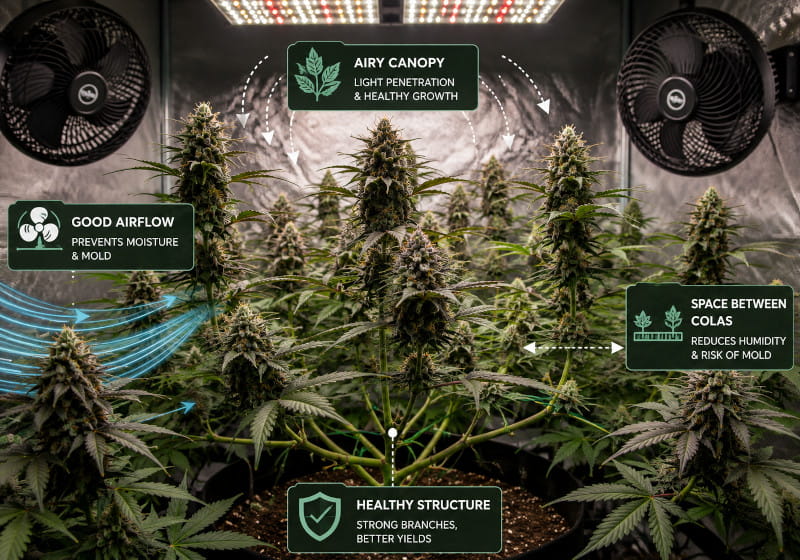
As flowering progresses, the flowers become increasingly compact and develop the dense trichome coverage typical of Slurricane. Heavy flowers may require additional support for individual side branches. Even air movement between the branches helps carry humid air away from the dense plant canopy and reduces the risk of mold and bud rot. Fans should not be directed continuously at leaves and flowers at high power in order to avoid wind burn.
How Long Does Slurricane Flower?
Slurricane has a flowering time of around 8 to 10 weeks, with many phenotypes reaching full maturity after approximately 55 to 65 days.
How quickly the plants actually mature depends on the individual phenotype and growing conditions. Toward the end of flowering, the flowers swell noticeably once again and the trichome coverage becomes increasingly dense. Rather than counting days alone, the development of the flowers and trichomes should therefore also be taken into account when determining the appropriate harvest time.
When growing outdoors, maturity is additionally influenced by location, hours of sunlight, temperatures and weather conditions. Especially in regions with a cool or damp autumn, Slurricane should be checked regularly during the final weeks because the compact flowers can retain moisture for longer and may therefore be more susceptible to mold and bud rot.
How Do You Grow Slurricane Indoors?
Indoors, Slurricane benefits above all from a stable climate, good air circulation, controlled height management and enough space for flower development.
Because individual phenotypes can differ in stretch, it is worth observing the plants early. Gentle Low Stress Training can help expose side branches more evenly to light and build a broad canopy. On vigorous plants, topping can also be used, provided there is enough recovery time before flowering.
A consistent environment is more important than making as many interventions as possible. Strong fluctuations in temperature, humidity, watering or nutrient concentration can impair growth and quality. Especially in late flowering, air should be able to circulate between the flower sites.
| Area | Practical Approach for Slurricane |
|---|---|
| Plant Shape | observe the phenotype and plan for height early |
| Training | LST and topping are possible on vigorous plants |
| Air Movement | even, without continuously directing strong airflow at the flowers |
| Humidity | monitor especially as the flowers become denser |
| Odor Control | plan for it in indoor grows due to the intense aroma |
| Flowering | approximately 8–10 weeks as a rough guideline |
Is Slurricane Suitable for Outdoor Growing?
Slurricane is also suitable for outdoor cultivation but prefers warm, sunny locations with a late summer and autumn that are as dry as possible.
Under good conditions, the plants can branch vigorously and reach an impressive size. Climate becomes especially important during the later flowering stage: the compact, resin-rich flowers should be able to dry as quickly as possible after rain or high humidity. An airy location with plenty of sun is therefore particularly important. In regions with an early, cool and rainy autumn, a sheltered spot can offer an additional advantage.
Slurricane is therefore not among the genetics that are equally suitable for every outdoor climate. In regions with a shorter season, early-finishing and especially robust outdoor cannabis seeds may be the more suitable choice. Anyone growing Slurricane outdoors should pay particular attention to maturity and weather developments during the final weeks of flowering.
Which Training Methods Suit Slurricane?
Thanks to its vigorous growth and good lateral branching, Slurricane is suitable for various training methods such as LST, topping and SCROG.
With Low Stress Training, dominant shoots are carefully tied down so that the side branches develop more evenly and receive more light. Vigorous plants can also be topped to create several main shoots and better control vertical growth. A SCROG (Screen of Green) is particularly interesting: the side branches are distributed across a screen so that Slurricane can develop a broad, evenly lit plant canopy.
A Sea of Green (SOG) is also possible. Unlike SCROG, several smaller plants are placed closer together and switched to flowering earlier. This method is particularly suitable for evenly growing Slurricane plants or selected clones, because major differences in stretch and growth habit within a seed population can make it more difficult to maintain an even canopy.
Regardless of the chosen method, Slurricane should be given enough time to recover after more intensive interventions. The key is an open, well-lit plant structure with sufficient air between the branches. Too many training measures in a short period, by contrast, offer no advantage and can unnecessarily slow growth.
What Problems Can Occur When Growing Slurricane?
Slurricane is considered a vigorous genetic line but can react sensitively to excessive humidity, a dense plant structure or mistakes in watering and nutrient supply.
The compact flowers require particular attention because moisture can remain trapped for longer between dense plant material. Good air circulation and enough spacing between branches help prevent stagnant humid air. At the same time, excessive defoliation should be avoided: selectively removing individual leaves can improve light and airflow into the plant without unnecessarily removing too much healthy leaf mass.
It is also worth keeping a close eye on the plants when watering and feeding. Too much water, constantly wet substrate or an excessively high fertilizer concentration can show up as slowed growth, leaf discoloration or damaged leaf tips. If such symptoms occur, our overview of cannabis growing problems covers typical causes, symptoms and suitable solutions.
How much water and nutrients Slurricane actually needs depends, among other things, on substrate, plant size, light intensity, temperature and stage of development. Instead of following a rigid schedule, the supply should therefore be adjusted to the condition and growth of the individual plant.
When Is Slurricane Ready to Harvest?
Slurricane is usually ready to harvest after around 8 to 10 weeks of flowering, although the actual maturity of the flowers is more important than a fixed number of days.
The stated flowering time provides a useful guideline, but the exact harvest date should be determined directly from the plant. The development of the flowers and the condition of the trichomes are particularly informative. With a magnifying glass or small microscope, you can see how the initially clear trichome heads gradually become milky and later partly amber. You can find more information in our detailed guide to the right time to harvest cannabis.
Not every Slurricane phenotype matures at exactly the same time. Especially when growing several plants from seed, individual specimens may finish a few days earlier or later. Rather than harvesting the entire grow on a fixed date, it is therefore worth assessing the maturity of each plant individually.
What Is the Difference Between Slurricane, Purple Punch and Do-Si-Dos?
Slurricane combines the sweet grape-and-berry dessert side of Purple Punch with the spicier, creamier and OG-influenced character of Do-Si-Dos.
| Genetics | Typical Aroma Focus | Relation to Slurricane |
|---|---|---|
| Purple Punch | grape, berries, sweetness, dessert | fruity sweetness and often purple appearance |
| Do-Si-Dos | earth, spices, cream, Cookies/OG | spicy depth, OG character and resin production |
| Slurricane | berries, grape, cream, earth, spices, gas | combination of both parents with phenotypic variation |
Why Is Slurricane So Well Known Among Growers?
Slurricane has made a name for itself mainly through its exceptionally resinous flowers, intense coloration and the combination of sweet fruit aromas with creamy, spicy and gassy notes.
The appearance of many Slurricane phenotypes is especially striking. The compact flowers can develop dark-green to deep-purple tones and are often covered in a dense layer of trichomes. Together with the orange pistils, this creates the high-contrast appearance that has contributed significantly to the strain’s popularity.
Slurricane has also left a clear mark on breeding. The combination of Do-Si-Dos and Purple Punch brings together two influential US genetics and later became the basis for numerous new hybrids itself. Particularly interesting selections are still used for further development and crosses today, allowing Slurricane genetics to spread far beyond the original strain from In House Genetics.
Frequently Asked Questions About Slurricane
The most common questions about Slurricane concern genetics, THC, effects, flavor and growing requirements.
Who bred Slurricane?
Slurricane was developed by In House Genetics.
What are Slurricane’s parents?
The original Slurricane is a cross between Do-Si-Dos and Purple Punch.
Is Slurricane Indica or Sativa?
Slurricane is generally described as an indica-dominant hybrid. A ratio of 60 % Indica to 40 % Sativa is often used as a guideline, although such percentages do not represent a scientific chemical classification.
What does Slurricane taste like?
Typical flavors include sweet berry and grape notes with cream, earth, spices and, depending on the phenotype, hints of OG or gas.
How long does Slurricane take to flower?
Around eight to ten weeks are often given as a rough guideline. Actual maturity depends on phenotype and growing conditions.
How high is the THC content?
Slurricane is considered THC-rich. Commonly reported values are around 20 % and above, but only an analysis of the specific batch can provide a reliable figure.
Which terpenes does Slurricane contain?
β-caryophyllene, limonene and myrcene are commonly mentioned. The actual terpene profile can vary between plants and batches.
Is Slurricane suitable for beginners?
A successful grow is certainly possible, but the climate should be controlled reliably, especially during dense flower development. Some experience with watering, humidity and plant structure is helpful.
What Makes Slurricane Interesting in the Long Term?
Slurricane remains interesting above all because the strain combines a clearly traceable modern US lineage with a distinctive dessert, berry and OG profile.
For strain enthusiasts, the cross is a good example of how traits from two well-known parents can recombine in different phenotypes. For growers, by contrast, trichome coverage, coloration, plant structure and aroma diversity are often the main points of interest. At the same time, Slurricane shows why modern strain names should always be considered in the context of the breeder, line and specific phenotype.
Slurricane is therefore more than just a description of “purple cannabis” or a particularly THC-rich strain. Its real recognition value comes from the interplay of Do-Si-Dos × Purple Punch, sweet and spicy aroma components, pronounced trichome production and the diversity of different selections.
Sources and Further Information
- Leafly – Slurricane: genetics, reported aromas and consumer experiences
- Weedmaps – Slurricane: origin and strain profile
- PubMed – Cannabis Chemovar Nomenclature Misrepresents Chemical and Genetic Diversity
- NCBI/PMC – Chemical and genetic diversity of commercial cannabis names
- National Institute on Drug Abuse – Cannabis: effects and health information
- Wikipedia – Hemp