The History of Bruce Banner
The History of the Bruce Banner Cannabis Variety
Updated: July 2026 | The history of the Bruce Banner cannabis variety, including its origin, original genetics, famous phenotypes and its evolution into one of the most influential modern US cannabis strains.
Author: Cannapot Grow Team | Reading time: approximately fifteen minutes
The Most Important Points at a Glance
✓ Bruce Banner was developed in the United States by Dark Horse Genetics and is considered one of the best-known modern cannabis genetics to emerge from Colorado.
✓ The original Bruce Banner cross was created from a selected OG Kush plant and Strawberry Diesel.
✓ The first generation produced several phenotypes, with Bruce Banner #3 and Bruce Banner #5 in particular gaining international recognition.
✓ Due to its exceptional potency, heavy resin production and distinctive Strawberry Diesel profile, Bruce Banner #3 became the best-known representative of the line.
✓ Today, numerous original lines, backcrosses, subsequent generations, feminized versions, fast-flowering variants and autoflowering interpretations exist.
✓ The name Bruce Banner therefore does not always refer to the same genetics. The breeder, lineage, generation and phenotype used should be checked individually for every variant.
Few modern US cannabis strains have developed a similarly legendary reputation in such a relatively short time as Bruce Banner. Originally created in Colorado, the genetics combine a powerful OG Kush line with the sweet, fruity and diesel-driven character of Strawberry Diesel. This cross produced several exceptional plants that later became known under numbered designations.
In particular, Bruce Banner #3 developed into an internationally sought-after elite selection. Its combination of exceptional resin production, high cannabinoid levels and an intense terpene profile made it an important symbol of the emerging US selection culture of the late 2000s and early 2010s.
Over time, the name Bruce Banner spread far beyond the original breeding line. Various seed banks worked with elite clones, backcrosses or their own selections and developed regular, feminized and autoflowering variants from them. As a result, the name Bruce Banner may now refer to genetically different products that trace back to the same historical line but are not necessarily identical.
The history of Bruce Banner is therefore not only the story of an especially potent cannabis strain. It also illustrates how individual phenotypes can become internationally recognised breeding lines, how elite clones are passed on and why numerous different versions may develop from one original cross over the years.
Why Is Bruce Banner Considered a Milestone of Modern US Strains?
Bruce Banner combined exceptional potency, intense terpenes and heavy resin production in a profile that had a lasting influence on modern US cannabis breeding.
When Bruce Banner was created, American cannabis breeding was undergoing profound change. Especially in medically regulated markets such as Colorado, breeders were able to select from larger plant populations, compare different phenotypes and preserve exceptional individual plants permanently through cloning.
In this environment, breeding lines gained importance that not only delivered reliable yields but also stood out through high cannabinoid levels, striking aromas and strong visual appeal. Bruce Banner met these expectations particularly well. Its flowers developed a dense coating of trichomes and combined sweet strawberry and fruit notes with diesel, citrus and classic OG and Kush nuances.
The strain thus became an early example of the terpene-rich and exceptionally resinous US hybrids that increasingly shaped the international market in the years that followed. While many older lines were described mainly in terms of origin, yield or growth structure, Bruce Banner placed greater emphasis on potency, elite phenotypes and a clearly recognisable aroma profile.
Another decisive factor in its long-term influence was the use of selected Bruce Banner plants in numerous later breeding projects. Bruce Banner #3 in particular was passed on both directly as an elite clone and through backcrosses and hybrids. As a result, the Banner line can now be found in the family trees of many modern strains.
How Was the Original Bruce Banner Created?
The original Bruce Banner was created by crossing a selected OG Kush plant with Strawberry Diesel and was subsequently refined through the selection of several exceptional phenotypes.
The breeding history of Bruce Banner began in Colorado at Dark Horse Genetics. An OG Kush line was used as the female parent, later described in some accounts as an original or older OG selection. The male parent came from Strawberry Diesel, a genetic line that combines sweet berry notes with an intense diesel profile.
The cross was genetically especially interesting because it combined two distinctly different terpene profiles. The OG side contributed earthy, Kush-like, citrus and fuel notes, while Strawberry Diesel added sweet strawberry and fruit aromas along with further diesel nuances. Both parent lines were also known for pronounced resin production, high vitality and vigorous growth. Readers interested in similar selections can discover more classic and modern Kush hybrids in our article on the Top 10 Kush Strains.
A relatively small number of germinated seeds produced several remarkable plants. The individual phenotypes differed in growth structure, aroma and the extent to which the traits of the two parent lines were expressed. Selected plants were assigned numbers for identification.
The selections Bruce Banner #3 and Bruce Banner #5 became particularly well known. Bruce Banner #3 developed into the most internationally recognised version and was passed on mainly because of its heavy resin production, potency and complex Strawberry Diesel and OG profile. Bruce Banner #5 represented a separate selection from the same original cross and should therefore not be equated with Bruce Banner #3.
This early phenotypic selection is essential for understanding today’s Bruce Banner landscape: the numbered variants are not merely product names but trace back to different individual plants within the same original cross.
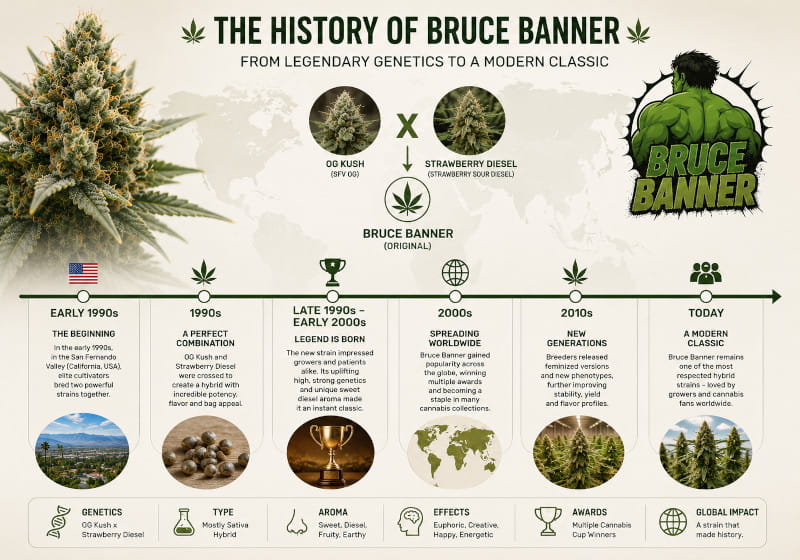
The Development of Bruce Banner at a Glance
| Period | Event |
|---|---|
| approx. 2008 | Dark Horse Genetics crosses OG Kush with Strawberry Diesel. |
| shortly afterwards | Several exceptional phenotypes are selected and numbered. |
| 2009–2011 | Bruce Banner #3 develops into the best-known elite phenotype of the line. |
| from 2012 onwards | Elite clones spread internationally and form the basis of numerous new breeding projects. |
| today | Bruce Banner exists worldwide in numerous original lines, backcrosses, filial generations, fast-flowering and autoflowering versions. |
The timeline illustrates how Bruce Banner developed within just a few years from a regional selection into a globally recognised cannabis genetic.
Who developed Bruce Banner?
Bruce Banner was developed by Jason Holck, better known as “OG Ironlung,” at Dark Horse Genetics in Colorado and is now considered one of the best-known US cannabis genetics of all.
Bruce Banner emerged during a period in which American cannabis breeding was advancing rapidly. Colorado in particular developed into a centre for new hybrid genetics between 2008 and 2010. Improved selection opportunities, larger plant populations and the targeted preservation of exceptional elite plants enabled individual phenotypes to gain worldwide recognition.
Dark Horse Genetics was among the breeding programmes that played a major role in shaping this development. The goal was not merely to create new crosses, but to identify exceptional individual plants with particularly high quality in terms of aroma, resin production, plant structure and cannabinoid content.
Crossing a selected OG Kush with Strawberry Diesel produced several plants, each combining different traits from the parents. Some of these individuals proved exceptional and were permanently preserved as elite clones. Rather than giving them new names, Dark Horse Genetics numbered the individual selections. This is how the Bruce Banner variants known today were created.
While numerous cannabis strains were renamed several times or substantially altered over the years, the original Bruce Banner line remained closely associated with Dark Horse Genetics. At the same time, individual elite clones spread worldwide and served as the basis for breeding programmes at numerous seed banks.
Why Did Bruce Banner #3 and Bruce Banner #5 Become So Famous?
Bruce Banner #3 and Bruce Banner #5 come from the same original cross but represent two different elite phenotypes, each with its own character.
After the original Bruce Banner seeds were germinated, all plants were carefully evaluated. Differences appeared in growth, flower structure, resin formation and the balance between OG and Strawberry Diesel influences. Some plants developed especially consistently and were therefore permanently preserved as mother plants.
Bruce Banner #3 stood out above all for exceptionally heavy resin production, making it highly suitable for the production of hashish, as well as pronounced potency and a distinctive Strawberry Diesel aroma. These traits quickly made the phenotype one of the best-known elite selections in the American cannabis scene. Numerous later crosses and backcrosses are based directly or indirectly on this line.
Bruce Banner #5 also developed into a high-quality line, but displayed a somewhat different balance of parental traits. Depending on the description, certain OG characteristics may be more pronounced, while aroma, growth behaviour or flower structure can differ slightly from Bruce Banner #3. Both variants share the same origin but represent separate genetic selections.
Today, different seed banks use either original Banner lines, backcrosses or their own interpretations of these phenotypes. For that reason, every Bruce Banner strain should be checked to determine which foundation genetics the respective breeding line is actually based on.
| Phenotype | Distinctive Traits | Significance |
|---|---|---|
| Bruce Banner #3 | intense Strawberry Diesel profile, exceptional resin production, very high potency | best-known elite phenotype of the original Bruce Banner line |
| Bruce Banner #5 | independent selection with a partly stronger OG influence | important original elite phenotype from Dark Horse Genetics |
The numbering therefore does not indicate quality, but distinguishes individual plants within the same original cross. Both phenotypes share a common origin but differ in several genetically determined traits.
What Genetics Are Behind Bruce Banner?
Bruce Banner combines two exceptional strains and therefore brings together intense diesel terpenes, strong OG influences and exceptional resin production.
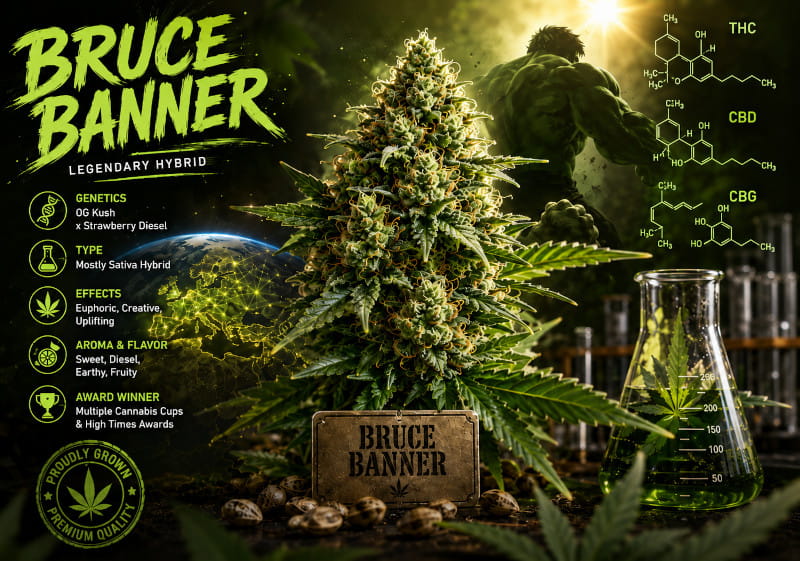
The original Bruce Banner line was created by crossing a selected OG Kush with Strawberry Diesel. Both parent lines were already among the best-known American cannabis genetics before Bruce Banner was created and complemented each other exceptionally well in many respects.
OG Kush contributed its vigorous plant structure, typical Kush character and earthy, spicy and citrus aromas. Strawberry Diesel added intense strawberry and fruit notes, pronounced diesel terpenes and strong vigour. The interaction of both lines produced a hybrid genetic with a high degree of visual and aromatic recognisability.
Depending on the phenotype, individual traits may be expressed to different degrees. While some plants show the OG Kush influence more clearly, others possess a more pronounced Strawberry Diesel profile. This natural diversity within the original cross later led to the selection of different elite plants.
| Parent Line | Typical Traits | Contribution to Bruce Banner |
|---|---|---|
| OG Kush | vigorous growth, Kush aromas, earthy and citrus notes | structure, resin production and classic OG character |
| Strawberry Diesel | sweet strawberry, fruit, diesel, high vitality | terpene profile, aroma and hybrid vigour |
This combination made Bruce Banner one of the most influential modern US genetics and later served as a starting point for numerous additional breeding projects.
Why Is the Strain Called Bruce Banner?
The name Bruce Banner is a reference to the comic-book character Bruce Banner, who transforms into the extraordinarily powerful Hulk.
Bruce Banner is the civilian name of the Marvel character Hulk. The developers of the strain chose the name as a humorous reference to the exceptional strength and impressive overall profile of the new genetics. Soon after its release, Bruce Banner became one of the best-known names in American cannabis breeding. Despite the name, there is of course no official connection to the Marvel character or the rights holders. The term is used solely as a historical strain name within the cannabis scene.
Numbered variants such as Bruce Banner #3 or Bruce Banner #5 do not refer to different generations or later developments, but to individual plants selected during the original selection process. Each number identifies a distinct phenotype with individual traits.
Why do so many Bruce Banner versions exist today?
As the genetics spread worldwide, numerous interpretations of the original Bruce Banner line were created.
After Bruce Banner became established internationally, many seed banks began developing their own breeding programmes based on the original genetics. Some worked directly with elite clones, while others used backcrosses, stable subsequent generations or combined Bruce Banner with additional modern US genetics.
Over the years, this resulted in numerous different Bruce Banner lines. Some remain very close to the original elite phenotypes, while others have developed clearly independent traits in terms of aroma, flowering time, plant structure or resin production.
Today, in addition to regular and feminized versions, there are also fast-flowering variants, backcrosses (BX), further-developed filial lines (F2, F3 and later generations) and autoflowering versions. Although they all carry the name Bruce Banner, their genetic traits may differ considerably.
It is therefore always worth checking the breeder and stated lineage before purchase. Only the combination of breeder, genetics and phenotype reliably indicates which Bruce Banner line is actually being offered.
How Did Bruce Banner Spread Worldwide?
Within a few years, Bruce Banner developed from a regionally known US genetic into a cannabis strain offered worldwide.
After the original Bruce Banner phenotypes attracted considerable attention within the American cannabis scene, elite clones and later seed programmes increasingly spread through international breeders. The combination of heavy resin production, intense aroma and exceptional potency made Bruce Banner especially attractive to many breeders.
As modern US genetics became more popular, numerous new breeding projects based on the original Banner line emerged worldwide. Many seed banks developed their own versions using different elite plants, backcrosses or selected offspring. As a result, numerous Bruce Banner variants now exist with traits that may differ significantly from one another.
While some breeders aim to remain as close as possible to the original elite phenotypes, others seek to develop flowering time, aroma, plant structure or yield in a targeted way. This is why today’s Bruce Banner lines can differ considerably depending on the breeder.
Which Bruce Banner Variants Exist Today?
Today, the Bruce Banner family includes numerous different genetics that may vary in lineage, generation and breeding objective.
Because the name Bruce Banner is now used by many international breeders, it is worth taking a close look at the genetics in each case. Some strains are based directly on the original elite phenotypes, while others represent independent further developments.
| Variant | Distinctive Feature | Typical Use |
|---|---|---|
| Bruce Banner #3 | most famous elite phenotype of the original Banner line | reference genetic for numerous later breeding projects |
| Bruce Banner #5 | independent elite phenotype from the same original cross | alternative selection with a slightly different profile |
| Bruce Banner F3 #9 | backcrosses for stabilising specific traits | preservation of selected traits |
| Bruce Banner F3 #7 | further-selected generations of the original line | genetic development |
| Bruce Banner Auto | cross with Ruderalis genetics | autoflowering plants |
| Bruce Banner Fast | shortened flowering time through fast-flowering versions | faster harvest in outdoor cultivation |
In addition to these lines, numerous other Bruce Banner crosses from international seed banks exist. These include the fast-flowering Bruce Nepali Banner for outdoor cultivation and Frost Cake, a cross between Wedding Cake and Bruce Banner. While some breeding projects aim to preserve the original genetics as faithfully as possible, others combine Bruce Banner with modern US hybrids or classic cannabis lines. As a result, the Bruce Banner family continues to develop to this day.
What Influence Did Bruce Banner Have on Modern Cannabis Breeding?
Bruce Banner is one of the US hybrids that played a major role in shaping the international trend towards exceptionally resinous and terpene-rich cannabis genetics.
Since its release, the Bruce Banner line has been used in numerous breeding programmes. Many breeders used individual elite plants as the starting point for new crosses or incorporated characteristic traits such as the intense Strawberry Diesel profile, heavy resin production or strong hybrid vigour.
Together with other well-known US genetics, Bruce Banner helped ensure that modern cannabis breeding today is often more strongly focused on terpene profile, resin production and selected elite phenotypes than it was in the 1990s. Its influence therefore extends far beyond the original strain and remains visible in numerous modern hybrids.
What Cultivation Traits Characterise Bruce Banner?
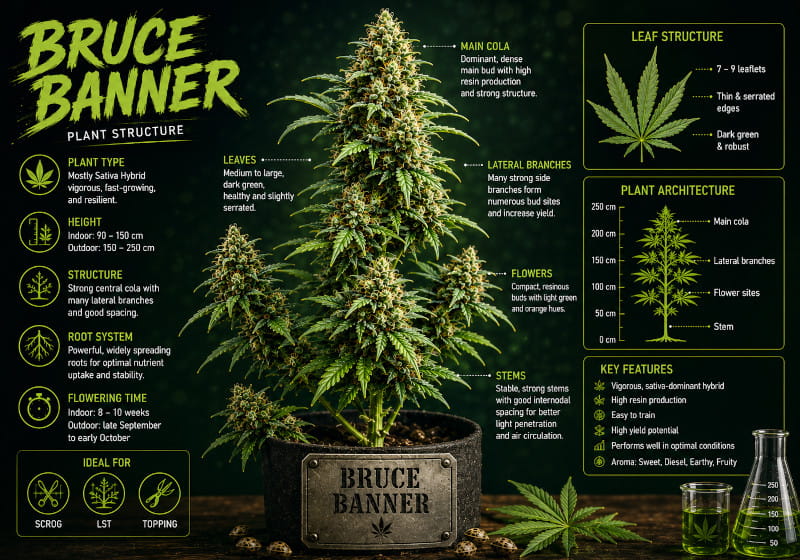
Bruce Banner is considered a vigorously growing modern hybrid genetic and develops large, heavily resinous flowers under good conditions.
Depending on the breeding line and phenotype used, Bruce Banner usually grows medium to tall and forms a stable main structure with strong side branches. The plants often respond well to various training techniques such as topping, low-stress training or Sea of Green, allowing them to be adapted to different cultivation systems.
A characteristic trait is the intense development of trichomes during flowering. Several weeks before harvest, many Bruce Banner lines already develop a striking resin coating, which is why these genetics have frequently been used as a basis for further breeding projects.
Because of its intense Strawberry Diesel and OG terpene profile, a powerful activated-carbon filter is recommended for indoor cannabis cultivation. Outdoors, Bruce Banner genetics prefer sunny, warm locations with good air circulation, allowing growth and flower development to unfold optimally.
| Trait | Typical Expression |
|---|---|
| Growth Form | vigorous, well branched and vital |
| Flowering Time | usually around 8 to 10 weeks (depending on the line) |
| Resin Production | very high |
| Cultivation | suitable for indoor and outdoor cultivation |
| Difficulty Level | moderate to higher demands depending on the genetics |
What Does Bruce Banner Smell and Taste Like?
Bruce Banner has one of the most distinctive terpene profiles among modern US genetics, combining sweet fruit notes with a powerful diesel and OG character.
The aroma profile may vary depending on the breeding line and phenotype, but it usually features a characteristic combination of sweet strawberry, ripe fruit, citrus, diesel and earthy, Kush-like nuances. This unusual blend made Bruce Banner internationally famous and contributed significantly to the strain’s popularity.
While some lines are more strongly fruity, others display a much more pronounced diesel or OG Kush influence. The intensity of individual aromas also depends on genetics, cultivation conditions, harvest timing, drying and curing.
-
sweet strawberry and fruit notes
-
strong diesel character
-
earthy and Kush-like nuances
-
occasional citrus and spicy accents
Frequently Asked Questions About Bruce Banner
Bruce Banner is one of the best-known modern US cannabis genetics. Questions about its history, phenotypes and genetics therefore arise frequently.
Who developed Bruce Banner?
Bruce Banner was developed by Jason Holck (OG Ironlung) at Dark Horse Genetics in Colorado.
What is Bruce Banner #3?
Bruce Banner #3 is the best-known elite phenotype of the original Bruce Banner cross and is still regarded as the reference genetic of the Banner line.
Is Bruce Banner #5 the same strain?
No. Bruce Banner #5 comes from the same original cross but represents a separate elite phenotype with partly different traits.
Why do so many Bruce Banner versions exist today?
Many seed banks developed their own breeding lines, backcrosses and further developments based on the original Banner genetics. As a result, today’s Bruce Banner strains may differ considerably from one another.
What genetics does Bruce Banner have?
The original Bruce Banner was created from a cross between OG Kush and Strawberry Diesel.
Are regular and feminized Bruce Banner seeds available?
Yes. Depending on the breeder, Bruce Banner genetics are offered as both regular and feminized cannabis seeds. Fast-flowering and autoflowering versions are also available.
Sources and Further Information
- Wikipedia – Cannabis
- National Center for Biotechnology Information (NCBI) – Cannabis Genetics and Breeding
- Frontiers in Plant Science – Cannabis Breeding and Genetic Diversity