Slugs on Cannabis: Prevent Feeding Damage
Identify and control slugs and snails on cannabis and protect plants
Updated: August 2026 | Learn how to identify snails and slugs on cannabis, what feeding damage they cause, and how to effectively protect especially young outdoor plants.
Author: Cannapot Grow Team | Reading time: approximately twenty-five minutes
Key points at a glance
✓ Snails and especially slugs can cause significant damage to outdoor cannabis. Typical signs include irregular holes, chewed leaf edges, and larger missing sections of leaves. Seedlings and young cannabis plants are particularly at risk.
✓ Silvery, shiny slime trails on leaves, pots, or the soil are an important indication of slug or snail feeding. Holes alone are not enough for a reliable diagnosis because caterpillars and other pests can cause similar feeding damage.
✓ Slugs are mainly active at night and in damp weather. They are particularly easy to spot after rain, late in the evening, and early in the morning. During the day, they usually hide in cool, moist places.
✓ Slug collars, slug fences, and other mechanical barriers can protect newly transplanted young plants in particular. For individual plants, regularly picking off slugs and snails is also a simple and targeted measure.
✓ Beer traps, coffee grounds, eggshells, ash, and other home remedies are not automatically reliable solutions. Their effectiveness may be limited or dependent on conditions, and some measures can also affect plants, soil, or other animals.
✓ With slug pellets, the active ingredient and the specific product must be considered separately. What matters is the current authorization, the approved area of use, and the information on the product label.
In the evening, the cannabis plant still looks undamaged, but the next morning pieces are suddenly missing from the leaf edges or several leaves have large, irregular holes. Especially when growing outdoors snails and especially slugs may be responsible. Damp nights, rain, and suitable hiding places around the plants create favorable conditions for these predominantly nocturnal animals.
Particularly at risk are seedlings and newly transplanted cannabis plants. While a large, vigorous plant can usually tolerate individual chewed leaves, a young plant has only a small amount of leaf mass and few shoots. Heavy feeding can therefore cause serious damage within a short time. Before taking countermeasures, however, you should determine as reliably as possible what is actually responsible for the damage: holes in cannabis leaves alone are not yet clear proof of slug or snail feeding.
How can you identify slugs and snails on cannabis?
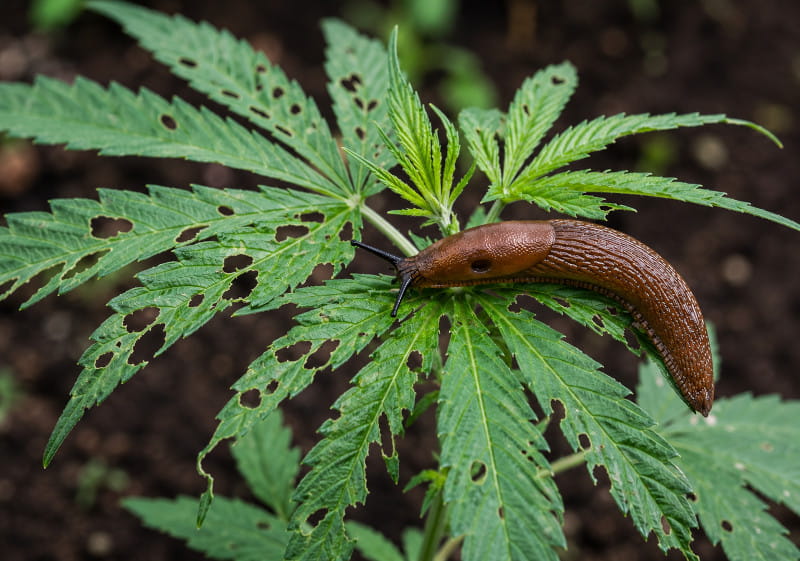
Typical signs of slugs and snails on cannabis include irregular feeding holes, chewed leaf edges, and silvery, shiny slime trails. If new damage appears mainly overnight or after damp weather, this strengthens the suspicion. The slugs or snails themselves are often no longer found on the plant during the day.
Holes and chewed leaf edges
Snails and slugs have a rasping tongue covered with numerous tiny teeth, known as the Radula. They use it to scrape away plant tissue. On cannabis, this produces feeding marks of varying size that are usually irregular. Damage often begins at the edge of the leaf, but slugs and snails can also feed within the leaf surface.
With heavier slug or snail feeding, several holes can merge so that larger parts of a cannabis leaf are missing. Young and soft plant tissues are especially susceptible. The severity of the damage depends, among other things, on the number and size of the slugs or snails, the plant’s stage of development, and how long the infestation lasts.
Slime trails as an important diagnostic sign
A particularly meaningful indication is slime trails. Slugs and snails secrete mucus as they move. Dried trails can appear silvery in the light and may be visible on cannabis leaves, stems, pots, saucers, bed borders, or the soil.
If you find clear slime trails close to fresh feeding damage, this strongly suggests slugs or snails as the cause. However, the absence of such trails does not automatically rule out slug or snail feeding. On damp soil or after rain, for example, slime trails can be difficult to see.
| Characteristic | What suggests slugs or snails? | How to check |
| Irregular holes | Typical feeding pattern, but not conclusive on its own | Look for slime trails and visible slugs or snails |
| Chewed leaf edges | Common with slug or snail feeding, but also possible with other pests | Look for slime trails and inspect the plant at night |
| Silvery, shiny slime trails | Strong indication of snails or slugs | Inspect leaves, stems, pot rims, and soil in angled light |
| New damage overnight | Consistent with the predominantly nocturnal activity of many slugs | Inspect the plant after dark |
| More feeding damage after rain | Damp conditions encourage the activity of many slugs and snails | Look for slugs and snails in the evening or early morning after rain |
What damage do slugs and snails cause to cannabis?
On cannabis, slug and snail feeding mainly affects leaves and soft, young plant tissue. Large, established outdoor plants can usually compensate well for isolated feeding damage. Damage to seedlings and small young plants is much more critical because they can lose a large proportion of their leaf mass within a short time.
Feeding damage on cannabis leaves
Damaged leaves are usually the first thing noticed. Individual small feeding marks generally affect a vigorous cannabis plant only slightly. However, if new holes keep appearing or increasingly large sections of leaves are missing, the cause should be identified as quickly as possible.
Slugs and snails can feed both from the edge of a cannabis leaf and within the leaf surface. There is therefore no single characteristic hole pattern. For diagnosis, the combination of feeding pattern, slime trails, timing of the damage, and weather conditions is much more informative.
Why seedlings and young cannabis plants are particularly at risk
Seedlings and newly transplanted cannabis plants have only a few leaves and mainly soft plant tissue. If a large portion is eaten within a single night, the plant loses a significant amount of the leaf area available for photosynthesis.
Damage to young shoots or the growing tip is particularly problematic. A larger, well-branched plant has considerably more leaf mass and can compensate for limited feeding damage more effectively. On a small young plant, the same amount of feeding can significantly impair further development.
| Plant stage | Risk from slug or snail feeding | Possible consequences |
| Seedling | Very high | Severe loss of leaf mass, potentially resulting in loss of the entire plant |
| Newly transplanted young plant | High | Severe leaf feeding, damaged shoots, and delayed development |
| Larger established plant | Usually lower | Individual feeding marks are usually compensated for well; persistent heavy feeding can still become problematic |
Damage to young shoots and stems
In addition to leaves, slugs and snails can also feed on soft tissue on young shoots and plant parts close to the ground. Strong or already woody stems are much less susceptible. If the thin stem, a side shoot, or the growing tip of a young cannabis plant is badly damaged, however, the consequences can be far more serious.
Which slugs and snails can feed on cannabis?
Not every snail or slug in the garden is automatically responsible for feeding damage on cannabis. Of the many species found in Central Europe, only a comparatively small number regularly cause substantial damage to cultivated plants. Various slugs are particularly relevant, including Arion and field slugs.
Arion slugs
Various Arion slugs are among the well-known pest species. Particularly widespread is the Spanish slug (Arion vulgaris), which can feed on numerous herbaceous and cultivated plants. Other Arion slugs can also damage young and soft plant tissues.
Field slugs
Field slugs of the genus Deroceras can also damage plants. One example is the grey field slug (Deroceras reticulatum). It remains considerably smaller than large Arion slugs and is therefore easier to overlook. A close inspection is especially worthwhile when seedlings or plant parts close to the ground show feeding damage.
Not every slug or snail is a pest
Finding a slug or snail near a cannabis plant does not prove that this particular animal caused the feeding damage. Many slugs and snails also feed on dead plant material, fungi, or algae, and some species play an important role in breaking down organic matter. Certain species are also protected. Countermeasures should therefore be directed as specifically as possible at pests that have actually been identified.
When are slugs and snails especially active around cannabis plants?
Slugs are predominantly active at night and when humidity is high. Mild, damp nights and periods after rain provide especially favorable conditions. During hot and dry daytime hours, many retreat to sheltered hiding places.
This explains a typical outdoor-cannabis scenario: the plant is checked in the afternoon and no slug or snail is visible. Nevertheless, new feeding damage is present the next morning. The animals can visit the cannabis plant during the night and then retreat to their daytime hiding places. If slug or snail feeding is suspected, inspections are therefore especially worthwhile late in the evening, early in the morning, or after rain.
Where do slugs and snails hide during the day?
Typical daytime hiding places are cool, shady, and damp. If feeding damage keeps recurring, check especially underneath plant containers, saucers, boards, and stones, as well as dense plant material, dead wood, and other sheltered areas around the cannabis plants.
Moist mulch can also provide suitable hiding places for slugs and snails. At the same time, mulch benefits the soil and water balance and should therefore not automatically be removed. When slug pressure is high, however, it is worth regularly inspecting the immediate surroundings of sensitive young plants and reducing especially favorable hiding places right next to them.
Slug or caterpillar – what is eating my cannabis plant?
Slugs, snails, and caterpillars can leave similar feeding damage on cannabis. Both can cause irregular holes and chewed leaf edges. For the most reliable diagnosis possible, look for additional signs: silvery, shiny slime trails strongly indicate slugs or snails, while caterpillar droppings, visible larvae, or rolled or webbed leaves are more suggestive of caterpillars.
| Characteristic | Snails / slugs | Caterpillars |
| Irregular holes | Typical | Typical |
| Chewed leaf edges | Common | Also possible depending on the caterpillar species |
| Silvery, shiny slime trails | Strong indication of slugs or snails | Not typical |
| Droppings near the feeding damage | Of limited value as a diagnostic sign | Dark droppings can be an important clue |
| New damage after damp nights | Very typical | Not conclusive; depends on the caterpillar species |
| Rolled or webbed leaves | Not typical | Possible with certain caterpillar species |
| Finding the pest directly | Especially in the evening, at night, or in damp weather | Inspect leaf undersides, shoots, and rolled leaves |
Detailed information on this second important cause of feeding damage can be found in our guide to caterpillars on cannabis. Our overview of outdoor cannabis pests covers other possible causes of holes and feeding marks.
How can you control slugs and snails on cannabis?
With only a few cannabis plants, a slug or snail problem can often be limited through regular inspections, hand-picking, and mechanical protection. Especially with young plants, it makes sense to make access to the plant as difficult as possible before major feeding damage occurs.
Hand-pick slugs and snails in the evening and early morning
Hand-picking is a particularly targeted measure for individual cannabis plants. Good times to search are late evening, early morning, and periods of damp weather. A flashlight often makes slugs and snails around the plants easier to spot.
If the problem keeps recurring, carry out inspections for several days in a row. Finding a single slug or snail does not necessarily mean there are no others in the immediate area.
Target daytime hiding places
Because slugs seek protection from sun and drying out during the day, this behavior can be used when checking for them. They may retreat under boards, plant containers, stones, and other dark, damp places. If you inspect such areas regularly, slugs and snails are often easier to find than by searching randomly throughout the garden.
Slug collars for young cannabis plants
For individual newly transplanted cannabis plants, slug collars are particularly useful. They form a mechanical barrier around the plant. Models with a clearly outward- or downward-curved rim make it more difficult for slugs and snails to cross the barrier.
It is essential that no slug or snail is already inside the protected area when the collar is installed. Leaves, grasses, or other plants must also not form a bridge over the rim.
Slug fence for outdoor cannabis
If you grow several cannabis plants in a defined bed, you can use a slug fence. A suitable overhang, closed corners, and a gap-free setup are important. Openings or poorly designed transitions can significantly reduce the protective effect.
Regular inspection is necessary even after installation. Overhanging cannabis leaves, neighboring grasses, or other plants can form a natural bridge over the fence. You should also check whether slugs or snails were already inside the protected area when it was set up.
Keeping slugs and snails away from potted cannabis
Cannabis in pots is not automatically protected from slugs and snails either. The animals can crawl up container walls or reach the pot via neighboring plants and objects. Therefore, inspect especially the underside of the pot, the saucer, and the area between the pot and the ground.
Position the pot so that leaves and shoots do not touch neighboring vegetation if possible. Mechanical barriers or sufficiently wide copper tape can be attached relatively easily to plant containers. Regular inspections remain useful even with such barriers.
Does copper help against slugs and snails on cannabis?
Copper can create a difficult-to-cross or deterrent barrier for slugs and snails, but it does not provide guaranteed protection. Its effectiveness depends, among other things, on the width, condition, and placement of the copper surface. A narrow copper wire is therefore not equivalent to sufficiently wide copper tape.
Copper can be used as an additional barrier on plant containers, raised beds, or other clearly defined areas. Germany’s Federal Environment Agency recommends copper tape at least five centimeters wide. It is also essential that slugs and snails cannot bypass the barrier via neighboring plants, soil, or other objects.
Why slugs and snails sometimes avoid copper surfaces is often oversimplified as an alleged “electric shock.” This explanation should not be presented as a proven mechanism. In practice, it is more important not to regard copper as a stand-alone guarantee against feeding damage and to continue checking protected plants.
How does watering affect slugs and snails on cannabis?
Moist soil surfaces create favorable conditions for slug activity. If the entire area around cannabis plants is heavily watered in the evening on a regular basis, the surface remains damp for longer precisely during the animals’ nocturnal activity period.
When slug pressure is already present, it can therefore be useful to water in the morning and specifically around the root zone. The soil surface around the plant then has more time to dry again before evening. The cannabis plant must of course still receive enough water—the aim is not to let the plant or root ball dry out. Detailed guidance on the right amount of water and suitable timing can be found in our guide to watering cannabis correctly.
Persistently wet areas, leaking irrigation systems, or saucers that remain filled with water should also be checked. They can create damp refuges immediately beside the plants.
Slug pellets on cannabis: what should you consider?
Slug pellets are not a single uniform product. Molluscicides can contain different active ingredients and therefore differ in how they are used and in their risk profiles. Before use, always check the specific active ingredient, current authorization, approved use, and all information on the product label.
Ferric phosphate
Ferric phosphate is used as an active ingredient in various slug-pellet products. After ingestion, slugs and snails stop feeding and often retreat into hiding places.
However, this does not mean that every product containing ferric phosphate is automatically suitable for every crop or use. Non-target slugs and snails can also be affected. The authorization and directions for use of the specific product are therefore always decisive.
Metaldehyd
Metaldehyd is also used as an active ingredient against slugs and snails, but it has a different risk profile. If ingested improperly, the substance can be dangerous, especially for pets such as dogs. The instructions for the specific product must therefore be followed strictly and unnecessary applications avoided.
Which home remedies help against slugs and snails on cannabis?
There are especially many home remedies suggested for slugs and snails, but not all stand up to closer examination. Some may provide a limited barrier effect under certain conditions, while others work only briefly or have additional disadvantages. Especially around young cannabis plants, materials should therefore not be scattered indiscriminately around the root zone.
| Home remedy | Assessment | Problem / limitation |
| Beer trap | Not recommended as a general protective measure | Can attract slugs and snails without trapping all of them; other animals can also fall into open traps |
| Coffee grounds / coffee | Not a reliable long-term solution | The deterrent effect is not reliable; larger amounts can also affect soil and plants |
| Eggshells | Do not rely on this as dependable slug protection | Not a reliably effective barrier; slugs and snails can cross the scattered material |
| Ash | Not suitable as a permanent barrier | Loses its barrier effect when damp; depending on its origin, ash may also contain undesirable substances |
| Sawdust | Only of limited use as a dry barrier | Its possible barrier effect decreases significantly when wet |
| Sand | Only limited barrier effect | Not a reliable substitute for a mechanical barrier such as a slug collar |
| Copper | Potentially useful as a sufficiently wide barrier | No guaranteed protection; narrow or poorly installed barriers can be crossed or bypassed |
| Salt | Do not use | Can damage plants, soil organisms, and the soil and is not a suitable method of slug control |
Why beer traps can be problematic
Beer traps are among the best-known home remedies for slugs. However, their attractive effect is also a disadvantage: the smell can draw slugs and snails from the surrounding area without all of them actually ending up in the trap. This can bring additional animals toward the plants you are trying to protect.
Other animals can also end up in open traps. For protecting individual outdoor cannabis plants, mechanical barriers and targeted hand-picking are therefore easier to control.
Coffee grounds are not reliable slug protection
Coffee grounds are also frequently recommended as a simple slug deterrent. However, evidence that coffee or caffeine can have a deterrent effect does not mean that scattered used coffee grounds will reliably protect a cannabis plant. Concentration, moisture, and method of application differ considerably, so results involving caffeine cannot simply be transferred to a thin layer of used coffee grounds.
Especially with seedlings and sensitive young plants, coffee grounds should therefore not be used as the primary protective measure. Slug collars and other mechanical barriers offer options that are much easier to control.
Why salt is not a solution
Salt should not be used against slugs and snails around cannabis plants. High salt concentrations can harm plant roots, soil organisms, and soil quality. Directly sprinkling salt on slugs or snails is also not a sensible method for targeted, plant-compatible pest control.
What natural predators do slugs have?
Slugs and snails, as well as their eggs and young, serve as food for various animals. A structurally diverse outdoor garden can therefore encourage natural predators. However, this does not replace direct protection for cannabis young plants that are under immediate threat.
Natural predators include various ground beetles and other predatory invertebrates. Toads, some bird species, and slow worms can also prey on slugs and snails. Which species actually contribute to natural regulation depends on the location, available habitat, and the size of the slugs and snails.
Hedgehogs are not specialized slug hunters
Hedgehogs can also eat slugs and snails. However, this should not be taken to mean that a hedgehog in the garden will reliably solve a larger slug problem. Slugs and snails are not among their preferred foods and can also serve as intermediate hosts for various parasites. A wildlife-friendly garden is beneficial for many reasons, but individual animal species should not be regarded as biological “pest controllers” with guaranteed effectiveness.
How can newly transplanted cannabis plants be protected from slugs and snails?
The first days and weeks after transplanting are especially critical. A small cannabis plant has little leaf mass and mainly soft tissue. Slug protection should therefore ideally be in place before the first feeding damage occurs.
- Transplant vigorous young plants: A well-developed plant can tolerate limited feeding damage better than a very small seedling.
- Install slug collars immediately: Individual young plants can be protected with a mechanical barrier at the time of transplanting.
- Check the enclosed area: Before installing the barrier, check whether slugs or snails are already inside the protected area.
- Avoid plant bridges: Grasses, leaves, and neighboring plants must not extend over the protective rim and give slugs or snails an alternative route in.
- Water in the morning whenever possible: When slug pressure is high, allowing the soil surface to dry by evening can create less favorable conditions for the nocturnal animals.
- Check after rain: Damp weather provides a good opportunity to find and hand-pick slugs and snails.
- Search the surrounding area: Inspect possible daytime hiding places under pots, boards, stones, and damp plant material.
How can you prevent slug and snail damage on outdoor cannabis?
Slugs and snails cannot be completely excluded from an outdoor garden. Sensible prevention therefore means specifically protecting vulnerable plant stages, keeping an eye on favorable hiding places close to the plants, and identifying the beginning of feeding damage as early as possible.
- Protect vulnerable plant stages: Seedlings and newly transplanted cannabis plants need considerably more protection than large, established plants.
- Identify feeding damage early: New holes, missing leaf sections, and chewed leaf edges should prompt a closer inspection.
- slime trails beachten: Inspect leaves, stems, pots, and the soil, especially after damp nights.
- Keep an eye on damp hiding places: Boards, stones, plant containers, and dense plant material immediately beside young plants can provide hiding places for slugs and snails.
- Plan watering carefully: When slug pressure is high, water in the morning whenever possible and target the root zone without restricting the plant’s water supply.
- Check barriers regularly: Slug collars and slug fences protect reliably only when no gaps or plant bridges have formed.
- Create a diverse garden: Structurally diverse habitats can support ground beetles, amphibians, birds, and other natural predators.
No particular cannabis genetics provide guaranteed protection against slugs or snails. This applies to plants grown from classic cannabis seeds as well as outdoor seeds, autoflower seeds or CBD seeds. The key factors are primarily slug pressure, plant stage, weather, location, and the protective measures used.
Which mistakes should you avoid when dealing with slugs and snails?
| Commoner Fehler | Why it is problematic |
| Automatically attributing every hole to slugs or snails | Caterpillars, beetles, and other animals can cause similar feeding damage. Also look for slime trails or visible slugs and snails. |
| Looking for slugs and snails only during the day | Many slugs are especially active at night and in damp weather and spend dry daytime hours in sheltered hiding places. |
| Transplanting young plants without protection | A small cannabis plant can lose a large proportion of its leaf mass within a short time and be seriously damaged as a result. |
| Relying blindly on home remedies | Eggshells, coffee grounds, and similar methods are not a reliable substitute for diagnosis, inspection, and mechanical barriers. |
| Watering large areas in the evening | A persistently damp soil surface can create favorable conditions for slugs and snails during their nighttime activity period. |
| Salt einsetzen | Salt can harm plant roots, soil organisms, and the soil and is not a suitable method for protecting cannabis plants. |
| Choosing slug pellets based only on the active ingredient | What matters is the specific product, its current authorization, the approved area of use, and all instructions for application. |
FAQs about slugs and snails on cannabis
Q: Do slugs and snails eat cannabis plants?
A: Yes. Various snails and especially slugs can feed on cannabis leaves and other soft plant tissue. Seedlings and young outdoor plants are particularly at risk.
Q: How can I recognize slug or snail feeding on cannabis?
A: Typical signs are irregular holes, chewed leaf edges, and larger missing sections of leaves. A particularly important clue is silvery, shiny slime trails on leaves, stems, pots, or the soil.
Q: Why do my cannabis leaves suddenly have holes?
A: Slugs and snails are only one possible cause. Caterpillars, beetles, and other animals can also cause holes. If new damage appears mainly overnight and you also find slime trails, this strongly suggests slugs or snails.
Q: What is the difference between slug or snail damage and caterpillar damage?
A: Both can cause irregular holes and chewed leaf edges. Slime trails indicate slugs or snails. Caterpillar droppings, visible larvae, or webbed or rolled leaves can indicate caterpillars.
Q: Can slugs or snails completely eat a young cannabis plant?
A: On small seedlings and young plants, heavy slug or snail feeding can destroy a large proportion of the available plant tissue within a short time. Mechanical protection immediately after transplanting is therefore particularly useful.
Q: When are slugs especially active around cannabis?
A: Slugs are predominantly active at night and when humidity is high. They are especially easy to find late in the evening, early in the morning, and after rain.
Q: How do I protect young cannabis plants from slugs and snails?
A: Mechanical barriers such as slug collars are particularly suitable for individual young plants. You should also inspect possible hiding places, look for slugs and snails after damp nights, and prevent plant bridges over the protective rim.
Q: Does copper help against slugs and snails?
A: Copper can act as a deterrent barrier, but it does not provide guaranteed protection. Sufficient width and gap-free installation are crucial. On plant containers or raised beds, copper can be an additional protective measure.
Q: Do coffee grounds help against slugs and snails on cannabis?
A: Coffee grounds are not reliable slug protection. Studies on coffee or caffeine cannot simply be applied to scattered used coffee grounds. For young cannabis plants, mechanical barriers such as slug collars are much easier to control.
Q: Are beer traps useful against slugs and snails?
A: Beer traps are problematic as a general protective measure because they can attract slugs and snails from the surrounding area without trapping all of them. Other animals can also fall into open traps. Hand-picking and mechanical barriers are more targeted.
Q: Can slug pellets be used around cannabis plants?
A: There is no blanket answer. What matters is the specific product, its current authorization in the relevant country, the approved area of use, and all information on the product label.
F: What natural predators do slugs have?
A: Slugs and snails, their eggs, and their young are eaten by ground beetles and other predatory invertebrates, certain birds, amphibians, and slow worms. Natural predators can contribute to regulation, but they do not replace direct protection for vulnerable young cannabis plants.
Identify slugs and snails early and protect young cannabis plants
With slugs and snails on outdoor cannabis, making the most reliable diagnosis possible is the most important first step. Irregular holes and chewed leaf edges can have other causes as well. However, if new damage appears mainly overnight and you find silvery, shiny slime trails on the plant, pot, or soil, there is strong evidence that slugs or snails are responsible.
Seedlings and newly transplanted cannabis plants should be protected especially consistently. Slug collars, suitable slug fences, regular inspections, and hand-picking are easier to control than many traditional home remedies. At the same time, adjusted watering, checking damp hiding places, and maintaining a diverse garden can help limit slug pressure over the long term.
Sources and further information
- German Environment Agency: Environmentally friendly ways to deter slugs – Information on pest slugs, behavior, hand-picking, slug fences, slug collars, copper, watering, natural predators, home remedies, and slug pellets.
- Federal Office of Consumer Protection and Food Safety: Plant Protection Products Register – Current information on authorized plant-protection products and molluscicides in Germany.
- Royal Horticultural Society: Slugs and snails – Biology, feeding damage, natural predators, and ways to protect vulnerable garden plants.