Sinsemilla: Meaning, Origins & Seedless Cannabis Flowers
Sinsemilla explained: What lies behind seedless cannabis flowers
Updated: October 2026 | Sinsemilla – definition, botany and history
Author: Cannapot Grow Team | Reading time: approximately eleven minutes
Key takeaways at a glance
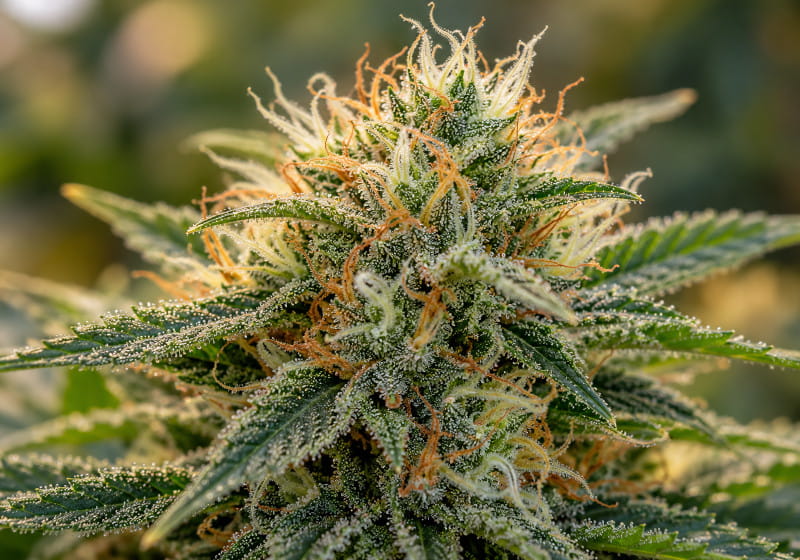
✓ Sinsemilla comes from Spanish and means “without seeds”. In the cannabis context, it refers to female flowers that contain no developed seeds because fertilization has not occurred.
✓ Sinsemilla is neither a separate cannabis strain nor a distinct genetic line. The term must not be confused with feminized cannabis seeds.
✓ Successfully pollinated and fertilized female cannabis flowers can develop seeds. Without fertilization, seeds do not form, regardless of whether the plant originated from regular or feminized seeds.
✓ Scientific research shows that fertilization can influence flower development and cannabinoid profiles. One experimental study found predominantly lower cannabinoid concentrations after fertilization, but this does not establish any particular THC level.
✓ Seedless cannabis flower production has a longer history than the modern commercial term Sinsemilla. The name became internationally familiar particularly through the North American cannabis market of the 1970s and 1980s.
Sinsemilla refers to seedless female cannabis flowers in which successful fertilization, and therefore seed development, has not occurred. The term comes from the Spanish sin semilla, literally “without seeds”. It does not describe a separate strain or subspecies, but rather the seedless condition and development of the flowers.
The term is rooted in botanical processes as well as an important chapter in international cannabis history. The distinction between unfertilized flowers, the biological sex of the plant and the type of seed used is crucial. The widespread assumption that Sinsemilla is always exceptionally rich in THC is not scientifically justified. Actual cannabinoid concentrations depend on several factors, including genetics, developmental stage and environmental conditions.
What does Sinsemilla mean?
The name combines the Spanish words sin (“without”) and semilla (“seed”). Written as one word, Sinsemilla has become established internationally in cannabis culture and commerce. The alternative spelling Sensimilla has the same meaning and does not designate a separate botanical category. Sin Semilla, written as two words, reflects the original Spanish expression.
Pronunciation and alternative spellings
In Spanish, sin semilla is pronounced approximately “seen seh-MEE-yah”, with the stress on the second-to-last syllable of semilla. Pronunciation varies somewhat in English-speaking regions. Whether written Sinsemilla, Sensimilla or Sin Semilla, the meaning remains the same: cannabis flowers without developed seeds.
Is Sinsemilla a separate strain?
No. Sinsemilla is not a distinct cannabis strain, landrace, subspecies or genetically defined plant line. Seedless flowers can occur in cannabis plants of many strains and genetic backgrounds. The United Nations Office on Drugs and Crime (UNODC) also describes Sinsemilla as the result of a particular production approach rather than a separate genetic category. [1]
The botanical basis: Pollination, fertilization and seed formation
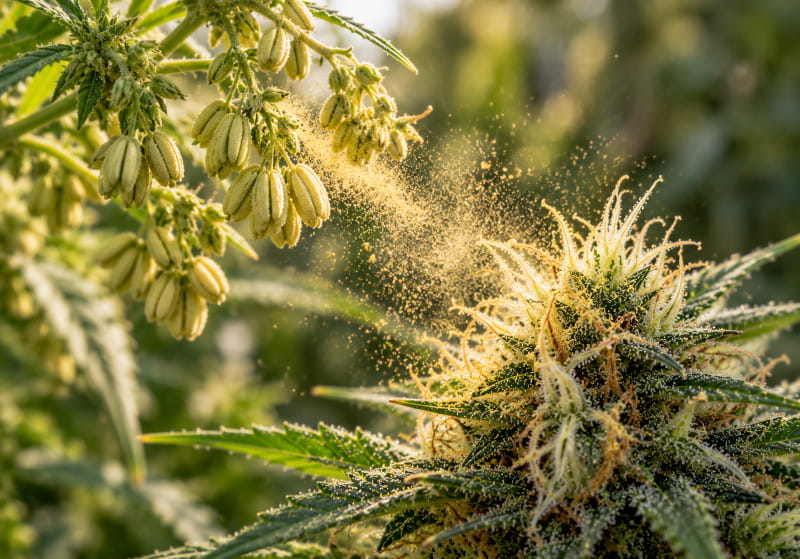
Cannabis is predominantly dioecious, meaning male and female flowers usually grow on separate plants. Plants bearing both male and female flower structures can also occur. Female cannabis flowers have stigmas capable of receiving pollen. When viable pollen reaches a receptive stigma, successful fertilization may initiate seed development. If fertilization does not occur, seeds do not form. This biological relationship underlies Sinsemilla.
Our article on male cannabis plants explains the reproductive role of male flowers and how cannabis produces pollen. The anatomical differences between male and female plants and their characteristic floral features are covered in our guide to identifying the sex of cannabis plants.
What is the difference between pollinated and unpollinated flowers?
In successfully pollinated and fertilized female cannabis flowers, seeds develop from ovules. This reproductive process uses plant resources and may affect subsequent flower development and chemical composition. Unpollinated cannabis flowers, by contrast, do not form seeds and are described as Sinsemilla. However, neither a particular flower size nor an inherently higher THC concentration can be inferred from this alone. Genetics, developmental stage and environmental conditions remain important.
Can a flower described as Sinsemilla contain a few seeds?
In its literal sense, Sinsemilla means completely seedless. Nevertheless, a few seeds may occasionally appear in supposedly seedless cannabis flowers, for example following unnoticed or localized pollination. Strictly speaking, such flowers no longer meet the original definition, even if the term is sometimes used less precisely in commerce. One possible pollen source is plants that develop additional male flower structures. Our article on hermaphroditism in cannabis plants explains the biological background.
Sinsemilla, feminized and regular cannabis seeds: What is the difference?
The terms Sinsemilla, feminized cannabis seeds and regular cannabis seeds are sometimes confused, but they describe different biological concepts. Sinsemilla refers to seedless female cannabis flowers, whereas “feminized” and “regular” describe characteristics of the seeds. Whether a female plant subsequently develops seeds in its flowers depends on successful pollination and fertilization, not on whether it originally grew from regular or feminized seeds.
| Term | Definition and meaning | Relationship to seed formation |
|---|---|---|
| Sinsemilla | Seedless female cannabis flowers that developed without successful fertilization. | No developed seeds because successful fertilization did not occur. |
| Pollinated female flower | Female cannabis flower whose receptive stigmas have come into contact with pollen. | Following successful fertilization, mature cannabis seeds can develop from the ovules. |
| Regular cannabis seeds | Seeds not deliberately feminized, which can generally produce both male and female plants. | Female plants may produce seedless flowers or form seeds following successful fertilization. |
| Feminized cannabis seeds | Specially produced seeds with a high probability of developing into female plants. | Female plants grown from feminized seeds can also develop seeds after successful fertilization. |
The key distinction is therefore between seed type and flower development. A female cannabis plant grown from regular seeds can produce Sinsemilla flowers just as a plant grown from feminized seeds can. Conversely, feminization does not guarantee seedless flowers if successful fertilization occurs. Our guide to feminized cannabis seeds provides more information about seed types. You can also explore corresponding strains and genetic lines in our regular cannabis seeds category.
Where does Sinsemilla come from? Origins and history of the term
The history of seedless cannabis flowers before Sinsemilla
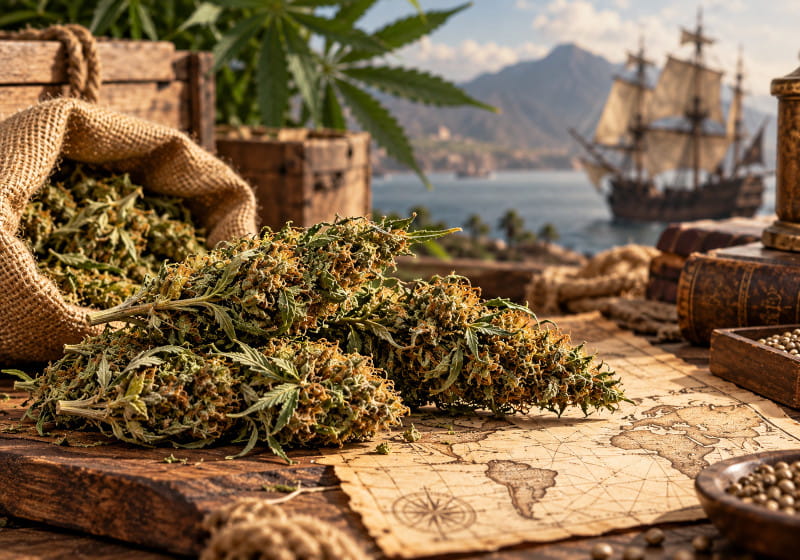
The deliberate use of unfertilized female cannabis flowers predates the international spread of the word Sinsemilla. Historical accounts from the United Nations refer to relevant knowledge in India and indications of comparable practices in Central America. The UNODC World Drug Report 2006 discusses these connections without identifying a definitively documented origin of Sinsemilla production. The sources do not establish a single inventor or country of origin beyond doubt. [1]
How Sinsemilla spread through North America and Europe
Sinsemilla gained international importance particularly in the North American cannabis market of the 1970s. According to the UNODC historical account, production known by this name spread in the United States mainly from the early to mid-1970s. For Europe, the report describes wider adoption around 1980. These dates concern growing awareness and commercial importance in Western markets, not the first discovery or production of seedless cannabis flowers. [1]
The linguistic history can only be reconstructed in part. The Online Etymology Dictionary documents the use of Sinsemilla in English in 1975. This demonstrates that the Spanish-derived term had entered English usage by then, but does not prove its very first use or exact date of origin. [2]
From a historical trade term to a modern cannabis product
As seedless cannabis flowers became more widespread, Sinsemilla evolved from a specialized trade designation into an internationally recognized term in cannabis culture. The distinction between seeded and seedless flowers became especially relevant where cannabis was assessed by visible product characteristics and chemical composition. Today, Sinsemilla primarily describes female cannabis flowers without developed seeds. The term implies neither a particular genetic origin nor guaranteed quality or cannabinoid content.
Sinsemilla and THC: What does science say?
Sinsemilla is often equated with especially THC-rich cannabis flowers. In reality, the absence of fertilization can influence the development and chemical composition of female flowers. However, this does not mean that seedless cannabis flowers always have higher THC concentrations than every pollinated flower. Meaningful scientific comparisons must consider genetics, developmental stage, environmental conditions and analytical methods. Studies comparing pollinated and unpollinated flowers under controlled conditions are particularly informative.
What the study by Lipson Feder and colleagues shows
A 2021 experimental study by Lipson Feder and colleagues investigated how fertilization affects the chemical composition of female cannabis flowers. The researchers compared THC-dominant and CBD-dominant cannabis lines pollinated using different pollen sources with unfertilized control flowers. Most of the phytocannabinoids examined showed lower concentrations after successful fertilization. Differences between individual compounds and experimental conditions were also observed, while the ratio of the dominant cannabinoids remained largely unchanged. [3]
Under the conditions studied, the researchers observed sometimes substantial decreases in total phytocannabinoid concentrations in fertilized flowers. These findings provide experimental evidence that reproduction can influence the chemical development of cannabis flowers. However, they cannot be generalized to all cannabis strains or growing conditions. In particular, they do not establish a universal percentage THC advantage for Sinsemilla or any specific THC concentration. [3]
How does fertilization affect terpenes?
Alongside cannabinoids, Lipson Feder and colleagues examined changes in the terpenoid profiles of cannabis flowers. Fertilization affected different groups of compounds differently. Concentrations of numerous monoterpenoids declined in the fertilized flowers studied, whereas sesquiterpenoids responded differently depending on the genetic line and individual compound. Some substances even showed increased concentrations. These findings demonstrate that seedlessness alone does not establish a particular aroma profile or an invariably higher terpene content. [3]
Why Sinsemilla does not guarantee a particular THC concentration
The concentration of THC and its natural precursor THCA is influenced by multiple factors, especially plant genetics, developmental stage, environmental conditions and analytical measurement. Sinsemilla, by contrast, describes only the seedlessness of female flowers and does not reliably indicate their cannabinoid concentration. A CBD-dominant cannabis strain can also produce seedless flowers without becoming THC-dominant. Sinsemilla is therefore neither a separate class of active compounds nor a scientifically defined quality seal.
Sinsemilla in modern cannabis breeding and commerce
Why flower production and seed production pursue different goals
In cannabis breeding and seed production, successful pollination and fertilization of female flowers are essential parts of reproduction. Male plants may supply pollen, while fertilized female flowers develop new seeds. In Sinsemilla flower production, by contrast, the goal is seedless female flowers. These activities therefore have different objectives: seed production aims to create offspring and new genetic combinations, whereas Sinsemilla describes a flower product without developed seeds. Our article on male cannabis plants explains their reproductive role and the importance of pollen.
Why feminized cannabis seeds do not automatically mean Sinsemilla
Feminizing cannabis seeds aims to produce seeds with a high probability of female offspring. It does not fundamentally prevent later pollination or fertilization. A female plant grown from feminized seed can still develop seeds following successful fertilization. Conversely, female plants grown from regular seeds can produce seedless flowers. Feminized cannabis seeds and Sinsemilla therefore describe two different properties: the expected sex expression of offspring and the seedlessness of flowers. For further details, see our guide to feminized cannabis seeds.
What does Sinsemilla mean in a strain description?
When a cannabis strain or flower product is described as Sinsemilla, the term refers to seedlessness rather than a particular genetic lineage. It provides no information about a strain’s parents and does not guarantee a specific THC concentration, terpene profile or uniform quality. Describing a cannabis strain therefore requires additional details about genetics, origin and verifiable characteristics. Our Canna Wiki offers further information on strain development, genetic lines and selection.
10 well-known and award-winning cannabis strains
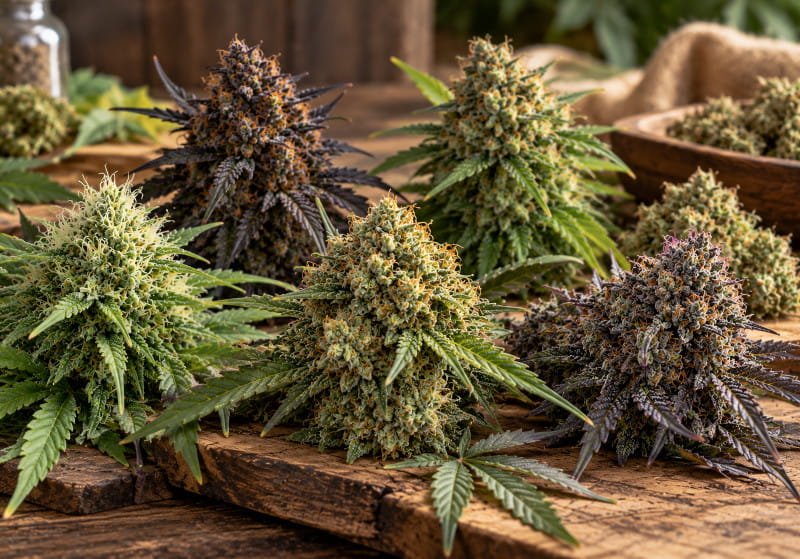
Sinsemilla is not a separate cannabis strain; it describes seedless female cannabis flowers. There is therefore no scientifically recognized ranking of the best Sinsemilla strains. The following selection presents ten well-known cannabis strains that attracted attention through awards or industry evaluations. Modern genetics such as Permanent Marker, Super Boof and Bay Burger appear alongside established classics such as White Widow, Runtz and Bruce Banner #3. This is not a ranking: many different cannabis strains can produce seedless flowers regardless of their genetic background. A strain name alone does not guarantee seedlessness.
| Strain | Award / reason for selection | Typical aroma description* |
|---|---|---|
| Permanent Marker | Leafly Strain of the Year | Spicy, slightly sweet, distinctive |
| Super Boof (Blockberry) | Leafly Strain of the Year | Citrus, cherry, berries |
| Bay Burger | Copa Mendoza | Spicy, savory, earthy |
| White Widow | New York Cannabis Cup | Pine, pepper, citrus |
| Blue Zushi | New York Cannabis Cup | Fruity, sweet, spicy |
| Super Lemon Haze | Michigan High Times Cup | Lemon, tangy, classic Haze notes |
| Blueberry Pancakes | Emerald Cup | Berries, sweet |
| Runtz | Leafly Strain of the Year | Fruity, sweet, creamy |
| Zoap | Oregon Leaf Bowl | Floral, spicy |
| Bruce Banner #3 | High Times Cannabis Cup | Sweet, diesel, fruity, earthy |
*The aroma descriptions reflect typical strain profiles and may vary with genetic line, phenotype and environmental conditions. This selection is not a scientific quality ranking. Awards refer to specific competition entries or editorial strain assessments and do not automatically apply to every seed product bearing the same strain name. The linked Cannapot products provide further information about the respective strains and their genetics without guaranteeing complete genetic identity with the award-winning plants.
Common misconceptions about Sinsemilla
“Sinsemilla is an exceptionally potent cannabis strain.” False. Sinsemilla is not a separate strain or genetic line, nor does the term imply a particular THC concentration. Actual cannabinoid levels depend on various biological and environmental factors.
“All female cannabis plants automatically produce Sinsemilla.” Not necessarily. Female cannabis flowers can develop seeds following successful pollination and fertilization. What matters is not just the plant’s sex but whether fertilization occurred.
“Sinsemilla can only come from feminized cannabis seeds.” False. Female plants grown from regular seeds can also produce seedless flowers. Seed category and subsequent seed formation must be distinguished.
“Seedless cannabis flowers always contain more terpenes.” Scientific research paints a more nuanced picture. Fertilization can change concentrations of individual terpenoids, with different compound groups and genetic lines responding differently. An invariably higher concentration of every terpene has not been established. [3]
“Sinsemilla was invented in the United States.” There is insufficient historical evidence for this claim. The term comes from Spanish, while knowledge of seedless cannabis flowers predates their commercial spread in North America. The United States played an important role in popularizing the term internationally during the 1970s. [1]
Conclusion: What Sinsemilla really means
Sinsemilla refers to seedless female cannabis flowers and is a historically established term closely connected with cannabis reproductive biology. Without successful fertilization, seeds do not develop. Sinsemilla is therefore neither a distinct cannabis strain nor a special genetic line or synonym for feminized cannabis seeds.
The history of seedless cannabis flowers extends beyond their international marketing in the twentieth century. Scientific studies also show that fertilization can affect the development and chemical composition of female cannabis flowers. However, no universally applicable THC level or quality advantage follows from this. The crucial distinction is between genetic origin, seed formation and actually measured compounds. This provides the basis for a scientifically grounded understanding of Sinsemilla.
Frequently asked questions about Sinsemilla (FAQ)
Q: How do you pronounce Sinsemilla?
A: The Spanish expression sin semilla is pronounced approximately “seen seh-MEE-yah”, with the stress on “MEE”. Pronunciation can vary in English-speaking regions.
Q: Is Sensimilla the same as Sinsemilla?
A: Yes. Sensimilla is an alternative spelling of Sinsemilla. Both refer to seedless female cannabis flowers, not different strains or genetic categories.
Q: Can CBD-dominant cannabis flowers also be Sinsemilla?
A: Yes. Sinsemilla is not limited to THC-dominant strains. CBD-dominant plants can also produce seedless female flowers. The term describes seedlessness, not the cannabinoid ratio.
Q: Are Sinsemilla flowers genetically modified?
A: No genetic modification is required. Seedless female cannabis flowers can develop when successful fertilization does not occur. The designation implies neither genetic modification nor any particular genetic ancestry.
Q: What does “sin semilla” literally mean?
A: The Spanish words sin and semilla mean “without” and “seed”. They gave rise to the internationally used term Sinsemilla for cannabis flowers without developed seeds.
Q: Why is Sinsemilla often associated with the 1970s?
A: Production and marketing of seedless cannabis flowers gained importance in North America during the 1970s, helping the name Sinsemilla spread internationally. The underlying practice is older, however. [1]
Q: Can a cannabis flower without visible seeds still have been pollinated?
A: Yes. Pollination and successful fertilization are different biological processes. Not every contact with pollen produces a mature seed. Ovules may also still be at an early developmental stage, so a flower that looks seedless was not necessarily never pollinated.
Q: Is Sinsemilla synonymous with high-quality cannabis?
A: No. Seedlessness is just one characteristic of the flower product. Quality cannot be determined from this alone. Genetics, developmental condition, chemical composition and other verifiable properties must be assessed separately.
Scientific and historical sources
[2] Online Etymology Dictionary: Sinsemilla – Spanish etymology and documented use in English.
[4] Dictionary.com: Sinsemilla – definition, pronunciation and alternative spellings.