Regular Cannabis Seeds: Benefits & Differences
Regular Cannabis Seeds and Their Characteristics
Updated: August 2026 | Regular cannabis seeds explained clearly: sex, genetics, advantages, and differences compared with feminized and autoflower seeds
Author: Cannapot Grow Team | Reading time: approximately sixteen minutes
The Most Important Points at a Glance
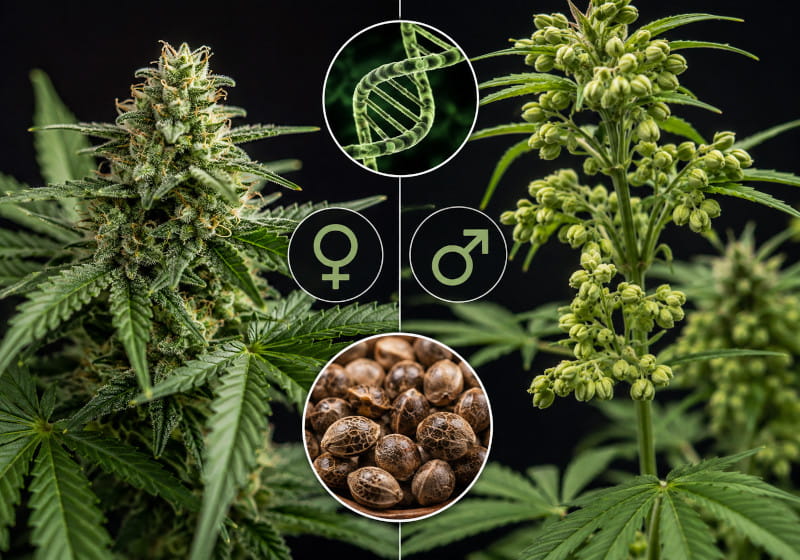
✓ Regular cannabis seeds can produce both male and female plants. This fundamentally distinguishes them from feminized seeds, which are specifically designed to produce female offspring.
✓ In typical dioecious cannabis lines, female plants have two X chromosomes (XX), while male plants have one X and one Y chromosome (XY).
✓ Regular seeds are particularly interesting for breeding and genetic preservation because both male and female plants can be available for selection, crosses, and the continuation of lines.
✓ Regular, feminized, and autoflower refer to different traits: regular and feminized mainly describe the expected sexes of the offspring, while autoflower refers to flowering behavior.
✓ An exact ratio of 50 % male and 50 % female plants is not guaranteed. Genetic diversity and stability also depend on the specific line, the parents, and its breeding history.
Regular cannabis seeds can produce both male and female plants in typical dioecious cannabis lines. This is their most important difference from feminized seeds, which are specifically produced to favor female offspring. Regular seed is classically produced by pollinating a female plant with pollen from a male plant and therefore plays an important role in breeding, selection, and genetic preservation.
However, the term “regular” is not a quality indicator. Regular seeds are not automatically more original, more stable, or more genetically diverse than feminized seeds. Nor does the term initially say anything about flowering behavior: both photoperiod and autoflowering cannabis lines can exist as regular seed. Sex, flowering behavior, genetic diversity, and stability should therefore be considered separately.
What Are Regular Cannabis Seeds?
Regular cannabis seeds are not designed to produce exclusively female offspring and can produce both male and female plants in typical dioecious lines. Cannabis sativa is predominantly dioecious, technically referred to as dioecious. This means that male and female flowers are normally formed on separate plants. Monoecious and intersexual forms also exist, which makes the biology more complex than a simple division into two unchanging categories.
In typical dioecious forms, female plants have two X chromosomes (XX), while male plants have one X and one Y chromosome (XY). At the same time, modern research shows that visible sex expression cannot be explained solely by the presence of these chromosomes. Gene regulation, plant hormones, developmental stage, and environmental conditions can influence flower development.
What Exactly Does “Regular” Mean for Cannabis Seeds?
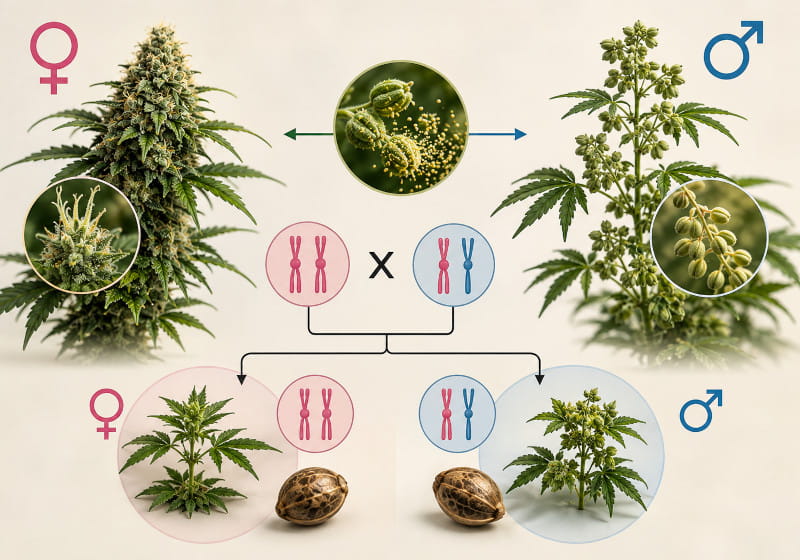
For cannabis seeds, “regular” means that the seed can produce both genetically male and genetically female plants. In a classic cross between a male XY plant and a female XX plant, the female gamete contributes an X chromosome. Pollen from the male plant, by contrast, can contain either an X or a Y chromosome. This means both female XX and male XY offspring can result.
For this reason, regular cannabis seeds are often described as producing an approximately 50 % female and 50 % male sex ratio. However, this ratio is a statistical expectation, not a guarantee for an individual seed pack. With a small number of seeds, the actual distribution can vary considerably – ten regular seeds certainly do not have to produce exactly five female and five male plants.
How Are Regular Cannabis Seeds Produced?
Regular cannabis seeds are classically produced when pollen from a male cannabis plant pollinates the flowers of a female plant. In the process, the genetic material of both parents is recombined. Each seed receives its own combination of genetic traits and may therefore differ from its siblings in characteristics such as growth, flowering time, aroma, or other traits.
How uniform or diverse the offspring turn out does not depend solely on the fact that male and female plants were crossed. More important are the genetics and selection of the parents, their degree of relatedness, and the breeding and selection history of the line. Highly selected parents can produce comparatively uniform offspring, whereas genetically broader populations may show considerably more variation.
Can Regular Cannabis Seeds Produce Male and Female Plants?
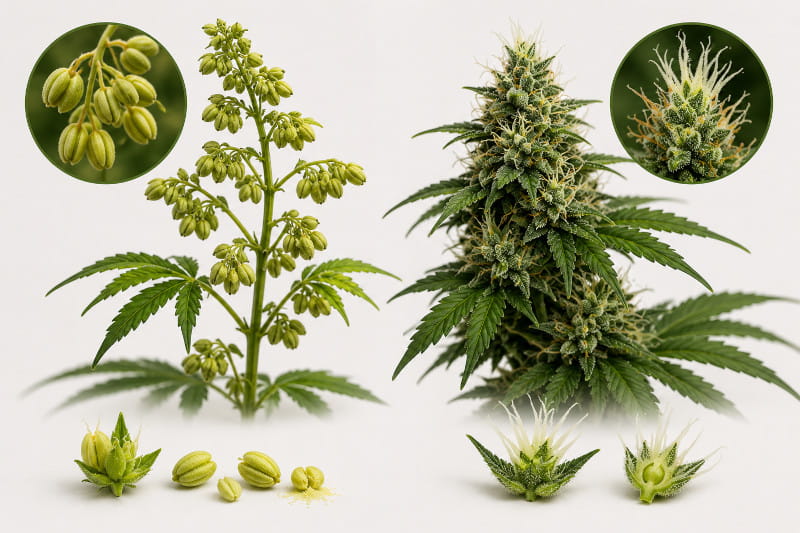
Yes, regular cannabis seeds can produce both male and female cannabis plants produce. In typical dioecious lines, female plants have two X chromosomes (XX), while male plants have one X and one Y chromosome (XY). In young plants, however, genetic sex cannot yet be reliably identified from external appearance. It usually becomes visible only when the corresponding sexual characteristics develop; molecular tests can determine it earlier.
A distinction should be made between genetic sex and visible sex expression. XX and XY form the genetic basis of sex determination in dioecious cannabis, but flower development can additionally be influenced by hormonal and other factors. Under certain conditions, flower traits of the opposite sex can therefore also occur. Sex expression in cannabis is thus more complex than a purely external classification as male or female.
What Is the Difference Between Regular and Feminized Cannabis Seeds?
Regular seeds can produce XX and XY offspring in dioecious lines, while feminized cannabis seeds are deliberately produced so that the offspring are genetically predominantly, or practically exclusively, female. In the production of feminized seed, a genetically female plant is induced to form pollen-producing male flowers. This pollen comes from an XX plant and contains no regular paternal Y chromosome. When it fertilizes an XX plant, genetically female seeds result.
Feminization therefore primarily changes the sex composition of the offspring. This does not automatically mean that feminized genetics are inherently unstable or that regular genetics are inherently superior. Stability is a breeding trait and depends on the quality of the parents, the selection process, and the specific line. The tendency toward unwanted intersexual flower formation should therefore not be inferred solely from the label “regular” or “feminized”.
|
Characteristic |
Regular Seeds |
Feminized Seeds |
Autoflower Seeds |
|
What does the term mean? |
Male and female plants can occur |
Seed designed to produce female plants |
Describes flowering behavior that is largely independent of day length |
|
Male plants |
Yes, possible in typical dioecious lines |
Normally not expected with correctly produced seed |
Depends on whether the autoflower seeds are regular or feminized |
|
Flowering behavior |
Can be photoperiod or autoflowering |
Can be photoperiod or autoflowering |
Flowering begins largely independently of changes in day length |
|
Breeding with male plants |
Directly possible with male offspring |
Male XY offspring are normally not intended |
Possible with regular autoflower lines |
|
Particularly interesting for |
Breeding, selection, and genetic preservation |
Planning with predominantly female plants |
Genetics with flowering onset largely independent of photoperiod |
|
Important to know |
“Regular” does not automatically indicate stability or quality |
“Feminized” does not describe flowering behavior |
Autoflower seeds can be regular or feminized |
What Is the Difference Between Regular Seeds and Autoflower Seeds?
Regular and autoflower describe two different characteristics of cannabis seeds: “regular” refers to the possible sexes of the offspring, while “autoflower” refers to flowering behavior. Regular seeds can produce male and female plants. Autoflowering plants, by contrast, begin flowering largely independently of changes in day length, whereas photoperiod strains respond to corresponding light and dark periods.
Regular seeds and autoflower seeds are therefore not opposites. Autoflowering genetics can be offered as either regular or feminized seeds. Conversely, photoperiod strains can also be regular or feminized. When comparing cannabis seeds, you should therefore consider two characteristics separately: Which sexes can occur, and how is flowering triggered?
What Are the Advantages of Regular Cannabis Seeds?
Regular cannabis seeds offer the advantage that both male and female plants can be available for breeding, selection, and genetic preservation. This allows not only female plants to be selected, but also suitable male parents to be included in breeding. This is particularly important for developing new crosses and preserving lines over the long term.
-
Male and female plants: Both sexes can be selected within a line and used for further breeding.
-
New crosses: Selected male and female plants can be deliberately crossed to recombine desired traits.
-
Genetic preservation: Regular seeds make it possible to continue lines through male and female parents and preserve existing genetic diversity.
-
Broad selection pool: Differences among individual offspring can be used to select plants with desired traits for further breeding generations. How such differences are systematically compared and promising phenotypes selected as keepers is explained in detail in our Canna Wiki guide to cannabis pheno hunting.
What Are the Disadvantages of Regular Cannabis Seeds?
The main practical disadvantage of regular cannabis seeds is that male plants can occur alongside female plants. Anyone who needs exclusively female plants therefore cannot assume in advance that every seed will produce a female plant. Sex must later be determined from sexual characteristics or earlier with a suitable genetic test.
-
Sex ratio cannot be planned exactly: Especially with only a few seeds, the ratio of male to female plants can vary considerably.
-
More selection required: Depending on the goal, several plants may need to be raised and later selected according to sex and desired traits.
-
Risk of unintended pollination: Male plants can release pollen and pollinate female flowers if they are not identified in time or intentionally used for a cross.
-
Regular does not automatically mean better or worse: The label alone says nothing about genetic stability, uniformity, germination capacity, or the overall quality of a line.
Why Are Regular Cannabis Seeds So Important for Breeding?
Regular cannabis seeds are especially valuable for breeding because male and female plants can be selected and deliberately crossed with one another. This makes it possible to evaluate both parental sides of a line and develop specific traits over several generations. In addition to female plants, male plants can also be selected based on origin, vigor, growth, development, and the quality of their offspring.
How suitable a plant is for breeding cannot be determined from its appearance alone. Many traits are influenced by multiple genes and can additionally be shaped by environmental conditions. What matters most is which traits a selected parent actually passes on to its offspring. Reliable assessment of a breeding line therefore usually requires observation of multiple offspring and generations.
What Role Do Male Cannabis Plants Play?
Male cannabis plants provide pollen for pollination and contribute a substantial part of the offspring’s genetic material in a classic cross. They are therefore just as important for breeding as female parent plants. Their genetic traits can influence growth, development, and many other characteristics of the next generation.
Selecting suitable male plants is demanding because not all desired traits can be assessed directly on the male parent. Breeders therefore consider factors such as lineage, growth, and vigor, as well as the characteristics of related plants and the offspring produced. Only these observations show which traits a male parent can actually and reliably pass on.
Why Are Regular Seeds Used for Genetic Preservation?
Regular seeds are particularly useful for genetic preservation because male and female plants from a line can be selected for further propagation. This allows a population to be maintained over multiple generations without fundamentally excluding either sex. However, it is crucial that enough different parents contribute to the next generation. If only a very small number of plants are repeatedly crossed, the genetic diversity of a line can gradually decline.
Genetic preservation therefore means more than simply storing existing seeds or propagating individual plants. Especially with original cannabis landraces it can be important to preserve as many characteristic genetic traits of a population as possible. To achieve this, a sufficient number of different parents should be included and severe genetic bottlenecks avoided. When deliberately developing a uniform breeding line, by contrast, a narrower selection may be used intentionally.
Are Regular Cannabis Seeds More Genetically Diverse?
Regular cannabis seeds can have a high degree of genetic diversity, but they are not automatically more diverse than feminized seeds. How strongly individual offspring differ from one another depends mainly on the genetics of the parents, their relatedness, and the breeding and selection history. The number of plants involved in continuing a population can also play an important role.
A regular line that has been heavily selected over many generations can, for example, be very uniform. A cross between genetically different parents, on the other hand, can produce considerably more variation – regardless of whether the resulting seed is regular or feminized. With heirloom strains the long-term preservation of old genetics also plays an important role. For assessing genetic diversity, the origin and breeding history of a line are therefore more informative than the label “regular” alone.
Are Regular Cannabis Seeds More Stable Than Feminized Seeds?
No, regular cannabis seeds are not automatically genetically more stable than feminized seeds. A stable line is instead characterized by certain desired traits appearing as reliably and predictably as possible over several generations. Selecting suitable parents, making deliberate crosses, applying consistent selection, and evaluating the offspring are crucial for this.
Sex expression also cannot be inferred solely from the label “regular” or “feminized”. In cannabis, it is determined primarily by genetics but can additionally be altered by hormonal and external influences. Whether a line is genetically stable and reliably passes on desired traits therefore becomes clear only through observation of its offspring over several generations.
Who Are Regular Cannabis Seeds Suitable For?
Regular cannabis seeds are particularly interesting for breeders, genetics collectors, preservation projects, and traditional growers who deliberately want to work with male and female plants. They allow classic selection of both sexes and thus provide the basis for custom crosses, continuation of existing lines, and preservation of specific genetics.
Even among old-school growers regular seeds still hold a special place today. Before feminized seeds became widespread, male and female plants were simply part of growing from seed. Anyone who prefers this traditional approach, wants to preserve classic genetics, or select suitable parent plants themselves will therefore still find regular seed a suitable foundation.
Anyone who wants to plan exclusively with female plants and does not need male plants for breeding or genetic preservation can simplify planning with feminized seed. Which type of seed makes more sense therefore depends primarily on the individual goal – regular and feminized seeds serve different purposes, and neither option is inherently better.
If you are specifically looking for classic and modern genetics of this type, you will find a selection in the category regular cannabis seeds.
Which Well-Known Regular Cannabis Seeds Are There?
Regular cannabis seeds are available from traditional strains as well as landraces, preserved old-school lines, and modern crosses. The following selection shows well-known and genetically interesting regular strains with different lineages and breeding focuses.
|
Strain |
Breeder |
Genetics |
Notable feature |
|
Mr. Nice Seeds |
Brazil Sativa × South Indian Indica |
Original Widow genetics |
|
|
Cannapot |
Blueberry × True Blueberry |
Classic Blueberry line from DJ Short |
|
|
Brothers Grimm Seeds |
Cinderella-99-Linie |
Well-known Sativa classic |
|
|
HYP3RIDS Genetics |
Highland Colombian Gold NLD × Colombian Gold |
Broadly based Colombian genetics |
|
|
Sensi Seeds |
Secret Sativa/Indica lineage |
Complex classic hybrid |
|
|
Kens Grand Daddy |
Purple Urkle × Big Bud |
Well-known California Purple genetics |
|
|
Cannapot |
Sour Diesel K.G. × Biker Kush V1 |
F2 line with Diesel and Kush background |
|
|
ACE Seeds |
Lebanese Landrace |
Lebanese landrace genetics |
|
|
ApeOrigin |
Sour Diesel × Afghani × Hawaiian |
Classic Diesel genetics |
|
|
Mr. Nice Seeds |
White Widow × Skunk #1 |
Old-school Widow/Skunk hybrid |
|
|
Sagarmatha Seeds |
Kali Mist Selection |
Classic Haze/Sativa line |
|
|
Cannapot |
AK-47 (Late 90s) × Thai Stick |
Old-school Sativa hybrid |
What Misconceptions Exist About Regular Cannabis Seeds?
There are several persistent misconceptions surrounding regular cannabis seeds – especially regarding sex ratio, genetic diversity and stability, and comparisons with feminized and autoflower seeds. The most important misconceptions can be clearly explained:
-
“Regular seeds always produce exactly 50 % female and 50 % male plants.” An approximately even ratio is a statistical expectation, but not a guarantee for an individual seed pack. Especially with only a few seeds, the actual distribution can differ considerably.
-
“Regular seeds are automatically more stable.” Whether a line reliably passes on certain traits depends on its genetics, breeding history, and selection – not simply on whether the seeds are regular or feminized.
-
“Feminized seeds are genetically identical.” Feminized seeds are not clones. They too are created through reproduction and recombination of genetic material, so individual offspring can differ genetically and in their visible traits.
-
“Autoflower is the opposite of regular.” This is incorrect because the two terms describe different characteristics. Autoflower refers to flowering behavior, while regular describes the possible sexes of the offspring. Autoflower seeds can therefore be regular or feminized.
-
“Male cannabis plants are useless.” Male plants are highly important for classic cannabis breeding: they provide pollen, pass genetic traits on to their offspring, and enable the continuation of regular lines.
Regular, Feminized, or Autoflower: What Does Each Term Mean?
The three terms are easiest to understand when considered as separate genetic or breeding characteristics. “Regular” and “feminized” mainly answer the question of which genetic sexes can be expected from the seed and how it was produced. “Autoflower”, by contrast, describes how strongly flowering induction is linked to the photoperiod.
|
Term |
Mainly describes |
What does not automatically follow from it |
|
Regular |
The seeds can produce male and female plants |
Higher quality, greater genetic diversity, or better stability |
|
Feminized |
The seeds are specifically designed to produce female offspring |
That all offspring are genetically identical or that the genetics are inherently less stable |
|
Autoflower |
Flowering begins largely independently of changes in day length |
Whether the seeds are regular or feminized |
FAQs About Regular Cannabis Seeds
Q: What are regular cannabis seeds?
A: Regular cannabis seeds can produce both male and female plants. In typical dioecious cannabis lines, female plants have two X chromosomes (XX), while male plants have one X and one Y chromosome (XY).
Q: Are regular cannabis seeds always 50 % male and 50 % female?
A: No. A ratio of approximately 50 % male and 50 % female plants is a statistical expectation, but not a guarantee. Especially with only a few seeds, the actual distribution can differ considerably.
Q: Which is better: regular or feminized cannabis seeds?
A: Neither type of seed is inherently better. Regular seeds are particularly interesting for breeding, selection, and genetic preservation, while feminized seeds simplify planning when female plants are the priority.
Q: Can regular cannabis seeds be autoflowering?
A: Yes. “Regular” describes the possible sexes of the offspring, while “autoflower” refers to flowering behavior. Autoflower genetics can therefore be either regular or feminized.
Q: Are regular cannabis seeds genetically more stable?
A: No, not automatically. How stable and uniform a line is depends mainly on its genetics, the selection of the parents, its breeding history, and selection over several generations.
Q: Why are male cannabis plants important for breeding?
A: In classic crosses, male plants provide the pollen and pass part of their genetic material on to the offspring. This allows them to be deliberately selected for new crosses and for continuing existing lines.
Q: Can you identify the sex of a regular cannabis seed?
A: No. The shape, size, color, or pattern of a seed does not reliably indicate whether it will produce a male or female plant. Sex becomes visible later through corresponding plant characteristics or can be determined earlier with suitable genetic tests.
Q: Are feminized cannabis seeds clones?
A: No. Feminized seeds are not clones; they are produced through sexual reproduction and can differ genetically from one another. A clone, by contrast, is a vegetatively produced genetic copy of a parent plant.
Q: Can genetically female XX plants produce male flowers?
A: Yes. Genetically female XX plants can also develop pollen-producing flowers under certain influences. Deliberate hormonal manipulation of this process is also used in the production of feminized cannabis seeds.
Why Do Regular Cannabis Seeds Remain Important?
Regular cannabis seeds remain important primarily for breeding, selection, and genetic preservation because they can produce both male and female plants. Their particular value does not lie in being inherently better or more stable than feminized seeds. Rather, they enable the classic selection of both sexes and thus the development of new crosses, continuation of existing lines, and preservation of genetic diversity.
Regular seeds therefore continue to have a firm place among traditional growers and enthusiasts of old-school genetics. Ultimately, what matters is not only the label on the seed pack, but the specific genetics and their breeding history. Anyone who can correctly distinguish between regular, feminized, and autoflower seeds can assess the respective genetics much more accurately.
Sources and Scientific Background
-
Riera-Begue A. et al. (2025): A simple and reliable PCR-based method to differentiate between XX and XY sex genotypes in Cannabis sativa. Planta.
-
Toscani M. et al. (2026): Three closely linked X-chromosomal genes potentially control sex determination in Cannabis sativa. New Phytologist.
-
Richards C. D. et al. (2026): Hermaphroditism in Cannabis sativa L.: Impacts, Inducers, and Industry Implications. Plants.
-
Kim J. et al. (2024): Characterization of Male Flower Induction by Silver Thiosulfate Foliar Spray in Female Cannabis at the Middle Reproductive Stage for Breeding. Plants.
-
Judkevich M. D. et al. (2026): Anatomical and Ontogenetic Basis of Silver Thiosulfate-Induced Masculinization in Genetically Female Cannabis sativa. Plants.
-
Stack G. M. et al. (2020): Genetic Architecture of Flowering Time and Sex Determination in Hemp (Cannabis sativa L.): A Genome-Wide Association Study.
-
Dowling C. A. et al. (2023): Comparative genomics of flowering behavior in Cannabis sativa. Frontiers in Plant Science.
-
Divashuk M. G. et al. (2014): Molecular Cytogenetic Characterization of the Dioecious Cannabis sativa with an XY Chromosome Sex Determination System. PLOS ONE.