Male Cannabis Plants Explained: Flowers, Pollen, Genetics and Their Role in Breeding
Updated: October 2026 | Male cannabis plants: botany, reproduction and cannabis breeding
Author: Cannapot Grow Team | Reading time: approximately twelve minutes
Key Takeaways
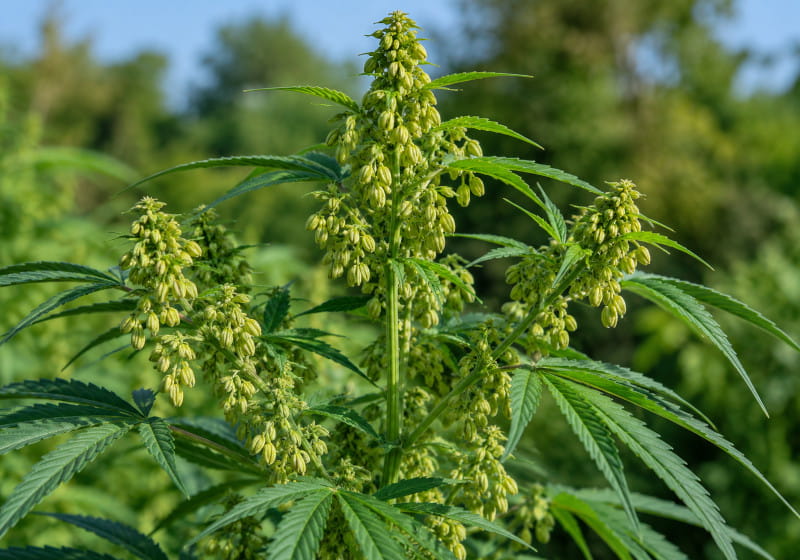
✓ Male cannabis plants develop characteristic flower clusters with stamens whose anthers produce and release pollen.
✓ Cannabis is predominantly dioecious: male and female flowers usually develop on separate plants. Monoecious forms and different patterns of sex development also exist.
✓ Male cannabis plants supply the pollen needed for natural pollination and are therefore essential to sexual reproduction, seed formation and genetic diversity.
✓ Male cannabis flowers and examined pollen samples can also contain cannabinoids such as THC and CBD. Reported concentrations vary according to genetics, plant part and developmental stage and often differ from those found in female flowers.
A male cannabis plant produces pollen-bearing flowers and serves as the pollen donor in sexual reproduction. Its pollen enables the fertilisation of female flowers and the creation of new plant generations. Yet male cannabis plants are much more than pollen donors: in cannabis breeding they play an important role in passing on genetic traits and maintaining genetic diversity.
What Is a Male Cannabis Plant?
Cannabis is predominantly dioecious, meaning that male and female flowers normally develop on separate plants. Male cannabis plants produce flowers with stamens whose anthers form and release pollen grains. Female flowers, by contrast, have stigmas and ovules, from which seeds can develop following successful fertilisation. This separation of the sexes promotes reproduction between different plants.
However, sex expression in Cannabis sativa is more varied than a simple distinction between male and female suggests. Monoecious forms of cannabis are particularly well known from fibre hemp breeding; these produce male and female flowers on the same plant. Genetic, hormonal and environmental factors can also influence flower development. Our Canna Wiki article on cannabis anatomy provides further information about the plant's basic structure.
What Do Male Cannabis Plants Look Like?
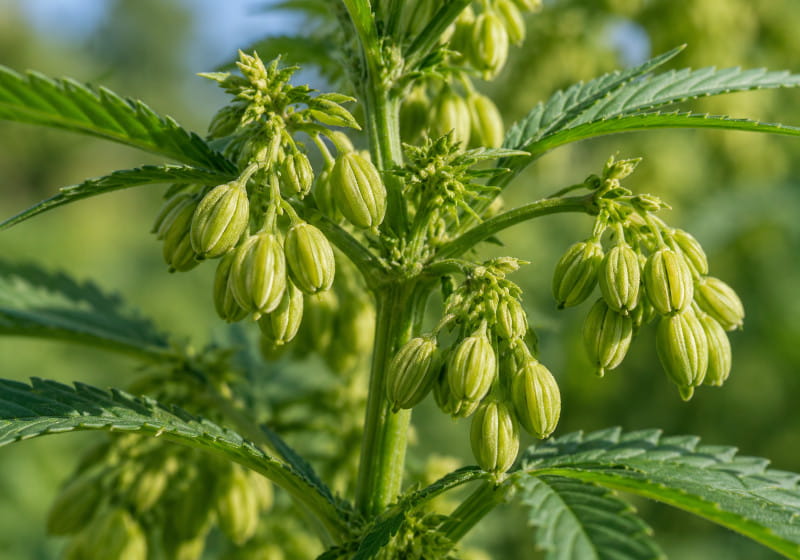
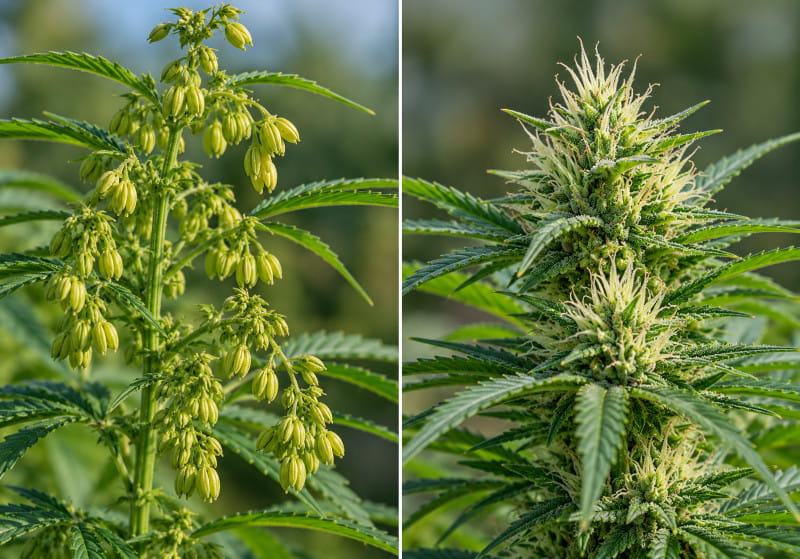
The most distinctive feature of a male cannabis plant is its small, initially closed flower buds, which often grow in groups on branching inflorescences. As they mature, the flowers open and expose the stamens and their pollen-producing anthers. These closed male flowers are commonly called pollen sacs. Botanically speaking, however, pollen forms and matures in the anthers inside the flowers.
Male cannabis plants are often described as taller, slimmer or less heavily branched than female plants. Such differences may occur within particular populations, but they are not reliable indicators of sex. Plant height, leaf width, branching and internode spacing depend largely on genetics and environmental conditions. The distinguishing features are therefore the flowers, not the plant's overall growth habit.
Our detailed Canna Wiki guide to identifying male and female cannabis plants explains how male and female pre-flowers differ, how to recognise pollen sacs and female stigmas, and what to look for in intersex cannabis plants. This article instead focuses on the botany, reproduction and genetic significance of male cannabis plants.
Structure and Development of Male Cannabis Flowers
From Flower Bud Formation to Pollen Release
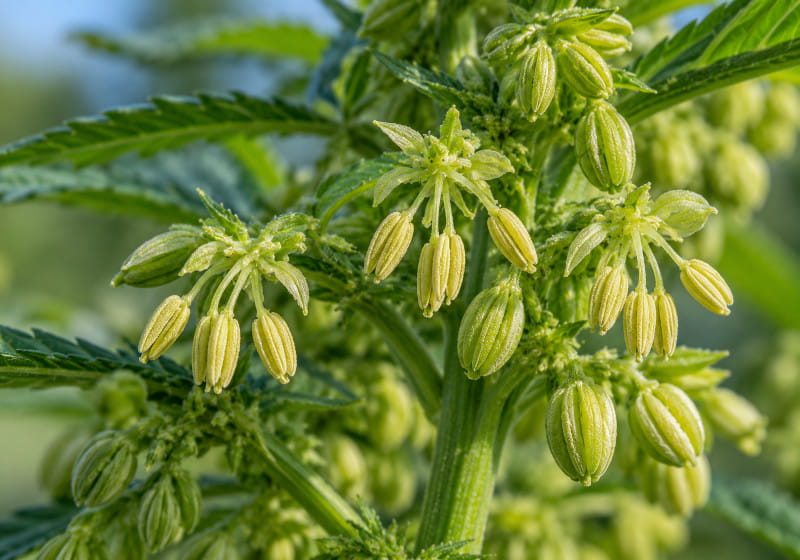
Male cannabis flowers have a simple floral envelope usually consisting of five perianth segments and typically contain five stamens. During development, the pollen-producing anthers mature inside the initially closed flowers. When the flowers open, the stamens become visible and the mature anthers can release their pollen. Although individual flowers are relatively small, they often occur in large numbers on branching inflorescences.
The timing of male flower formation and opening depends on several factors. In addition to genetic predisposition, the plant's developmental stage, day length and other environmental conditions influence the onset and progression of flowering. Even within the same population, individual plants may differ in when they flower and release pollen.
Stamens, Anthers and Pollen Grains
A stamen consists of a filament and an attached anther, in which pollen grains develop. During pollen formation, meiosis, a specialised form of cell division, first produces haploid microspores containing a single set of chromosomes. These subsequently develop into pollen grains that carry male genetic information. After successful pollination, a male gamete can fuse with the egg cell. The fertilised egg develops into an embryo containing genetic information from both parent plants.
How Do Male Cannabis Plants Pollinate Female Flowers?
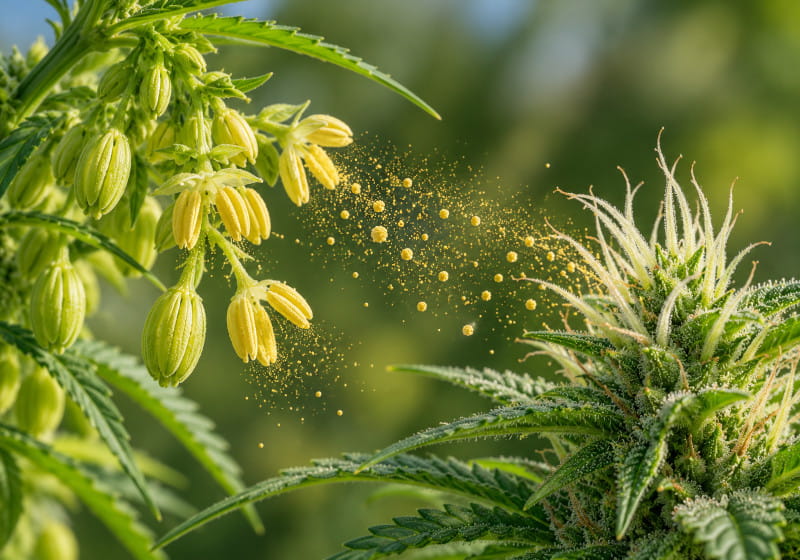
Cannabis is a predominantly wind-pollinated plant. Once male flowers are mature, their anthers open and release numerous pollen grains that can be carried by air currents to female flowers. If a viable pollen grain lands on a receptive stigma, it can germinate and form a pollen tube. This grows through the tissue of the pistil towards the ovule, where the male gametes participate in fertilisation. Pollination therefore refers to the transfer of pollen, while fertilisation itself takes place afterwards.
Following successful fertilisation, the egg cell develops into an embryo while the ovule matures into a seed. Botanically, cannabis produces a dry, one-seeded indehiscent fruit known as an achene. What is commonly called a hemp seed, including in commercial use, is therefore botanically a small fruit enclosing the true seed. How far cannabis pollen travels and whether it actually causes fertilisation depend on wind conditions, pollen viability and the receptivity of female flowers, among other factors. There is no universally applicable pollination distance.
The significance of pollination depends on the purpose of cannabis cultivation. In the production of unpollinated female flowers, pollen from other plants is undesirable because successful fertilisation can lead to seed formation. In seed production and conventional cannabis breeding, however, the same process is essential because sexual reproduction creates new genetic combinations. Male cannabis plants are therefore not inherently unwanted; they perform important biological and breeding functions.
Why Are Male Cannabis Plants Important for Breeding?
Male Parent Plants and Genetic Diversity
In conventional cannabis breeding, male and female parent plants both contribute to the genetic makeup of their offspring. The male plant passes on its genetic material through pollen, while the female plant provides the egg cell and supports seed development. Recombination of genetic information during sexual reproduction produces offspring with different combinations of traits. Male parental lines are therefore important for preserving genetic diversity and developing new cannabis genetics.
Their importance is particularly clear with regular cannabis seeds. These result from conventional crosses in which pollen from a male plant fertilises female flowers. Regular seeds can develop into either male or female cannabis plants. An approximately balanced sex ratio is often expected, although the actual ratio may vary depending on genetic background and sample size. Our Canna Wiki guide provides more background on regular cannabis seeds and their characteristics.
Which Traits Can Male Plants Pass On?
Male cannabis plants can pass on genetic variants that influence their offspring's growth habit, flowering time, cannabinoid and terpene profiles, and tolerance of certain environmental conditions. Many of these traits, however, arise from interactions between multiple genes and are also shaped by external factors. A particularly vigorous or early-flowering male parent therefore does not guarantee that its offspring will display the same traits to a similar degree.
Traits that are not directly visible in a male plant can also be genetically relevant to the next generation. These include genetic factors affecting the chemical composition of female flowers or particular growth characteristics. Which traits are actually inherited and how they are expressed in offspring depend on the combination of both parental lines and the underlying inheritance mechanisms. These genetic relationships can be described using F1 and F2 generations, backcrosses (BX) and inbred lines (IBL).
Why Does Appearance Reveal Little About Breeding Value?
A male cannabis plant cannot be judged to be a particularly valuable parent solely on the basis of its size, vigour or flower development. Although such features may offer clues about its own phenotype, they do not reliably predict which traits will appear in its offspring. What matters more is its genetic breeding value, meaning the contribution a parental line makes to the expression of particular traits in the next generation.
For a scientifically sound assessment, genetic origin, offspring characteristics and the reproducibility of observed traits are therefore more important than the appearance of a single plant. This distinction applies to both male and female parental lines. The targeted search for plants with desirable characteristics is known as pheno hunting and is covered in a separate Canna Wiki article.
Sex Chromosomes and Sex Development in Cannabis
In most dioecious cannabis plants, genetic sex is determined by an XX/XY sex chromosome system. Female plants typically have two X chromosomes (XX), while male plants have one X and one Y chromosome (XY). Visible sex expression, however, is not determined solely by these chromosomes. Genetic regulatory mechanisms, plant hormones and environmental conditions also influence whether and how male or female flowers develop. Research on monoecious cannabis lines in particular shows that genetic sex and actual flower expression do not always correspond perfectly.
A scientific review by Baek and colleagues published in 2025 describes the complex relationships between sex chromosomes, genetic regulatory mechanisms and external influences. Despite substantial progress, not all processes involved in sex development in cannabis are fully understood. The XX/XY system therefore provides an important genetic foundation but does not explain every form of male, female or mixed flower development.
Alongside predominantly dioecious forms of cannabis, there are also monoecious plants that produce male and female flowers on the same individual. Such forms are particularly well known in fibre hemp breeding. These should be distinguished from intersex or sexually unstable flower development, in which plants may additionally form reproductive structures of the other sex. Although the two phenomena may look similar, they differ in their genetic basis, origins and breeding significance. Our dedicated Canna Wiki article on Hermaphrodite cannabis plants explores these distinctions in more detail.
Sex biology also plays an important role in the production of feminised cannabis seeds. This process uses pollen from genetically female plants in which male flower formation has been deliberately induced. Because these pollen donors normally lack Y chromosomes, the resulting crosses produce predominantly genetically female offspring. However, this does not guarantee exclusively female flowers under all conditions, since subsequent sex expression can also be influenced by genetic and environmental factors.
Do Male Cannabis Plants Contain THC and CBD?
Yes, male cannabis plants can also contain THC, CBD and other cannabinoids. The widespread assumption that male cannabis plants contain no cannabinoids at all is not supported by scientific evidence. However, measured concentrations often differ considerably from those found in female plants. Relevant factors include not only sex but also genetics, the plant part examined, developmental stage and the analytical method used.
Cannabinoids in Male Flowers, Leaves and Pollen
Many characteristic cannabinoids are produced primarily in specialised glandular hairs known as glandular trichomes. These are especially abundant on the floral organs of female cannabis plants. In many studied genetic lines, female flowers therefore contain higher cannabinoid concentrations than male flowers. Nevertheless, male flowers and other plant parts can also contain these compounds. Concentrations vary substantially and cannot be inferred from plant sex alone.
As early as 2005, Ross and colleagues identified 16 different cannabinoids in analysed cannabis pollen extracts, including THC and CBD. These findings show that pollen-containing material can contain such compounds. However, analysing pollen extracts does not automatically establish that all detected cannabinoids originated exclusively inside the pollen grains. Nor do the results support universal conclusions about their concentrations, effects or practical uses.
What Do Scientific Comparisons of Male and Female Flowers Show?
A study published in iScience in 2026 examined differences in gene expression and chemical composition between male and female cannabis flowers. The reported findings suggest that the flowers analysed differ in certain cannabinoids and other metabolites. Such differences must always be interpreted in the context of the genetics involved, the samples examined and the analytical methods used. Individual measurements cannot be generalised to all cannabis varieties or plant parts.
These research findings illustrate why blanket statements about cannabinoid concentrations in male cannabis plants are of limited value. Male plants are not necessarily free of THC or CBD, nor do male and female flowers automatically have comparable chemical compositions. Reliable conclusions require direct analysis of the particular plant material concerned.
| Plant Material Examined | Scientific Interpretation |
|---|---|
| Male flowers | May contain glandular trichomes and various cannabinoids. Reported concentrations depend on genetics and developmental stage, among other factors. |
| Female flowers | In many studied cannabis lines, female flowers have a higher density of cannabinoid-producing glandular trichomes and higher cannabinoid concentrations than male flowers. |
| Cannabis pollen | Various cannabinoids have been detected in analysed pollen extracts. This does not directly establish their concentrations inside the pollen grains themselves. |
| Leaves and other plant parts | May also contain cannabinoids, with concentrations varying considerably. Meaningful comparisons require comparable samples and appropriate analytical methods. |
What Are Male Cannabis Plants Used For?
The main function of male cannabis plants is producing pollen for sexual reproduction and seed production. In conventional cannabis breeding, they serve as parent plants whose genetic traits can be combined with those of female plants. Male cannabis lines thus contribute to the development of new varieties and the preservation of genetic diversity. This applies to the breeding of fibre hemp as well as other types of cannabis. Sexual reproduction is also relevant to the preservation of genetic diversity in traditional cannabis landraces.
Male plants also played a role in traditional hemp production. Historically, they were sometimes considered separately from female plants because the two sexes can differ in development, maturity and certain fibre characteristics. Their significance for fibre production depends particularly on the variety and production method. Our Canna Wiki article on different approaches to hemp cultivation explains these uses and their background. Male hemp plants are therefore neither inherently unsuitable nor automatically superior for every fibre application.
Scientists also investigate the chemical composition of male cannabis flowers, leaves and other plant organs. Studies have identified various cannabinoids and other secondary plant compounds. Such findings broaden our understanding of the plant's biology, but they do not in themselves establish any proven medical benefit or justify a general recommendation to use male plant material.
Common Myths About Male Cannabis Plants
Myth: Male cannabis plants are useless.
Male plants are generally undesirable when the aim is to produce unpollinated female flowers. However, they play an important role in natural reproduction, conventional cannabis breeding and the preservation of genetic diversity. Male hemp plants have also been used in traditional fibre production.
Myth: Male cannabis plants contain no THC.
This claim is not supported by scientific evidence. THC and other cannabinoids have also been detected in male plant material. Their concentrations depend on genetics, the plant part examined and other factors.
Myth: Particularly tall male plants automatically pass on vigorous growth.
The appearance of a parent plant does not reliably predict the characteristics of its offspring. Many growth traits are influenced by multiple genes and also depend on environmental conditions. The actual breeding value of a parental line is therefore what matters.
Myth: Cannabis only has separate male and female plants.
Although cannabis is predominantly dioecious, monoecious forms also exist, with male and female flowers developing on the same plant. Genetic, hormonal and environmental influences can also alter sex expression.
Myth: One male plant will inevitably pollinate every female plant nearby.
Cannabis pollen can be carried by wind over varying distances. Whether fertilisation actually occurs depends on wind conditions, distance, pollen viability and the receptivity of female flowers, among other factors. There is no universally applicable pollination distance.
Frequently Asked Questions About Male Cannabis Plants
What Is the Biological Role of Male Cannabis Plants?
Male cannabis plants produce pollen that carries male gametes. In dioecious cannabis, this enables the fertilisation of female flowers and sexual reproduction. The resulting offspring inherit genetic contributions from both parent plants.
Do Male Cannabis Flowers Have Glandular Trichomes?
Yes. Male cannabis flowers can also have glandular trichomes in which characteristic plant compounds are produced or accumulated. However, the abundance and chemical composition of these trichomes often differ from those found on female flowers.
Can Male Cannabis Plants Contain CBD?
Yes. CBD has also been detected in male cannabis tissue and analysed pollen extracts. Actual concentrations vary according to genetics, plant part and developmental stage and can only be reliably determined through suitable laboratory analyses.
Which Genetic Traits Can a Male Parent Plant Pass On?
Male cannabis plants can pass on genetic variants affecting growth habit, flowering time, cannabinoid and terpene profiles, and certain adaptive characteristics. Which traits are ultimately expressed in offspring depends on the interaction between both parental lines and their environmental conditions.
Are Male Plants Needed to Produce Feminised Cannabis Seeds?
Not necessarily. Feminised cannabis seeds can be produced using pollen from genetically female plants in which male flower formation has been deliberately induced. A conventional male XY plant is not required. Our separate guide to feminised cannabis seeds explains the background.
Is a Male Cannabis Plant the Same as an Intersex Plant?
No. A typical male cannabis plant produces male flowers. An intersex or sexually unstable plant, by contrast, may develop male and female reproductive structures on the same individual. The causes and botanical classification of these phenomena can differ.
Scientific References
The following scientific publications provide the basis for the botanical, genetic and chemical information in this article. Findings from individual studies apply to the plants, populations and analytical methods examined and cannot be generalised without qualification to all cannabis genetics.
- Baek et al. (2025): A review of sexual strategies in Cannabis sativa L. under genomic and environmental controls
- Chen et al. (2026): Comparative analysis of gene expression and metabolites in female and male Cannabis sativa flowers, iScience
- Ross et al. (2005): Flavonoid glycosides and cannabinoids from the pollen of Cannabis sativa L., Phytochemical Analysis
- Riera-Begue et al. (2025): A simple and reliable PCR-based method to differentiate between XX and XY sex genotypes in Cannabis sativa, Planta
- Barbosa-Xavier & Venancio (2026): Transcriptomic dissection of floral identity and trichome-derived metabolite pathways in Cannabis sativa L., Planta