Making hash – how to produce hashish yourself
How to Make Hash at Home: 5 Methods, Best Strains and Everything You Need to Know
Updated: June 2026 | How to Make Hash by yourself: 5 Solventless Methods
Author: Cannapot Grow Team | Reading time: approximately eighteen minutes

The Most Important Things At A Glance
✓ Hash is one of the oldest cannabis products in the world and is made by separating and compressing the trichomes from the cannabis plant.
✓ Trichomes contain the majority of a plant’s cannabinoids and terpenes, making them the foundation of high-quality hash production.
✓ Kief consists of loose trichomes, while hash is produced by applying pressure and sometimes gentle heat to create a compact, concentrated product.
✓ The quality of the starting material directly determines the quality of the finished hash, making genetics and cultivation practices critically important.
✓ Hand-rolled Charas is the oldest known method of hash production and remains part of traditional cannabis culture in regions of India and Nepal.
✓ Dry sift hash uses fine mesh screens to separate trichomes and remains one of the most popular solventless extraction methods.
✓ Dry ice hash improves efficiency by using extremely low temperatures to make trichomes brittle and easier to separate from plant material.
✓ Premium bubble hash can achieve full-melt quality, meaning it vaporises completely with virtually no residue.
✓ Rosin is created through heat and pressure rather than mechanical separation and represents one of the fastest ways to produce cannabis concentrates.
✓ Strains such as Fire OG Kush, Moby Dick, Northern Lights, Original Glue and Gelato #420 are highly valued for hash production because of their resin output.
✓ Cold temperatures improve trichome separation and play a vital role in nearly every solventless hash-making technique.
✓ Bubble hash must be thoroughly dried before storage to prevent mould growth and preserve quality.
✓ Heat, light, moisture and oxygen are the primary factors that degrade hash over time and should be minimised during storage.
✓ Airtight glass containers stored in cool, dark conditions provide the best environment for preserving potency, flavour and terpene content.
✓ Different extraction methods offer different balances of simplicity, yield, purity and equipment requirements.
✓ Making hash at home is an excellent way to maximise the value of a harvest while gaining a deeper understanding of cannabis and its resin production.
Hash is one of the oldest cannabis products in the world, and it still holds a special place among growers and consumers today. If you have recently harvested a homegrow or you are sitting on a good stash of trim, making your own hash at home is one of the most rewarding things you can do with it. You turn leftover plant material into something genuinely potent and aromatic, and you do it without any chemical solvents.
This guide walks you through five tried and tested methods for making hash at home. Each one is solventless, meaning it relies only on physical separation rather than butane, ethanol or other chemicals. We also cover the best cannabis strains to use, how to store your finished hash, how to use it and the answers to the questions people ask most often. Whether you are new to this or have made hash before and want to refine your results, you will find what you need here.
Before we get into the methods, it helps to understand exactly what hash is and where it comes from inside the plant.
What Is Hash and Where Does It Come From?
Hash, short for hashish, is a concentrated cannabis extract made by separating the trichomes from the rest of the plant and then compressing them. Trichomes are the tiny, crystal-like structures you can see covering cannabis buds and sugar leaves. They look like frost or a fine powder depending on the strain. These structures are where the plant stores its cannabinoids, including THC and CBD, as well as the terpenes that give each strain its distinctive smell and taste.
When you collect trichomes and press them together, you get hash. The finished product is more potent than raw flower because it is essentially a concentration of the most active parts of the plant. Colour can range from light golden brown through dark brown to near black, depending on the method used and how much plant material made it into the final product. Lighter coloured hash tends to be purer. Darker hash usually contains more chlorophyll and other plant matter.
Hash has been made for centuries across Central Asia, the Middle East and the Indian subcontinent. Traditional methods like hand rolling are still practiced in parts of India and Nepal today. Modern methods like bubble hash and rosin pressing have pushed quality to levels those early producers could not have imagined, but the core idea has never changed: collect the trichomes, apply a little heat and pressure, and you have hash.
To learn more about cannabinoids, terpenes and how the cannabis plant produces these compounds, visit the Cannabis Knowledge section of the Cannapot Canna Wiki.
Kief vs Hash: What Is the Difference?
People sometimes use kief and hash interchangeably, but they are not the same thing. Kief is the loose, unpressed collection of trichome heads that falls from dried cannabis when it is handled or ground. You see it accumulate in the bottom chamber of a grinder. It is already quite potent on its own, but it is still a powder.
Hash is what you get when you take kief or trichomes and press them together using heat and pressure. That compression changes the texture, activates some of the cannabinoids through gentle warming, and produces the firm, pliable blocks or balls that most people picture when they think of hash.
Every method covered in this guide ultimately leads to the same outcome: pressed trichomes. The differences lie in how you collect those trichomes, how pure the final product is and how much equipment the process requires.
What You Need Before You Start
The equipment varies depending on which method you choose, but a few things apply across all of them.
Start with quality plant material. Hash magnifies whatever is in your starting material, so good genetics and a well-grown plant will always produce better results than trim from a mediocre harvest. You can use dried and cured flower, fresh frozen material or trim and sugar leaves. Trim is the most common choice because most growers have a lot of it after harvest and would otherwise discard it.
Temperature matters more than most beginners realise. Trichomes are fragile and they separate most cleanly when they are cold. Working in a cool room, keeping your plant material frozen until just before use and using cold water where relevant all make a meaningful difference to quality and yield. Heat at the wrong stage degrades terpenes and can smear trichomes rather than separating them cleanly.
Cleanliness is equally important. Any contaminants that end up in your collection will end up in the final product. Wipe down surfaces, use clean equipment and wash your hands thoroughly before starting.
With those basics covered, here are the five methods in order from simplest to most equipment-intensive.
Method 1: Hand Rolling (Charas)
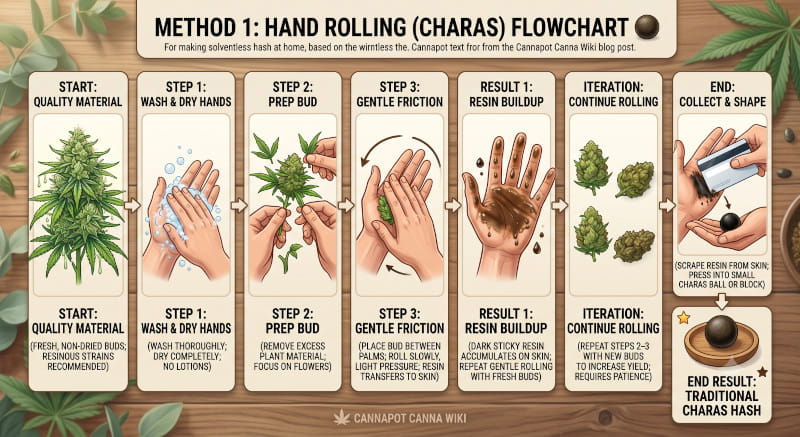
Hand rolling is the oldest method of making hash and requires no equipment whatsoever beyond your own hands and fresh cannabis buds. The finished product is called charas in South Asia, where this technique originated. It is still practiced by hand in parts of India and Nepal, particularly in the Himalayan regions where cannabis grows wild.
What You Need
- Fresh, non-dried cannabis buds (not trim)
- Clean hands
Step by Step
- Wash your hands thoroughly with unscented soap and dry them completely.
- Take a fresh cannabis bud and remove any large leaves or stems.
- Place the bud between your palms and roll it gently in a slow circular motion. Use light pressure. You are not trying to crush the bud, just to let the resin transfer onto your skin through gentle friction.
- After a few minutes you will notice a dark, sticky resin building up on your palms and fingers. This is the hash.
- Continue rolling with fresh buds, adding to the layer of resin on your hands. This is a slow process and requires patience.
- When you have collected enough resin, scrape it carefully from your hands using the edge of a credit card or a clean knife and press it into a small ball or block.
Pros and Cons
This method requires nothing to get started and is deeply traditional. The downside is that it is very time consuming, the yield per gram of starting material is low and the finished product is less refined than hash made by other methods because skin oils and plant residue inevitably mix in. Still, many people enjoy the process and the product has a character of its own.
Best used for
Small amounts, casual production, or when you want to experience hash-making in its most traditional form.
Method 2: Dry Sift Hash (Kief Pressing)
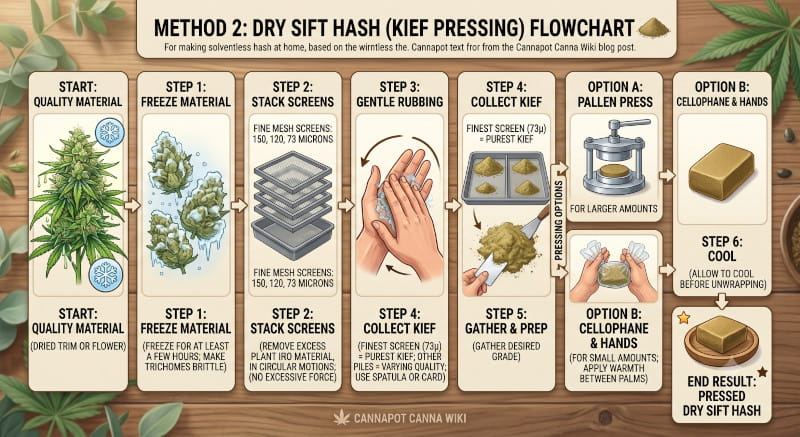
Dry sifting is the classic mechanical method for making hash. You pass dried cannabis over fine mesh screens to knock loose trichomes through the screen, collect them as kief, and then press that kief into hash using heat and pressure. The result is significantly purer than hand-rolled hash and the method scales well from small personal batches to larger quantities.
What You Need
- Dried and cured cannabis, frozen overnight before use
- Fine mesh screens in two or three micron sizes, typically 150, 120 and 73 microns for best results
- A clean smooth surface or tray to collect kief on
- A pollen press or a piece of cellophane and your hands for pressing
- A spatula or card for scraping
Step by Step
- Freeze your cannabis material for at least a few hours before starting. Cold makes trichomes brittle and they break away from the plant more cleanly.
- Stack your screens from finest on the bottom to coarsest on top, placed over a clean tray or sheet of parchment paper.
- Place small amounts of the frozen cannabis on the top screen and gently rub it in slow circular motions. Do not apply excessive force. The trichomes fall through while most plant matter stays behind.
- The finest screen at the bottom collects the purest kief. Material from coarser screens will contain more plant matter and produce lower quality hash.
- Once you have collected enough kief, gather it and press it into hash. For small amounts, wrap the kief tightly in cellophane, squeeze it hard in your hands for a few minutes and then apply gentle warmth by pressing it briefly between your palms. For larger amounts, use a pollen press.
- Allow the pressed block to cool before unwrapping. The finished hash should be firm on the outside and slightly pliable inside.
Tips for Better Results
Work in a cold environment. A cool room or even outdoors on a winter day produces visibly better separation than working in a warm kitchen. The finer your bottom screen, the purer your output, but your yield will be lower. Multiple passes through the screens give different quality grades, and you can keep them separate rather than mixing them.
Best used for
Home growers who want a step up from finger hash without investing in more specialised equipment. Dry sift is also the base material for making rosin if you want to take things further. If you are still building your grow skills, the Cannapot Beginner Guides are a good place to start before your first hash-making session.
Method 3: Dry Ice Hash
Dry ice hash is a faster and more efficient version of dry sifting that uses carbon dioxide ice rather than freezer temperature to make trichomes brittle. The extreme cold of dry ice, around minus 78 degrees Celsius, makes trichomes snap off more completely with less agitation and produces good yields quickly. It is a popular method for larger batches of trim.
What You Need
- Cannabis trim, sugar leaves or buds
- Dry ice pellets (available from most supermarkets or gas suppliers)
- A clean bucket
- Bubble bags or micron bags in 73, 120 and 160 micron sizes
- A clean smooth surface for collection
- A spatula
- Gloves and eye protection
Step by Step
- Put on your gloves before handling dry ice. It causes skin damage on direct contact.
- Place your cannabis trim in the bucket and add a similar volume of dry ice pellets. Mix them together so the plant material is fully surrounded by the dry ice.
- Wait about five minutes for the dry ice to freeze the trichomes completely.
- Place a bubble bag over the bucket, pull it up over the edges so the mesh is stretched across the top opening, and flip the whole bucket upside down over a large, clean, smooth surface.
- Shake the inverted bucket firmly but not aggressively. The frozen trichomes will break away and fall through the mesh onto the surface below as a fine powder.
- Scrape up the collected kief and press it into hash using the same approach described in the dry sift method above.
- You can shake for longer to get more material, but the quality drops as you continue because more plant matter starts coming through the screen. The first minute of shaking tends to give the finest, purest output.
Safety Note
Work outdoors or in a very well ventilated space. Dry ice releases carbon dioxide as it sublimates and in an enclosed room this can displace oxygen. There is no fire risk, but the gas buildup is a genuine concern in small spaces.
Best used for
Larger batches where speed matters. Dry ice hash is a practical choice after a big outdoor harvest when you have kilos of trim to process.
Method 4: Bubble Hash (Ice Water Extraction)
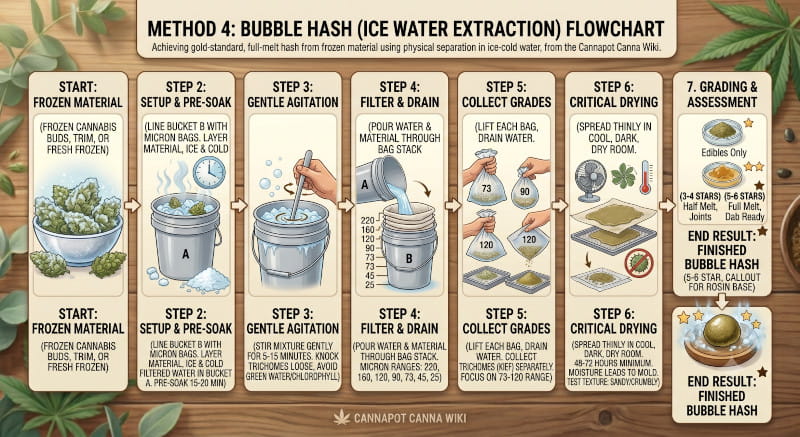
Bubble hash is widely considered the gold standard of solventless hash-making for home producers. It uses ice cold water and agitation to knock trichomes from the plant material, then filters them through a stack of mesh bags at different micron sizes to collect them by grade. The name comes from the way high quality hash bubbles as it vaporises rather than burning.
The process is more involved than the previous methods but the results in terms of purity, potency and flavour are noticeably better. High quality bubble hash made from the right strains can reach 6-star full melt status, meaning it vaporises completely without leaving any residue behind.
What You Need
- Cannabis trim, sugar leaves or buds, ideally frozen overnight (fresh frozen material gives the best results)
- A set of bubble bags in multiple micron sizes, typically 220, 160, 120, 90, 73, 45 and 25 microns
- Two clean buckets
- Plenty of ice
- Cold water, ideally filtered
- Drying screens or parchment paper
- A large spoon or mixing paddle
Step by Step
- Line your second bucket with the bubble bags, starting with the finest mesh at the bottom and working up to the coarsest at the top. Fold the bag tops over the bucket rim to keep them in place.
- In your first bucket, layer your frozen cannabis material with ice and add enough cold water to fully submerge everything. Let it sit for 15 to 20 minutes. This pre-soak allows the trichomes to become cold and brittle before any agitation begins and makes a real difference to the final quality.
- Stir the mixture gently for five to 15 minutes. You are trying to knock trichomes loose without grinding up leaves and creating green water, which indicates over-agitation and contamination with chlorophyll. Gentle is always better than vigorous.
- Slowly pour the mixture through the bag stack in your second bucket. The water passes through all the mesh layers while each bag catches trichomes according to its micron size.
- Lift each bag in turn starting from the top, allow the water to drain through, and inspect the layer of trichomes left on each mesh. The bags in the 73 to 120 micron range typically hold the finest quality material.
- Collect the trichomes from each bag separately onto drying screens or parchment paper. Keep each micron grade separate at this stage so you can assess quality before deciding what to blend.
- Drying is critical. Spread the collected hash out thinly and allow it to dry fully in a cool, dark, dry place for 48 to 72 hours minimum before pressing or using. Hash that retains moisture will go mouldy in storage.
Understanding the Hash Star Grading System
Hash is graded on a scale from one star to six stars based on purity and melt quality.
- 1 to 2 stars: Contains significant plant matter. Best used in edibles rather than smoked.
- 3 to 4 stars (half melt): Burns well in a joint or pipe but leaves some residue when dabbed.
- 5 to 6 stars (full melt): Nearly pure trichomes. Vaporises completely without leaving any carbon behind. This is the benchmark of exceptional bubble hash.
The micron bags in the 73 to 90 micron range most often yield 5 to 6 star material from suitable strains. The coarser bags produce lower grade hash that is still excellent for edibles and joints.
Best used for
Anyone who wants the highest quality hash possible from home production. Bubble hash is the method most often discussed by serious solventless producers and it scales from small personal batches to semi-professional quantities with the same equipment.
Method 5: Rosin Press (Hair Straightener Method)
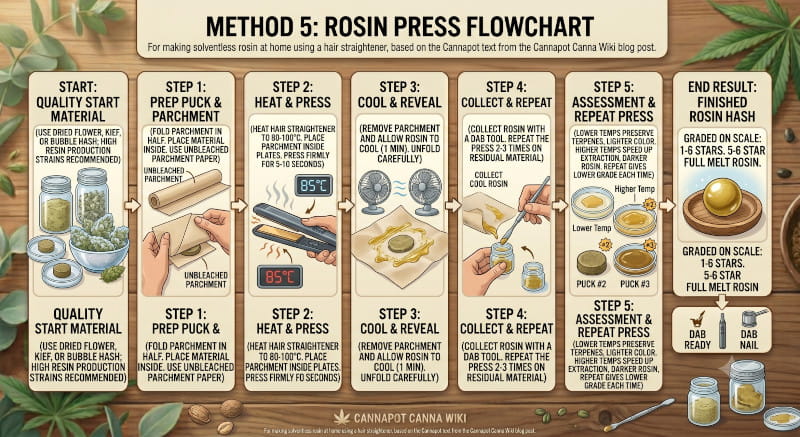
Rosin pressing is different from the other four methods in that you are not collecting loose trichomes first. Instead, you use heat and pressure to squeeze the resin directly out of flower, kief or dry sift hash and onto parchment paper. It is the fastest modern method and requires the least setup for small batches.
When made from high quality bubble hash as the starting material, rosin becomes hash rosin, which is one of the finest cannabis concentrates available. Starting from whole flower or kief is simpler and still gives excellent results at home.
What You Need
- Cannabis flower, kief or dry sift hash
- Hair straighteners or a dedicated rosin press
- Unbleached parchment paper
- A dab tool or small spatula for collection
Step by Step
- Cut a small square of parchment paper and fold it in half. Place your cannabis material inside the fold in the centre.
- Heat your hair straighteners to between 80 and 100 degrees Celsius. Lower temperatures preserve more terpenes but give slightly lower yields. Higher temperatures speed up extraction but can darken the rosin and reduce flavour.
- Place the parchment containing your material between the straightener plates and press down firmly for five to ten seconds. You will hear a slight sizzle as the resin releases.
- Open the plates, carefully remove the parchment and unfold it. The rosin will have spread out onto the paper as a golden or amber sticky liquid.
- Allow it to cool for a minute, then collect it with a dab tool and store in a small glass jar or on parchment.
- Repeat the press two or three times on the same material to extract residual rosin, though each subsequent press will be lower quality.
Best used for
Quick small-batch production. A hair straightener works well for personal use and requires zero specialised equipment. If you want to produce larger quantities or work with bubble hash as your starting material, a dedicated rosin press with adjustable temperature and pressure gives much more consistent results.
For more detail on rosin, vaporisers and other cannabis consumption methods, see the Consumption and Products section of the Canna Wiki.
The Best Cannabis Strains for Making Hash
Not all cannabis strains are equally suited to hash production. The best strains for hash are heavily coated in trichomes, have high resin production relative to their overall plant size, and ideally have stable genetics that express those traits consistently across multiple plants. Indica and Indica-dominant hybrids have traditionally been the most popular choice for hash because they tend to carry dense, bulky trichome heads that separate cleanly. That said, some Sativa strains and modern hybrids are outstanding for the job.
Here are the key traits to look for when choosing seeds specifically for hash production:
- High trichome density visible to the naked eye, flowers appear frosted or almost white
- Resinous sugar leaves, not just buds
- Strong, complex terpene profile, because terpenes contribute significantly to hash quality
- Stable genetics that produce consistent plants across the batch
Among the classic strains that hash makers return to repeatedly, the following deserve particular attention.
Fire OG Kush
A foundational Indica-dominant strain with exceptional resin coverage. The trichomes of Fire OG Kush are large, dense and rich in both THC and the terpenes that give OG its earthy, fuel-like character. It produces beautiful golden dry sift kief and excellent bubble hash from both the buds and the trim.
Moby Dick
The famous Moby Dick is one of the most famous European strains and a classic choice for kief and hash production. The buds are so heavily coated in trichomes that the entire plant appears white at peak maturity. It has been a staple in hash production for decades for good reason.
Northern Lights
Northern Lights is a reliable Indica with dense, compact buds and strong resin glands. Northern Lights has been used in hash production since the 1980s and remains one of the benchmark strains for dry sift. It is also an easy plant to grow, making it a sensible first choice for beginners who want to learn hash-making at the same time as growing.
Original Glue (GG4)
Original Glue #4 is a fantastic sticky hybrid that produces an almost absurd quantity of trichomes. The name comes from the way the scissors stick together when trimming. GG4 is one of the most resin-heavy strains in modern breeding and the hash it produces reflects that. Both bubble hash and dry sift from this strain regularly rate at five or six stars.
Gelato #420
Gelato #420 is a modern hybrid with an outstanding terpene profile. Gelato hash is prized for its complex, creamy, fruity aroma and strong effect. The trichome coverage is dense and the resin quality is excellent. Its popularity in solventless extraction has grown sharply over the past several years.
Desert Skunk
Desert Skunk by Khalifa Genetics is a classic mostly Sativa hybrid with consistent genetics and reliable resin production. The Original Skunk has been a workhorse in hash production for forty years because it is stable, productive and gives predictable results. It is a good choice for a first hash-making grow.
You can explore all of these strains and find seeds from trusted breeders in the Cannapot cannabis seeds shop. If you are looking for Indica-dominant genetics with strong resin production specifically, the regular weed seeds collection includes several classic varieties that have been used for traditional hash production for generations.
For autoflowering varieties that can complete a full harvest cycle in eight to ten weeks, check the autoflower seeds section. Several modern autoflowers carry the resin genetics of their photoperiod parents and make very usable hash despite their compact size.
For help choosing between strains based on genetics, effect, and growing characteristics, the Cannabis Strains section of the Canna Wiki gives detailed breakdowns of Sativa, Indica and hybrid varieties.
How to Dry and Cure Your Hash
Drying applies mainly to bubble hash, which retains moisture from the ice water process. Rosin and dry sift hash can generally be used almost immediately after pressing, but bubble hash needs proper drying before storage.
Spread the collected hash from each micron grade out thinly on a clean drying screen or a sheet of parchment paper. Place it in a cool, dark, dry room with good air circulation. Temperature should stay below 20 degrees Celsius if possible. Allow it to dry for a minimum of 48 hours and ideally 72 hours or longer for thicker collections.
A freeze dryer, if you have access to one, dramatically speeds up this process and is considered the best method for preserving terpenes during drying. It removes moisture without any heat exposure and produces a fine, sandy texture that is ideal for pressing into rosin or packaging. However, a freeze dryer is a significant investment and is not necessary for home production.
You can check progress by pressing a small pinch of the hash between your fingers. Properly dried hash feels sandy or slightly crumbly depending on the grade. Hash that still clumps wetly needs more time.
How to Store Hash
Properly made and dried hash stores very well. The main enemies are heat, light, moisture and oxygen. Keep these four away from your hash and it will remain potent and aromatic for months or longer.
Store hash in an airtight glass jar or container. Small food-grade glass jars with tight-fitting lids work perfectly. Keep the jar in a cool, dark place such as a drawer, cupboard or a dedicated storage box away from any light source. A refrigerator works well for medium-term storage. For long-term storage of several months or more, a freezer preserves potency and terpenes very effectively, although you should allow the container to return to room temperature before opening it to prevent condensation from forming on the cold hash.
Avoid storing hash in plastic bags for extended periods. Terpenes can degrade faster in contact with plastic and the seal is never as tight as glass.
Frequently Asked Questions
Can I make hash at home without any special equipment?
Yes. Hand rolling and basic dry sifting require no specialised tools at all. You need nothing more than your hands or a simple fine mesh screen to get started. More sophisticated methods like bubble hash require bubble bags and buckets, but these are affordable and widely available.
What is the difference between hash and rosin?
Hash collects trichomes through physical separation using screens, ice water or hand friction. Rosin extracts resin from the plant material by applying heat and pressure, squeezing the resin out rather than sifting it out. Both are solventless. Hash rosin combines both: bubble hash is made first and then pressed into rosin as a second extraction step.
How long does it take to make bubble hash?
The washing and collection process typically takes two to three hours from setup to finished wet hash. Drying then takes two to three days. Plan for the full process across several days rather than expecting to start and finish in a single session.
What is the hash star grading system?
Hash is rated on a scale of one to six stars based on how cleanly it melts when heated. One and two star hash contains notable plant matter and works best in edibles. Three and four star hash burns well in joints and pipes. Five and six star hash is full melt quality and vaporises completely with no residue, making it suitable for dabbing.
Which cannabis strains give the highest hash yield?
Resin-heavy Indica and Indica-dominant strains consistently give the best yields. Gorilla Glue, White Widow, OG Kush and Northern Lights are among the most dependable choices. The most important variable is trichome coverage, which you can assess by looking at how frosted the flowers appear at harvest.
How should I store hash to preserve its potency?
Use an airtight glass container stored in a cool, dark place. For storage beyond a few weeks, a refrigerator or freezer extends shelf life significantly. Allow frozen hash to return to room temperature before opening the container.
Can I use outdoor cannabis for making hash?
Yes, and many growers specifically grow outdoor cannabis for hash production. The larger plant size common in outdoor growing means more trim at harvest and therefore more material for hash. Outdoor strains that produce good resin in your climate are worth seeking out specifically for this purpose. The outdoor cannabis seeds collection at Cannapot includes many varieties suited to European outdoor conditions with solid resin production.
Is fresh frozen cannabis better for bubble hash?
Many experienced producers consider fresh frozen material superior for bubble hash because freezing the plant immediately after harvest locks in volatile terpenes before they can degrade. The resulting hash is typically more aromatic and complex than hash made from dried and cured material. It is a more demanding process that requires careful handling of frozen plant matter, but the quality gain is real and noticeable, particularly at the highest micron grades.
Quick Comparison of the Five Methods
|
Method |
Equipment needed |
Difficulty |
Quality ceiling |
Best starting material |
|
Hand rolling |
None |
Easy |
Low to medium |
Fresh buds |
|
Dry sift |
Screens, pollen press |
Easy |
Medium to high |
Dried trim or flower |
|
Dry ice |
Dry ice, bucket, bags |
Easy to medium |
Medium to high |
Dried trim or flower |
|
Bubble hash |
Bubble bags, buckets, ice |
Medium |
Very high (full melt) |
Fresh frozen or dried flower |
|
Rosin press |
Hair straighteners or press, parchment |
Easy |
High (hash rosin is exceptional) |
Flower, kief or bubble hash |
Making hash at home is one of the most satisfying things a cannabis grower can do with a harvest. It transforms material that would otherwise be composted into something genuinely impressive, and the process itself deepens your understanding of the plant in a way that simply growing and smoking it does not. You start to see a cannabis plant differently once you understand what those trichomes contain and how to work with them.
Start with whichever method feels most accessible given your equipment and the material you have on hand. Hand rolling and dry sifting need nothing you do not already have. Bubble hash requires a small investment in bubble bags but pays it back many times over in the quality of what you produce. Rosin pressing is the fastest path to a concentrated extract if you already have flower or kief ready to use.
The single biggest lever you can pull to improve the quality of your hash is the starting material itself. Growing genetics specifically suited to resin production makes every method work better. You can find a wide selection of high-trichome strains at the Cannapot Shop, with detailed strain information to help you identify the best fit for your growing setup and hash-making goals.
For more growing knowledge, strain guides, and advice on cannabinoids and terpenes, explore the full Cannapot Canna Wiki. It covers everything from your first grow setup through to advanced cultivation techniques, all written for growers who want to understand what they are doing rather than just follow instructions.
The Cannabis Growing section is a good next stop if you want to make sure your next harvest gives you the best possible raw material for hash production.