How to Clone Cannabis: Cuttings & Rooting
How to Take, Root and Grow Cannabis Cuttings Correctly
Updated: August 2026 | Taking and rooting cannabis cuttings: detailed guide to suitable shoots, clean cuts, rooting methods, rooting in water, climate, care and common problems.
Author: Cannapot Grow Team | Reading time: approximately twenty-five minutes
The Most Important Points at a Glance
✓ Vegetative propagation produces genetic copies of a mother plant. They have the same genetic basis as the mother, but can still develop differently under different growing conditions.
✓ Healthy, vigorous shoots from a pest- and disease-free plant in the vegetative growth stage are best suited. The rooting medium should already be prepared before the cutting is taken.
✓ Use a sharp, clean tool for cutting. The cut is usually made just below a node. An angled cut of around 45° is widely used, but it is not essential for successful rooting.
✓ Cannabis cuttings can be rooted in seedling soil, Jiffys, rockwool, coco or even in a glass of water. Which method is best depends on the growing setup and how the plants will be cultivated later.
✓ As long as the young shoots have not developed their own roots, they are particularly sensitive to drying out. High humidity, moderate light and an evenly moist but not wet rooting medium create good conditions for root development.
✓ Rooting hormones can support the formation of new roots, but they are not essential. Healthy shoots can also root successfully without rooting gel or powder.
✓ Under good conditions, the first roots often appear after about one to two weeks. For later transplanting, however, the number of days is less important than having a sufficiently well-developed root system.
What Are Cannabis Cuttings and Why Are They Called Clones?
A cannabis cutting is a detached part of a plant that develops its own roots and can then continue growing independently.
Unlike propagation from seed, the genes of two parent plants are not recombined. The plant material comes directly from a mother plant and has the same genotype as the mother plant. This is why cannabis growers often refer to cloning.
However, the term “clone” does not mean that every copy will later develop in exactly the same way. Plant height, yield and other traits can vary despite the same genetic basis. Light, temperature, root space, nutrient and water supply, stress and disease all influence how the plant actually develops.
In short: A clone has the same genetic basis as its mother plant. How that genetics is expressed later also depends on the specific growing conditions.
Cannabis Cuttings or Seeds: What Is the Difference?
With cuttings, an existing genetic profile is propagated vegetatively, while seeds produce genetically new plants.
When growing from cannabis seeds, development begins with germination and the seedling stage. Even within the same strain, plants can differ, for example, in growth habit, aroma or flowering time. During cannabis pheno hunting, these differences are systematically compared to identify promising phenotypes and preserve selected plants as keepers. A cutting, by contrast, skips the germination stage and preserves the genetic makeup of its mother plant.
| Feature | Cannabis cutting | Cannabis from seed |
|---|---|---|
| Propagation | vegetative | generative |
| Genetics | essentially the same genotype as the mother plant | new genetic combination |
| Germination stage | not required | required |
| Known traits | genetic traits of the source plant are already known | expression can vary between individual plants |
| Health status | problems from the source plant can be carried over | not directly dependent on a mother plant |
| Root development | must form new adventitious roots | develops a seedling root |
Which Mother Plant Is Suitable for Cannabis Cuttings?
Choose a healthy, vigorous mother plant that is as free from stress as possible.
A plant in the vegetative growth stage. It should be growing vigorously, show no visible signs of nutrient deficiency or overfertilization, and be free of visible pests, fungal diseases or other health problems.
A suitable mother plant can in principle be raised from different types of seed. regular cannabis seeds are also suitable, provided that a healthy female plant with the desired traits is subsequently selected as the mother.
The health of the mother plant is especially important because cuttings can pass on more than the desired genetic traits. Pests and pathogens can also enter a new crop with the plant material. A shoot that looks usable should therefore not be taken from an obviously weakened or diseased plant. Particular attention should be paid to HPLVD in cannabis, because the viroid can also be spread through infected plant material.
Which Shoots Are Suitable for Cannabis Cuttings?
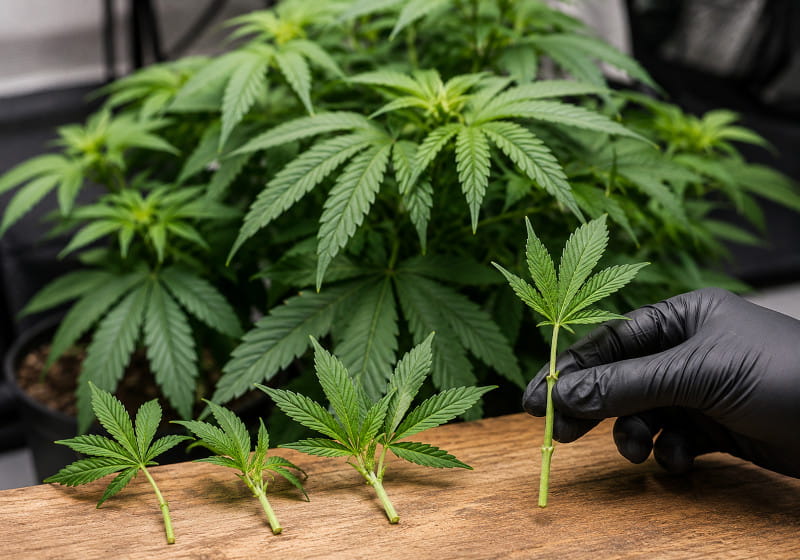
Healthy, green, vigorous shoots with several nodes and an intact growing point are suitable.
There is no universally ideal length. Studies use shoots of different sizes. In addition to length, the number of nodes, vigor and stage of development also play a role. A study published in 2026 using specimens measuring 5, 10, 15 and 20 cm, for example, suggests that longer, more vigorous shoots and the presence of an apical growing point may promote root formation.
In practice, a rigid rule such as “exactly 10 cm” is therefore less important. Choose a healthy, sufficiently developed side shoot with several nodes, enough leaf mass and a length that can be prepared easily and inserted safely into the chosen rooting medium.
What Should Be Prepared Before Taking Cuttings?
Before taking the first cutting, the tools, rooting medium and propagation area should be fully prepared.
Freshly detached plant tissue can initially absorb only a limited amount of water. The shorter the time between cutting and placing the shoot in a moist medium, the lower the risk of unnecessary drying. It is therefore impractical to wait until after cutting to soak Jiffys, prepare rockwool or fill pots with substrate.
You should have a sharp cutting tool, a suitable cleaning or disinfecting agent, the prepared rooting medium, optionally a rooting hormone such as Clonex, and a propagator or a comparable way to control humidity ready to use.
Taking Cannabis Cuttings: Step-by-Step Guide
When taking cuttings, the key factors are a healthy mother plant, clean and sharp tools, and a transition into the prepared propagation medium that is as gentle as possible.
1. Prepare the Propagation Medium
Prepare seedling soil, a Jiffy, rockwool, coco or a glass of water before removing plant material from the cannabis mother plant The substrate used should be evenly moist but not waterlogged. With solid propagation media, it is advisable to prepare a small planting hole in advance. This allows the freshly cut stem to be inserted later without unnecessarily crushing or damaging the sensitive cut surface.
2. Clean and Sharpen the Tool
Use sharp scissors, a razor blade or a scalpel to create as clean a cut surface as possible. Blunt tools can crush the stem and unnecessarily damage the tissue. Clean and disinfect the tool thoroughly before use, for example with 70% alcohol.
3. Select a Suitable Shoot
Choose a healthy, green and vigorous side shoot with several nodes. Very thin, discolored, damaged or visibly infested plant parts are not suitable for propagation. You should also avoid taking cuttings if there are unresolved pest or disease problems.
4. Cut Below a Node
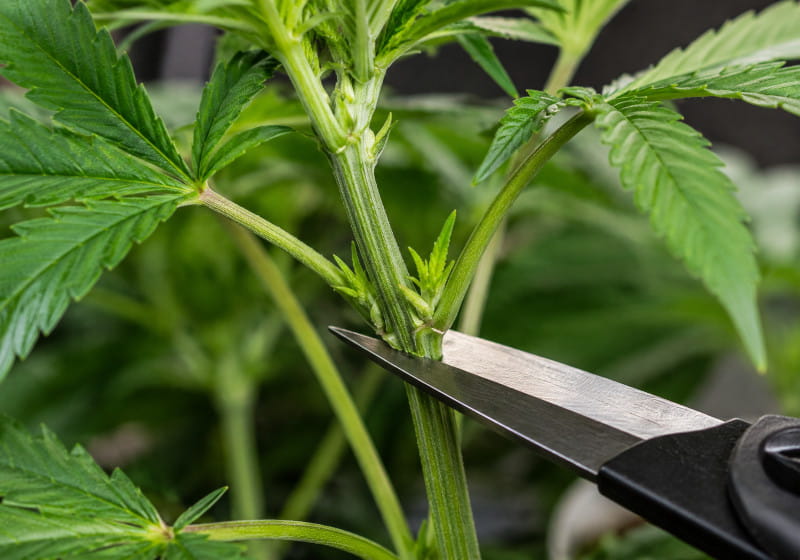
Make the cut just below a node. This is the point on the stem where leaves and side shoots emerge. Work cleanly and carefully so the stem is neither crushed nor unnecessarily damaged.
Do Cannabis Cuttings Have to Be Cut at a 45° Angle?
An angled cut of around 45° is widely used for cannabis cuttings, but it is not essential for successful rooting.
The angled cut creates a larger cut surface at the lower end of the stem. However, it is not possible to say generally whether this actually makes a cutting root faster or more reliably. The vigor of the mother plant, the quality of the cutting and good conditions during the subsequent rooting phase are equally important.
Good to know: A 45° cut is an established method, but not a secret trick. A fresh, clean cut surface without crushed or frayed tissue is more important.
5. Remove Lower Leaves and Adjust Leaf Area
First remove the lower leaves that would come into contact with the rooting medium when the cutting is inserted. Very large leaves can also be shortened slightly. This can reduce water loss through the leaf surface while a sufficiently developed root system is still absent.
However, you should not defoliate the cutting too heavily because the remaining leaves are still needed for photosynthesis. The aim is not to remove as much leaf mass as possible, but to achieve a sensible balance between water loss and the remaining leaf area. In practice, large leaves are therefore often only partially trimmed.
6. Optionally Use Rooting Hormone and Insert the Cutting
If you use rooting gel or powder, treat the lower part of the stem according to the manufacturer’s instructions and then place the cutting directly into the prepared medium. It should sit securely without the fresh cut surface being crushed or unnecessarily stressed during insertion.
7. Set Humidity, Temperature and Light
After insertion, the most sensitive phase of rooting begins. Because no new roots are present yet, the cutting must be protected from excessive water loss. A propagator or transparent cover helps maintain high humidity. At the same time, light should remain moderate because freshly taken cuttings do not yet require the same light intensity as established plants.
Rooting Cannabis Cuttings: Which Method Is Suitable?
Cuttings can be rooted in different media; the key factors are a balanced ratio of moisture to oxygen and stable environmental conditions.
| Method | Advantages | Disadvantages | Effort | Special consideration |
|---|---|---|---|---|
| Seedling soil | simple, direct transition to soil-based growing | moisture is harder to monitor visually | low | use an airy substrate that is not heavily pre-fertilized |
| Jiffy / peat pellet | compact, easy to transplant | can stay very wet for a long time if overwatered | low | check moisture regularly |
| Rockwool | uniform structure, good control | preparation and water chemistry are more important | medium | do not keep permanently waterlogged |
| Coco | airy and well-draining | moisture and nutrient management require attention | medium | keep evenly moist rather than wet |
| Water | root development is directly visible, little material required | oxygen deficiency and rot are possible; later transfer to substrate required | low to medium | pay attention to water quality and hygiene |
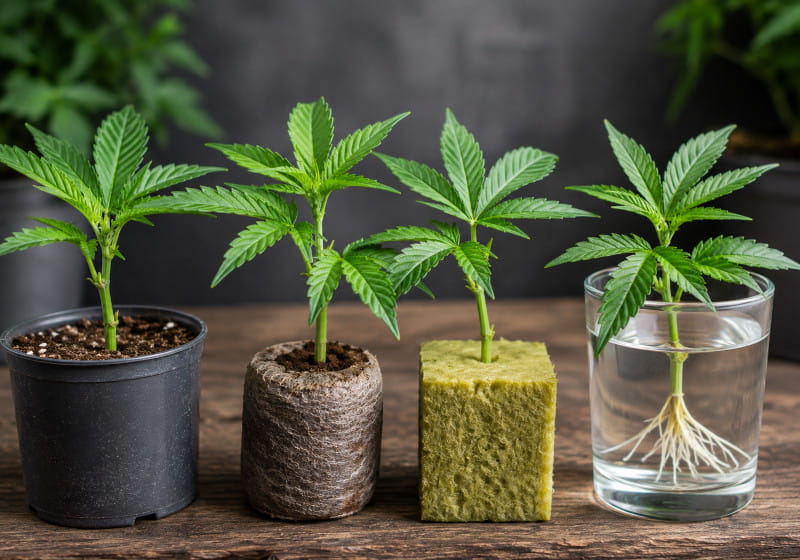
Soil, coco and rockwool differ not only during rooting, but also in how they store water, receive nutrients and are handled during later cultivation. You can learn more about their respective advantages and disadvantages in our guide to soil, coco and rockwool for cannabis.
Planting Cannabis Cuttings Directly in Soil
Freshly taken shoots can be placed directly into a suitable, loose propagation substrate and form new roots there.
The substrate should retain moisture while still allowing enough air to reach the lower stem area. Heavily pre-fertilized, compacted or permanently wet soil is generally unfavorable for freshly cut plant material. At this early stage, a balanced supply of water and oxygen is most important; heavy fertilization is not initially required.
Rooting Cuttings in Jiffys
Peat pellets are practical because, once roots have formed, the young plant can be transplanted into a larger container together with the Jiffy. After swelling, the material should be evenly moist but not dripping wet. Too much water reduces the amount of air in the Jiffy and can promote rot.
Root Formation in Rockwool
Rockwool cubes are often used for vegetative propagation and in controlled growing systems. Their uniform structure provides a manageable balance of moisture and air around the young root zone. Compared with conventional seedling soil, however, rockwool requires more attention to water quantity and pH.
The cube should remain moist throughout without standing permanently in water. In mineral or hydroponic systems, the quality and composition of the nutrient solution used also play a greater role than when propagating in soil.
Rooting Cuttings in Coco
Coco substrate has a loose structure, retains moisture and at the same time allows air into the root zone. This provides good conditions for new root development. Correct moisture remains crucial, however: coco can also become too wet or too dry through improper watering.
Cannabis Cuttings in a Glass of Water: Does It Work?
Yes, new roots can also form in a glass of water. The method is straightforward, but it requires clean water and regular checks to prevent rot.
Only the lower part of the stem is placed in the water while the leaves remain above the waterline. One advantage of this method is that new root development can be observed directly. Unlike a loose substrate, however, water contains no air-filled pores. If it becomes too warm, dirty or low in oxygen, unfavorable conditions can develop for the plant tissue.
How Do You Root Cannabis Cuttings in a Glass of Water?
Use a clean container with fresh water and immerse only the lower part of the stem. The leaves should remain dry and above the water surface. Place the container in a bright location, but not under intense lighting or in strong heat. If the water becomes cloudy, smells unpleasant or shows visible contamination, it should be changed and the container cleaned.
A daily water change is not fundamentally necessary. What matters is that the water stays clean and there are no signs of rot on the stem. Unnecessarily frequent removal and handling should be avoided so the young roots can develop with as little disturbance as possible.
When Can Water Roots Be Transplanted into Soil?
Once several clearly visible young roots have formed, the young plant can be carefully placed into a loose, evenly moist substrate. Very long water roots are delicate and are easier to bend or damage during planting. It is therefore usually better not to delay the transfer unnecessarily.
Do Cannabis Cuttings Need Rooting Hormone?
No. New roots can form successfully even without rooting hormone. Rooting gel or powder can support this process, however, and is therefore often used for vegetative propagation.
Many of these products contain auxins or active ingredients with a similar function. One of the most frequently studied is IBA (indole-3-butyric acid). This plant growth regulator can promote the formation of so-called adventitious roots – the new roots that develop on the cut stem of the cutting.
Studies on cannabis show that IBA can influence, among other things, the number and length of the roots formed. The strength of the effect depends on factors such as concentration, genetics and growing conditions. At the same time, untreated shoots can also develop roots successfully. Rooting hormone can therefore be helpful, but it is not a requirement.
Good to know: Rooting gel such as "Clonex" can support the formation of new roots, but it does not replace good conditions. A healthy shoot can also root successfully without additional hormones.
What Conditions Do Cuttings Need to Establish?
For reliable root formation, freshly taken shoots primarily need a stable, warm environment, initially high humidity, moderate light and an evenly moist but airy propagation medium.
The optimal values are not identical in every setup. Temperatures of around 22 to 25 °C and a light cycle of 18 hours of light and 6 hours of darkness can serve as a guide. Relative humidity should be high during the first few days because a sufficiently developed root system is not yet present. Once new roots begin to form, humidity can be reduced gradually.
Stable conditions are more important than any single exact value. As root development progresses, the young plants can gradually be acclimated to lower humidity, somewhat more air movement and finally the normal conditions of the vegetative growth stage.
| Factor | Guideline | Why is it important? |
|---|---|---|
| Temperature | about 22–25 °C | creates favorable conditions for metabolism and root formation; excessively high temperatures increase water loss and stress |
| Humidity | high initially, then reduce gradually | limits water loss while a sufficiently developed root system is not yet present |
| Light cycle | often 18/6 | supports continued vegetative growth |
| Light intensity | moderate | light that is too intense can increase water loss and place additional stress on the young plants |
| Substrate moisture | evenly moist, not wet | the lower stem area needs sufficient moisture and oxygen at the same time |
| Air movement | gentle at first, then increase gradually | prevents stagnant moisture and makes later acclimation to normal growing conditions easier |
What Humidity Do Young Cuttings Need?
Immediately after cutting, high relative humidity is helpful because there are no new roots yet to absorb water. In published cannabis protocols, initial values sometimes range between 80 and 100%. Such figures should be understood as guidance rather than an exact requirement for every setup.
As soon as the first roots develop, humidity can be reduced gradually. For example, the vents of a propagator can be opened progressively or the cover removed temporarily. This allows the young plants to acclimate slowly to their later environmental conditions.
How Much Light Is Needed at This Stage?
Freshly taken shoots need light, but not high intensity yet. An 18/6 schedule with 18 hours of light and 6 hours of darkness is commonly used. At this early stage, stable conditions that prevent unnecessary water loss from the leaves are more important than maximum light output.
Avoid intense lighting and excessive heat. If the leaves dry out quickly or become noticeably warm under the lamp, the stress is too high. As root development progresses, light intensity can later be adjusted gradually.
How Often Should Cuttings Be Watered?
Do not water according to a fixed schedule; instead, use the moisture level of the propagation medium as your guide. It should neither dry out completely nor remain permanently wet.
Overwatering is a common mistake, especially at the beginning. As long as no well-developed root system is present, water requirements remain relatively low. Too much moisture displaces air from the root zone and can promote rot. You can find more about water requirements, watering volume and the right timing in our guide to watering cannabis correctly.
When Do Young Cuttings Need Fertilizer?
Heavy fertilization is normally unnecessary during the first stage. Before enough new roots have developed, nutrient uptake is still limited. Heavily pre-fertilized substrates or concentrated nutrient solutions can place additional stress on the young plants.
Once a stronger root system is present and new vegetative growth begins, nutrient supply can be adjusted gradually to the substrate and growing system being used.
How Long Do Cannabis Cuttings Take to Root?
Under suitable conditions, the first visible roots can form within approximately one to two weeks; some shoots take longer.
Many research and production protocols check root development after approximately 14 days. Other studies assess rooting success after 21 or 25 days. These differences show why a fixed statement such as “roots appear after exactly seven days” is not reliable.
The time required is influenced by factors including genetics, the age and position of the shoot, leaf area, temperature, light, moisture, oxygen supply, rooting medium and any rooting hormone used.
How Can You Tell Whether a Cannabis Cutting Has Rooted Successfully?
The most reliable sign is visible development of new roots in the rooting medium or in the glass of water.
With Jiffys, rockwool or propagation cubes, young root tips often emerge on the outside or through drainage openings. New shoot growth can additionally indicate that the young plant is functionally established. Gently pulling on the stem is sometimes recommended as a test, but it should not be done unnecessarily: young roots are delicate and can be damaged.
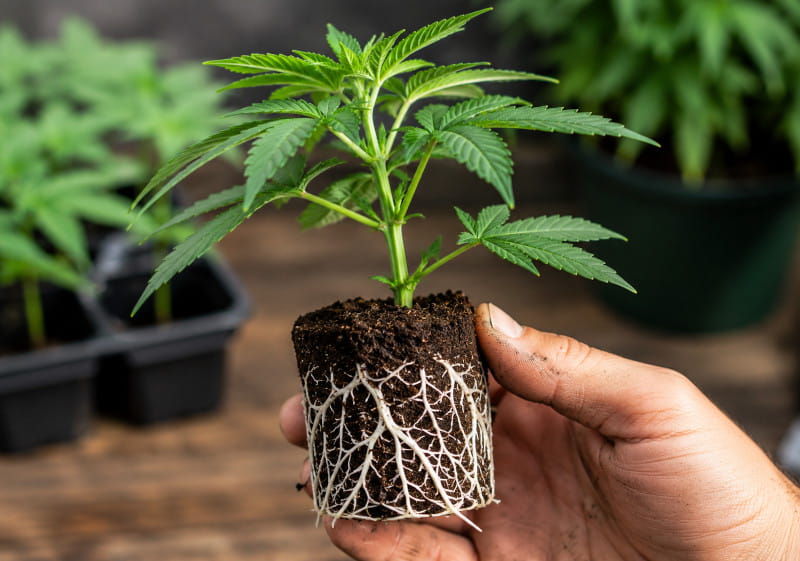
Better than the pull test: If the medium allows visual inspection, visible new roots are a much gentler confirmation. New growth is an additional positive sign.
When Can Cannabis Cuttings Be Transplanted?
The young plant can be transplanted once it has a sufficiently developed root system to stabilize the root ball and absorb water after transplanting.
A few tiny root tips are not yet a reason to use a very large pot immediately. A gentle transition into a suitably sized container with an appropriate substrate is better. The roots should be crushed or torn as little as possible.
Alongside root development, hardening off: humidity is reduced gradually, ventilation is increased and the plant is acclimated to normal vegetative growth conditions. Research protocols likewise describe this kind of transition from very high humidity during rooting to lower values after successful root formation.
Common Problems with Cannabis Cuttings
If a freshly taken shoot does not root, turns yellow, droops or rots, a single factor is rarely responsible.
| Problem | Possible cause | Recommended action |
|---|---|---|
| Leaves droop | high water loss, humidity too low, too much light or heat | check climate, light intensity and moisture |
| Leaves turn yellow | stress, aging of individual leaves, root problems or unsuitable moisture/nutrient levels | check the overall condition instead of immediately applying heavy fertilizer |
| No roots | unsuitable shoot, unfavorable climate, genetics, medium too wet or too dry | check conditions systematically; do not handle the plant material every day |
| Stem becomes soft or brown | rot, permanently wet medium, poor hygiene | reduce moisture and check hygiene and air supply |
| Mold | stagnant humid air, dead plant material, contamination | remove affected material and improve ventilation and hygiene |
| Cutting dries out | humidity too low, intense lighting, heat or dry medium | reduce transpiration stress and monitor moisture |
| Roots present, growth stalls | climate changes too quickly, root damage during transplanting or unsuitable new substrate | harden off gradually and handle the root zone gently |
Yellow or discolored leaves on a freshly taken shoot do not automatically mean that fertilizer is needed. Typical deficiency symptoms can be assessed more meaningfully only after rooting and once growth is established. We explain in detail which signs can indicate insufficient nutrient supply in our guide to identifying nutrient deficiencies in cannabis.
Why Does a Cannabis Cutting Droop?
Slight wilting can occur immediately after cutting because the shoot continues to lose water through its leaves but does not yet have a new root system. Severe or persistent wilting, however, is a sign that water balance and environmental conditions are not in sync.
Typical points to check are humidity, temperature, light intensity and the actual moisture level of the medium. Drooping leaves do not automatically mean that more water is needed. If the medium is already wet, additional water can make the problem worse.
Why Is My Cannabis Cutting Not Developing Roots?
Not every shoot roots at the same speed. Genetic differences demonstrably play a role. In addition, a weak starting shoot, unfavorable temperature, drying out, lack of oxygen in the medium, rot or frequent disturbance of the cut surface can delay rooting.
Therefore, do not intervene too quickly after only a few days without visible roots. Many protocols do not check until around two weeks. A more urgent cause analysis is warranted only if clear signs of stress or rot appear at the same time.
Which Grower Myths Surround Cannabis Cuttings?
Many practical recommendations are passed around about vegetative propagation. They may work, but that does not automatically mean they are scientifically proven to be essential or superior.
| Claim | Assessment |
|---|---|
| A clone will turn out exactly like the mother plant. | The genotype is essentially the same; actual development is also influenced by the environment and cultivation practices. |
| Only a 45° cut can root properly. | A 45° cut is common and is also used in protocols, but it has not been established as the sole factor for success. |
| No roots form without rooting hormone. | False. New roots can also form without added rooting hormone. |
| The higher the humidity, the better – permanently. | High initial humidity can be useful; after rooting, gradual acclimation to lower levels is important. |
| A drooping cutting needs more water immediately. | Not necessarily. High temperature, intense lighting or an already waterlogged medium may also be involved. |
Frequently Asked Questions About Cannabis Cuttings
When Should You Take Cannabis Cuttings?
Healthy, vigorous shoots from a thriving plant in the vegetative growth stage are suitable. A specific age is less important than the health and stage of development of the selected shoot.
How Long Do Cannabis Cuttings Take to Root?
Under suitable conditions, the first visible roots can often appear within approximately one to two weeks. Depending on genetics, cutting size, medium and climate, rooting can take longer.
Can Cannabis Cuttings Be Planted Directly in Soil?
Yes. A loose, airy substrate suitable for propagation can be used directly for rooting. It should be evenly moist but not permanently waterlogged.
Can Cannabis Cuttings Be Rooted in a Glass of Water?
Yes, new roots can also form in water. A clean container, clean water and prevention of rot are important. Once enough roots have formed, the young plant can be transferred carefully into substrate.
Do Cannabis Cuttings Need Rooting Hormone?
No. Rooting hormones such as IBA can influence root development, but they are not essential. Untreated shoots can also form roots successfully.
What Humidity Do Cannabis Cuttings Need?
Freshly taken shoots initially benefit from high humidity because they do not yet have an effective root system. As rooting progresses, humidity should be reduced gradually so the plant can acclimate to normal growing conditions.
Why Is My Cannabis Cutting Drooping?
Drooping leaves can be caused by transpiration stress, humidity that is too low, heat, intense lighting or problems with the moisture level of the medium. More water is therefore not automatically the right solution.
Why Is My Cannabis Cutting Not Developing Roots?
Possible causes include a weak starting shoot, unfavorable temperature or moisture, lack of oxygen in the medium, rot, hygiene problems or genetic differences. Some cuttings also take considerably longer than others.
When Can a Rooted Cannabis Cutting Be Transplanted?
Once a sufficiently developed root system has formed, the young plant can be transplanted carefully. At the same time, it should be acclimated gradually to lower humidity, more air movement and the conditions of the normal vegetative growth stage.
Sources and Further Information
- Vegetative Propagation of Cannabis sativa and Resin Obtained From its Female Inflorescences
- Bio-protocol – Vegetative Propagation of Cannabis sativa
- Favero et al. – Alternative Rooting Methods for Medicinal Cannabis Cultivation
- PubMed – Alternative Rooting Methods for Medicinal Cannabis Cultivation in Denmark
- An Alternative In Vitro Propagation Protocol of Cannabis sativa Presenting Efficient Rooting
- PubMed – Efficient Rooting of Cannabis sativa Cuttings
- The Effects of Far-Red Light on Medicinal Cannabis – Propagation Methods
- Moving Away from 12:12 – Cannabis Propagation and Photoperiod Methods
- Analysis of Cannabis sativa Cuttings: Morphological Traits and Vegetative Reproduction