Cannabis Mother Plant: Selection, Care & Keeping
How to Choose, Care for and Maintain a Cannabis Mother Plant Long-Term
Updated: August 2026 | Choosing and keeping a cannabis mother plant healthy: comprehensive guide to selection, lighting, care, pruning, bonsai maintenance, cuttings and common problems.
Author: Cannapot Grow Team | Reading time: approximately twenty minutes
The Most Important Points at a Glance
✓ A cannabis mother plant is kept permanently in the vegetative growth phase so that its genetics can be preserved and it can be propagated regularly through cuttings.
✓ A good mother plant should be healthy, vigorous and free from pests or signs of disease. Equally important are the characteristics of the plant that are intended to be preserved long-term.
✓ Photoperiod mother plants are kept vegetative with long light periods. An 18/6 light cycle with 18 hours of light and 6 hours of darkness is commonly used.
✓ Regular pruning keeps the plant compact and promotes a branched structure with many strong side shoots. Where space is limited, a bonsai mother plant can also be useful.
✓ Mother plants need a balanced supply of water and nutrients rather than as much fertilizer as possible. What matters is even growth, healthy roots and a feeding regime suited to plant size, substrate and growing conditions.
✓ There is no fixed maximum lifespan. Health, vigor, root condition and the quality of new shoots are what matter. If necessary, a healthy cutting can be developed into a new mother plant.
✓ Hygiene is especially important because pathogens such as Hop Latent Viroid can be passed on through infected plant material and cuttings taken from it.
What Is a Cannabis Mother Plant?
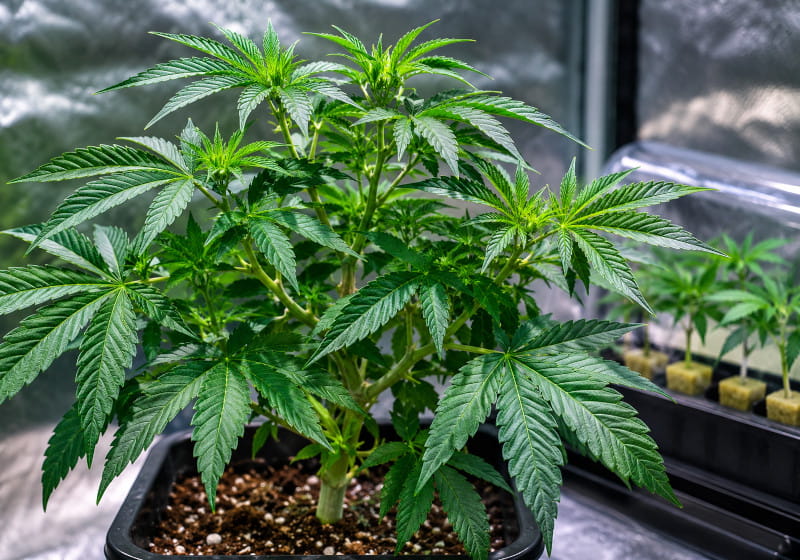
A cannabis mother plant is a selected female plant that is kept permanently in the vegetative growth phase in order to preserve and propagate its genetics through cuttings.
Unlike a plant cultivated for flower production, a mother plant should not enter the flowering phase. Instead, it should remain healthy in vegetative growth over a longer period and produce strong side shoots from which cuttings can be taken regularly. These can be rooted and cultivated further as genetic copies of the mother plant.
The resulting plants basically possess the same genotype as the mother plant. However, this does not mean that they will develop completely identically under all conditions. Light, temperature, root space, water and nutrient supply, stress and disease all influence how the existing genetics are actually expressed.
In short: A mother plant is not a special type of plant. It is a deliberately selected cannabis plant whose genetics are intended to be preserved long-term through vegetative propagation.
Why Keep a Cannabis Mother Plant?
The main reason for keeping a mother plant is the long-term preservation of genetics that have already been selected.
Plants grown from seeds are siblings and not genetically identical copies. Even seeds of the same strain can produce different phenotypes because each plant has its own combination of genetic traits. We explain in more detail how generations and crosses differ genetically in our guide to F1, F2, BX, S1 and IBL in Cannabis. If an individual plant has particularly interesting characteristics, its specific genetic combination cannot simply be reproduced by germinating another seed.
This individual genetic profile can be preserved through cuttings. This can be useful, for example, when a plant stands out in terms of growth structure, vigor, aroma, flowering time or other desired traits.
Mother plants also make it possible to cultivate several plants with the same genetic starting point. Differences between the resulting plants then arise not from a new combination of parental genes, but mainly from cultivation conditions, plant condition and other environmental influences.
Which Cannabis Plant Is Suitable as a Mother Plant?
A good mother plant should be healthy, vigorous and free from visible pests and diseases – while also possessing the genetics that are actually intended to be preserved.
Strong growth alone is therefore not enough as a selection criterion. A very fast-growing young plant may later show traits that do not match expectations. Conversely, a phenotype that initially appears unremarkable may later develop exactly the desired characteristics.
When selecting, factors such as vigor, branching, internodal spacing, growth structure, stress responses and overall plant health can be considered. If cuttings have already been tested, their rooting behavior can also be relevant.
How Do You Select a Suitable Phenotype?
If you want to preserve specific genetics over the long term, you should not select the mother plant solely on the basis of its early growth phase. How different plants within a population are systematically compared and promising phenotypes selected as keepers is explained in detail in our Canna Wiki guide to cannabis pheno hunting.
Many interesting characteristics only become fully apparent later in plant development. For this reason, backup cuttings can first be taken from several candidates. The respective original plants can then be assessed further while their genetically corresponding cuttings remain in vegetative growth.
Once it is clear after evaluation which phenotype should be preserved, the corresponding cutting can be developed further into the new mother plant. This means the final selection does not have to be made before important characteristics are even known.
Why Is the Health of the Mother Plant So Important?
Problems in a mother plant can affect many subsequent cuttings and should therefore be taken especially seriously.
A mother plant should show no visible signs of pest infestation, fungal disease, root problems or unexplained growth disorders. Pathogens present in plant tissue are particularly problematic because they can be passed on with the cuttings taken from the plant.
Ein wichtiges Beispiel ist HPLVD in Cannabis. Studies show that Hop Latent Viroid can occur in infected mother plants and can be transmitted through cuttings taken from them. Clean tools and consistent hygiene are therefore especially important with mother plants – even when no pests or disease symptoms are visible.
Grow a Mother Plant from Seed or Cutting?
A mother plant can be developed either from a seed or from an already rooted cutting. However, both approaches have different advantages.
| Starting point | Advantages | Disadvantages | Useful when ... |
|---|---|---|---|
| seeds | different phenotypes can be selected and compared with one another | the desired characteristics are not yet fully known at the beginning | you want to select your own mother plant |
| Cutting | the genotype of the selected original plant is preserved | the health and origin of the starting material are especially important | already selected genetics are to be preserved |
If a mother plant is grown from seed, several genetically different plants can be compared and a suitable phenotype can be selected deliberately. If, on the other hand, a cutting from an already selected plant is developed into a mother plant, the genetics to be preserved are already established.
How Do You Maintain a Cannabis Mother Plant?
A cannabis mother plant is kept permanently in the vegetative growth phase and is not deliberately induced to flower by shortening the daily light period.
Anyone who wants to keep a cannabis mother plant long-term needs a suitable space, sufficient light, healthy root space and regular care. Unlike a normal vegetative phase of limited duration, it must be taken into account that the same plant may remain vegetative for many months or even longer. One suitable option for this is a grow box, where light and other environmental conditions can be controlled specifically.
The goal is not maximum growth at any cost. A controlled balance is more useful: the mother plant should remain vigorous, regularly produce new side shoots and recover reliably after pruning without becoming unnecessarily large.
Important: A mother plant does not need to grow as quickly as possible. For long-term maintenance, controlled, healthy growth is more important than producing as much plant mass as possible.
What Lighting Does a Cannabis Mother Plant Need?
The lighting should reliably keep the cannabis mother plant in the vegetative growth phase while providing enough light for healthy, strong new shoots.
A commonly used light cycle is 18 hours of light and 6 hours of darkness. Longer light periods are also used to keep cannabis in vegetative growth. However, more light or a longer lighting duration is not automatically better for a mother plant.
What also matters is how much light actually reaches the plant. A blanket recommendation such as “100 watts per mother plant” is not very meaningful because lamp efficiency, distance from the plant, illuminated area, plant shape and light distribution can vary greatly. You can find more fundamentals on lighting and the growing area in our Cannabis Grow Setup for Beginners.
18/6 or 24/0 for a Mother Plant?
An 18/6 schedule is a common and practical way to keep photoperiod mother plants in vegetative growth.
Continuous lighting for 24 hours is not required for this. With photoperiod strains, a sufficiently long daily light period keeps the mother plant in vegetative growth. An 18/6 cycle also provides a daily dark period and reduces electricity consumption and heat generation compared with 24-hour lighting.
A stable and consistent light cycle is more important than maximizing the number of light hours. Unintentionally long or strongly fluctuating dark periods should be avoided.
How Much Light Does a Mother Plant Need?
The required light intensity depends mainly on how large the mother plant is kept and how much new plant material it is expected to produce regularly.
A small mother plant from which only a few cuttings are occasionally needed has different requirements from a large mother plant from which numerous shoots are taken regularly. Studies on cannabis mother plants show that the available amount of light can influence growth, node formation, branching and the production of suitable shoots for cuttings, among other things.
However, higher light intensity can also increase water and nutrient requirements and generate additional heat. Lighting should therefore always be matched to plant size, climate and the desired growth rate.
How Do You Care for a Cannabis Mother Plant?
For a mother plant kept long-term, stable conditions, healthy root space and a water and nutrient supply tailored to its needs are especially important.
| Factor | Guideline | Why is it important? |
|---|---|---|
| Light cycle | often 18/6 | keeps photoperiod plants in vegetative growth |
| Light intensity | adapt to plant size and desired growth | influences growth, branching and shoot production |
| Temperature | stable conditions without severe heat or cold stress | influences metabolism, water requirements and growth |
| Humidity | adapt to temperature and plant development | influences transpiration and disease risk |
| Substrate | structurally stable, sufficiently airy and suitable for the growing system | healthy roots need both water and oxygen over the long term |
| Watering | according to actual need rather than a rigid schedule | avoid prolonged waterlogging and severe drying out |
| Nutrients | supply vegetative growth according to actual needs | underfeeding and overfeeding can impair vigor and shoot quality |
How Often Should a Mother Plant Be Watered?
A mother plant should also not be watered according to a rigid schedule. How quickly it uses water and how fast the substrate dries again depends on factors including plant size, pot volume, substrate, temperature, humidity and light intensity.
A large, vigorously growing mother plant can require considerably more water than a compact bonsai mother plant. At the same time, the substrate should not remain permanently wet, because a constantly waterlogged, oxygen-poor root zone stresses the plant and can encourage root rot in cannabis. Therefore, check the actual condition of the substrate and adjust watering to the plant, pot and growing conditions.
How Should a Cannabis Mother Plant Be Fertilized?
Because a cannabis mother plant is kept permanently in vegetative growth, its nutrient supply should be geared toward healthy and even growth.
A mother plant kept long-term does not therefore automatically need especially large amounts of fertilizer. Overfeeding can be just as problematic as a deficiency. The actual nutrient requirement depends on factors including substrate, water quality, plant size, growth rate and the fertilizer system being used.
Discoloration or other changes in the leaves should therefore not automatically be met with additional fertilizer. It is more useful to first narrow down the cause while also considering watering, root condition and other environmental factors. We explain typical symptoms and possible causes in more detail in our guide Identifying Nutrient Deficiencies in Cannabis.
Does a Mother Plant Need to Be Repotted Regularly?
When keeping a mother plant long-term, the root space must be monitored and adjusted if necessary.
A mother plant cannot continue producing new roots indefinitely in a small pot. Once the container is fully rooted through, the balance between root space, water uptake and above-ground growth can become increasingly difficult to control.
One option is to repot into a larger container. Those who deliberately want to keep the mother plant compact can instead use controlled plant and root maintenance. Especially with a bonsai mother plant, long-term management of limited root space is part of the cultivation strategy.
How Do You Prune a Cannabis Mother Plant?
Regular pruning helps keep a cannabis mother plant compact and well branched while encouraging strong side shoots for later propagation through cuttings.
Without pruning, a photoperiod cannabis plant will continue to grow in height and width. This is often impractical for a mother plant kept long-term. By selectively removing or shortening dominant shoot tips, branching can be encouraged and the size and shape of the plant can be controlled more effectively.
Plant material should not be removed indiscriminately in large amounts. The goal is a compact, well-organized structure with healthy, well-lit shoots. Weak, damaged or densely inward-growing shoots can be removed if necessary.
Why Are Mother Plants Often Topped?
When topping, the dominant shoot tip is removed so that the side shoots below can develop more strongly.
For a mother plant, a branched structure is usually more practical than a single dominant main shoot. This keeps it more compact while allowing it to develop several strong side shoots that can later be used as cuttings.
After more intensive pruning, the mother plant should be given sufficient time to recover. How quickly it then produces new shoots depends on factors including genetics, root health, lighting and overall vigor.
How Can You Keep a Cannabis Mother Plant Small?
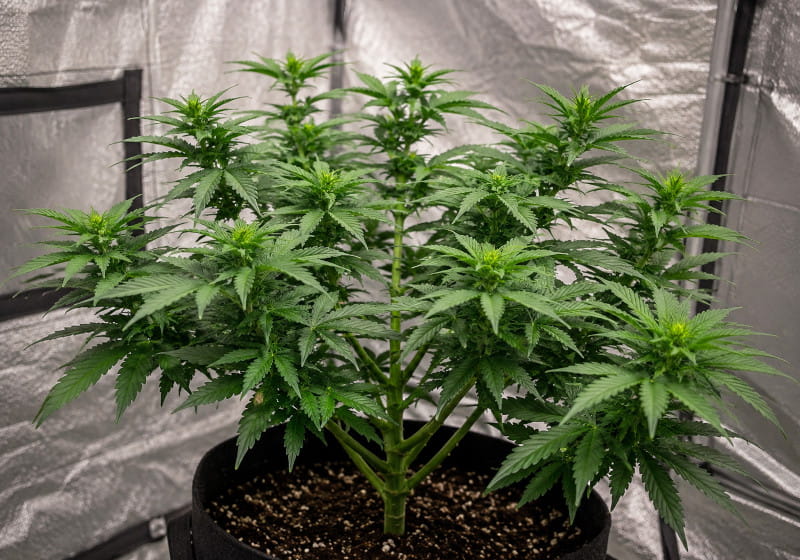
A cannabis mother plant does not need to be large. Regular pruning, adjusted lighting and controlled pot and root management can keep it compact.
How large the mother plant should be depends mainly on how many cuttings are needed regularly. Anyone who only occasionally takes a few shoots does not need a large plant. A compact mother plant requires less space and is easier to care for and keep in shape.
Keeping it “small” should not mean subjecting the plant to constant stress. Even a compact mother plant needs enough healthy leaf area, a functioning root zone and sufficient strong new shoots.
What Is a Cannabis Bonsai Mother Plant?
A cannabis bonsai mother plant is a deliberately compact mother plant whose size is limited through regular pruning and controlled pot and root management.
The term “bonsai” here mainly describes the cultivation method. The goal is not a decorative miniature plant in the classical bonsai sense, but a space-saving mother plant that can regularly produce healthy, strong new shoots despite its small size.
For this purpose, the canopy is regularly pruned and a branched, compact structure is developed. When kept long-term in a limited container, controlled root maintenance may also become necessary. However, major interventions to the roots and above-ground parts of the plant should not be combined unnecessarily, so that the mother plant has enough time to recover.
Save space: A compact mother plant can be entirely sufficient for preserving genetics. How large it needs to be depends mainly on how many healthy cutting shoots are regularly required.
When Can You Take Cuttings from a Mother Plant?
Cuttings should only be taken once the mother plant is growing healthily and vigorously and has sufficiently developed, strong shoots.
What matters less than an exact prescribed plant age is the condition of the mother plant and its shoots. Young or still weak plants should first develop a stable root and shoot system. After heavy pruning, repotting or other stressful situations, an adequate recovery period is also advisable.
Healthy and strong shoots with several nodes and an intact growing tip are suitable for vegetative propagation. We explain step by step how to select suitable shoots, cut them cleanly and then root them in soil, Jiffys, rockwool, coco or water in our guide to taking and rooting cannabis cuttings.
How Many Cuttings Can You Take from a Mother Plant?
There is no fixed number. How many cuttings can be taken depends on the size, branching, genetics, vigor and regenerative capacity of the mother plant.
A large, well-branched mother plant can provide considerably more suitable shoots than a compact bonsai mother plant. Nevertheless, not every available shoot should be removed at the same time. The plant needs sufficient leaf and shoot mass to continue photosynthesizing and subsequently produce healthy new growth.
Rather than aiming for the highest possible number of cuttings, the amount taken should be adapted to the size, vigor and actual regenerative capacity of the individual mother plant.
How Do You Care for the Mother Plant After Taking Cuttings?
After several cuttings have been taken, the mother plant mainly needs stable conditions and enough time to recover and produce new shoots.
Check the cut sites and avoid unnecessary additional stress immediately afterward. A particularly heavy fertilizer application does not automatically speed up recovery. After losing larger amounts of leaf and shoot mass, water and nutrient requirements may even be temporarily lower.
How Long Can You Keep a Cannabis Mother Plant?
There is no fixed maximum lifespan for a healthy cannabis mother plant of, for example, six months, one year or three years.
Under suitable conditions, mother plants can be kept vegetative for a long time. Whether this remains practical depends on health, vigor, root condition, space requirements and the quality of the shoots produced.
The age of a plant alone also does not automatically mean that its genetics become “worse.” Problems that occur in old mother plant stock can just as easily be related to long-term stress, root space, diseases, pests or unfavorable cultivation practices.
When Should an Old Mother Plant Be Replaced?
Replacement can make sense if the mother plant permanently loses vigor, develops health problems or becomes increasingly difficult to maintain long-term.
One option is to root a healthy cutting from the existing mother plant in good time and develop it into a new mother plant. This basically preserves the same genotype while allowing you to start again with a smaller plant and a young root system.
No fixed expiration date: A mother plant does not need to be replaced simply because it has reached a certain age. Health, vigor, shoot quality and the practical maintenance effort are more meaningful decision criteria.
Common Problems with Cannabis Mother Plants
Yellow leaves, slow growth or weak new shoots can have different causes in a cannabis mother plant. Individual symptoms are therefore usually not enough to clearly identify the underlying problem.
| Problem | Possible causes | What to check? |
|---|---|---|
| Yellow leaves | nutrient supply, overwatering, root problems, unsuitable pH or natural aging of individual leaves | check affected leaves, substrate, watering habits, root zone and the overall condition of the plant |
| Slow growth | too little light, root problems, unfavorable climate, unbalanced nutrient supply or stress | check lighting, temperature, root space, watering and nutrient supply |
| Very long internodes | genetics, insufficient light intensity or unfavorable light distribution | check lighting, lamp distance and overall plant development |
| Growth stalls after pruning | heavy pruning, weakened root zone or additional environmental stress | allow sufficient recovery time and avoid additional stress factors |
| Weak new shoots | too little light, root problems, unbalanced nutrient supply or general plant weakness | check lighting, roots and nutrient supply instead of automatically increasing fertilizer |
| Pests | infestation introduced through plants, substrate, tools or other plant material | carefully inspect leaf undersides, young shoots, substrate and neighboring plants |
| Cuttings repeatedly develop poorly | condition of the mother plant, genetics, pathogens or unsuitable conditions during rooting | assess the health of the mother plant and the rooting conditions separately |
Why Does a Mother Plant Get Yellow Leaves?
Yellow leaves can have many causes and by themselves are not a diagnosis of a specific nutrient deficiency.
First check which leaves are affected, how quickly the problem is developing and whether changes are also occurring in shoots, roots or substrate. Permanently wet soil, for example, can impair nutrient uptake and cause symptoms that are mistakenly treated with additional fertilizer.
Why Are Pests Especially Problematic on Mother Plants?
An infested mother plant can become the starting point for problems in numerous cuttings taken from it.
Therefore, regularly inspect leaf undersides, young shoots and the area around the substrate. Abnormalities should be detected as early as possible before further plant material is taken for propagation.
Our Canna Wiki guides on typical cannabis pests and plant problems can help with diagnosis. With mother plants, hygiene of scissors, blades and other tools that come into contact with several plants one after another is also especially important.
What Role Does Hygiene Play with Cannabis Mother Plants?
Clean working practices are especially important with cannabis mother plants because the same plants are maintained over a long period and pruned repeatedly.
Scissors and blades should be kept clean and thoroughly disinfected especially before moving between different plants. Dead leaves, cut shoots and other plant material should also not be left unnecessarily in the growing area.
Hygiene is important not only when fungal or pest problems are visible. Studies on HLVd show that infected mother plants can transmit the pathogen through vegetatively propagated plant material. Mechanical transmission through contaminated plant sap and cutting tools is also possible.
Practical tip: If the same scissors are used on several plants one after another, plant sap can be transferred from one plant to the next. Cleaning and disinfecting cutting tools is therefore an important part of hygiene when working with mother plants.
What Myths Exist About Cannabis Mother Plants?
Many rigid rules circulate around cannabis mother plants, even though the actual relationships are often more nuanced.
| Claim | Assessment |
|---|---|
| A mother plant is worn out after a certain age. | There is no universally valid expiration date. Health, vigor, root condition and shoot quality are more informative than a rigid age limit. |
| Old mother plants automatically lose their genetics. | The age of a mother plant does not automatically mean that its genotype progressively deteriorates. Health, plant condition and cultivation conditions should be considered separately from this. |
| A mother plant needs light around the clock. | No. Photoperiod mother plants can, for example, be kept in vegetative growth with an 18/6 light cycle. |
| The larger the mother plant, the better. | The appropriate size depends mainly on how many cutting shoots are needed and how much space is available. |
| After taking many cuttings, the mother plant immediately needs a lot of fertilizer. | Not automatically. Nutrient supply should continue to be based on the plant’s actual needs and condition. |
Frequently Asked Questions About Cannabis Mother Plants
What Is a Cannabis Mother Plant?
A cannabis mother plant is a selected female plant that is kept in vegetative growth in order to preserve its genetics long-term through cuttings. It is therefore not deliberately induced to flower, but is intended to continuously produce healthy vegetative growth.
How Long Can You Keep a Cannabis Mother Plant?
There is no fixed maximum lifespan for a cannabis mother plant. Under suitable conditions, it can be maintained for a long time. Health, vigor, root condition and the quality of newly formed shoots are especially important.
What Light Cycle Does a Mother Plant Need?
For photoperiod cannabis mother plants, a light cycle of 18 hours of light and 6 hours of darkness is commonly used. A sufficiently long daily light period keeps the plant vegetative without requiring continuous 24-hour lighting.
How Can You Keep a Cannabis Mother Plant Small?
Regular pruning, topping and controlled pot and root management can help limit the size of a cannabis mother plant. A compact bonsai mother plant can be especially practical if only a few cuttings are needed occasionally.
How Often Should a Mother Plant Be Pruned?
There is no fixed schedule for this. When pruning is done depends on growth, the desired plant shape and the number of new shoots needed. After more intensive interventions, the mother plant should be given sufficient time to recover.
Can You Grow a Mother Plant from Seed?
Yes, a mother plant can be grown from seed. This makes it possible to compare different plants and phenotypes. If the genetics of a particular plant are to be preserved after selection, a cutting previously taken from that plant can then be cultivated further as a mother plant.
Can a Cutting Become a Mother Plant Itself?
Yes, a healthy rooted cutting can itself be developed into a new mother plant. It is kept in vegetative growth and trained into a branched structure through appropriate pruning. Its genotype basically corresponds to that of the original plant.
When Can You Take Cuttings from a Mother Plant?
The mother plant should be healthy, vigorous and sufficiently developed, with several strong side shoots. After heavy pruning, repotting or other stressful situations, it should first be given enough time to recover.
Why Are Mother Plants Replaced Regularly?
A mother plant can be replaced if maintaining it becomes increasingly demanding or if problems with vigor, roots or shoot quality occur. A healthy cutting from the existing mother plant can then be developed into the next mother generation so that the genotype is basically preserved.
Can an Autoflower Serve as a Permanent Mother Plant?
Photoperiod plants are suitable for classic long-term mother plant maintenance. Autoflowering genetics begin flowering according to age and therefore cannot be kept indefinitely in the vegetative growth phase by means of a long light cycle.
Sources and Further Information
- Supplemental greenhouse lighting increased the water use efficiency, crop growth, and cutting production in Cannabis sativa
- Transmission, Spread, Longevity and Management of Hop Latent Viroid in Cannabis
- Endophytes in Cannabis sativa: Identifying and Characterizing Microbes with Beneficial and Detrimental Effects on Plant Health
- The Impact of LED Spectra on Cannabis sativa Morphology and Physiology
- Optimizing LED Light Intensity and Photoperiod to Promote Growth and Rooting of Medicinal Cannabis