Cannabis Root Aphids: Infestation, Damage & Control
Root Aphids on Cannabis: Hidden Infestations in the Root Zone
Updated: October 2026 | Root aphids on hemp and cannabis: identification, symptoms, diagnosis, lookalikes, control measures and prevention.
Author: Cannapot Grow Team | Reading time: approximately seventeen minutes
The Most Important Points at a Glance
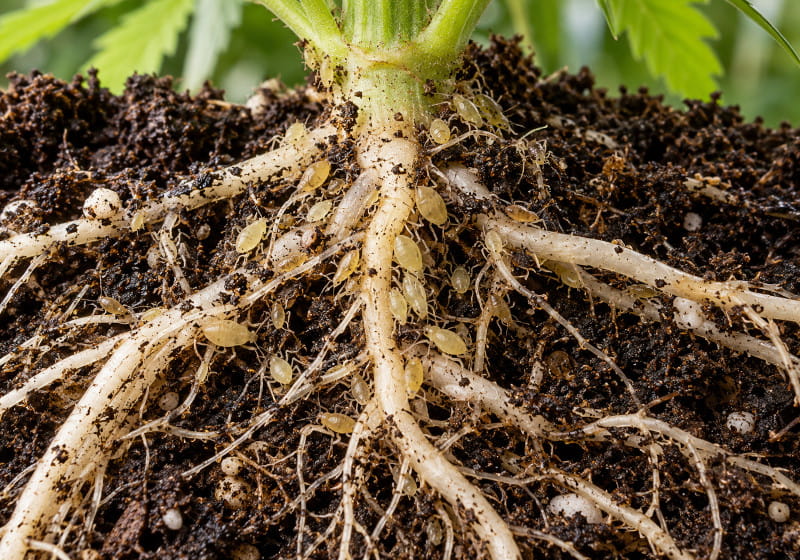
✓ Root aphids are sap-sucking aphids that primarily colonize underground plant parts. The rice root aphid, Rhopalosiphum rufiabdominale, in particular, has been scientifically documented as a pest of cannabis.
✓ These small aphids live mainly on roots but may also occur in the growing medium and around the base of the stem. Winged individuals can spread to other plants and are sometimes found on yellow sticky traps.
✓ Heavy infestations may impair plant development, causing stunted growth, yellowing leaves or wilting. However, these symptoms are not specific and can also result from other pests or problems affecting the roots.
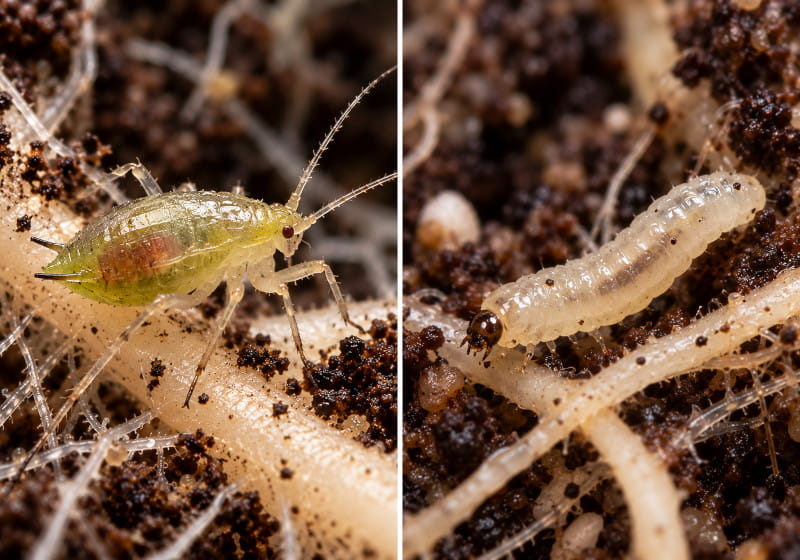
✓ Root aphids must not be confused with fungus gnat larvae. Body shape, the presence of legs and direct examination of insects in the root zone are crucial for telling them apart. Visible plant symptoms alone are not sufficient for a reliable diagnosis.
✓ Targeted control begins with correctly identifying the pest. New plants should be inspected before introduction, infested specimens isolated wherever possible and roots examined carefully. Regular follow-up checks help assess how the infestation is developing and whether the measures are working.
A cannabis plant suddenly starts growing more slowly, its leaves turn yellow or begin to wilt despite apparently ideal care. Watering mistakes, nutrient problems or root rot are often suspected first. But the cause may also be a pest that remains largely hidden in the growing medium: root aphids. Because these small insects live mainly below the surface of the growing medium, infestations often go unnoticed for a long time.
One species particularly relevant to cannabis cultivation is the rice root aphid Rhopalosiphum rufiabdominale, known internationally as the Rice Root Aphid. Its presence on Cannabis sativa has been scientifically documented. Heavy infestations can interfere with plant development. However, neither yellowing leaves nor slowed growth is a clear indication of root aphids. Only a targeted inspection of the root zone can provide a reliable diagnosis.
This Canna Wiki guide examines root aphids as a distinct pest problem, explaining their characteristics, possible damage symptoms and suitable diagnosis and control strategies. Other causes of wilting, yellow leaves or impaired growth are discussed in greater detail in our overview of Cannabis Plant Problems & Diseases.
What Are Root Aphids on Cannabis?
Root aphids are sap-sucking insects belonging to the aphid family Aphididae that primarily colonize underground plant parts. While many familiar aphid species live on leaves and young shoots, root-dwelling species mainly inhabit roots. There, they use piercing-sucking mouthparts to extract sap from plant tissue.
The rice root aphid Rhopalosiphum rufiabdominale has been scientifically documented on cannabis. In 2020, Cranshaw and Wainwright-Evans described Cannabis sativa as a host plant for this species in North America. However, not every root aphid is necessarily a rice root aphid. Reliable identification at species level may require microscopic examination and specialist entomological knowledge.
The name “rice root aphid” refers to rice as one of its known host plants. However, the species does not depend exclusively on rice and can colonize other plants as well. In cannabis cultivation, its ability to establish itself in the root zone of protected growing systems and remain undetected for extended periods is particularly relevant.
What Do Root Aphids Look Like?
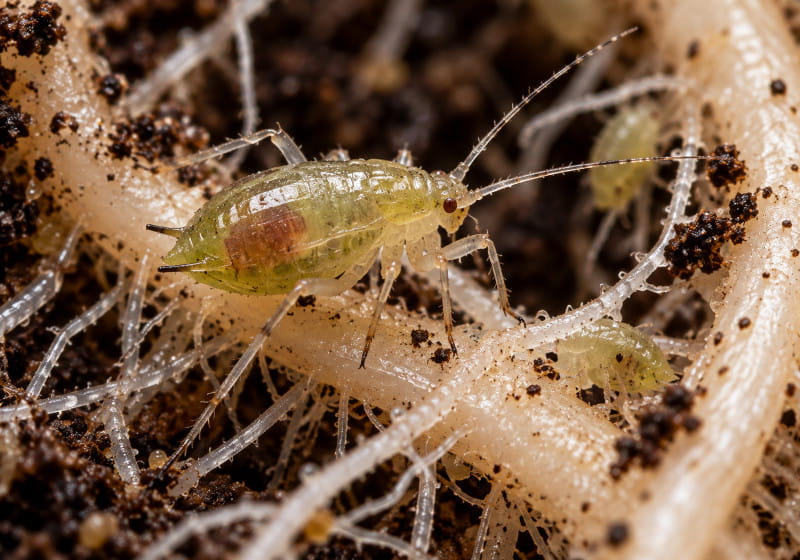
Root aphids are small, soft-bodied insects with six legs and piercing-sucking mouthparts. The rice root aphid has a somewhat rounded to pear-shaped body and may appear dark green, olive green or brownish. Reddish-brown areas may sometimes be visible on the abdomen. Since coloration varies, it is not sufficient on its own for reliable species identification.
The integrated pest management (IPM) manual published by the Canadian province of British Columbia gives a body length of approximately 1.6 to 2.2 millimetres. The insects are therefore visible to the naked eye in principle. Nevertheless, they are easily overlooked among growing-medium particles, densely branched roots or in damp areas. Examining exposed roots and the base of the stem with a magnifying glass is therefore particularly useful.
The rice root aphid occurs in both wingless and winged forms. Wingless individuals mainly remain in the root zone, where they form colonies. Winged individuals can spread to other plants and occasionally appear on yellow sticky traps. However, finding a winged insect on a sticky trap does not by itself prove a root aphid infestation. For reliable identification, the insect’s physical characteristics and, wherever possible, the root zone must also be examined.
|
Characteristic |
Rice root aphid |
|
Scientific name |
Rhopalosiphum rufiabdominale |
|
Insect group |
Aphids (Aphididae) |
|
Body length |
approximately 1.6–2.2 mm (according to the British Columbia IPM manual) |
|
Typical location |
Roots and root crown, mainly within the growing medium |
|
Forms |
Wingless and winged individuals |
|
Feeding behaviour |
Extracts plant sap using piercing-sucking mouthparts |
Where Do Root Aphids Live on the Plant?
Root aphids primarily inhabit underground plant parts. If an infestation is suspected, particular attention should therefore be paid to the root ball, fine roots and the junction between the stem and growing medium. The insects may sit directly on root surfaces, hide between particles of growing medium or form small colonies in areas that are rarely visible during routine plant care.
Infestations are often harder to detect in soil and coco coir than in growing systems with freely accessible roots. However, hydroponic systems do not offer complete protection either. The British Columbia IPM manual notes that root aphids can survive in such systems under certain conditions. How readily they establish themselves depends, among other factors, on the growing system and conditions in the root zone.
When examining suspicious plants, checking only the surface of the growing medium is therefore not enough. Carefully inspecting the entire root ball can be much more informative. If it can be removed from the container without significant damage, the outer roots and the area near the root crown should be examined with a magnifying glass.
What Damage Can Root Aphids Cause?
A heavy root aphid infestation can impair the growth and overall development of a cannabis plant. The insects extract sap from roots and, at high population densities, may weaken the plant. Possible signs include slowed growth, yellowing leaves and wilting. In severe infestations, the entire plant may visibly lose vigour.
However, these symptoms are not characteristic of root aphids. Overwatering, lack of water, nutrient problems, insufficient oxygen in the growing medium and diseases of the root system can all cause similar changes. Yellow leaves or stunted growth alone are therefore not sufficient evidence of a root aphid infestation. Before attempting targeted control, living pests should be detected in the root zone and identified as reliably as possible.
The severity of damage depends on factors including the number of root aphids, the plant’s developmental stage, the health of its root system and growing conditions. A generally accepted economic damage threshold for root aphids on cannabis has not yet been established. The number of insects found alone therefore cannot reliably indicate how severely an individual plant is affected.
Yellowing leaves, wilting or a weakened root system are important warning signs, but not conclusive proof. Only finding the relevant aphids on the roots provides a sound basis for deciding what to do next.
Root Aphids or Fungus Gnats: How to Tell Them Apart
Root aphids are sometimes confused with fungus gnats or their larvae. Both pest groups can occur in the growing medium and, in heavier infestations, may be associated with weakened plant development. However, their lifestyles and the ways they damage plants differ significantly. Root aphids belong to the aphid family and feed by sucking plant sap. Fungus gnats, by contrast, are small fly-like insects whose larvae live in the growing medium and feed on fungi, organic material and, in some cases, fine plant roots.
|
Characteristic |
Root aphids |
Fungus gnats |
|
Damaging life stage |
Nymphs and adult aphids |
Primarily larvae |
|
Body shape |
Stocky, soft-bodied insect with six legs |
Elongated, legless larvae, usually with a dark head capsule |
|
Feeding behaviour |
Suck sap from roots |
Larvae feed on fungi, organic matter and sometimes fine roots |
|
Winged individuals |
Winged aphids that disperse to other plants |
Adult, gnat-like insects |
Yellow sticky traps can catch both winged root aphids and adult fungus gnats. They are therefore useful for monitoring flying insects, but cannot reliably distinguish between them without closer identification. Anyone noticing unusual insects should examine their physical features with a magnifying glass where possible and also check the root zone. Detailed information on identification, diagnosis and control is available in our guide How to Identify and Control Fungus Gnats on Cannabis.
Root Aphids, Other Aphids and Root Rot: Further Lookalikes
Not every aphid found on cannabis is a root aphid. The cannabis aphid Phorodon cannabis mainly colonizes above-ground plant parts such as leaves, shoots and flower clusters. The rice root aphid Rhopalosiphum rufiabdominale, by contrast, primarily inhabits the roots. Although winged root aphids may also appear above ground, the preferred habitats and lifestyles of these two species differ significantly. For more information about identifying and controlling aphids living above ground, see our Canna Wiki article How to Identify and Control Aphids on Cannabis.
Another possible source of confusion is root rot. This is not an insect infestation but damage to the root system that can be promoted, for example, by pathogens or unfavourable conditions such as prolonged waterlogging and oxygen deficiency. Discoloured, damaged or dying roots are therefore not clear evidence of root aphids. Conversely, these changes alone cannot establish a specific root disease either. The possible causes must be investigated separately for a reliable diagnosis. Our guide How to Identify Root Rot on Cannabis explains in detail which symptoms may indicate root rot and how to distinguish it from other problems.
How to Diagnose Root Aphids Reliably: Step by Step
A reliable diagnosis requires direct evidence of the pests in the root zone. Above-ground symptoms such as stunted growth, yellowing or wilting may raise initial suspicions, but they are not enough for definite identification. Examining the roots and the visible physical features of any insects found is essential.
1. Identify suspicious plants: Specifically inspect plants showing slowed growth, yellowing leaves or wilting. Record which symptoms are present, when they first appeared and whether individual plants or larger sections of the crop are affected.
2. Inspect the growing-medium surface and root crown: Carefully examine the junction between the stem and growing medium. Look for small, mobile, aphid-like insects. A magnifying glass with adequate magnification makes it easier to identify body shape, legs and other features.
3. Carefully inspect the root ball: If it can be done without significant damage, gently remove the root ball from the container and inspect the outer, fine roots in particular. Look for individual insects or small clusters. Avoid forceful pulling, tearing or unnecessarily exposing the roots, as this can cause additional root damage.
4. Look for insects washed out after watering: The British Columbia IPM manual recommends checking newly introduced plants after watering for aphids that may have been washed out. A light-coloured collection tray can make small insects in drainage water easier to spot. However, a negative result does not rule out an infestation.
5. Identify any insects found more precisely: Root aphids have stocky bodies and six legs. Fungus gnat larvae, by contrast, are elongated, legless and often recognizable by their dark head capsule. If identification remains uncertain, clear macro photographs or examination by a qualified specialist can help prevent mistakes.
6. Repeat and document inspections: Root aphids may be unevenly distributed throughout the root zone. If no insects are found during an initial inspection, a localized or still relatively light infestation cannot be completely ruled out. If suspicion persists, carry out further checks and document any unusual changes.
Yellow sticky traps can capture winged aphids and provide clues about their spread. However, they do not replace root inspections or reliable identification of the insects caught. Trap counts alone also cannot reliably indicate the size of the underground population.
Life Cycle and Spread Within a Crop
The rice root aphid Rhopalosiphum rufiabdominale can spend much of its life cycle in the root zone. Under suitable conditions, aphids of this species can also reproduce asexually, with females giving birth to live young. In protected growing systems, populations may therefore develop without necessarily requiring seasonal movement between different host plants. Actual development, however, depends on environmental conditions and the characteristics of the particular population.
For spread within a crop, winged aphids are particularly important. They can leave their original root zone, reach other plants and establish new colonies. Careful monitoring is therefore especially important in densely planted crops or growing systems where new plants are regularly introduced. Winged individuals may also be seen on sticky traps, while wingless aphids remain hidden on the roots.
Another risk is the introduction of already infested plants and their root balls. Especially with purchased young plants or rooted cuttings, root aphids can enter a previously pest-free crop unnoticed along with the growing medium. Healthy-looking leaves do not rule out a hidden infestation. New plants should therefore be inspected before introduction wherever possible and kept separate initially if an infestation is suspected.
What Should You Do If Root Aphids Are Confirmed?
When a root aphid infestation is confirmed, the first priority is to contain its spread. Affected plants should be separated from healthy specimens wherever possible. The next step is to assess how far the pests have already spread through the crop. Neighbouring plants should also be inspected, even if they show no visible growth problems or leaf changes.
Tools, work surfaces, plant containers and collection trays that have come into contact with infested growing medium or plant material should be thoroughly cleaned. This helps reduce the risk of accidentally spreading the pests. In the case of heavily infested individual plants, completely removing the affected plant and growing medium may also be appropriate, particularly to prevent further spread to previously healthy plants.
Suitable measures depend on the stage of infestation, the number of affected plants and the growing conditions. Local legal requirements also play an important role. No single treatment is known to reliably eliminate root aphids under all conditions. Control measures should therefore always be combined with regular follow-up inspections.
Biological Control: What Does the Scientific Evidence Show?
When considering biological control of root aphids, it is essential to distinguish carefully between scientifically studied methods and general pest-control recommendations. Beneficial organisms used against above-ground aphids or fungus gnat larvae are not automatically effective against root aphids in the growing medium. What matters is whether their effectiveness against the particular aphid species has actually been demonstrated under comparable conditions.
A study published by Ong and colleagues in 2025 investigated the parasitoid wasp Aphelinus varipes. The researchers showed that this parasitoid can attack both the rice root aphid Rhopalosiphum rufiabdominale and the cannabis aphid Phorodon cannabis. Under the conditions studied, parasitism rates did not exceed 21 percent for either species. These findings demonstrate biological potential, but do not yet establish reliable control under commercial growing conditions.
For other beneficial organisms, too, demonstrated effectiveness must be distinguished from general supplier recommendations. This is especially important for entomopathogenic nematodes and predatory mites, which are frequently used against fungus gnat larvae: their effectiveness cannot simply be assumed to extend to root aphids without appropriate studies. Reliable recommendations require data on the specific target species, application in the root zone and actual reduction of the infestation.
Growing-Medium Treatments and Plant Protection Products
Controlling root aphids is particularly challenging because much of the population remains protected within the root zone. An appropriate treatment must reach the pests there without unnecessarily stressing the roots. At the same time, any plant protection products used must be legally authorized for the crop, the intended application and the location concerned. This applies particularly to treatments delivered through the growing medium or nutrient solution.
Blanket recommendations for home remedies, unauthorized active ingredients or aggressive flushing of the growing medium should be avoided. Such applications can damage sensitive roots, disrupt the biological balance in the growing medium or leave unwanted residues. Residues are especially relevant in cannabis when plant parts will later be processed or consumed. It is therefore not responsible to recommend a universally applicable dosage or a guaranteed effective single treatment.
Anyone intending to use plant protection products must follow the currently valid authorizations and binding application instructions in their country. Scientific findings from other crops or countries with different plant protection regulations do not replace legal authorization for use on cannabis.
The success of a measure cannot be judged solely by falling catch numbers on yellow sticky traps. What matters is whether the number of living root aphids in the root zone decreases, no new colonies appear and the condition of affected plants stabilizes.
Preventing Root Aphids: Inspect Plants and Growing Media
The most effective foundation for prevention is to detect possible infestations as early as possible and prevent their introduction. Purchased young plants and rooted cuttings in particular should be carefully inspected before being introduced into an existing crop. In addition to leaves and shoots, the root crown and accessible parts of the root ball deserve special attention. Keeping new plants separate for an observation period can help detect pests that initially went unnoticed.
A clean, well-organized growing area makes regular inspections easier and reduces unnecessary contact between plants and containers. Our guide to Growing Cannabis Indoors and our instructions on Building Your Own Grow Box explain what matters when planning and organizing protected growing spaces.
When growing cannabis in a greenhouse, inspecting newly introduced plants and consistently monitoring the root zone are also advisable. However, much of the scientific evidence concerning Rhopalosiphum rufiabdominale on cannabis comes from studies of protected, intensive production systems. The infestation patterns and dispersal conditions observed there cannot automatically be applied to outdoor crops or every greenhouse system.
Plant containers, tools and work surfaces should also be cleaned before reuse. Previously used or potentially infested growing medium should not be transferred between plants without appropriate precautions. Keeping simple records of pest findings, affected plants and follow-up inspections is helpful as well. This makes possible routes of spread easier to trace and recurring infestations easier to detect early.
FAQ: Frequently Asked Questions About Root Aphids on Cannabis
How can you identify root aphids on cannabis?
The most reliable way to identify root aphids is to examine the root zone directly. Typical findings include small, aphid-like insects on fine roots, in the root ball or around the root crown. Yellowing leaves, wilting and slowed growth may raise suspicion, but do not provide conclusive evidence on their own.
How big are root aphids?
The rice root aphid Rhopalosiphum rufiabdominale documented on cannabis reaches a body length of approximately 1.6 to 2.2 millimetres according to the British Columbia IPM manual. Younger life stages may be smaller. Although the insects are generally visible to the naked eye, they can easily be missed among growing-medium particles and fine roots.
Can root aphids fly?
Yes. Both wingless and winged forms can occur among root aphids. While wingless individuals mainly remain in the root zone, winged aphids can spread to other plants. They may occasionally be found on yellow sticky traps.
Are root aphids and fungus gnats the same thing?
No. Root aphids are sap-sucking aphids with six legs and stocky bodies. Fungus gnats, by contrast, belong to the order Diptera (true flies). Their larvae live in the growing medium, are elongated and legless, and usually have a dark head capsule. Although both pest groups can occur in the root zone, their lifestyles and appropriate control measures differ significantly.
Do yellow sticky traps help against root aphids?
Yellow sticky traps can catch winged root aphids and provide clues about their presence or spread. However, they do not adequately capture wingless individuals, which live mainly on the roots. Yellow sticky traps are therefore primarily a monitoring tool, not a reliable stand-alone control method.
Can root aphids also occur in hydroponics?
Yes. Rice root aphids can survive in hydroponic growing systems under certain conditions, as described in the British Columbia IPM manual. Hydroponics therefore does not provide complete protection against infestation. Whether root aphids are actually present must be established through targeted root inspections.
Are yellow leaves a sure sign of root aphids?
No. Yellow leaves can result from many factors, including overwatering, nutrient deficiencies, unfavourable root-zone conditions and plant diseases. A root aphid infestation may also be accompanied by yellowing. However, reliable diagnosis requires finding the relevant pests on the roots.
Which beneficial organisms help against root aphids?
The parasitoid wasp Aphelinus varipes was able to parasitize rice root aphids in a study published in 2025. However, the observed parasitism rates were not sufficient to demonstrate reliable control under commercial growing conditions. Species-specific studies are also needed for other beneficial organisms before their effectiveness against root aphids on cannabis can be assessed.
How quickly do root aphids disappear after treatment?
The time needed for control depends on infestation severity, growing conditions and the measure chosen. No generally applicable timeframe can be given responsibly. Regular follow-up inspections of the root zone are essential to determine whether the number of living aphids is declining and whether new colonies are appearing.
Sources & Further Reading
Cranshaw, W. & Wainwright-Evans, S. (2020): Cannabis sativa as a Host of Rice Root Aphid (Hemiptera: Aphididae) in North America. Journal of Integrated Pest Management, 11(1), 15. Primary source on the host plant, biology and spread of the rice root aphid on cannabis.
Government of British Columbia: Integrated Pest Management for Commercial Cannabis in BC. Official IPM manual covering identification, damage symptoms and monitoring of rice root aphids.
University of California, Davis: Integrated Pest Management – Rice Root Aphids. Specialist resource with further information on pests affecting hemp.
University of New Hampshire Extension: Hemp Pests in New Hampshire. Overview of the rice root aphid and documented growing systems.
Ong, M. et al. (2025): Rice root aphids, Rhopalosiphum rufiabdominale, and cannabis aphids, Phorodon cannabis, are parasitised by Aphelinus varipes. The Canadian Entomologist, 157, e39. Experimental evidence of parasitism; not proof of established effectiveness in commercial practice.