Cannabis Pheno Hunting: How to Select Phenotypes
Pheno Hunting: Compare and Select Cannabis Phenotypes
Updated: September 2026 | Cannabis Pheno Hunting: identify, compare and select phenotypes and preserve selected keepers
Author: Cannapot Grow Team | Reading time: approximately twenty minutes
Key Takeaways at a Glance
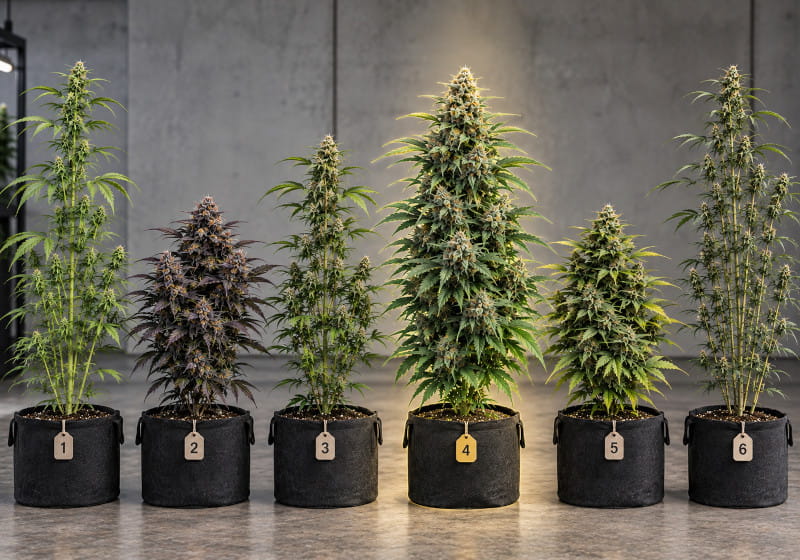
✓ Pheno hunting refers to the systematic search for interesting plants within a population. Several individuals are observed and documented under conditions that are as comparable as possible and selected according to predefined traits.
✓ A phenotype describes the observable or measurable characteristics of a plant. It results from the interaction between its genotype and the respective environmental conditions. Two seeds from the same cross are therefore not automatically genetically identical.
✓ During a pheno hunt, traits such as growth structure, branching, maturation time, aroma, cannabinoid and terpene profile, vigor or resilience may be considered. Which plant becomes the keeper depends on the specific selection goal.
✓ Clones of interesting candidates are often preserved as a genetic backup. If a particular original plant is later selected as the keeper, its corresponding clone can be maintained or kept as a mother plant.
✓ Pheno hunting and cannabis breeding are not the same thing. A pheno hunt selects interesting individuals from an existing population. Breeding goes beyond this and may include crosses, progeny testing, backcrossing or selection over several generations.
Anyone who grows several plants from cannabis seeds of the same genetics will often notice that they do not develop in exactly the same way. One grows more compactly, another branches more strongly, while a third matures earlier or displays a different aroma profile. These differences are precisely what form the basis of cannabis pheno hunting: a population is systematically compared in order to identify and deliberately select individual plants with particularly interesting characteristics.
The aim is not simply to pick the largest or most striking plant. A meaningful pheno hunt begins with a selection goal. The desired traits might include a particular plant structure, early maturation, a distinctive aroma, a desired chemical profile or a combination of several characteristics. The plant that best meets these requirements and is intended to be preserved is often referred to as a keeper.
What Is Cannabis Pheno Hunting?
Pheno hunting is the deliberate search for and selection of interesting phenotypes within a cannabis population. Several plants are compared with one another and evaluated according to defined traits. Particularly interesting individuals can then be preserved as so-called keepers or used for further breeding work.
The term comes from the English expression “phenotype hunting,” meaning the search for phenotypes. In the cannabis sector, the spellings Pheno Hunting and Pheno Hunt have become especially common. “Pheno-Hunting” and the single-word form “Phenohunting” are also used. They all essentially refer to the same selection process.
A pheno hunt can be small or very large. A grower may compare just a few plants from a seed pack, while professional breeding projects may examine hundreds or thousands of individuals. The principle remains the same: a genetically variable population is observed, interesting combinations of traits are identified, and individual plants are selected for a specific goal.
What Is a Cannabis Phenotype?
The phenotype describes the observable or measurable characteristics of a cannabis plant that arise from the interaction between its genotype and the respective environmental conditions. These can include plant height, branching, leaf shape, maturation time, pigmentation and chemical traits such as cannabinoid and terpene profiles.
In cannabis-industry terminology, “phenotype” is also frequently used to refer to an individual plant or a particular expression within a seed population. Scientifically, this usage is somewhat simplified: phenotype is not simply another word for a plant or genetics, but refers to the traits that are actually expressed by an organism.
What Is the Difference Between Genotype and Phenotype?
The genotype is the genetic makeup of a plant; the phenotype, by contrast, describes how the characteristics of that plant are actually expressed under specific environmental conditions. The two concepts are closely related, but they should not be treated as identical.
|
Term |
Meaning |
Examples |
|
Genotype |
genetic makeup of an individual |
the combination of genetic variants inherited from the parents |
|
Phenotype |
observable or measurable expression of traits |
growth habit, maturation time, pigmentation, aroma or chemical profile |
|
Environment |
conditions under which the genotype develops |
light, temperature, water, nutrient supply, root space or stress |
This distinction is crucial for pheno hunting. A striking trait does not necessarily have to be caused exclusively by genetics. Differences can also result from the environment or from genotype-by-environment interactions. The more comparable the conditions under which candidates are evaluated, the easier it is to interpret differences between the plants. To plan the different developmental stages on a clear timeline, our Cannabis Grow Calendar for Indoor & Outdoor can also help.
Why Do Plants with the Same Cannabis Genetics Differ?
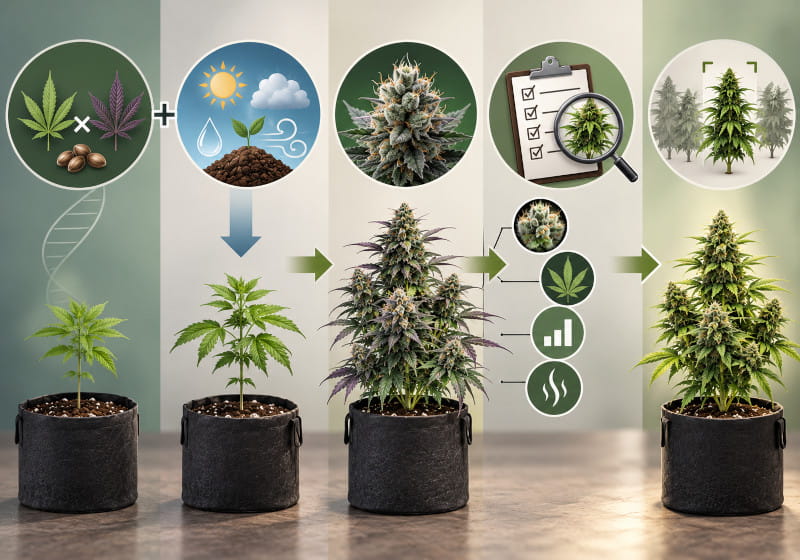
Plants grown from different seeds of the same cross are siblings, but they are normally not genetically identical copies. During sexual reproduction, genetic variants originating from the parents are recombined during the formation of gametes and fertilization. As a result, each seed can receive a different combination of the available genetic variants.
How large the differences among offspring are depends strongly on the genetic starting material. In a very uniform line, many plants may develop similarly. With highly heterozygous parents or certain segregating generations, however, considerably greater variation can occur. A cultivar name alone therefore does not reliably predict how uniform all seed-grown plants will be.
Environmental influences are another factor. Even genetically identical clones can look different and produce different measurements under different light, temperature, water or nutrient conditions. In pheno hunting, it is therefore always necessary to distinguish between genetic variation and environmentally induced variation.
How Does a Pheno Hunt Work?
A pheno hunt works as a multi-stage selection process: a population is established, each individual is clearly documented and evaluated according to predefined traits, and the most interesting candidates are then selected. It is important not to make the selection spontaneously only at the end, but to define in advance, as far as possible, which traits are actually being sought.
|
Step |
What happens? |
Why is it important? |
|
1. Define the goal |
define desired traits and priorities |
prevents a purely spontaneous selection based on individual striking traits |
|
2. Record the population |
clearly number or label each plant |
observations and later clones must be clearly traceable to the correct plant |
|
3. Compare |
observe plants under conditions that are as comparable as possible |
reduces the influence of avoidable environmental differences on the evaluation |
|
4. Document |
systematically record traits and observations |
enables a traceable comparison throughout the entire development period |
|
5. Preserve candidates |
preserve genetically traceable clones of interesting plants |
the selected genotype can be preserved after the evaluation is complete |
|
6. Select the keeper |
compare the overall results with the original selection goal |
the plant most relevant to the goal is preserved, rather than simply the most striking one |
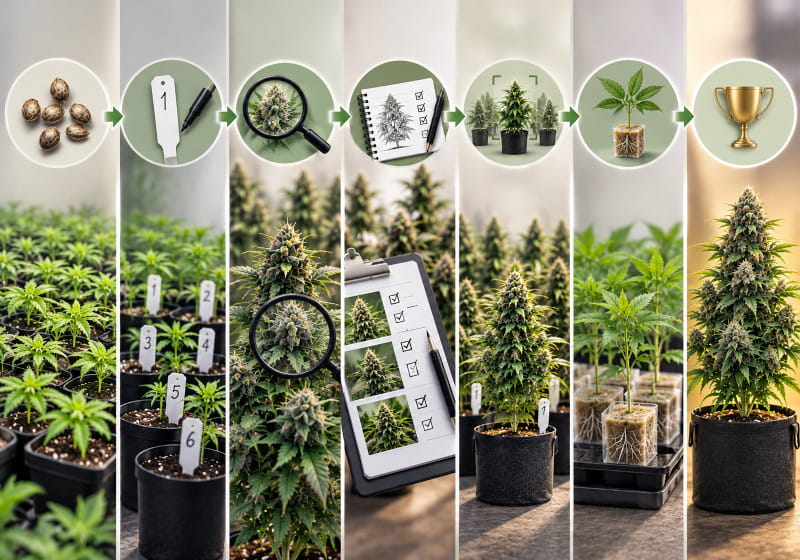
Which Traits Are Evaluated During Pheno Hunting?
Which characteristics matter in a pheno hunt depends on the selection goal. There is therefore no universal checklist that can automatically determine the “best” cannabis phenotype. In addition to visible characteristics, professional breeding programs may also consider chemical analyses and genetic data.
|
Category |
Possible traits |
Important context |
|
Growth |
height, branching, internodal spacing, plant architecture |
strongly influenced by genetics and growing conditions |
|
Development |
vigor, maturation time, developmental rhythm |
should be evaluated over a longer period rather than at a single point in time |
|
Aroma |
intensity and composition of the aroma profile |
sensory evaluation can be supplemented with analytical terpene data |
|
Chemical profile |
cannabinoid and terpene composition |
reliable quantitative statements require suitable analyses |
|
Robustness |
response to environmental stress as well as susceptibility or tolerance to problems |
individual observations should not be prematurely interpreted as genetically determined resistance |
A common mistake is to focus on only one striking trait. A plant may, for example, grow particularly compactly while being less suitable for the intended goal in other important respects. In selections for outdoor cultivation, early maturation, plant structure and the response to changing environmental conditions may instead be weighted more heavily—traits that also play an important role when choosing suitable outdoor cannabis seeds. The more precisely the selection goal is defined before the hunt begins, the more meaningfully different traits can be weighed against one another.
What Is a Keeper in Pheno Hunting?
In pheno hunting, a keeper is a selected plant whose genotype is to be preserved because of its interesting characteristics. The term therefore does not automatically mean the “best plant of the cultivar.” A keeper is the selection that best matches the specific goal of the hunt.
Suppose four plants from the same population differ noticeably: Plant A grows particularly compactly, Plant B has a distinctive aroma profile, Plant C matures earlier, and Plant D shows particularly high vigor under the tested conditions. Which one is the most interesting keeper depends on which of these traits is actually being sought.
This is also why it is problematic to describe pheno hunting simply as a search for the “best phenotype.” Selection is always goal-dependent. Different breeders can examine the same population and deliberately select different plants because they prioritize different traits.
Why Are Clones Taken During Pheno Hunting?
Clones make it possible to preserve the genotype of an interesting candidate while the original plant continues to be evaluated. This is important because the specific genetic combination of an individual grown from seed cannot simply be reproduced by germinating another seed of the same cultivar later.
A cutting, by contrast, is vegetatively derived from the selected original plant and essentially has the same genotype. If several candidates are clearly numbered and their respective clones are labeled accordingly, the clone of the plant later selected as the keeper can be retained after the evaluation is complete.
How suitable shoots are selected, cut and rooted is a topic of its own. You can therefore find the complete practical guide in our Canna Wiki article Taking and Rooting Cannabis Cuttings.
How Is a Selected Keeper Preserved?
A selected keeper can be preserved vegetatively through clones; a corresponding clone can then, for example, be maintained as a mother plant. This preserves the genotype of the selected individual without its genetic combination being reshuffled through seeds in every new generation.
However, even genetically identical clones do not develop exactly the same way under all conditions. Different environmental conditions can continue to influence how traits are expressed. Preserving a keeper therefore preserves the genotype—not an outward appearance that remains unchanged under every condition.
We explain in detail how selected genetics can be maintained vegetatively over the long term in the article Cannabis Mother Plant: Selection, Care & Maintenance. For pheno hunting, the key point here is that only a clear link between the evaluated plant and its preserved clone makes it possible to reliably maintain the eventual keeper.
Is Pheno Hunting the Same as Cannabis Breeding?
No. Pheno hunting is a selection method and can be part of a breeding program, but it is not the same as cannabis breeding as a whole. In a pheno hunt, individuals with desired traits are first sought within an existing population. Breeding can then go far beyond this.
A breeder can, for example, use selected plants as parents for new crosses, test offspring, select certain traits over generations, or work with backcrossing and other breeding methods. In particular, regular cannabis seeds play an important role in traditional breeding programs because populations can contain male and female plants. What matters is not only how good an individual plant looks, but also which traits it passes on to its offspring.
An exceptional keeper is therefore not automatically a stable new cultivar. It is initially a selected individual with a particular genotype. Whether its desired traits are reliably inherited can only be assessed through appropriate breeding and progeny work.
What Role Do F1, F2, BX, S1 and IBL Play in Pheno Hunting?
The genetic structure of a population influences which differences, and how many of them, may become visible during a pheno hunt. An F2, for example, can display a broad range of different trait combinations because existing genetic variants segregate and recombine. However, this does not mean that every F2 automatically shows strong variation or that other generations are unsuitable for selection.
F1, F2, BX, S1 and IBL describe different generations or breeding routes and should not be understood as quality levels. The genetic variation actually present depends, among other things, on the original parents, their homozygosity or heterozygosity, and the previous selection history.
We deliberately do not explain the genetic background of these terms in detail a second time here. Everything about filial generations, backcrossing, selfing and inbred lines can be found in the Canna Wiki under Cannabis Genetics: F1, F2, BX, S1 & IBL.
How Many Plants Do You Need for a Pheno Hunt?
There is no fixed minimum number of plants above which a selection automatically qualifies as a successful pheno hunt. In principle, a larger population increases the chance of seeing more of the available genetic variation. However, it guarantees neither an exceptional keeper nor a better selection.
How useful a particular population size is depends on the genetic starting point and the selection goal. Someone examining ten plants is looking at only a small sample of the possible genetic combinations. With one hundred or one thousand individuals, that sample is considerably larger—while the workload, documentation and requirements for comparable conditions also increase substantially.
The number of plants should therefore not be confused with the quality of the selection. A large population without clear labeling, defined criteria and proper documentation can be less informative than a smaller, systematically conducted comparison.
What Do Large Pheno Hunts Look Like in Practice?
Professional pheno hunts can involve several thousand plants and require precise labeling, documentation and tracking of the preserved genetics. A well-known example is the large-scale selections carried out by Humboldt Seed Company in California.
During a large hunt in 2018, the team examined around 10,000 seed-grown plants. In 2019, another selection followed with approximately 2,500 individual plants, with the aim of finding the best part of the population. The plants were tracked individually, clones were assigned to their respective original plants, and interesting traits were compared using a scoring system.
Such scales show why professional pheno hunts are far more than simply choosing a visually attractive plant. The larger a population becomes, the more important clear IDs, standardized evaluation criteria and complete clone tracking become. You can learn more about the history behind these projects in our article about Humboldt Seed Company and Its Pheno Hunts.
What Are the Most Common Pheno Hunting Mistakes?
Many mistakes in pheno hunting do not occur during the actual selection itself, but result from poor comparability, unclear goals or inadequate documentation. If the important traits are only decided at the end, the population can hardly be compared objectively.
-
No clear selection goal: Without predefined priorities, the most striking plant is often simply selected even though other candidates might better match the actual goal.
-
Plants not clearly labeled: Without stable IDs, observations, photos and preserved clones can no longer be reliably assigned to the correct original plant later.
-
Ignoring environmental differences: Different light, water, temperature or root-zone conditions can alter traits and thereby mimic or obscure a genetic difference.
-
Selecting too early: Some relevant traits only appear at later developmental stages. Particularly vigorous early growth alone does not make a plant the best keeper.
-
Selecting based on only one trait: A single exceptional trait can mask other weaknesses. It is more useful to evaluate plants according to several predefined criteria.
-
Failing to preserve interesting candidates: If a plant is fully evaluated without preserving its genotype vegetatively, that exact individual cannot simply be reproduced later from a new seed.
-
Confusing phenotype with genotype: An observed trait is not automatically determined exclusively by genetics. Environment and genotype-by-environment interactions must be considered when interpreting it.
-
Equating a keeper with a stable cultivar: A selected keeper is a specific individual. Whether its traits are reliably passed on to offspring is a separate question and requires appropriate breeding and progeny testing.
FAQs
Q: What does pheno hunting mean in cannabis?
A: Pheno hunting refers to the systematic search for interesting phenotypes within a cannabis population. Several plants are compared and selected according to defined characteristics.
Q: Is it written Pheno Hunting, Pheno-Hunting or Phenohunting?
A: All three spellings are used. In the cannabis sector, “Pheno Hunting” and “Pheno Hunt” are particularly common. The terms essentially describe the same phenotype-selection process.
Q: What is a phenotype in cannabis?
A: A phenotype describes the observable or measurable characteristics of a plant. These arise from the interaction between its genetic makeup and the respective environmental conditions.
Q: What is the difference between genotype and phenotype?
A: The genotype refers to the genetic makeup of a plant. The phenotype, by contrast, describes the actually observable or measurable traits influenced by genotype, environment and their interactions.
Q: Why do plants grown from seeds of the same cultivar look different?
A: Different seeds are normally not genetic copies. During sexual reproduction, genetic variants from the parents are recombined. Environmental conditions additionally influence how the existing genetics are expressed.
Q: What is a keeper in cannabis?
A: A keeper is a selected individual whose genotype is to be preserved because of certain desired traits. Which candidate becomes the keeper depends on the specific selection goal.
Q: How many plants do you need for a pheno hunt?
A: There is no fixed minimum number. A larger population generally makes it possible to examine a larger sample of the available genetic variation, but it does not automatically guarantee a better keeper.
Q: Why are cuttings taken during pheno hunting?
A: A cutting can preserve a candidate's genotype vegetatively while the original plant continues to be evaluated. If it is later selected as the keeper, genetically corresponding plant material remains available.
Q: Can a keeper that has been found later be grown again from seed?
A: Not as a genetically identical copy. A new seed is produced through sexual reproduction and the recombination of genetic variants. If the exact genotype of a keeper is to be preserved, this is normally done vegetatively through clones.
Q: Is pheno hunting the same as cannabis breeding?
A: No. Pheno hunting describes the selection of individuals from a population. Breeding additionally includes, among other things, the selection of parents, crosses, progeny testing and the further development of genetic lines over generations.
How Should Pheno Hunting Be Understood?
Pheno hunting is primarily a structured selection process: a genetically variable population is compared, interesting combinations of traits are identified, and selected individuals are preserved as keepers. The key is not to find a universally “best” plant, but a plant whose characteristics match a previously defined goal as closely as possible.
To understand pheno hunting correctly, genotype and phenotype must also be distinguished. Plants from different seeds of the same cross can be genetically different, while environmental conditions additionally influence how their traits are expressed. A well-conducted pheno hunt therefore aims to evaluate candidates under conditions that are as comparable as possible and to document observations throughout the entire relevant development period.
If an interesting individual is found, its genotype can be preserved through clones and, for example, maintained as a mother plant. If the aim is instead to develop a new line that reliably passes on its traits, the actual breeding work is only beginning: crossing, progeny testing and further selection determine which traits are truly passed on to subsequent generations.
Scientific and Technical Sources
-
Benkirane et al. (2026): Unraveling the genetic diversity of Cannabis sativa L.: Phenotypic and molecular assessment, drivers of variation, and implications, Industrial Crops and Products 240, 122575.
-
Halpin-McCormick et al. (2026): Dissecting genotype-environment relationships with functional implications for parental selection in Cannabis breeding, Journal of Heredity 117(1):24–38.
-
Kovalchuk et al. (2020): Potentials and Challenges of Genomics for Breeding Cannabis Cultivars, Frontiers in Plant Science.
-
de Meijer et al. (2003): The inheritance of chemical phenotype in Cannabis sativa L., Genetics 163(1):335–346.
-
Campbell et al. (2020): Cannabinoid Inheritance Relies on Complex Genetic Architecture.
-
Des Marais, Hernandez & Juenger (2013): Genotype-by-Environment Interaction and Plasticity: Exploring Genomic Responses of Plants to the Abiotic Environment, Annual Review of Ecology, Evolution, and Systematics.
-
MG Magazine: Humboldt Seed Company's Grand Design – contemporary report on Humboldt Seed Company's large-scale pheno hunts in 2018 and 2019.