Growing Cannabis: The Most Common Beginner Mistakes
Common Mistakes During Your First Cannabis Grow
Updated: September 2026 | Recognize and avoid common mistakes during your first cannabis grow.
Author: Cannapot Grow Team | Reading time: approximately twenty minutes
The Most Important Points at a Glance
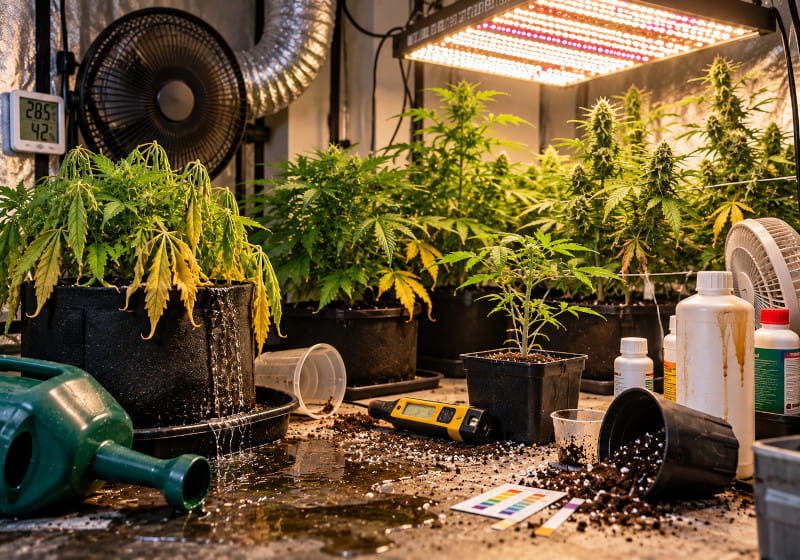
✓ Many problems during a first cannabis grow are not caused by too little care, but by intervening too often or too quickly.
✓ Rigid watering, feeding, or weekly schedules only work to a limited extent. What a plant needs depends, among other things, on its stage of development, substrate, pot size, and climate.
✓ A visible symptom is not yet a diagnosis. Yellow or drooping leaves can have different causes – so more water or fertilizer is not automatically the right solution.
✓ When problems occur, a systematic approach makes sense: observe, narrow down the cause, change one variable, and wait for the reaction. Making several corrections at the same time makes it harder to identify the cause.
✓ Mistakes can also occur during harvest and drying. Breeder information is not a fixed harvest date, and drying too quickly can impair quality.
During a first cannabis grow, the temptation to react immediately to every change is strong. A leaf droops, so the plant gets watered. A leaf tip changes color, so more fertilizer is added to the water. The plant grows more slowly than expected, so light, climate, and pH are all changed at the same time. This can quickly turn a small problem into a confusing one.
Many common beginner mistakes when growing cannabis therefore have a similar cause: intervention happens too early, too much is changed, or a rigid routine is followed even though plants, substrates, and growing conditions react differently. Good plant care does not mean changing as much as possible. It is more important to observe development, understand relationships, and make targeted adjustments.
Are you planning your first grow and looking for a complete introduction first? Then start with our guide Growing Cannabis Without Experience. This article, by contrast, focuses on which growing mistakes occur particularly often, why they can become problematic, and how they can be avoided.
Why Are Mistakes So Common During a First Cannabis Grow?
Anyone with little experience has to assess many things at the same time: moisture in the substrate, growth, leaf color, light, temperature, humidity, nutrient supply, and later the right time for flowering and harvest. At the same time, forums, videos, feeding schedules, and grow guides contain very different recommendations.
The problem is therefore often not a lack of information, but too much information without clear priorities. A value is taken out of context, a recommendation from another growing system is adopted, or a single symptom is treated immediately. Yet many factors are interconnected: a substrate that remains too wet, for example, can cause problems in the root zone whose visible symptoms are then mistakenly interpreted as a nutrient deficiency.
A more helpful basic approach is simple: Stability first, changes targeted and traceable. A grow does not have to be perfect. Especially at the beginning, it is more valuable to understand how the plant reacts to the specific conditions than to constantly chase a theoretical ideal value.
The Most Common Beginner Mistakes at a Glance
|
Beginner mistake |
Typical consequence |
Better approach |
|
Choosing a strain only by THC, name, or hype |
Genetics do not suit the available space, climate, or experience level |
Consider growth pattern, flowering time, seed type, and conditions |
|
Making the grow unnecessarily complicated |
Many potential sources of error and processes that are difficult to trace |
Choose a simple, stable setup |
|
Keeping germination too wet or constantly intervening |
Seedling and young root are unnecessarily stressed |
Maintain consistent conditions and intervene as little as possible |
|
Treating seedlings like mature plants |
Too much water, fertilizer, or stress |
Take the plant's stage of development into account |
|
Watering according to a calendar |
Substrate that is too wet or too dry |
Assess the plant's actual water requirements |
|
Equating more fertilizer with more growth |
Overfeeding and additional symptoms |
Consider demand, growing medium, and stage of development |
|
Treating yellow leaves immediately as a deficiency |
Incorrect diagnosis and unnecessary corrections |
Assess symptoms in context |
|
Changing several conditions at the same time |
Cause and effect become unclear |
Change one variable at a time |
|
Judging light only by wattage or intuition |
Too much or too little light |
Consider area, growth stage, and actual light levels |
|
Considering temperature and humidity separately |
Climate is assessed incorrectly |
Understand their interaction and VPD |
|
Underestimating exhaust ventilation and air movement |
Trapped heat and humidity |
Plan for air exchange and gentle circulation |
|
Planning for stretch too late |
Insufficient vertical space during flowering |
Consider genetics and available space early |
|
Deriving the harvest date from the calendar |
Harvesting too early or too late |
Assess the plant's actual maturity |
|
Rushing drying and curing |
Loss of quality after harvest |
Dry in a controlled manner and give the curing process time |
1. Choosing the Wrong Cannabis Strain
A common mistake begins even before germination: a strain is selected mainly because of a high THC level, a well-known name, striking images, or current trends. For practical cultivation, however, other characteristics are at least as important.
The key question is whether the genetics suit the available space, the planned growing method, and the climate. Strains that stretch heavily or flower for a very long time can quickly become a problem in a low grow tent. Outdoors, regional conditions and the expected maturation time play an important role. The choice between photoperiod and autoflowering strains also affects the course of the grow.
When choosing Cannabis Seeds, you should therefore not decide on the basis of a single characteristic. Experience, available space, growth habit, flowering time, indoor or outdoor suitability, and seed type together provide a much more useful selection profile.
2. Making the First Grow Unnecessarily Complicated
More technology does not automatically mean more control. Especially during a first grow, too many devices, measurements, additives, training methods, and different genetics can cause the actual fundamentals to be overlooked.
A simple setup has one major advantage: changes are easier to understand. If several plants with very different growth patterns and nutrient requirements are cultivated at the same time while different methods are also being tested, the number of variables quickly increases. This makes it harder to understand why a plant develops in a particular way.
For beginners, a manageable system is usually more sensible. We explain in more detail which components are actually necessary and how they work together in our Cannabis Grow Setup for Beginners.
3. Keeping Cannabis Seeds Too Wet During Germination or Intervening Too Much
During germination, caution can quickly turn into overcaution. The medium is repeatedly moistened, the seed is constantly checked, or the young root is touched unnecessarily. Successful germination primarily requires suitable and, as far as possible, stable conditions.
Moisture is necessary, but the environment should not remain waterlogged. Temperatures that are too low or frequent handling can also make this sensitive start more difficult. The mistake is therefore not only “too much water,” but often also the attempt to constantly monitor or accelerate the natural process.
We cover the different germination methods, suitable conditions, and the subsequent planting of the germinated seed separately under Germinating Cannabis Seeds.
4. Treating Seedlings Like Mature Plants
A seedling has neither the root system nor the leaf mass of an established cannabis plant. Nevertheless, young plants are sometimes watered, fertilized, or trained according to the same principles used for plants in a later growth stage.
Large amounts of water can keep the still-small root zone wet for a long time. Heavily pre-fertilized conditions or additional fertilizer can also place unnecessary stress on young plants. Intensive training is usually not the primary goal at this early stage either. First, the plant should be allowed to develop and build a stable root system.
Our overview of the Growth Stages of Cannabis shows how requirements change during germination, the seedling stage, vegetative growth, and flowering.
5. Watering Cannabis on a Fixed Schedule
“I water every other day” sounds like a reliable routine. But that is precisely the mistake in thinking: a plant's water requirements do not follow a fixed schedule.
How quickly a pot loses water depends, among other things, on pot size, substrate, drainage, temperature, air movement, humidity, root mass, and stage of development. A small pot with a large plant can dry out much faster than a large pot with a young plant. Soil also behaves differently from coco or other growing media.
Instead of looking only at the calendar, the actual condition of the root zone should be assessed. Pot weight and substrate moisture provide much more information than a fixed watering interval. Drooping leaves alone are also not a clear signal, as both too little and too much water can be possible causes.
We explain in detail how to assess water requirements, pot weight, drainage, and overwatering in practice in Watering Cannabis Correctly.
6. Equating More Fertilizer With More Growth
Plants need nutrients – but this does not mean that additional nutrients automatically produce more growth. How many nutrients a plant can absorb and use depends, among other things, on its stage of development and the particular growing system.
It becomes particularly problematic when weaker growth or every leaf discoloration is treated by adding more fertilizer as a precaution. A plant may already be adequately supplied while the actual cause lies, for example, in the root zone, watering practices, or pH.
Feeding schedules are not universal instructions either. Soil, coco, and hydroponic systems are supplied differently, and fertilizer products and their concentrations also vary. You can find the basics of nutrients, dosage, growth stages, and different growing systems under Fertilizing Cannabis Correctly.
7. Treating Every Yellow Leaf Immediately as a Nutrient Deficiency
A yellow leaf is a symptom, but not yet a diagnosis. Nevertheless, leaf discoloration is often immediately interpreted as a nutrient deficiency and answered with additional fertilizer. This can make an existing problem worse if the actual cause is something else.
Leaf discoloration can occur in connection with watering, nutrient supply, pH, root problems, light, stage of development, or pests and diseases. The position of the affected leaves and the type of change are also important. A single yellow leaf therefore provides far less information than the overall condition of the plant.
Instead of following the formula “yellow = nitrogen = more fertilizer,” first check what has changed recently and which causes fit the observed pattern. A broader introduction to diagnosis can be found under Cannabis Plant Problems & Diseases and in the guide Recognizing Nutrient Deficiencies.
8. Changing Several Conditions at the Same Time
A plant suddenly looks worse. In response, watering is reduced, the amount of fertilizer is changed, the pH is corrected, the lamp is raised, and the temperature is lowered. A few days later, the plant looks better or worse – but it is almost impossible to tell which change was responsible.
Making several corrections at the same time makes it difficult to distinguish cause from effect. At the same time, the changes can trigger new reactions and thereby obscure the original problem. It is more useful to narrow down possible causes first and then change individual conditions in a targeted manner.
This does not mean remaining inactive when an acute problem requires immediate action. Changes should, however, be made for a reason and in a way that can be traced. If in doubt, document when you watered, fertilized, or changed a setting. Even simple notes can later help identify relationships and recurring patterns.
This way of thinking is more important than searching for a single perfect value. A stable setup with small, traceable adjustments usually provides more insight than constantly trying to optimize individual values.
9. Judging Cannabis Lighting Only by Wattage or Intuition
The wattage of a lamp alone does not tell you how much usable light actually reaches the plants. Likewise, a general recommended distance from the lamp is not a universal solution.
Important factors include the fixture, illuminated area, distance, light distribution, and the plants' stage of development. Young plants need different conditions from established flowering plants. At the same time, the same lamp can produce a very different light intensity over a small area than over a larger one.
For beginners, it is therefore important not to think of light simply as “strong” or “weak.” Lighting is part of the overall setup and should match the area and stage of plant development. We cover practical planning in the Grow Setup for Beginners.
10. Considering Temperature and Humidity Separately
“25 °C is perfect” is too simplistic as a standalone statement. Temperature and relative humidity jointly influence the conditions around the plant. In addition, leaf temperature can differ from the measured room temperature.
The same temperature can therefore create a different situation for the plant at different humidity levels. The concept of Vapor Pressure Deficit, or VPD, takes this interaction between temperature, humidity, and leaf temperature into account.
For beginners, this does not have to turn into a constant hunt for a decimal value. The first priority is to understand that climate consists of several interconnected variables. Our VPD Calculator and Guide shows how VPD is calculated and how it can be interpreted according to the plant's growth stage.
11. Underestimating Exhaust Ventilation and Air Movement
A grow tent needs more than light. Heat and humidity must be controlled, and the air around the plants should not remain stagnant. Exhaust ventilation and circulation fans perform different tasks.
Exhaust ventilation removes air from the growing space and helps regulate heat and humidity. Circulation, by contrast, moves air within the space and reduces stagnant, humid areas between leaves and flowers. A fan should not continuously subject the plants to a strong direct airflow.
Especially as the canopy becomes denser, the microclimate between leaves and shoots changes. Airflow should therefore be part of the plan from the beginning rather than being considered only after temperature or humidity has already caused problems.
12. Planning for Stretch and Plant Height Too Late
During the vegetative stage, a plant may still seem to fit the grow tent well. After the transition to flowering, however, it can gain considerable height. If the available space is only considered once the shoot tips are already close to the lamp, there is much less room to respond.
How much a plant stretches depends, among other things, on genetics, phenotype, plant condition, and growing conditions. That is exactly why a blanket figure is of little use. The important point is to factor possible height development into the plan before flowering begins.
Training can help control plant structure, but it should be carried out at the right time and in a way that suits the stage of development. We explain in detail what happens during flowering and why the transition phase matters under Cannabis Flowering Stage.
13. Reading the Harvest Date From the Calendar
Statements such as “8–9 weeks of flowering” are useful guidelines, but not guaranteed harvest dates. Plants do not develop at exactly the same speed under all conditions, and differences can also occur within the same strain.
The calendar therefore indicates when closer inspection may become worthwhile rather than specifying a day on which harvesting must take place. The overall appearance of the flowers should be considered when assessing maturity. Trichomes can provide important clues, but they are not an exact countdown either.
We explain how to assess plant maturity and the harvest window in our guide to the right harvest time. The structure, development, and color changes of glandular trichomes are explained separately in the article Trichomes on Cannabis.
14. Rushing Drying and Curing After Harvest
After weeks or months of cultivation, impatience is often greatest just before the finish line. This is precisely when flowers are sometimes dried as quickly as possible using additional heat or strong direct airflow. Faster, however, is not automatically better.
Drying is a controlled postharvest process. Too much heat and strong direct air movement can dry the outside of the flowers quickly while more moisture remains inside. Conversely, conditions that remain too humid are also problematic. A controlled environment rather than maximum speed is therefore crucial.
The process is not necessarily complete after drying itself. Subsequent curing or fermentation involves the controlled maturation and storage of the dried flowers. We explain how this process works and what to pay attention to in our detailed guide Curing Cannabis.
What Beginners Should Really Learn About Growing Cannabis
The most important progress in growing does not come from memorizing more and more individual values. It is much more important to understand what conclusions a particular observation actually allows.
A dry top layer of soil does not automatically mean that the entire pot is dry. A yellow leaf does not prove a nitrogen deficiency. A breeder's specification is not a fixed harvest date. A particular room temperature does not tell you everything about the climate without humidity. And if a plant looks better after five simultaneous changes, it is almost impossible to determine which one actually helped.
That is exactly why observing, narrowing down the cause, and responding in a targeted way is the more useful learning strategy. Anyone who documents changes and gives the plant time to react gains more personal experience with every grow. A Cannabis Grow Calendar can help put the timing of the grow into perspective – but it should be understood as a guide rather than a rigid script.
Frequently Asked Questions About Beginner Mistakes When Growing Cannabis
Q: What is the most common mistake when growing cannabis?
A: There is no single most common mistake for every setup. Typical problems, however, arise from rigid watering routines, excessive fertilization, and hasty reactions to individual symptoms. What many of these mistakes have in common is that action is taken before the possible cause has been narrowed down sufficiently.
Q: Can you overwater cannabis?
A: Yes. If the substrate is kept permanently too wet, oxygen availability in the root zone can be impaired. How quickly a pot needs water again depends, among other things, on pot size, substrate, plant size, and climate. A fixed watering rhythm is therefore not a universal solution.
Q: Why do cannabis leaves turn yellow?
A: Yellow leaves can have different causes. These include nutrient supply, watering, pH, root problems, light, stage of development, as well as pests or diseases. The overall pattern of symptoms is therefore what matters, not the color of a single leaf alone.
Q: Can cannabis be overfertilized?
A: Yes. More nutrients do not automatically lead to more growth. Actual demand depends, among other things, on the stage of development, substrate, and growing system. Especially with young plants or already pre-fertilized substrates, additional fertilizer is not automatically beneficial.
Q: Which cannabis strain is suitable for beginners?
A: That depends on the specific conditions. A suitable strain should match the available space, the indoor or outdoor setup, the climate, and the desired seed type. A high THC level or a well-known strain name, by contrast, says little about how well the genetics suit the specific setup.
Q: When is cannabis really ready to harvest?
A: Breeder flowering-time information serves as a guideline, but it is not a fixed harvest date. The actual development of the flowers and several signs of maturity should be considered when making an assessment. Trichomes also provide important clues, but they should not be reduced to a rigid percentage rule.
Q: Should you change several things at once when a plant has a problem?
A: If there is no acute situation requiring immediate intervention, it is usually more useful to narrow down possible causes first and make targeted changes. If water, fertilizer, light, and climate are all changed at the same time, it becomes almost impossible to determine later which measure actually helped or made the problem worse.
Scientific Sources and Further Information
Many common beginner mistakes are easier to understand when individual topics are examined more closely. Questions about germination, watering, fertilization, plant problems, climate, flowering, harvest, trichomes, and curing are therefore covered in greater detail in the respective linked Cannapot specialist articles. In addition, scientific publications on cannabis cultivation and postharvest processes were consulted for this guide. Results from individual studies should always be considered in the context of genetics, stage of development, growing system, and the specific experimental conditions.
• Rodriguez-Morrison, V., Llewellyn, D. & Zheng, Y. (2021): Cannabis Yield, Potency, and Leaf Photosynthesis Respond Differently to Increasing Light Levels in an Indoor Environment. Frontiers in Plant Science, 12:646020.
• Baek, Y., Grab, H. & Chen, C. (2025): Postharvest Drying and Curing Affect Cannabinoid Contents and Microbial Levels in Industrial Hemp (Cannabis sativa L.). Plants, 14(3):414.
• Das, P. C., Vista, A. R., Tabil, L. G. & Baik, O.-D. (2022): Postharvest Operations of Cannabis and Their Effect on Cannabinoid Content: A Review. Bioengineering, 9(8):364.