Cannabis Consumption Methods: Effects & Risks
Cannabis Consumption Methods Compared: Smoking, Vaping, Edibles and Oils
Key Takeaways
✓ The different ways of using cannabis differ primarily in how cannabinoids enter the body and how the product is administered. When cannabis is smoked or vaporized, cannabinoids are absorbed through the lungs; with edibles and swallowed oils, they enter the body through the digestive tract. Cannabis flower, hashish, rosin and cannabis oil, by contrast, describe different product types rather than routes of administration.
✓ When cannabis is smoked or vaporized, the effects of THC usually begin within seconds to minutes. Noticeable effects often last around two to four hours. However, individual differences, the amount consumed and the product used can substantially affect their duration.
✓ Cannabis edibles, beverages and swallowed cannabis oils have a delayed onset. Initial THC effects often appear after approximately 30 minutes to two hours, while peak effects may occur considerably later. Effects frequently last four to eight hours or longer, increasing the risk of unintentionally consuming too much.
✓ Smoking cannabis produces harmful substances through combustion, which can particularly affect the respiratory tract. When used as intended, vaporizers avoid directly burning plant material, but they are not risk-free. Contaminated concentrates, unsuitable liquids and problematic devices can pose additional health risks.
✓ Depending on their use, cannabis oils, tinctures and certain mouth sprays may be absorbed partly through the oral mucosa or, after swallowing, through the digestive tract. The actual absorption route depends on the formulation and how the product is used. Onset and duration therefore cannot be assumed to be the same for all cannabis oils.
✓ Cannabis creams and other products applied to the skin do not automatically produce effects throughout the body. Ordinary topical creams differ from specially developed transdermal medicines intended to carry active ingredients through the skin into the bloodstream. For many over-the-counter cannabis skin products, robust scientific evidence of cannabinoid absorption and medical effectiveness is lacking.
Whether a joint, vaporizer, cannabis edible or cannabis oil: Different methods of cannabis use vary considerably in onset, duration, route of administration and health risks. When cannabis is smoked or vaporized, cannabinoids enter the body through the lungs; with edible cannabis products, they are absorbed through the digestive tract. Oils and certain mouth sprays can involve different absorption routes depending on how they are used. But which differences are scientifically established, what risks exist, and what roles do THC and CBD play? This comparison explains the main methods of cannabis use, puts their characteristics into context and shows why product type should not be confused with route of administration.
What Are the Different Ways of Using Cannabis?
Methods of cannabis use describe the different ways cannabinoids such as THC and CBD enter the body. It is essential to distinguish between the product itself, how it is used and the actual route by which its active ingredients are absorbed.
Cannabis can be used in several ways: by smoking, vaporizing, eating, drinking or using certain oils and mouth sprays. The route of administration affects how quickly cannabinoids enter the bloodstream, when their effects begin and how long they may last. Inhaled cannabinoids are absorbed primarily through the lungs, whereas edibles are absorbed through the digestive tract. Certain medicines can also be absorbed partly through the lining of the mouth. These differences are particularly relevant to THC's effects.
The various cannabis product types must be distinguished from the methods of use themselves. Cannabis flower consists of dried plant material, while hashish is made mainly from collected resin glands or their components. Rosin is a cannabis extract produced using pressure and heat without additional solvents. These products can have different cannabinoid concentrations, but they do not automatically determine the route of administration. You can find more information in our article on how hashish is made.
Furthermore, cannabis oil is not a uniformly defined product category. The term may refer to THC-containing extracts in carrier oils, CBD oils or pharmaceutical cannabis medicines. Hemp seed oil, extracted from hemp seeds, is different and normally contains no appreciable quantities of THC or CBD. A meaningful assessment therefore always depends on the ingredients, their concentrations, product quality and intended use.
Smoking Cannabis: Joints, Pipes and Bongs
When cannabis is smoked, THC and other compounds are absorbed through the inhaled smoke and the lungs. Effects generally begin within seconds to minutes, but combustion produces harmful substances that can particularly affect the respiratory tract.
Among the best-known ways of consuming cannabis are joints, pipes and bongs. All three involve burning cannabis flower or another cannabis product intended for smoking. THC in the inhaled smoke rapidly enters the bloodstream through the air sacs in the lungs and subsequently reaches the brain. Effects often begin within minutes, peak relatively quickly and generally subside much sooner than those of orally ingested THC. Their intensity depends on factors such as THC content, the amount absorbed and individual sensitivity.
The greatest health concern associated with smoking is the combustion of plant material. Cannabis smoke contains particulate matter, carbon monoxide and numerous other irritating or potentially harmful substances. Regular smoking is associated with chronic coughing, increased mucus production and bronchitis-like symptoms. Mixing cannabis with tobacco adds the known health risks of tobacco smoke and nicotine dependence. A bong does not make smoke harmless either: water may trap some components or cool the smoke, but it does not remove all pollutants.
High THC concentrations, low individual tolerance and simultaneous alcohol consumption can increase the likelihood of unwanted reactions such as anxiety, dizziness, a racing heart or circulatory problems. Attention, coordination and reaction time may also be impaired.
Vaporizing Cannabis: Vaporizers and Inhalation
Vaporizing involves heating cannabis in a suitable vaporizer without intentionally burning the plant material. This can avoid or reduce certain combustion by-products. However, inhaling the resulting aerosol is not harmless and can still pose health risks.
A dry-herb vaporizer heats cannabis flower so that cannabinoids and other volatile compounds enter an inhalable aerosol. Because absorption also takes place through the lungs, THC effects can begin as quickly as with smoking. The main differences concern how inhaled substances are generated and what they contain. The amounts released depend on the device, its temperature control, and the quality and chemical composition of the plant material.
It is important to distinguish between dry-herb vaporizers and vape pens for cannabis extracts or liquids. The latter may contain highly concentrated cannabinoids, carrier substances, flavorings or other additives. Contaminants, unsuitable ingredients and technical defects can create additional health risks. The 2019 EVALI outbreak in the United States, involving severe lung injuries, was linked predominantly to certain THC-containing vaping products, particularly those containing vitamin E acetate. However, these events cannot simply be generalized to all vaporizers or vaporization methods.
Vaporizing should not be equated with healthy or risk-free cannabis use. The long-term health effects of different devices and aerosols remain insufficiently studied. High doses of THC remain risky even without combustion.
Eating and Drinking Cannabis: Edibles and Beverages
Cannabis edibles are foods and drinks containing added cannabinoids such as THC or CBD. Unlike smoking or vaporizing, absorption takes place primarily through the digestive tract. THC effects therefore usually begin later and can last considerably longer.
Common edibles include cannabis brownies, cookies, gummies, chocolate and cannabis-infused drinks. Capsules containing cannabis extracts are also taken orally but are not considered conventional foods in the strict sense. After swallowing, cannabinoids first enter the gastrointestinal tract and are then partly metabolized by the liver. With THC, this process produces the psychoactive metabolite 11-hydroxy-THC, among other substances. This metabolism helps explain why the timing and perceived effects of edibles can differ substantially from inhaled THC.
Delayed onset is one of the most important risks of THC-containing edibles. Initial effects often occur after around 30 minutes to two hours, while peak effects may not be reached for several hours. Misjudging an apparent lack of effects can lead to unintentionally consuming too much THC. Possible consequences include severe anxiety, panic, confusion, rapid heartbeat, nausea and significant circulatory problems. Children are particularly vulnerable if cannabis-infused sweets are mistaken for ordinary food and accidentally eaten.
Because edibles do not involve inhaling smoke, the respiratory tract is not directly exposed to combustion by-products. Nevertheless, edible cannabis products are not necessarily safer than other methods of use. Their often longer duration, variable absorption and possible differences between labeled and actual THC content make their effects harder to predict. The composition of the food, stomach contents and individual metabolic differences can also affect onset.
Cannabis Oils, Drops and Mouth Sprays
Cannabis oils, drops and mouth sprays differ in formulation, use and absorption. Swallowed cannabis oils are absorbed primarily through the digestive tract, whereas specially formulated mouth sprays and tinctures may deliver some cannabinoids through the oral mucosa. The route of administration particularly influences the onset and duration of THC effects.
Cannabis oils and capsules taken orally are absorbed through the gastrointestinal tract much like edibles. Their cannabinoids enter the body through the intestinal lining and partly undergo first-pass metabolism in the liver. With THC, this route frequently produces a later onset and longer duration than smoking or vaporizing. Actual absorption can vary considerably, influenced by oil composition, food consumed at the same time and individual metabolic differences. Cannabis oil therefore does not automatically work faster or more reliably than other orally consumed cannabis products.
With sublingual and oromucosal cannabis preparations, cannabinoids can enter the body by different routes. Specially developed mouth sprays and tinctures may deliver some cannabinoids through the mucous membranes under the tongue or inside the mouth. Another portion is swallowed with saliva and then absorbed through the digestive tract. How much of the active ingredient actually reaches the bloodstream through the oral mucosa depends particularly on the formulation, cannabinoid solubility and intended method of use. The widespread claim that every cannabis oil placed under the tongue works within minutes is not sufficiently supported by scientific evidence.
A clear distinction must be made between THC oils, CBD oils and standardized cannabis medicines. THC can produce psychoactive effects, whereas CBD does not cause the typical intoxication associated with THC. Products also differ in cannabinoid content, manufacturing, quality control and legal classification. Not every commercially available cannabis oil is suitable for medical purposes, and not every oil-based preparation is designed for absorption through the oral mucosa.
Anyone interested in learning more about different cannabis oils can find further information in our Canna Wiki about CBD and its effects, how CBD oil is made and the basics of making THC oil.
Cannabis on the Skin: Creams and Transdermal Products
Cannabis creams, CBD ointments and other skin products are applied externally and differ substantially from inhaled or orally ingested cannabis products. Ordinary topical preparations are mainly intended for local application on or within the skin, whereas specially developed transdermal systems aim to transport cannabinoids through the skin into the bloodstream.
Common externally applied cannabis products include CBD creams, cannabis ointments, lotions, skincare balms and cannabinoid-containing skin gels. Depending on the product, they contain different concentrations of CBD, other cannabinoids, plant extracts and skincare ingredients. They are applied directly to the skin, where active compounds must first cross the outer skin barrier to reach deeper layers. Whether and to what extent this happens depends on the chemical properties of the cannabinoids, their concentration, the carrier ingredients and the condition of the skin. Topical application therefore does not automatically mean that meaningful amounts of cannabinoids enter the bloodstream.
The medical effectiveness of many commercially available cannabis and CBD skin products has not yet been adequately demonstrated scientifically. Researchers are investigating potential anti-inflammatory, pain-relieving and skin-related properties of various cannabinoids, but much of the evidence still comes from laboratory experiments, animal models or small clinical studies. Such findings cannot simply be applied to ordinary cannabis creams. For many products, high-quality studies are lacking to establish actual absorption, appropriate uses and long-term safety. Claims of proven therapeutic effects should therefore be viewed critically.
A separate category comprises transdermal cannabis products and cannabinoid-containing drug patches. Unlike ordinary skin creams, these are designed to deliver certain active ingredients in a controlled manner through several skin layers into the systemic bloodstream. This may require special carrier systems, penetration enhancers or other pharmaceutical technologies. Developing such products is challenging because cannabinoids have physicochemical properties that limit their ability to cross the skin barrier. Transdermal cannabis products should therefore not be equated with ordinary CBD creams. Moreover, the label “transdermal” alone does not prove that sufficient absorption or medical effectiveness has been demonstrated in clinical studies.
Applying cannabis products to the skin can also cause side effects such as redness, itching, skin irritation or allergic contact reactions. These symptoms may be caused by cannabinoids, fragrances, preservatives or other formulation ingredients. Ordinary topical cannabis creams are generally not expected to produce enough systemic THC absorption to cause intoxication. The situation may differ with specially developed transdermal preparations. It is therefore not possible to give uniform onset or duration figures for cannabis skin products, because local and systemic applications have different aims and the available scientific evidence varies substantially between products.
Cannabis Consumption Methods: A Direct Comparison
The different methods of using cannabis vary particularly in onset, duration, route of administration and health risks. Inhaled THC usually takes effect within minutes, while edibles and swallowed cannabis oils have a substantially delayed onset and can last much longer. The following table compares the key differences.
The time ranges shown are based on scientific findings and consumer and professional information from Health Canada. They refer mainly to THC-containing cannabis products and are intended as typical guidelines. It is also important to distinguish between onset, peak intensity, perceived duration and actual impairment.
| Method of cannabis use | Route of administration | Typical onset | Common duration of noticeable effects | Specific risks |
|---|---|---|---|---|
| Joints, pipes and bongs | Lungs, through cannabis smoke | Seconds to a few minutes | Usually around 2–4 hours | Combustion by-products, respiratory irritation and potentially additional tobacco and nicotine risks |
| Dry-herb vaporizers | Lungs, through inhaled aerosol | Seconds to a few minutes | Usually around 2–4 hours | Aerosol exposure, possible release of harmful substances, device and material quality, uncertain long-term effects |
| Edibles and cannabis beverages | Gastrointestinal tract, followed in part by liver metabolism | Often around 30 minutes to 2 hours | Often 4–8 hours, sometimes up to 12 hours or longer | Delayed peak effects, unintentionally high THC intake, risk of accidental consumption by children |
| Swallowed cannabis oils and capsules | Gastrointestinal tract, followed in part by liver metabolism | Often around 30 minutes to 2 hours | Often 4–8 hours, sometimes longer | Variable absorption, delayed effects, possible interactions with medicines |
| Sublingual and oromucosal preparations | Partly oral mucosa, partly gastrointestinal tract | Highly product-dependent; initial effects may occur within approximately 15–40 minutes with certain medicines | Highly product-dependent; several hours are possible | Different absorption routes, partly swallowed active ingredients, possible irritation of the oral mucosa |
| Cannabis creams and CBD ointments | Skin, mainly local application | No generally reliable time estimate | No generally reliable time estimate | Skin irritation, contact allergies, limited clinical evidence of effectiveness |
| Transdermal cannabis products | Through the skin into the bloodstream, if appropriately formulated | No generally applicable estimate; depends on the system | Depends on formulation and drug release | Insufficiently studied absorption for many products, possible skin reactions and systemic side effects |
Why Does Cannabis Take Effect at Different Speeds Depending on How It Is Used?
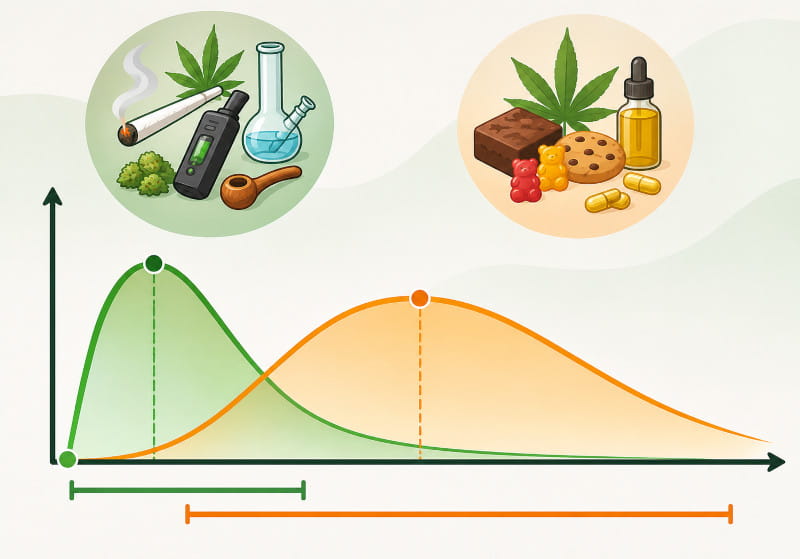
How quickly cannabis takes effect depends largely on how THC and other cannabinoids enter the body. The route of administration determines how rapidly active ingredients reach the bloodstream, which metabolic processes they undergo and how long their effects may last. Cannabis products with the same THC content can therefore produce substantially different patterns of effects.
When cannabis is inhaled by smoking or vaporizing, cannabinoids rapidly enter the bloodstream through the air sacs in the lungs and then reach the brain. Initial THC effects may occur within seconds to minutes. Blood concentrations rise relatively quickly and then begin to decline. However, the fading of the feeling of intoxication does not mean that reaction time, concentration or driving ability have fully recovered.
When cannabis edibles, beverages or swallowed oils are taken orally, absorption takes place mainly through the gastrointestinal tract. Gastric emptying, food composition, product formulation and individual metabolism all influence how quickly THC reaches the bloodstream. Some of the active ingredient is metabolized during absorption and its first passage through the liver. Effects therefore usually begin later, often peak only after several hours and can last substantially longer than with inhaled THC. This makes the onset of effects harder to predict.
With sublingual and oromucosal cannabis preparations, two routes of absorption may be involved simultaneously. With an appropriate formulation, some cannabinoids pass directly through the oral mucosa into the bloodstream, initially bypassing liver metabolism. Other portions are swallowed with saliva and absorbed through the digestive tract. The relative contribution of these pathways depends on the product. Cannabis oils, drops and mouth sprays therefore cannot all be assigned the same onset time.
In addition to the route of administration, active-ingredient concentration, individual sensitivity and interactions influence the course of effects. The time ranges mentioned refer primarily to THC, not CBD.
Bioavailability and the First-Pass Effect Explained
Bioavailability describes the proportion of an administered substance that reaches the systemic bloodstream unchanged. The first-pass effect is the metabolic process by which some of a substance is transformed in the intestinal wall and particularly the liver before reaching the systemic circulation. Both factors substantially influence how much THC or CBD is actually available to the body.
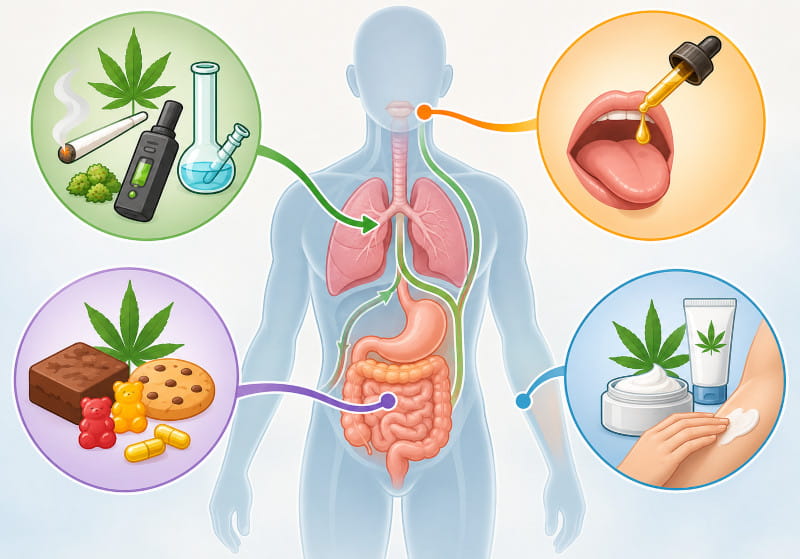
The bioavailability of THC and CBD varies considerably depending on how cannabis is used. When smoked or vaporized, cannabinoids pass through the lungs directly into the bloodstream, initially bypassing the first-pass effect. Swallowed cannabis products must first pass through the digestive tract. Some active ingredients are metabolized in the intestinal wall and during their subsequent passage through the liver. As a result, oral administration often delivers only a relatively small and highly variable proportion of the original THC to the systemic bloodstream unchanged.
A particularly relevant process is the conversion of THC into 11-hydroxy-THC (11-OH-THC). This metabolite is produced, among other processes, when THC is broken down in the liver and is itself psychoactive. With orally ingested THC, 11-hydroxy-THC can play a greater role relative to unchanged THC than after inhalation. This contributes to differences in the course of effects. The same number of milligrams of THC therefore does not automatically produce the same exposure or psychoactive effect. Metabolism also affects CBD bioavailability, although CBD's pharmacological properties differ substantially from those of THC.
Bioavailability is not a fixed property of a cannabis strain. It varies with factors such as product formulation, food consumed at the same time and individual metabolism. With inhalation, the device and inhalation behavior also affect the amount absorbed.
The following table compares the main routes of administration and shows how the first-pass effect differs between methods of cannabis use. General percentage figures for bioavailability have deliberately been omitted, because study results and measurements cannot reliably be generalized to every product, device and method of use.
| Route of administration | First-pass effect | Characteristics of absorption | Important limitations |
|---|---|---|---|
| Inhalation through the lungs Joints, bongs, pipes, vaporizers |
Largely bypassed during initial absorption | Rapid transfer of cannabinoids into the bloodstream through the lung's air sacs; rapid increase in THC concentration | Bioavailability depends on the device, product quality and inhalation behavior; possible exposure to smoke or aerosols |
| Oral absorption through the digestive tract Edibles, beverages, swallowed oils and capsules |
Can be substantial; metabolism in the intestinal wall and liver | Delayed and variable absorption; THC produces the psychoactive metabolite 11-hydroxy-THC | Strong influence of food, formulation and individual metabolism; delayed peak effects |
| Sublingual and oromucosal absorption Suitable mouth sprays and tinctures |
Initially bypassed with direct mucosal absorption; present for swallowed portions | Potential combination of direct absorption through the oral mucosa and subsequent absorption through the intestine | Relative contribution of each route strongly depends on the product; not every cannabis oil is significantly absorbed through the mucosa |
| Topical application to the skin CBD creams, cannabis ointments and lotions |
Generally not meaningfully comparable in terms of systemic bioavailability when used mainly locally | Primarily local application; penetration into deeper skin layers depends on the active ingredient and formulation | Systemic absorption often insufficiently established; limited clinical evidence for many products |
| Targeted transdermal absorption Specially developed drug patches and systems |
Initially bypassed if systemic absorption through the skin is successful | Intended controlled release and absorption through the skin; specialized pharmaceutical formulations required | Absorption and effectiveness must be demonstrated for each product; not equivalent to ordinary cannabis creams |
What Roles Do THC and CBD Play in Different Methods of Cannabis Use?
THC and CBD are among the best-known cannabinoids in the cannabis plant, but their effects and health risks differ substantially. THC is responsible for the typical intoxicating effects of cannabis, whereas CBD does not produce comparable intoxication. The route of administration influences the bioavailability and timing of both cannabinoids, but their pharmacological properties must not be treated as equivalent.
THC (tetrahydrocannabinol) is the main psychoactive compound in cannabis. Among other actions, it affects the body's endocannabinoid system and can alter perception, mood, memory, concentration and reaction time. The intensity of these effects depends not only on THC content but also on the method of use, the amount actually absorbed, individual sensitivity and previous experience with cannabis. A high THC concentration does not automatically mean equally strong effects across different routes of administration.
CBD (cannabidiol) has different pharmacological properties from THC and normally does not produce the typical cannabis high. However, CBD is not necessarily free of side effects. Depending on the amount taken and individual sensitivity, possible effects include fatigue, gastrointestinal symptoms and changes in certain liver test results. Particularly important are potential interactions between CBD and medicines, because CBD can affect the metabolism of various drugs. The appropriate CBD dosage also cannot be determined simply from the route of administration.
In addition to THC and CBD, cannabis contains numerous other cannabinoids and their naturally occurring precursors. These include THCA (tetrahydrocannabinolic acid) and CBDA (cannabidiolic acid), which may occur in fresh or unheated plant material. Heating can partially convert these compounds into THC and CBD through decarboxylation. THCA does not have the same typical intoxicating effects as THC. The amounts present in a cannabis product depend on its processing, storage and composition. The labels cannabis oil, cannabis extract or cannabis flower therefore do not reliably indicate a product's psychoactive effects.
The composition and relative proportions of cannabinoids can vary considerably between cannabis strains. Anyone wishing to explore the genetic diversity of cannabis can find a wide selection of strains, with information about their genetics and characteristics, in the Cannapot Seedshop.
Findings from THC studies cannot automatically be applied to CBD, THCA or other cannabinoids.
How Do Health Risks Differ Between Cannabis Consumption Methods?
No method of cannabis use is completely free from health risks. Smoking primarily involves exposure to combustion by-products and respiratory harm, while vaporizing carries potential aerosol- and product-related risks. Edibles and swallowed cannabis oils pose particular dangers because THC effects begin later and last longer. In addition, psychoactive cannabinoids carry general risks regardless of how they enter the body.
Smoking and respiratory health: Regular cannabis smoking can contribute to coughing, mucus production and bronchitis-like symptoms. Tobacco adds nicotine exposure and additional smoke-related risks; second-hand smoke must also be considered.
Vaporizing, vape pens and cannabis extracts: With vape pens and concentrates, unsuitable additives, contamination and technical defects can create additional risks. Highly concentrated extracts also increase the likelihood of intense THC effects. Reliable long-term data on different vaporization methods remain limited.
Edibles, beverages and orally consumed cannabis products: Unintentionally consuming too much THC can cause severe anxiety, confusion, rapid heartbeat or circulatory symptoms. Cannabis-infused sweets also pose a particular risk of being mistaken for ordinary food by children. THC-containing products must therefore be stored securely and out of children's reach. If a child accidentally consumes cannabis or severe symptoms occur, seek medical help immediately.
Mental and physical risks associated with THC: High amounts of THC can intensify psychological and physical symptoms. In susceptible individuals, cannabis use can increase the risk of psychotic symptoms. Regular or intensive use can also contribute to the development of cannabis use disorder, including symptoms of dependence. Particular caution is warranted for adolescents, people with certain pre-existing mental health conditions and those with cardiovascular disease. Cannabis should be avoided during pregnancy and breastfeeding because of potential risks to the child.
Interactions with medicines and other substances: CBD can inhibit the metabolism of certain medicines; THC may cause additional cardiovascular and attention-related effects. Combining cannabis with alcohol can increase impairment and the likelihood of adverse reactions. Medical advice is especially important for people with existing illnesses or those taking medication regularly.
Cannabis and driving: THC can impair reaction time, attention, coordination and the ability to participate safely in road traffic. Impairment may persist even after the subjective effects have faded. General estimates of effect duration cannot be used to establish a reliable or legally safe waiting period before driving. Laws and legal limits also differ between countries.
What Matters When Cannabis Is Used Medically?
With medical cannabis, the exact active-ingredient composition, pharmaceutical quality, dosage form and medically prescribed use are crucial. Not every method of cannabis use is equally suitable for medical purposes, and findings about commercially available cannabis products cannot automatically be applied to approved or prescribed cannabis medicines.
Medical cannabis products can differ substantially in their THC and CBD concentrations, release characteristics, bioavailability and quality control. Depending on the country and medical indication, options may include standardized cannabis extracts, capsules, oils, oromucosal sprays or cannabis flower. Certain medicines are supported by clinical trials and defined quality standards, while evidence for other applications remains limited. A prescription does not automatically mean that effectiveness is equally well established for every condition.
The route of administration also affects the onset and duration of medical cannabis effects. However, the medically appropriate route depends not only on speed but also on the treatment goal, individual tolerability, possible side effects and existing health conditions.
With THC-containing medicines, potential benefits must be weighed against side effects such as dizziness, fatigue and difficulty concentrating. CBD preparations have a different profile of effects and interactions.
Medical cannabis use should therefore always be considered in the context of a specific course of medical treatment. The choice of product, route of administration and method of use depends on the individual medical situation and available scientific evidence. This general comparison does not provide an individual treatment recommendation or identify a preferred dosage form for particular illnesses.
Common Misconceptions About Ways of Using Cannabis
Many misconceptions persist about the different methods of cannabis use. Terms such as “natural”, “smoke-free” or “fast-acting” are particularly often mistaken for indications of lower health risks. In reality, effects and risks depend on cannabinoid content, product quality, route of administration and individual factors.
“Vaporizers are healthy and completely harmless”: This claim is false. Vaporizing can avoid or reduce certain pollutants produced by combustion. Nevertheless, inhaled aerosols can affect the respiratory tract. Device quality, possible contamination and cannabis product composition also play important roles. Fewer combustion by-products do not automatically mean that a product is harmless.
“Cannabis edibles are always safer than smoking”: Although edible cannabis products avoid direct exposure to smoke, they have a different risk profile. With THC-containing edibles in particular, effects may begin later, peak several hours after ingestion and last substantially longer than with inhaled cannabis. This increases the risk of unintentionally consuming too much THC. Intense psychoactive effects, anxiety and circulatory symptoms are also possible.
“Cannabis oil always works immediately under the tongue”: Not every cannabis oil is designed for absorption through the oral mucosa. With many oil-based preparations, a substantial portion of the cannabinoids is swallowed with saliva and then absorbed through the digestive tract. Onset therefore depends on the particular formulation, active ingredient and actual absorption route. General promises of immediate effects are not scientifically justified.
“A bong filters all harmful substances out of cannabis smoke”: Bong water may cool smoke and retain certain components, but it does not remove all harmful combustion products. Irritating and potentially harmful substances still enter the respiratory tract when smoking through a water pipe. A bong therefore does not make cannabis smoke free from pollutants.
“CBD is natural and therefore always free of side effects”: CBD normally does not produce intoxication comparable to THC, but it can cause adverse effects. Examples include fatigue, gastrointestinal complaints and, with certain uses, changes in liver test results. Interactions with medicines are also possible. A substance's plant origin is not proof of its safety.
“Longer-lasting effects automatically mean greater medical benefits”: This assumption is also incorrect. Duration alone says nothing about whether a cannabis product is suitable for a particular medical use. Relevant factors include the active ingredient, available scientific evidence, tolerability and individual treatment goals. Prolonged THC effects may even be undesirable in some circumstances, for example when concentration or reaction time remains impaired.
“Natural” and “smoke-free” are not guarantees of safety or medical benefit.
What Should Be Considered When Evaluating a Method of Cannabis Use?
Evaluating a method of cannabis use requires careful consideration of the active ingredient, product quality, health risks and individual circumstances. There is no single best or safest method for everyone.
Product type and route of administration should be assessed separately. Even within one product category, active-ingredient content, quality and use can vary substantially.
Another essential distinction is the difference between THC and CBD: the two cannabinoids have different effects and risk profiles.
Anyone researching methods of cannabis use should look for traceable scientific sources, a clear distinction between cannabinoids and a realistic presentation of possible risks. Related topics such as cannabis edibles, CBD administration, the general effects of cannabis or comparisons between joints and vaporizers can offer further insights. This overview explains the fundamental differences between absorption routes without recommending a particular method of use.
Which Scientific Sources Were Used?
The information on methods of cannabis use, onset, duration, bioavailability and health risks is based on publications by public health authorities and specialist pharmacological sources. Particular attention is given to the different routes of administration of THC and CBD and to the limits of scientific claims about specific products and methods of use.
The health information used comes from organizations including Health Canada, the CDC and CAMH. All time ranges are general guidelines, not individual predictions.
The following sources provide scientific context for the various methods of cannabis use. Alongside information from public health authorities, pharmacological publications examine, in particular, the bioavailability of THC and CBD, the first-pass effect, the formation of 11-hydroxy-THC and cannabinoid absorption through the skin. These publications allow readers to explore the relationships discussed in greater depth and are neither a recommendation to use cannabis nor individual medical advice.
- Health Canada: Consumer Information – Cannabis – General consumer information on cannabis, health risks and different methods of use.
- Health Canada: Using a Cannabis Product – Information on routes of administration, onset and characteristics of different cannabis products.
- Health Canada: What You Need to Know if You Choose to Consume Cannabis – Guidance on methods of use, duration of effects and potential health risks.
- Health Canada: Information for Health Care Professionals – Cannabis and Cannabinoids – Comprehensive pharmacological information on THC, CBD, bioavailability, metabolism, the first-pass effect and medical applications.
- CDC: Cannabis – Frequently Asked Questions – Answers to common questions about cannabis and its health effects.
- CDC: Cannabis and Poisoning – Information about cannabis poisoning, unintentional THC exposure and particular risks to children.
- CDC: About Cannabis – Basic information about cannabis, cannabinoids and different methods of use.
- Health Canada: Health Effects of Cannabis – Overview of short- and long-term health effects of cannabis use.
- CAMH: Cannabis – Do You Know – Evidence-based information about cannabis effects, consumption patterns and health risks.
- Millar SA et al. (2018): A Systematic Review on the Pharmacokinetics of Cannabidiol in Humans – Frontiers in Pharmacology – Systematic review of the pharmacokinetics and bioavailability of CBD in humans, including different dosage forms.
- Mahmoudinoodezh H et al. (2022): The Transdermal Delivery of Therapeutic Cannabinoids – Pharmaceutics – Review of transdermal cannabinoid delivery, skin permeability, formulation technologies and challenges in achieving effective systemic absorption.
Frequently Asked Questions About Cannabis Consumption Methods (FAQ)
Q: What are the main ways of using cannabis?
A: The main methods include smoking, vaporizing, eating and drinking cannabis, as well as using cannabis oils, mouth sprays and skin products. They differ particularly in their routes of administration, onset, duration and potential health risks. Cannabis flower, hashish and extracts are product types rather than separate absorption routes.
Q: What is the difference between smoking and vaporizing cannabis?
A: Smoking burns cannabis and produces smoke containing harmful combustion by-products. A vaporizer heats suitable cannabis material while aiming to avoid combustion. Both methods allow THC to be absorbed quickly through the lungs. Vaporizing can reduce exposure to certain pollutants but is not harmless.
Q: Which method of cannabis use takes effect the fastest?
A: Smoking and vaporizing deliver THC into the bloodstream particularly quickly through the lungs. Initial effects may occur within seconds to minutes. With edibles and swallowed cannabis oils, effects often begin only after 30 minutes to two hours. Actual onset depends on the product and individual factors.
Q: How long do cannabis edibles last?
A: Noticeable effects of THC-containing edibles often last around four to eight hours, but may persist for twelve hours or longer. Peak effects are frequently reached only after several hours. Attention, reaction time and driving ability can remain impaired even after the feeling of intoxication has faded.
Q: Why do edibles feel different from smoked cannabis?
A: With edibles, THC is absorbed through the digestive tract and then partly metabolized by the liver. This produces 11-hydroxy-THC, among other substances, which is also psychoactive. These metabolic processes help explain why effects begin later and often last longer than when cannabis is smoked or vaporized.
Q: Does cannabis oil work faster when placed under the tongue?
A: Not necessarily. Specially formulated sublingual or oromucosal preparations can deliver some cannabinoids through the oral mucosa. With ordinary cannabis oils, however, some active ingredients are often swallowed and absorbed through the digestive tract. Onset therefore depends on the formulation and actual absorption route.
Q: What is the difference between cannabis oil, THC oil and CBD oil?
A: Cannabis oil is a general term for different cannabinoid-containing extracts and preparations. THC oil contains tetrahydrocannabinol and can produce psychoactive effects. CBD oil mainly contains cannabidiol, which does not cause comparable intoxication. What matters is the actual composition, cannabinoid concentration and intended use. Hemp seed oil is a different product.
Q: Is using a vaporizer less harmful than smoking cannabis?
A: A suitable vaporizer can avoid or reduce certain harmful substances produced when cannabis burns. However, inhaled aerosols can still affect the respiratory tract. Device quality, temperature, product composition and possible contaminants influence the risks. Long-term safety has not been scientifically established.
Q: Does a bong filter harmful substances out of cannabis smoke?
A: A bong passes cannabis smoke through water, which can cool it and trap some components. However, harmful combustion products are not completely removed. Smoking through a bong can still affect the respiratory tract and pose health risks.
Q: Can hashish be consumed in different ways?
A: Yes. Hashish is a cannabis product consisting mainly of collected resin glands or their components. It can be included in different preparations and, for example, smoked or vaporized using suitable devices. The actual route of administration and the cannabinoids present determine onset and duration.
Q: Can cannabis creams or CBD ointments cause a high?
A: Ordinary cannabis creams and CBD ointments are generally not expected to deliver enough THC into the bloodstream to cause intoxication. These topical products differ from specially developed transdermal systems intended to transport active ingredients through the skin into the bloodstream. Actual absorption depends on the formulation.
Q: Which methods of cannabis administration are used in medicine?
A: Depending on the country, condition and medical prescription, different dosage forms may be used for medical cannabis. Examples include standardized cannabis extracts, capsules, oils, oromucosal sprays and certain cannabis flower preparations. The choice depends on treatment goals, scientific evidence, possible side effects and individual circumstances.