CBD Dosage: How Much CBD Should You Take?
CBD Dosage: How Much CBD Should You Take?
Updated: August 2026 | CBD dosage, CBD oil dosage, mg per drop, concentrations and safe interpretation
Author: Cannapot Grow Team | Reading time: approximately twenty minutes
The Most Important Points at a Glance
✓ There is no universally applicable CBD dosage for over-the-counter CBD products . How much CBD may be appropriate depends, among other things, on the product, concentration, method of use, individual response and context of use.
✓ Percentage, milligrams and drops are different measurements . For a meaningful comparison, you should first calculate how many milligrams of CBD a specific amount of product actually contains.
✓ In a 10 ml oil with 10% CBD, 10% corresponds mathematically to 1,000 mg of CBD in the entire bottle . Assuming 20 drops per millilitre, that would be approximately 5 mg of CBD per drop.
✓ Drop size is not standardised . Therefore, “5 drops of CBD” is not a precise quantity unless the concentration and drop volume are known.
✓ In 2026, EFSA published a provisional safe level of 0.0275 mg/kg body weight per day for certain highly purified CBD food supplement formulations . For a 70 kg adult, that is around 2 mg per day – not a general therapeutic dosage recommendation.
✓ CBD can cause side effects and interact with medicines . If you take medication, are pregnant or breastfeeding, have a medical condition, or intend to use CBD medically, dosage questions should be discussed with a qualified professional.
What Does CBD Dosage Actually Mean?
CBD dosage refers to the amount of cannabidiol (CBD) actually consumed and should preferably be expressed in milligrams of CBD – not only in drops or percentages.
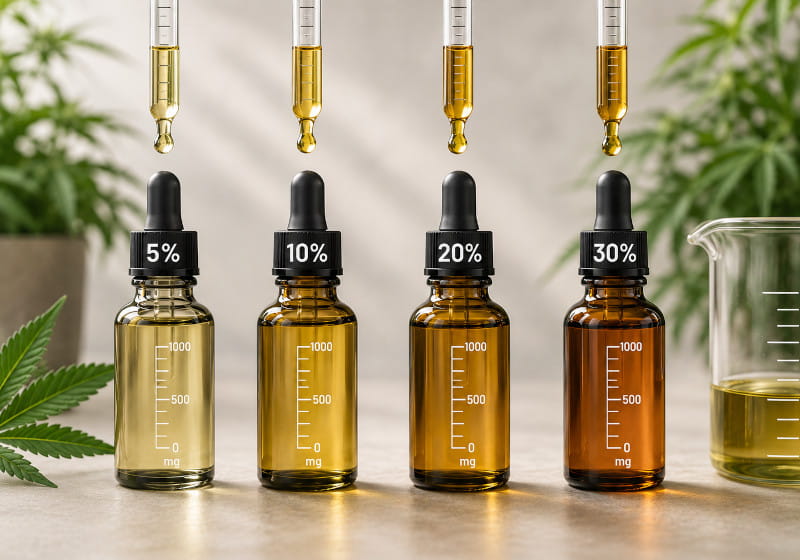
CBD oils are often labelled with values such as 5%, 10%, 20% or 30% . These percentages describe the concentration of the product . On their own, they do not tell you how many milligrams of CBD you consume with a certain amount . To determine that, concentration and the volume used must be considered together.
For practical interpretation, the unit mg CBD is therefore especially useful . Two people may each use five drops yet receive very different amounts of CBD if one oil contains 5% CBD and the other 20%, or if the droppers produce drops of different sizes.
How Much CBD Should You Take?
For over-the-counter CBD products, no single milligram amount can be defined as the universally correct CBD dosage for everyone.
Studies on cannabidiol investigate very different preparations, doses, groups of people and research questions . This also applies to areas of research such as CBD for stress, where results must always be interpreted in the context of the respective study design . Findings from a clinical trial therefore cannot simply be converted into a general number-of-drops recommendation for commercially available CBD oil . In addition, formulation, food intake and individual pharmacokinetics influence how much CBD the body absorbs.
It is particularly important to distinguish between medical dosing and the amount stated for an over-the-counter CBD product . For the prescription purified CBD medicine Epidiolex, indication-specific, weight-based dosing regimens exist under medical supervision . These doses are not intended as guidance for ordinary CBD oils.
How Do You Calculate CBD in Milligrams?
If the percentage on a typical CBD oil label represents the CBD concentration by volume, you can approximately calculate the amount of CBD from the concentration and bottle size.
Using this common calculation method, 1% CBD corresponds to about 10 mg of CBD per millilitre . A 10% oil therefore contains approximately 100 mg of CBD per ml . A 10 ml bottle would contain a total of around 1,000 mg of CBD.
Example: 10% × 10 ml × 10 = 1,000 mg CBD. The specific product label remains decisive . If the manufacturer states the total amount of CBD in milligrams, that figure should be preferred for the calculation.
How Much CBD Is in 5%, 10%, 15%, 20% or 30% Oil?
For a 10 ml bottle, the calculated total CBD amounts range from about 500 mg at 5% to 3,000 mg at 30%.
The following table also assumes 0.05 ml per drop, i.e . 20 drops per millilitre . This is a calculation assumption and not a guaranteed drop size for your dropper.
| CBD concentration | CBD in 10 ml | CBD per ml | CBD per 0.05 ml |
| 5 % | 500 mg | 50 mg | 2.5 mg |
| 10 % | 1,000 mg | 100 mg | 5 mg |
| 15 % | 1,500 mg | 150 mg | 7.5 mg |
| 20 % | 2,000 mg | 200 mg | 10 mg |
| 30 % | 3,000 mg | 300 mg | 15 mg |
How Many Milligrams of CBD Does One Drop Contain?
The amount of CBD per drop is determined by the CBD concentration per millilitre and the actual drop size.
The commonly used assumption of 20 drops per millilitre corresponds to 0.05 ml per drop . In practice, the dropper, oil viscosity, temperature and dropping technique can change the volume . A statement such as “3 drops” is therefore less precise than an amount given in milligrams or millilitres.
A 10% oil contains about 100 mg of CBD per ml according to the calculation described above . With 20 drops per ml, that would be 5 mg of CBD per drop; with 25 drops per ml, however, it would be only 4 mg per drop.
How Does the CBD Dosage Calculator Work?
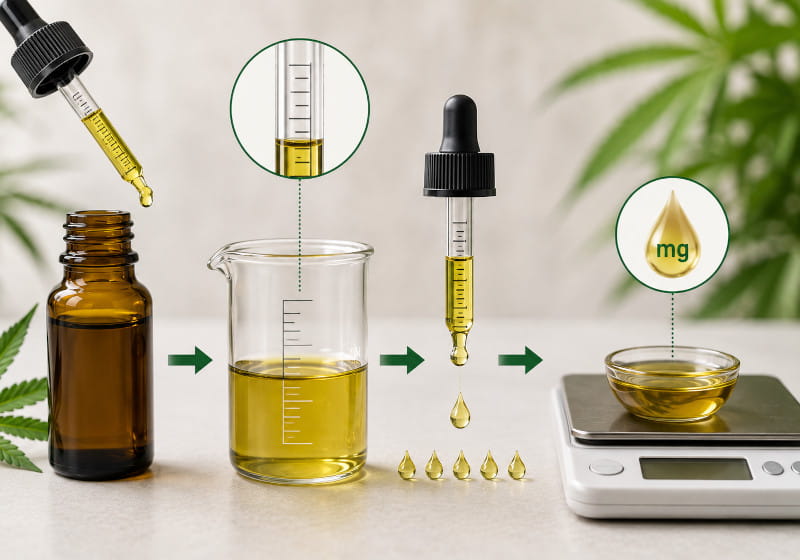
The CBD dosage calculator converts bottle size, CBD concentration and number of drops into a calculated amount of CBD in milligrams.
The calculator does not determine a medically appropriate dose . It only answers the quantity question: How much CBD is mathematically contained in the number of drops you enter? Because drops can vary in size, you can adjust the assumed number of drops per millilitre yourself.
CBD Dosage Calculator
Calculation aid, not a dosage recommendation . The calculation assumes that the percentage can be used according to the usual concentration statement in g/100 ml . Check the manufacturer's information on the total CBD amount and the dropper.
Why Are mg of CBD and the Number of Drops Not the Same?
Milligrams describe the amount of active compound, whereas drops merely represent a variable liquid volume.
This is exactly where many misunderstandings about CBD oil dosage arise . Five drops of a low-concentration oil may contain less CBD than a single drop of a highly concentrated product . At the same time, the same dropper can produce drops of different sizes depending on how it is handled.
If you want to compare products, the question “How many mg of CBD does my amount contain?” is therefore more meaningful than “How many drops do I take?” . For a reproducible measurement, a dropper graduated in millilitres can be more accurate than simply counting drops.
Does “Start Low, Go Slow” Make Sense with CBD?
A cautious approach with a low starting amount and without rapid, large increases may reduce risks, but it does not replace a medically justified dosing decision.
The commonly used phrase “Start Low, Go Slow” is a precautionary principle, not a scientifically established CBD dosing table . It reflects the fact that people can respond differently to cannabidiol and that products vary in concentration and composition.
Anyone using CBD should keep changes traceable and avoid changing the product, concentration, amount and timing all at once . If adverse effects occur, the amount should not simply be increased further . If symptoms are significant or medicines are being used at the same time, professional advice is advisable.
Can CBD Dosage Be Calculated by Body Weight?
Body weight alone is not sufficient to calculate an individually appropriate dose for over-the-counter CBD products.
Weight-based values in mg/kg are common in pharmaceutical research and for certain approved medicines . However, this does not mean that a freely chosen formula such as “0.5 mg CBD per kilogram” has been validated for general CBD use . Age, liver function, concomitant medication, formulation, use with or without food and other factors can influence exposure.
Body-weight tables can look mathematically correct while still conveying a level of precision that is not scientifically supported . For a general guide, it is therefore more appropriate to distinguish between calculating the CBD content and determining a medically appropriate dose.
What Does the New EFSA Safe Level for CBD Mean?
In 2026, EFSA derived a provisional safe level of 0.0275 mg CBD per kilogram of body weight per day for certain CBD food supplement formulations; it is not a recommendation for a therapeutically effective dose.
For an adult weighing 70 kg, this value corresponds to approximately 2 mg CBD per day . This figure is notably low compared with many amounts promoted commercially . However, the context is crucial: EFSA explicitly refers to a provisional safe level, which was derived using uncertainty factors because of existing data gaps.
According to EFSA, the value applies only to food supplement formulations containing at least 98% pure CBD, without nanoparticles, where manufacturing has been assessed as safe and genotoxicity has been excluded . EFSA could not establish safety for people under 25, pregnant or breastfeeding women, or people taking medication . These limitations are crucial when the figure of 2 mg per day is cited.
Why Do CBD Doses Differ So Much Between Studies?
CBD doses differ between studies because the research question, preparation, route of administration, target group, treatment duration and condition studied are not identical.
A dose from an epilepsy study using pharmaceutically standardised cannabidiol is not equivalent to a few drops of a commercially available oil . The product matrix also matters: cannabidiol is fat-soluble, and clinical data show that food can substantially alter the absorption of orally administered CBD.
This also applies to research areas such as CBD for depression: findings from individual studies cannot automatically be transferred to other uses, products or dosages . A single study dose should therefore never be adopted without context as the “correct CBD dosage” . The scientifically meaningful question is always which CBD preparation was studied, in which population, for what purpose and under what conditions.
Does Food Affect CBD Absorption?
Yes, food can substantially affect the absorption of orally administered CBD and thereby change the resulting CBD exposure.
CBD is lipophilic, meaning fat-soluble . A systematic review of clinical data found pronounced food effects on the pharmacokinetics of oral CBD formulations . This means that the same milligram amount can lead to different blood concentrations under different conditions of use.
For comparability, therefore, not only the amount matters but also keeping conditions of use as consistent as possible . This is another reason why a simple drops table only incompletely describes actual CBD exposure.
When Should You Take CBD?
There is no scientifically established universal time of day for taking over-the-counter CBD; product form, intended use, tolerability and consistent conditions are more important.
Whether CBD is used in the morning, evening or in divided amounts cannot be answered independently of the specific product and context of use . Anyone seeking a reproducible assessment should consider not only the time of day but also whether the product is consistently used with or without food.
For medical questions, timing should not be determined according to general internet rules . This is especially important when other medicines are taken at the same time.
What Role Does the Method of Administration Play in CBD Dosage?
The method of administration affects how CBD is released, absorbed and made available in the body; identical milligram amounts are therefore not automatically pharmacologically equivalent.
Oils, capsules, foods, medicinal solutions and topical products differ considerably . With oral use, digestion, liver metabolism, formulation and meals all play a role . With topically applied products, the amount of CBD applied cannot simply be compared with an orally consumed dose.
For a meaningful product comparison, the dosage form, portion size and manufacturer information should therefore be considered alongside the CBD content . A milligram figure is important, but without context it does not provide the complete dosing information.
What Side Effects Can Occur with CBD?
CBD can cause adverse effects; reported effects include drowsiness, gastrointestinal complaints, reduced appetite and possible changes in liver test values.
The likelihood and significance of side effects depend, among other things, on dose, preparation, concomitant medication and individual factors . Data from high-dose medical use should not be transferred directly to every over-the-counter product, but they do show that cannabidiol should not be regarded as inherently free of side effects.
Severe tiredness, persistent gastrointestinal complaints or other noticeable reactions are not a reason to increase the amount further . Serious or persistent symptoms should be medically assessed.
Can CBD Interact with Medicines?
Yes, CBD can affect the metabolism of certain medicines and thereby alter their effects or risk of side effects.
Cannabidiol can affect enzyme systems involved in the metabolism of numerous medicines . Clinically relevant interactions are known particularly from medical CBD use . Their significance in an individual case depends on the medicine, dose, amount of CBD and health situation.
If you regularly take medication, you should therefore not adjust CBD solely according to an online dosage table . This is particularly important for medicines with a narrow therapeutic range or if liver problems are already present.
Who Should Be Particularly Careful with CBD?
Particular caution is advised during pregnancy and breastfeeding, when taking medication, in people with liver disease, and in children and young people.
The FDA advises against CBD during pregnancy and breastfeeding . In its 2026 updated assessment, EFSA could not establish safety for people under 25, pregnant or breastfeeding women, and people taking medication . These groups should therefore not try to determine a personal CBD dosage solely using a calculator or general anecdotal experience.
Why Is Product Quality Important for Dosage?
A mathematically precise CBD dosage is only as reliable as the actual concentration and quality of the product used.
If the actual CBD content differs from the label, the calculated milligram amount will also be inaccurate . Reliable laboratory analyses can confirm levels of CBD, THC and, where applicable, other cannabinoids . Different CBD strains can also have very different cannabinoid profiles, which means that the composition of the plant cannot simply be transferred to the concentration of a product made from it . Such genetics originate from corresponding CBD seeds, whose genetically determined cannabinoid profiles can vary depending on the strain.
When breeding CBD-rich cannabis strains, genetics are selectively chosen and stabilised for specific cannabinoid profiles . One breeder specialising in such genetics is, for example, CBD Crew . What matters for dosing a finished CBD product, however, is not the name of a strain or breeder, but how much CBD the specific product actually contains.
For quantity calculations, you should preferably use the total amount in milligrams stated on the specific product . If the label states, for example, “1,000 mg CBD in 10 ml”, you can calculate directly with 100 mg of CBD per ml without having to interpret the percentage backwards.
In addition to cannabinoids, cannabis products often contain different terpene profiles . How terpenes and CBD interact in a plant or a product made from it depends on the genetics and processing involved . For pure quantity calculations, however, the stated CBD content remains decisive: terpenes do not change how many milligrams of CBD are contained in a given amount of product.
Which Mistakes Are Most Common with CBD Oil Dosage?
The most common mistakes are treating drops and milligrams as equivalent, blindly relying on body-weight tables, changing amounts too quickly, and ignoring medicines or differences between products.
Percentages are also often misread . In a 10 ml bottle, 10% CBD does not mean 100 mg in the entire bottle under the usual calculation method, but about 1,000 mg . Likewise, a 20% oil is not automatically “better” than a 5% oil – it is simply more concentrated and provides more CBD at the same volume.
Another mistake is transferring high doses from clinical studies to over-the-counter products without context . Drug trials use standardised preparations, defined diagnoses, medical monitoring and often very different amounts from typical consumer products.
How Can You Document the Amount of CBD Used?
A simple record should include the product, concentration, milligram amount, timing, conditions of use and observed tolerability.
This is far more informative than a note such as “three drops in the morning” . If you change products, the amount of CBD per drop may change . Recording amounts in milligrams makes different concentrations easier to compare.
| Item | Example | Why is it relevant? |
| Product | CBD oil | Formulations can differ. |
| Concentration | 10% / 1,000 mg in 10 ml | Basis for calculating the amount. |
| Amount used | e.g . 0.1 ml | More precise than counting drops. |
| CBD amount | 10 mg | Enables product comparisons. |
| Conditions of use | Time / meal | Can improve comparability. |
What Is Most Important About CBD Dosage?
The most important point is to clearly distinguish between a mathematically calculable amount of CBD and an individually appropriate or medically effective dose.
If a product is correctly labelled, it is straightforward to calculate how many milligrams of CBD are contained in a certain amount of oil . Whether that exact amount is appropriate, well tolerated or medically indicated for a particular person cannot be inferred from the calculation.
In practical terms, this means converting percentages into milligrams, not treating drop size as a fixed constant, checking product information and critically assessing supposedly exact universal tables . For medical use or when taking medication at the same time, dosage should be discussed with a qualified professional.
Frequently Asked Questions About CBD Dosage
Q: How many drops of CBD should you take per day?
A: There is no universally valid number of drops . Drops contain different amounts of CBD depending on their size and the product concentration.
Q: How many mg of CBD are in one drop?
A: This depends on the CBD concentration and drop volume . With 10% CBD and an assumed 20 drops/ml, it would mathematically be about 5 mg of CBD per drop.
Q: How much CBD does 10% CBD oil contain?
A: According to the usual concentration calculation, a 10% oil contains about 100 mg of CBD per ml; a 10 ml bottle therefore contains approximately 1,000 mg of CBD.
Q: How much CBD does 20% CBD oil contain?
A: Mathematically, it contains about 200 mg of CBD per ml, or 2,000 mg in a 10 ml bottle.
Q: Are 5 drops of CBD a lot?
A: This cannot be answered without knowing the concentration and drop size . Five drops of a 5% oil contain significantly less CBD than five drops of a 30% oil.
Q: Can I dose CBD according to body weight?
A: Body weight alone does not provide a scientifically validated personal dosage for over-the-counter CBD products.
Q: Can CBD be taken in the morning and evening?
A: There is no universal time of day for taking CBD . For medical questions or when taking medication, the approach should be discussed with a qualified professional.
Q: Is more CBD automatically stronger?
A: A larger milligram amount means more CBD is consumed, but not automatically a proportionally stronger or better effect.
Q: Is the EFSA level of around 2 mg CBD per day a dosage recommendation?
A: No . It is a provisional safe level for certain CBD food supplement formulations and not a therapeutic dosage recommendation.
Q: Why should I compare CBD in mg rather than drops?
A: Milligrams indicate the amount of CBD . Drops are only a variable liquid volume and can differ in size depending on the dropper.
Sources and Scientific Background
- European Food Safety Authority (EFSA): Provisional safe level for cannabidiol as a novel food, 2026
- U.S . Food and Drug Administration (FDA): What You Need to Know About Products Containing Cannabis or Cannabis-derived Compounds, Including CBD
- U.S . Food and Drug Administration (FDA): CBD, pregnancy and breastfeeding
- Silmore LH et al.: Food effects on the formulation, dosing, and administration of cannabidiol (CBD) in humans . Pharmacotherapy . 2021
- FDA: EPIDIOLEX (cannabidiol) oral solution – Prescribing Information