Cannabis Tissue Culture – Micropropagation
Tissue Culture: Preserving Cannabis Genetics in the Laboratory
Updated: November 2026 | Plant tissue culture, in vitro propagation, meristem culture, genetic archives, opportunities and limitations.
Author: Cannapot Grow Team | Reading time: approximately fifteen minutes
Key Facts at a Glance
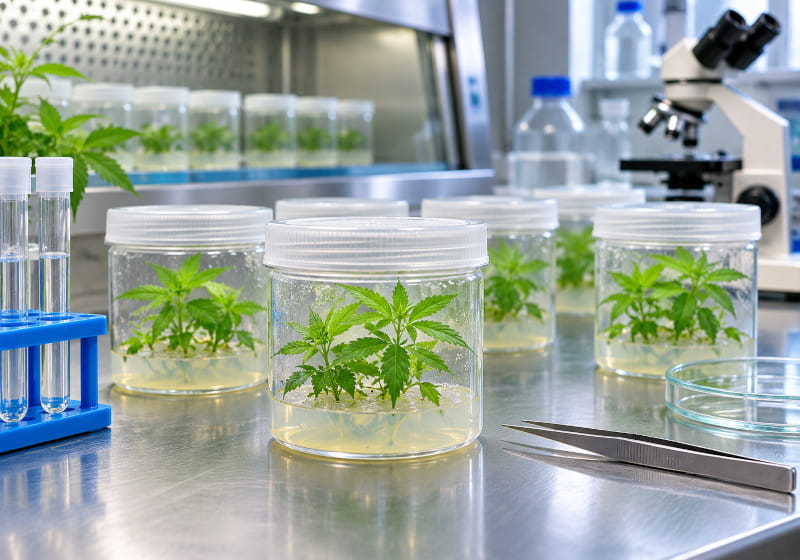
✓ Tissue culture in cannabis involves cultivating small plant parts under controlled, aseptic laboratory conditions. Tissue culture enables the clonal propagation and long-term preservation of selected cannabis genetics.
✓ Micropropagation and meristem culture have different priorities: micropropagation multiplies plants, whereas meristem culture uses actively dividing growth tissue and may, under certain conditions, help eliminate pathogens.
✓ Tissue culture allows valuable phenotypes to be preserved in a space-efficient manner and can supplement or partially replace large mother-plant collections. However, plant identity and health status still require regular verification.
✓ Contamination, cultivar-dependent responses and possible genetic or epigenetic changes present challenges. High laboratory costs and technical demands mean the method is not economically viable for every cannabis line.
An exceptional cannabis plant cannot simply be reproduced by sowing more seeds. Even when its offspring display similar characteristics, sexual reproduction produces new genetic combinations. Anyone wishing to preserve an outstanding phenotype and its distinctive traits over time must therefore rely on vegetative propagation and dependable methods of clonal genetic preservation.
Tissue culture in cannabis, also known as plant tissue culture or in vitro culture, offers a modern biotechnological approach. Whereas propagation through cannabis seeds can produce new genetic combinations, tissue culture allows small parts of a selected cannabis plant to be cultivated and multiplied under controlled, aseptic laboratory conditions. The method has been used in plant biotechnology for decades, but cannabis presents particular challenges because individual genotypes respond differently.
Cannabis tissue culture offers valuable opportunities for clonal propagation, long-term genetic preservation and professional cannabis breeding. At the same time, it entails technical, biological and economic challenges. This article examines the scientific principles, the differences from conventional cutting propagation, and the advantages and limitations of tissue culture, without presenting it as a guarantee of pathogen-free or genetically unchanged plants.
What Is Tissue Culture in Cannabis?
Cannabis tissue culture means cultivating plant cells, tissues or small plant parts under controlled, aseptic laboratory conditions. Its purpose is to preserve and multiply selected cannabis genetics through in vitro propagation or keep them available for future use.
The term tissue culture refers to the cultivation of plant tissue. The Latin expression in vitro literally means “in glass”. It describes growing plant material in suitable culture vessels on specially formulated nutrient media. Unlike conventional plant propagation, growth takes place under controlled conditions designed to prevent bacteria, fungi and other microorganisms from entering the culture.
In cannabis research, tissue culture encompasses several biotechnological methods. These include micropropagation from existing shoot structures, regeneration of new shoots from plant tissue, and longer-term preservation of selected genotypes. The appropriate method depends on the cannabis genetics, the starting tissue and the intended objective. Not every cannabis cultivar responds equally reliably under laboratory conditions.
The distinction between clonal propagation and conventional cannabis breeding is crucial. Crossbreeding produces new genetic combinations, whereas clonal tissue culture primarily aims to preserve the genotype of an already selected plant. The method therefore does not automatically create new cannabis varieties; instead, it enables the controlled preservation and multiplication of existing genetics. Culture-induced changes cannot, however, be ruled out entirely.
How Does Plant Tissue Culture Work?
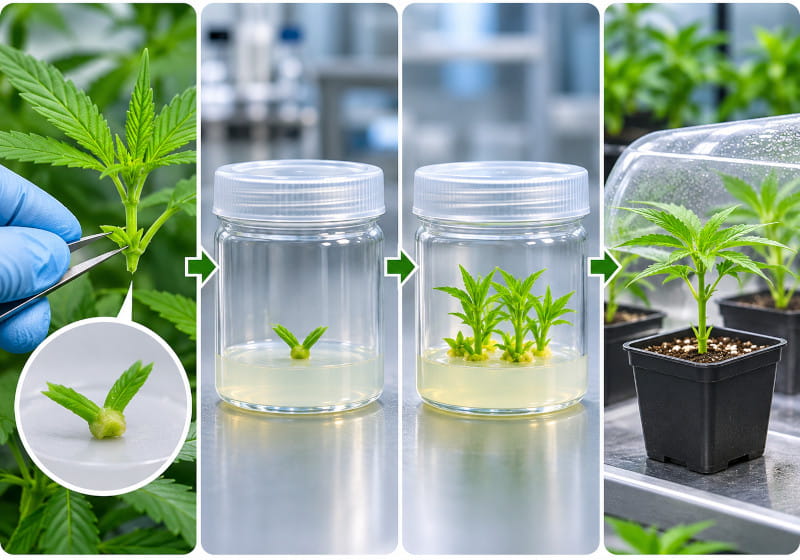
In plant tissue culture, a small piece of suitable plant material, known as an explant, is cultivated under controlled conditions in a sterile culture vessel. Depending on the tissue used and the culture conditions, new shoots and roots can develop, eventually producing independent cannabis plants.
The scientific basis is the regenerative potential of plant cells and tissues. Many plants can form new organs from suitable tissue structures. This ability is related to plant totipotency: the fundamental potential of certain cells to regenerate a complete plant under appropriate conditions. Not every isolated cell can actually express this potential, however. In cannabis, success is influenced particularly by genotype, explant origin and culture conditions.
In vitro cultures receive controlled supplies of water, mineral nutrients, carbohydrates and, where appropriate, plant growth regulators. Light, temperature and the composition of the culture environment also affect plant development. A particular challenge is preventing microbial contamination. Even small amounts of bacteria or fungi can multiply inside a vessel, impair delicate plant tissues or render an entire culture unusable.
Successful shoot formation and rooting are followed by acclimatization, the gradual adjustment of young plants to conditions outside the culture vessel. This transition is especially demanding because in vitro plants often develop in high humidity with limited gas exchange. Their leaves, stomata and roots must adapt to the changed environment. Success therefore depends not only on laboratory propagation but also on the quality and survival of the subsequently established plants.
What Is the Difference Between Micropropagation and Meristem Culture?
Micropropagation is used to multiply selected plants clonally under controlled in vitro conditions, enabling the production of numerous genetically largely identical offspring. Meristem culture, by contrast, uses very small areas of actively dividing growth tissue and may also help eliminate certain pathogens.
A meristem consists of undifferentiated or only slightly differentiated plant cells that actively divide and generate new tissue. In cannabis, these growth zones occur at shoot tips and in axillary buds, among other locations. Our article on the anatomy of the cannabis plant explains these structures in more detail. While conventional shoot culture develops already existing shoot structures, other tissue culture methods can produce new shoots from tissue that did not previously contain a shoot primordium. This is known as de novo regeneration.
In micropropagation, the focus is on multiplying a selected cannabis genotype under controlled conditions, achieving a high propagation rate and producing high-quality young plants. Meristem culture often has an additional aim: cultivating very small shoot tips may, under certain conditions, produce plants in which particular previously present pathogens are no longer detectable. The two methods are therefore not mutually exclusive. Meristem culture can form part of a wider micropropagation and quality-assurance programme.
It is particularly important to distinguish aseptic cultivation from actual pathogen elimination. A sterile laboratory environment helps prevent external microorganisms from entering a culture but does not automatically remove pathogens already present inside plant tissue. Meristem culture does not guarantee complete sanitation either: its success depends on the pathogen, the cannabis genotype and the methods employed. Only appropriate diagnostic testing can confirm whether a regenerated plant tests negative for a particular pathogen.
| Method | Starting material | Main purpose | Key limitation |
|---|---|---|---|
| Micropropagation via shoot culture | Existing shoot structures and axillary buds | Clonal propagation of selected cannabis genetics | Genotype-dependent propagation rates and possible transmission of existing pathogens |
| Meristem culture | Very small, actively dividing growth tissues, often from shoot tips | Preservation of selected lines and potential elimination of certain pathogens | No guaranteed pathogen freedom; diagnostic follow-up tests required |
| De novo regeneration | Suitable plant tissues from which new shoot structures form | Formation of new plant organs for research, regeneration and biotechnology | Strong dependence on genotype and starting tissue, with possible somaclonal changes |
Tissue Culture vs. Cuttings: What Are the Differences?
Both conventional cuttings and tissue culture allow a selected cannabis plant to be propagated vegetatively while largely preserving its genotype. The main differences concern the plant material used, cultivation conditions, technical requirements and options for long-term preservation of valuable cannabis genetics.
In conventional cutting propagation, selected cannabis mother plants are maintained and shoots are regularly taken from them for vegetative propagation. Under suitable conditions, these shoots develop their own roots and continue growing as independent plants. The basics are covered in our detailed article on taking and rooting cannabis cuttings.
In cannabis tissue culture, much smaller plant parts, called explants, are cultivated under controlled in vitro conditions. Suitable starting material can produce new shoots and ultimately complete plants. Conventional cuttings require comparatively little technical equipment, whereas tissue culture calls for an appropriate laboratory environment, trained personnel and consistent quality controls. In return, many cultures can be managed separately, documented and multiplied as needed within a limited space.
Another difference concerns long-term genetic preservation. Mother plants continuously require space, care and suitable growing conditions. In vitro cultures, by contrast, can serve as a documented genetic reserve without every line having to be maintained permanently as a large plant. This can provide organizational advantages for professional breeders, genetic archives and operations with many selected phenotypes.
For home growers and smaller plant collections, conventional cuttings generally remain the simpler and more economical option. Tissue culture offers advantages primarily when numerous valuable lines need to be systematically safeguarded, repeatedly propagated or kept available over extended periods. Important: Neither cuttings nor ordinary in vitro cultures are automatically free from viruses, viroids or other pathogens. Their actual health status must be verified through suitable testing when necessary.
| Criterion | Conventional cuttings | Tissue culture |
|---|---|---|
| Starting material | Shoots cut from a mother plant | Small explants, such as shoot tips or segments |
| Culture conditions | Ordinary propagation environment with controlled humidity | Controlled, aseptic in vitro environment |
| Technical requirements | Relatively modest equipment and staffing needs | Laboratory infrastructure, expertise and quality assurance required |
| Propagation and scaling | Depends on the number, size and growth of mother plants | Potentially high propagation rates with little space per culture |
| Genetic stability | Largely clonal preservation of the original genotype | Clonal preservation possible; culture-induced changes cannot be completely ruled out |
| Pathogen status | Existing pathogens may be passed on from the mother plant | Ordinary micropropagation does not automatically remove systemic pathogens; testing required |
| Long-term genetic preservation | Continuous care of living mother plants | Documented in vitro archives and specialized preservation methods possible |
| Economic viability | Often suitable for small and medium plant collections | Especially attractive for valuable genetic collections and professional propagation programmes |
What Are the Benefits of Tissue Culture in Cannabis?
Tissue culture makes it possible to propagate selected cannabis genetics under controlled conditions, preserve valuable phenotypes over the long term and organize extensive genetic collections efficiently in terms of space. For professional breeding programmes and genetic archives, documented preservation, traceability and the on-demand availability of plant material are especially valuable.
A major benefit is the space-efficient preservation of valuable cannabis genetics. Conventional mother plants require continuous lighting, care and sufficient space, whereas small in vitro cultures can be housed in suitable vessels. This allows professional operations to manage more distinct lines without keeping each genotype permanently as a mature mother plant. Actual space and energy requirements nevertheless depend on the laboratory infrastructure and preservation methods used.
Another benefit is controlled, standardized micropropagation. Under suitable conditions, selected shoot structures can repeatedly produce new plants. This makes the supply of specific genotypes easier to plan and may help reduce variation between propagation cycles. Efficiency, however, depends heavily on the cannabis line, culture protocol and quality of the starting material.
A further advantage is documentation and quality assurance. Individual in vitro cultures can be clearly labelled, with their origin, culture history and completed tests recorded and traced. Combined with appropriate diagnostic methods, this enables systematic plant-health management. A sterile working environment reduces certain contamination risks but guarantees neither the absence of systemic pathogens nor permanently unchanged genetics.
For long-term breeding, separating active plant production from the genetic reserve is also attractive. A selected parent line need not be continuously used for crosses or cutting production; under suitable conditions, it can instead be preserved as reference genetics. This may help safeguard rare or irreplaceable phenotypes and enable their future use in breeding programmes.
How Can Valuable Cannabis Genetics Be Preserved Long Term?
Valuable cannabis genetics can be safeguarded over extended periods through clonal propagation and controlled preservation of selected plant lines. Tissue culture provides specialized in vitro methods that can keep rare phenotypes and important parent lines available without maintaining large mother-plant collections.
A professional genetic archive, however, involves much more than storing plant material. Each line should be clearly identifiable, with traceable information on its origin, genetic background, culture history and health status. This includes documenting repeated subcultures and carrying out appropriate tests of genetic identity and potential pathogens. Only systematic quality assurance turns a collection of in vitro plants into a dependable genetic reference archive.
Different preservation strategies can be used for longer-term storage. In slow-growth preservation, the growth of in vitro cultures is reduced under controlled conditions so that plant material needs to be transferred to fresh media less frequently. This differs from cryopreservation, in which suitably prepared biological material is stored at extremely low temperatures, often in liquid nitrogen. Both approaches aim to keep valuable genetics available long term, but differ substantially in technique, effort and scientific validation for individual cannabis genotypes.
Studies of long-term in vitro culture in cannabis and hemp indicate that genetic stability can be maintained over certain culture periods under suitable conditions. Such findings must nevertheless be interpreted in light of the genotypes examined, culture duration and detection methods employed. The absence of detectable changes in genetic markers or DNA-content measurements does not automatically mean that all genetic and epigenetic properties remain unchanged indefinitely.
Before a genotype can be preserved over the long term, a suitable plant must first be selected. During cannabis pheno hunting, different individuals from a genetic line are compared for their characteristics to identify especially interesting phenotypes. Tissue culture can then help preserve these selected plants as clonal reference lines and make them available for future breeding projects.
Can Tissue Culture Eliminate Pathogens?
Certain cannabis tissue culture methods can help eliminate individual viruses, viroids or other pathogens from plant material. Whether pathogen elimination succeeds depends on the pathogen, cannabis genotype and method used, and must be confirmed through appropriate diagnostic testing.
A crucial distinction is between sterile tissue culture and pathogen-tested plant material. Aseptic laboratory conditions can limit the introduction of external microorganisms. This does not mean that a plant is automatically free from pathogens already present in its tissues. Systemic pathogens, in particular, may persist in outwardly healthy in vitro cultures and be passed on during clonal propagation.
Shoot-tip meristem culture is among the methods being investigated for targeted elimination of certain pathogens. It uses very small growth tissues in which particular pathogens may, under certain conditions, be absent or present only at low concentrations. Scientific studies sometimes combine this approach with additional treatments. Its effectiveness, however, cannot be generalized to all viruses, viroids or cannabis genotypes.
One relevant example is Hop latent viroid (HLVd), which has also been detected in cannabis. Scientific studies show that the success of sanitation methods can differ considerably between cultivars. Even technically sophisticated procedures therefore provide no universal guarantee of complete pathogen elimination. The pathogen's biological properties and the response of the individual cannabis line play major roles.
A reliable assessment of plant health therefore requires appropriate laboratory tests and documented follow-up testing. A negative result applies to the pathogen tested, the material examined and the time of sampling. It does not demonstrate that a plant is free from every pathogen or will remain healthy indefinitely. Tissue culture can thus be part of a professional plant-health programme, but it does not replace diagnostics or consistent hygiene measures.
How Stable Are Cannabis Genetics During Tissue Culture?
The aim of clonal cannabis tissue culture is to preserve the genotype of a selected plant as faithfully as possible and produce genetically largely identical offspring. Complete genetic stability cannot be guaranteed, however, because certain culture conditions, regeneration methods and repeated subcultures may promote changes.
An important scientific concept is somaclonal variation: genetic changes that may arise in connection with in vitro cultivation and regeneration of plant tissue. The risk depends, among other things, on the starting material and regeneration pathway. Propagation from pre-existing shoot structures is generally considered more favourable for maintaining varietal identity than methods involving prolonged phases of undifferentiated tissue. Changes cannot be entirely excluded even in shoot culture.
In addition to changes in DNA sequence, epigenetic changes also matter. These can alter the activity of certain genes without changing the underlying DNA sequence. A familiar example is DNA methylation, a chemical mechanism involved in regulating gene activity. Such changes may be influenced by development, environmental conditions or culture stress. They do not necessarily result in visible or permanently heritable differences.
For professional breeders and genetic archives, traceable verification of genetic identity is therefore especially important. This includes documented culture histories, suitable molecular tests and, where appropriate, comparison of regenerated plants with the original reference line. Environmental conditions must also be considered: two genetically largely identical plants can display different characteristics under different growing conditions without an underlying genetic change.
Why Do Cannabis Cultivars Respond Differently to Tissue Culture?
Different cannabis genotypes respond differently to plant tissue culture conditions, particularly during shoot formation, multiplication, rooting and subsequent acclimatization. An in vitro protocol that works reliably for one line may produce much lower propagation rates, or no regeneration at all, in another cultivar.
In plant biotechnology, this is called genotype dependence. A plant's genetic makeup affects how its cells and tissues respond to culture conditions and plant growth regulators. Differences can arise when a culture is first established and continue during shoot multiplication, root formation or adaptation to ordinary growing conditions. The success of cannabis tissue culture therefore cannot be judged solely by the method used.
The starting tissue, known as the explant, also plays a major role. Shoot tips, axillary buds and other plant tissues have different developmental characteristics and do not necessarily respond alike to in vitro cultivation. The physiological condition of the donor plant, developmental stage of the tissue and previous culture history may also affect the outcome. Consequently, even plants from the same genetic line can produce different results in separate culture attempts.
Scientific studies of cannabis regeneration and micropropagation show that cultivars can differ in their capacity to regenerate and form new shoots. Researchers therefore investigate protocols that yield reproducible results across as many genotypes as possible. Of particular interest are approaches that reduce the commonly observed dependence on specific cannabis lines and make tissue culture more widely applicable.
Such approaches are sometimes described in scientific literature as genotype-independent regeneration protocols. This does not necessarily mean that every existing cannabis cultivar can be grown successfully under identical conditions. Rather, the term refers to methods that perform relatively reliably across several tested genotypes. Their practical value depends on whether the results can be reproduced in further cannabis lines and whether regenerated plants retain their desired traits.
What Are the Risks and Challenges?
The main challenges of cannabis tissue culture include microbial contamination, genotype-dependent propagation results, possible genetic changes and difficulties acclimatizing young plants. Tissue culture also requires suitable laboratory infrastructure, trained staff and ongoing quality controls, which can make it substantially more technically demanding and expensive than conventional cutting propagation.
Microbial contamination is a particularly common problem. Bacteria, fungi and other microorganisms can enter vessels through the starting material, work environment or repeated culture handling. Some contamination becomes visible quickly; other contaminants initially go unnoticed and only later impair plant growth. Microorganisms already inside the starting tissue are especially problematic because surface cleaning cannot reliably remove them. An outwardly clean culture is therefore not sufficient evidence of complete microbiological safety.
Besides contamination, physiological disorders during in vitro culture can occur. These include hyperhydricity, also known as vitrification. Affected shoots often appear unusually glassy, water-soaked or partly deformed. Such changes can disrupt normal development and reduce survival outside the culture vessel. Poor rooting or abnormal leaf development may also make subsequent establishment more difficult.
The economic requirements of cannabis tissue culture should not be underestimated. Beyond vessels, nutrient media and technical equipment, recurring costs include staff, energy, documentation, microbiological controls and potentially molecular diagnostics. Losses from contamination, poor regeneration or unsuccessful acclimatization add to the expense. A high theoretical propagation rate does not automatically make a method profitable. For smaller operations, a proven cutting system may still be more sensible.
Finally, legal requirements must also be considered. Cultivation, storage and transfer of cannabis plant material are subject to different laws depending on the country. Growing plant tissue in a laboratory vessel rather than as a mature plant does not automatically change its legal classification. Professional applications must therefore account for both biological and technical requirements and the applicable regulations.
| Challenge | Possible consequence | Practical significance |
|---|---|---|
| Microbial contamination | Impaired growth or complete loss of individual in vitro cultures | Controlled working conditions, hygiene and regular quality checks |
| Genotype dependence | Different regenerative capacity, propagation rates and plant quality | Assessing the suitability of individual cannabis lines for the culture method |
| Hyperhydricity and physiological disorders | Glassy, water-soaked or malformed shoots with reduced viability | Monitoring plant quality and evaluating culture-induced developmental disorders |
| Somaclonal and epigenetic changes | Possible deviations from the original reference genetics | Documented culture history and suitable genetic identity tests |
| Difficult acclimatization | Growth problems or plant losses during transfer from in vitro culture | Assessing rooting, plant development and survival |
| Laboratory operation and staffing costs | High recurring expenses and possible economic disadvantages | Balancing propagation performance, genetic value and actual costs |
| Legal requirements | Restrictions on cultivation, storage or transfer of plant material | Compliance with applicable laws and regulatory requirements |
How Do Professional Breeders and Seedbanks Use Tissue Culture?
Professional cannabis breeders and seedbanks can use tissue culture to preserve and multiply valuable parent lines, selected phenotypes and rare cannabis genetics over the long term. For extensive breeding programmes, it offers advantages in organizing genetic collections, tracing individual lines and assuring plant-material quality.
Regular cannabis seeds remain important for developing new crosses because they can produce both male and female plants. Tissue culture serves a different function: it does not sexually recombine genetic material but preserves and vegetatively multiplies existing genotypes. Selected parent lines can therefore remain available throughout different stages of a breeding programme without having to be maintained continuously as large mother plants.
The combination of modern cannabis breeding, genetic documentation and biotechnological methods is particularly interesting. James Loud is one example of a breeder involved in preserving extensive cannabis genetics and using modern laboratory methods. Such approaches illustrate the importance of systematically safeguarding selected plant lines for long-term breeding programmes. It is important, however, to distinguish the general use of tissue culture from specifically demonstrated characteristics of individual plant collections.
Another benefit is the long-term comparability of genetic lines. When selected plants are maintained as clearly identified reference genetics, they can be revisited in later breeding decisions. This is particularly useful in multi-year projects involving different crosses, backcrosses or offspring generations. Our article on cannabis genetics, F1, F2, BX, S1 and IBL explains these terms and their importance for breeding in detail.
Accurate claims also matter in marketing. The term tissue-culture plant initially describes only a plant's origin in an in vitro culture process. On its own, it is not scientific evidence of superior growth, higher yields or freedom from pathogens. More meaningful indicators are documented testing, traceable quality standards and actual plant performance after acclimatization.
Can Tissue Culture Replace Conventional Mother Plants?
Tissue culture can partially replace the permanent maintenance of large cannabis mother-plant collections in professional breeding and propagation operations, reducing the space needed to preserve valuable genetics. A complete replacement is not appropriate for every operation, however, because in vitro cultures require additional laboratory work and not every cannabis line can be cultured equally reliably.
Conventional cannabis mother plants serve a practical purpose: they continuously produce shoots from which new cuttings can be taken. This system is relatively straightforward and allows direct propagation of established plants. Mother plants, however, need permanent space, lighting, care and regular health checks. As the number of distinct genetics increases, so do the potential demands on space, organization and maintenance.
An in vitro genetic archive, by contrast, is primarily designed to keep selected lines available under controlled conditions while minimizing space requirements. Small shoot cultures can serve as a genetic reserve from which plants can be regenerated for further propagation when needed. However, an archived tissue culture must pass through additional development and adjustment stages before becoming a fully established mother plant. An in vitro collection is therefore not always an immediate substitute for a mother plant already ready for production.
For larger breeding programmes, a combination of both methods can be particularly useful. Selected mother plants meet the ongoing demand for cuttings, while other valuable genetics are maintained as documented in vitro cultures. This avoids keeping every line as a large plant at the same time. It also provides an additional safeguard if mother plants are lost to disease, technical problems or other causes.
Nevertheless, a tissue culture archive is not risk-free. Contamination, incorrect labelling, culture-induced changes or technical failures can also result in the loss of plant material. Responsible genetic preservation should therefore not depend exclusively on a single backup system. Particularly valuable lines may benefit from a combination of documented mother-plant collections, suitable in vitro cultures and independent backups.
What Does the Future Hold for Cannabis Tissue Culture?
The future of cannabis tissue culture lies in more reliable propagation and regeneration methods, long-term preservation of valuable genetics and improved plant-quality control. Advances in plant biotechnology could make tissue culture suitable for more cannabis genotypes, improve its economic viability and expand its role in professional breeding programmes.
A major research priority is developing regeneration protocols that work across genotypes. Different cannabis lines currently respond very differently to identical in vitro conditions. Researchers are therefore studying methods that reliably regenerate new shoots and complete plants from different tissues. Such progress could improve conventional micropropagation and open new opportunities for plant biotechnology research and certain breeding applications. Regeneration from plant tissue must, however, be distinguished from routine clonal preservation of pre-existing shoot structures.
Optimizing culture conditions is another important research area. Topics include gas exchange within culture vessels, lighting and the development of functional plant organs. One promising approach is photoautotrophic in vitro culture, in which plants rely more heavily on their own photosynthesis for nourishment. Under suitable conditions, such systems may improve plant quality and make subsequent acclimatization easier. Any economic benefit must nevertheless be demonstrated for the particular culture systems and cannabis genotypes involved.
A further focus is long-term preservation of genetic resources. Professional breeders and genetic archives are interested in methods that keep rare parent lines and exceptional phenotypes available as reliably as possible over extended periods. These include refining slow-growth preservation, investigating suitable cryopreservation techniques and systematically monitoring genetic and epigenetic changes. A key question is how stable different cannabis lines actually remain during prolonged storage and cultivation.
For growers, collectors and breeders, realistic expectations are essential: tissue culture does not guarantee higher yields, stronger plants or automatically pathogen-free genetics. It is a specialized tool for controlled propagation, preservation and scientific investigation of plant material. Its value comes from appropriate methods, careful documentation and verifiable results.
FAQs
F: Is tissue culture the same as cloning?
A: Not exactly. Cloning refers to vegetative plant propagation, whereas tissue culture means cultivating plant tissue under controlled in vitro conditions. Micropropagation is a tissue culture application that produces genetically largely identical plants.
F: Can every cannabis cultivar be propagated through tissue culture?
A: Many plant tissues have considerable regenerative potential, but not every cannabis genotype can be propagated successfully using the same in vitro methods. Results depend on genotype, starting tissue and culture conditions. No universally reliable protocol for all cannabis cultivars has yet been established.
F: Are tissue culture plants automatically virus-free?
A: No. Even apparently clean in vitro cultures can contain viruses, viroids or other systemic pathogens. Methods such as meristem culture can help eliminate certain pathogens, but success must be verified through suitable laboratory tests.
F: Can tissue culture preserve an exceptional phenotype?
A: Yes. Clonal in vitro propagation can preserve the genotype of a selected cannabis plant over an extended period and multiply it again when needed. Reliable genetic preservation nevertheless requires documented protocols and regular identity checks.
F: What is an explant?
A: An explant is a piece of plant tissue removed for use as the starting material in an in vitro culture. In cannabis, examples include shoot tips and shoot segments. Suitability depends on the culture method and developmental condition of the plant material.
F: Is meristem culture always better than micropropagation?
A: No. Micropropagation primarily multiplies plants clonally, while meristem culture uses very small areas of actively dividing growth tissue. Meristem culture can be part of a micropropagation programme and is used, among other things, in methods intended to eliminate certain pathogens.
F: Can an in vitro plant differ genetically?
A: Yes. Although clonal tissue culture aims to produce genetically identical plants, somaclonal or epigenetic changes can occur under certain conditions. The risk depends on regeneration pathway, genotype and culture history.
F: Does tissue culture replace conventional cutting propagation?
A: Not necessarily. Conventional cuttings often remain simpler and more economical for smaller collections. Tissue culture offers advantages particularly to professional breeding programmes and genetic archives that need to preserve many valuable cannabis lines and keep them available under controlled conditions.
Scientific References
- Sorokin, A. & Kovalchuk, I. (2025). Development of efficient and scalable regeneration tissue culture method for Cannabis sativa. Plant Science, 350, 112296. Study / DOI
- Kastelec, D. et al. (2025). Optimization of micropropagation protocols and assessment of epigenetic changes in tissue cultures of diverse medical cannabis genotypes. Industrial Crops and Products, 229, 121015. Study / DOI
- Dreger, M. et al. (2025). Clonal propagation of hemp and assessment of genetic stability in long-term in vitro culture. Industrial Crops and Products, 232, 121242. Study / DOI
- Torres, A. et al. (2025). Differential gene expression analysis of Cannabis sativa following Hop Latent Viroid (HLVd) eradication therapy in micropropagation tissue culture. Plant Cell, Tissue and Organ Culture, 161, 66. Study / DOI
- Bennur, P. L. et al. (2025). Genotype-independent de novo regeneration protocol in Cannabis sativa L. through direct organogenesis from cotyledonary nodes. Plant Methods, 21, 145. Study / DOI
- Johnson, G. A. et al. (2025). Optimizing Growth Regulator Concentrations for Cannabis sativa L. Micropropagation. Plants, 14, 2586. Study / DOI
- Improve Cannabis sativa micropropagation through increasing air change rate in photoautotrophic and traditional tissue culture (2024). Scientia Horticulturae, 333, 113238. Study / DOI