Cannabis Grow Calendar for Indoor & Outdoor
Cannabis Grow Calendar: Plan Your Entire Grow
Updated: September 2026 | Guidance from germination to harvest
Author: Cannapot Grow Team | Reading time: approximately twenty minutes
The Most Important Points at a Glance
✓ Cannabis grow calendar: all key timings at a glance
✓ Interactive cannabis grow calendar for indoor & outdoor
✓ When to germinate, repot, top, fertilize and harvest?
✓ Cannabis outdoor calendar from March to October
✓ How does the schedule differ for autoflowers?
✓ Why the calendar uses time windows instead of fixed dates
✓ Frequently asked questions about the cannabis grow calendar
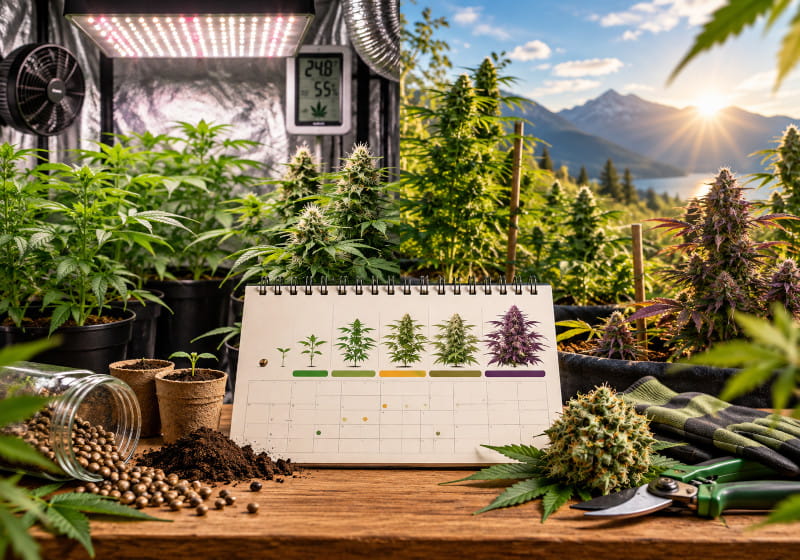
A cannabis grow calendar helps you plan the timeline of a grow: When should cannabis seeds be germinated, when should you repot, top or fertilize – and when does harvest time finally begin? Instead of merely describing the plant’s developmental stages, this calendar shows which tasks and checks become relevant during each stage of cultivation.
How quickly a grow progresses depends, among other things, on genetics, stage of development, indoor or outdoor cultivation, substrate, light and climate. Photoperiod strains and autoflowers also differ significantly. The cannabis grow calendar takes these differences into account and therefore works with realistic time windows.
Further down, you will also find our interactive cannabis grow calendar. There, you can select the key details of your grow and receive an individual schedule with suitable tasks and time windows for each stage.
If you first want to know what happens biologically to the plant during germination, vegetative growth and flowering, you can find a detailed explanation in our guide to the growth stages of cannabis. The grow calendar, by contrast, focuses on the practical question: What needs to be done or checked, and when?
Cannabis Grow Calendar at a Glance
The following overview shows which tasks and checks typically come up during a cannabis grow. The timing is not based solely on grow weeks, but above all on the plant’s stage of development. A strain may pass through individual stages faster or more slowly – so the decisive factor is always how far the plant has actually developed.
| Development stage | What should be done or checked now? | What does the timing depend on? |
|---|---|---|
| Start / Germination | Start and monitor germination; observe the transition to the seedling stage | Seeds, germination conditions and the planned indoor or outdoor start |
| Seedling | Monitor development; check light, temperature and humidity | Root development, growth rate and growing environment |
| Early Vegetative Growth | Check root space and pot size; monitor water and nutrient requirements | Plant size, substrate, pot volume and growth rate |
| Vegetative Growth | Assess whether repotting is needed; plan topping or training if necessary; adjust nutrient supply | Genetics, plant structure, root space, available space and cultivation system |
| Late Vegetative Growth | Check plant size and structure; prepare for space requirements and the transition to flowering | Photoperiod, genetics, desired plant size and outdoor season |
| Transition to Flowering | Observe the start of flowering; reassess stretch, space requirements, climate and nutrient supply | Light cycle for photoperiod plants, genetics and age for autoflowers, and outdoor day length |
| Flowering | Check climate and plant condition; adjust nutrient supply and monitor flower development | Flowering time, flower density, genetics, climate and cultivation system |
| Late Flowering | Monitor maturation and begin narrowing down the possible harvest window | Genetics, actual maturity and environmental conditions |
| Harvest Window | Check signs of maturity and determine the appropriate harvest time | The plant’s actual maturity rather than a predetermined calendar date |
Interactive Cannabis Grow Calendar
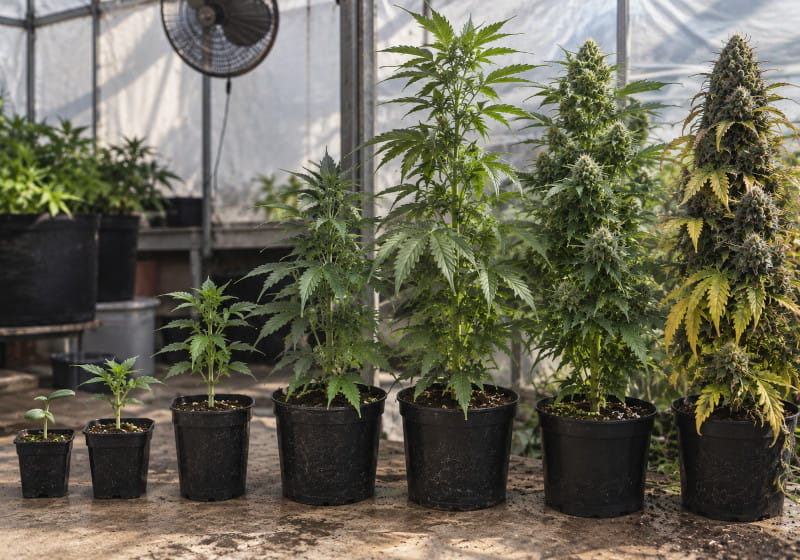
With the interactive cannabis grow calendar, you can plan your grow based on your individual setup. Choose, among other things, between indoor and outdoor, photoperiod strains and autoflowers, your growing medium and the nutrient system you use. Based on these details, the calendar creates a personal schedule with the most important development stages, tasks and checks – from germination to the possible harvest window. It also displays relevant Cannapot guides and, where available, example feeding information for the selected manufacturer’s schedule.
Cannabis Grow Calendar
Your grow, your schedule: Enter a few details about your grow and the calendar will show you when important tasks and checks are due. You’ll also find relevant Cannapot guides and example feeding rates based on the selected manufacturer schedule. We have included some of the best-known nutrient brands and growing systems as practical examples.
–
Your personal grow schedule
What Needs to Be Done When Growing Cannabis?
When growing cannabis, there are several points in time that frequently raise questions: When should you germinate, repot, top or fertilize? When does flowering begin and when is harvest approaching? Not every one of these questions can be answered with a specific grow week. What matters more is the plant’s stage of development and the conditions under which it is growing.
When to Germinate Cannabis Seeds?
The growing cycle begins with germination. Indoors, the start can largely be planned independently of the season, provided the required conditions can be controlled. Outdoors, by contrast, the region, temperatures, weather and the planned timing for moving plants outside later play a much greater role. We explain how germination itself works and which methods are suitable in our detailed guide to germinating cannabis seeds.
When to Repot Cannabis?
When repotting, the condition of the plant is more important than a fixed number of days. A larger pot becomes relevant when the plant and root system increasingly fill the available space and the current pot volume could limit further development. Our guide to repotting cannabis explains which signs to look for and how to assess pot size, roots and substrate.
When to Top Cannabis?
Topping usually becomes relevant during vegetative growth once the plant is already growing steadily and has developed sufficient plant mass. The right timing depends, among other things, on the stage of development, genetics, plant structure and available space. Especially with fast-developing plants, this time window can shift considerably. We explain how the technique works and what to look out for in detail under topping cannabis.
When to Fertilize Cannabis?
A rigid weekly schedule is of limited use for fertilizing as well. Nutrient requirements change with the stage of development and also depend on the substrate, existing nutrient content in the substrate, cultivation system and previous nutrient supply. Especially during the transition from vegetative growth to flowering, nutrient supply should therefore be reassessed. Detailed information on dosage, NPK, pH, EC and different substrates can be found in the guide fertilizing cannabis correctly.
When Does Cannabis Start Flowering?
The timing of flowering differs fundamentally between photoperiod and autoflowering plants. In photoperiod cannabis, flower formation is largely controlled by the duration of the daily light and dark periods. Indoors, this transition can be influenced through the light cycle, while outdoors the natural change in day length plays a central role. Autoflower genetics, by contrast, begin flowering largely independently of the photoperiod. We explain the further progression in our guide to the cannabis flowering stage.
When to Flush Cannabis?
So-called flushing is often associated with a fixed period immediately before harvest. However, a universal period such as seven or fourteen days cannot be applied to every grow. Whether and when nutrient supply is changed toward the end of flowering depends, among other things, on the cultivation system, substrate, feeding schedule and plant condition. A fixed date in the grow calendar would therefore be misleading.
When to Harvest Cannabis?
Flowering-time information helps narrow down the possible harvest window, but does not by itself determine the right time to harvest. Once the plant reaches late flowering, its actual maturity should therefore be monitored increasingly closely. Genetics, flowering progression and growing conditions can cause harvest to shift earlier or later than an initial time estimate. We explain which signs of maturity are decisive in detail under harvesting cannabis – the right time.
Cannabis Outdoor Calendar by Month
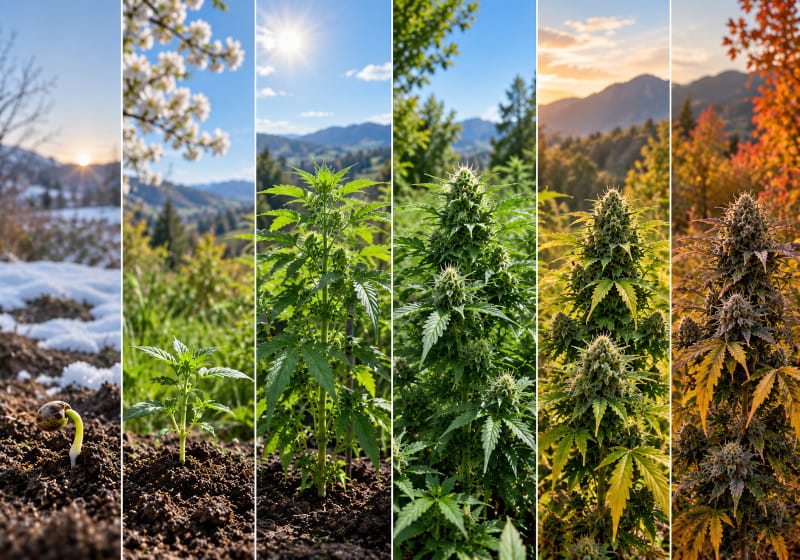
With outdoor cultivation, the season plays a much greater role than indoors. Especially with photoperiod cannabis plants, the natural change in day length influences the transition from vegetative growth to flowering. The following months serve as a rough guide for Central Europe: The actual timing can vary considerably between southern France, Austria, northern Germany, coastal regions and Alpine areas.
| Month | What typically needs to be done? | What can shift the timing? |
|---|---|---|
| March | Plan the outdoor season and choose the location and genetics. Depending on the region, starting plants indoors or in a protected environment may already become relevant. | Region, late frost, elevation, genetics |
| April | Continue raising young plants started in advance and monitor weather conditions. In many places, it may still be too early for plants to remain outdoors permanently. | Night temperatures, late frost, weather, microclimate |
| May | For many Central European locations, the typical window for moving plants outdoors now begins. | Late frost, night temperatures, region, location |
| June | Long days support vegetative development in photoperiod plants. Growth, water requirements and available root space become increasingly important. | Sunlight exposure, temperature, water supply, genetics |
| July | Vegetative growth continues to dominate in many photoperiod plants. Depending on genetics and location, the first changes may begin to appear toward the end of the month. | Day length, latitude, genetics, location |
| August | For many outdoor photoperiod plants, flowering now begins or is already in an early stage. Plant structure and flower development should be monitored more closely. | Genetics, latitude, day length, weather |
| September | Flowering progresses significantly in many strains. With early genetics, maturity checks may already become relevant, while weather conditions become increasingly important. | Time to maturity, precipitation, humidity, temperature, genetics |
| October | For many photoperiod strains, the possible harvest window falls within this period. Later-maturing genetics, however, may need considerably longer. | Actual maturity, weather, location, genetics |
You can find more about choosing a location, climate and the particular features of an outdoor season in our detailed guide to growing cannabis outdoors. For additional regional guidance, you can also use our cannabis climate map.
Autoflower vs. Photoperiod: What Changes in the Calendar?
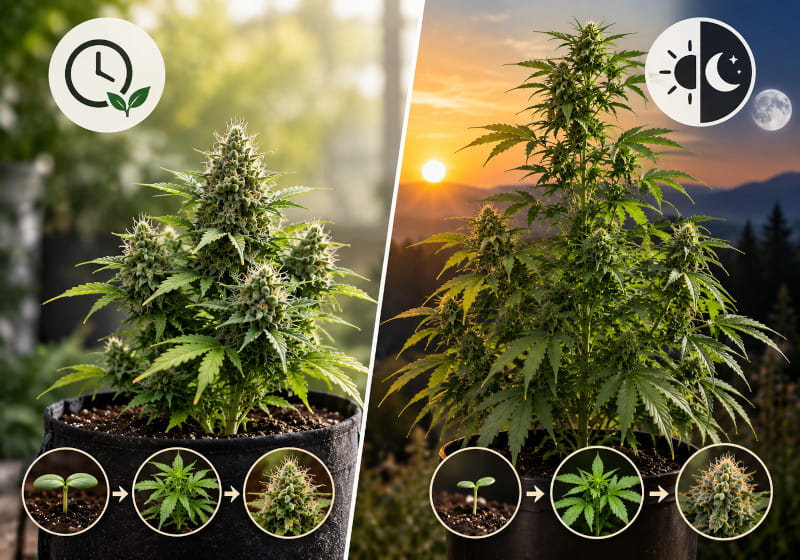
For the grow calendar, it makes a significant difference whether an autoflower or a photoperiod cannabis strain is grown. Photoperiod plants respond to the duration of the daily light and dark periods when transitioning to flowering. Autoflowering genetics, by contrast, begin flowering largely independently of day length. As a result, their vegetative phase is less flexible to plan and the overall grow cycle is often more compact.
| Calendar point | Photoperiod Cannabis | Autoflower |
|---|---|---|
| Vegetative Stage | Indoors, timing can largely be controlled through the light cycle | Less flexible and more strongly determined by genetics and age |
| Start of Flowering | Largely influenced by the photoperiod | Begins largely independently of day length |
| Indoor Planning | The timing of the transition to flowering can be deliberately influenced | The time window for vegetative growth and training is more limited |
| Outdoor Season | The start of flowering and the course of the season are closely linked to natural day length | The start of flowering is much less dependent on seasonal changes in day length |
| Planning in the Calendar | Take into account the stage of development, light cycle and, for outdoor plants, the season | Monitor the stage of development and expected total duration particularly closely |
These differences affect not only the start of flowering, but also when repotting, training and other tasks can be scheduled appropriately. Anyone planning a grow with autoflowering strains can find detailed information about their specific characteristics in our guide to autoflowering cannabis.
Why the Cannabis Grow Calendar Does Not Use Fixed Dates
A cannabis grow calendar would be especially simple if every task could be assigned to a fixed week. In practice, however, cannabis does not develop according to a universal schedule. Even plants of the same strain can grow or mature at different rates. Timing differences can be even greater between different genetics, cultivation methods and locations.
Genetics: Strains differ, among other things, in growth rate, start of flowering and maturation time.
Indoor or Outdoor: Indoors, light and other environmental conditions can be controlled more closely. Outdoors, day length, season and weather additionally determine the timeline.
Autoflower or Photoperiod: Photoperiod plants and autoflowers differ mainly in what determines the transition to flowering.
Substrate and Root Space: Pot volume, substrate and root development influence when repotting and changes in water and nutrient requirements become relevant.
Climate and Location: Temperature, humidity, light and other environmental conditions can accelerate or delay growth and development.
Actual Stage of Development: For many decisions, the condition of the plant is more informative than a specific grow week or calendar date.
This is exactly why our interactive cannabis grow calendar uses time windows and development stages instead of a rigid weekly schedule. It helps you determine which tasks and checks become relevant at each stage. For precise instructions, the respective links lead to detailed specialist articles.
Frequently Asked Questions About the Cannabis Grow Calendar
How Long Does Cannabis Take from Seed to Harvest?
How long cannabis takes from seed to harvest depends primarily on genetics, cultivation method and the duration of the individual development stages. Autoflowering genetics often go through a more compact overall cycle. With photoperiod plants, the vegetative stage in particular can be set to different lengths indoors. Outdoors, the season, day length and climate also come into play. Our detailed article on the growth stages of cannabis explains how germination, vegetative growth and flowering follow one another biologically.
Is There a Fixed Cannabis Grow Plan by Week?
No, there is no universally applicable cannabis grow plan by week. Week-by-week estimates can serve as a guide, but plants do not always develop at the same pace. Especially when repotting, topping, fertilizing, watering and determining the harvest time, the actual stage of development should therefore be given more weight than a fixed figure such as “week 4” or “week 8”.
When Does the Outdoor Cannabis Season Begin?
In Central Europe, late spring is often an important period for starting outdoors. However, there is no universally valid date. Late frost, night temperatures, elevation, region and microclimate can shift the appropriate timing considerably. You can find monthly guidance above in the Cannabis Outdoor Calendar. You can also find detailed information on planning an outdoor season in our guide to growing cannabis outdoors.
Is the Cannabis Grow Calendar the Same Indoors and Outdoors?
No. Indoors, a grow can be planned more closely around development stages and controllable conditions. Outdoors, the season, natural day length and regional weather conditions also come into play. That is why our interactive cannabis grow calendar distinguishes between indoor and outdoor cultivation.
Does the Grow Calendar Differ for Autoflower and Photoperiod Cannabis?
Yes. In photoperiod plants, the transition to flowering is strongly influenced by the daily light and dark periods. Autoflowering cannabis, by contrast, begins flowering largely independently of day length. As a result, the planning of the vegetative stage and the possible timing of tasks such as repotting or training differ in particular. The key differences are shown in the section Autoflower vs. photoperiod. You can find more information in our detailed guide to autoflowering cannabis.
Why Does the Calendar Not Show Fixed Fertilizing or Watering Days?
Because water and nutrient requirements cannot be derived from a plant’s age alone. Substrate, pot size, root space, climate, stage of development and previous nutrient supply influence when watering or nutrient supply should be adjusted. Fixed days of the week would therefore suggest a level of precision that does not exist in practice. Detailed information can be found in our guides to watering cannabis correctly and fertilizing cannabis correctly.
Sources and Further Information
The following specialist publications, among others, were consulted for the scientific assessment of plant development, photoperiod, flowering onset and autoflowering:
- Morphological Characterization of Cannabis sativa L. Throughout Its Complete Life Cycle
- Inflorescence development in female cannabis plants is mediated by photoperiod and gibberellin
- A FLOWERING LOCUS T ortholog is associated with photoperiod-insensitive flowering in hemp (Cannabis sativa L.)
- Identification and mapping of major-effect flowering time loci Autoflower1 and Early1 in Cannabis sativa L.