CBD for Sleep Problems: Effects & Studies
CBD for Sleep Problems: Effects, Use & Studies
Updated: August 2026 | CBD for sleep, current studies, timing of use, dosages in research, CBD & melatonin, and safety
Author: Cannapot Grow Team | Reading time: approximately twenty-five minutes
The Most Important Points at a Glance
✓ CBD is often used for sleep problems, but the current clinical evidence is insufficient to classify cannabidiol as a reliably effective treatment for insomnia.
✓ A randomized pilot study using 150 mg of CBD per night found no significant advantage over placebo for most of the sleep parameters examined; however, some objective measurements differed.
✓ A study using 300 mg of CBD plus terpenes showed a small change in certain sleep stages, but no improvement in total sleep duration.
✓ A study published in 2026 found better results with 300 mg of CBD than with 50 mg for individual sleep measures, but no statistically significant advantage over placebo.
✓ Percentages such as 10%, 20%, or 30% describe the CBD concentration of a product. They do not automatically indicate how much CBD is taken or whether a certain amount affects sleep.
✓ CBD can cause side effects and drug interactions. Especially with regular medication use, pregnancy, or breastfeeding, CBD should not be used without professional medical advice.
Does CBD Help with Sleep Problems?
Whether CBD helps with sleep problems has not yet been reliably established scientifically: controlled studies provide some positive signals, but so far they show no consistent benefit compared with placebo.
Sleep problems can take very different forms. Some people lie awake for a long time, others wake frequently during the night, sleep too little overall, or do not feel rested in the morning despite spending enough time in bed. That is why the statement “CBD improves sleep” is scientifically too imprecise. What matters is which sleep parameter is being studied and in which group of people.
CBD and sleep are part of a broader field of research on cannabinoids and health. You can find an overview of medical applications, scientific evidence, and the limitations of current research under Cannabis, Medicine & Health.
The situation is particularly complex for CBD. Even the fundamental CBD effects depend on various biological and pharmacological factors. Studies on sleep problems also differ in dose, route of administration, duration, number of participants, and product composition. Some examine pure CBD, while others test formulations containing additional plant compounds. Results from such a study cannot automatically be applied to every commercially available CBD oil.
What Does a Sleep Disorder or Insomnia Actually Mean?
Insomnia refers to persistent difficulty falling asleep or staying asleep, or impaired sleep quality despite adequate opportunity for sleep, when this results in meaningful daytime impairment.
Not every bad night is a sleep disorder. Temporary problems can arise, for example, from stress, travel, unusual sleep schedules, noise, alcohol, caffeine, or distressing events. Recurrent or persistent symptoms, however, should not simply be masked with a sleep product because very different causes may be involved.
For chronic insomnia, cognitive behavioral therapy for insomnia (CBT-I) is considered the evidence-based first-line treatment. Sleep hygiene is useful, but by itself it does not constitute the full treatment of chronic insomnia.
What Does Current Research Say About CBD and Sleep?
Current research presents a mixed picture: in some studies, CBD affects certain sleep or well-being parameters, but a stable and clinically convincing effect on insomnia has not yet been demonstrated.
Randomized, placebo-controlled studies are particularly informative because they control expectations and other confounding factors more effectively. These studies in particular show why sweeping claims about CBD for sleep are problematic. A positive result for a single measure does not automatically mean that people fall asleep faster, sleep longer, and feel better the next morning.
|
Study |
Amount Studied |
Participants |
Key Finding |
| Narayan et al., 2024 | 150 mg CBD pro Nacht | 30 people with primary insomnia | No difference from placebo for most sleep measures; some objective or secondary outcomes favored CBD. |
| Wang et al., 2025 | 300 mg CBD + 8 mg Terpene | 125 people with insomnia | Small increase in the proportion of deep and REM sleep; no improvement in total sleep duration. |
| Randomized Study, 2026 | 50 mg or 300 mg CBD daily | 63 people with pronounced tendency to worry | 300 mg performed better than 50 mg for certain sleep measures, but not statistically significantly better than placebo. |
What Did the Study with 150 mg of CBD for Insomnia Show?
In a small randomized study, 150 mg of CBD per night did not improve most key sleep parameters significantly more than placebo.
In the 2024 pilot study published in the Journal of Clinical Sleep Medicine 15 participants received CBD and 15 received placebo. Administration was sublingual approximately 60 minutes before bedtime for two weeks. The study assessed, among other things, insomnia severity, sleep onset latency, sleep efficiency, and wake time after sleep onset.
There was no significant difference between CBD and placebo in insomnia severity, subjective sleep onset time, subjective sleep efficiency, or nighttime wakefulness. After two weeks, however, objectively measured sleep efficiency showed a difference in favor of CBD. The authors nevertheless interpreted the overall picture cautiously and called for larger controlled studies.
What Did the Study with 300 mg of CBD and Terpenes Show?
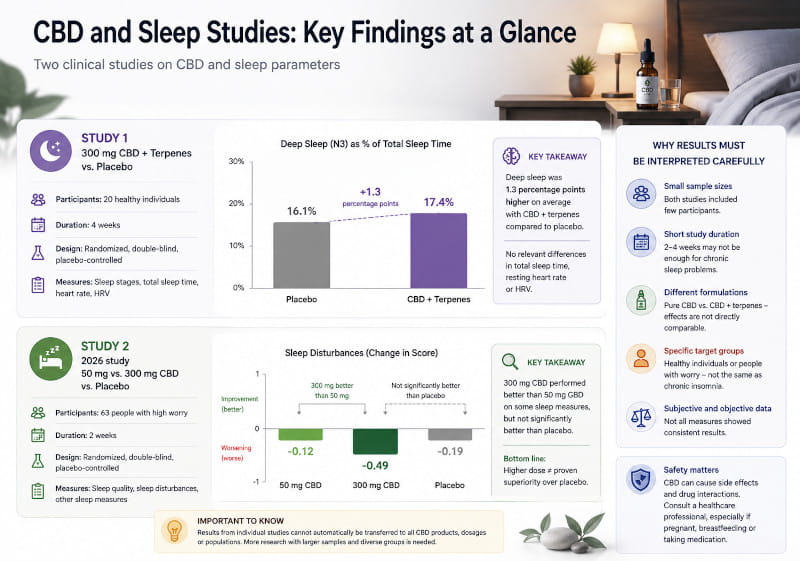
A formulation containing 300 mg of CBD and several terpenes slightly increased the measured proportion of deep and REM sleep, but did not extend total sleep time.
The placebo-controlled crossover study examined 125 people with insomnia. It did not use ordinary CBD oil, but rather a defined oral formulation of CBD and eight terpenes. The primary endpoint was the combined proportion of slow-wave sleep and REM sleep, measured with a wearable sleep tracker.
On average, this proportion was 1.3 percentage points higher with the CBD-terpene formulation than with placebo. This is statistically interesting, but should not be equated with a general improvement in sleep. Total sleep duration, resting heart rate, and heart rate variability did not differ meaningfully. In addition, the study cannot determine how much of the result was attributable to CBD and how much to the added terpenes.
What Is Particularly Interesting About the CBD Sleep Study?
The study published in 2026 argues against a simple dose-response narrative, because although 300 mg of CBD performed better than 50 mg on certain sleep measures, it was not statistically significantly better than placebo.
The randomized double-blind study included 63 people with a pronounced tendency to worry. For two weeks, they received either 50 mg of CBD, 300 mg of CBD, or placebo daily. The higher CBD dose showed a greater improvement in sleep disturbance and sleep quality compared with 50 mg. However, this difference did not reach statistical significance compared with placebo.
This comparison is particularly important for practical interpretation. The fact that a higher dose performs better than a lower dose does not prove that the substance itself is more effective than a placebo treatment. The authors therefore emphasize that further research is needed.
Can CBD Help You Fall Asleep?
There is currently no convincing clinical evidence that CBD reliably shortens the time it takes to fall asleep.
Sleep onset latency is a separate measure and should not be confused with overall sleep quality. In the 150 mg insomnia study, self-reported sleep onset latency did not differ significantly between CBD and placebo. Other studies sometimes examine people with stress, worry, or other accompanying conditions and therefore can only be applied to primary insomnia to a limited extent.
If rumination, stress or physical discomfort make it harder to fall asleep, the subjective experience may also be influenced by these factors. However, this does not mean that CBD is a specific treatment for sleep-onset problems.
Can CBD Help You Stay Asleep?
It has also not yet been shown that CBD reliably works better than placebo for frequent nighttime awakenings.
For sleep maintenance, studies assess, among other things, the number of nighttime awakenings and so-called wake after sleep onset time. In the controlled 150 mg study, there was no significant treatment advantage for nighttime wakefulness. Individual objective sleep values may nevertheless change without all other parameters improving at the same time.
Does CBD Make You Tired?
CBD is not a conventional sleep medication, but it can cause drowsiness or fatigue in some people; others may not experience this effect.
A possible side effect should not be equated with a therapeutic sleep effect. Drowsiness, for example, says nothing about whether sleep onset time, deep sleep, total sleep duration, or daytime functioning actually improve. Dose, product composition, individual sensitivity, and concurrently used medications can also alter perception.
Particular caution is advised when combining CBD with alcohol, sedating medications, or other substances that can reduce alertness or wakefulness. This can intensify sedation.
When Should You Take CBD Before Sleep?
There is no scientifically established optimal time for taking CBD for sleep problems.
In the 150 mg study, CBD was taken sublingually about 60 minutes before bedtime. In the study of the CBD-terpene formulation, the capsules were also taken approximately one hour before sleep. This shows how the respective research protocols were designed, but it does not define a generally optimal time for CBD oil, capsules, or other products.
Absorption and timing can differ depending on the form of administration. Therefore, the timing used in a capsule study cannot simply be transferred to every oil, food product, or other CBD product.
How Much CBD Is Studied in Sleep Research?
Recent controlled sleep studies have examined very different amounts of CBD, including 50 mg, 150 mg, and 300 mg per day or night.
This range makes it clear that there is currently no scientifically established standard dose of “CBD for sleep.” The amounts studied come from specific study protocols using defined preparations and participant groups. They should not be interpreted as individual dosing recommendations. We explain in detail how CBD amounts can generally be interpreted and calculated in our guide to CBD Dosage.
More importantly, more is not automatically better. Although the published study showed differences between 300 mg and 50 mg, the higher dose did not provide a statistically significant advantage over placebo. A serious dosage assessment must therefore consider efficacy and safety separately.
What Do 10%, 20%, or 30% CBD Mean in an Oil?
10%, 20%, or 30% CBD describe the concentration of the product, not automatically the actual dose of CBD consumed.
A higher percentage means that the same amount of product contains more CBD. However, bottle size, total CBD content, and the amount used are also crucial for determining the actual intake. Two people can therefore use the same 20% oil and still consume different amounts of CBD.
The percentage also does not indicate whether a product is effective for sleep problems. Clinical studies use defined milligram amounts and precisely described formulations. A percentage on a bottle is therefore not directly equivalent to a study dose.
Is CBD Oil for Sleep Better Studied Than Other Forms?
No over-the-counter CBD product form is currently studied well enough to be considered the best option for sleep problems in general.
Studies use, among other things, sublingually administered CBD, capsules, or specially developed formulations. These differ not only in dosage form, but also in purity, accompanying ingredients, and CBD amount. Even results obtained with sublingual CBD therefore cannot automatically be applied to every commercial CBD oil.
You can find basic information about cannabidiol, its classification, and its properties in our CBD guide. CBD-rich cannabis strains should be distinguished from this as plant genetics: they can differ, among other things, in their cannabinoid profile, genetic origin, and the ratio of different cannabinoids. You can learn more about these differences in our overview of CBD Strains and CBD Genetics You can also find a selection of corresponding genetics in the category CBD Seeds.
CBD or Melatonin – What Is the Difference?
CBD and melatonin are fundamentally different substances: melatonin is an endogenous hormone involved in circadian timing, while CBD is a cannabinoid from cannabis.
Melatonin signals biological night to the body and plays a central role in the sleep-wake cycle. CBD, by contrast, acts on various biological signaling pathways and does not have a comparable role as an endogenous timing signal. That is why the question “CBD or melatonin?” is not a simple comparison between two similar sleep aids.
The evidence and appropriate areas of use also differ. Whether melatonin is suitable depends, among other things, on the type of sleep problem and the circadian rhythm. A reliable treatment effect of CBD for insomnia has not currently been demonstrated.
Can CBD and Melatonin Be Combined?
CBD and melatonin are offered together in some products, but that does not mean the combination is more effective or safe for everyone.
Combination products also make interpretation more difficult: if sleep changes, it is hard to determine which ingredient was responsible without suitable comparison groups. Other components such as CBN, plant extracts, or terpenes may also be included.
Anyone taking medication or regularly using other sedating substances should have such combinations assessed particularly carefully by a doctor or pharmacist. Several substances that cause drowsiness can impair alertness more strongly.
What Side Effects Can CBD Have?
CBD is not automatically free of side effects; possible risks include fatigue or drowsiness, gastrointestinal complaints, liver values, and interactions with medicines.
The safety profile depends on dose, duration of use, product quality, concomitant medication, and individual factors. Findings from the approved CBD medicine show, among other things, that clinically relevant drug interactions and changes in liver values are possible. Some of these data come from higher medical doses and cannot be transferred one-to-one to every over-the-counter product; however, they show why “plant-based” should not be equated with “risk-free.”
In 2026, EFSA derived a provisional safe level of 0.0275 mg per kilogram of body weight per day for certain highly purified CBD food supplements because important data gaps remain, corresponding to approximately 2 mg per day for a 70 kg adult. This cautious safety assessment is not an effective dose and is far below the substantially higher amounts examined in some sleep studies.
Can CBD Interact with Medications?
Yes, CBD can affect the metabolism of other medicines and thereby alter their effects or side effects.
CBD is metabolized through liver enzyme systems and can be involved in drug interactions. This is particularly relevant with regular use of prescription medicines, drugs with a narrow therapeutic range, and products that are themselves sedating or can affect the liver.
Anyone taking medication should therefore not make decisions based solely on online dosage tables. A doctor or pharmacist can assess whether known or plausible interactions exist with the specific medication.
Who Should Be Particularly Cautious with CBD?
Particular caution is advised during pregnancy and breastfeeding, with regular medication use, in people with liver problems, and in anyone for whom reduced alertness would pose a safety risk.
There are substantial data gaps for pregnant and breastfeeding people, so self-directed use is discouraged. In 2026, EFSA was also unable to establish the safety of CBD as a novel food for people under 25 and for those taking medication. Anyone who feels tired or drowsy after taking CBD should not perform activities that require full attention.
Why Does CBD Not Work for Some People?
Differences in how CBD is experienced subjectively may be due to the cause of the sleep problem, expectations, dose, product composition, absorption, and individual biological differences.
Sleep is not a single mechanism. Pain, stress, depression, anxiety, shift work, sleep apnea, restless legs, alcohol, medications, irregular sleep schedules, or chronic insomnia can cause similar symptoms. A substance that influences a single biological process therefore does not necessarily have the same effect across all causes.
Sleep problems can also be part of a more complex symptom picture in serious illnesses. We explain in more detail the role cannabinoids may play, for example, in symptoms related to cancer and where the scientific limitations lie under Cannabis and Cancer.
The placebo effect can also be relevant in sleep studies. Expectations, a new evening routine, and the hope of better sleep can influence subjective ratings. This is exactly why blinded placebo comparisons are especially important when evaluating CBD.
What Role Does Sleep Hygiene Play Alongside CBD?
Sleep hygiene can create favorable conditions, but in chronic insomnia it does not replace targeted diagnosis or evidence-based treatment.
Helpful measures include keeping sleep times as regular as possible, maintaining a dark and quiet bedroom, being mindful of late caffeine and alcohol, and getting enough daylight and physical activity. However, people who spend long periods awake in bed often develop learned associations between the bed, wakefulness, and tension. CBT-I addresses these patterns with structured behavioral and cognitive methods.
CBD should therefore not lead people to overlook obvious causes or a sleep disorder that requires treatment. In particular, loud snoring with pauses in breathing, pronounced daytime sleepiness, persistent sleep problems, or severe psychological distress are reasons to seek professional assessment.
How Should the Evidence on CBD and Sleep Be Interpreted?
The current evidence shows research signals for individual sleep parameters, but CBD has not yet been proven to be a reliably effective treatment for sleep disorders.
This means neither that CBD is fundamentally ineffective nor that a sleep-promoting effect has been reliably demonstrated. Larger and longer-term studies with clearly defined patient groups, standardized preparations, and clinically relevant endpoints are needed for robust conclusions.
For future research, it will be especially important to distinguish pure CBD from combination products, compare different doses directly, and combine subjective reports with objective sleep measurements. This could make it possible to assess more precisely whether certain groups of people may benefit from CBD and what role dose and form of administration play.
Which Sources Are Particularly Helpful for CBD and Sleep?
For evaluating CBD in relation to sleep problems, randomized clinical studies, sleep medicine guidelines, and current safety assessments from expert authorities are particularly relevant.
The following sources allow for a more detailed review of the evidence described in the article. Study results should always be interpreted in the context of study design, number of participants, dose, preparation, and the endpoint examined.
- Narayan et al.: 150 mg CBD for moderate to severe insomnia – randomized pilot study
- Wang et al.: CBD-terpene formulation for insomnia – randomized crossover study
- Randomized study 2026: 50 mg and 300 mg CBD for sleep disturbance and pronounced tendency to worry
- American Academy of Sleep Medicine: Behavioral treatment of chronic insomnia
- EFSA 2026: Provisional safe level for cannabidiol as a novel food
- FDA: Safety risks and interactions of CBD
- Wikipedia: Cannabidiol
- Wikipedia: Insomnia
FAQs
Q: Does CBD help with sleep?
A: Research provides some indications of changes in certain sleep parameters, but so far it does not reliably show that CBD improves sleep problems in general.
Q: Does CBD help you fall asleep?
A: A reliable reduction in sleep onset time compared with placebo has not currently been demonstrated.
Q: Does CBD help you stay asleep?
A: There is also no consistent evidence of efficacy for nighttime awakenings or wake time after sleep onset.
Q: Does CBD make you tired?
A: Fatigue or drowsiness can occur, but these effects vary between individuals and are not equivalent to a proven treatment for insomnia.
Q: How long before sleep should CBD be taken?
A: There is no scientifically established optimal time. Some clinical studies used CBD approximately 60 minutes before bedtime.
Q: How much CBD has been used in sleep studies?
A: Recent controlled studies examined, among other amounts, 50 mg, 150 mg, and 300 mg. These research doses are not dosing recommendations.
Q: Is 20% CBD better for sleep than 10%?
A: No. The percentage describes the concentration of a product and proves neither a stronger effect on sleep nor an appropriate individual dose.
Q: What does 30% CBD mean?
A: The figure describes a high CBD concentration in the product. The amount of product used must be taken into account to determine the actual intake.
Q: Is CBD oil for sleep scientifically proven?
A: No. There is clinical research on CBD and sleep, but no robust evidence that commercially available CBD oil reliably treats insomnia.
Q: Is CBD a sleep medication?
A: CBD should not be equated with an approved sleep medication. Its efficacy for insomnia has not been sufficiently demonstrated.
Q: Can CBD and melatonin be taken together?
A: Combination products exist, but an additional benefit has not been reliably demonstrated. When medications or other sedating substances are used, the combination should be discussed with a healthcare professional.
Q: Does CBD have side effects?
A: Yes. Possible effects include fatigue, gastrointestinal complaints, changes in liver values, and drug interactions.
Q: Can CBD interact with sleeping pills?
A: Interactions are possible. In particular, when combined with sedating medicines, impairment of alertness may increase.
Q: Why are experiences with CBD and sleep so different?
A: Sleep problems have different causes, while product composition, dose, expectations, and individual responses also vary.
Q: What is advisable for persistent sleep problems?
A: Recurrent or chronic symptoms should be assessed professionally. For chronic insomnia, CBT-I is considered the evidence-based first-line treatment.