Aphids on Cannabis: How to Get Rid of Them
Recognizing an aphid infestation, assessing it correctly and controlling it effectively
Updated: August 2026 | Learn how to reliably recognize aphids on cannabis, what sticky leaves and honeydew mean, why ants can be an important clue, and which mechanical, biological and preventive measures make sense depending on the severity of the infestation.
Author: Cannapot Grow Team | Reading time: approximately twenty-five minutes
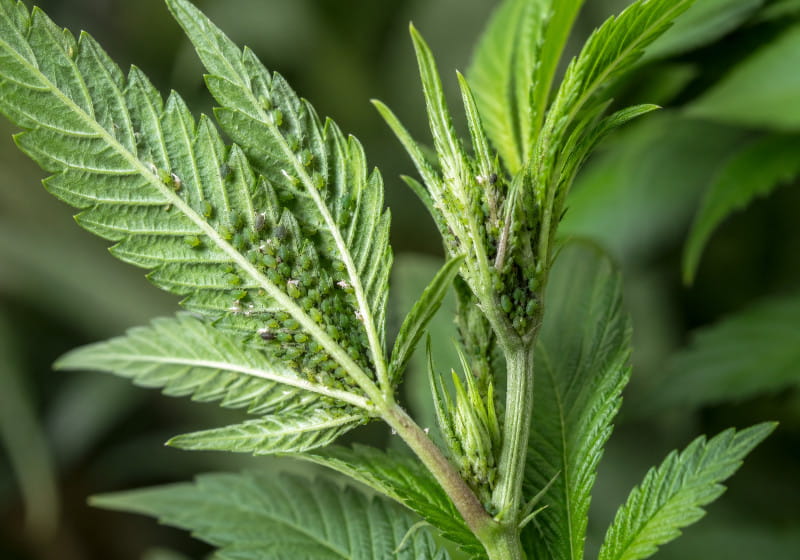
The most important points at a glance
✓ Aphids are small sap-sucking insects that prefer to settle on the undersides of leaves, young shoots, shoot tips and leaf stalks. Cannabis can be affected by the cannabis aphid Phorodon cannabis, among others, although other aphid species may also occur depending on the region and growing conditions.
✓ An infestation can often be recognized by small green, yellowish, brownish or dark aphids sitting in groups on the plant. Other typical signs include sticky or shiny leaves, white shed skins, and curled or deformed young leaves.
✓ Sticky leaves are caused by so-called honeydew. This sugary liquid is excreted by aphids and can collect on leaves and shoots. In more severe infestations, dark sooty mold fungi can also develop on the sticky coating.
✓ An unusually high number of ants on a cannabis plant can also indicate aphids. They are attracted by the sweet honeydew and may even protect aphid colonies from natural enemies such as ladybirds, lacewing larvae, hoverfly larvae or parasitic wasps.
✓ With a light infestation, aphids can often still be controlled through regular checks and mechanical removal. If larger colonies have already formed, beneficial insects such as lacewing larvae, ladybird larvae, parasitic wasps or the aphid predatory midge Aphidoletes aphidimyza can help.
✓ During flowering, particular care is required with spray treatments. Aphids should then be removed mechanically wherever possible or reduced with suitable beneficial insects in order to avoid additional moisture and unwanted residues on the flowers.
Sticky leaves, tiny green or dark insects and an unusually high number of ants are among the classic signs of aphids on cannabis. Especially in the early stages, however, an aphid infestation can easily be overlooked: the insects prefer sheltered areas, reproduce quickly and can vary so much in color that they are not always immediately recognized as aphids.
For a reliable diagnosis, you should therefore not look only for the insects themselves. The combination of visible colonies, honeydew, white shed skins and changes in young plant tissue is particularly informative. Which countermeasure makes sense then depends on whether you find only individual insects or larger colonies are already present, and whether the plant is still growing or has already started flowering.
How can you recognize aphids on cannabis?
Aphids are small, soft-bodied insects that usually occur in groups. They are especially common on the undersides of leaves, young shoots and shoot tips. Sticky leaves caused by honeydew and white shed skins are further typical signs of an infestation.
Aphids feed on the sap of the cannabis plant. With their fine mouthparts, they pierce the plant tissue and suck the sugar-rich sap from the vascular system. In larger colonies, this constant withdrawal of sap can weaken young plant parts in particular and impair their development. At the same time, the insects excrete honeydew, which appears as a sticky or shiny coating on leaves and shoots.
This makes the damage pattern quite different from that of other common cannabis pests. Thrips, for example, tend to leave silvery or scraped-looking patches on the leaves, while spider mites can cause fine pale speckling and later webbing.
What do aphids look like?
Aphids are tiny insects that usually grow to only a few millimeters in size. Their soft body is oval to slightly pear-shaped. Depending on the species and stage of development, they can be green, yellowish, light brown, gray, reddish or almost black. Young aphids already look very similar to the adults, but are significantly smaller.
A typical feature of many aphid species is a pair of small tube-shaped projections on the abdomen. They are difficult to see with the naked eye, but can help with identification when using a magnifying glass. The cannabis aphid Phorodon cannabis prefers sheltered areas such as leaf undersides and young shoots. In a heavier infestation, however, the insects can spread to other parts of the plant and also occur on stems or near the flowers.
Where do aphids sit on a cannabis plant?
Check soft and young plant tissue first. Aphids are especially common on the undersides of leaves, along larger leaf veins, on leaf stalks, young shoots, shoot tips and newly formed leaves. In a heavier infestation, they can spread over larger parts of the plant and may also occur near flower clusters or on flower stems.
Leaf undersides are particularly important for diagnosis. There, aphids are less exposed to direct sunlight, air movement and mechanical disturbance. Small colonies on the underside of a downward-hanging leaf are also easy to miss, even though honeydew may already be shining on the upper surface.
Green, black or winged aphids – what are the differences?
Color alone says little about how dangerous an infestation is. Green aphids can camouflage themselves extremely well on plant tissue, while dark or black forms are more noticeable. Different color morphs can also occur within the same aphid species.
Wingless aphids make up the majority of a growing colony. Winged forms develop especially when populations spread or new host plants are colonized. Individual winged aphids can therefore be an indication that new plants are being reached. However, they are not automatically a different aphid species.
| Quick diagnosis | Typical indication | What you should check |
| Insects | Small, soft-bodied, rather pear-shaped insects; often in colonies | Check leaf undersides, leaf veins, young shoots and shoot tips with a magnifying glass |
| Sticky leaves | Shiny or sticky coating caused by honeydew | Look above the sticky leaf for colonies on higher leaves or shoots |
| White particles | Empty, pale shed skins from young aphids | Check whether the white remains look hollow and are located near a colony |
| New growth | Curled, deformed or weakened young leaves and shoots | Look for insects under curled leaf edges and at the shoot tip |
| Ants | Several ants repeatedly move to the same young plant parts | Look specifically for honeydew and aphid colonies; ants alone do not prove an infestation |
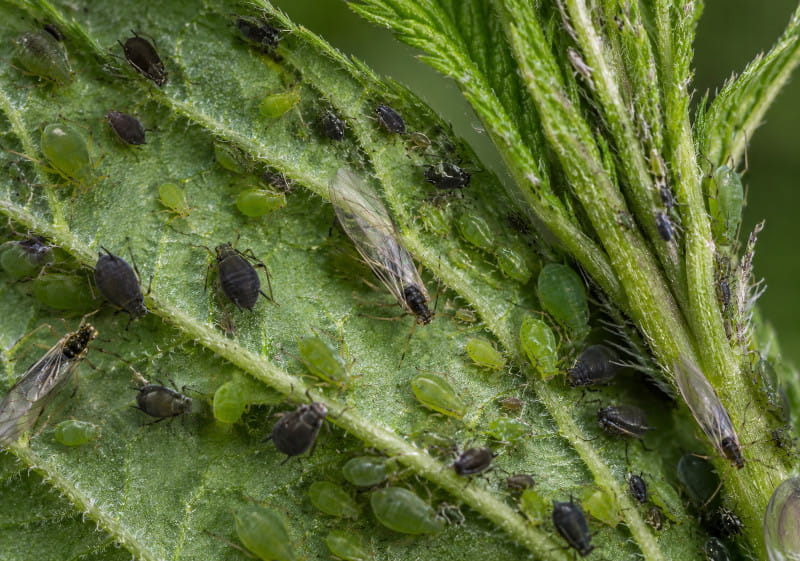
What symptoms do aphids cause on cannabis?
Typical symptoms include deformed or curled young leaves, weakened shoots, slower growth, sticky honeydew and, with longer-lasting or more severe infestations, yellowing. Young plants usually react more sensitively than large, established plants.
Aphids continuously remove phloem sap from the plant. This is the sugar- and nutrient-rich plant sap that travels through the vascular tissue and, among other things, transports the sugars produced in the leaves to other parts of the plant. A single aphid causes hardly any visible damage to a vigorous plant. The situation becomes problematic when colonies develop and numerous young and adult aphids feed on the plant parts at the same time. Growth can then visibly slow down and fresh growth may develop unevenly.
Curled and deformed young leaves
Young tissue is still actively developing and reacts particularly clearly to sustained feeding damage. Leaves may curl, crinkle or unfold asymmetrically. At the same time, aphids find additional protection in curled areas, which means a small infestation can remain unnoticed during a quick inspection of the plant.
Weakened shoots and slower growth
As the infestation increases, new growth may appear weaker, internodes and leaves may develop less evenly, and heavily colonized shoot tips may lag behind in growth. Slight yellowing can also occur. However, such symptoms are not specific to aphids and should always be assessed together with visible insects, honeydew or shed skins.
White shed skins on leaves and shoots
Young aphids molt several times during their development. What remains are very light, whitish to translucent empty skins. On a sticky layer of honeydew, these shed skins can literally stick in place. As a result, infested leaves can sometimes look as though they are covered with small white particles.
These shed skins are sometimes confused with whiteflies, mold or mineral residues. With a magnifying glass, it is often possible to see that they have the shape of a small insect body and are hollow. In combination with living aphids, they are a very useful diagnostic clue.
Why are cannabis leaves sticky when aphids are present?
Sticky cannabis leaves in an aphid infestation are usually caused by honeydew. Aphids have to ingest large amounts of sugar-rich phloem sap and excrete excess water and sugar again as a sticky liquid.
What is honeydew?
Phloem sap contains a lot of sugar, while nitrogen compounds and amino acids important to aphids are present in comparatively lower concentrations. To obtain enough of these nutrients, aphids have to process large quantities of plant sap. They excrete the excess water and carbohydrates again as honeydew.
Fresh honeydew first appears as small clear droplets. As the amount increases, it forms a shiny, sticky film on leaves, stems or other plant parts below. Dust, pollen and shed skins adhere to it particularly easily. With a more severe infestation, the surface can therefore quickly look dirty.
Honeydew is especially valuable for diagnosis because it often becomes noticeable before the actual feeding damage is pronounced. If you notice sticky cannabis leaves for no obvious reason, specifically inspect the undersides of leaves and all shoot tips above them. Besides aphids, however, other honeydew-producing sap-sucking pests such as whiteflies, mealybugs or certain scale insects may also be responsible.
How do sooty mold and dark coatings develop?
So-called sooty mold fungi can settle on the sticky honeydew. They do not directly infect the plant tissue, but grow on the sugary excretions of the aphids. This creates gray to black coatings on the leaves that really do look a little like soot. If they spread extensively, they can cover the leaf surface and thereby impair the plant's photosynthesis.
Dark or black coatings on the leaves therefore do not automatically mean that the cannabis plants themselves are infected by a fungus. Often, the actual problem is the aphids and the honeydew they excrete. As long as honeydew continues to be produced, sooty mold fungi find favorable conditions. The aphid infestation should therefore be addressed first and foremost.
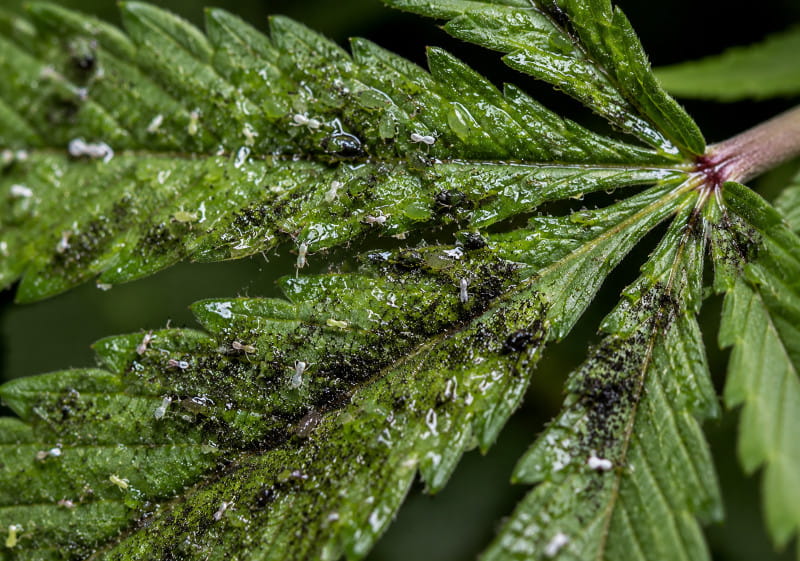
What do ants have to do with aphids?
Ants visit aphid colonies primarily because of the sugar-rich honeydew. Some ant species defend aphids against natural enemies, which means heavy ant activity can make biological aphid control more difficult.
Why ants protect aphids
For ants, the sweet honeydew produced by aphids is an easily accessible food source. They therefore visit aphid colonies regularly and consume the sugary excretions. In return, some ant species even defend the aphids against their natural enemies. Ladybird larvae, lacewing larvae or parasitic wasps can be attacked or driven away by the ants.
How pronounced this behavior is depends on the ant and aphid species involved. However, it can play an important role in control: if beneficial insects are introduced while numerous ants are guarding the aphid colonies, their effectiveness can be significantly reduced.
Are ants on cannabis an indication of aphids?
An unusually high number of ants on a cannabis plant can indeed indicate aphids. Individual ants, however, are not yet proof of an infestation. It becomes particularly noteworthy when several ants repeatedly visit the same leaf undersides, young shoots or shoot tips. In that case, you should inspect those areas more closely for aphids, sticky honeydew and white shed skins.
Especially when growing cannabis outdoors, this connection can be helpful for early detection. Aphid colonies are often well hidden between young leaves or on their undersides, while ants can already be noticeable from some distance away. However, many ants do not automatically mean that aphids are present, because other sap-sucking pests also produce honeydew and can attract ants.
How dangerous are aphids for cannabis plants?
A small aphid infestation that is detected early can usually be brought under control fairly well on a vigorous cannabis plant. It becomes problematic when larger colonies form, the infestation goes unnoticed for a longer period, or very young or already weakened plants are affected.
Aphids on seedlings and young plants
Seedlings and young cannabis plants still have little leaf mass and comparatively limited reserves. An aphid colony on the shoot tip can therefore affect them much more severely than a large, well-developed plant. You should take deformed new growth, clearly slowed growth or wilting young leaves particularly seriously.
Aphids during vegetative growth and stretch
During the vegetative phase and the so-called stretch, the strong growth spurt at the beginning of flowering, cannabis produces a great deal of fresh, soft plant tissue. These young shoots and leaves are exactly what aphids find attractive. A vigorous plant can often tolerate a small local infestation at first. The key factor, however, is whether the number of aphids increases during subsequent checks.
It is particularly unfavorable when several shoot tips are infested at the same time. The aphids are then sitting precisely on the areas where new leaves and later the flower clusters develop. You should therefore control an infestation as early as possible, before the plant becomes denser and hidden colonies are more difficult to detect.
Aphids during flowering
During flowering, an aphid infestation becomes more problematic mainly because control becomes more difficult. The insects can settle on stems and in sheltered areas around the flowers. At the same time, sticky honeydew can reach the flowers, and direct spray treatments should be viewed increasingly critically as flower density increases.
An infestation should therefore be reduced as early as possible. The further flowering progresses, the more important mechanical measures, suitable beneficial insects and an approach that leaves as little residue as possible become. We explain in detail how vegetative growth, stretch and flowering fit into the timeline in our guide to the cannabis grow cycle.
| Plant stage | Why aphids are problematic here | What matters now |
| Seedling / young plant | Little leaf mass and limited reserves make young plants particularly sensitive | Intervene early and prevent larger colonies from forming |
| Vegetative phase | Many young leaves and shoots provide suitable feeding sites for aphids | Monitor the infestation, reduce it mechanically and introduce beneficial insects early if necessary |
| Stretch | Rapid new growth and increasing plant density make spread easier and later inspections more difficult | Reduce the infestation significantly before denser flower formation if possible |
| Flowering | Aphids and honeydew can reach areas close to the flowers and control becomes more difficult | Prefer mechanical measures and suitable beneficial insects |
Why does cannabis get aphids?
Aphids do not appear because of incorrect care. They first have to reach the plant or be introduced. Certain conditions can then cause an existing population to reproduce particularly quickly.
How aphids are introduced indoors
Indoors, aphids often enter the growing area on plants or cuttings that are already infested. Especially small aphids can sit well hidden between young leaves, on leaf undersides or shoot tips and can easily be overlooked during the first inspection. Winged aphids can also enter the grow room through open windows, ventilation openings or from the surroundings of other plants.
Once aphids have been introduced, they can spread quickly indoors. In an enclosed grow room or a grow box, natural enemies such as ladybirds, lacewings or parasitic wasps are usually absent. At the same time, the aphids have continuous access to suitable plants and relatively stable conditions. As a result, a few unnoticed insects can turn into a much larger infestation within a short period of time.
How aphids reach plants outdoors
Outdoors, aphids usually reach cannabis plants as winged individuals. They can fly in from other plants in the surrounding area and then settle on young leaves and shoots. Which aphid species occur and how severe the infestation becomes depends, among other things, on the season, the surrounding vegetation and local conditions. Outdoors, it is hardly possible to prevent incoming aphids completely.
Outdoor cultivation does, however, have a natural advantage: numerous predators and antagonists of aphids live outside. Ladybirds, lacewings, hoverflies and various parasitic wasps can help prevent smaller aphid colonies from spreading unchecked.
Which other pests can occur outdoors and how to recognize them is explained in detail in our guide to outdoor cannabis pests.
Which conditions favor an infestation
How quickly aphids reproduce depends, among other things, on the aphid species, temperature, the condition of the plant and the number of natural enemies present. Many aphid species can reproduce for a time even without mating and give birth directly to live young. Under favorable conditions, a larger colony can therefore develop from only a few aphids within a short time.
The nutrition of the cannabis plant can also play a role. Excessive nitrogen supply often promotes especially soft and vigorous growth. This young plant tissue can be attractive to aphids and favor their reproduction. Too much nitrogen does not cause an aphid infestation, however – the insects must first reach the plant or be introduced.
How can aphids on cannabis be controlled?
Which method is most suitable depends mainly on the severity of the infestation. Individual aphids and small colonies can often still be removed mechanically. If the infestation spreads further, suitable beneficial insects can also be introduced.
Before reaching for different treatments, you should first get an accurate picture of the infestation. A few aphids on one shoot tip are much easier to eliminate than numerous colonies on several plants. Therefore inspect the entire crop: how many plants are affected? Are the aphids sitting only on individual shoots or already in many places? Do you see winged individuals? And how pronounced are the honeydew and visible plant damage already?
Remove individual aphids mechanically
You can carefully remove individual aphids or small colonies from the plant with your fingers, a soft cloth or a soft brush. Afterwards, inspect the undersides of the leaves, young shoots and neighboring plant parts particularly thoroughly. With a very light infestation, this simple method may already be sufficient if it is repeated consistently.
Rinse aphids off with water
On vigorous cannabis plants, aphids can also be carefully rinsed off with water. The water jet should be strong enough to dislodge the insects from leaves and shoots without damaging the plant. The undersides of the leaves are particularly important because larger colonies often hide there.
Indoors, make sure that the rinsed-off aphids do not land on neighboring plants. Water also rarely removes every single insect. Hidden aphids can remain and form a new colony. Therefore keep checking the plant repeatedly over the following days.
Remove heavily infested leaves and shoots
If individual leaves or small side shoots are particularly heavily covered with aphids, it can make sense to remove them selectively. This allows a large proportion of the pests to be eliminated at once. This is especially useful when the rest of the plant is still largely free of aphids. However, you should not unnecessarily remove too many healthy leaves.
Infested leaves and shoots should then be removed from the growing area immediately and disposed of. If you leave them next to the plants or on the substrate, surviving aphids can make their way back onto the cannabis plants.
When biological measures make sense
Beneficial insects are particularly useful when aphids are already appearing in several places or cannot be controlled sufficiently by mechanical removal alone. They also have the advantage that they do not leave spray residues on the plant. Which beneficial insect is most suitable depends, among other things, on the aphid species, the severity of the infestation and the growing conditions.
Parasitic wasps are particularly well suited to finding aphids early and limiting their further reproduction. Where colonies are already present, predatory beneficial insects such as lacewing larvae or aphid predatory midges can be helpful because their larvae specifically feed on aphids. We explain which species are suitable in more detail in the next section.
| Infestation severity | What you can do | What to keep in mind afterwards |
| Very light infestation | Wipe off individual aphids or rinse them off carefully; indoors, separate the affected plant from other plants if possible | Regularly inspect leaf undersides and shoot tips over the following days |
| Light to moderate infestation | Reduce aphid colonies mechanically, remove heavily infested leaves and introduce suitable beneficial insects if necessary | Watch for new aphids and check whether ants are interfering with natural enemies |
| Moderate infestation | Inspect all plants thoroughly, reduce larger colonies and introduce suitable beneficial insects in a targeted way | Also inspect neighboring plants and observe whether the number of aphids is decreasing |
| Severe infestation | Remove heavily infested plant parts and combine several suitable measures | Closely monitor the entire crop; during flowering, pay particular attention to honeydew and infested flower areas |
Which beneficial insects help against aphids on cannabis?
Various beneficial insects can be used against aphids. Ladybirds and their larvae, lacewing larvae, certain parasitic wasps and the aphid predatory midge Aphidoletes aphidimyza are particularly interesting. Outdoors, naturally occurring hoverfly larvae also help keep aphid colonies under control.
Which beneficial insect is best suited depends on the severity of the infestation, the aphid species present and the growing conditions. Some beneficial insects feed on different aphid species, while certain parasitic wasps are effective only against selected species. Temperature, humidity and previously applied plant protection products can also influence how well the beneficial insects develop and perform their task.
Ladybirds and ladybird larvae
Ladybirds are among the best-known natural enemies of aphids. Their larvae in particular are extremely voracious and can consume numerous aphids within a short time. For targeted use, ladybird larvae are often more suitable than adult beetles because adults can fly and may leave the growing area again.
Outdoors, different ladybird species also occur naturally. If you already find several ladybirds or their larvae on a plant that is only lightly infested, it may make sense to observe how the situation develops first. Natural enemies can often reduce smaller aphid colonies considerably.
Lacewing larvae
Lacewing larvae are also effective natural enemies of aphids. The lacewing Chrysoperla carnea is commonly used. Its larvae actively search for aphids and other small, soft-bodied pests and are therefore particularly well suited when several aphid colonies are already present.
The larval stage is especially relevant here: while adult lacewings feed mainly on pollen, nectar and honeydew, their larvae are the actual aphid hunters.
Parasitic wasps against aphids
Certain parasitic wasps can specifically locate aphids and limit their reproduction. These include, for example, species from the genera Aphidius, Aphelinus, Praon and Ephedrus. The tiny wasps lay their eggs inside aphids. The larva then develops inside the aphid until a characteristically swollen and dried-out shell remains. This is often referred to as an aphid mummy.
However, not every parasitic wasp species is suitable for every aphid. It is therefore important to select a beneficial insect that matches the aphid species present. If the exact species is unknown, mixtures of different parasitic wasps or predatory beneficial insects such as lacewing larvae may be the simpler choice depending on the situation.
Aphid predatory midge Aphidoletes aphidimyza
The aphid predatory midge Aphidoletes aphidimyza is a natural enemy of numerous aphid species. The adult midges specifically search for aphid colonies and lay their eggs nearby. After hatching, the small larvae attack the aphids and suck them dry.
Aphidoletes aphidimyza is particularly suitable when several aphid colonies are already present. How well the midge can be used depends, however, on the conditions in the growing area. Temperature and day length play an important role. For targeted use, you should therefore follow the recommendations of the respective beneficial insect supplier.
Which beneficial insects are suitable indoors and outdoors?
| Beneficial insect | How it works | Indoor | Outdoor |
| Ladybirds / larvae | Consume large numbers of aphids and are well suited when colonies are already present | Larvae are usually more suitable because adult beetles can fly away | Important natural enemies that often occur on their own |
| Lacewing larvae | Feed on aphids and other small, soft-bodied pests | Well suited for targeted control of existing aphid colonies | Occur naturally and can also be introduced deliberately; weather influences their activity |
| Parasitic wasps | Locate aphids and lay their eggs inside them | Well suited if the selected parasitic wasp species matches the aphid present | Different species occur naturally; ants can make their work more difficult |
| Aphidoletes aphidimyza | The larvae attack many aphid species and suck them dry | Particularly interesting when colonies are already present and conditions are suitable | Can occur naturally; targeted use depends more strongly on weather and temperature |
| Hoverfly larvae | The larvae are natural aphid hunters and consume large numbers of insects | Less typical for enclosed grow rooms | Very valuable natural enemies; flowering plants nearby can encourage hoverflies |
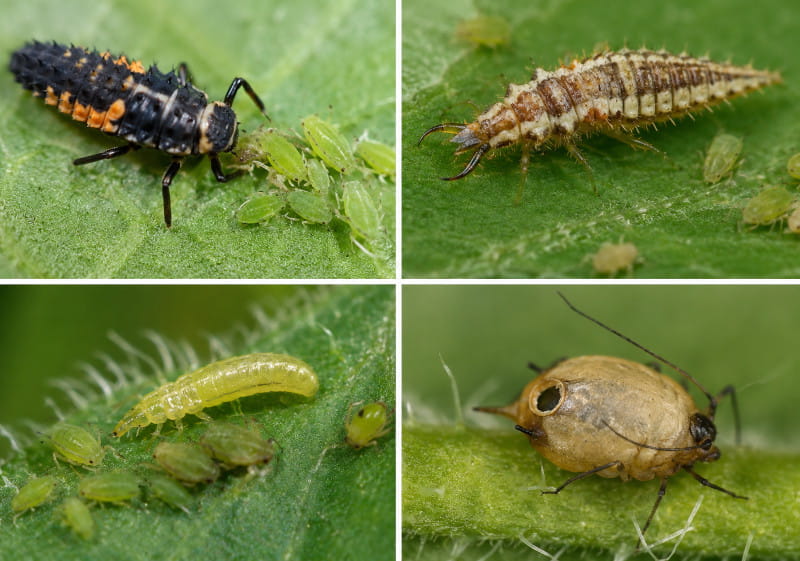
How do you control aphids during cannabis flowering?
During the flowering phase, an aphid infestation should be controlled with as little residue on the flowers as possible. Mechanical removal, selectively cutting off heavily infested plant parts and suitable beneficial insects are particularly useful at this stage. The further flowering has progressed, however, the more cautious you should be with spray treatments.
Why spray treatments are more problematic during flowering
As flower density increases, liquid may dry more slowly between the flowers and in other sheltered areas. Additional moisture is undesirable there because it can increase the risk of mold. Depending on the product used, residues may also remain on the flowers. A treatment that may still be suitable during vegetative growth is therefore not automatically appropriate for advanced flowering.
You should also take any beneficial insects already introduced into account. Some sprays can affect not only aphids but also lacewing larvae, aphid predatory midges or parasitic wasps. Before combining different methods, you should therefore always check whether they are compatible with one another.
Mechanical removal and beneficial insects during flowering
With small aphid colonies, you can carefully remove the insects from leaves and shoots. If individual leaves are particularly heavily infested, it can make sense to cut them off completely and remove them directly from the growing area. Proceed as carefully as possible so that aphids are not unnecessarily spread onto other plant parts or neighboring plants.
Suitable beneficial insects can then help locate any remaining aphids and reduce the infestation further. During flowering, also check regularly for sticky honeydew. If it reaches areas near the flowers, dust and plant debris can stick to it and sooty mold fungi can establish under suitable conditions. The earlier you control an infestation, the lower the risk that aphids and honeydew will reach the flowers.
What is different about aphids indoors compared with outdoors?
Indoors, aphids usually enter the growing area on introduced plants or cuttings and can spread there unnoticed. Outdoors, incoming winged aphids can hardly be prevented. In return, there are significantly more natural enemies outside that can keep aphid colonies under control.
There are also differences in control. Indoors, infested plants can often be separated from the others and beneficial insects can be introduced in a targeted manner. Outdoors, such isolation is hardly possible. Ladybirds, lacewings, hoverflies and parasitic wasps play a greater role there. At the same time, wind, rain and temperature fluctuations can influence aphid development.
| Aspect | Indoor | Outdoor |
| How aphids reach the plant | Often through cuttings, new plants or other infested plants; winged aphids can also enter through windows and ventilation openings | Winged aphids can fly in from plants in the surrounding area and establish new colonies |
| Natural enemies | Usually scarcely present unless beneficial insects are introduced deliberately | Ladybirds, lacewings, hoverflies and parasitic wasps can naturally reduce aphid populations |
| Ants | Can occur, but usually play a smaller role in enclosed growing areas | May regularly visit aphid colonies because of the honeydew and defend them against natural enemies |
| Separating infested plants | Often possible and useful for making further spread more difficult | Usually hardly possible; new winged aphids can also arrive at any time |
| Using beneficial insects | Targeted use is possible because temperature and surroundings can be controlled more effectively | Natural enemies are often already present; deliberately introduced beneficial insects are more strongly influenced by weather and surroundings |
| Especially important | Inspect new plants, detect infestations early, separate affected plants and introduce beneficial insects if necessary | Inspect plants regularly, reduce larger aphid colonies early and encourage natural enemies |
How can aphids on cannabis be prevented?
Aphids cannot always be prevented completely. However, regular inspections, careful handling of new plants and cuttings, good hygiene and balanced fertilization can significantly reduce the risk of a larger infestation. The most important thing is to detect the first aphids before larger colonies can form.
- Inspect new plants and cuttings carefully: Examine new plants thoroughly before placing them with the others. Pay particular attention to leaf undersides, leaf stalks and young shoots. A magnifying glass can be very helpful.
- Keep new plants separate at first: Indoors, you should avoid placing new arrivals directly among your existing plants if possible. Check them several times first for aphids and other pests.
- Regularly inspect leaf undersides and shoot tips: Aphids prefer young and sheltered plant parts. A small colony is much easier to eliminate than an infestation that has already spread to several plants.
- Watch for sticky leaves: Honeydew can reveal an aphid infestation before the insects themselves become noticeable. Unusually sticky or shiny leaves should therefore always be examined more closely.
- Do not overfertilize: Too much nitrogen does not cause aphids, but it can promote particularly soft and vigorous growth that offers favorable conditions for the pests. A balanced nutrient supply is therefore the better choice.
- Maintain cleanliness: Removed infested leaves and shoots should be taken out of the growing area immediately and disposed of. After working on infested plants, also check your hands and the tools used before touching healthy plants.
- Encourage natural enemies outdoors: A varied and flowering environment can attract hoverflies, lacewings and other natural enemies of aphids and provide them with food.
- Keep an eye on ants: An unusually high number of ants can indicate hidden aphid colonies or other honeydew-producing pests. Ants can also drive away natural enemies of aphids.
Aphids or other cannabis pests?
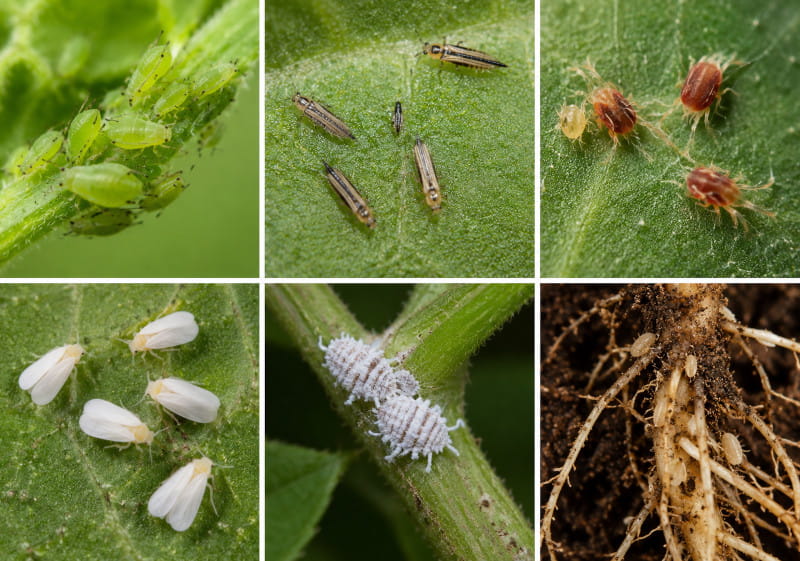
Aphids can usually be distinguished from other cannabis pests by their body shape, their tendency to occur in colonies, and by sticky honeydew and white shed skins. They are most likely to be confused with thrips, spider mites, whiteflies, scale insects, mealybugs and root aphids.
Aphids or thrips
Thrips have a clearly narrower and more elongated body than aphids. Typical signs are silvery to gray patches on the leaves that can look scraped. Small black fecal spots are also common. Aphids, by contrast, often sit in visible groups on young plant parts and leave behind sticky honeydew and white shed skins.
Aphids or spider mites
Spider mites are much smaller than aphids and are often difficult to see with the naked eye. A typical sign is numerous small pale dots on the leaves. With heavier infestations, fine webbing also develops on leaf undersides, leaf edges and shoot tips. Aphids, by contrast, do not produce webbing and are usually recognizable as individual insects or whole colonies.
If you discover numerous pale dots or fine webbing on your plant, our detailed guide to spider mites on cannabis will help you identify the problem further.
Aphids or whiteflies
Like aphids, whiteflies prefer to stay on the undersides of leaves and also produce honeydew. Adult insects, however, are white, have wings and resemble tiny moths. A particularly noticeable feature is that they often fly up when the plant is touched or moved. Young whiteflies, by contrast, sit flat on the underside of the leaf and look clearly different from young aphids.
Aphids or scale insects
Scale insects often look like small fixed shields or bumps on leaves and stems. Adults of many species barely move and can also produce sticky honeydew. Aphids, by contrast, are clearly recognizable as small insects with legs and are usually more mobile.
Aphids or mealybugs
Mealybugs stand out because of their whitish, waxy surface and often look as though they are covered with small tufts of cotton. They can also excrete honeydew and cause sticky leaves. Aphids, by contrast, do not have a conspicuous white wax coating and have a smooth, soft body.
Aphids or root aphids
Root aphids live mainly in the root zone and are therefore often discovered only during a closer inspection of the substrate or root ball. Aphids, by contrast, usually sit visibly on leaves, young shoots and stems. If a cannabis plant has growth problems even though no above-ground pests can be found, it can therefore also make sense to inspect the root zone.
| Pest | Typical appearance | Typical signs | Difference from aphids |
| Aphids | Small, soft, oval to pear-shaped, greenish to dark; often in groups | Honeydew, white shed skins and deformed or curled new growth | Colonies together with sticky honeydew are particularly typical |
| Thrips | Very narrow and elongated; young insects are usually lighter | Silvery leaf patches and small black fecal spots | Clearly narrower body and normally no sticky honeydew |
| Spider mites | Tiny and difficult to see with the naked eye | Many small pale dots on the leaves, later fine webbing | Webbing is a particularly clear indication of spider mites |
| Whiteflies | Small white, moth-like insects | Honeydew; adult insects often fly up when the plant is moved | White winged insects are easy to distinguish from aphid colonies |
| Scale insects | Small fixed shields or bumps | Depending on the species, honeydew, sticky leaves and weakened growth | Adult scale insects usually remain fixed to the plant |
| Mealybugs | Whitish and waxy, often resembling small tufts of cotton | Honeydew and sticky areas on the plant | Conspicuous white wax coating instead of the smooth body of an aphid |
| Root aphids | Small aphids in the root zone, sometimes with whitish deposits | Weak growth and problems in the root zone | Live mainly in the substrate and on the roots rather than on leaves and shoots |
Which mistakes make aphid infestations particularly persistent?
An aphid infestation becomes particularly persistent when only the visible insects are removed, hidden colonies remain undetected, or the plants are no longer checked after the first treatment. An unsuitable combination of different control methods can also reduce success.
| Common mistake | Why it is problematic |
| Checking only the upper leaf surfaces | Aphids often hide on leaf undersides, young shoots and inside curled leaves |
| Not checking again after a single removal | Overlooked aphids can continue reproducing and form new colonies within a short period of time |
| Ignoring ants | Ants can defend aphid colonies against natural enemies and thereby reduce the effectiveness of beneficial insects |
| Overfertilizing | Excessive nitrogen supply can promote especially soft growth and favor an existing aphid infestation |
| Combining beneficial insects with incompatible sprays | Some products harm not only aphids but also introduced beneficial insects such as lacewing larvae or parasitic wasps |
| Spraying flowers without sufficient caution | Additional moisture may dry poorly between dense flowers, and residues may remain depending on the product used |
FAQs about aphids on cannabis
Q: Why are my cannabis leaves sticky?
A: Sticky or unusually shiny leaves can be caused by honeydew. This sugar-rich liquid is excreted by aphids and some other sap-sucking pests. Therefore check the undersides of leaves and the shoots above them especially carefully for aphids, white shed skins, whiteflies, mealybugs or scale insects.
Q: Can aphids be removed with water?
A: Yes. On vigorous plants, careful rinsing can remove a large proportion of the visible aphids. However, continue to inspect the plant regularly afterwards, because hidden or overlooked insects may remain and form new colonies.
Q: Do ladybirds help against aphids on cannabis?
A: Yes. Ladybirds, and especially their larvae, are natural enemies of aphids and can consume many insects. For targeted indoor use, larvae are often more suitable because adult ladybirds can fly and may leave the growing area again.
Q: Can aphids infest cannabis flowers?
A: Aphids can also occur on flower stems and in sheltered areas around the flowers. Besides their feeding on the plant, sticky honeydew and contamination are then particularly problematic. At the same time, the options for direct treatment become more limited as flowering progresses.
Q: Why are there ants on my cannabis plant?
A: Ants are often attracted by the sweet honeydew produced by aphids and other sap-sucking pests. If unusually large numbers of ants repeatedly visit the same shoots or leaf undersides, you should specifically look for aphids there. Ants alone, however, are not definitive proof of an infestation.
Q: Why do aphids keep coming back?
A: Individual insects, hidden colonies or infested neighboring plants were often overlooked. Outdoors, new winged aphids can also fly in at any time. Therefore do not inspect only the originally infested area, but check the entire plant and neighboring plants over several days.
Q: Where do aphids sit on cannabis plants?
A: Aphids are especially common on leaf undersides, leaf stalks, young shoots and shoot tips. In a more severe infestation, the insects can also spread to other parts of the plant and into areas close to the flowers.
Q: Are there aphids on cannabis roots?
A: Yes, so-called root aphids can occur in the root zone. However, they should be distinguished from the aphids that live on leaves and shoots. If a plant shows growth problems even though no above-ground pests can be found, it can therefore also make sense to inspect the substrate and roots.
Q: Do yellow sticky traps help against aphids?
A: Yellow sticky traps can attract and reveal winged aphids. They therefore mainly help with detecting an infestation early. However, yellow sticky traps are not sufficient against aphid colonies on leaves and shoots and should only be considered a supplementary monitoring method.
Detect aphids early and control them effectively
The earlier you detect aphids on your cannabis plant, the easier they are usually to get rid of. Small colonies are much easier to control than an infestation that has already spread across numerous leaves, shoot tips or even into areas close to the flowers.
Therefore, do not pay attention only to the aphids themselves. Sticky honeydew, white shed skins, deformed young leaves and an unusually high number of ants can also indicate an infestation. Together with the appearance of the insects, these characteristics help you distinguish aphids from thrips, spider mites and other cannabis pests.
With a light infestation, mechanical measures and regular inspections are often sufficient. If the aphids continue to spread, suitable beneficial insects can provide useful support. During flowering, you should be particularly careful to avoid unnecessary moisture and residues on the flowers. Continue checking the plants even after the infestation has visibly declined – the problem is truly under control only when no new aphids or colonies appear over an extended period of time.