CBDA: Cannabidiolic Acid Explained
CBDA: Cannabidiolic Acid, Differences from CBD & Basics
Updated: August 2026 | What CBDA is, how cannabidiolic acid forms in the cannabis plant, how it differs from CBD, and what matters when it comes to decarboxylation, stability, and research.
Author: Cannapot Grow Team | Reading time: approximately twenty minutes
The Most Important Points at a Glance
✓ CBDA stands for cannabidiolic acid and is the natural acidic precursor of CBD.
✓ In the cannabis plant, CBDA is formed from CBGA. The enzyme CBDA synthase catalyzes the conversion of cannabigerolic acid into cannabidiolic acid.
✓ Fresh, raw, or only lightly heated CBD-rich flowers can contain a substantial portion of their cannabinoid profile as CBDA rather than CBD.
✓ Through decarboxylation, CBDA can release carbon dioxide (CO₂) and become CBD. Heat accelerates this process, but temperature and time must always be considered together.
✓ In theory, a maximum of around 87.7 mg of CBD can be formed from 100 mg of CBDA. The commonly used factor 0.877 is derived from the ratio of the molar masses of CBD and CBDA.
✓ CBDA is not completely stable. Heat, light, oxygen, storage duration, and the respective matrix can influence conversion and degradation.
✓ There are interesting laboratory and animal data on possible biological effects of CBDA. However, sufficiently robust human studies are still lacking for many potential applications.
What is CBDA?
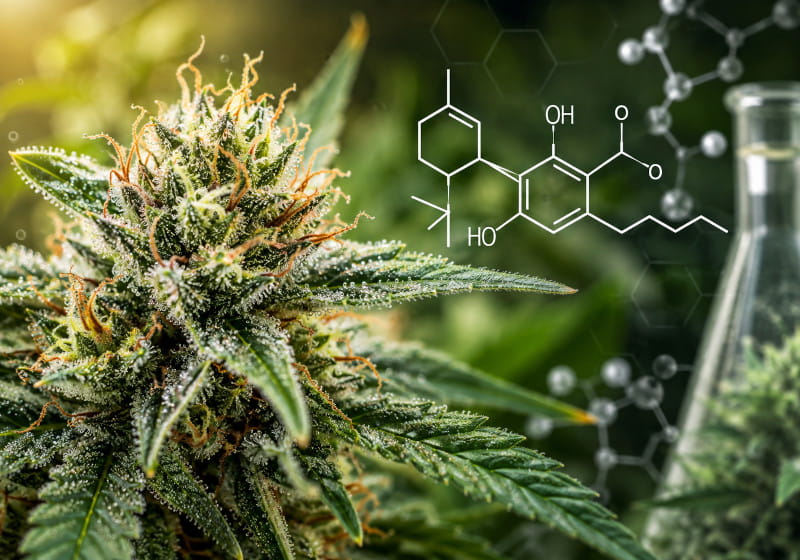
CBDA is the abbreviation for cannabidiolic acid. It is a naturally occurring phytocannabinoid in the cannabis plant and the acidic precursor of CBD.
When you think of CBD, it may seem obvious that the plant produces this cannabinoid directly in large amounts. In fact, cannabis initially produces many important cannabinoids predominantly in their acidic form. In CBD-rich plants, CBDA is therefore a central component of the original cannabinoid profile.
The “A” in CBDA stands for “Acid.” Chemically, CBDA differs from CBD mainly because it has an additional carboxyl group. This group can later be released as carbon dioxide. This is precisely the process that converts CBDA into CBD.
In short: CBDA is not simply another name for CBD. It is a distinct molecule with an additional carboxyl group and is the direct biosynthetic precursor of CBD.
How is CBDA formed in the cannabis plant?
CBDA is formed in the cannabis plant from CBGA, cannabigerolic acid. The enzyme CBDA synthase catalyzes the oxidative cyclization of CBGA into CBDA.
CBGA is often described as a common starting point for several important cannabinoid acids. Depending on which synthase enzymes are active in a plant, CBGA can be converted into CBDA, THCA, or CBCA, among others. In CBD-dominant chemotypes, CBDA synthase plays a particularly important role.
What does CBDA synthase do?
CBDA synthase is the enzyme that enables the crucial step from CBGA to CBDA. It therefore has a major influence on whether a plant develops its cannabinoid profile more strongly toward CBDA and, later, CBD.
Biochemically, it is a specialized oxidase. Earlier studies showed that CBDA synthase preferentially uses CBGA as its starting substrate. Later genetic studies also demonstrated that variants of the genes for CBDA and THCA synthases are associated with the chemical phenotype of different cannabis lines.
| Step | Compound | Significance |
|---|---|---|
| Starting material | CBGA | Cannabigerolic acid serves as an important precursor to various cannabinoid acids. |
| Enzymatic step | CBDA synthase | Catalyzes the conversion of CBGA into CBDA. |
| Product | CBDA | Acidic precursor of CBD. |
| Later conversion | CBD | Formed through the decarboxylation of CBDA. |
Where is CBDA found?
CBDA is found mainly in the cannabinoid-rich glandular trichomes of cannabis flowers and is a significant part of the cannabinoid profile, especially in CBD-dominant plants.
Fresh or only lightly heated plant material in particular can contain significantly more CBDA than CBD. During drying, storage, and processing, this ratio can gradually change because some of the CBDA decarboxylates and is thereby converted into CBD.
We explain in more detail which genetics have been specifically selected for high CBD levels and different cannabinoid profiles in our overview CBD Strains: the Best CBD Genetics.
Why do raw cannabis flowers often contain more CBDA than CBD?
The plant does not simply produce CBD as the dominant compound from the outset. In CBD-rich chemotypes, CBDA is initially formed as the main compound. Such characteristics are particularly relevant in genetically CBD-dominant plants, such as those that can develop from CBD Seeds. Only through non-enzymatic processes such as heat, prolonged storage, or other environmental influences can some of the CBDA become CBD.
That is why laboratory values for fresh or gently treated flowers are often divided into two separate figures: CBD and CBDA. Only when both values are taken into account can the theoretically possible total CBD after assumed complete decarboxylation be estimated.
CBDA vs. CBD: What is the Difference?
CBDA and CBD are chemically related but are not identical cannabinoids. CBDA has an additional carboxyl group and is the acidic precursor of CBD.
| Characteristic | CBDA | CBD |
|---|---|---|
| Name | Cannabidiolic Acid | Cannabidiol |
| Molecular formula | C22H30O4 | C21H30O2 |
| Molar mass | approx. 358.47 g/mol | approx. 314.46 g/mol |
| Occurrence | Primarily in raw or lightly heated CBD-rich plant material | Increases after decarboxylation of CBDA |
| Conversion | Can become CBD through the release of CO₂ | Neutral form after decarboxylation |
CBDA and CBD should not be treated as equivalent pharmacologically either. The two molecules are studied separately and may show different interactions with biological targets. Findings on CBD therefore cannot automatically be transferred to CBDA – and vice versa.
How is CBDA converted into CBD?
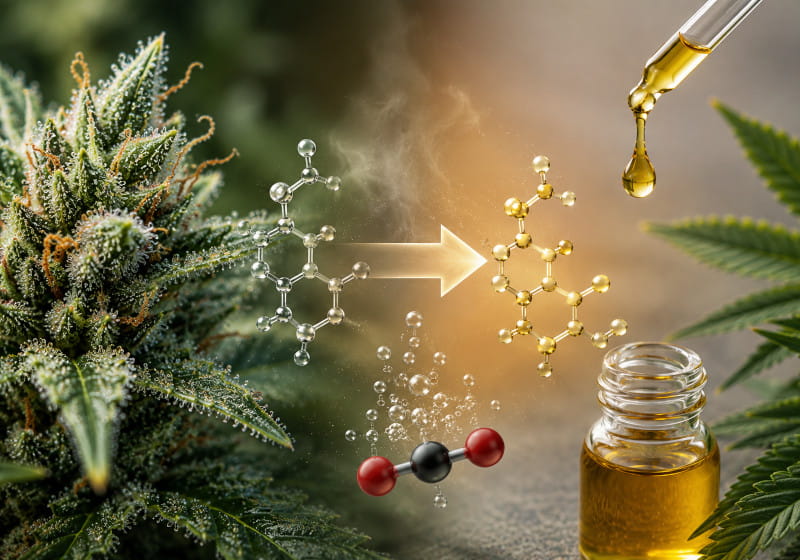
CBDA is converted into CBD through decarboxylation. In this process, the CBDA molecule loses its carboxyl group, which is released as carbon dioxide (CO₂).
Decarboxylation is not an enzymatic reaction of the living plant; rather, it can proceed after harvest through heat, time, and other environmental influences. Heating significantly accelerates this process. As a result, thermal processing shifts the ratio of CBDA to CBD in favor of CBD.
Simplified: CBDA → CBD + CO₂. The molecule loses mass in the process. This is exactly why the theoretical amount of CBD after conversion is lower than the original amount of CBDA.
What does CO₂ release mean in CBDA decarboxylation?
During decarboxylation, carbon dioxide is released from the carboxyl group of CBDA. This changes not only the chemical structure but also the molecular mass: CBDA is heavier than the CBD formed from it.
This loss of mass is why laboratory reports and theoretical total-CBD calculations do not add CBDA to CBD at a 1:1 ratio.
Why is CBDA converted using the factor 0.877?
The factor 0.877 describes the theoretical proportion of mass that can remain as CBD after complete decarboxylation of CBDA. It is derived from the ratio of the molar masses of CBD and CBDA.
Calculation:
314.46 g/mol ÷ 358.47 g/mol ≈ 0.877
With assumed complete decarboxylation, a theoretical maximum of about 87.7 mg of CBD can therefore be formed from 100 mg of CBDA. For laboratory values, this often results in the formula:
Theoretical total CBD = existing CBD + (CBDA × 0.877)
CBDA Calculator: Convert CBDA to CBD
With the following calculator, you can determine the theoretical maximum amount of CBD that can be formed from a known amount of CBDA. If CBD is already present in the sample, you can also enter that value and calculate the theoretical total CBD.
Important: The calculator shows only a theoretical value based on the conversion factor 0.877. It assumes complete decarboxylation of CBDA into CBD. Incomplete conversion and possible losses or degradation processes are not taken into account.
The word “theoretical” is important. The factor accounts only for the stoichiometric change in mass caused by the release of CO₂. It does not mean that, in a real process, 100% of the CBDA will always be converted completely into CBD without any further losses.
What role do temperature and time play with CBDA?
The decarboxylation of CBDA depends on temperature and time. Higher temperatures accelerate the conversion, while excessive or prolonged heat exposure can also promote the degradation of cannabinoids that have already formed.
Therefore, there is no single temperature that can always be regarded as “the correct CBDA temperature” regardless of duration, material, moisture, and experimental setup. Scientific studies examine decarboxylation under very different conditions – for example, in extracts, plant material, open or closed systems, and over different periods of time.
In one frequently cited study, acidic cannabinoids were analyzed at 80, 95, 110, 130, and 145 °C over different periods of time. Such data show one thing above all: the conversion follows reaction kinetics. A specific combination of temperature and time therefore cannot simply be transferred to every other material or process.
| Influencing factor | Possible effect |
|---|---|
| Temperature | Higher temperatures accelerate decarboxylation but can also promote degradation under intense exposure. |
| Duration | A longer period can increase conversion but may also contribute to further degradation. |
| Moisture | Can alter heat transfer and reaction conditions in the plant material. |
| Matrix | Plant material, extract, or oil do not necessarily behave identically. |
| Oxygen / open system | Can promote additional oxidative changes. |
We explain in detail how decarboxylation and the conversion of CBDA to CBD can be taken into account when making an infused oil in our guide Make CBD Oil Yourself: CBD Oil from Cannabis Flowers.
How stable is CBDA?
Under normal conditions, CBDA is not indefinitely stable. Heat, light, oxygen, storage duration, and the respective product matrix can contribute to CBDA decarboxylating or undergoing further changes.
Especially during prolonged storage, it is therefore important not to look at individual cannabinoid values in isolation. If CBDA decreases, some of it may reappear as CBD; at the same time, overall losses can occur. These processes proceed at different rates depending on the matrix.
What effect does light have on CBDA?
Light can promote chemical changes in cannabinoids and should be reduced as much as possible during storage. Studies on cannabis preparations show that light, together with temperature and oxygen, can influence cannabinoid stability.
Is CBDA sensitive to heat?
Yes. Heat accelerates the decarboxylation of CBDA into CBD. However, this does not mean that every increase in temperature immediately results in complete conversion. Temperature, duration, and the physical environment of the CBDA are decisive.
What role does oxygen play?
Oxygen can promote oxidative changes in cannabis constituents. The extent to which CBDA is affected depends, among other things, on storage method, packaging, matrix, light, and temperature. Controlled storage conditions are therefore particularly important for analytically defined products.
Important: A general statement such as “CBDA is stable for X months at room temperature” would be too broad. Stability data must always be considered in the context of the material studied, the container, light, oxygen, moisture, and temperature.
What does research tell us about CBDA?
CBDA has been studied pharmacologically for years, but the body of research is much less extensive than it is for CBD. Many interesting findings come from cell models or animal studies and must not automatically be interpreted as proven effects in humans.
Research has examined inflammatory processes, nausea and vomiting, pain models, enzyme activities, and various cellular signaling pathways, among other topics. The strength of these studies varies greatly and depends heavily on whether they involve laboratory experiments, animal models, or human studies.
| Research level | What has been studied with CBDA? | How should it be interpreted? |
|---|---|---|
| In vitro studies | Including COX-2, gene expression, and cellular signaling pathways | Show possible mechanisms but do not prove a therapeutic effect in humans. |
| Animal studies | Including models of nausea, inflammation, and hyperalgesia | Can show biological effects but cannot be directly transferred to humans. |
| Human studies | So far, mainly limited data on the pharmacokinetics, absorption, and tolerability of CBDA-containing preparations | There is not yet broad clinical evidence for general therapeutic claims. |
| Well-established findings | Chemistry, biosynthesis, decarboxylation, and analytical properties are much better supported than clinical applications. | The scientific basis is considerably more robust in these areas. |
Is CBDA being studied for nausea and vomiting?
Yes, CBDA has been studied in preclinical models for possible effects on nausea and vomiting. Reviews describe interesting results but explicitly emphasize the need for clinical studies. At present, no proven efficacy in humans can be concluded from these findings.
Is CBDA being studied in relation to inflammatory processes?
Inflammation-related mechanisms are also among the areas being studied. In vitro studies have found effects on COX-2, among other findings, while animal studies have described changes in models of acute inflammation and hyperalgesia.
Such findings are scientifically interesting, but they are not yet evidence that CBDA treats or prevents a specific disease in humans.
Are there human studies on CBDA?
Yes, there are now initial human studies involving CBDA-containing cannabis or hemp preparations that examine pharmacokinetics and acute effects, among other aspects. However, the amount of data remains limited.
For example, a more recent controlled human study examined a full-spectrum preparation containing approximately equal proportions of CBD and CBDA as well as other cannabinoids. Such studies help us understand how CBDA is absorbed and processed in the body. However, they are not sufficient to support general claims about therapeutic efficacy.
Crucial for interpretation: “observed in a cell study,” “shown in an animal model,” and “confirmed in a clinical human study” represent three different levels of evidence. With CBDA, a large part of the effects research still falls into the first two categories.
Can the effects of CBD be transferred to CBDA?
No. Although CBDA is the precursor of CBD, the two are distinct molecules and are studied separately from a pharmacological perspective. A claim supported for CBD by human studies therefore does not automatically apply to CBDA.
Conversely, interesting preclinical findings on CBDA must not be presented as though they replace the known or studied properties of CBD. For general information about cannabidiol itself, you can therefore find a separate article on CBD, Effects, Risks and Differences.
You can also find more basics, guides, and background information about cannabidiol in our CBD Guide.
Frequently Asked Questions About CBDA
What is CBDA?
CBDA is cannabidiolic acid and the natural acidic precursor of CBD. In CBD-rich cannabis plants, CBDA is formed from CBGA and can later be converted into CBD through decarboxylation.
What does CBDA stand for?
CBDA stands for cannabidiolic acid. The “A” denotes the acidic form of the cannabinoid.
What is the difference between CBDA and CBD?
CBDA has an additional carboxyl group and is the acidic precursor of CBD. Through decarboxylation, CBDA can release CO₂ and become CBD.
Is CBDA the same as CBD?
No, CBDA and CBD are two different molecules. They are closely related chemically but differ in structure, molar mass, and their studied pharmacological properties.
Where is CBDA found?
CBDA is found mainly in the resin-rich glandular trichomes of CBD-dominant cannabis flowers. Especially in fresh or lightly heated plant material, a large part of the cannabinoid profile may be present as CBDA.
Do CBD flowers contain CBDA?
Yes, CBD-rich flowers can contain significant amounts of CBDA. The actual amounts of CBDA and CBD present depend on genetics, maturity, processing, storage, and the time of analysis, among other factors.
How does CBDA become CBD?
CBDA becomes CBD through decarboxylation. In the process, carbon dioxide is released from the carboxyl group and the molecule loses mass accordingly.
What does decarboxylation mean for CBDA?
Decarboxylation refers to the removal of a carboxyl group as CO₂. With CBDA, this process leads to the formation of CBD and can be significantly accelerated by heat.
At what temperature is CBDA decarboxylated?
There is no single temperature that always represents the optimal CBDA decarboxylation temperature regardless of duration. Scientific studies show that temperature and time together determine the reaction rate and that material, moisture, and experimental setup also play a role.
Why is CBDA converted using 0.877?
The factor 0.877 is derived from the ratio of the molar masses of CBD and CBDA. Because CO₂ is lost during decarboxylation, a theoretical maximum of about 87.7 mg of CBD can be formed from 100 mg of CBDA.
Is CBDA sensitive to heat?
Yes, heat accelerates the conversion of CBDA into CBD. Stronger or longer heat exposure can also lead to additional degradation processes, which is why temperature should always be considered together with duration.
How stable is CBDA?
CBDA is not indefinitely stable. Heat, light, oxygen, storage duration, and the respective matrix can influence decarboxylation and further changes. There is therefore no universal shelf-life figure for every CBDA-containing sample.
What does research tell us about CBDA?
The chemistry and biosynthesis of CBDA are well described, while pharmacological research remains considerably more incomplete. Much of the effects data comes from cell or animal studies; robust clinical human studies have so far been comparatively limited.
Does CBDA have an effect?
CBDA shows biological activity in preclinical studies, including in models of inflammation, hyperalgesia, nausea, and vomiting. However, no generally established therapeutic effect in humans can be concluded from this. Further clinical studies are required.
What should you know about CBDA?
CBDA is more than simply “CBD before heating.” Cannabidiolic acid is a distinct phytocannabinoid that is formed enzymatically from CBGA in the plant and is chemically the direct precursor of CBD.
CBDA is particularly important for understanding CBD-rich cannabis genetics and the corresponding Cannabis Seeds, because a substantial portion of the original cannabinoid profile may be present in this acidic form. During decarboxylation, CO₂ is released, forming CBD while simultaneously reducing the mass of the molecule. This also explains the conversion factor 0.877.
Temperature and time influence the conversion together. At the same time, light, oxygen, storage conditions, and the respective matrix can alter stability. A single universally valid temperature or shelf-life rule would therefore be an excessive scientific simplification.
Caution is important when discussing possible effects: the chemical fundamentals of CBDA are well studied, while many pharmacological questions have not yet been conclusively answered. Interesting findings from cell and animal models are a starting point for further research, but they are no substitute for robust human studies.
Scientific and Technical Sources
- Purification and characterization of cannabidiolic-acid synthase from Cannabis sativa L.
- Cannabidiolic-acid synthase, the chemotype-determining enzyme in the fiber-type Cannabis sativa
- (−)-Cannabidiolic Acid, a Still Overlooked Bioactive Compound: An Introductory Review and Preliminary Research
- Decarboxylation Study of Acidic Cannabinoids
- Analysis of cannabinoids in commercial hemp seed oil and decarboxylation kinetics studies of cannabidiolic acid (CBDA)
- Thermo-chemical conversion kinetics of cannabinoid acids in hemp (Cannabis sativa L.)
- Cannabidiolic acid as a selective cyclooxygenase-2 inhibitory component in cannabis
- Effect of cannabidiolic acid and Δ9-tetrahydrocannabinol on carrageenan-induced hyperalgesia and edema in a rodent model of inflammatory pain
- Therapeutic Potential of Cannabidiol, Cannabidiolic Acid, and Cannabidiolic Acid Methyl Ester as Treatments for Nausea and Vomiting
- The Pharmacokinetics and Pharmacodynamics of a Hemp-Derived Full-Spectrum Oral Cannabinoid Product with CBD and CBDA