White Widow: The Story of a Legendary Strain
White Widow: The History, Origins and Legacy of a Legendary Strain
Updated: July 2026 | Explore the origins, genetics, history, key characteristics and lasting influence of White Widow, one of the world's most legendary cannabis strains.
Author: Cannapot Grow Team | Reading time: approximately fifteen minutes
The Most Important Points at a Glance
✓ White Widow has been one of the world’s best-known cannabis strains since the 1990s and has had a lasting influence on modern hybrid breeding.
✓ The strain was probably created by crossing a Brazilian sativa with a distinctive South Indian indica.
✓ White Widow owes its legendary reputation to its exceptionally dense flowers, balanced hybrid effect and reliable cultivation characteristics.
✓ Numerous modern cannabis strains contain White Widow as a direct or indirect part of their lineage.
✓ Black Widow by Mr. Nice Seeds is regarded by many experts as the original White Widow.
✓ Thanks to its stable characteristics, high resin production and easy cultivation, White Widow is suitable for both beginners and experienced growers.
Hardly any cannabis strain has shaped modern cannabis breeding as profoundly as White Widow. Since its introduction in the mid-1990s, it has stood for exceptional quality, balanced hybrid genetics and a distinctive terpene profile. Within just a few years, White Widow developed into an international classic and is considered one of the most influential cannabis genetics in the world.
Whether in coffeeshops, seedbanks, specialist books or the family trees of countless modern hybrids, White Widow is known worldwide. Numerous famous strains are based directly on its genetics or have been significantly shaped by it.
The creation of White Widow, its origins—which remain controversial to this day—its defining characteristics and its lasting influence on international cannabis breeding make it one of the most important cannabis strains in modern breeding history.
Why Is White Widow Considered a Milestone in Cannabis History?
White Widow permanently changed modern cannabis breeding and set new standards for trichome formation, stability and hybrid quality.
When White Widow first appeared on the market, many cannabis strains still differed greatly in terms of yield, flowering time and uniformity. White Widow combined several characteristics that had rarely appeared together before: vigorous growth, high resilience, strong trichome production and a comparatively balanced effect.
Within a few years, the strain attracted international attention and received awards at numerous competitions. As a result, its genetics spread rapidly throughout Europe and later around the world. Many breeders subsequently used White Widow as the basis for new crosses, ensuring that its influence remained strong even decades later.
How Was White Widow Created?
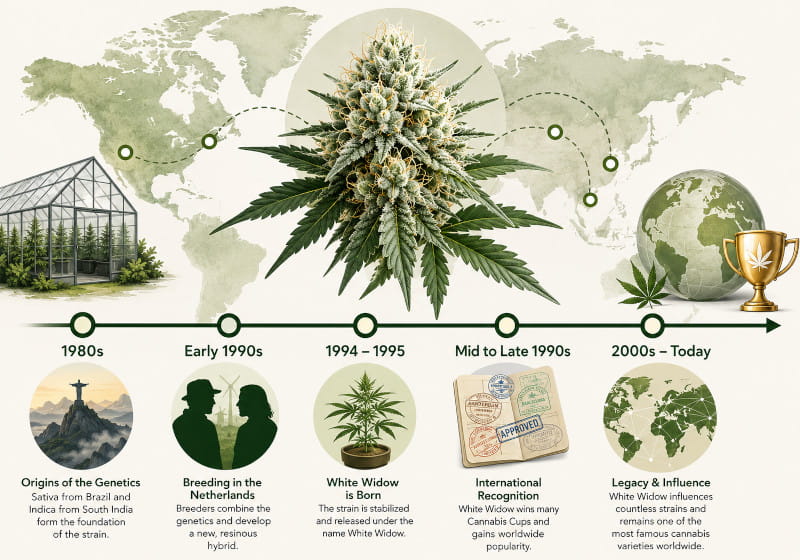
White Widow was created in the early 1990s and developed into one of the world’s best-known cannabis strains within just a few years. Some details of its creation have never been fully clarified.
Few classic cannabis strains have been described in as many different ways as White Widow. While its historical development and later distribution can be traced relatively well, the origin and creation of the original genetics are described differently. It is widely accepted that White Widow is based on a cross between a Brazilian landrace and a particularly high-quality indica from South India.
The breeding objective was to combine the vitality and vigour of tropical sativas with the compact structure, short flowering time and exceptional production of Indian plants. The result was a hybrid characterised by high stability, vigorous growth and a level of trichome formation that was unusually dense for its time.
European cannabis breeding was undergoing rapid development in the early 1990s. New hybrid lines were becoming increasingly important, and White Widow’s characteristics matched the needs of many growers and breeders precisely. Shortly after its introduction, the strain became an internationally recognised benchmark for modern hybrid genetics.
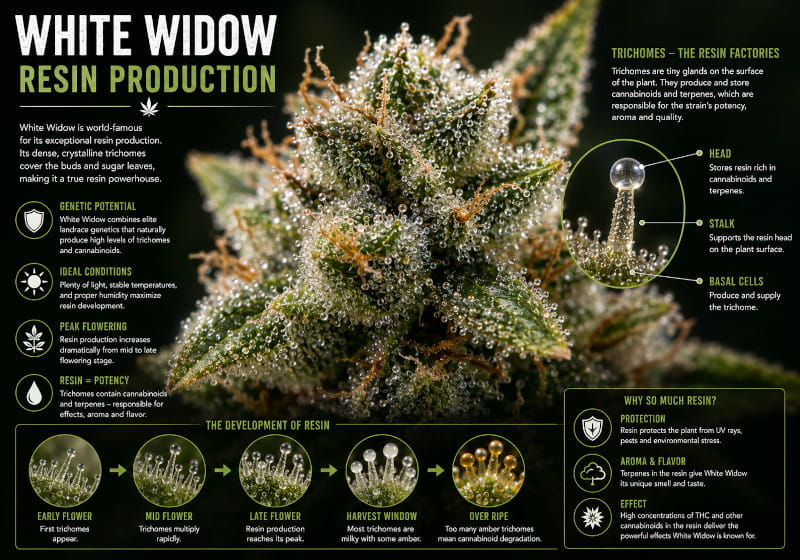
Its exceptionally heavy resin coverage was particularly striking. During the flowering stage, the dense layer of trichomes often makes the flowers appear almost white—a characteristic that probably contributed significantly to the name White Widow.
Who Developed White Widow?
The authorship of White Widow is one of the best-known unresolved questions in modern cannabis history and continues to be described in different ways.
White Widow is most commonly associated with breeder Scott Blakey, better known as Shantibaba. In the 1990s, he initially worked as a breeder at Green House Seeds, where White Widow achieved its international breakthrough. He later founded the Mr. Nice Seedbank and the CBD Crew together with Howard Marks (Mr. Nice). At the same time, Dutch breeder Ingemar also claims to have developed the original genetics or to have played a decisive role in their creation.
After Shantibaba left Green House Seeds, the name White Widow remained with the company. According to Shantibaba, the original genetics are therefore continued by Mr. Nice Seedbank under the name Black Widow. For this reason, many cannabis experts regard Black Widow as the original White Widow line, even though the historical authorship and certain details of its creation remain disputed.
Because only a small number of independent sources from that period exist and the statements of those involved partially contradict one another, the history of its creation can no longer be reconstructed with certainty. Regardless of the actual authorship, however, there is broad agreement that White Widow became one of the most influential hybrid strains of its era in the mid-1990s and had a lasting impact on international cannabis breeding.
Ultimately, this historical controversy is not decisive for the botanical and genetic characteristics of the strain. Regardless of its exact origin, White Widow is considered one of the most influential cannabis genetics of all time and served as the foundation for numerous later breeding projects.
What Genetics Are Behind White Widow?
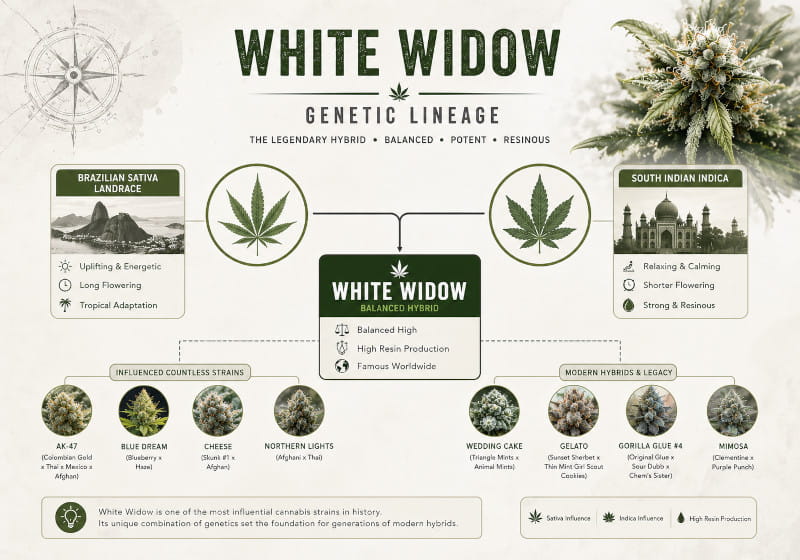
White Widow combines two genetically very different landraces and thereby brings together characteristics from both regions of origin.
Its starting point is considered to be a Brazilian sativa landrace known for its vitality, vigour and comparatively open growth structure. It was paired with a South Indian indica line traditionally used for the production of high-quality hashish and known for developing an exceptional number of resin glands.
Combining these two genetic origins produced a hybrid with vigorous branching as well as compact flowers heavily coated in trichomes. At the same time, its flowering time was significantly shorter than that of many tropical sativas, making White Widow far more attractive for indoor cultivation.
To this day, these original characteristics form the basis of many modern White Widow lines, even though individual breeding programmes have produced different phenotypes over the decades.
| Genetic Origin | Typical Characteristics | Contribution to White Widow |
|---|---|---|
| Brazilian landrace | vigorous growth, vitality, sativa influences | vigour and hybrid vitality |
| South Indian indica line | compact growth, strong resin production, short flowering period | dense flowers and exceptional trichome production |
This balanced combination in particular made White Widow one of the most important foundation genetics in modern cannabis breeding. Many later hybrids adopted individual traits from this line and developed them in different directions.
Why Did White Widow Become World-Famous So Quickly?
White Widow impressed not only through its characteristics but also because it appeared at exactly the right time and met the needs of a rapidly developing cannabis scene.
In the mid-1990s, professional cannabis breeding became increasingly important in Europe. Growers were looking for strains that delivered high yields, stable characteristics and reproducible results. White Widow met these requirements particularly well and appealed to both beginners and experienced breeders. Since then, it has ranked among the best-known and most influential cannabis strains in modern breeding history.
Its unmistakable appearance also played a decisive role in its success. The exceptionally dense layer of resin glands made the flowers appear almost snow-white even during the flowering stage. This striking characteristic clearly distinguished White Widow from many strains available at the time and quickly made it recognisable around the world.
The genetics also impressed with their balanced combination of different characteristics. The plants developed comparatively uniformly, delivered reliable yields and demonstrated high stability. This predictability made White Widow attractive not only for commercial cultivation but also as a valuable foundation for numerous later breeding projects.
What Role Did International Cannabis Cups Play?
Success at international competitions made White Widow one of the world’s best-known cannabis strains within just a few years.
In the 1990s, renowned Cannabis Cups were considered the most important platform for presenting new genetics to a broad audience. Strains that performed well there attracted international attention and often spread within a short period through numerous seedbanks and breeding programmes.
White Widow won major awards shortly after its release. As a result, the strain quickly became an international reference point for modern hybrid genetics. Many growers first encountered White Widow through these competitions and subsequently made it a permanent part of their collections.
Its success was not based on awards alone, however. The decisive factor was that the strain reliably confirmed its qualities outside competitions as well. It was precisely this combination of awards and practical everyday performance that cemented its legendary reputation.
| Characteristic | Importance to Its Success |
|---|---|
| Exceptional resin production | High recognition value and striking appearance |
| Stable hybrid genetics | Consistent cultivation results |
| International awards | Worldwide recognition within just a few years |
| Versatility | Suitable for numerous later breeding projects |
Why Is the Strain Called White Widow?
The name refers to the exceptionally dense layer of trichomes that covers the flowers almost completely with a white film of resin.
During flowering, White Widow plants develop an enormous resin coating. These microscopic trichomes reflect the light and give the flowers an almost white appearance. Especially shortly before harvest, the entire flower often looks as though it has been covered with a fine layer of frost.
The first part of the name therefore largely explains itself. Why the word Widow was added, however, cannot be established conclusively from historical evidence. Various explanations have circulated for many years, but none has been proven beyond doubt. The origin of this part of the name therefore remains unresolved.
Regardless of this, the name White Widow became a globally recognised brand in cannabis history and is now almost synonymous with extremely resin-rich hybrid genetics.
What Characteristics Made White Widow So Special?
The combination of vigorous growth, high resin production and a balanced overall profile made White Widow one of the most successful hybrid lines of its time.
Many older cannabis strains were known either for high yields or for distinctive effect profiles. White Widow was among the first to combine numerous desirable characteristics in comparatively stable genetics. This made the strain suitable for both private and professional cultivation.
-
exceptionally strong trichome production
-
vigorous and uniform plant growth
-
comparatively short flowering time for a hybrid
-
good adaptability to different cultivation methods
-
high genetic stability as a foundation for further breeding
These characteristics in particular ensured that White Widow became one of the most frequently mentioned historic cannabis strains and can be found in the lineages of countless modern hybrids.
How Did White Widow Influence Modern Cannabis Breeding?
White Widow developed into one of the most important foundation genetics in modern cannabis breeding and has influenced numerous well-known strains.
Few cannabis strains have been used for new crosses over such a long period as White Widow. Its combination of reliable growth, vigorous resin production and balanced hybrid genetics made it attractive to breeders around the world. Over the years, this gave rise to countless descendants and further developments that selectively intensified individual characteristics of the original line or combined them with other genetics.
While some breeding programmes remained as close as possible to the original White Widow genetics, entirely new hybrids were created elsewhere in which White Widow forms only one part of the lineage. Even so, typical traits such as strong resin production or balanced growth can still be recognised in many of these strains today.
Which Well-Known Strains Descend from White Widow?
Numerous internationally known cannabis strains have White Widow directly or indirectly in their ancestry.
Because White Widow was used as stable foundation genetics for many years, numerous hybrids now exist with varying proportions of this line. Depending on the breeding objective, characteristics such as trichome formation, flowering time, aroma or plant structure were further developed and combined with other genetics.
| Strain | Relationship to White Widow | Distinctive Feature |
|---|---|---|
| Black Widow | original White Widow genetics from Mr. Nice Seeds | regarded by many as the original White Widow |
| White Rhino | White Widow × Afghan indica | compact growth and strong performance |
| White Russian | White Widow × AK-47 | multiple award-winning hybrid |
| Shark Shock | White Widow × Skunk #1 | vigorous growth and intense aromas |
| Frosted Bubba | White Widow × Bubbleum | very fast, highly resistant strain, also suitable for outdoor cultivation |
| White Berry | White Widow × Blueberry | combines fruity aromas with high potency |
| Mango Widow | White Widow × Mango | tropical terpene profile and vigorous hybrid vitality |
| White Widow Fast | Brazil × South India | bred for a short outdoor maturation time |
| Dream Widow | White Widow × Blue Dream | White Widow and Blue Dream hybrid by Brothers Grimm Seeds |
| White Widow Automatic | White Widow × Ruderalis | stable autoflowering strain for outdoor cultivation |
In addition, numerous regional or smaller breeding lines contain White Widow as a parent or grandparent line. This makes it one of the most genetically influential cannabis strains of all time.
Today, White Widow is a permanent part of the ranges offered by numerous international breeders. Accordingly, various cannabis seeds are available whose characteristics can differ considerably depending on the breeding line and selection, particularly in terms of growth, flowering time, aroma and production.
What Role Did White Widow Play in the Coffeeshops of the 1990s?
White Widow was one of the strains that had a lasting influence on the menus of many Dutch coffeeshops.
As the strain became better known, its availability also increased. In the Netherlands in particular, White Widow quickly became a permanent fixture on numerous coffeeshop menus. Many visitors directly associated their first encounter with high-quality cannabis with this strain.
Its consistent quality made White Widow an excellent reference point for other hybrid genetics. New strains were often compared with it when discussing above-average potency, plant structure or overall quality.
White Widow also spread quickly beyond Europe. Just a few years after its introduction, it was known in North America, Australia and numerous other countries and ranked among the most widely discussed strains of its time.
Why Is White Widow So Fascinating?
White Widow represents a turning point in modern cannabis history and combines historical significance with exceptional breeding quality.
Many cannabis strains enjoy great popularity for a few years and then disappear from the spotlight. White Widow is one of the few exceptions. More than three decades after its release, it continues to be cultivated, collected and used as the foundation for new crosses.
Its long-term success is not based on short-lived trends, but on characteristics that remain valued today. These include stable genetics, impressive resin production and a balanced overall profile. At the same time, White Widow has a permanent place in the history of modern cannabis breeding and is frequently described as one of the most influential hybrid lines of all time.
White Widow is therefore far more than merely a famous cannabis strain. It is regarded as a historic milestone whose influence can still be found in numerous modern genetics and whose name stands worldwide for high-quality hybrid breeding.
What Cultivation Characteristics Distinguish White Widow?
For decades, White Widow has been regarded as a robust and comparatively uncomplicated hybrid strain that can thrive reliably under different cultivation conditions.
One reason for the strain’s worldwide success lies not only in its history, but also in its practical characteristics. White Widow became a popular choice among indoor growers early on because the plants generally display uniform growth and can be controlled effectively. At the same time, it can also deliver impressive results outdoors under suitable climatic conditions.
The plants form vigorous side branches and develop numerous dense flower clusters during flowering. Their exceptionally strong trichome production is characteristic, often leaving the leaves and flowers visibly covered in resin several weeks before harvest.

| Characteristic | Typical Expression |
|---|---|
| Growth habit | vigorous, bushy and well branched |
| Flowering time | usually around 8 to 10 weeks, depending on the phenotype |
| Resin coverage | exceptionally high |
| Cultivation | possible indoors and outdoors |
| Difficulty level | frequently described as beginner-friendly |
What Does White Widow Smell and Taste Like?
White Widow has a complex aroma profile that combines earthy, woody, spicy and lightly fresh notes.
The aroma of classic White Widow lines is often described as balanced. Earthy and slightly woody impressions usually dominate, accompanied by spicy and subtly herbal nuances. Depending on the phenotype, fresh, lightly citrus-like or floral accents may also appear.
The intensity of individual aromas depends, among other factors, on the specific genetics, the cultivation conditions and the drying and curing of the flowers. Different White Widow lines can therefore differ noticeably despite their shared ancestry.
-
earthy base notes
-
spicy and woody aromas
-
occasionally fresh or lightly citrus-like nuances
-
subtle floral hints depending on the phenotype
How Is the Effect of White Widow Commonly Described?
White Widow is often described as balanced hybrid genetics whose subjectively perceived effects can vary from one individual to another.
The perception of cannabis depends on factors including the genetics used, individual sensitivity, dosage and the respective cannabinoid and terpene profile. It is therefore not possible to make universally valid statements about the effects of a particular strain.
In experience reports, White Widow is often described as a hybrid that combines mentally stimulating qualities with physical relaxation. These subjective impressions can, however, vary considerably from person to person and have not been scientifically established for every White Widow line.
For medical applications, only approved medicines and individual medical advice are relevant. Neither therapeutic effects nor specific health benefits can be inferred from the strain name alone.
Does the Original White Widow Still Exist Today?
The original White Widow genetics are regarded as a historical reference, while numerous different lines and interpretations exist today.
Over more than three decades, White Widow has been further developed, selected and recrossed by different breeders. As a result, today’s White Widow variants can differ significantly in growth habit, aroma, flowering time or resin production.
Some breeding programmes aim to remain as close as possible to the original genetics. Others use White Widow merely as the starting point for modern hybrids with new characteristics. The name White Widow can therefore refer today to different lines that share the same historical origin but differ in individual traits.
This development spanning more than three decades has helped White Widow remain one of the world’s best-known and most influential cannabis strains to this day.
Frequently Asked Questions About White Widow
White Widow is one of the world’s best-known cannabis strains. Similar questions about its origin, genetics and characteristics therefore arise frequently.
Is White Widow an indica or a sativa?
White Widow is generally classified as a hybrid. The original genetics were probably created from a Brazilian sativa landrace and a South Indian indica line. It therefore combines characteristics of both forms of origin.
How old is White Widow?
White Widow was developed in the early 1990s and became internationally known in the mid-1990s. It is therefore one of the classic cannabis strains of modern hybrid breeding.
Why does White Widow produce so much resin?
Exceptionally strong trichome production is one of the strain’s most important genetic characteristics. It probably derives mainly from the South Indian indica line used, which was already known for its intensive resin production.
Does the original White Widow still exist?
There are different views regarding the original genetics. Numerous White Widow lines from different breeders exist today, and they can differ significantly from one another. Some are intended to remain as close as possible to the historic genetics, while others have been further developed over many generations.
Why is White Widow so famous?
The strain combined high resin production, stable hybrid genetics, easy cultivation and international competition success at an early stage. It consequently influenced numerous later cannabis strains and remains one of the most important historic genetics.
Sources and Further Information
- Wikipedia – White Widow
- Wikipedia – Cannabis
- National Center for Biotechnology Information (NCBI) – Cannabis genetics and breeding
- Frontiers in Plant Science – Cannabis breeding and genetic diversity
- Plants (MDPI) – Cannabis Genetics and Cultivation
White Widow is one of the most influential cannabis strains in modern breeding history.
More than three decades after its introduction, White Widow remains one of the world’s best-known hybrid genetics. Its exceptional success is based on a combination of historical significance, stable genetics and resin production that was extraordinary for its time.
Regardless of which modern line is considered, White Widow remains an important milestone in cannabis history. Its genetic influence lives on in numerous contemporary hybrids and makes it one of the most formative strains ever developed.