When to Germinate Cannabis Seeds Outdoors in Europe
When to Germinate Cannabis Seeds Outdoors in Europe in 2026
Updated: March 2026 | Germinate Cannabis Seeds Outdoors | Cannapot
Author: Cannapot Grow Team | Reading time: approximately ten minutes
Key Takeaways
✓ Across much of Northern and Central Europe, the safest route is usually to germinate cannabis seeds indoors in March or April and move plants outside from mid-May onward.
✓ Local climate, night temperatures, and season length matter far more than one fixed Europe-wide planting date.
✓ Autoflowering strains are often the safest outdoor choice for short, cooler, or unpredictable European growing seasons.
✓ Moving seedlings outside too early, planting into cold wet soil, and skipping hardening off are some of the most common outdoor mistakes.
✓ Seedlings should only move outdoors permanently once nights stay mild and late frost is no longer a real risk.
✓ Choosing genetics that actually match your region and season is usually more important than trying to start as early as possible.
Across much of Northern and Central Europe, the safest outdoor route in 2026 is to germinate cannabis seeds indoors in March or April, then move seedlings outside from mid-May onward once nights are mild and the soil has warmed up. In Southern Europe, earlier starts are often possible. In colder inland and mountain areas, waiting longer is usually the better choice.
That is the short answer. The better answer depends on your climate, your season length, and the type of seed you want to grow. Starting too early can slow a plant down before the season has even begun. Starting too late can leave outdoor growers rushing against autumn weather.
If you want to avoid wasting seeds and choose a route that actually fits your region, this guide will help you decide when to start, when to transplant, and which seed type makes the most sense for your outdoor setup.
Contents
-
The short answer by region
-
Why timing matters more outdoors
-
Europe outdoor germination calendar for 2026
-
Should you start indoors or sow directly outside?
-
When seedlings are actually safe to move outside
-
Which seed type fits your season best?
-
Best seed route by region and climate
-
Strain-family and breeder logic for outdoor timing
-
The mistakes that ruin an outdoor start
-
What to do next based on your situation
-
FAQ
The short answer by region
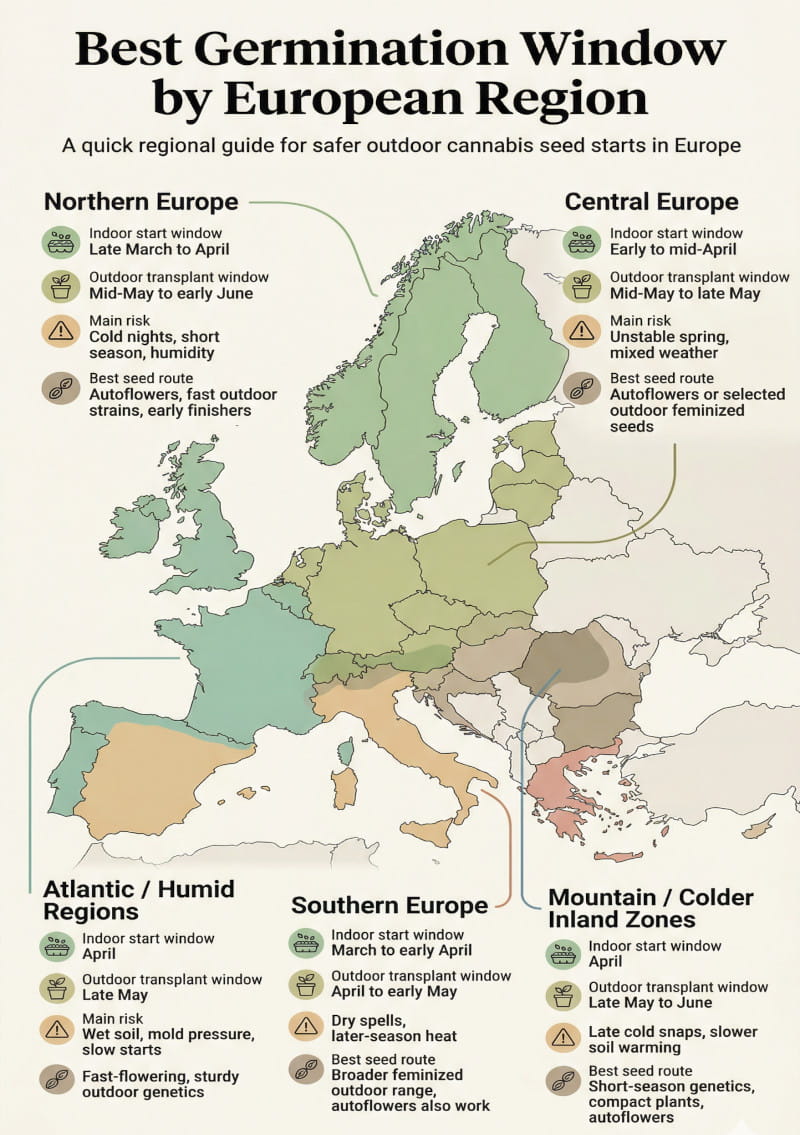
The best time to germinate cannabis seeds outdoors in Europe is not one fixed date. Europe is too varied for that. A grower in the Netherlands, northern Germany, or the UK is dealing with a very different spring than a grower in Spain, southern Italy, or coastal Greece.
-
Northern Europe: germinate indoors in late March or April, then move plants out in mid-May to early June.
-
Central Europe: germinate indoors in early to mid-April, then transplant around mid to late May.
-
Atlantic and humid regions: start indoors in April and wait until late May if spring stays wet and unstable.
-
Southern Europe: many growers can begin in March or early April and move outside earlier if warmth is steady.
-
Mountain and colder inland zones: April indoor starts are often safer, with outdoor transplanting pushed into late May or June.
These are not hard rules. They are safer seasonal lanes. Your actual weather matters more than the date on a calendar.
Why timing matters more outdoors
Indoor growers can recover from a rough start more easily because the environment stays controlled. Outdoor growers do not get that luxury. Cold nights, soaked soil, spring wind, and sudden weather swings can stress young seedlings fast. A plant that starts badly can lose momentum for weeks, even if the summer later turns good.
That is why the real question is not only when can I germinate. It is also:
-
When will my seedlings be strong enough for real outdoor conditions?
-
How much season do I actually have where I live?
-
Would autoflowers be safer than a longer outdoor feminized strain?
-
Am I choosing genetics that fit my climate, or just genetics I like on paper?
Good timing protects more than germination. It protects the whole season.
Europe outdoor germination calendar for 2026
Use this as a working guide, then adjust based on your local temperatures, rainfall, and frost risk.
| Region | Indoor germination window | Safer outdoor transplant window | Main outdoor risk | Best seed route | Best Cannapot path |
| Northern Europe | Late March to April | Mid-May to early June | Cold nights, short season, humidity | Autoflowers, fast outdoor strains, early finishers | Growing autoflowering cannabis |
| Central Europe | Early April to mid-April | Mid-May to late May | Unstable spring, mixed weather | Autoflowers or selected outdoor feminized seeds | Outdoor cannabis seeds |
| Atlantic / humid regions | April | Late May | Wet soil, mold pressure, slow starts | Fast-flowering, sturdy outdoor genetics | Outdoor cannabis seeds |
| Southern Europe | March to early April | April to early May | Dry spells, heat later in the season | Broader feminized outdoor range, autos also work | Choose the right cannabis seeds in 2026 |
| Mountain / colder inland zones | April | Late May to June | Late cold snaps, slower soil warming | Short-season genetics, compact plants, autos | Fastest autoflower seeds in 2026 |
If your spring still feels doubtful, do not rush outdoors just because the daytime sun feels stronger. A healthy transplant two weeks later usually beats a stressed transplant too early.
Should you start indoors or sow directly outside?
Indoor pre-start is the safer default for much of Europe
For a lot of European growers, starting seeds indoors or under cover is the safest move. It gives you control over warmth, moisture, and early growth while spring outside is still unreliable. This is especially useful in Northern Europe, humid Atlantic climates, and colder inland areas where direct sowing can turn into a slow, risky start.
If you want a practical walkthrough for the first step, start with Cannapot’s guide on germinating cannabis seeds step by step.
Direct sowing works best when spring is already stable
Direct sowing can work well in warmer regions or protected outdoor spaces, but it asks for more confidence in your conditions. The soil should already be warming up, heavy cold rain should not be your daily pattern, and late frost should no longer be hanging over the forecast.
For beginners, indoor germination followed by a calm outdoor transition is usually the safer route. It gives each seed a better chance to become a healthy plant instead of a weather gamble.
A greenhouse or sheltered middle step can help
If your climate sits between warm and risky, a greenhouse, cold frame, or sheltered balcony can work as a useful transition stage. That is often easier on seedlings than moving them straight from an indoor environment into fully exposed outdoor conditions.
When seedlings are actually safe to move outside
This is where many growers make the season harder than it needs to be. A seedling is not ready for outdoor life just because one afternoon feels warm.
Before transplanting, use this simple checklist:
-
Night temperatures are staying mild. As a practical rule, many growers wait until nights are consistently around 10 to 12°C or above rather than dropping sharply.
-
The soil no longer feels cold and soaked. Young roots hate sitting in cold, wet ground.
-
Late frost is no longer a real threat. One cold snap can set small plants back fast.
-
The plant has already been hardened off. Give it a few days of increasing outdoor exposure before the final move.
-
The seedling looks healthy and established. A weak, stretched, overwatered seedling is not ready for stress.
How to harden off cannabis seedlings
Hardening off simply means teaching the plant to handle real outdoor conditions step by step. Start with short periods outside in mild weather. Increase the time over several days. Let the plant get used to stronger light, wind, and cooler mornings before it spends all day and night outdoors. This small step prevents a lot of avoidable stress.
Which seed type fits your season best?
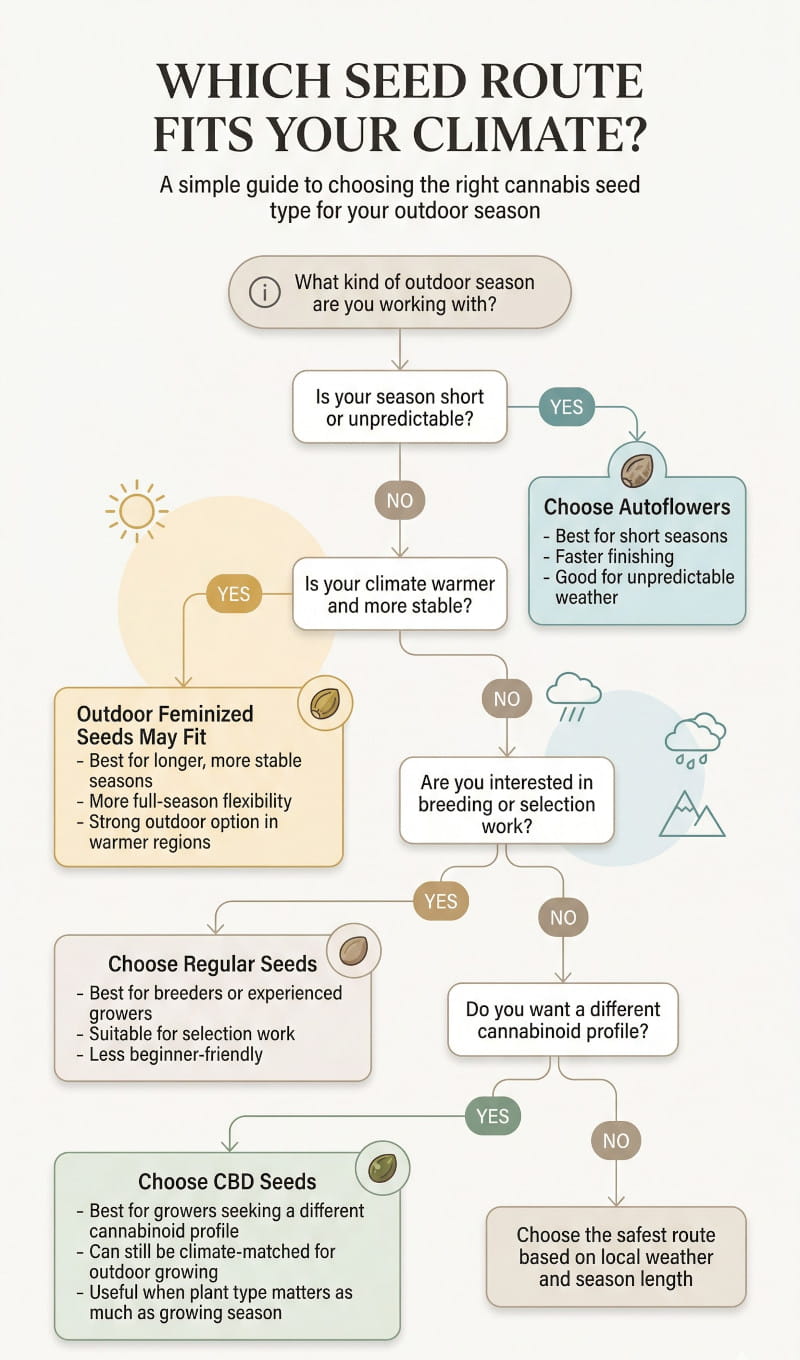
The timing question becomes much easier once you match your climate to the right seed type. This is where Cannapot’s 2026 guide to choosing cannabis seeds becomes especially useful.
Choose autoflowers if:
-
your summer is short
-
your climate is cooler or less predictable
-
you want a simpler outdoor route
-
you want plants that finish sooner
Autoflowering seeds are often the safest outdoor lane for Northern Europe, colder inland regions, and beginners who want less seasonal pressure. If that sounds like your setup, read Cannapot’s autoflower guide and browse the fastest autoflower strains for 2026.
Choose outdoor feminized seeds if:
-
your season is long enough to support them
-
you want more choice in plant structure and flavour direction
-
you are growing in a warmer or more reliable climate
-
you want a broader outdoor catalog to choose from
In Central and Southern Europe, outdoor feminized strains can be a very strong choice if your local climate gives them enough time.
Choose regular seeds if:
-
you already know why you want them
-
you are interested in breeding or selection work
-
you are comfortable with a less beginner-friendly route
Regular seeds are not the easiest answer to a timing problem, but they remain relevant for growers who want a more traditional genetic path.
Choose CBD seeds if:
-
you want a different cannabinoid profile
-
you still want outdoor-friendly genetics
-
you are filtering by plant type rather than just potency
For that route, Cannapot’s CBD seed collection is the natural place to continue.
Best seed route by region and climate
Northern Europe
Spring arrives slowly, nights stay cool longer, and the season can feel shorter than the calendar suggests. The most common mistake here is choosing genetics that need too much time. A safer route is usually autoflowers, early finishers, and plants bred for quicker outdoor success.
If you are growing in this lane, speed matters more than ambition. A compact, reliable outdoor plant often gives a better result than a long-flowering strain that never fully suits the season.
Central Europe
Central Europe gives you more room, but spring is still inconsistent enough to punish a rushed start. Many growers here can choose between autos and outdoor feminized seeds, depending on their local weather and how much season they trust. If your area often stays cold into spring, lean safer. If your summers are stable and long enough, broader outdoor options open up.
Atlantic and humid regions
Here the timing problem is not only about cold. It is also about moisture. Wet starts, slower drying soil, and autumn humidity make fast, sturdy, outdoor-sensible genetics more attractive. This is not the best place to get romantic about long, slow-finishing plants unless you really trust your setup.
Southern Europe
Warmer regions usually allow earlier starts and more flexibility. Growers in these climates can often choose between autos for speed or broader feminized outdoor lines for full-season performance. The mistake here is less about starting too late and more about overlooking later-season heat, watering demands, and exposure.
Mountain and colder inland zones
These areas reward patience. It is often smarter to start indoors, wait longer, and choose short-season genetics than to rush into a cold outdoor setup. If your spring often tricks growers with one warm week followed by another cold spell, plan for the slower version of the season, not the hopeful one.
Strain-family and breeder logic for outdoor timing
Outdoor timing is not only about seed type. It is also about the kind of plant you are choosing inside that category.
Compact, early-finishing plants are often easier outdoors
If your region has a short or damp season, compact plants with quicker flowering behavior are usually easier to manage than long, stretched-out plants that need a lot of stable late-season weather.
Long-flowering tropical or haze-leaning plants often ask for more season
These can be rewarding in the right place, but they are usually less forgiving in climates with short summers, colder nights, or wet autumn conditions. That does not make them bad genetics. It just makes them a poorer match for many outdoor growers in Northern and mixed European climates.
Fast breeder ecosystems matter when speed is the priority
If your main concern is finishing in time, breeder collections built around fast autos and quicker outdoor cycles become especially relevant. Cannapot’s 420 Fast Buds section is a strong place to look if you want speed-led outdoor options, especially for cooler or shorter seasons.
Use flowering time as a filter, not a decoration
Many growers shop by name, aroma, or reputation first. Outdoors, the better habit is to shop by fit. Look at flowering speed, plant size, outdoor reputation, climate tolerance, and how realistic the finish window is for where you live.
The mistakes that ruin an outdoor start
-
Using one Europe-wide date. Europe is too varied for that to work well.
-
Starting outside because one weekend feels warm. What matters is the pattern, not a single nice day.
-
Skipping hardening off. Indoor seedlings need a transition, not a shock.
-
Ignoring soil conditions. Cold, wet soil slows roots and adds stress fast.
-
Choosing the wrong seed type for your season. This is one of the biggest preventable mistakes.
-
Choosing long-flowering genetics in a short season. The plant may never get the finish you hoped for.
-
Waiting too long because of fear. Being cautious is smart. Waiting so long that you shrink your season is not.
What to do next based on your situation
If you already know your climate, the next step becomes much simpler.
-
I need the safest route for a short or unpredictable season: start with autoflowering cannabis.
-
I want the fastest outdoor options: check the fastest autoflower seeds in 2026.
-
I want broader outdoor strain choice: browse Cannapot’s outdoor seeds.
-
I am still unsure which seed type fits me: read the 2026 seed choice guide.
-
I am still at the very first step: follow this germination guide.
-
I want a different cannabinoid route outdoors: explore CBD seeds.
FAQs
Q: When should I germinate cannabis seeds outdoors in Northern Europe?
A: For many growers, late March or April indoors is the safer starting point, followed by outdoor transplanting from mid-May to early June once nights are milder and the soil has warmed.
Q: Is March too early to start cannabis seeds for outdoor growing?
A: It can be too early for direct sowing in many parts of Europe, but it is often a good time to start indoors if you plan to transplant later.
Q: Is May too late to start cannabis seeds outdoors in Europe?
A: No, not at all. In many regions, May is exactly when outdoor growing begins to feel safer. It can even be the smarter month if spring stayed cold or unstable.
Q: Should I germinate cannabis seeds indoors before moving them outside?
A: For much of Europe, yes. Indoor pre-start gives young plants a more stable beginning and reduces the risk of losing them to cold, rain, or sudden weather changes.
Q: Can I germinate cannabis seeds directly in outdoor soil?
A: Yes, but only when the ground is warm enough and the weather is steady. In cooler or wetter regions, indoor germination is usually the safer option.
Q: What temperature is too cold for cannabis seedlings outside?
A: If nights are still regularly dropping low and the soil remains cold and wet, seedlings are likely to struggle. Many growers wait until night temperatures stay around 10 to 12°C or above before making the full move outdoors.
Q: Are autoflower seeds better than feminized seeds for outdoor growing in Europe?
A: They are often the easier and safer choice for shorter, cooler, or less predictable seasons. Feminized outdoor seeds can work very well too, but they usually need more time and more confidence in local conditions.
Q: Which seed type is safest for short summers?
A: Autoflowers and other quick-finishing outdoor genetics are usually the safest place to start if your season is short or your autumn weather becomes difficult early.
The best time to germinate cannabis seeds outdoors in Europe in 2026 is the point where your climate, your seed type, and your season finally line up. That is why the safest answer is rarely the earliest one. A well-timed outdoor start gives seedlings a stronger beginning, gives growers better choices, and gives the season a fair chance to do its work.
If you treat timing as part of seed selection rather than a separate question, the whole process becomes easier. Start with your region. Be honest about your season length. Choose genetics that match reality. Then build from there.