Watering Cannabis Correctly – A Guide
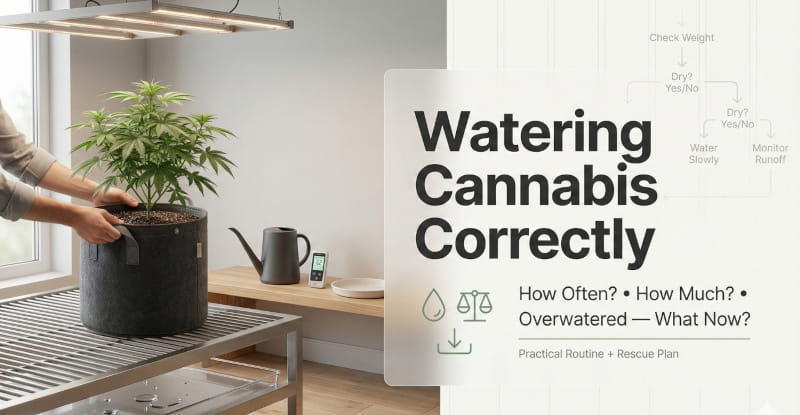
Watering Cannabis Correctly – A Guide (How Often? How Much? Overwatered – What Now?)
Updated: February 2026 | Watering Cannabis Correctly: How Often, How Much & Fixes | Cannapot
Author: Cannapot Grow Team | Reading time: approximately fourteen minutes
The Most Important Things At A Glance
✓ Cannabis should only be watered when pot weight, dry upper soil and the absence of standing water all indicate that watering is necessary.
✓ Overwatering is one of the most common beginner mistakes and often leads to drooping leaves, slow growth and oxygen deprivation in the root zone.
✓ Soil and coco require different watering routines — coco is watered more frequently, while soil benefits from slower and less frequent watering.
✓ Stable water quality, proper pH levels, good drainage and slow watering techniques are essential for healthy roots and vigorous growth.
In this guide, you get exactly that: a simple routine that beginners can implement immediately, plus the details that advanced growers expect (water quality, pH/EC, substrate differences, irrigation methods). And if it has already happened: cannabis overwatered what to do – with a rescue plan based on severity.
Table of Contents
-
Quick-Check in 60 Seconds: Do I really need to water?
-
Core Principle: Why there is no fixed watering schedule
-
How often to water Cannabis? (Table by Pot, Phase, Substrate)
-
How much water is "correct"? (Numbers that actually help)
-
Water Quality: pH, EC, Tap Water, Temperature
-
Irrigation Methods: Hand Watering, Ring Watering, Bottom-Watering, Drip
-
Cannabis Overwatered – What now? (Rescue Plan + Decision Tree)
-
Common Watering Mistakes (with quick fixes)
-
FAQ
-
Read more in the Cannapot Canna Wiki
Quick-Check in 60 Seconds: Do I really need to water?
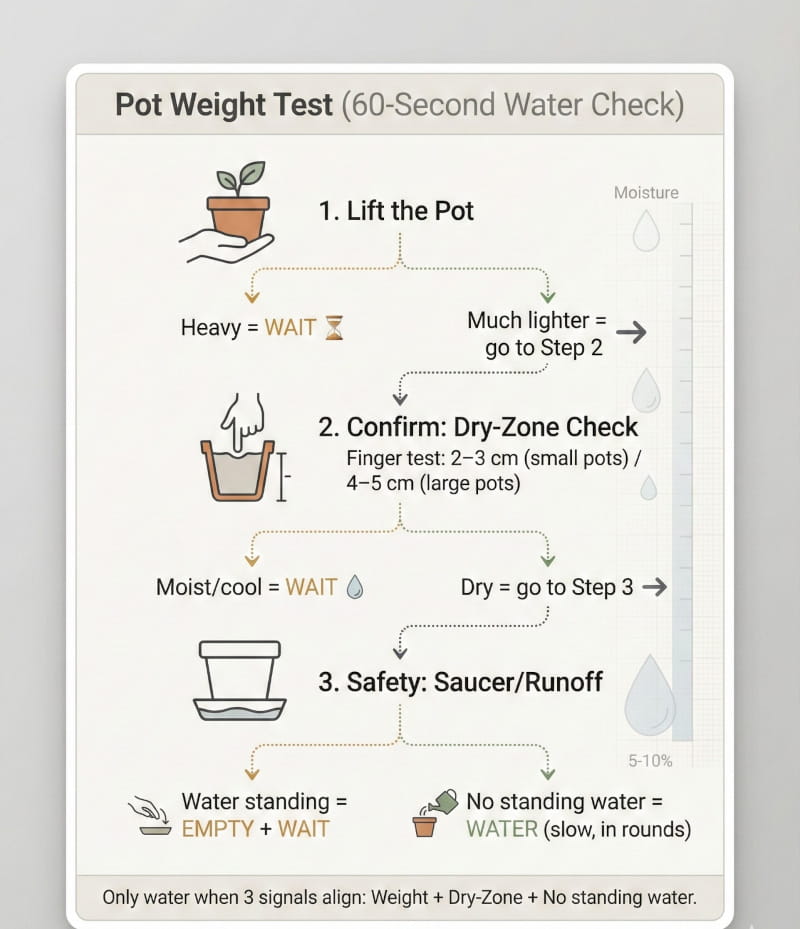
If you only take one thing from this article: Only water when 3 signals align. This prevents most problems.
-
Pot Weight (the most important test): Lift the pot. Is it significantly lighter than after the last full watering? If no: wait.
-
Dry-Zone-Test: Stick your finger into the soil: for small pots 2–3 cm deep, for larger ones 4–5 cm. Is it still clearly moist/cool there? Then wait.
-
Runoff/Saucer: Is there water standing in the saucer? Pour it off first. Standing water = risk of oxygen deprivation.
Bonus Signals (helpful, but not decisive alone):
-
Surface: light-colored and dry = likely ready to water (but only in combination with the weight test).
-
Leaves: drooping can mean thirst – or overwatering. Therefore: never judge by "look" alone.
-
Smell: musty/rotten = alarm signal (too wet / too little air in the root zone).
If you are just starting out, this intro is worth reading (typical beginner mistakes are explained compactly there): Growing Cannabis Without Experience.
Core Principle: Why there is no fixed watering schedule
The question how often to water cannabis has no single correct number. Two people can have the same strain – and still require completely different intervals. Because water consumption isn't just about the "plant," but a system:
-
Pot Size: 5 L dries out much faster than 20 L.
-
Substrate: Soil vs. Coco vs. Mixes store water and air differently.
-
Drainage: Without proper runoff, "watering correctly" becomes almost impossible.
-
Climate: Temperature, air movement, and humidity determine evaporation.
-
Phase: Seedling, Veg, Flowering – completely different needs.
Rule of thumb: You don't water "so the soil is wet." You water so the root zone gets water – and afterwards gets air again.
If you want to categorize the phases clearly (makes watering much easier): Cannabis Grow Cycle.
How often to water Cannabis? (Table by Pot, Phase, Substrate)
The table is a starting point, not the law. The law is the Quick-Check (Weight + Dry-Zone + Runoff).
|
Pot |
Phase |
Soil – Typical Interval |
Coco – Typical Interval |
Signal "Water Now" |
|
5 L |
Seedling / Early Veg |
every 2–5 days (small amounts, targeted) |
daily to every 2 days (small amounts) |
Pot significantly lighter + upper zone dry |
|
5 L |
Late Veg / Early Flower |
every 2–4 days |
1× daily possible (depends on setup) |
Weight + 3–4 cm dry + no standing water |
|
10 L |
Veg |
every 3–6 days |
daily (sometimes 2× daily) |
Pot clearly lighter, surface light, finger test dry |
|
10 L |
Flowering |
every 2–5 days (more often in heat) |
daily / 2× daily possible |
stable "Dry-back": lighter pot, no waterlogging |
|
20 L+ |
Veg / Flowering |
every 4–9 days (more often too much than too little) |
daily to 2× daily possible (depends on setup) |
Weight test is more important here than surface |
Practical Trick (extremely helpful): Remember your "starting weight." After a full watering, lift the pot briefly. Later, only water again when the pot is significantly lighter. This is simpler than any app.
How much water is "correct"? (Numbers that actually help)
Many guides say: "There is no fixed liter number." True. But humans still need orientation. Here are two frameworks that work in practice – and remain flexible.
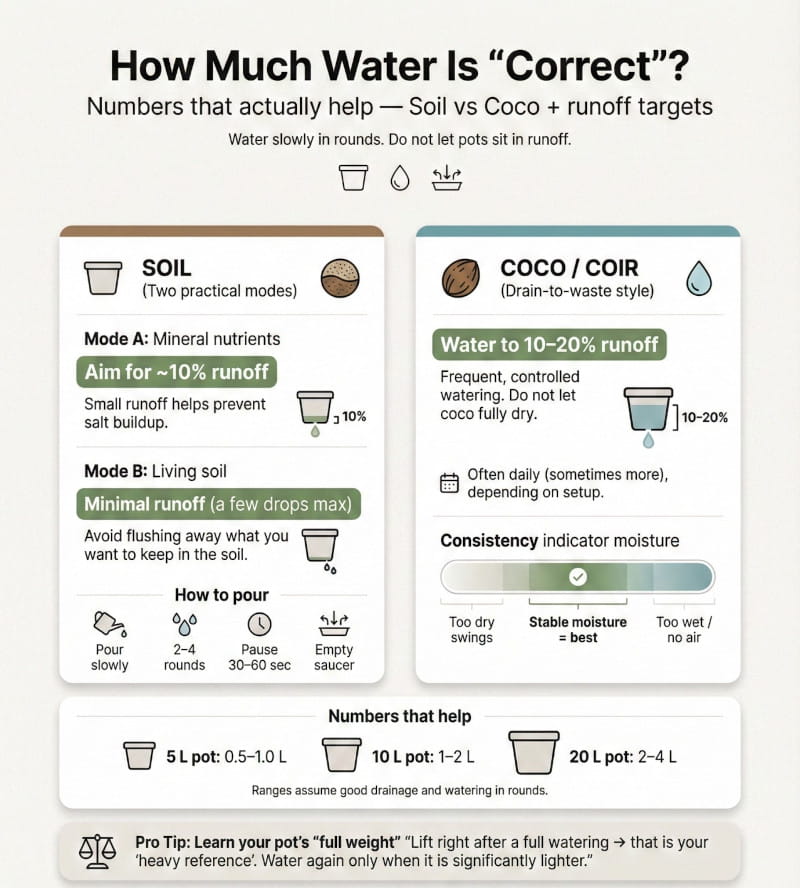
Framework A (Soil): 10–20% of Pot Volume – but slowly in stages
Guideline: For soil, 10–20% of the pot volume per watering is a usable starting point (if drainage is adequate). For very young plants significantly less – there you water more specifically around the stem rather than flooding the whole pot.
-
5 L Pot: often approx. 0.5–1.0 L (depending on dryness/setup)
-
10 L Pot: often approx. 1.0–2.0 L
-
20 L Pot: often approx. 2.0–4.0 L
How to water "cleanly" (Soil):
-
Water slowly in 2–4 small rounds.
-
Wait 30–60 seconds between rounds so the soil can absorb it.
-
Stop when the soil looks evenly moist and, if applicable, a minimal amount comes out the bottom.
-
Always empty the saucer. Do not let water stand.
Important: If you regularly have a lot of "runoff" with soil, it is often a sign that you are watering too fast or the soil is repelling water (became too dry). In that case: slower, in stages, and potentially moisten the surface slightly beforehand.
Framework B (Coco): Water until slight Runoff (10–20%), but more often
Coco is often driven differently than soil: generally more frequently, but controlled, and with clear drainage. A common practical approach is to water until there is a small runoff (e.g., 10–20%), so the zone remains evenly supplied.
Important: Coco is not an "every 7 days" substrate. Treating Coco like soil often produces stress and uneven supply.
Water Quality: pH, EC, Tap Water, Temperature
pH (simplified, practical)
-
Soil: many setups work well in the range around pH 6.0–7.0.
-
Coco/hydro-style: often rather pH 5.8–6.2 as orientation.
Why this matters: If pH is way off, the plant looks "hungry" or "sick," even though you are watering correctly. Desperation often leads to more watering or fertilizing – making everything worse.
Simple practical way: If you regularly see problems (spots, yellowing, stunted growth), measure pH at least as a test. And if you can't categorize symptoms: Recognizing Nutrient Deficiencies.
EC / Water Hardness (brief, no overkill)
EC is essentially "how many dissolved substances are in the water." Tap water can be soft or very hard depending on the region. Extremely hard water can promote buildup and affect nutrient balance – especially if you fertilize heavily on top.
If you want to keep it simple: Use a constant water source (always the same), and don't change everything every week. Consistency beats perfection.
Chlorine / Temperature
-
Water Temperature: practical orientation often pleasant at 18–24°C (not ice cold from the cellar).
-
Chlorine: If you have a strong chlorine smell, you can let the water stand in an open container (not always necessary, but sometimes helpful).
Irrigation Methods: Hand Watering, Ring Watering, Bottom-Watering, Drip
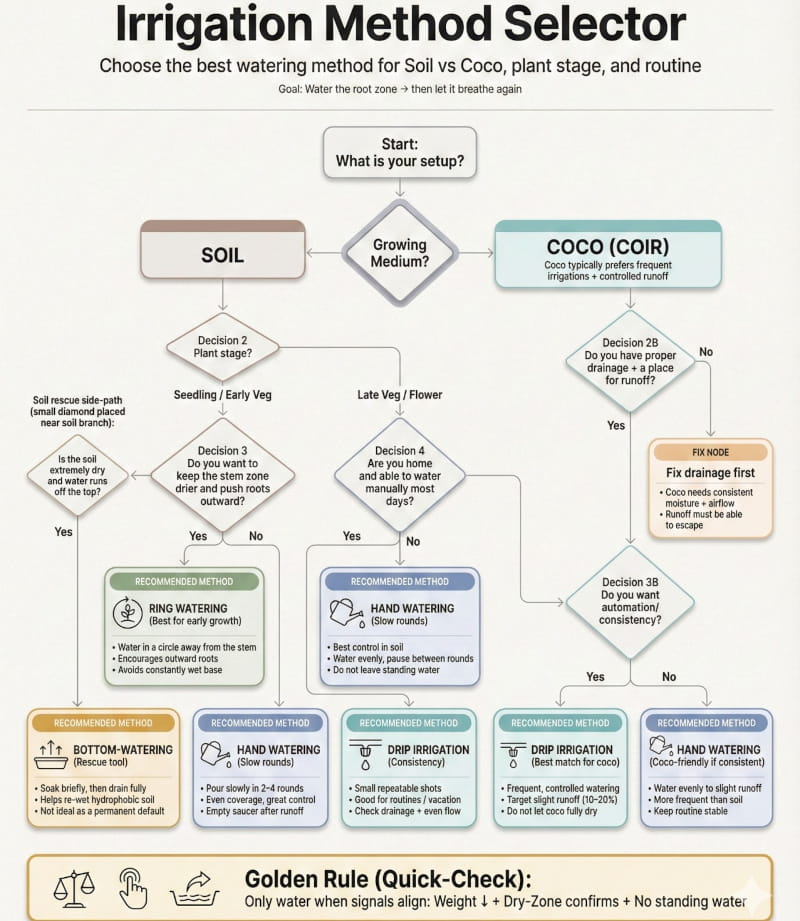
Hand Watering (Standard) – slowly in stages
Ideal for soil because you have control. The biggest mistake is "too fast." Water slowly, wait, water again – this gives the soil time to absorb water.
Ring Watering (especially good in Veg)
You don't water directly at the stem, but in a ring around the plant. This way the plant "pulls" roots outward and builds a stable root zone. This also reduces waterlogging directly at the stem.
Bottom-Watering (only in specific cases)
The pot draws water from below via the saucer. Can help if soil has become very dry and water beads off the top. But: Not permanently as a standard, otherwise you risk constantly wet "feet."
Drip / Simple Irrigation (for vacation, balcony, stress-free routine)
If you are outdoors/balcony or frequently forget in summer, a simple drip solution can help (e.g., dripper/hose or simple bottle-drip idea). Important is: You do not replace the Quick-Check with this. You only make it easier to stay consistent.
For balcony setups (heat, wind, small pots) it is worth reading: Growing Cannabis on the Balcony (Autoflowers).
Cannabis Overwatered – What now? (Rescue Plan + Decision Tree)
First Diagnosis: Overwatered or Underwatered?
-
Overwatered: Pot heavy, soil dark/moist for a long time, possibly musty smell, growth slows, leaves hang softly.
-
Underwatered: Pot very light, soil very dry, possibly pulling away from the edge, leaves rather dry/crispy.
Decision Tree (short):
Pot heavy?
├─ Yes → Soil moist at 4–5 cm depth?
│ ├─ Yes → DO NOT water → Increase air/drainage → Empty saucer → wait
│ └─ No → water slowly (small stages) → check again
└─ No → Dry-Zone dry?
├─ Yes → water (appropriate framework)
└─ No → wait, check again later
Rescue Plan by Severity
Mild (Pot ok, no waterlogging, no smell)
-
Watering pause (really a pause, not "a little bit")
-
More air movement and air to the bottom of the pot
-
Quick-Check daily (Weight + Depth)
Moderate (Pot heavy for days, leaves drooping, growth stops)
-
Completely empty the saucer
-
Tilt the pot slightly / place on a grate so water can escape
-
Gently loosen surface (only 1–2 cm) so more air can get in
-
No "rescue fertilizer" (often worsens stress)
Severe (musty/rotten, very wet, risk of root stress)
-
Same as B), plus: Keep environment stable (no extremes)
-
Find the cause: Drainage? Soil too dense? Permanently high humidity?
-
Do not repot frantically, do not constantly dig in the soil
Note: Many confuse overwatering with nutrient deficiency or "CalMag" issues. Before pouring in new products, check the basics first: Recognizing Nutrient Deficiencies.
Common Watering Mistakes (with quick fixes)
Mistake 1: "A little bit every day" (in Soil)
This keeps the surface constantly moist and deprives the root zone of air. Common result: slow growth, fungus gnats, drooping leaves.
Fix: In soil, better less often, but cleanly in stages – and then wait until the pot is significantly lighter.
Mistake 2: Water standing in the saucer
Standing water is one of the fastest ways to oxygen deprivation.
Fix: Always empty saucer, raise pot, check drainage.
Mistake 3: Watering seedlings like "big plants"
Seedlings do not need large amounts of water. They need a small, evenly moist zone – and lots of air.
Fix: Water specifically (ring/zone), do not flood the whole pot.
Mistake 4: Treating Coco like Soil (or vice versa)
This is one of the most common causes for "weird" symptoms.
Fix: Consciously decide which substrate you are running – and stick to the appropriate framework.
Mistake 5: Ignoring Climate (Indoor vs Outdoor)
Without air movement, a pot dries much slower. Outdoors, weeks of rain can completely destroy a "plan."
Read more:
Mistake 6: Stressing Autoflowers (too wet, too often, too early)
Autoflowers forgive less because their time is "running." Especially at the beginning, calm, clean watering behavior pays off.
Read more: Growing Autoflowering Cannabis.
FAQs
Q: How often to water Cannabis in flowering?
A: Usually more often than in early veg because the plant transpires more. The decisive factor remains the Quick-Check: Pot weight + Dry-Zone + No standing water.
Q: Should I water in the morning or evening?
A: Outdoors, morning is often practical. Indoors, it is less about "time of day" and more about consistency: water when the signal fits.
Q: How much water does a 10L pot need?
A: As a starting point in soil often 1–2 Liters (slowly in stages), then wait until the pot is significantly lighter. In Coco, the logic is different (more often, controlled, often with slight runoff).
Q: My leaves are drooping – Thirst or Overwatering?
A: Look at the pot (weight) and the depth (4–5 cm) first. Heavy + moist = likely overwatering. Light + dry = likely thirst.
Q: What should I NOT do when overwatered?
A: Do not water more "just to be safe," do not repot frantically, do not "save" with fertilizer. Establish air/drainage first, then stabilize.
Cannapot Editorial Team – Practical grow guides focusing on clear steps, typical mistakes, and everyday solutions. Goal: Content that truly advances your cultivation, without unnecessary fluff.