Thai Sticks: History and Origins
The Story Behind the Legendary Thai Sticks
Updated: October 2026 | Thai Sticks explained in detail: origins in Thailand, history of the 1970s, Udorn/Udon Thani, surf culture, international trade, the opium myth, Thai landraces and the connection to Haze.
Author: Cannapot Grow Team | Reading time: approximately 20 minutes
The Most Important Points at a Glance
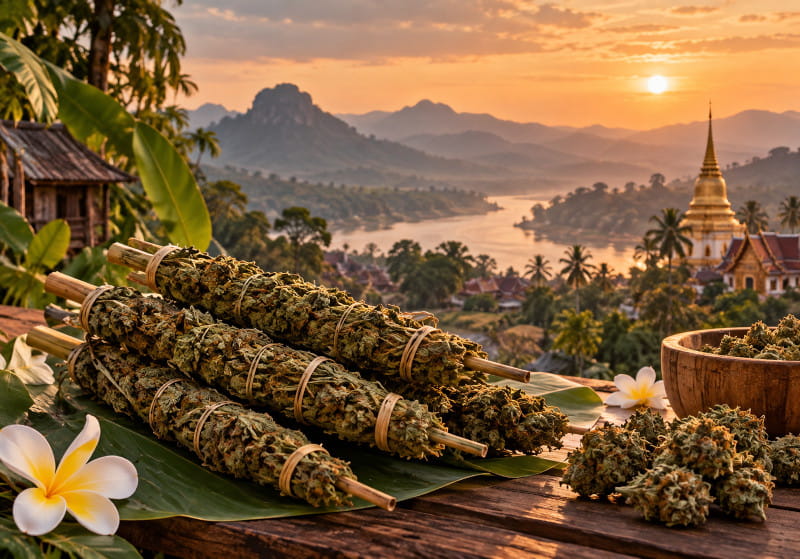
✓ Thai Stick was originally not a single cannabis strain, but a term for high-quality Thai cannabis prepared and sold in a distinctive bundled form.
✓ The classic Thai Sticks of the 1970s are primarily associated with northeastern Thailand. Historical sources also mention Udorn, now known as Udon Thani.
✓ In the 1970s, Thai Sticks crossed the Pacific to North America. Travelers, surfers, sailors and later professional smugglers were part of this growing international trade.
✓ Thai Sticks treated with opium are primarily part of the legends that developed later. Historical evidence does not support the claim that opium was generally a component of authentic Thai Sticks.
✓ There is no historical evidence for a single “extinct Thai Stick strain.” Rather, the Thai cannabis used came from regional populations with genetic diversity.
✓ Thai genetics left their mark on modern cannabis breeding. Southeast Asian lines entered Western breeding programs and were combined, among other things, with various Haze lines.
Thai Sticks are among the most legendary cannabis products of the 1970s. At the time, high-quality cannabis from Thailand crossed the Pacific to North America, where it gained an extraordinary reputation. Stories of enormous potency, adventurous trade routes and buds allegedly treated with opium eventually turned Thai Stick into a myth that lives on to this day.
Behind the legend, however, lies a well-documented history. Thai Stick was originally not the name of a single cannabis strain, but a term for high-quality Thai cannabis prepared and sold in a distinctive bundled form. Its history leads from the cultivation areas of northeastern Thailand through the American presence in Southeast Asia to the surf and counterculture of the 1970s and the trans-Pacific cannabis trade that emerged from it.
This guide follows the historical trail of Thai Sticks, distinguishing verifiable facts from later accounts and cannabis myths. It focuses on their origins, international trade, the famous opium legend and the role Thai genetics later played in Western cannabis breeding.
What Were Thai Sticks?
Thai Sticks were a distinctive form of high-quality Thai cannabis that became internationally famous during the 1970s. In their book Thai Stick: Surfers, Scammers, and the Untold Story of the Marijuana Trade, Peter Maguire and Mike Ritter trace the journey of this sought-after export from the cannabis-growing regions of Thailand to the American market.
Maguire describes the cannabis traded at the time as particularly high-quality Cannabis sativa. What Sativa in Cannabis means from a botanical and historical perspective – and how the term is used in the modern world of cannabis strains – is explained in our dedicated Canna Wiki guide. For trade, the buds were characteristically bundled and secured around a small stick – hence the name “Thai Stick.”
The key distinction is between the form in which the cannabis was traded and its genetics: historically, Thai Stick did not refer to a modern cannabis strain with a clearly documented pedigree. Modern strains bearing the name “Thai Stick” may reference this tradition or incorporate Thai genetics, but the name alone does not demonstrate direct genetic continuity with the cannabis used for the Thai Sticks exported during the 1970s.
Where Did the Original Thai Sticks Come From?
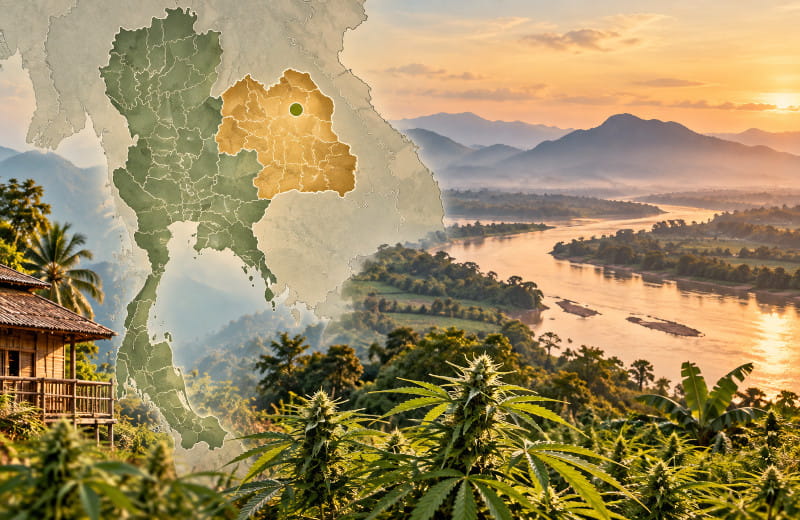
The classic Thai Sticks are primarily associated with northeastern Thailand. In their historical study, Peter Maguire and Mike Ritter trace the journey of cannabis from cultivation areas in this region through intermediaries and international trade networks to the United States.
Historical accounts also mention the name Udorn – the English name used at the time for present-day Udon Thani in northeastern Thailand. The region was also close to the Mekong and thus part of a larger cross-border cultural and economic area. Udon Thani should nevertheless not be understood as the sole place of origin of Thai Sticks: historical sources instead point to a broader cultivation area in northeastern Thailand.
The importance of this region did not end with the famous Thai Stick era of the 1970s. As late as the mid-1980s, the United Nations documented extensive illegal cannabis cultivation in northeastern Thailand and the Mekong region as well as government measures against production there. This also shows that the later disappearance of classic Thai Sticks cannot be equated with an abrupt end to cannabis cultivation in Thailand.
Thai Stick Was Not a Single Cannabis Strain
The idea of a single original “Thai Stick strain” projects our modern understanding of clearly defined strains onto a historical product that was not described in this way. Cannabis was cultivated in different regions of Thailand, and the regional populations were by no means genetically uniform.
Cannabis populations that developed over long periods in particular regions are often referred to as cannabis landraces. They develop under the influence of local environmental conditions and human selection without therefore being genetically uniform. The linked Canna Wiki guide explains in detail how landraces develop and why they are important to the history of modern cannabis strains.
A 2026 study of 50 cannabis samples from Thailand also illustrates how diverse Thai cannabis genetics can be. Using genetic ISSR markers, the accessions examined could be assigned to several groups. Particularly interesting from a historical perspective: the names examined included both Thai Stick and Green Thai Stick – the two samples were assigned to different genetic groups.
Even within a regional population, individual plants can differ considerably. Why breeders observe these differences and deliberately select particular phenotypes is explained in our Canna Wiki guide Pheno Hunting in Cannabis.
Why Did Thai Sticks Become So Famous in the 1970s?
Thai Sticks reached a U.S. cannabis market in the 1970s that differed fundamentally from today's market. A large share of the cannabis consumed at the time was imported, while domestic production in the United States still played a much smaller role. High-quality products from distant regions of origin could therefore stand out particularly clearly from the rest of the market.
In this environment, Thai cannabis developed an extraordinary reputation. Peter Maguire describes Thai Stick in 1974 as a sought-after premium product that could command correspondingly high prices on the American market. Limited availability, its Southeast Asian origin and its distinctive bundled form made Thai Sticks even more exceptional – and laid the foundation for the myth that still surrounds them today.
Was Thai Stick Stronger Than Today's Cannabis?
Contemporary witnesses often described high-quality Thai Sticks as exceptionally potent – but whether they were actually stronger than today's cannabis strains cannot be determined reliably. There are no systematic laboratory analyses of the export batches from the 1970s whose THC and cannabinoid levels could be compared with modern strains according to today's standards.
Even particularly intense or unusual experiences reported at the time are not a reliable measure of chemical potency. Statements such as “Thai Stick was stronger than any modern strain” therefore remain personal recollections and part of later lore. What is well documented historically, however, is the extraordinary reputation of Thai Stick as a high-quality and potent imported product – and it was precisely this reputation that contributed significantly to the legends that later developed around it.
What Role Did the Vietnam War Play?
The Vietnam War and the extensive American presence in Southeast Asia created important conditions for Thai cannabis to become known to a broader Western audience. U.S. military personnel, travelers and other Western visitors encountered local cannabis in the region. Maguire and Ritter describe how these early connections initially developed into smaller trading structures and later into a much more professional international business.
The Vietnam War was therefore an important part of the background to the international Thai Stick boom, but not its sole explanation. Thai Sticks were neither “invented” by American soldiers nor brought to Western markets exclusively by them. Rather, during the 1970s a broader network of travelers, dropouts, sailors, surfers and eventually professional smugglers emerged through which Thai cannabis crossed the Pacific.
The history of Thai Sticks, in turn, is only one chapter in the plant's much longer cultural history. Our Canna Wiki article A Brief History of Cannabis and Hemp shows how cannabis evolved from a cultivated plant used for thousands of years into part of the international counterculture of the 20th century.
How Did Surfers Become Part of the Thai Stick Story?
Surfers did in fact play an important role in the international spread of Thai Sticks – their connection to the story is not merely part of later cannabis folklore. Peter Maguire and Mike Ritter describe how Western surfers traveled between Hawaii, Australia, Southeast Asia and other surfing regions in the 1960s and 1970s. Travel, sailing and life along the coasts created international contacts that some later also used for the cannabis trade.
Initially, this trade still operated partly within travel, surf and counterculture circles. But the high demand for Thai cannabis and the potential profits changed the business. Smaller shipments developed into larger, increasingly professionally organized trading networks across the Pacific. Maguire and Ritter thus trace the transition from an informal trade associated with GIs, travelers and surfers to an international cannabis business.
This development also explains why surfers have remained so prominent in the history of Thai Sticks: they stood at the intersection of Southeast Asia, Pacific travel culture and the Western counterculture of the 1970s. As the trade became increasingly professionalized, however, larger networks and other actors moved to the forefront.

Did “Mr Asia” Control the Thai Stick Trade?
The so-called Mr Asia syndicate was one of the best-known smuggling networks of the era – but it did not control the entire Thai Stick trade. The network is associated primarily with New Zealander Marty Johnstone, who became known as “Mr Asia,” and Terry Clark. Their story is part of the broader drug smuggling history of the Pacific region in the 1970s and extends far beyond cannabis.
An important distinction is therefore necessary in the history of Thai Sticks: the trade did not consist of a single organization. Maguire and Ritter instead describe various actors and networks that became increasingly professionalized as demand grew. The Mr Asia syndicate was a significant part of this era, but the historical evidence does not support the idea that a single organization controlled production in Thailand and the global Thai Stick trade.
What Role Did Howard Marks “Mr. Nice” Play?
Howard Marks, later known worldwide by his nickname “Mr. Nice,” was also involved in the international trade of cannabis from Thailand. Chronologically, however, his story does not belong to the emergence of classic Thai Sticks, but to the later phase of an already highly professionalized international cannabis trade.
In the 1980s, Thailand was an important source for Marks' international network. Large quantities of cannabis reached Western markets from there. His story also illustrates why the end of the famous Thai Stick era must not be equated with the end of Thai cannabis exports: even after the classic Thai Sticks of the 1970s had become rarer, cannabis from Thailand remained part of international trade.
Howard Marks later became a well-known figure in international cannabis culture. His nickname lives on in the name of the Mr. Nice Seedbank, which he established together with Shantibaba. You can learn more about its history and classic genetics in our Canna Wiki profile Mr Nice Seedbank: Classic Regular Strains. The later seedbank story should, however, be clearly separated from Marks' earlier activities in the international cannabis trade.
Were Thai Sticks Laced with Opium?
The claim that authentic Thai Sticks were routinely treated with opium is one of the most persistent myths in their history. Even today, this is sometimes used to explain the extraordinary reputation and the intensity of 1970s Thai cannabis described by contemporary witnesses.
In an interview with Columbia University Press, Peter Maguire was explicitly asked about the claim that Thai Stick had been enhanced with other drugs. He described this idea as an “urban myth” and instead pointed to the high quality of the Thai Cannabis sativa used. The extraordinary reputation of Thai Sticks therefore cannot simply be explained by alleged treatment with opium.
When Did the Classic Thai Sticks Disappear?
The legendary peak period of classic Thai Sticks was surprisingly short. Peter Maguire roughly dates the period in which this particularly high-quality cannabis developed its famous reputation to 1974 to 1976/77. As international demand grew, production volumes increased and the trade became increasingly professionalized, both the product and the market subsequently changed.
The end of this peak period by no means marked the end of cannabis cultivation in Thailand. As late as the mid-1980s, the United Nations documented extensive illegal cultivation in the northeast of the country, particularly in the Mekong region, as well as large-scale government measures against production. International exports of cannabis from Thailand also continued after the classic Thai Stick era.
This development can be traced into the early 1990s. In 1992, the International Narcotics Control Board continued to describe northeastern Thailand as the country's most important cannabis-growing area, while also reporting a significant decline in production as a result of sustained government eradication measures.
Do the Original Thai Stick Genetics Still Survive Today?
The often-repeated claim that the original “Thai Stick strain” is extinct is historically problematic. As already shown, Thai Stick did not refer to a single, genetically clearly defined cannabis strain. It is therefore not straightforward to speak of the extinction of a specific “Thai Stick genetic line.”
A different question is whether the regional populations from which the cannabis for the famous Thai Sticks of the 1970s originated were later altered, displaced or crossed with other genetics. Historical plant samples and a genetic lineage documented over decades are lacking for a complete reconstruction.
Likewise, a modern strain name alone cannot prove that a present-day “Thai Stick” line descends directly and unchanged from the plants used for the export product around five decades ago. This would require traceable genetic continuity, which is not documented for the historical Thai Sticks.
How Did Thai Genetics Influence Cannabis Breeding?
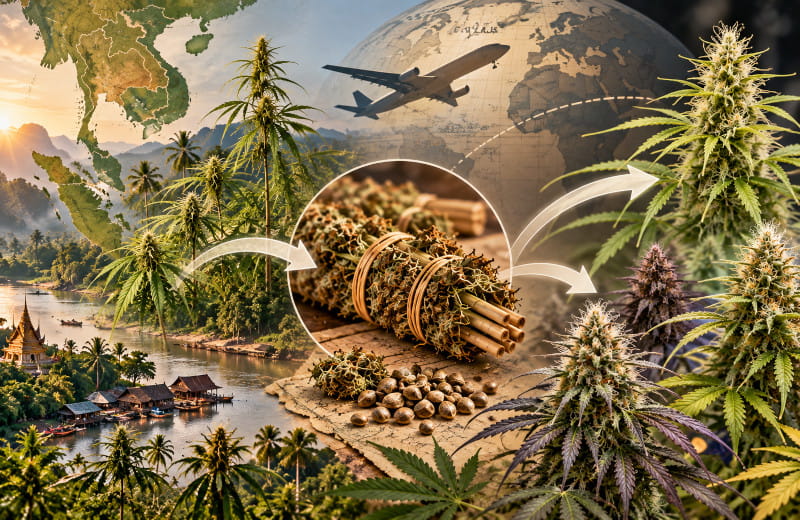
Regardless of the fate of classic Thai Sticks, Thai cannabis genetics left a clear mark on international cannabis breeding. During the second half of the 20th century, seeds from Thailand and other traditional cultivation regions reached North America and Europe, where breeders selected them and combined them with genetics from other origins.
Historical descriptions of Thai cannabis populations often mention pronounced vertical growth, narrow leaves and comparatively long development and flowering periods. Many of these populations therefore differed markedly from cannabis from regions such as Afghanistan or Pakistan, which had developed under different climatic and environmental conditions.
Our Canna Wiki article Cannabis Landraces: Origins, Significance & Genetics explains in detail how such regionally developed populations should be classified and why landrace, heirloom, hybrid and IBL describe different genetic concepts.
The international spread of such regional genetics also marked the beginning of a new phase in modern cannabis breeding. Lines originating from different parts of the world were combined and formed the basis of numerous strain families that later became well known. Our Canna Wiki article Haze, Kush & Skunk – The Pillars of Modern Breeding shows how Haze, Kush and Skunk lines shaped the modern world of cannabis strains.
What Do Thai Sticks Have to Do with Haze?
There are important connections between Thai cannabis genetics and the history of various Haze lines – but Thai Stick itself should therefore not be understood as a direct “original strain” of Haze. What matters is the Thai genetics that entered different lines over the course of subsequent breeding history.
Particular caution is required when discussing the early history of Original Haze. A seemingly clear pedigree involving Colombian, Mexican, South Indian and Thai genetics is often given. However, the surviving accounts of the origins of the early Haze lines come from different sources and do not agree in every respect regarding origin, chronology and the genetics involved.
What can be traced more clearly is that Thai genetics were combined with Haze lines early on and later helped shape various branches of this strain family. Cannabis from Thailand thus left its mark on modern cannabis breeding beyond the Thai Stick story itself. We cover the origins and further development of this strain family in detail in the Canna Wiki guide The World of Haze Strains.
This connection can also be seen in later European Haze lines. One example is Amnesia Haze: the history of Soma's line mentions Southeast Asian influences from Thailand, Laos and Cambodia. However, no direct pedigree from the historical Thai Sticks of the 1970s to Amnesia Haze can be derived from this – what they share instead is the genetic influence of Southeast Asian cannabis populations.
Thai Stick Then and Now – What's the Difference?
Today, the term “Thai Stick” is used for different things that should not be equated historically or genetically. It may refer to the famous cannabis product from 1970s Thailand, a modern recreation of its distinctive bundled form, or a present-day cannabis strain that carries “Thai Stick” in its name.
| Term | What does it mean? |
|---|---|
| Historical Thai Stick | High-quality Thai cannabis in a distinctive bundled form that became internationally famous particularly during the 1970s. |
| Modern Thai Stick interpretation | Present-day products whose name or appearance refers to the historical Thai Sticks. This does not imply historical or genetic identity with the export product of that era. |
| “Thai Stick” as a strain name | A modern cannabis strain or breeding line whose name refers to Thai genetics or the historical Thai Stick tradition. The name alone does not prove direct genetic continuity with the plants of the 1970s. |
Anyone encountering the name “Thai Stick” today should therefore always check whether it refers to the historical cannabis product, a modern bundled form or a strain name. It is precisely this mixing of different meanings that has led to many misunderstandings surrounding the history of Thai Sticks.
The History of Thai Sticks as a Timeline
The history of Thai Sticks did not emerge at a single moment. Traditional cannabis cultivation in Thailand, the American presence during the Vietnam era, international travel and surf culture, and the increasing professionalization of the cannabis trade interacted over several decades.
| Period | Development | Historical context |
|---|---|---|
| before the 1960s | Cannabis is cultivated and used in Thailand and other parts of Southeast Asia long before the later international Thai Stick boom. | regional and cultural-historical background |
| 1960s | The growing American presence in Southeast Asia creates additional contact between Western visitors and local Thai cannabis. | Vietnam era and early international contacts |
| early 1970s | Thai cannabis increasingly reaches Western markets through growing networks of travelers, surfers, sailors and other actors. | expansion of trans-Pacific trade |
| c. 1974–1976/77 | Peter Maguire dates the peak period of the particularly high-quality Thai Sticks that established their legendary reputation on the American market to this period. | peak period of classic Thai Sticks |
| late 1970s | Rising demand and larger trading volumes change the market. Smaller networks increasingly develop into a professionally organized international business. | professionalization of the cannabis trade |
| 1980s | Thailand remains an important source of cannabis in international trade. At the same time, Thai and international authorities intensify measures against cultivation and trade. | continued trade and increasing law enforcement |
| early 1990s | Northeastern Thailand continues to be regarded as the country's most important cannabis-growing area, while official reports also document a significant decline in production. | decline in large-scale illegal cultivation |
| today | Thai Stick is simultaneously a historical term, part of international cannabis culture and a name also used for modern products and cannabis lines. | historical legacy and modern use of the term |
How Did Thai Sticks Become a Cannabis Legend?
The legendary reputation of Thai Sticks arose from an unusual combination of quality, origin, limited availability and historical circumstances. High-quality cannabis from Thailand reached Western markets in the 1970s, where such imported products were something special. Their distinctive bundled form made Thai Sticks even more recognizable.
Added to this were the stories that accompanied their journey: surfers and travelers, long routes across the Pacific and eventually professionally organized trading networks. Thai Stick thus became associated with the surf and counterculture of an entire era. As time passed, documented events, personal memories and cannabis folklore became increasingly intertwined.
This is part of what continues to make them fascinating today. A real Thai cannabis product first became a sought-after import, then a symbol of the 1970s and finally a cannabis legend. The fact that the name is now used for historical Thai Sticks as well as modern products and strains shows how far the term has moved from its original context.
Frequently Asked Questions About Thai Sticks
Many questions about Thai Sticks concern their origins, genetics and the boundary between historical accounts and later myth. The key distinction is between the historical product from Thailand and modern strains or products that carry the same name today.
What Is a Thai Stick?
Historically, Thai Stick refers to high-quality cannabis from Thailand that was traded in a distinctive bundled form and became internationally known particularly during the 1970s. The term did not originally refer to a single, genetically clearly defined cannabis strain.
Where Did the Original Thai Sticks Come From?
The classic Thai Sticks are primarily associated with northeastern Thailand. Historical accounts mention Udorn, now Udon Thani, among other places. Later UN documents also demonstrate the long-term importance of northeastern Thailand and the Mekong region for cannabis cultivation.
Is Thai Stick a Cannabis Strain?
Historically, Thai Stick is better understood as a trade name for a cannabis product than as the name of a single genetically defined strain. Today, however, there are modern cannabis lines that use “Thai Stick” as a strain name.
Were Thai Sticks Laced with Opium?
Opium was not a defining feature of a Thai Stick. Peter Maguire described the widespread idea that Thai Sticks were routinely enhanced with other drugs as an “urban myth.” This does not rule out individual divergent practices in an illegal and non-standardized market in every conceivable case.
Why Were Thai Sticks So Famous?
High-quality Thai cannabis enjoyed an extraordinary reputation in the 1970s. Limited availability, the distinctive bundled form and its connection to the travel, surf and counterculture of the era further contributed to the legend.
Was Thai Stick Stronger Than Today's Cannabis?
This cannot be determined reliably. Historical Thai Stick batches lack systematic laboratory analyses that could be directly compared with today's measurements. What is well documented, however, is their reputation as particularly high-quality and potent imported cannabis.
Do the Original Thai Stick Genetics Still Survive Today?
A definitive answer is not possible because Thai Stick historically did not refer to a single, genetically clearly defined strain. Whether individual genotypes from the regional populations of that time have survived unchanged to the present day cannot be reliably demonstrated.
What Do Thai Sticks Have to Do with Haze?
Thai cannabis genetics were combined with Haze lines early on and later shaped various branches of this strain family. However, this does not mean that the historical Thai Sticks themselves were a single direct “original strain” of Haze.
What Remains of the History of Thai Sticks?
Thai Sticks vividly demonstrate how a regional cannabis product could become an international legend. Their history connects Thai cannabis populations with the Vietnam era, Western counterculture and surf culture, and the growing trans-Pacific cannabis trade of the 1970s.
The historical reality is at least as interesting as the myths that developed later. Thai Stick was not a single mysterious “original strain,” opium was not inherently part of it, and the end of the classic Thai Stick era meant neither the immediate end of cannabis cultivation in Thailand nor the disappearance of Thai cannabis genetics.
Its most enduring legacy therefore does not lie in a single strain name. Thai cannabis became part of international cannabis culture, while Thai and other Southeast Asian genetics later found their way into various Western breeding lines. You can learn more about this genetic background in the Canna Wiki topics cannabis landraces, Haze Strains and Pheno Hunting.
Sources and Further Information
- Columbia University Press – Peter Maguire & Mike Ritter: Thai Stick: Surfers, Scammers, and the Untold Story of the Marijuana Trade
- Columbia University Press Blog – Interview with Peter Maguire about Thai Sticks, surf culture and the opium myth
- Journal of Medical Globalization – Genetic diversity of local Thai Cannabis strains using ISSR molecular markers
- United Nations – Commission on Narcotic Drugs 1985: Report on cannabis cultivation in northeastern Thailand
- International Narcotics Control Board – Report 1992: Cannabis cultivation in north-eastern Thailand
- Howard Marks – Mr Nice: Autobiographical account of his international cannabis activities
- PBS FRONTLINE – Archive material on Howard Marks and the international cannabis trade